
Our readers keep the lights on and my morning glass full of iced black tea. As an Amazon Associate, I earn from qualifying purchases.
Specs are compiled from manufacturer listings and verified buyer reviews and can change over time — please confirm the key details on the product page before buying.
Hunting for a true 3D Enabled TV in the modern market means hunting for a laser projector, because the dedicated 3D television has vanished from store shelves. The real battle today is brightness — a 3D projector that dims in daylight is useless, but the newest triple-laser units hold their image even with the blinds open. You are choosing between ultra-short-throw consoles that sit inches from the wall and portable gimbal designs you can aim at any surface, and the one spec that decides everything is the lumen count.
I’m Min — the founder and writer behind Gadgets Feed. This guide is built by comparing the manufacturers’ published specifications and the patterns across verified customer reviews, so you get each pick’s real strengths and trade-offs instead of marketing spin.
Before you pick a 3d enabled tv, decide one thing: do you want a permanent home-theater setup, or a projector you can move around for 3D movie nights in any room? That choice separates the two best options here.
Our Picks at a Glance
How To Choose The Best 3D Enabled TV
When the category is really about laser projectors that play 3D content, your first decision is placement — ultra-short-throw consoles park near the wall while portable units sit anywhere in the room. After that, brightness, color coverage, and the built-in smart platform separate the everyday winners from the frustrating ones.
Brightness Is Everything for 3D
3D glasses block significant light, so a projector that is merely adequate in normal viewing turns muddy the moment you put the glasses on. Look for at least 2000 ISO lumens, and know that premium triple-laser models at 3300 ISO lumens keep a 3D picture vivid even in a room with ambient light.
Throw Ratio Decides Your Room Layout
An ultra-short-throw projector uses a fixed throw ratio around 0.25:1, meaning it sits roughly 8.5 inches from the wall to fill a 100-inch screen. A portable model with a standard lens needs more distance but adds a gimbal for aiming anywhere — decide which constraint your room can tolerate before you buy.
Color Gamut and Contrast Drive the Depth
3D relies on contrast to create believable separation, so color coverage matters more than casual buyers expect. Wide gamuts like 110% Rec.2020 or 147% DCI-P3 and high contrast ratios such as 2500:1 or 3000:1 tell you the projector can render the deep blacks that make 3D pop rather than looking flat.
Quick Comparison
| Model | Best For | Brightness | Contrast Ratio | Color Gamut | Amazon |
|---|---|---|---|---|---|
| AWOL Vision LTV-3000 Pro★ Best Overall | Fixed home theater with built-in center channel | 2000 lm spec / 3300 ISO lumens reported | 2500:1 | 107% BT.2020 & 147% DCI-P3 | Amazon |
| Dangbei DBOX02 Pro | Casual repositioning in a bedroom or living room | 2000 ISO lumens | High | 108% REC-709 | Amazon |
| JMGO N1S Ultimate | Bright rooms and flexible gimbal angles | 3300 ISO lumens | 1600:1 | 110% Rec. 2020 | Amazon |
| Hisense PL2 | Cinema color accuracy on a wall or screen | 2700 lumens | 3000:1 | 1.07 billion colors | Amazon |
In-Depth Reviews
1. AWOL Vision LTV-3000 Pro
Our pick — 4.5★ from 150+ verified ratings; the strongest balance of quality and price.
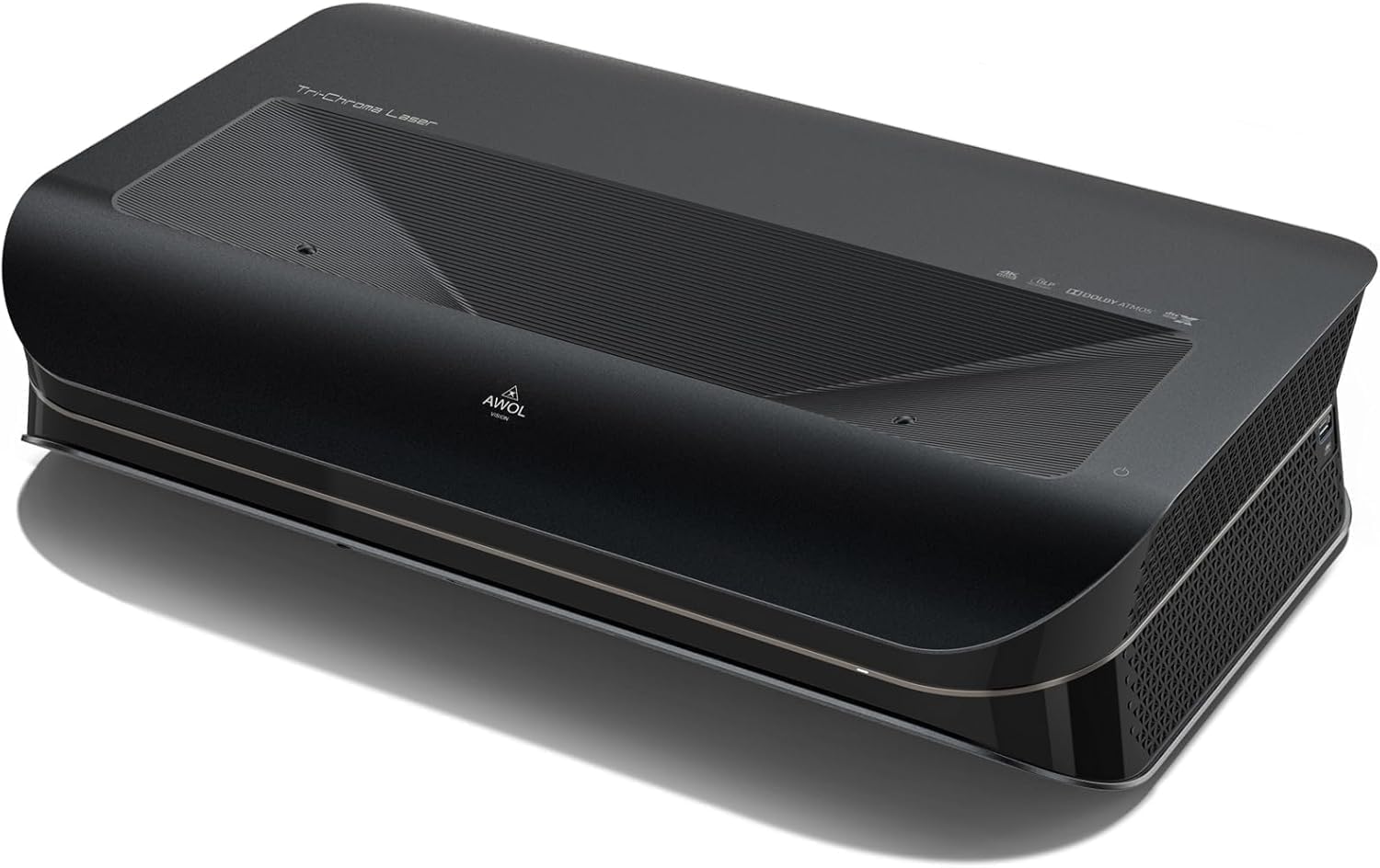
The ultra-short-throw laser home theater that replaces your TV with genuine 3D depth and built-in center-channel dialogue.
AWOL Vision earns its spot for buyers who want a fixed cinema installation, not a compromise. It is the first ultra-short-throw projector (one that sits close to the wall) with a built-in center channel speaker, so dialogue fires directly from the screen and pairs into a 5.2.2 setup (five main speakers, two subwoofers, and two overhead channels) with AWOL screens and the ThunderBeat surround system. The fixed 0.25:1 throw ratio (the distance from projector to wall relative to image width) means it parks about 8.54 inches from the wall for a 100-inch image and 12.84 inches for a 150-inch one — so you need a cabinet shallow enough to let it breathe that close to the surface.
You get deep blacks and contrast that make 3D feel dimensional, not gimmicky, thanks to a triple-laser light source covering 107% BT.2020 (a wide color standard for HDR) and 147% DCI-P3 (the digital cinema color gamut). The peak daytime brightness is the crowd favorite — buyers running it with an ALR screen (ambient light rejecting, which blocks glare) describe near-TV picture quality with blinds open, driven by a reported 3300 ISO lumens that the spec sheet lists conservatively at 2000 lm. Active shutter 3D glasses (which alternate lenses to create depth) connect to a 3D Blu-ray player for true cinematic depth, and owners call it “The best replacement for a TV I’ve ever owned.”
The honest trade-off appears in motion handling, not image quality — the 60Hz refresh rate can introduce blur in fast action, gaming, and some 3D sequences. Setup also demands patience because ultra-short-throw alignment is finicky until the geometry locks in. Buyers report the whole package justifies the effort, calling the result flawless once positioned, with a quiet fan and a sleek gunmetal finish adding to the premium feel.
Cinema-Grade Highlights
- Triple laser (no color wheel) covers 147% DCI-P3 for cinema-accurate color
- Built-in center channel maps dialogue directly from the screen
- Uses roughly 1/10 the energy of a conventional LED TV, per AWOL.
Real-World Caveats
- 60Hz refresh can blur fast action and demanding 3D scenes
- Fixed throw ratio demands precise cabinet and screen placement
- Menu navigation reads as unintuitive until you learn it
Reach for this when: you want a fixed home theater that replaces a traditional TV and you are willing to invest time in perfect alignment for a setup that then runs daily for movies, games, and 3D nights.
Look elsewhere if: you game competitively or hate fussing with projector geometry — the 60Hz limit and alignment patience will frustrate you.
2. Dangbei DBOX02 Pro

A 4K laser with a built-in gimbal that rotates 360 degrees and tilts 120 degrees, so repositioning for 3D takes seconds.
Dangbei made the DBOX02 Pro for people who lack a dedicated theater room but still want a 4K 3D image wherever they watch. The built-in gimbal stand (a pivoting mount) offers 360° rotation and 120° tilt, so you can aim it at a blank wall from a shelf, an alcove, or a low coffee table and project anywhere from 40 inches up to 300 inches while keeping 4K clarity. The 2000 ISO lumen brightness suits a living room, not a pitch-black cave, and owners mention the sharp picture looks “awesome” even on a normal white wall.
Setup is the headline feature because Dangbei’s InstanPro AI handles focus, keystone correction (fixing a skewed image), and screen fitting automatically — owners consistently describe a painless first run, with one reporting “I was able to set the projector up without a problem.” The onboard Google TV certification opens 10,000+ apps with voice control via “Hey Google,” and WiFi 6 (the latest wireless standard) keeps 4K streaming smooth without external devices. Dual 12W speakers with a 600cc acoustic chamber and Dolby Audio deliver sound that fills a bedroom, while Bluetooth 5.2 lets you switch to wireless headphones for a private 3D session.
The trade-off is that autofocus earns mixed reactions in the review data — a majority love it, but some units need a manual nudge to lock focus. Owners also note minor fan noise that disappears the moment audio plays, and the M25 metric threaded hole (25mm diameter) means you must verify any third-party mount matches before buying. Picture quality and performance are the clear strengths, with families calling it a favorite for everyday living-room viewing rather than a dedicated cinema install.
easy Flexibility
- Auto-focus and real-time keystone make repositioning genuinely painless
- Google TV with voice control and WiFi 6 for smooth 4K streaming
- 360° gimbal rotates and tilts for any wall, ceiling, or corner
What to Verify First
- Autofocus is solid for most, but occasional units need a manual nudge
- M25 threaded hole (25mm) limits which stands and mounts fit
- Fan noise is present though minimal when audio is running
Ideal if: you want one projector you can move between bedroom and living room, with automated focus that makes 3D movie nights a two-minute setup rather than a calibration project.
Pass it by when: you need a permanent ultra-short-throw install or you plan to mount it on a non-standard stand without checking the thread size.
3. JMGO N1S Ultimate

The 3300-ISO-lumen triple-laser performer that stays bright enough for daytime sports and backyard movie nights.
JMGO targets the buyer who watches in bright rooms and wants a projector that does not surrender to sunlight. At 3300 ISO lumens, the N1S Ultimate delivers an image sharp enough for moderate daytime viewing, and owners confirm it shines for sports and gaming with colors that stay vivid even on a 13-foot throw. The triple-laser engine covers 110% Rec. 2020 with a 1600:1 contrast ratio and 10-bit color depth, so the measured accuracy reaches ΔE<1 — buyers call it the best 4K projector they have used, with no loud fan noise to spoil the scene.
Flexibility comes from the 360° horizontal and 135° vertical rotation gimbal plus a 3D-TOF sensor (a depth sensor that measures distance) and CMOS camera (a standard image sensor) that drive real-time auto-keystone and focus. That means you can aim it at a ceiling, a garden wall, or a camping screen and still get a squared image with lossless zoom. Google TV 3.0 brings certified Netflix, 10,000+ apps, and 800+ free channels with Google Assistant voice control, while a built-in 20W subwoofer hitting 45Hz ultra-bass pairs with DD+ (Dolby Digital Plus) and DTS-HD Master Audio for sound that impresses without a soundbar.
The catch is the projector’s own fans of auto-adjustment — the screen-fit and focus tools work reliably only when the unit sits 5 to 10 feet from the screen, and it does not memorize your screen-fit settings after a power cycle, forcing a roughly 30-second re-fit each time. Buyers also note that dark-scene contrast trails an OLED television and that ceiling mounting needs custom rigging since the gimbal is meant for tabletop use. For a room where you move the image around, though, it is a genuinely bright and flexible pick.
Daylight-Ready Strengths
- 3300 ISO lumens keeps images watchable in a bright room or backyard
- Gimbal rotates 360° and tilts 135° for ceiling, wall, or garden projection
- Built-in 20W subwoofer with 45Hz ultra-bass beats typical projector audio
Adjustment Frustrations
- Auto screen-fit only works reliably 5–10 feet from the screen
- Does not memorize screen-fit after power-off — expect a 30-second re-fit
- Black levels in dark scenes fall short of an OLED display
Best suited to: sports fans and families who watch in daylight and want a single bright projector they can aim in any direction across multiple rooms.
Not for: cinephiles sensitive to black-level depth or anyone wanting a set-and-forget ceiling install without extra rigging.
4. Hisense PL2

A 4K ultra-short-throw console that renders more than 1.07 billion colors for genuine cinematic 3D at a value price.
Hisense brings the PL2 to buyers who want ultra-short-throw cinema without paying the highest premium, and the crown is its color engine. With more than 1.07 billion colors on tap, owners describe a palette so accurate that “the colors look like they are coming out of the screen,” with natural skin tones and true-to-life grass greens. Projection spans 80 inches to a giant 150 inches, and the DLP system controls 2.07 million micro mirrors to deliver sharp 4K pictures that look crisp even on a regular light gray wall.
The 2700-lumen brightness with Dolby Vision and multiple HDR standards strikes a balance that works in moderate lighting, and customers note it is quieter than expected and renders “TV-like quality” on a plain off-white wall. Stereo sound from the built-in speakers earns praise for everyday viewing, while Google TV handles the smart platform. The X-Fusion laser light source is rated beyond 25,000 hours, which buyers interpret as a decade-plus of nightly entertainment.
The honest weak spot in the review data is 3D-specific — at least one owner reports issues getting 3D functionality working, so check your source chain (the 3D Blu-ray player, HDMI cable, and glasses) if 3D is the main reason you are here. Auto-keystone also gets poor marks and requires a clunky phone-photo upload to the device’s website, while audio routing frustrates owners who cannot easily send both streaming and cable sound to an external stereo. For a wall-mounted, no-screen cinema room, the picture itself is described as “wonderfully perfect” and tough to top at the price.
Color-First Advantages
- 1.07 billion colors render skin tones and grass with real accuracy
- 3000:1 contrast among the highest here for deep 3D blacks
- Ultra-short-throw projects 80–150 inches from close to the wall
Known Friction Points
- 3D functionality has had reported hiccups for some buyers
- Auto-keystone is weak — expect a manual phone-photo correction
- External stereo audio routing is limited to the Hisense unit
Choose it for: the sharpest color accuracy per dollar in this lineup, especially if you watch on a bare wall and want true cinema-grade 3D visuals without a dedicated screen.
Think twice when: 3D is your must-have feature and you do not want to troubleshoot the source chain, or if you need dependable automatic keystone.
Understanding the Specs
ISO Lumens vs. Raw Lumen Specs
Brightness is the single most important number for 3D because the glasses cut light before it reaches your eyes. Some manufacturers list a conservative base figure while the real-world output is higher — AWOL lists 2000 lm but owners measure roughly 3300 ISO lumens in daylight. The safest rule is to compare ISO lumens specifically, since that standard reflects how the projector actually performs with ambient light present.
Color Gamut Coverage
Wide color gamuts like Rec.2020 and DCI-P3 tell you how many shades the projector can reproduce, and more shades mean richer, more believable 3D depth. A figure like 110% Rec. 2020 means the projector exceeds that broadcast standard, while 147% DCI-P3 references the digital cinema palette. Both matter more than a raw contrast ratio when your goal is realistic, layered imagery rather than a flat picture.
FAQ
What makes a projector a 3D Enabled TV replacement?
Does the AWOL Vision LTV-3000 Pro require a special screen for 3D?
How much space does an ultra-short-throw projector need from the wall?
Can I use the Dangbei DBOX02 Pro on a ceiling mount?
Is 60Hz refresh rate enough for 3D gaming and action movies?
Do these projectors have built-in streaming apps for 3D content?
How loud are these laser projectors during operation?
Do I need special glasses for each projector model?
Final Thoughts: The Verdict
For the majority of shoppers, the best 3D Enabled TV replacement is the AWOL Vision LTV-3000 Pro because it pairs the widest cinema color coverage with a built-in center channel that makes it a true television replacement. If you want a flexible daytime projector you can aim anywhere, grab the JMGO N1S Ultimate for its 3300 ISO lumens and gimbal rotation. And for the sharpest colors per dollar on a bare wall, the Hisense PL2 is the one to reach for — a 4.4-star crowd favorite that proves cinematic 3D at home does not require the highest price tag.
How We Picked
We do not accept paid placement. Every pick is matched to a real buyer and a real use-case; we do not hands-on test units.
Sources & Methodology
Specifications: manufacturer listings and product documentation. Review insights: verified customer reviews, as of September 2026. Pricing: not shown on this page (it changes often); check the current price via the retailer link.
As an Amazon Associate, Gadgets Feed earns from qualifying purchases. This does not affect which products we feature.