
Our readers keep the lights on and my morning glass full of iced black tea. As an Amazon Associate, I earn from qualifying purchases.
Specs are compiled from manufacturer listings and verified buyer reviews and can change over time — please confirm the key details on the product page before buying.
Every 3D print starts and ends with the filament. A spool that looks perfect on the outside can hide a diameter that wanders, a tangle waiting to happen, or moisture that turns a crisp model into a stringy mess. This guide cuts through the shelf noise to find the 1.75mm filament that actually delivers consistent prints, strong layer bonds, and colors that land exactly as you imagined.
I’m Min — the founder and writer behind Gadgets Feed. This guide is built by comparing the manufacturers’ published specifications and the patterns across verified customer reviews, so you get each pick’s real strengths and trade-offs instead of marketing spin.
The nine spools here represent the best 3d filament 1.75 mm you can reliably buy right now, from the crowd-favorite generalist to the high-speed specialist and the budget multi-pack that keeps your print farm running.
Our Picks at a Glance

How To Choose The Best 3D Filament 1.75 Mm
You need a 1.75mm filament that prints reliably and makes parts that last. That means you have to get three things right: how precisely the filament holds its diameter (dimensional accuracy), what plastic it is made of (material type), and how well it resists absorbing water from the air (moisture resistance). Pick a filament with loose tolerance and your print can fail halfway through. Pick the wrong plastic and a functional part can snap under light pressure.
Diameter Tolerance: The Spec That Controls Everything
A filament’s 1.75mm diameter is never exactly 1.75mm all the way through. It drifts a tiny amount during manufacturing. A tight tolerance like +/- 0.02mm means the filament stays very close to its target, so your extruder gets a steady volume of plastic at the nozzle — that gives you consistent layer lines. A looser tolerance (like +/- 0.05mm) can cause under-extrusion in thin sections and over-extrusion in thick ones. The top spools here stay within +/- 0.03mm or tighter, which is the balance for reliable daily printing on most printers.
PLA vs PETG vs ABS: Which Material Fits Your Project
PLA is the easiest material to print with. It sticks well, has low warp, and produces a nice surface finish with minimal odor. PETG adds toughness and a bit of flexibility — it handles higher mechanical stress and resists heat better than PLA, but it strings more if not dried. ABS offers the highest heat resistance and durability, but it requires an enclosed printer and handles fumes you need to ventilate. For most beginners and decorative printers, stick with PLA or PLA+. If you are making functional parts that hold weight, PETG is a better bet.
Winding Quality and Spool Design
A spool that is wound poorly can cause the filament to cross over itself. That crossing creates a knot that stops the extruder mid-print. The best manufacturers use tight mechanical winding and a final manual check. Also check the spool hub size — some spools won’t fit into an AMS system without an adapter. Cardboard spools are increasingly common and more eco-friendly, but they need to hold their shape without warping in a dry box.
Quick Comparison
| Model | Best For | Material | Diameter Accuracy | Net Weight | Amazon |
|---|---|---|---|---|---|
| HATCHBOX PLA★ Best Overall | Reliable everyday printing | PLA | +/- 0.03 mm | 1 kg | Amazon |
| Polymaker PETGTop Performer | High-speed functional parts | PETG | — | 1 kg | Amazon |
| Creality Rainbow PLA+Best for Multi-Color | Multi-color prints with one spool | PLA+ | +/- 0.02 mm | 1 kg | Amazon |
| LANDU Silk Tri-Color | Decorative pieces with silk finish | Silk PLA | +/- 0.02 mm | 1 kg | Amazon |
| FLASHFORGE Rapid PETG | Speed printing at 600mm/s | PETG | +/- 0.02 mm | 1 kg | Amazon |
| FLASHFORGE ABS Pro | Heat-resistant functional parts | ABS Pro | +/- 0.02 mm | 1 kg | Amazon |
| Bambu Lab PLA | smooth AMS integration | PLA | +/- 0.03 mm | 1 kg | Amazon |
| ELEGOO Matte PLA Bundle | Injection-molded look, pastel colors | Matte PLA | — | 4 kg | Amazon |
| ELEGOO Black PLA 4-Pack | High-value bulk black printing | PLA | +/- 0.02 mm | 4 kg | Amazon |
In‑Depth Reviews
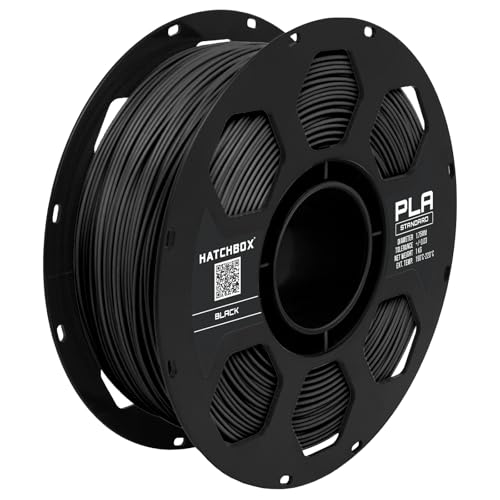
1. HATCHBOX 1.75mm Black PLA — 1 KG Spool
Our pick — over 4.5★ from 40,500+ verified ratings; the strongest balance of quality and price.
The crowd-favorite spool that tens of thousands trust for first-layer confidence and repeatable quality.
HATCHBOX has built a reputation on consistency, and it shows in the numbers. The filament holds a dimensional accuracy of +/- 0.03 mm, which means your extruder sees a steady 1.75mm diameter from the start of the spool to the end. The recommended nozzle temperature sits at a comfortable 180°C–210°C (356°F–410°F), so it works fine on most printers without a heated bed — a real plus for beginner setups. It is also vacuum-sealed with desiccant, which keeps moisture from turning your first layer into a rough surface.
What wins people over is the quality — it is the most-praised aspect across the thousands of owner experiences, with print quality coming in a close second. Buyers report clean layer lines, minimal stringing, and a consistent material flow that plays well with both direct-drive and Bowden extruders. It is a spool you can order blind and expect to work.
The honest catch: a small number of spools have been reported with improper winding that forces manual unspooling. That is rare for a spool with this many cycles behind it, but worth knowing if you are planning an unattended 24-hour print.
What Owners Rave About
- Exceptional consistency in diameter across the entire spool — no random under-extrusion.
- Prints cleanly with minimal odor, even without a heated bed.
- Strong bed adhesion with clean release once the plate cools.
- Vacuum sealing with desiccant keeps it dry from the factory.
The One Thing to Know
- Some spools have been wound incorrectly, creating a tension knot that needs manual correction.
Reach for this if: you want a proven, no-surprises PLA that works on nearly every consumer FDM printer — it is the safest single-spool buy on this list.
Look elsewhere if: you exclusively print functional parts that need the higher strength of PETG or the heat resistance of ABS.
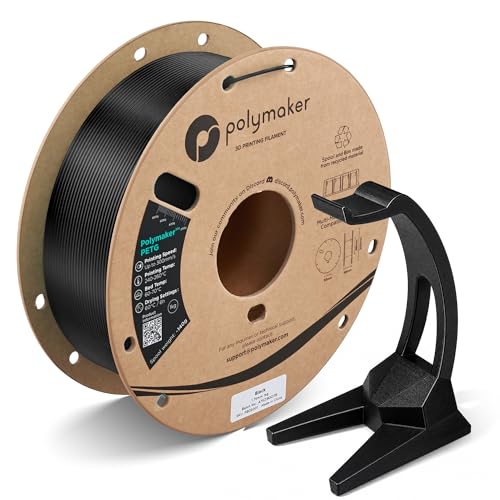
2. Polymaker PETG Filament 1.75mm Black — 1 KG
A PETG that prints at 300mm/s without sacrificing the layer adhesion that functional parts depend on.
Polymaker’s updated PETG formula is built for speed. The material supports a print speed up to 300mm/s, which puts it in the high-speed zone for a PETG that still handles strong mechanical stress. It offers a heat resistance up to 80°C, so parts like brackets and outdoor mounts will hold their shape under real-world warmth. The enhanced layer adhesion is the standout trait — owners consistently point to print quality and quality as the top aspects, noting that results stay consistent across multiple prints without delamination.
One of the subtle wins here is how well it strings compared to other PETG. Owners mention that it produces fewer wisps even when not kept in a dry box, which reduces cleanup time. The black color (hex code #070908) is a deep, rich tone that looks good straight off the print bed. Buyers who run a Prusa Mini or a Bambu Labs machine with a PETG HF profile find it feeds reliably without tangles or jams.
The recurring downside: durability gets mixed feedback from owners, and a few spools arrive with tangling that interrupts long prints. That said, the majority of owners describe it as a tangle-free, low-maintenance experience.
Best move for speed-focused makers: If your printer handles high-speed PETG profiles and you need durable, warp-free parts, this spool is a better value than what the premium price tier might suggest — it runs reliably out of the bag.
Grab this for: functional prints where layer strength matters more than surface gloss — brackets, fixtures, and outdoor parts.
Hold off if: you want a purely decorative finish with a high-gloss sheen; standard PLA gives a cleaner look for display models.
3. Creality Rainbow PLA+ Filament 1.75mm — 1 KG
A single spool that produces a full rainbow gradient without needing a multi-material unit.
Creality’s Rainbow PLA+ brings the color party without the complexity of a filament swap system. The filament transitions through multiple hues as it feeds, creating a multicolor effect that is consistently described by owners as beautiful and eye-catching. At 1.75mm with a dimensional accuracy of +/- 0.02 mm, compared to the HATCHBOX standard of +/- 0.03 mm, which gives it smoother flow through high-speed nozzles. The PLA+ formulation adds toughness — it can be bent repeatedly without snapping the way standard PLA sometimes does.
Where it really shines is on long, single-extruder prints where you want visual variety. Owners note that on models like the Bambu Lab P1S, it runs cleanly at high speed with minimal stringing. The vacuum-sealed packaging with desiccant keeps moisture away from the moment it leaves the factory. The rainbow effect itself depends on layer height and print speed, so you can tune the color transition width to match your model size.
The most-discussed trait of this spool is the color change itself — and it gets mixed feedback. Some owners want the colors closer together, while others find the wider transitions exactly right for their project. The official summary calls printability mixed, meaning you might need to dial in your settings on the first test print.
Our take on the mixed feedback: The color transitions are wider than some expect, so small prints may not cycle through the full rainbow. Plan your model size accordingly and you will get spectacular results.
Perfect for: decorative prints, toys, and any model where a gradual color gradient adds value — think fidget toys, vases, and character parts.
skip it if: you need precise, single-color consistency for functional parts or you are printing models smaller than the natural color segment length.
4. LANDU Silk Tri-Color PLA Filament 1.75mm — 1 KG

A single strand that blends red, blue, and green into a silk finish that looks post-processed straight off the bed.
LANDU’s silk PLA uses a tri-color design that combines three separate pigments into one filament. As the material feeds through the hotend, it creates a smooth gradient between red, blue, and green, giving each print a unique multicolor look from different viewing angles. The silk texture delivers a glossy surface that needs no sanding or coating — it comes off the build plate looking polished. Owners often describe the color transitions as stunning and the silk finish as eye-catching.
The tolerance is tight at +/- 0.02 mm, which keeps extrusion consistent even on detailed decorative models. The neat winding is a point of praise; customers note no tangling or feeding interruptions during long prints. At 1 kg total weight, it is a standard spool that fits most open-frame and enclosed printers. The low stringing means you spend less time cleaning up wisps on complex geometries.
The main caveat involves the cardboard reel. While many find it works fine, a subset of reviewers point out that the spool can cause compatibility issues with some AMS systems. If your printer uses a side-mounted spool holder with a narrow hub, check the fit before starting a long print.
Final read: For decorative prints where visual impact matters more than mechanical strength, this is a standout spool that delivers its promise without requiring post-processing.
Choose this for: display models, cosplay parts, and gift items where the silk finish and color gradient are the main attraction.
Consider another spool if: you need a purely functional material with high impact resistance — PLA in silk form is slightly less tough than standard PLA.
5. FLASHFORGE Rapid PETG Filament 1.75mm Metallic Blue — 1 KG
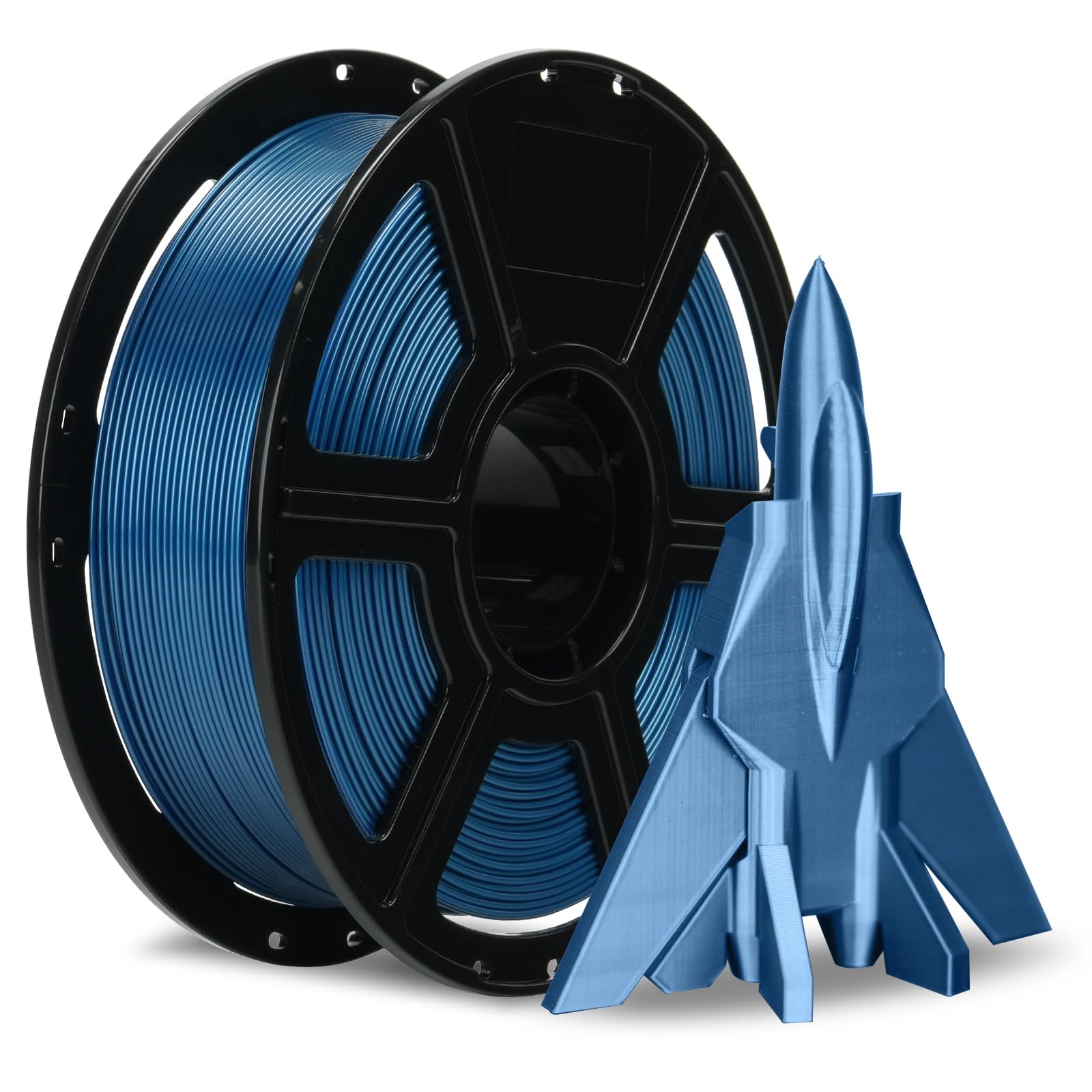
PETG that keeps up with a 600mm/s hotend without sacrificing the metallic finish.
FLASHFORGE engineered this filament for the speed era of 3D printing. It supports a maximum print speed of 600mm/s, which puts it among the fastest PETG options available. Despite that speed, it maintains excellent layer adhesion and a low shrinkage rate that keeps dimensional stability intact. The metallic blue color has a subtle shimmer that owners consistently praise — one describes it as having “such rich and vibrant color” that it makes other gold finishes look faded.
The quality is the top-scoring aspect among owners, with printability following close behind. The upgraded winding technology is designed to reduce tangling and blockages, and the majority of prints run uninterrupted. First layer adhesion is strong, even without pre-drying, and bridging performance prevents sagging on overhangs. The tolerance of +/- 0.02 mm means the filament feeds smoothly at high flow rates.
The specific note: for the metallic finish to look its best, FLASHFORGE recommends using the filament within a week of opening or drying it at 80°C for 4-6 hours. If you live in a humid environment, budget for a dryer to maintain that rich color.
Speed meets aesthetics: If your printer can handle high-speed PETG, this is the spool that lets you print functional parts fast without the bland grey of standard engineering material.
Best for: speed-focused makers running printers like the Flashforge AD5X or Bambu P1S who want both strength and a premium metallic look.
Not ideal if: you only print at slow speeds — the high-flow formulation offers no advantage in a standard 60mm/s setup.
6. FLASHFORGE ABS Pro Filament 1.75mm Burnt Titanium — 1 KG
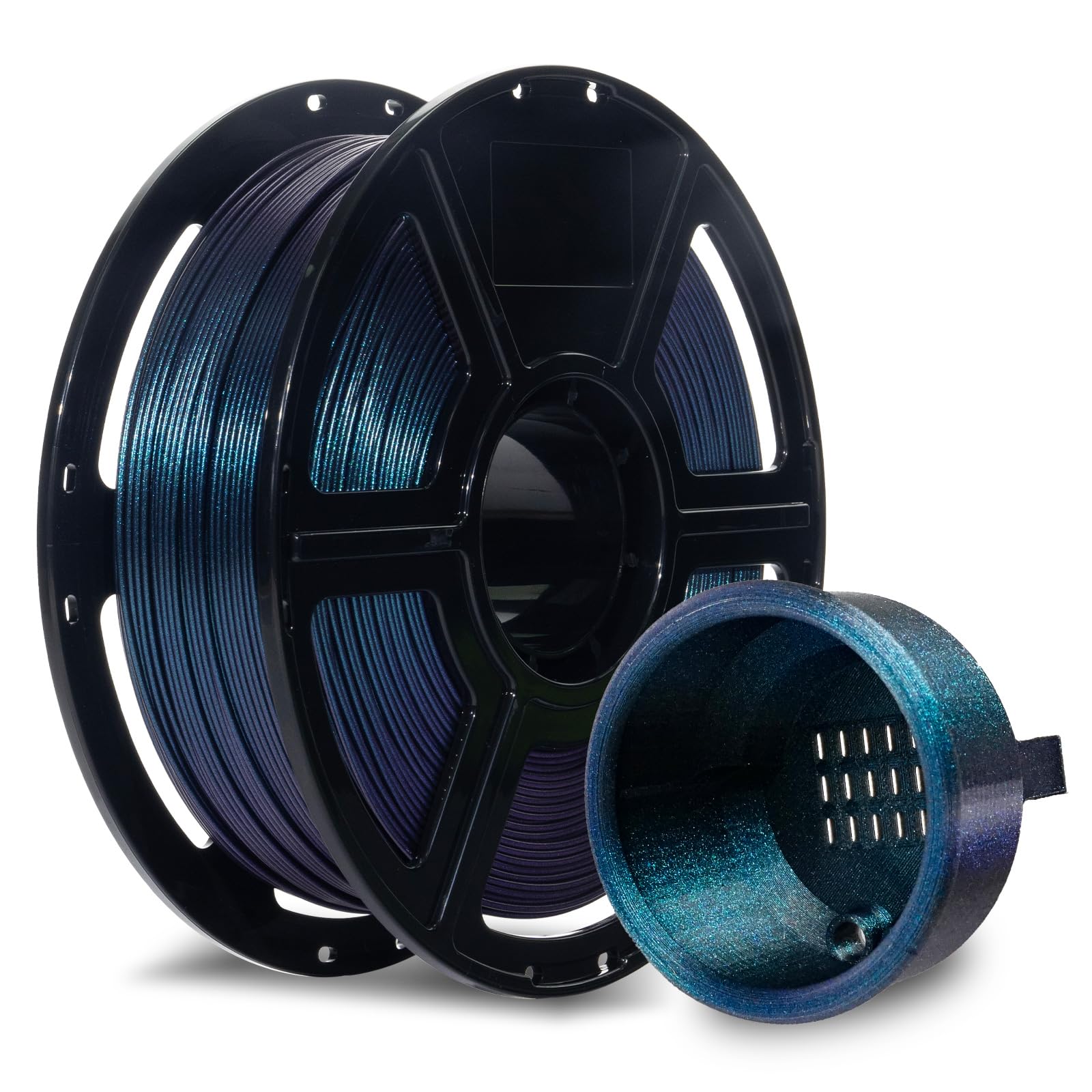
A color-shifting ABS that hides layer lines and withstands 90°C heat without warping.
FLASHFORGE’s ABS Pro is a purpose-built material for functional parts that need real heat resistance. The formulation resists hot deformation below 90°C, making it suitable for parts that sit in a warm car or near a motor. The Burnt Titanium color is a chameleon effect — special pigments shift in response to different light and angles, giving each print a dynamic appearance that also conceals layer lines. Owners note that it prints well out of the bag with no pre-drying, which is rare for ABS.
The quality and printability are the top aspects praised by owners. It runs cleanly on the Flashforge Adventure 5M Pro and holds strong bed adhesion without needing glue. Compared to standard ABS, the Pro version has lower warping and cracking risk, so it handles large prints with fewer failures. The dimensional accuracy of +/- 0.02 mm ensures consistent flow even on parts with thin walls.
The honest side: ABS is inherently less flexible than PLA or PETG. Shoppers say that if you bend a thin part too much, it will snap rather than bend. Layer adhesion also receives mixed feedback, meaning tall thin parts may need carefully tuned temperature settings. The spool is also slightly too wide for some AMS enclosures.
Our honest assessment: This is the best ABS option on the list for functional parts that need heat resistance and a premium look, but it demands a printer with an enclosure and careful slicer tuning.
Reach for this when: you are printing parts that will live in a warm environment — think car interior clips, electronics enclosures, or Voron printer components.
Skip this if: you own an open-frame printer without an enclosure, or you primarily print decorative models where PLA’s ease of use outshines ABS’s toughness.
7. Bambu Lab Genuine PLA Filament 1.75mm Black — 1 KG
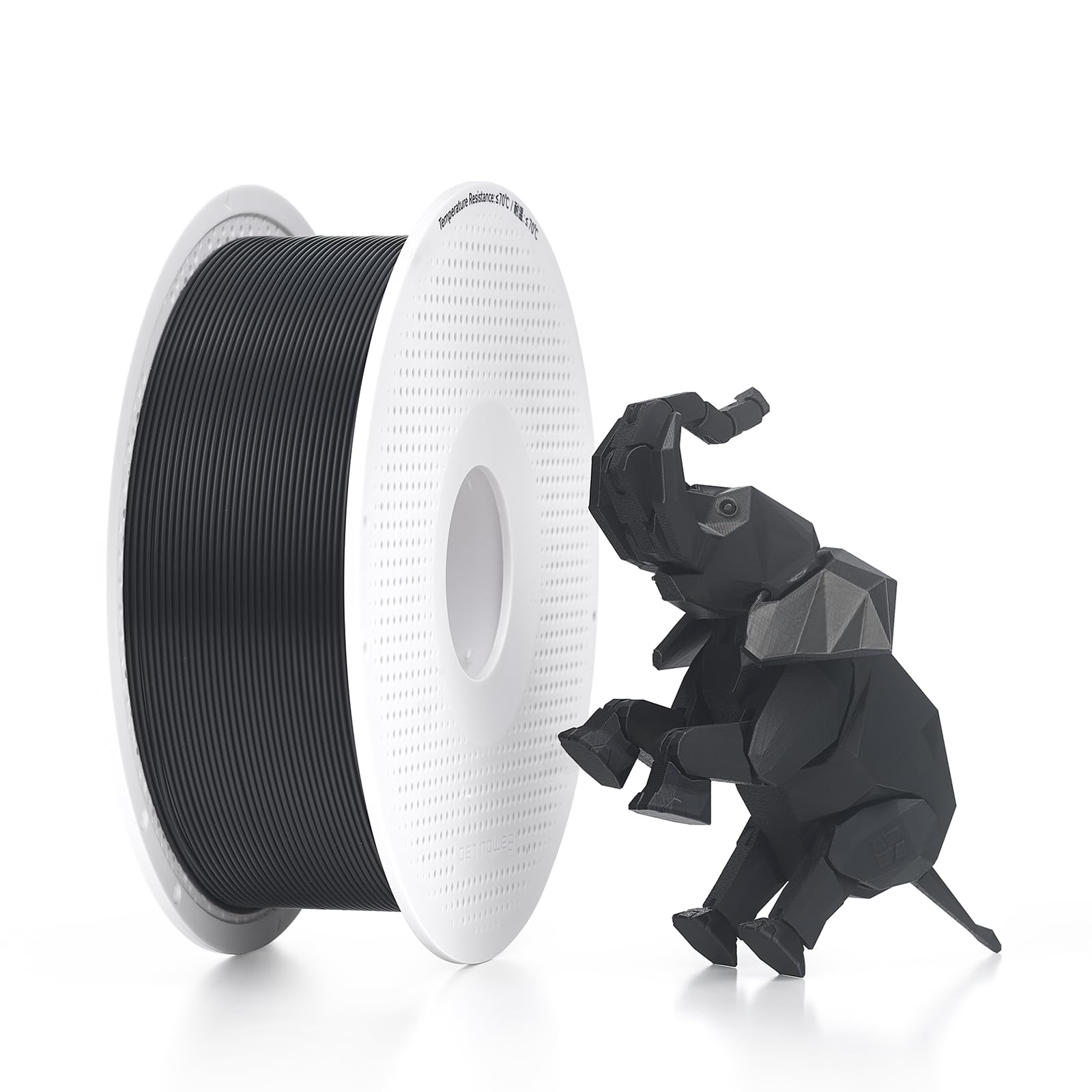
The RFID tag auto-configures your printer settings, turning a spool swap into a one-click operation.
Bambu Lab’s genuine PLA is built for their ecosystem, but it works well on any standard 1.75mm printer. The key differentiator is the integrated RFID tag. When you load the spool into a Bambu AMS, the printer reads the tag and automatically adjusts the nozzle temperature, bed temperature, and flow rate — no manual profile selection needed. For non-Bambu users, it functions as a high-quality standard PLA with a 1.75mm diameter accuracy of +/- 0.03 mm.
The quality is the most-praised aspect, with owners noting consistent layers and a smooth finish that outperforms bargain-brand filaments. The reusable spool design reduces waste — you buy the filament, and when it runs out, the spool can be refilled with future Bambu refills. The black color is deep and even across the entire print. Buyers report flawless feeding into the AMS with no tangles and no clogs.
The practical trade-off is the price point — this spool costs more than other standard PLAs on this list. Owners readily acknowledge this, describing it as “a bit pricey” but worth it for the smooth integration within the Bambu ecosystem. The cardboard packaging offers no extra rain protection for delivery.
The ecosystem tax or a fair price?: If you own a Bambu Labs printer with an AMS, the RFID convenience and flawless feeding justify the premium. If you print on a generic open-frame machine, the added cost buys you no extra advantage over the HATCHBOX or ELEGOO alternatives.
Perfect if: you are already inside the Bambu ecosystem and want spools that load with zero configuration — the RFID is genuinely useful for multi-material prints.
Not the right pick if: you own a non-Bambu printer or you are buying multiple spools and need the best per-gram value.
8. ELEGOO Matte PLA Filament 1.75mm Bundle — 4 KG
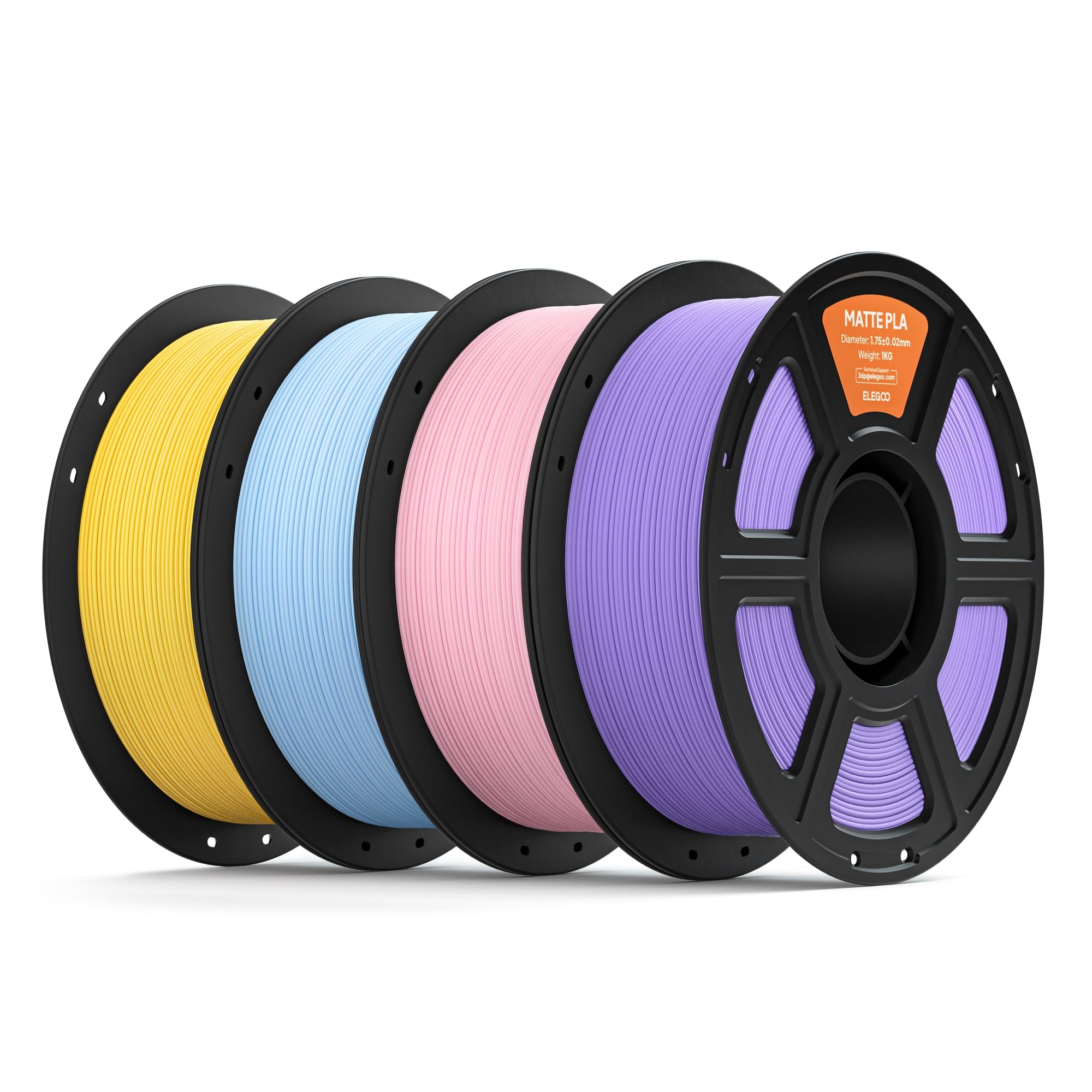
Four pastel spools that deliver an injection-molded matte finish straight from the nozzle.
ELEGOO’s matte PLA bundle is designed for makers who want a premium visual finish without sanding. The matte surface has a low gloss and smooth texture that hides layer lines almost completely, giving prints the look of molded plastic. The bundle includes four 1 kg spools in Sunshine Yellow, Ice Blue, Sakura Pink, and Lavender Purple — pastel tones that owners describe as gorgeous and stunning. The matte finish diffuses light gently, avoiding the harsh reflections that can make layer lines visible on standard PLA.
The filament is thoroughly dried and vacuum-sealed before packaging, which prevents clogs and bubbles during the first print. Owners mention consistent extrusion across all four colors with no tangling or feeding interruptions. The 1.75mm diameter stays within tight tolerances throughout each spool, and the material prints cleanly using standard PLA temperature settings — around 210°C nozzle and 55°C bed. The 4 kg bundle is a strong value if you plan to run multiple color projects back to back.
The one detail to plan for: matte PLA sometimes needs a slight adjustment to first-layer squish and 100% cooling fan speed. This is a minor slicer tweak rather than a defect, but it is worth running a test cube before committing to a large model.
The matte advantage: If you are making display models, gifts, or cosplay props where surface quality matters, this bundle gives you four colors at a per-spool cost that beats buying singles.
Grab this bundle if: you produce decorative prints in pastel tones and want a smooth, matte surface that looks post-processed without extra work.
Think twice if: you need high-strength functional parts or prefer high-gloss finishes — the matte formulation is slightly softer and less glossy by design.
9. ELEGOO PLA Filament 1.75mm Black 4-Pack — 4 KG
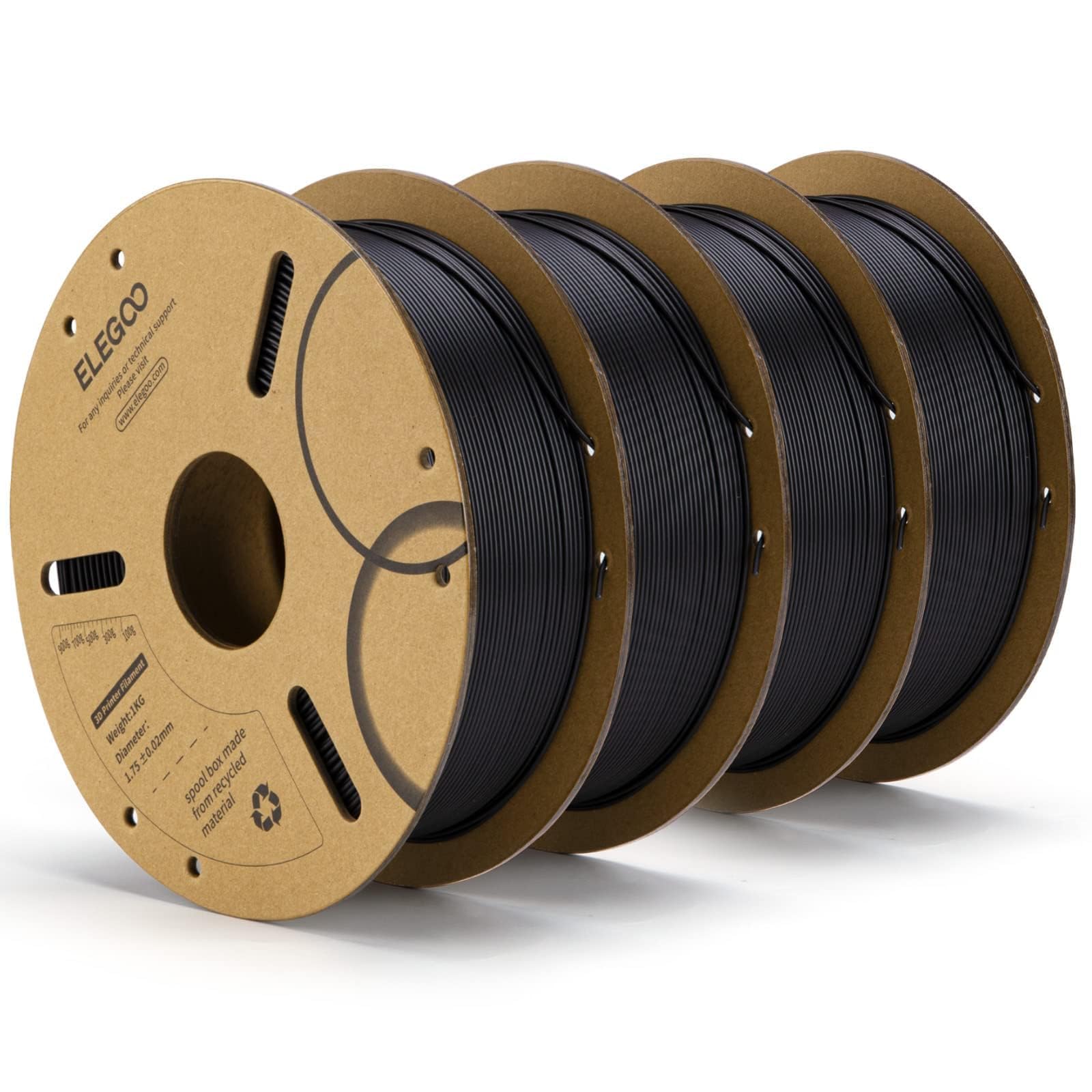
Four kilograms of black PLA at a bulk price that keeps print farms running without the per-spool anxiety.
ELEGOO’s black PLA 4-pack is the volume play for makers who burn through material fast. Each spool holds 1 kg (2.2 lbs) of 1.75mm filament with a dimensional accuracy of +/- 0.02 mm — the same tight tolerance as the premium picks above. The material is a standard high-quality PLA with a glossy surface finish that works well for everyday prints, prototypes, and functional parts that do not face high heat or impact stress. The 4-pack brings your per-spool cost down significantly compared to buying individual rolls.
Owners consistently praise the quality and print quality as the top aspects. The filament comes vacuum-sealed with individual shrink wrap and anti-moisture packets, so you can store unopened spools without worrying about humidity. The PLA has a low melting temperature and prints with minimal odor, making it comfortable for indoor use. It runs reliably across multiple printer models, including Elegoo Neptune 3 Pro, Creality Ender 3 Pro, and Bambu Labs machines.
The most-discussed negative is tangling — roughly one in five spools shows some level of winding issue according to owner reports. This is not a dealbreaker, as tangles are usually correctable at the start, but it adds a step before loading. Adhesion and clogging also get mixed feedback, meaning a small percentage of spools may need slightly different temperature tuning than the others in the same pack.
Our honest bulk verdict: For the price per spool, this is a solid workhorse filament. The occasional winding issue is the trade-off for the low per-gram cost, so check the first few meters when you open a new spool.
Choose this for: high-volume printing, prototypes, and any project where black is the default color — the 4-pack keeps your stock level comfortable.
Pass on this if: you want guaranteed tangle-free winding or you need a variety of colors in your next batch of prints.
Understanding the Specs
Dimensional Accuracy (Diameter Tolerance)
This spec separates a reliable spool from a frustrating one. It tells you how much the filament’s actual diameter can deviate from the stated 1.75mm. A tolerance of +/- 0.03mm means the filament can vary between 1.72mm and 1.78mm — enough to cause subtle under- or over-extrusion on long prints. A tighter tolerance of +/- 0.02mm (like on the Creality Rainbow and FLASHFORGE Rapid PETG) gives the printer a more consistent volume of material at the nozzle, which directly reduces visible layer artifacts and improves dimensional accuracy of the finished part.
Material Type: PLA vs PETG vs ABS
PLA is the easiest material for beginners and decorative prints. It has low warp, sticks to the bed well, and produces a clean finish with minimal odor. PETG is tougher and slightly flexible — parts printed in PETG handle mechanical stress and heat better than PLA, but the material is more prone to stringing. ABS offers the highest heat resistance and strength, but it requires an enclosed printer to prevent warping and releases fumes that need ventilation. For most daily printing, start with PLA. Move to PETG when you need a part that carries weight or sits near a warm environment.
FAQ
Will 1.75mm filament work in my 2.85mm printer?
What nozzle temperature should I use for 1.75mm PLA?
Is a tighter diameter tolerance always better?
How long does a 1kg spool of 1.75mm filament last?
What causes filament to snap or become brittle?
Will these spools fit inside an AMS system?
Is it worth paying more for a premium brand like HATCHBOX or Bambu?
Can I print flexible TPU with these 1.75mm filaments?
Final Thoughts: The Verdict
If you want one dependable pick, the 3d filament 1.75 mm winner is the HATCHBOX PLA because its proven quality, tight tolerance, and broad printer compatibility make it the safest pick for beginners and experienced makers alike. If you want a PETG that prints fast and holds strong functional parts, the Polymaker PETG is the better choice. And for high-volume black printing that keeps the per-spool cost low, the ELEGOO Black PLA 4-Pack is the one to reach for.
How We Picked
We do not accept paid placement. Every pick is matched to a real buyer and a real use-case; we do not hands-on test units.
Sources & Methodology
Specifications: manufacturer listings and product documentation. Review insights: verified customer reviews, as of July 2026. Pricing: not shown on this page (it changes often); check the current price via the retailer link.
As an Amazon Associate, Gadgets Feed earns from qualifying purchases. This does not affect which products we feature.