
Our readers keep the lights on and my morning glass full of iced black tea. As an Amazon Associate, I earn from qualifying purchases.
Specs are compiled from manufacturer listings and verified buyer reviews and can change over time — please confirm the key details on the product page before buying.
You want to turn a real object into a digital 3D model for printing, design, or archiving — but the real question is which handheld scanner actually delivers usable detail without costing a fortune or needing a computer science degree to operate. The difference between a scanner that sits in a box after one try and one you reach for every project depends on a handful of specs: accuracy, scanning speed, how it handles tricky surfaces, and whether it ties you to a PC or lets you scan freely. This guide walks you through the trade-offs that actually matter.
I’m Min — the founder and writer behind Gadgets Feed. This guide is built by comparing the manufacturers’ published specifications and the patterns across verified customer reviews, so you get each pick’s real strengths and trade-offs instead of marketing spin.
if you need to reverse-engineer a part, capture a sculpture for printing, or build a digital archive, the right 3d handheld scanner makes the difference between a clean, printable model and hours of software cleanup that never quite fixes the geometry.
Quick Picks
- Einstar Vega Wireless 3D Scanner — Best Overall
- EINSTAR 2 Wireless 3D Scanner — Fastest Scan
- Creality CR-Scan Otter — Versatile Dual-Lens
- Revopoint POP3 Plus — Refined Precision
- Revopoint INSPIRE 2 — Laser Advantage
- Shining 3D Einstar — Human & Hair Ready
- Creality CR-Scan Ferret Pro — Entry-Level Wireless
- 3DMakerpro Seal Lite — Budget Precision
How To Choose The Best 3D Handheld Scanner
The spec sheet for a 3D handheld scanner throws a lot of numbers at you, but three things decide whether you walk away with a print-ready model or a frustrating pile of raw data: accuracy, how it handles black and shiny surfaces, and if you need to be glued to a laptop. Here is how to cut through the noise.
Accuracy and Precision — The Numbers That Define Your Model
Accuracy (how close the scan matches the real object) and precision (how repeatable the measurement is) come first. A scanner with 0.02mm accuracy is dramatically more capable for small mechanical parts than one at 0.1mm — the difference means a bolt thread scans clearly versus coming out as a blurry cylinder. Units labeled in millimeters are the standard here, not DPI or PPI. If you plan to scan tiny objects like coins, jewelry, or gear teeth, aim for a spec below 0.05mm.
Scanning Technology: Structured Light, Laser, or Both
Structured light (often blue or infrared LED) is great for medium objects and full color, but struggles on reflective or transparent surfaces. Laser-based scanning cuts through shine and black surfaces without needing spray, but often captures monochrome geometry only. The best hybrid units give you both modes — use the laser for tricky automotive parts and structured light for color-rich objects like sculptures.
Wireless Freedom vs. Tethered Stability
A scanner that streams data over Wi-Fi frees you to walk around a large object, but the trade-off is battery life and occasional lag. Tethered scanners (USB) offer steady, high-speed data transfer and never run out of power, but you are always a few feet from a computer. Some premium units like the Einstar Vega solve this by building the computer right into the scanner handle, so you have a standalone device with its own screen.
Quick Comparison
| Model | Best For | Accuracy / Precision | Scanning Speed | Connectivity | Amazon |
|---|---|---|---|---|---|
| Einstar Vega | Standalone on-site scanning | High | Up to 20 FPS | All-in-one (built-in PC) | $1,999.00Amazon |
| EINSTAR 2 | High-speed versatile scanning | High | Up to 90 FPS | Wireless / USB | $999.00$1,249.00Amazon |
| Creality CR-Scan Otter | Large to small object versatility | 0.1 mm | Up to 20 fps | Wi-Fi / USB | $899.00Amazon |
| Revopoint POP3 Plus | Refined medium-object scanning | 0.04 mm precision | Up to 18 fps | Wi-Fi 6 / USB-C | $557.10$619.00Amazon |
| Revopoint INSPIRE 2 | Challenging surfaces with laser | 0.03 mm precision | Fast | Wi-Fi 6 / USB-C | $534.65$629.00Ends inAmazon |
| Shining 3D Einstar | Hair and body scanning | 0.1 mm resolution | Up to 14 FPS | USB | $645.00Amazon |
| Creality CR-Scan Ferret Pro | Entry-level wireless scanning | 0.1 mm accuracy | Fast | Wi-Fi 6 | $359.00Amazon |
| 3DMakerpro Seal Lite | High-accuracy small objects | 0.02 mm accuracy | 10 fps | USB (tethered) | $359.00Amazon |
In‑Depth Reviews
1. Einstar Vega Wireless 3D Scanner

A self-contained scanner that processes models on-board, so you never need a bulky laptop nearby.
The Einstar Vega is the only unit here that packs its own computer — an 8-core 2.4GHz CPU, 32GB RAM, and a 512GB SSD — plus a 6.4-inch 2K AMOLED display right in the handle. That means you pick it up, scan, and save, all without connecting to anything else. It uses VCSEL infrared for medium-to-large objects and MEMS projection for small-to-medium detail, each mode hitting up to 20 FPS. For outdoor work, the infrared light source handles direct sunshine without washing out, and the unit scans black and shiny surfaces without spray, according to the maker.
Buyers report that a full car front scan takes under 10 minutes with no spray or markers needed, and the build quality feels premium for the price. On the other hand, some owners found the unit extremely inaccurate on difficult surfaces and suspect a batch defect — the Vega is not a magic wand, and it requires practice like any 3D scanner. The swappable battery delivers over an hour of scanning, though several reviewers wished it lasted longer.
Self-sufficient powerhouse: If you want a scanner that travels without a laptop and processes models on the spot, the Vega is the most complete option at this level — the all-in-one design removes the single biggest hassle of 3D scanning.
Reach for this if: you scan on-site (cars, large objects, field work) and hate being tethered to a computer.
Look elsewhere if: your budget is tight or you plan to scan mostly tiny parts — the learning curve is real and some units may have quality variance.
2. EINSTAR 2 Wireless 3D Scanner
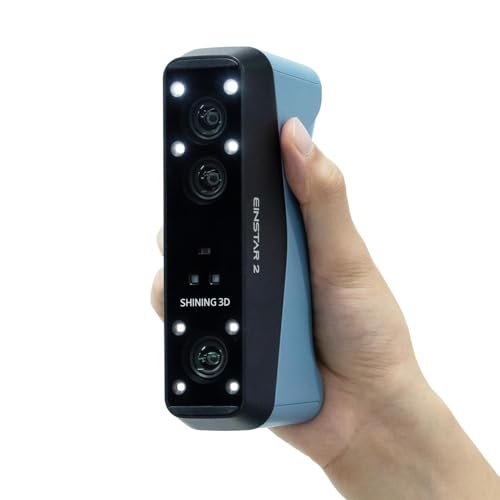
Blue laser lines cut through reflective surfaces at speeds no structured-light-only scanner can match.
The EINSTAR 2 combines 17 parallel blue laser lines for high-detail small-object capture with a VCSEL infrared mode for scanning large items outdoors. In laser HD mode it runs up to 90 FPS and works in up to 110,000 lux — bright sunlight, essentially. The swappable built-in battery lasts up to 3 hours of continuous scanning, and you can connect wirelessly or via USB-C if Wi-Fi interference crops up. It also handles black or reflective objects without spray, which is a major time-saver when scanning automotive parts.
Reviewers coming from the original Einstar noted the jump in speed and the freedom of no wires — the wireless scanning with the included batteries actually works well, and the software is described as polished. The catch is that this scanner demands a beefy PC: one reviewer noted needing an i7-12700KF, 4060 Ti 8GB, and 32GB DDR5 to run it smoothly at high detail. A few users also reported poor instructions and trouble with initial tracking, so budget time for the learning curve.
Speed Demon Advantages
- Up to 90 FPS in blue laser mode — fastest on this list
- 3-hour swappable battery for untethered sessions
- Scan reflective and black surfaces without spray
Demanding Trade-offs
- Needs a powerful PC for high-resolution scans
- Steep learning curve for first-time users
Ideal for fast workflows: If speed is your priority and you already own a strong computer, this scanner chews through large or complex objects faster than anything else here.
skip it if: you are new to 3D scanning and want a simpler, more forgiving introduction.
3. Creality CR-Scan Otter

Two lens sets let you switch from a coin to a car without changing hardware.
The Otter uses a short-focal and a long-focal dual-lens system to cover object sizes from 10 x 10 x 10mm up to 2000 x 2000 x 2000mm — a range that spans coins, engine parts, furniture, and whole vehicles. With 8 infrared LEDs, 2 white LEDs, 4 stereo depth cameras, and an RGB camera, it captures full 24-bit color at up to 20 fps. The anti-shake tracking and One-Shot 3D imaging reduce the tracking losses that plague cheaper scanners. It handles black and metallic objects like car parts and tires without spray, and works outdoors up to 30,000 lux.
Buyers confirm the hardware is impressive but note the software still has room to grow — the marker tracking mode works well, but feature and texture tracking can be unreliable, meaning you will often attach reflective dots to save time. The learning curve is real: one owner said it took practice (and usually dots) to get consistent results. Another reviewer described calibration as difficult for first-time users, with misleading app prompts.
Size-agnostic hardware: The Otter is the one scanner on this list that handles both tiny jewelry and full car doors with the same unit — no add-on lenses, no trade-offs in scan distance.
Choose this if: you scan a wide variety of object sizes and want dual-lens flexibility in a single package.
Consider skipping if: you expect reliable automatic tracking without markers and are not willing to calibrate carefully first.
4. Revopoint POP3 Plus

Optical zoom and a photolithographic calibration board push point cloud detail 30% higher than the previous model.
The POP3 Plus is an evolution of Revopoint’s popular POP line, with a new calibration board that holds the scanner within 20 microns of accuracy and an optical zoom function (1.5x and 2x magnification) that captures 30% more point cloud detail. It scans at up to 18 fps with a 9-axis IMU (a motion sensor that detects rotation and acceleration) to stabilize the scan and reduce errors from hand shake. It captures full-color models using an HD RGB camera, flash LED lighting, and class 1 infrared light that is eye and skin safe. It connects over Wi-Fi 6 or USB-C to iOS, Android, Windows, or macOS.
Reviewers praise the complete kit — it includes two turntables (small and large), a tripod, a gimbal, and tracking markers. One buyer mentioned the software on PC is more powerful than the mobile apps. A common complaint, however, is that the scan rate is low, forcing you to move very slowly. Reflective and black surfaces need spray coating to work. One reviewer who got lousy results initially later upgraded to 5 stars after using a “smooth tab” setting and free tech support from Revopoint.
What Shines Here
- 0.04 mm precision with optical zoom for fine detail
- Full kit with turntables, gimbal, tripod included
- Excellent customer support with free training sessions
What Holds It Back
- Very slow scan rate — you must move the scanner slowly
- Reflective or black surfaces require spray coating
Best for detail-oriented scanning: If you need fine surface detail on medium objects and are willing to move slowly and use spray on tricky surfaces, the POP3 Plus delivers impressive precision for the price.
Not for you if: you want fast capture or need to scan shiny parts without prep.
5. Revopoint INSPIRE 2
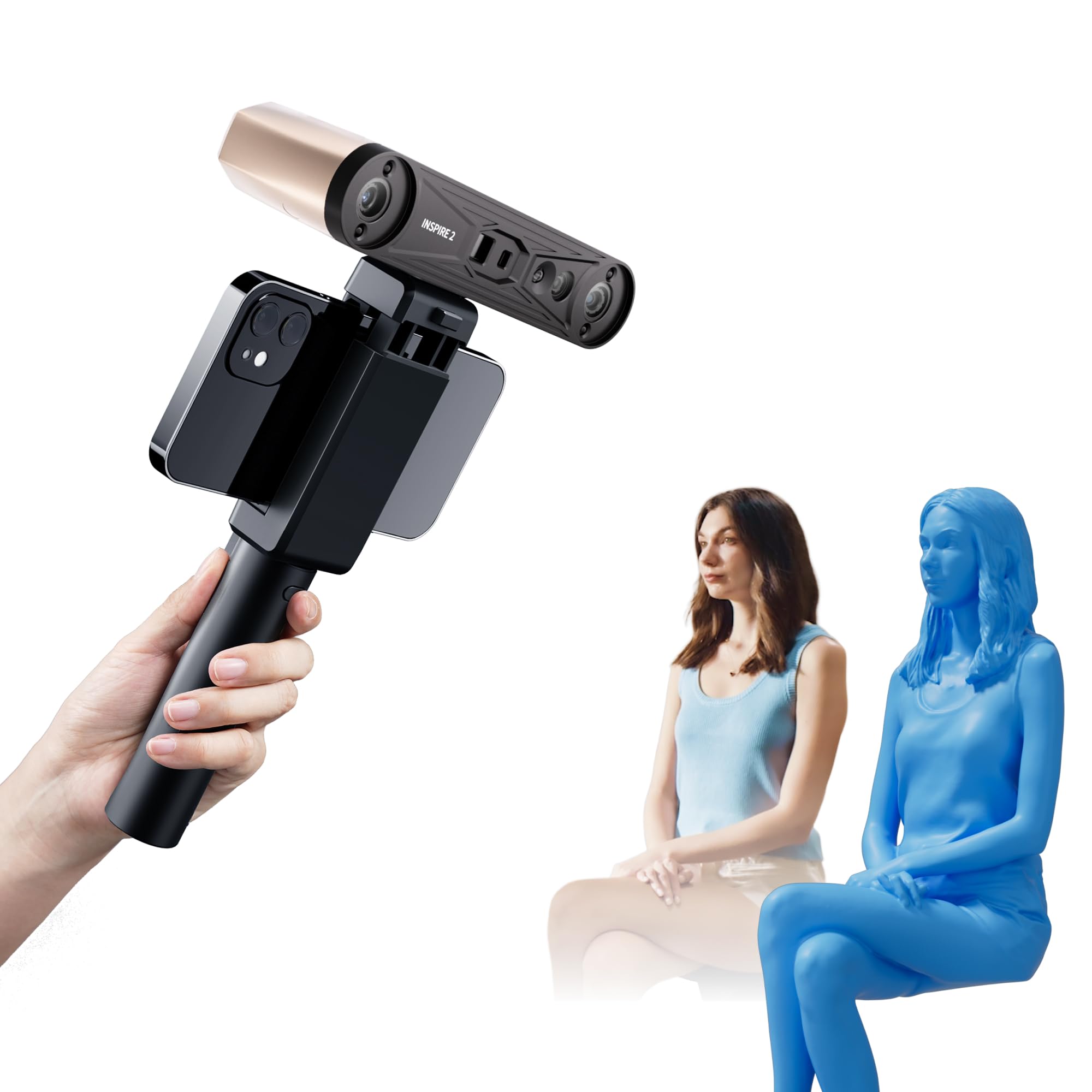
Eleven infrared laser lines let it scan dark and shiny surfaces without a single drop of spray.
The INSPIRE 2 shines (literally) on surfaces that trip up most structured-light scanners — reflective metal, dark plastic, glossy finishes — using 11 infrared laser lines that need no scanning spray. It pairs that with infrared structured light for full-color scanning, offering adjustable optical zoom at 1.5x and 2x magnification. Its precision is rated at 0.03 mm, while accuracy reaches 0.05 mm, and a high-precision calibration board boosts point cloud accuracy by 75%. It weighs just 190g and connects via Wi-Fi 6 or USB-C to iOS, Android, Windows, and macOS.
Owners mention excellent accuracy with both Laser Matt and optical feature modes, though they note the learning curve is real — one owner reported needing to work through the PDF manual and YouTube tutorials before getting consistent results. The sticky dots for calibration drew complaints for not staying stuck. On the other hand, once dialed in, the results hit within 0.5mm tolerance for 3D printing, and reviewers felt it was great value against + competitors.
Surface-agnostic capture: If you constantly scan car parts, tools, or dark objects that other scanners reject, the INSPIRE 2 laser modes are a genuine differentiator — it is the only mid-range pick here that truly skips the spray can.
Grab this if: you scan a lot of dark, reflective, or tricky surfaces and want laser-assisted tracking without moving to a professional-grade budget.
Consider alternatives if: you want a truly beginner-friendly experience with minimal calibration and a larger, more forgiving scanning volume.
6. Shining 3D Einstar
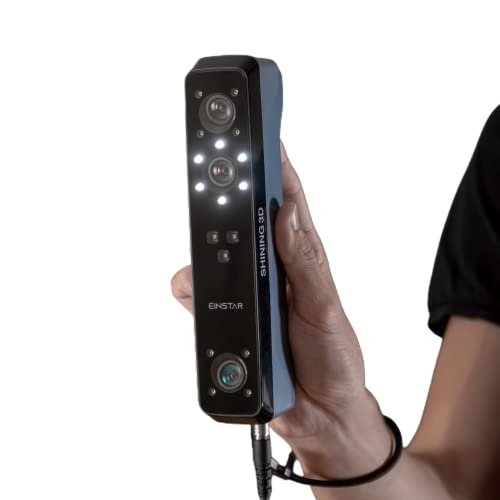
Infrared projectors and a dedicated hair mode make it the go-to for full-body and portrait scanning.
The Einstar uses three infrared VCSEL projectors and two stereo depth cameras to generate dense point clouds with a point distance up to 0.1mm. A built-in RGB camera captures full color, and the detail enhancement technology tune the point cloud for complete data. The “Hair Mode” is a real differentiator here — it switches the scanning algorithm to handle fine, dark hair strands that usually disappear in most consumer scanners. Scanning speed reaches up to 14 FPS, and there is no projector light during scanning, which keeps the process comfortable and eye-safe. It connects via a single USB cable for both data and power.
Buyers directly compare it favorably to the Revopoint Range at a similar price — one reviewer called it the best consumer-grade scanner on the market as of May 2023, noting it tracked a dark, shiny bumper without dots or spray in dim light. The software was described as easy with good features. On the downside, some found the software interface poor and the ergonomics awkward, with no tripod mount and tangled wires. A few owners reported losing tracking initially and needing to learn what the scanner can and cannot handle.
Human Scanning Strengths
- Hair Mode captures fine hair detail other scanners miss
- No projector light — comfortable for face/body scanning
- One USB cable for power and data — simple setup
Design Limitations
- No tripod mount built-in — ergonomics are awkward
- Software can be frustrating with no tutorial
Perfect for human subjects: If you scan people, hair, or organic forms, the Einstar’s infrared comfort and hair-specific algorithm set it apart from the rest.
Pass on this if: you need precise small-object scanning (0.1mm point distance limits fine detail) or you want a wireless, untethered workflow.
7. Creality CR-Scan Ferret Pro

At just 105g, it is the lightest full-featured wireless scanner you can slip into a backpack.
The Ferret Pro is built for portability — it weighs only 105g and connects wirelessly via Wi-Fi 6 to Windows, macOS, Android, and iOS devices. It offers up to 0.1mm accuracy with 24-bit full-color scanning and anti-shake technology designed for objects ranging from 50mm to 2000mm. The kit includes a Wi-Fi box, tripod, power bank, phone holder, and carrying case, making it a true all-in-one travel package. It exports in OBJ, STL, and PLY formats, and works reliably outdoors up to 30,000 lux. The manufacturer explicitly notes it is not ideal for very small or highly detailed items like jewelry or precision parts.
Buyers are split: several praised its ability to capture fine branding details on a pen and produce a perfectly fitting 3D-printed glasses holder, while others cited buggy software and limited functionality. One specific complaint from a buyer was that the unit “only exports STL, no negative part creation,” which limits how you can edit models. Another pointed out that Creality software crashes immediately on computers with AMD hardware — a critical warning if you run AMD.
Ultraportable starter: The Ferret Pro gets you into 3D scanning with minimal weight and wireless freedom, but be prepared to work around software quirks and AMD incompatibility.
Good for beginners: If you own an Intel-based PC or recent iPhone/Android device and want the lightest possible wireless scanner for medium objects.
Not for you if: you use an AMD computer, need fine details on small objects, or want a polished all-in-one software experience.
8. 3DMakerpro Seal Lite
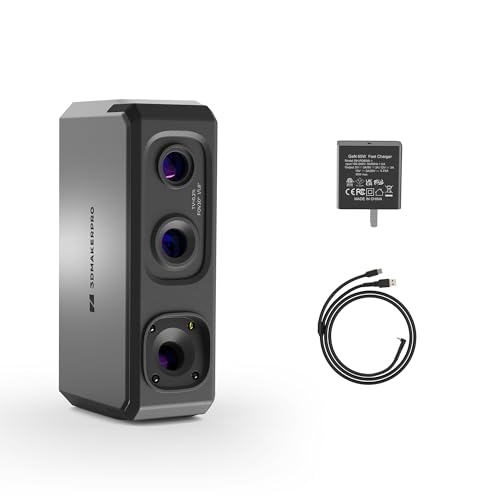
Tiny objects meet their match with a blue LED light source that catches texture down to 0.02mm.
The Seal Lite uses a blue LED light source with a shorter wavelength (400–500nm) to project finer structured light than standard white or infrared LEDs, achieving 0.02mm accuracy — five times finer than the Ferret Pro’s 0.1mm. It is designed specifically for small-format scanning of objects from 10mm to 300mm, with a recommended working distance of 180–280mm. It captures mono texture only (no color) at 10 fps and relies on JMStudio software for visual tracking, error correction, and auto-alignment. It is a tethered unit requiring a USB connection to a PC or Mac.
Reviewers describe it as a budget-friendly entry-level scanner with a steep learning curve — one owner reports it produces high-quality scans after practice but is not plug-and-play. Another buyer returned it because it could not scan a black bow riser at all, and one reviewer pointed out the documentation is poor, making setup frustrating. The unit struggles with shiny and dark materials, often requiring spray. Unlike the Ferret Pro, it needs a powerful PC (65W charger included) and wall power.
Small-Object Specialist
- 0.02mm accuracy is the finest on this list — ideal for tiny parts and details
- Blue LED light catches surface texture other scanners miss
- Lifetime free JMStudio software updates
Real Limitations
- Mono texture only — no full-color capture
- Struggles badly with black and shiny surfaces
- Poor documentation makes the learning curve harder than necessary
Best for tiny, precise scans: If your world is small objects — coins, gears, miniatures, jewelry — and you are willing to tether to a PC and learn the software, the Seal Lite delivers class-leading accuracy for the price.
pass on it if: you need color, scan large objects, or want a wireless, beginner-friendly workflow from the start.
Understanding the Specs
Accuracy vs. Precision
Accuracy tells you how close the digital model is to the real object’s size and shape. Precision tells you how consistently the scanner captures the same point. A unit with 0.02mm accuracy like the Seal Lite can detect a dent 0.02mm deep; a unit with 0.1mm will smooth that dent out. For 3D printing functional parts, aim for 0.05mm or better. For artistic or display scans, 0.1mm is often fine.
Laser vs. Structured Light
Structured light (LED-based) projects a known pattern and reads how it deforms on the object — it handles color and texture well but fails on shiny, dark, or transparent surfaces. Laser scanners project one or more laser lines and track them with cameras — they cut through reflections and black surfaces but often capture geometry-only data. Some hybrid scanners offer both, letting you switch modes per object.
FAQ
Can a 3D handheld scanner scan black or shiny objects without spray?
What computer specs do I need for a 3D handheld scanner?
What is the difference between 0.02mm and 0.1mm accuracy in a 3D scanner?
Will a 3D handheld scanner work outdoors in sunlight?
Can I scan a person’s face with a handheld 3D scanner?
What file formats do handheld 3D scanners export?
Do I need to use marker dots for every scan?
How long does it take to learn a 3D handheld scanner?
Final Thoughts: The Verdict
For most people, the 3d handheld scanner winner is the Einstar Vega because it packs its own computer, handles large and small objects, and scans outdoors without any tether — the single tool that does not need a laptop. If you want high-speed blue laser scanning for reflective surfaces and already own a powerful PC, grab the EINSTAR 2. And for budget-friendly small-object work with the finest accuracy on this list, the standout is the 3DMakerpro Seal Lite — just budget time for the learning curve.
How We Picked
We do not accept paid placement. Every pick is matched to a real buyer and a real use-case; we do not hands-on test units.
Sources & Methodology
Specifications: manufacturer listings and product documentation. Review insights: verified customer reviews, as of July 2026. Pricing: not shown on this page (it changes often); check the current price via the retailer link.
As an Amazon Associate, Gadgets Feed earns from qualifying purchases. This does not affect which products we feature.
Product prices and availability are accurate as of the date/time indicated and are subject to change. Any price and availability information displayed on Amazon at the time of purchase will apply to the purchase of this product. As an Amazon Associate I earn from qualifying purchases.
CERTAIN CONTENT THAT APPEARS ON THIS SITE COMES FROM AMAZON. THIS CONTENT IS PROVIDED "AS IS" AND IS SUBJECT TO CHANGE OR REMOVAL AT ANY TIME.
Amazon and the Amazon logo are trademarks of Amazon.com, Inc. or its affiliates.