
The leap from measuring with calipers and tape to capturing a full object as a digital mesh is the single largest productivity shift in reverse engineering, custom fabrication, and 3D printing today. A 3D measurement system replaces guesswork with a point cloud, turning a physical part into a dimensionally accurate digital twin you can modify, replicate, or inspect.
I’m Min — the co-founder and writer behind Gadgets Feed. I’ve spent hundreds of hours analyzing the technical specifications, real-world accuracy claims, and actual user workflows across every handheld and LiDAR-based system in this space, separating the tools that deliver repeatable results from those that frustrate.
This guide breaks down the 3D measurement landscape by accuracy tier, scanning technology, and real-world ease of use so you can confidently choose the best 3d measurement system for your specific workshop, studio, or professional application.
How To Choose The Best 3D Measurement System
Selecting the right 3D measurement system comes down to matching scanning technology to your object size, required accuracy, and budget for compute infrastructure. A unit that excels at scanning a 5mm gear tooth will fail on a 2-meter car bumper, and vice versa.
Accuracy and Precision: The Real Numbers
Look past marketing claims and focus on the stated accuracy in millimeters and the point distance/resolution spec. Entry-level structured light scanners typically deliver 0.1mm accuracy, sufficient for hobbyist 3D printing. Metrology-grade systems using blue laser technology push down to 0.02mm, essential for aerospace or automotive jig fitment. Remember that accuracy is affected by surface reflectivity, ambient light, and operator technique.
Scanning Technology: Structured Light vs Blue Laser vs LiDAR
Structured light (infrared or blue LED) excels at capturing fine surface detail on matte, non-reflective objects. Blue laser systems handle reflective and dark surfaces without spray and deliver higher accuracy on medium to large parts. LiDAR is reserved for architectural and spatial scanning, trading micron-level detail for range and speed across rooms or building exteriors.
PC Requirements and Software Ecosystem
The scanner is only half the investment. Many systems require a Windows PC with a dedicated GPU and 32GB of RAM for real-time processing. Wireless all-in-one scanners eliminate this dependency but cost more upfront. Verify compatibility with your existing hardware before purchasing, and check whether the software is free, subscription-based, or requires a separate license for CAD export.
Quick Comparison
On smaller screens, swipe sideways to see the full table.
| Model | Category | Best For | Key Spec | Amazon |
|---|---|---|---|---|
| Shining 3D Einstar | Structured Light | Hobbyist body & object scanning | 0.1mm point distance | Amazon |
| Creality CR-Scan Otter | Structured Light | Small to car-sized objects | 10-2000mm scan range | Amazon |
| Revopoint POP3 Plus | Structured Light | Medium object detail capture | 0.04mm precision | Amazon |
| Revopoint INSPIRE 2 | Hybrid Laser/Light | Reflective & dark surfaces | 0.03mm precision | Amazon |
| Creality Raptor Pro | Blue Laser | Automotive & metrology | 0.02mm accuracy | Amazon |
| 3DMakerpro Seal Lite | Blue LED Light | Small-format beginner scanning | 0.02mm accuracy | Amazon |
| Creality Ferret Pro | Structured Light | Entry-level wireless scanning | 0.1mm accuracy | Amazon |
| Shining 3D Einstar Vega | All-in-One | Standalone wireless scanning | Built-in 32GB RAM/512GB SSD | Amazon |
| Matterport Pro3 | LiDAR | Architectural & spatial capture | 100m scanning range | Amazon |
| Haimer 3D-Sensor | Mechanical Probe | CNC work zeroing | 3-axis edge finding | Amazon |
| Creality Ferret Pro (Gen2) | Structured Light | Wireless mobile scanning | 105g weight | Amazon |
In‑Depth Reviews
1. Shining 3D Einstar Handheld 3D Scanner
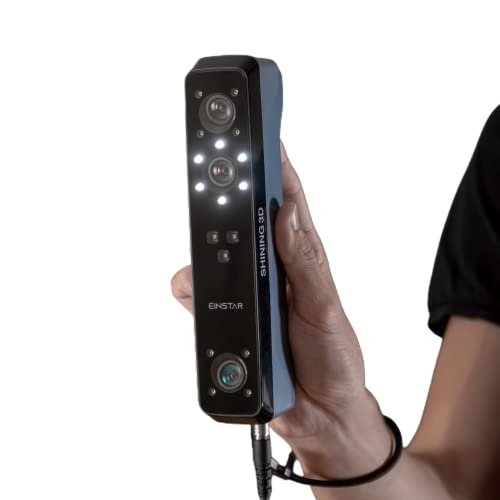
The Einstar dominates the consumer-prosumer boundary because its three infrared VCSEL projectors and dual depth cameras deliver effortless tracking on objects that stump lesser units. Users report scanning dark, shiny car bumpers with only tracking dots in poor lighting while the Einstar held alignment — a task that made competing scanners lose tracking and produce corrupt data. The 14 FPS capture speed with point distances down to 0.1mm produces dense meshes suitable for reverse-engineering custom automotive parts.
The built-in RGB camera captures full-color texture, and the dedicated Hair Mode optimizes the infrared projectors to capture head scans with realistic strand detail. At roughly , it undercuts professional-grade scanners by an order of magnitude while delivering results users compare to units costing over . The trade-off is a significant learning curve around optimal scanning distance and surface preparation, plus a requirement for a capable PC with at least 16GB of RAM.
The free EXstar software includes automatic alignment and data quality indicators that guide you toward better scans, but the interface lacks the polish of Revopoint’s Revo Scan. For the price-to-performance ratio in a structured light scanner that handles body, automotive, and medium-object scanning, the Einstar remains the benchmark.
Why it’s great
- Exceptional tracking stability on challenging surfaces without spray
- Hair Mode enables detailed human head scans impossible on most competitors
- Smooth outdoor scanning up to 30,000 lux with reliable data capture
Good to know
- Requires a powerful PC (Ryzen 5 or better with dedicated GPU and 16GB+ RAM)
- Steep learning curve for optimal distance and settings
- Some units reported defective cooling fans out of the box
2. Creality CR-Scan Otter 3D Scanner

The CR-Scan Otter addresses the single biggest limitation of most handheld scanners — object size range — by integrating dual focal-length lenses that let you scan objects from a 10mm coin to a 2-meter car with the same unit. The four stereo depth cameras and eight infrared LEDs enable One-Shot 3D imaging that stabilizes tracking even with quick hand movements, while the 24-bit full-color RGB camera and proprietary color mapping algorithm faithfully reproduce textures in low-light conditions.
Users consistently praise the hardware but note that the software ecosystem lags behind. Marker tracking mode is reliable, but feature/texture tracking can be inconsistent, requiring users to spend significant time attaching and removing tracking markers. The wireless bridge reduces framerate to 8-9 FPS with occasional interface hangs, so tethered USB operation remains the most stable workflow. Performance requirements are steep — Creality recommends an i7 Gen7 CPU and 16GB of RAM.
At , the Otter competes directly with the Einstar but offers a wider object range at the cost of a rougher software experience. For users who regularly switch between scanning small mechanical parts and large automotive panels, the Otter’s dual-lens flexibility justifies the compromise.
Why it’s great
- Dual focal-length lenses cover 10mm to 2,000mm object sizes
- Excellent color texture capture with million-pixel RGB camera
- Anti-shake tracking reduces tracking loss for beginners
Good to know
- Software interface still maturing with occasional stability issues
- Wireless bridge reduces performance and introduces lag
- Requires a computer with strong GPU and at least 16GB RAM
3. Creality 3D Scanner Raptor Pro
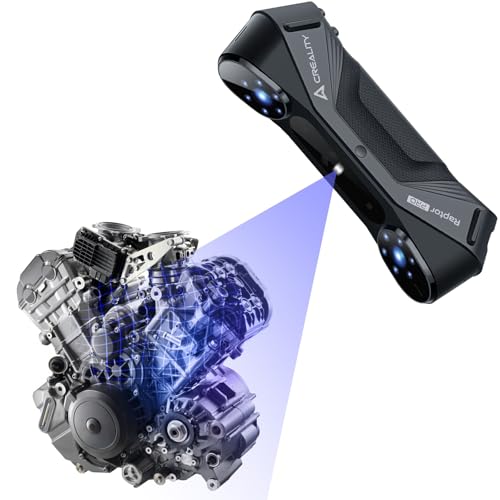
The Raptor Pro is the first Creality scanner that genuinely legitimately targets professional metrology applications. Its 22 cross blue laser lines and 7 parallel blue laser lines deliver 0.02mm accuracy on medium to large objects, with each laser line measuring just 0.1mm thick. The 60 FPS capture speed processes 660,000 points per second, drastically cutting scan times for automotive engine components and custom body panels where iterative design cycles demand speed.
The blue laser system handles reflective and dark surfaces without scanning spray, a critical advantage over structured light scanners that require surface treatment. The 405g weight and metal lens barrel make it suitable for on-site automotive work. The Creality Scan software integrates with Geomagic Control X, Geomagic Design X, and Verisurf Inspect for seamless transition into reverse engineering and quality control workflows. The minimum PC requirement of an i7 Gen7 CPU with 16GB RAM and an Nvidia GPU with 6GB VRAM is demanding but reasonable for the accuracy tier.
At , the Raptor Pro occupies a unique space — delivering metrology-grade accuracy at a fraction of the cost of traditional blue laser scanners from established industrial brands. The primary caveat is the learning curve for laser scanning technique and the need for a high-end workstation.
Why it’s great
- Metrology-grade 0.02mm accuracy with blue laser technology
- 60 FPS capture with 660K points per second for rapid scanning
- Handles reflective and dark surfaces without scanning spray
Good to know
- Requires a high-end PC with Nvidia GPU and 32GB RAM recommended
- Higher price point at positions it beyond hobbyist budgets
- Laser scanning technique has a steeper learning curve than structured light
4. Shining 3D Einstar Vega Wireless 3D Scanner

The Einstar Vega eliminates the PC requirement entirely by integrating an 8-core 2.4GHz CPU, 32GB of RAM, and a 512GB SSD directly into the handheld unit. The 6.4-inch 2K AMOLED touchscreen provides real-time scanning feedback, and the dual scanning technology — VCSEL for long-range fast mode (up to 20 FPS, 270-1500mm) and MEMS for HD short-range mode (up to 15 FPS, 100-350mm) — covers everything from small mechanical parts to full vehicles without ever connecting to a computer.
Wireless transfer via the Shining 3D Cloud offers 5GB of free storage for sharing scans, and the unit supports screen casting to a secondary display. The automatic configuration selection makes it beginner-ready, while features like 12mm marker alignment for super-large objects and hybrid alignment enhance tracking stability. Users report scanning a car front in under 10 minutes without spray or tracking dots. However, some users report failures on dark, shiny, or transparent surfaces even with markers.
At , the Vega is a premium investment, but for professionals who need to scan in the field without a laptop and battery pack, the all-in-one design is transformative. The battery life exceeds one hour of continuous scanning, and the infrared light source is eye-safe for scanning people.
Why it’s great
- Fully standalone scanning with built-in compute, display, and storage
- Dual scanning modes (VCSEL and MEMS) cover small to large objects
- Beginner-ready with one-click scanning and automatic configuration
Good to know
- Struggles with dark, shiny, and transparent surfaces despite claims
- Battery life could be longer for extended field sessions
- Software UI has fewer advanced options compared to PC-based solutions
5. Matterport Pro3 3D Lidar Scanner
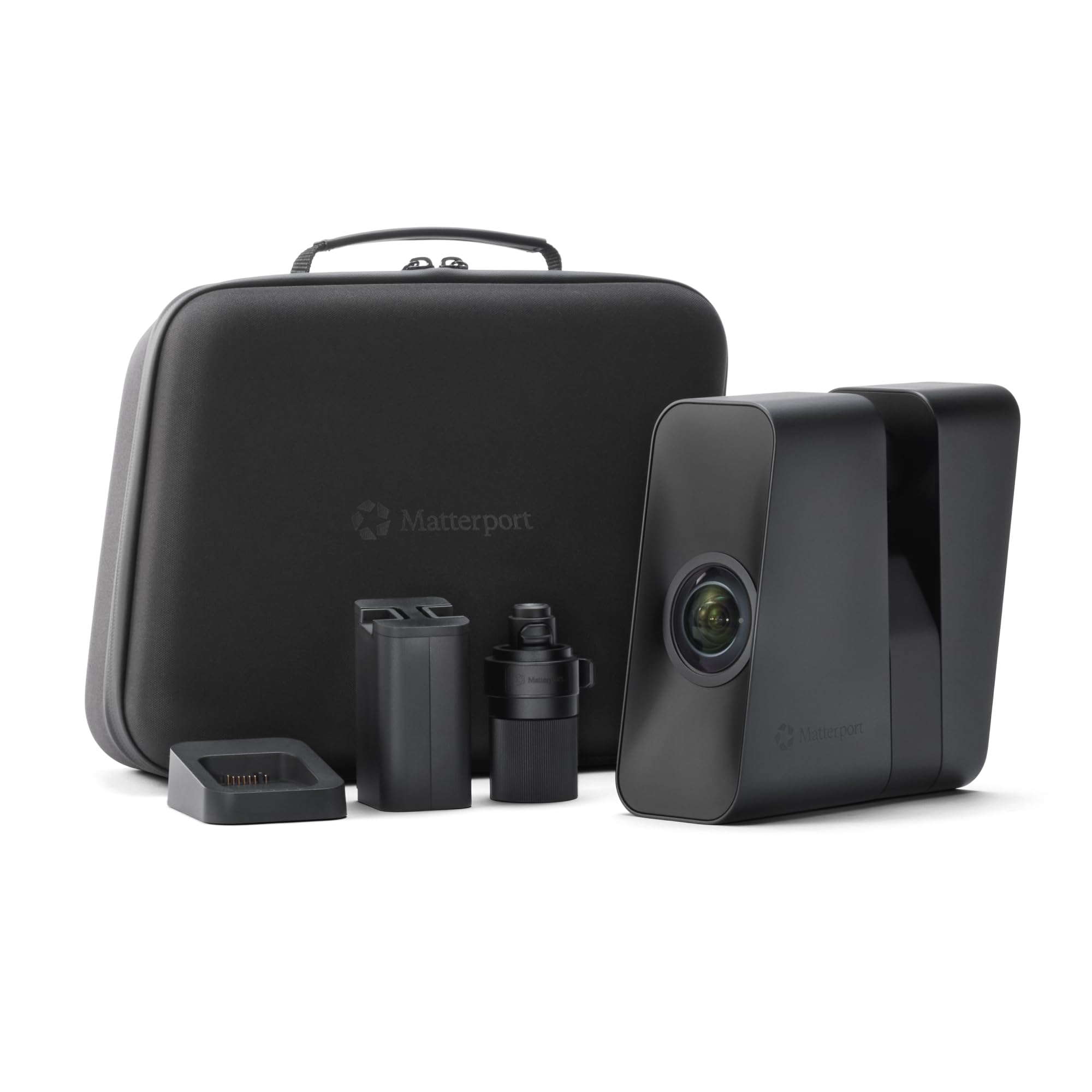
The Matterport Pro3 is the professional standard for architectural and spatial 3D measurement, using a LiDAR sensor that captures 100,000 points per second with ±20mm accuracy at 10 meters. The extended scanning range of up to 100 meters enables quick capture of large indoor and outdoor spaces — warehouses, construction sites, heritage buildings — that handheld structured light scanners cannot handle. Each sweep completes in under 20 seconds, and the removable battery supports continuous scanning for full-day site visits.
The 4K 360-degree photography overlays photo-realistic texture onto the LiDAR mesh, producing virtual tours and dimensionally accurate floor plans compatible with Matterport’s professional and business subscription plans. The Pro3 is significantly quieter than its Pro2 predecessor and ships with a rugged carrying case, tripod mount, and charging kit. However, it is not compatible with free or starter Matterport plans, and the subscription cost adds to the already substantial purchase price.
For real estate, architecture, and construction professionals who need millimeter-accurate spatial capture with minimal setup time, the Pro3 is the uncontested leader. It is not designed for object scanning, jewelry, or small parts — its value is purely in space-scale digital twinning.
Why it’s great
- 100-meter LiDAR range captures entire buildings and outdoor sites
- Ultra-fast 20-second sweeps with precision LiDAR measurements
- Professional-grade build with removable battery for continuous field use
Good to know
- Requires Matterport professional subscription for full functionality
- Not designed for small object or mechanical part scanning
- High entry price of nearly limits it to commercial users
6. Revopoint POP3 Plus 3D Scanner

The POP3 Plus refines Revopoint’s popular POP 3 formula with a new photolithographic calibration board that maintains 20-micron accuracy, and an optical zoom feature at 1.5x and 2x magnification that delivers 30% more point cloud detail. The 18 FPS scanning speed and 9-axis IMU stabilize scans to prevent faulty frames from hand shake. The class 1 infrared light is eye-safe for scanning body parts, making it suitable for animation and digital archiving of organic forms.
The free Revo Scan software is widely regarded as one of the most polished and user-friendly scanning applications on the market, with in-depth tutorials and a global marker tracking mode that dramatically enhances marker-based scans. The POP3 Plus connects over Wi-Fi 6 or USB Type-C to iOS, Android, Windows, and macOS devices. At 190 grams, it is one of the lightest full-featured scanners available. However, reflective and dark surfaces still require scanning spray, and the supplied accessories (charging cables and turntable) have been reported as failure points by some users.
At , the POP3 Plus offers the best detail-per-dollar ratio for medium objects in the 20mm to 2-meter range. The two-year warranty and responsive 24/7 customer support add peace of mind that budget scanners lack.
Why it’s great
- Optical zoom (1.5x and 2x) captures finer surface detail than any competitor at this price
- Excellent free Revo Scan software with global marker tracking mode
- Two-year warranty and responsive customer support
Good to know
- Requires scanning spray for reflective and dark surfaces
- Some bundled accessories reported as low-quality by users
- Software only compatible with x86_64 architecture
7. Revopoint INSPIRE 2 3D Scanner
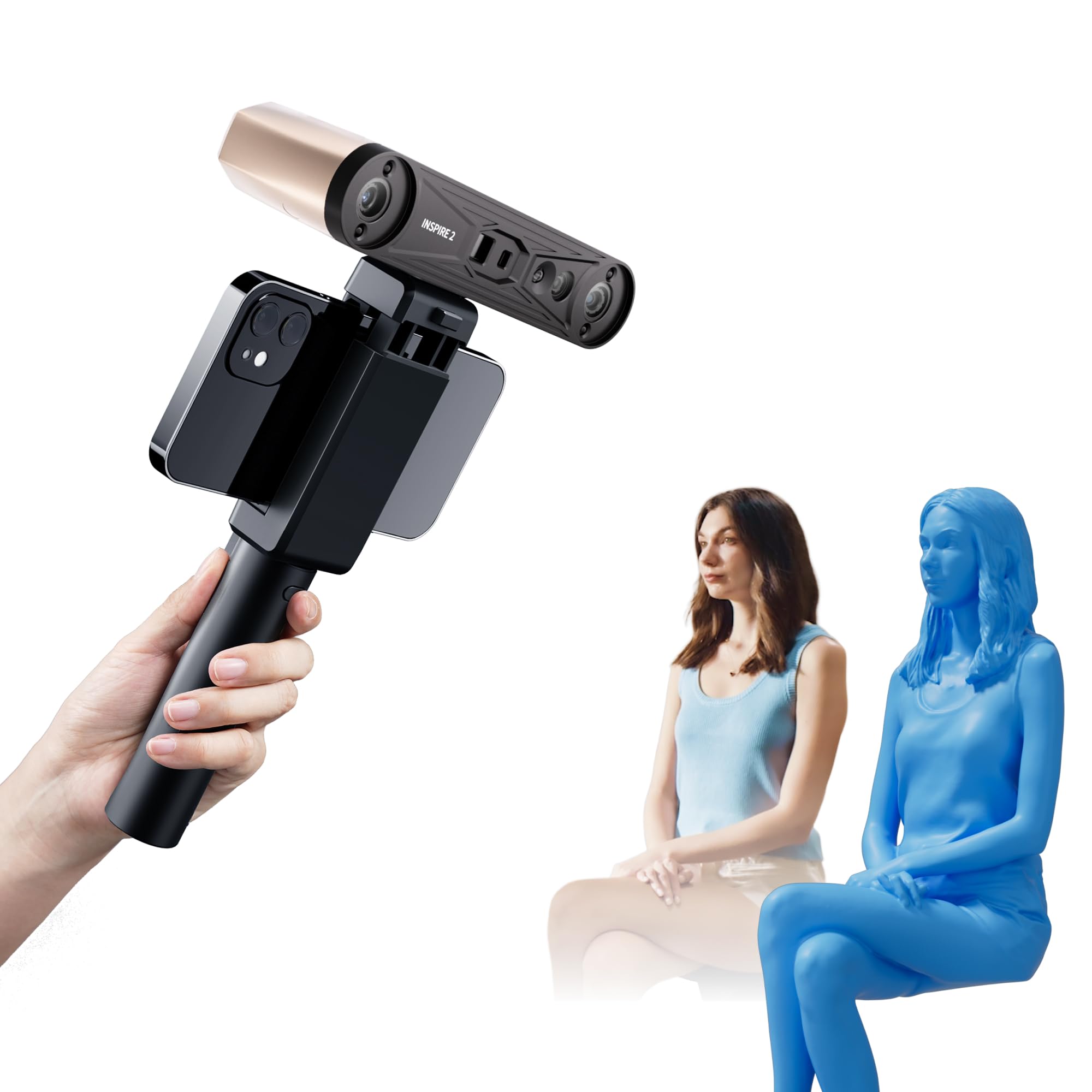
The INSPIRE 2 is Revopoint’s answer to the problem of reflective and dark surfaces, combining infrared structured light with 11 infrared laser lines that can capture detail on challenging materials without scanning spray. The dual scanning modules allow users to switch between structured light for general objects and multi-line laser for glossy, black, or metallic surfaces. The precision rating of 0.03mm and accuracy of 0.05mm place it above the POP3 Plus in the Revopoint lineup.
Built-in Wi-Fi 6 enables wireless mobile scanning or real-time PC-to-mobile interactive scan streaming for remote operations. The aerospace-grade aluminum alloy front panel adds durability while keeping weight at 190 grams. The adjustable optical zoom at 1.5x and 2x magnification provides flexibility across object sizes. The free Revo Metro software offers advanced scan settings and powerful post-processing, though the Revo Design CAD conversion tool is paid separately and Windows-only.
At , the INSPIRE 2 is priced close to the POP3 Plus but adds laser scanning capability that eliminates the need for spray on many surfaces. The trade-off is more demanding PC requirements — Revopoint recommends an i7 13th Gen or Ryzen 7 5800 with 16GB RAM and an RTX 3060 GPU.
Why it’s great
- 11 infrared laser lines scan reflective and dark surfaces without spray
- Dual scanning modules adapt to different material types and sizes
- High precision (0.03mm) approaches professional-grade metrology
Good to know
- PC requirements are demanding — RTX 3060 and 16GB RAM recommended
- Calibration dots included have poor adhesive quality per some users
- Revo Design CAD conversion software is paid and Windows-only
8. 3DMakerpro 3D Scanner Seal Lite
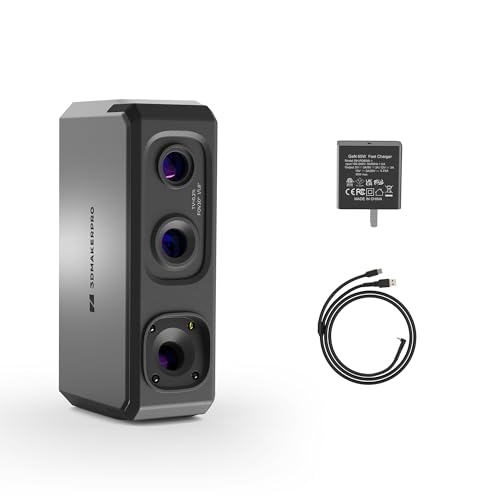
The Seal Lite uses a blue LED light source with a 400-500nm wavelength to project finer structured light patterns than infrared alternatives, achieving 0.02mm accuracy on small-format objects between 10mm and 300mm. The recommended working distance of 180-280mm and 10 FPS frame rate encourage slow, deliberate scanning technique. The included JMStudio software provides visual tracking, error correction, and auto-alignment with lifetime free updates, exporting in OBJ, STL, PLY, and ASC formats.
Users consistently report that the Seal Lite produces impressive detail after a learning curve, but the documentation is sparse and the setup process can be frustrating. The scanner requires a 65W wall charger (not USB-powered) and a relatively powerful PC. Mono texture scanning means color information is not captured. Reflective and dark objects require scanning spray. The plastic build feels less premium than metal-bodied competitors, but the 0.02mm accuracy at is exceptional for the price point.
The Seal Lite is best suited for users who primarily scan small mechanical parts, figurines, and jewelry-sized objects and are willing to invest time in mastering the scanning workflow. The optional turntable, tripod, and Smart Grip accessories improve the experience significantly.
Why it’s great
- 0.02mm accuracy at a budget-friendly price point
- Lifetime free JMStudio software with frequent updates
- Blue LED source captures fine edge detail on small objects
Good to know
- Poor documentation leads to frustrating setup for beginners
- Requires 65W wall power and a powerful PC — not USB-powered
- Fails on dark, shiny, and very small objects without spray
9. Haimer 80.360.00NG 3D-Sensor

The Haimer 3D-Sensor is a mechanical edge finder and probe for CNC machining, not a digital scanner. It locates workpiece zero points in X, Y, and Z axes simultaneously without needing to subtract probe tip diameter — the sensor reads center directly. The included short probe tip allows measuring surface flatness, bore positions, and workpiece dimensions with repeatable mechanical accuracy that digital cameras cannot match on metal surfaces.
Machinists who invest in the Haimer consistently report that it eliminates the wigglers and radius compensation errors of traditional edge finders, saving significant setup time. The all-metal construction is heavy and precise, with a bezel for easy calibration. However, the NG model has limited adjustment range compared to the Universal model — some users report out-of-box concentricity errors of 0.010 inches that cannot be fully corrected. The learning curve involves understanding the two allen key adjustment on one axis.
At , the Haimer is expensive for a mechanical probe, but for CNC operators who repeatedly touch off tools and set work offsets, the time saved on setup pays for itself rapidly. This is not a 3D scanner — it is a precision measurement tool for subtractive manufacturing.
Why it’s great
- Direct 3-axis zeroing eliminates math and radius compensation errors
- All-metal construction for repeatable precision on the machine table
- Significantly faster workpiece setup than traditional wigglers
Good to know
- NG model has limited adjustment range for concentricity correction
- Requires manual two-allen-key adjustment technique
- Not a 3D scanner — purely mechanical CNC probe only
10. Creality CR-Scan Ferret Pro (Gen2)

The second-generation Ferret Pro improves on the original with 30 FPS scanning speed, 0.1mm accuracy, and 0.16mm resolution, powered by upgraded optical technology and intelligent algorithms that maintain performance in outdoor environments up to 30,000 lux. The one-shot 3D imaging with anti-shake tracking reduces tracking loss for beginners, and the WiFi 6 wireless transmission offers 3x faster speeds than WiFi 5 for stable data transfer to iOS (iPhone 11+), Android, Windows, and macOS devices.
Users report that the Ferret Pro produces usable scans right out of the box but hit frustrating software limitations — the initial software version had significant bugs, and the scanning environment must be carefully controlled for good results. The need for tracking markers on featureless surfaces is a common complaint, and the 105g lightweight design, while portable, can feel less stable than heavier units. The bundled WiFi bridge enables wireless scanning, but some users report that wired USB connection remains more reliable.
At , the Ferret Pro Gen2 finds its sweet spot as an entry-level wireless scanner for users who already have a compatible iPhone or high-end Android device and want to avoid PC dependency. The 1-year warranty and responsive customer support provide a safety net for beginners.
Why it’s great
- 30 FPS scanning speed reduces capture time significantly
- WiFi 6 wireless scanning works with iPhone 11+ and Android devices
- Lightweight 105g design for portable scanning anywhere
Good to know
- Software had significant early bug issues that required updates
- Requires perfect environmental conditions for decent scan quality
- WiFi bridge can be unreliable; wired USB connection preferred
11. Creality CR-Scan Ferret Pro (Gen1)

The original Ferret Pro established Creality’s entry into the wireless consumer 3D scanning market with 24-bit full-color capture, 0.1mm accuracy, and WiFi 6 connectivity. Its 105g weight makes it the lightest full-function scanner on this list, and the bundled WiFi box, tripod, power bank, phone holder, and carrying case provide a complete starter kit. The scanning range of 50mm to 2000mm covers most hobbyist use cases, though the recommendation to avoid very small items, jewelry, or precision parts is a real limitation.
User experiences are mixed — some report exceeding expectations on small, detailed scans like custom glasses holders, while others describe frustrating tracking loss, buggy software, and an inability to scan even moderately challenging surfaces like red or white objects. The app is not particularly user-friendly, and many users recommend investing in a turntable for decent scan quality. The requirement for a Gen8 i5 CPU and 8GB RAM is modest by comparison to higher-end scanners.
At the same price point as the Gen2, the original Ferret Pro is best viewed as a budget entry point for users who want to test whether 3D scanning fits their workflow before investing in a higher-tier system. The 1-year warranty provides basic coverage.
Why it’s great
- Ultra-light 105g design is the most portable option available
- Complete starter kit includes WiFi box, tripod, and carrying case
- Wireless scanning works with iOS and Android devices
Good to know
- Software is buggy and the app interface is not user-friendly
- Struggles with red, white, and dark objects without scanning spray
- Requires a turntable for consistent scan quality
FAQ
What accuracy do I need for 3D printing functional parts?
Can a handheld 3D scanner measure large objects like furniture or rooms?
Why do I need scanning spray and when can I skip it?
Final Thoughts: The Verdict
For most users, the best 3d measurement system winner is the Shining 3D Einstar because it delivers professional-grade tracking stability and detail across human, automotive, and object scanning at a price point that hobbyists and small shops can justify. If you need standalone wireless scanning without a PC, grab the Shining 3D Einstar Vega. And for metrology-grade blue laser accuracy on reflective surfaces, nothing beats the Creality Raptor Pro.