
Our readers keep the lights on and my morning glass full of iced black tea. As an Amazon Associate, I earn from qualifying purchases.
Specs are compiled from manufacturer listings and verified buyer reviews and can change over time — please confirm the key details on the product page before buying.
You want a print that finishes strong — no stringing, no mid-print tangles, no warped corners on a model you’ve been running for 12 hours. The right spool is the cheapest upgrade you can make; the wrong one wastes time, filament, and patience. This guide cuts through brand noise to find spools that deliver on diameter consistency and bed adhesion.
I’m Min — the founder and writer behind Gadgets Feed. This guide is built by comparing the manufacturers’ published specifications and the patterns across verified customer reviews, so you get each pick’s real strengths and trade-offs instead of marketing spin.
Whether you are dialling in your first Benchy or cranking out production parts, choosing the right 3d print filament is the single fastest way to turn a frustrating hobby into a reliable workflow.
Our Picks at a Glance


How To Choose The Best 3D Print Filament
You want a print that finishes clean, not one that ends up in the scrap bin. The difference depends on a few key specs you can check before you buy.
Diameter Tolerance — The Gatekeeper
The filament diameter is your nozzle’s lifeline. A spec of ±0.02mm is the gold standard for standard PLA — it means the filament’s thickness barely varies as it feeds, so your extruder gets a consistent volume of plastic every second. Wider tolerances (like ±0.05mm) can cause uneven extrusion, leading to under-extrusion in one layer and a blob in the next. For high-speed printing, the same tolerance matters even more because the filament is moving faster through the hot end.
Standard PLA vs. High-Speed vs. Silk vs. Matte
Not all PLA is the same. Standard PLA is your everyday workhorse — it prints at moderate speeds (50-100mm/s) and is forgiving on most printers. High-speed PLA has a modified formula that lets it flow faster at lower temperatures, supporting print speeds up to 600mm/s without losing layer adhesion. Silk PLA contains additives that give it a glossy, polished look right off the build plate — but it is often more brittle and less strong than standard PLA. Matte PLA reduces surface shine and softens visible layer lines, making it the go-to for display models where you want a more refined, low-sheen finish.
Spool Size and Winding Quality
A full 1kg spool is the standard, but multi-pack bundles with 250g spools let you sample colors without committing to a full kilo. The spool itself matters: cardboard spools can cause friction issues in enclosed AMS (automatic material system) units, while plastic spools tend to feed smoother. More important is the winding — a neatly wound spool with even layers will feed without snagging, while a poorly wound one can cause the filament to cross over itself and tangle mid-print, forcing you to stop and unspool manually.
Bed and Nozzle Temperature Compatibility
Every spool comes with a recommended temperature range — most PLA prints between 190°C and 220°C for the nozzle, and somewhere between 25°C and 65°C for the heated bed. If your printer can’t reach those temps, the filament won’t stick or will under-extrude. A wider range (like 180-230°C) gives you more room to dial in the perfect print for your specific machine and environment.
Quick Comparison
| Model | Best For | Diameter Tolerance | Print Speed | Spool Weight | Amazon |
|---|---|---|---|---|---|
| HATCHBOX PLA (Black)★ Best Overall | Everyday reliability | ± 0.03 mm | Standard | 1 kg | Amazon |
| Polymaker Panchroma Matte PLA RefillPremium Pick | Low-sheen prints & AMS systems | ± 0.02 mm | High Speed (300 mm/s) | 1 kg | Amazon |
| LANDU Silk Tri-Color PLABest for Decor | Decorative prints & color gradients | ± 0.02 mm | Standard | 1 kg | Amazon |
| Creality PLA 2-Pack | Budget 2-pack for large projects | ± 0.02 mm | Standard | 2 x 1 kg | Amazon |
| FLASHFORGE Silk Tri-Color PLA | Vibrant color-shift models | — | Up to 200 mm/s | 1 kg | Amazon |
| JAYO Rapid PLA 8-Pack | High-speed sampling kit | ± 0.02 mm | 50-600 mm/s | 8 x 250 g | Amazon |
| SUNLU PLA 8-Color Bundle | Multi-color projects on a budget | ± 0.02 mm | 50-100 mm/s | 8 x 250 g | Amazon |
| ELEGOO PLA 4-Pack Black | Bulk black for production runs | ± 0.02 mm | Standard | 4 x 1 kg | Amazon |
| Creality Hyper RFID PLA 4-Pack | RFID auto-configuration on Creality CFS | ± 0.03 mm | 30-600 mm/s | 4 x 1 kg | Amazon |
In‑Depth Reviews
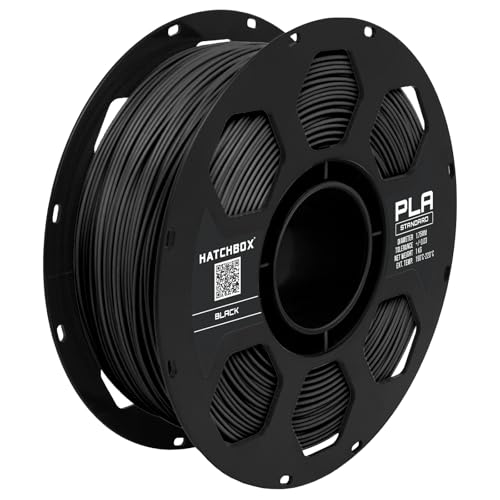
1. HATCHBOX 1.75mm Black PLA Filament (1 KG)
Our pick — over 4.5★ from 40,500+ verified ratings; the strongest balance of quality and price.
The crowd-favorite workhorse that has earned its reputation one spool at a time.
With over 40,000 ratings behind it, this is the spool beginners and veterans alike reach for first. The recommended nozzle temperature sits between 180°C and 210°C, and the filament is advertised as clog-free, bubble-free, and tangle-free — a promise the community has largely found to be true. Each spool is vacuum-sealed with desiccant to keep moisture out, so you can pull it from the start and start printing without drying first. At ±0.03mm diameter tolerance, it is slightly wider than the premium ±0.02mm standard, but in practice it prints cleanly on everything from an Ender 3 to a Bambu P1S. The crowd is so loyal that one owner reports buying over a dozen spools before a single one had a winding issue.
What truly sets HATCHBOX apart is its availability across a vast range of colours — buyers praise the colour consistency, noting that the True Blue, for example, delivers vibrant prints every time with solid bed adhesion and clean layer lines. The recurring minor gripe is adhesion, which some find inconsistent depending on their printer and settings. The spool design also does not naturally fit the Bambu Labs A1 AMS Lite without a printed adapter, but that is a minor hurdle for a spool that otherwise delivers flawless results.
The Winning Formula
- Proven reliability — the most-reviewed spool on the market with a 4.7-star consensus across tens of thousands of owners.
- Vacuum-sealed with desiccant means no pre-drying needed for standard PLA prints.
- Wide temperature range (180-210°C) works with virtually any FDM printer without tweaking.
The Fine Print
- Adhesion can vary between printers; a brim or glue stick helps when first dialling it in.
- Spool does not natively fit the Bambu Labs A1 AMS Lite — you will need a 3D-printed adapter.
Your go-to if: you want a spool that has been battle-tested by hundreds of thousands of prints and simply works across the widest range of printers.
Look elsewhere if: you need ultratight ±0.02mm tolerance for high-speed production or you exclusively use an AMS Lite without adapters.
2. Polymaker Panchroma Matte PLA Filament Refill (Army Dark Green)
A spoolless refill that cuts waste while delivering a premium matte finish.
This refill comes without a disposable spool, so you load it into a reusable spool of your own — a design that reduces plastic waste and saves storage space. The ±0.02mm diameter tolerance is tighter than HATCHBOX’s allowed spec, and it supports print speeds up to 300mm/s, making it a strong candidate for modern high-speed printers. The recommended nozzle temperature is 190-230°C with a bed temp of 25-60°C. Buyers report that it works flawlessly with the Bambu P1S AMS, delivering no clogs, perfect bed adhesion, and consistent quality straight from the vacuum-sealed nylon bag.
The matte finish here is the real draw. It softens visible layer lines so your models look almost injection-moulded rather than printed. One owner noted that the colour distribution is even across the entire roll, and the subtle lack of sheen gives display models a more refined look. Tangle-free winding is hit-or-miss though — while many report smooth feeding, a minority have had the filament knot from the start, so inspect the spool before loading. It is also note that the spoolless format requires you to own a compatible reusable spool (like Bambu Lab’s), so it is not for someone who wants a ready-to-go spool from the start.
Matte magic: the low-sheen finish softens layer lines so effectively that you will want to use it for every display model. One catch: occasional winding inconsistencies mean you should check the roll before committing to a long print.
Reach for this if: you want a premium matte surface without post-processing and you already have a reusable spool system.
skip it if: you need a traditional ready-to-go spool or you are not comfortable dealing with occasional winding quirks.
3. LANDU Silk Tri-Color PLA Filament (1.75mm, Red Blue Green)
Three colours in one filament for a shimmering rainbow effect straight off the bed.
This silky spool combines red, blue, and green into a single 1.75mm strand, so every print shifts colour as it layers up. The ±0.02mm diameter tolerance is the same tight spec as premium filaments, and owners mention the silk finish gives the model a polished look without sanding or coating. The nozzle temperature range is not explicitly listed in the product data, but the consensus from owners is that it prints well on an Ender 3 V3 KE without much stringing, with the caveat that the tri-color material is a little brittle compared to standard PLA. The silk surface does reduce layer adhesion strength, so do not use this for functional parts that take a load.
The triple-colour gradient is what wins people over — it creates a smooth, eye-catching transition that looks different from every angle. One owner described it as “striking prints” without any setting adjustments. The compatibility with Bambu AMS is mixed, so if you have a multi-material system, test a short print first. Overall, for decorative vases, dragons, and fidget toys, the colour payoff is tough to top.
The showstopper: the rainbow gradient requires zero post-processing — your part comes off the bed looking like a polished art piece. The trade-off: the silk formula is more brittle than standard PLA, so skip it for anything that needs to flex or bear weight.
Perfect for: decorative models, fidget toys, and display pieces where colour is the star.
Not for: functional parts, hinges, or anything that requires impact resistance.
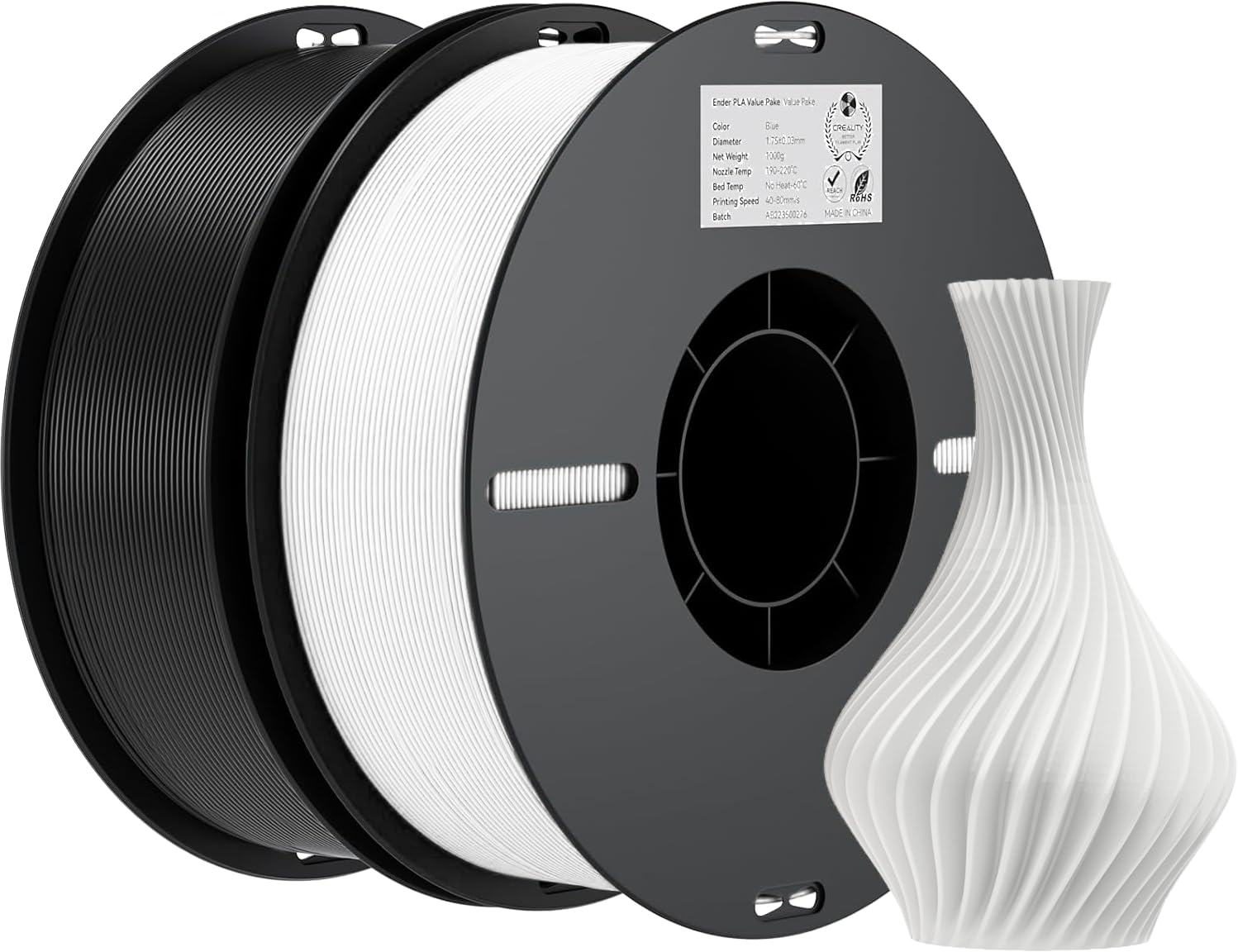
4. Creality PLA Filament Bundle 2KG (White & Black)
Two kilos of reliable filament for the price of one premium spool.
This bundle gives you a black and a white 1kg spool, both with a ±0.02mm tolerance — the same precision as high-end filaments but at a per-kilo cost that undercuts most competitors. The Creality Ender PLA formula is designed to print without warping and with low shrinkage, using high-purity raw materials that the company says are free of impurities to prevent clogging. Owners confirm that the white PLA prints cleanly and consistently, with good dimensional accuracy, no clogging, and strong layer adhesion. The neat EPC automatic winding keeps the line tidy, so tangle issues are rarer than with some budget spools.
The real strength here is the value-to-reliability ratio. In the data, the quality and print quality are the top positive aspects by a wide margin. Buyers have used it for large projects — one owner ran through two full rolls on a Mandalorian armour project without a single filament issue. The catch is the occasional tangle, which a small minority of customers note, so check the first few layers. But for the price of two spools that match the accuracy of much pricier brands, this is a strong choice for heavy-volume printing.
Why It Wins
- Two 1kg spools at a per-kilo price that is tough to top — ideal for large projects or learning.
- ±0.02mm tolerance matches premium spools, so you get consistent prints without premium cost.
- Creative’s own printer compatibility means it is tuned for Ender and CR series from the start.
The One Watch-Out
- Occasional tangling reported — inspect the spool before long prints and consider printing a filament guide.
Grab this for: high-volume projects where you need two kilos of reliable, precise filament without spending a fortune.
Think twice if: you need a specific colour beyond black and white, or you have had bad experiences with budget spool winding.
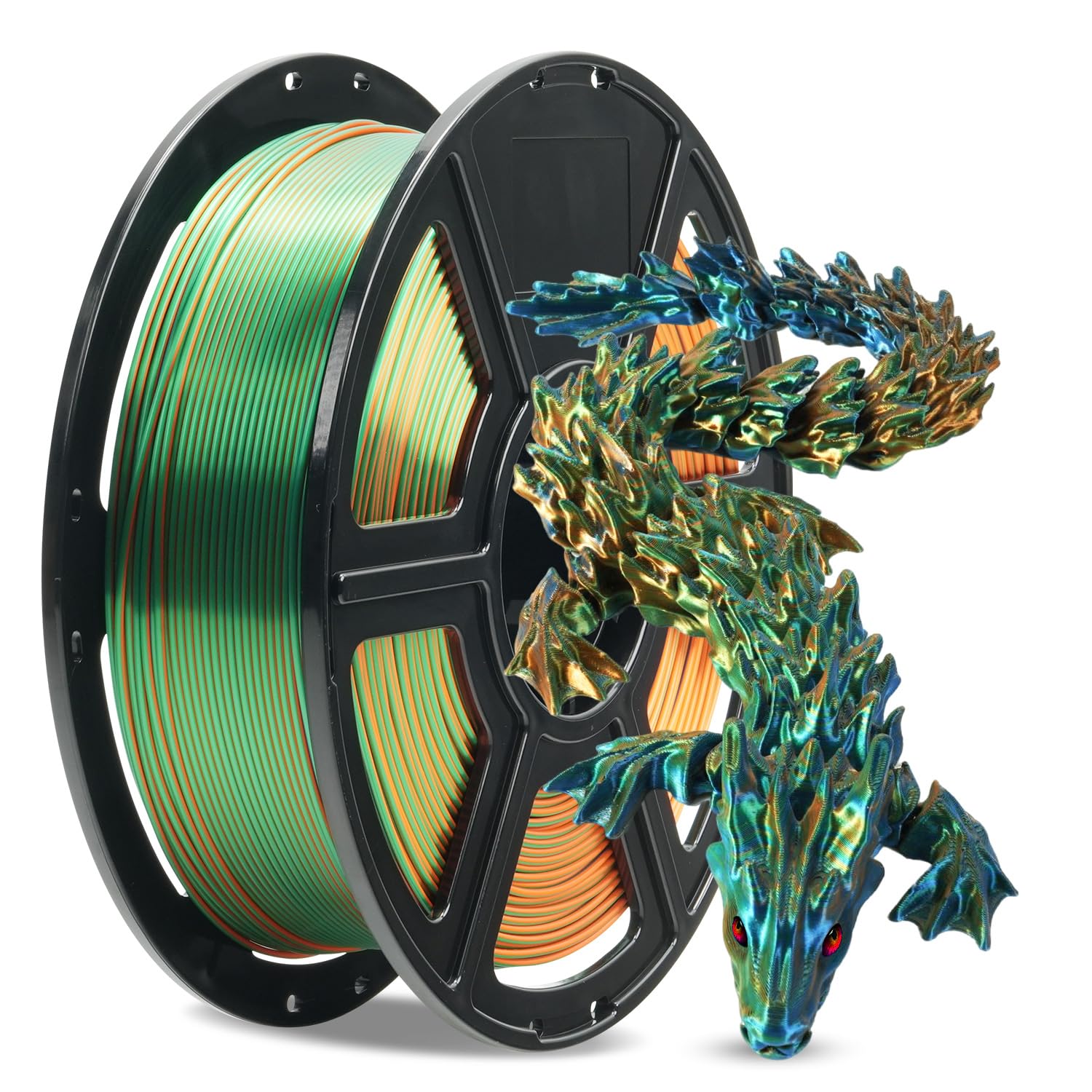
5. FLASHFORGE Silk Tri-Color PLA Filament (Orange, Green, Blue)
Vibrant colour-shift prints that look like they were painted, not printed.
FLASHFORGE’s coextrusion process blends orange, green, and blue into a single strand that shifts colour depending on the viewing angle. The filament is manufactured using clog-resistant methods, dried for 24 hours before packaging, and vacuum-sealed with desiccant. One owner reported flawless prints at 200mm/s on an Ender 3 V3, with no breaks and a beautiful, shiny finish. The filament quality and colour are the two most praised aspects in the review data, with buyers noting that the glossy finish makes small prints pop in a way standard PLA cannot.
Unlike the LANDU tri-color, this FLASHFORGE spool has a tougher formula that is less brittle, making it suitable for parts that see some handling. The downside is that colours vary per print depending on how the filament enters the extruder — you may get a dominant green on one model and orange on another, which is part of the charm for decorative work but frustrating if you want repeatable colour placement. The material is also more sensitive to moisture than standard PLA, so keep it in a dry box or sealed bag when not printing.
The visual payoff: the 360° colour shift means no two prints look identical — great for custom gifts or art pieces. The reality check: moisture sensitivity means this filament demands better storage than standard PLA; a dry box is strongly recommended.
Choose this for: display models, fidget toys, and custom gifts where the random colour shift adds character.
pass on it if: you need consistent colour placement across multiple prints or you lack a dry storage setup.
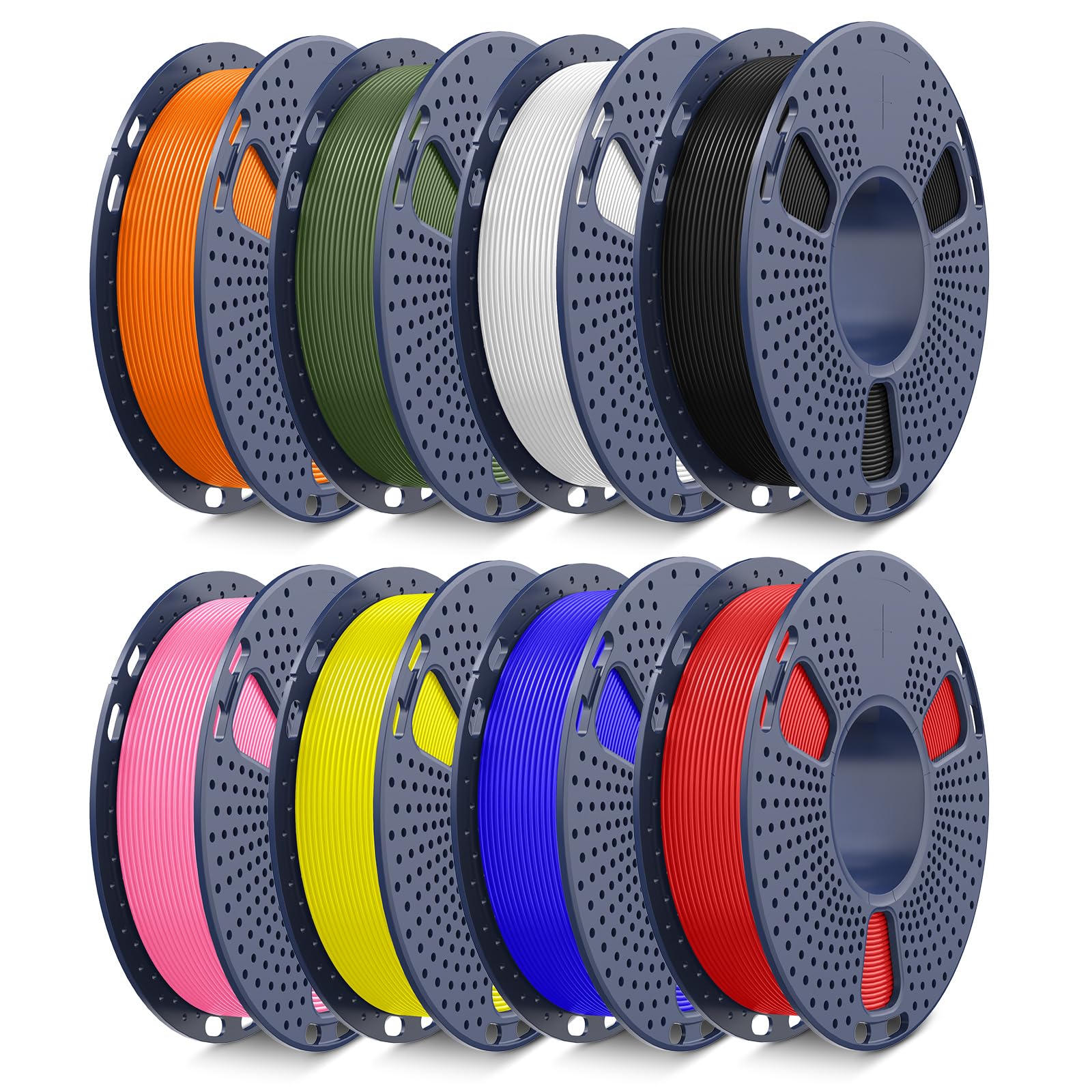
6. JAYO Rapid PLA Filament Bundle 2KG (8 x 250g Spools)
Eight small spools of high-speed PLA for sampling and multi-colour projects.
This bundle includes eight 250g spools in black, white, blue, red, pink, orange, yellow, and olive green. The standout spec is the print speed range of 50-600mm/s — the enhanced fluidity lets the filament melt and flow quickly without sacrificing layer adhesion. The ±0.02mm tolerance ensures consistent extrusion even at high speeds. The review data shows that quality and print quality are the top positive aspects, with owners reporting clean results at speeds up to 350mm/s and appreciating the vibrant colours. The quick-cooling properties are explicitly designed to minimise sagging on overhangs at high speeds.
Where this bundle falls short is the winding and durability. The data notes that tangling is the most-discussed negative aspect — some reviewers point out significant tangling issues and durability concerns, with one noting the filament kept breaking in the extruder. The small 250g spool size also means you will swap colours frequently, which is fine for sampling but not ideal for a large single-colour project. For the price, this is a great way to test high-speed printing across eight colours before committing to full-size spools.
The Speed Edge
- Rated for 50-600mm/s — verified by owners at 350mm/s with good results for a budget high-speed spool.
- Eight colours in one bundle gives you a wide palette without buying individual full-size spools.
The Trade-Off
- Tangling and brittleness are the most-cited complaints; inspect each spool before a long high-speed print.
- Small 250g spools run out fast on large projects — plan for mid-print swaps or stick to sample-sized models.
Ideal for: testing high-speed printing across multiple colours without buying full 1kg spools of each.
Not for: reliability-focused production runs — the tangle and breakage risk is too high for mission-critical prints.
7. SUNLU PLA Filament Bundle 8-Roll (250g each)
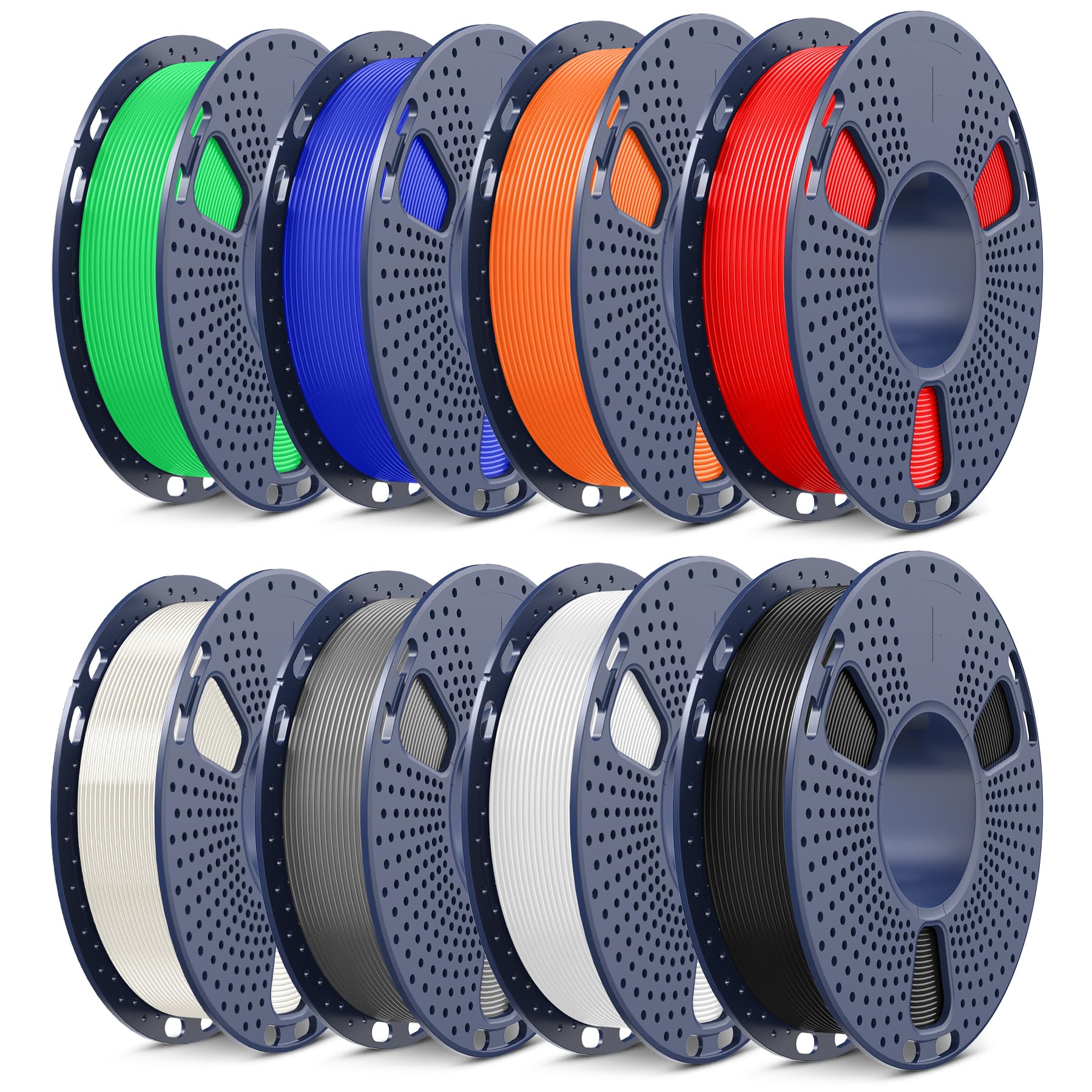
A rainbow of 250g spools that makes experimenting with colors affordable.
This bundle gives you eight 250g spools: black, white, grey, transparent, red, Klein blue, sunny orange, and green. The spool diameter is 140mm with a 53mm hub hole, and SUNLU explicitly notes that you can print a 250g spool adapter from Makerworld to make it compatible with AMS. The ±0.02mm tolerance and recommended nozzle temperature of 200-210°C with a bed temp of 50-65°C make it a standard PLA that works on virtually any FDM printer. The review data highlights quality and colour variety as the top positive aspects, with owners reporting smooth, consistent printing and professional results.
The value here is clear: for the price of two standard 1kg spools, you get eight colours to play with. The spool size is the most-cited negative — at 250g each, they run out fast for anything bigger than a small figurine or a batch of keychains. Some owners also report constant tangling, so again, check the winding before you start. But for someone who wants to test colours without buying full-size spools, the SUNLU bundle is a smart entry point.
The colour playground: eight distinct colours in one box lets you test match colours for models without committing to a full kilo. The reality check: 250g per spool means you will burn through them quickly on medium-sized prints — plan accordingly.
Best for: beginners, colour sampling, and small decorative projects where variety matters more than volume.
Not ideal for: large single-colour prints or production runs where running out mid-print would be a problem.
8. ELEGOO PLA Filament 1.75mm Black 4KG (4 x 1kg)
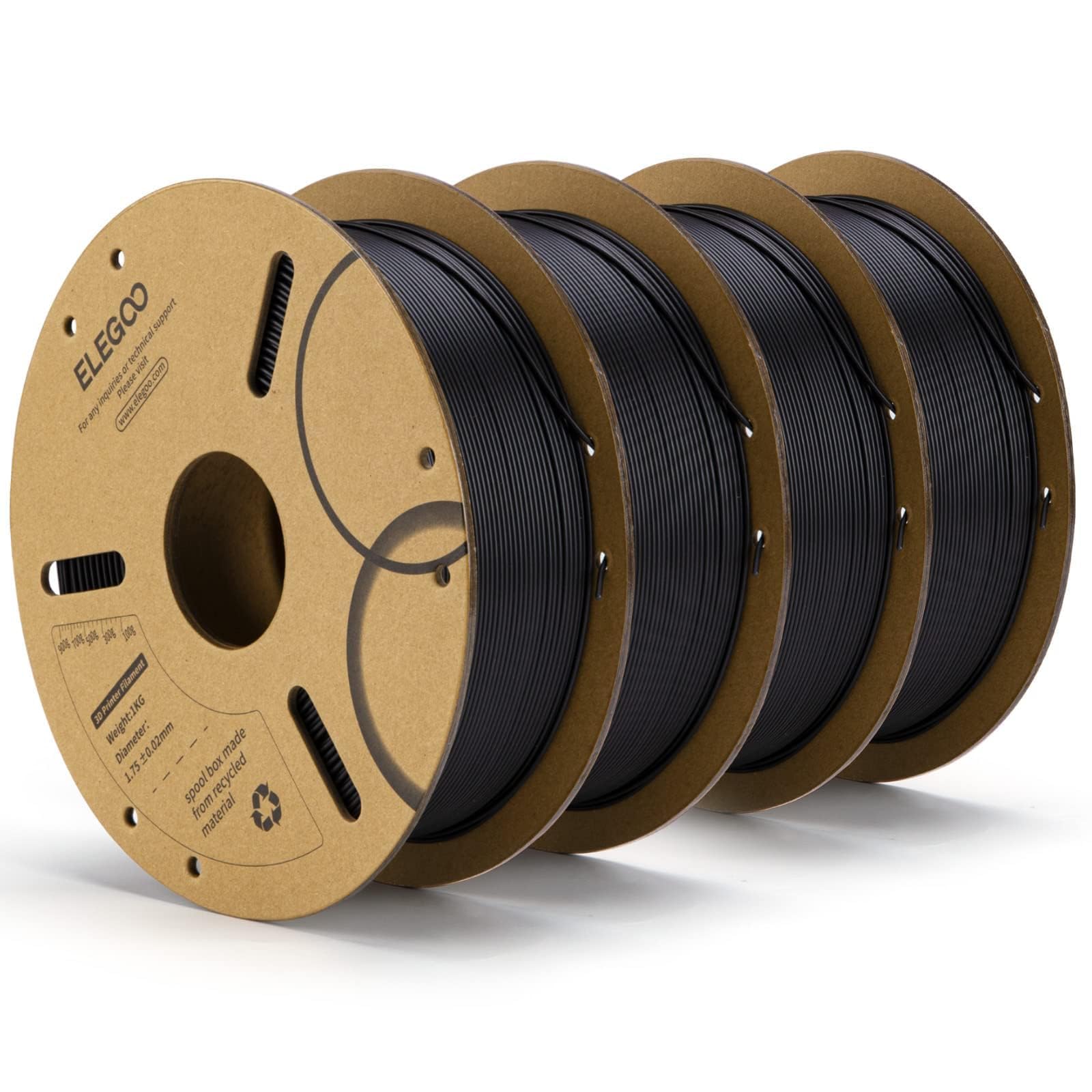
Four kilos of black PLA that delivers consistent prints at a bulk price.
If you print a lot of black parts — prototypes, connectors, enclosures — this 4-pack is the most cost-effective way to stock up. Each 1kg spool comes on a cardboard spool with a ±0.02mm tolerance, and ELEGOO says they use full mechanical winding with manual checks to minimise tangles. The review data confirms that quality, print quality, and value for money are the top three positive aspects. One owner ran this across a Neptune 3 Pro, a Centari Carbon, and an Ender 3 Pro without any clogs or adhesion issues. The 4-pack is shrink-wrapped individually with anti-moisture packets, so you do not need to dry them before use unless they have been sitting open for weeks.
The catch is that tangling is the most-cited negative — about one in five spools has minor tangling, according to the feedback. Adhesion and clogging get mixed reactions, with some owners getting perfect results and others reporting occasional issues. The cardboard spool can also cause friction in some enclosed AMS systems. But for the price per kilo, the reliability is solid for a bulk black filament, especially if you have a printer with a standard spool holder.
The Bulk Advantage
- Four full 1kg spools of black PLA at a price that works out significantly less per kilo than single spools.
- Consistent 1.75mm thickness across multiple printers with no clogs reported by long-term users.
The Catch
- Tangling on roughly one in five spools — not a dealbreaker, but check the spool before starting a long print.
- Cardboard spool can create friction in some AMS systems; a spool adapter may be needed for smooth feeding.
Stock up on this if: you go through black PLA quickly for prototypes, functional parts, or production runs and want the best per-kilo price.
Look elsewhere if: you need a variety of colours, or you exclusively use an AMS system that demands plastic spools.
9. Creality Hyper RFID PLA Filament 4-Pack (Black, White, Red, Blue)
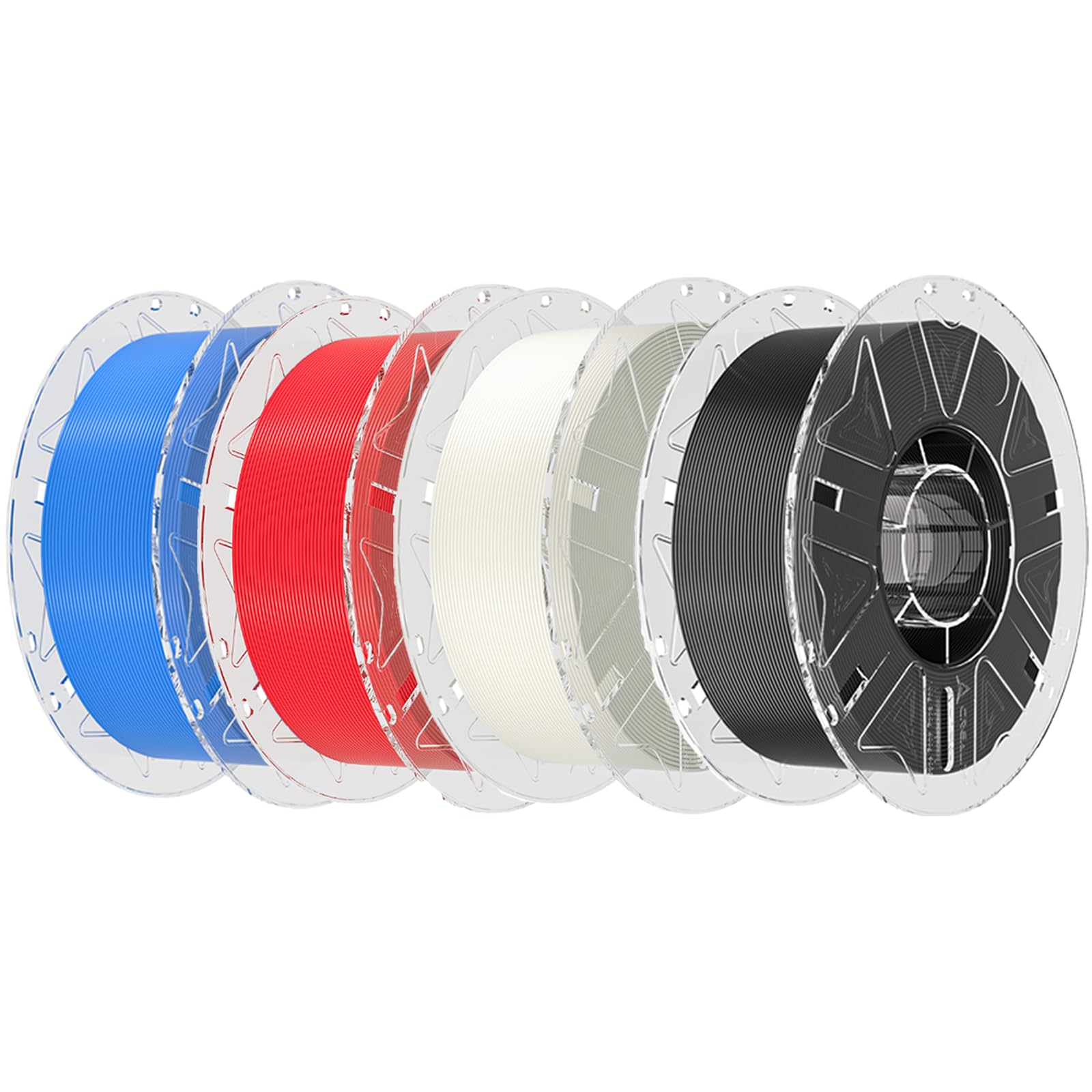
RFID-equipped spools that auto-configure your Creality printer for zero-fuss high-speed prints.
Each spool in this 4-pack has an RFID tag that the Creality CFS reads automatically, setting the correct temperature and speed profiles without manual input. The filament supports print speeds from 30mm/s up to 600mm/s, and the ±0.03mm tolerance is slightly wider than the premium ±0.02mm but still adequate for high-speed production. The data notes that the filament is stronger and more flexible than traditional PLA, with tensile strength higher than ABS — a rare claim for a PLA-based material. Owners confirm that the RFID auto-configuration works well on the K2 Plus, and the consistent prints across an entire spool have made it a repeat purchase for many.
The filament quality and performance are the top praised aspects, with buyers appreciating that the prints come out beautiful with very little clean-up and no clogging. The spool is neatly wound to reduce tangling — a clear improvement over some of the budget bundles. The one trade-off is the price, which sits at the premium end of the list, and the RFID (radio-frequency identification) functionality only works with Creality CFS systems, so if you have a different printer brand, you are paying for a feature you cannot use.
The smart advantage: RFID detection means no hunting for the right temperature profile — load and print. The limitation: the smart feature only works with Creality’s CFS; it is a standard high-speed spool otherwise.
Buy this for: a Creality K2 Plus or Hi Combo printer where RFID auto-config saves time and prevents waste.
it’s not for you if: you use a non-Creality printer — the RFID feature is locked to Creality’s ecosystem, and the standard spool costs more than comparable high-speed alternatives.
Understanding the Specs
Diameter Tolerance (± mm)
This number tells you how much the filament’s thickness varies along its length. A spec of ±0.02mm means the diameter stays within 1.73mm and 1.77mm. Tighter tolerance means more consistent extrusion, which translates to fewer layer inconsistencies, blobs, and under-extrusion. For high-speed printing, tight tolerance is even more critical because the filament is moving faster through the hot end, so any variation is magnified.
Print Speed Range (mm/s)
Standard PLA prints well between 50-100mm/s. High-speed PLA (often labelled “Rapid” or “Hyper”) uses modified polymer blends that flow more easily, letting you print at 300-600mm/s while maintaining layer adhesion. The trade-off is that high-speed filament is often more sensitive to cooling fan settings and may require more precise temperature tuning to avoid stringing at the top end of the speed range.
FAQ
What does ±0.02mm diameter tolerance mean for my prints?
Can I use high-speed PLA on a standard speed printer?
How important is vacuum-sealed packaging for PLA?
What is the difference between silk PLA and standard PLA?
Do I need a heated bed for PLA filament?
Will a 250g spool work for a full-sized helmet or large prop?
What printer settings should I start with for a new spool of PLA?
How do I fix a tangle on a spool mid-print?
Is PLA food safe for printing cookie cutters or kitchen tools?
What does RFID-enabled filament do?
Final Thoughts: The Verdict
For most people, the 3d print filament winner is the HATCHBOX Black PLA because its track record across over 40,000 owners is class-leading — it simply works on almost any printer with minimal tuning. If you want a premium matte finish for display models, grab the Polymaker Panchroma Matte PLA Refill. And for bulk black printing on a budget, the ELEGOO PLA 4-Pack is the one to reach for. The most common thread across every top pick is tight diameter tolerance and neat winding — these two specs matter more than any other for consistent, frustration-free prints.
How We Picked
We do not accept paid placement. Every pick is matched to a real buyer and a real use-case; we do not hands-on test units.
Sources & Methodology
Specifications: manufacturer listings and product documentation. Review insights: verified customer reviews, as of July 2026. Pricing: not shown on this page (it changes often); check the current price via the retailer link.
As an Amazon Associate, Gadgets Feed earns from qualifying purchases. This does not affect which products we feature.