
Whether you are fighting humidity-induced stringing on a PLA spool or hunting for a photopolymer resin that won’t shatter during support removal, the wrong supply can turn a promising print into a failed heap of wasted material. Every gram of filament or milliliter of resin you feed into your machine carries a measurable impact on layer adhesion, dimensional accuracy, and final part strength — so choosing the right consumables is the single most consequential decision you make as a maker.
I’m Min — the co-founder and writer behind Gadgets Feed. After analyzing dozens of technical datasheets, user-verified print logs, and real-world durability benchmarks across filaments, resins, and storage systems, I’ve zeroed in on the supplies that consistently deliver reliable results without forcing you to overpay for marketing claims.
This guide breaks down the top consumables and accessories that earned a spot through measurable consistency, so you can confidently stack your cart with the best 3d print supplies for your specific machine and material workflow.
How To Choose The Best 3D Print Supplies
The 3D printing supply ecosystem splits into three distinct lanes: spooled filament for FDM printers, liquid photopolymer resin for MSLA/DLP machines, and the storage accessories that keep both materials workable. Each lane has its own critical spec, and mixing them up guarantees frustration.
Dimensional Tolerance — The Precision Floor
For 1.75mm filament, the tolerance window your spool advertises (typically ±0.02mm to ±0.05mm) dictates whether your extruder sees consistent volumetric flow or random under-extrusion. A ±0.03mm rating is the practical sweet spot — tight enough for Bowden setups yet forgiving enough for direct-drive systems. Resin, by contrast, is defined by shrinkage rate; anything above 3-4% linear shrinkage will throw off hole diameters and press-fit tolerances.
Mechanical Resilience — Beyond Basic Strength
Standard PLA snaps under repeated bending, which is why modified PLA+ variants with elastomer additives matter for functional parts. In the resin world, elongation-at-break (measured as a percentage increase over the original length) separates brittle display-only models from parts that survive a drop onto concrete. Look for resins advertising over 80% improvement in this metric over standard material.
Moisture Management — The Invisible Variable
Filament absorbs atmospheric water even during a single overnight pause; hygroscopic materials like nylon and TPU can become unprintable within hours at 50% relative humidity. A storage solution that maintains a sealed sub-20% RH environment — verified by an integrated hygrometer — is worth more than a dryer unit you only run before each job. For resin, the concern is UV contamination and VOC leakage rather than moisture, so opaque, leak-proof bottles are the priority.
Quick Comparison
On smaller screens, swipe sideways to see the full table.
| Model | Category | Best For | Key Spec | Amazon |
|---|---|---|---|---|
| Creality Rainbow PLA+ | Filament | Multi-color FDM prints without swapping spools | ±0.02mm dimensional accuracy | Amazon |
| YOOPAI Storage Box 4-Pack | Storage | Budget-friendly multi-spool humidity protection | 4.0L per box / 8x50g desiccant included | Amazon |
| ANYCUBIC ABS-Like Resin Pro 2 | Resin | Tough functional prototype parts with low odor | 100%+ elongation-at-break increase | Amazon |
| Polymaker PolyDryer Box | Storage | Airtight feed-while-stored dry environment | Built-in hygrometer / sealed PTFE pass-through | Amazon |
| ELEGOO ABS-Like Resin 3.0+ | Resin | High heat deflection and impact resistance | Heat deflection up to 55°C / 10% higher than V3.0 | Amazon |
| Creality 74-Piece Tool Kit | Tool Kit | All-in-one maintenance set for FDM printers | 34 Cr-V steel bits + 10×0.38mm nozzle needles | Amazon |
| ANYCUBIC High Clear Resin | Resin | Transparent optical models with minimal yellowing | Resist-yellowing formula / 100% resilience increase | Amazon |
In‑Depth Reviews
1. Creality Rainbow PLA+

Creality’s Rainbow PLA+ hits the ideal convergence of visual payoff and mechanical reliability for FDM users who want multi-color effects without a multi-material upgrade. The filament is vacuum-sealed with desiccant and pre-dried for 24 hours before packing, which directly addresses the moisture-related stringing that plagues budget rainbow alternatives. Dimensional tolerance is rated at ±0.02mm, placing it in the top tier for consistent volumetric extrusion on Bowden and direct-drive setups alike.
The PLA+ formulation adds enough elastomeric flex to survive repeated bending without snapping — a notable upgrade over standard PLA that tends to crack under layer-shear stress. Users report that the color transitions are gradual, spanning several centimeters of print height, which means smaller models may only show a single hue. For larger functional or decorative pieces, though, the gradient delivers a smooth rainbow fade that single-extruder systems cannot replicate otherwise.
Print behavior is consistently clean: minimal stringing at 200-210°C, strong bed adhesion on smooth PEI sheets, and layer bonding that holds up under moderate torsional load. The 1kg spool is compatible with most common filament runout sensors, and the cardboard spool core reduces plastic waste. This is the filament to stock when you need aesthetic range without compromising the toughness your functional parts demand.
Why it’s great
- Excellent ±0.02mm diameter consistency prevents under-extrusion and blobbing
- PLA+ blend provides genuine flex resistance compared to basic PLA
- Pre-dried and vacuum-sealed packaging eliminates first-print moisture issues
Good to know
- Color-transition distance is long — small single-color prints may not show the gradient
- Rainbow cycle leans heavily on pink tones before moving through the spectrum
2. YOOPAI Storage Box 4-Pack
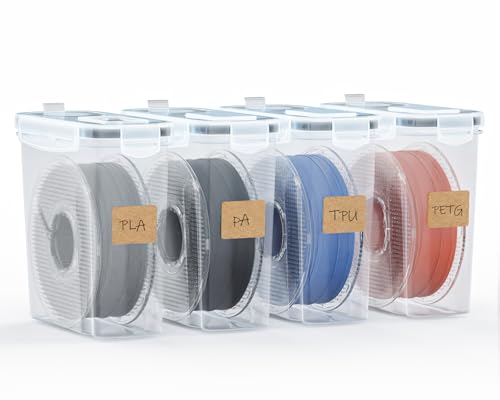
YOOPAI’s 4-pack of storage boxes solves the everyday filament humidity problem at a per-unit cost that makes it trivial to outfit your entire filament library. Each box holds a standard 1kg spool with enough headroom for the included 50g desiccant packets plus an optional roller or PTFE guide. The silicone-sealed flip lid and clear polypropylene body let you visually identify material type without breaking the seal, a small workflow detail that saves time when you have multiple active spools.
The kit ships with 8×50g desiccant packets and 18 identification labels, so there is nothing extra to buy before you can start organizing. Users report that the seal maintains sub-30% relative humidity for weeks in average indoor environments (40-60% ambient RH), which is sufficient for PLA, PETG, and ABS. For highly hygroscopic materials like nylon or TPU, you will want to supplement with rechargeable desiccant beads, but the included packets are adequate for standard filament storage.
Build quality is sturdy enough for workshop stacking — several users confirmed that six boxes fit neatly on a standard 30-inch bookshelf. The only notable design compromise is the large lid hole for filament pass-through, which defeats the seal if left uncapped. A small silicone grommet or printed plug solves this cheaply. For the price, this is the most practical entry into proper filament storage hygiene.
Why it’s great
- Sub- per box delivers 4.0L of airtight storage with desiccant included
- Transparent body and labels make material identification immediate
- Sturdy construction handles workshop stacking without deforming
Good to know
- Large lid hole bypasses the seal if not capped during passive storage
- Desiccant packets are basic silica — upgrade to color-indicating beads for monitoring
3. ANYCUBIC ABS-Like Resin Pro 2
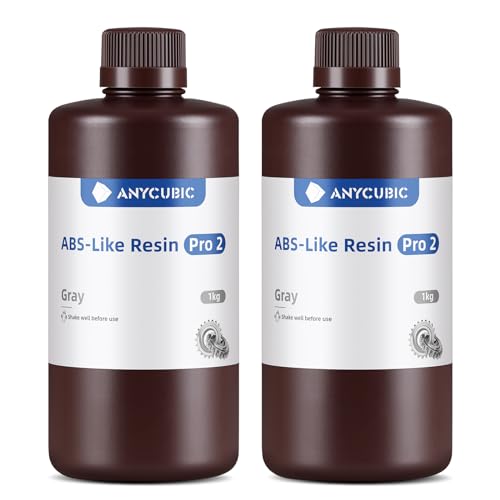
Anycubic’s ABS-Like Resin Pro 2 is the photopolymer equivalent of upgrading from a brittle plastic to an engineering-grade material. The headline improvement is a doubling of elongation-at-break compared to the previous Pro formula, which translates into printed parts that survive being dropped from workbench height without shattering. For functional prototypes, jigs, and fixtures, this toughness margin is the difference between a reusable part and a one-time test piece.
Viscosity is noticeably lower than standard ABS-like resins, allowing faster resin reflow between layers and reducing peel forces that cause delamination on large cross-sections. Users on Anycubic Photon M3 Max and Elegoo Saturn platforms report virtually zero failed prints once exposure settings are dialed in — typically 2.35-2.4 seconds per layer at 0.05mm. The low-odor formula is genuine; while no resin is scent-free, this version causes far less eye and throat irritation during multi-hour print sessions in unventilated spaces.
The 2kg bottle with leak-proof cap and tamper-evident seal provides good value on a per-gram basis. Post-processing with IPA is straightforward, and cured parts sand smoothly without the chalky dust common to standard resins. If your resin workflow demands strength over sheer detail density, this is the most balanced option on the current market.
Why it’s great
- 100%+ increase in elongation-at-break delivers genuine impact resistance
- Low viscosity enables fast layer curing with minimal delamination risk
- Low-odor formula improves workshop air quality during long prints
Good to know
- Requires a heater to maintain optimal viscosity in cold shops (below 20°C)
- Delivery date may slip from advertised next-day to several days out
4. Polymaker PolyDryer Box
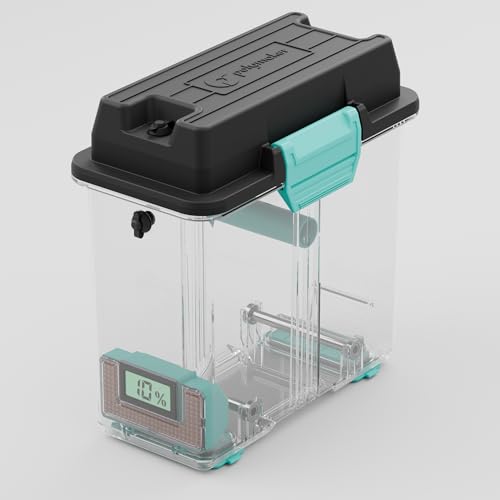
Polymaker’s PolyDryer Box is the reference design for passive filament storage that doubles as an active dry-while-print solution. The key differentiator from generic cereal containers is the integrated hygrometer mounted on the lid, giving you real-time relative humidity data without opening the seal. Users consistently report that this box holds 15-20% RH for over two months with the included desiccant, which is well within the safe zone for even the most hygroscopic materials like nylon and PVB.
The box is engineered for direct printing — a PTFE pass-through port and internal spool mounting bar let the filament feed into the extruder while the lid stays sealed. This is a major workflow advantage over storage-only bins, which force you to break the seal every time you start a print, re-exposing the filament to ambient moisture. The gaskets are robust rubber, the latches are secure metal clips, and the lid hinges are reinforced to survive repeated daily opening.
Compatibility spans 1.75mm, 2.85mm, and 3.00mm filament diameters, and the internal dimensions accept all standard 1kg spools including the wider Polymaker cardboard spools. The only downside is that this is the storage box only — the separate PolyDryer heating dock is sold separately (and is louder than most users expect). As a standalone storage unit, this is the best option for makers who print from the same spool over multiple sessions.
Why it’s great
- Built-in hygrometer provides verifiable sub-20% RH storage conditions
- Print-through design eliminates moisture exposure during multi-session jobs
- Robust gaskets and metal latches maintain seal integrity over months
Good to know
- Dock not included — this is the storage box only, not a heated dryer
- No rear pass-through port; front-only exit limits placement options
5. ELEGOO ABS-Like Resin 3.0+
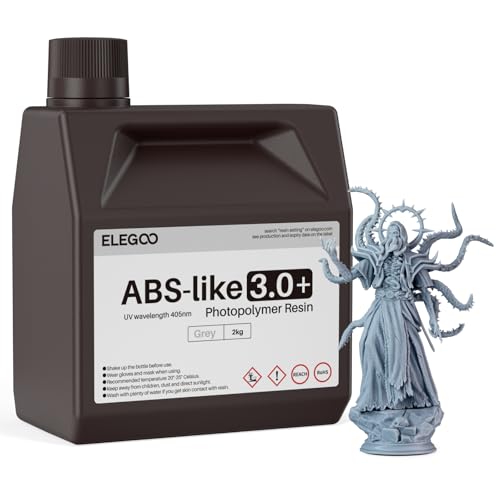
Elegoo’s ABS-Like Resin 3.0+ sets a new baseline for thermal performance in consumer photopolymers, with a heat deflection temperature of 55°C — roughly 10% higher than the previous 3.0 version. This matters for functional parts exposed to sunlight, warm enclosures, or post-processing heat guns: the model maintains its dimensional shape rather than softening and deforming under load. For engineering prototypes and enclosures, this thermal headroom is a genuine competitive advantage over standard ABS-like resins.
Print behavior is exceptionally fast for an impact-resistant material. Recommended exposure times for 405nm LCD printers sit around 1.8-2.2 seconds per layer at 0.05mm, which is on par with standard casting resins while delivering significantly better toughness. The cured parts can be drilled and tapped without cracking — a property that reviewers consistently confirmed, even on thin-walled sections as narrow as 2mm. Surface finish is smooth with nearly invisible layer lines at 0.05mm, and the opaque gray color masks minor surface imperfections that would be glaring on black or white resins.
The low-viscosity formula cleans up quickly with IPA and produces less residue in the wash station than thicker resins. Odor is noticeably reduced compared to earlier Elegoo formulations, though still present enough to require ventilation. If your print queue includes parts that must survive mechanical stress and elevated temperatures, this is the resin to reach for.
Why it’s great
- 55°C heat deflection allows functional use in warm environments
- Fast 1.8-2.2s layer cure time for a tough, impact-resistant material
- Can be drilled and tapped without cracking — genuine engineering-grade behavior
Good to know
- Still brittle compared to nylon-based materials; not suitable for high-flex applications
- Requires thorough IPA washing to avoid surface frosting from uncured residue
6. Creality 74-Piece Tool Kit

The Creality 74-Piece Tool Kit consolidates everything you need for printer maintenance and post-processing into a single organized case — a convenience that saves the cumulative time of hunting for individual wrenches, cutters, and scrapers across your workshop. The core tool complement includes 34 chromium-vanadium steel screwdriver bits, a 1.5mm nozzle cleaning needle, and 10×0.38mm finer needles for clearing stubborn clogs in small-orifice nozzles. The screwdriver handle includes a 100mm extension rod and universal swivel joint for reaching tight extruder and hotend fasteners.
The kit is weighted toward FDM maintenance rather than resin post-processing, though the included deburring tool, engraving knife with five replacement blades, and set of three files cover most support-removal and surface-finishing tasks. The chamfer knife’s 360° rotatable blade is particularly useful for cleaning up brim edges and elephant-foot artifacts on first layers. Pliers, tweezers, and a nipper handle filament trimming and support clipping without requiring separate purchases.
Build quality holds up to daily use: the magnetic mat keeps small screws organized during hotend swaps, and the zippered wrap case keeps everything in its designated slot. Some users note that the case stitching may show wear after heavy workshop use, but the tools themselves exceed what you would expect at this price point. For anyone setting up their first FDM printer, this kit eliminates the frustrating “I need a 7mm socket but only have a 6mm and 8mm” moment.
Why it’s great
- 34 Cr-V steel screwdriver bits cover every common fastener on FDM printers
- 10×0.38mm nozzle cleaning needles handle clogs in 0.4mm and smaller nozzles
- Organized wrap case with magnetic mat prevents lost screws during maintenance
Good to know
- Case stitching may show wear over time with heavy workshop use
- Geared toward FDM — resin users will need additional silicone spatulas and gloves
7. ANYCUBIC High Clear Resin

Anycubic’s High Clear Resin is formulated to solve the two frustrations that plague transparent photopolymer prints: yellowing over time and brittle fracture along layer lines. The anti-yellowing chemistry keeps printed models optically clear for extended indoor display — a property that standard clear resins lose within weeks under UV exposure or even indirect sunlight. For lens housings, microfluidics, decorative crystals, and light-pipe components, this longevity makes the difference between a showcase piece and a disposable prototype.
The 100% increase in resilience over Anycubic’s standard clear resin means these prints flex before they break, an important trait for press-fit assemblies or parts that need to survive shipping. The trade-off is print speed: this resin requires higher exposure times than the company’s Standard or ABS-Like lines. Users report that at 0.05mm layer height, exposures in the 2.8-3.2 second range are necessary to achieve full interlayer bonding; dropping below that causes delamination and warping. At 0.03mm, even higher times are needed, which extends print duration by 30-40%.
Post-processing requires an extra step for best optical results: after alcohol washing and support removal, a thin brush-on coat of the same uncured resin, followed by two minutes of UV curing, fills micro-scratches and restores full transparency. Without this step, the surface appears frosted. The low-odor formula is noticeably less irritating during printing than standard resins, though the alcohol wash stage does release a brief VOC spike. If crystal-clear output is your endgame, this resin delivers results that match more expensive engineering-grade optical materials.
Why it’s great
- Resist-yellowing chemistry maintains optical clarity months after curing
- 100% resilience improvement over standard clear resin reduces breakage risk
- Low-odor formulation makes multi-hour prints more tolerable indoors
Good to know
- Requires higher exposure times (2.8-3.2s) than standard Anycubic resins
- Best optical clarity requires a post-cure resin coat — adds an extra step
FAQ
Can I store PLA and PETG in the same humidity-controlled box?
What is the safe temperature range for ABS-like resin during printing?
How often should I replace desiccant in a sealed filament box?
Final Thoughts: The Verdict
For most users, the best 3d print supplies winner is the Creality Rainbow PLA+ because it combines premium dimensional tolerance with genuine toughness at a price that makes it a practical everyday workhorse. If you need impact-resistant resin for functional prototypes, grab the ANYCUBIC ABS-Like Resin Pro 2. And for keeping your entire filament library dry without breaking the bank, nothing beats the YOOPAI Storage Box 4-Pack.