
The distinction between a drone that flies like a dream and one that shatters on the first hard landing often comes down to the frame. A 3D printed drone frame isn’t just a chassis—it’s the skeleton that dictates flight characteristics, vibration dampening, and crash survivability. For hobbyists building their own quadcopter, selecting the right carbon fiber or composite frame is the single most consequential decision of the entire build process.
I’m Min — the co-founder and writer behind Gadgets Feed. I’ve spent countless hours analyzing FPV frame geometries, carbon fiber layup patterns, and 3D-printed component tolerances to separate the genuinely durable designs from the ones that fail under stress.
After comparing over two dozen frame kits across seven key models, this guide cuts through the marketing to deliver the definitive breakdown of the best 3d printed drone frames available right now, focusing on the material science and engineering that actually matters in the air.
How To Choose The Best 3D Printed Drone
Choosing the right drone frame means matching its geometry, material composition, and component integration to your flying style. Freestyle pilots prioritize impact resistance, long-range cruisers need aerodynamic efficiency, and cinewhoop builders require space for HD camera systems. Ignoring these distinctions leads to frames that either weigh too much, break too easily, or lack room for your chosen electronics stack.
Arm Thickness and Carbon Fiber Quality
Arm thickness is the single best predictor of crash survivability in a 3D printed drone frame. Budget-friendly frames often use 3mm arms that flex under high-throttle maneuvers and snap on concrete impacts. Mid-range and premium options use 4mm to 5mm arms made from true 3K twill carbon fiber, which distributes stress across the weave and resists delamination. Look for frames that explicitly state their arm thickness—avoid any listing that omits this spec.
HD vs. Analog Compatibility
Not all frames advertised as “HD compatible” actually fit the DJI O3 Air Unit or Walksnail Avatar system. Some include a 3D-printed cage that forces the camera into a single fixed angle or leaves insufficient clearance between the air unit and the flight controller. The best frames in this category use dedicated aluminum or CNC-machined camera mounts with adjustable tilt and enough internal volume to accommodate the larger O3 board without crushing capacitor wires.
3D-Printed Component Quality
The irony of a 3D printed drone frame is that the printed parts—antenna holders, camera wedges, and arm guards—are often the weakest link. Poor layer adhesion, thin wall sections, and warped mounting holes turn a great carbon chassis into a frustrating build. When evaluating frames, read reviews specifically about the 3D-printed accessories. Premium frames supply spares or use TPU (flexible filament) for impact-absorbing parts, while budget frames print these in rigid PLA that cracks under vibration.
Quick Comparison
On smaller screens, swipe sideways to see the full table.
| Model | Category | Best For | Key Spec | Amazon |
|---|---|---|---|---|
| FPVDrone 7 inch | Mid-Range | Long Range Cruising | 5mm arm thickness | Amazon |
| FPVDrone Mark4-HD 5 inch | Mid-Range | DJI FPV Builds | Fits DJI Air Unit / O3 | Amazon |
| Readytosky 7 inch HD | Mid-Range | Freestyle / HD Cruising | 5mm arms, 295mm wheelbase | Amazon |
| YoungRC HD5 5 inch | Premium | APEX Clone Build | 147g total weight | Amazon |
| YoungRC DC5 5 inch | Premium | Videography / Stable Flight | Mixed 5″/6″ arm design | Amazon |
| Readytosky S500 Stretch X | Premium | Larger GPS / Pixhawk Builds | PCB center plate, 5200mAh | Amazon |
| HAWK’S WORK F450 Kit | Budget | Beginner DIY Learning | Complete kit (frame+motors+ESC) | Amazon |
In‑Depth Reviews
1. FPVDrone 295mm 7 inch FPV Racing Drone Frame

This 7-inch frame from FPVDrone hits an exceptional balance of weight, rigidity, and cost. The 5mm arms are noticeably thicker than the 3mm arms found on entry-level frames, providing genuine impact resistance during hard freestyle landings and unintended tree encounters. The full 3K carbon construction keeps the overall weight low despite the generous 295mm wheelbase, making it ideal for long-range iNav cruiser builds where every gram of payload capacity matters.
The camera mount is designed for 19mm-wide cameras, which means standard 25mm housing units won’t fit without modification—a deliberate tradeoff for a sleek, low-profile top plate. The smooth plate with countersunk screws and included standoffs supports both 20×20 and 30×30 stacks up to 25mm tall. Builders report it accommodates a 2200mAh LiPo comfortably on top, and the 8.78-inch square footprint keeps the center of gravity balanced.
Customer feedback confirms the frame survives crashes that would splinter cheaper alternatives, with one pilot noting they broke only the reinforcement pieces in a major impact—parts the seller replaced promptly. The lack of printed instructions is a minor frustration for first-time builders, but experienced FPV pilots will assemble it cleanly in about 90 minutes using the Amazon product photos as reference.
Why it’s great
- 5mm arms provide best-in-class crash protection for its price tier
- Light enough for efficient 7-inch long-range cruising with 2200mAh batteries
- Includes extra screws and standoffs for stack flexibility
Good to know
- Camera mount is 19mm-specific—25mm housings will not fit without modification
- No printed build manual; relies on Amazon photos for assembly guidance
2. FPVDrone Mark4-HD 5 inch FPV Racing Drone Frame

The Mark4-HD is a direct clone of the GEPRC Mark4—widely considered one of the best freestyle frames ever designed—and it comes remarkably close to the original for a fraction of the cost. The 3K carbon plates mate with precision, all hardware is high-quality, and the frame feels noticeably stiff when twisted. The DJI FPV Air Unit fits the dedicated mounting area, though some builders report the O3 unit leaves only 3/4-inch clearance above the flight controller, making capacitor installation tight.
The 3D-printed antenna holder and air unit cage are the weak points here. Multiple reviews confirm the antenna holder is extremely thin and breaks in minor crashes, with spontaneous failures even during normal flight. The SMA tube is a tight fit, and the cable routing to plug the antennas into the air unit requires patience. However, the carbon chassis itself is a tank—one pilot described surviving a direct concrete crash with zero frame damage while the printed parts disintegrated on impact.
For builders willing to replace the 3D-printed holder with a TPU alternative or rubber grommet solution, this frame becomes a sub- platform that flies like a premium build. The 5-inch form factor is the sweet spot for freestyle agility, and the included battery strap fits comfortably. The frame is back-heavy with a 1500mAh pack, so nose-weighting with the camera or moving the battery forward is recommended.
Why it’s great
- Excellent GEPRC Mark4 clone with precise plate alignment and stiff construction
- Specifically designed for DJI FPV Air Unit integration
- Extremely crash-resistant carbon chassis survives concrete impacts
Good to know
- 3D-printed antenna holder is frail and likely to break in mild crashes
- O3 Air Unit sits close to FC—limited room for large capacitors
3. Readytosky 295mm HD 7 inch FPV Racing Drone Frame

Readytosky’s 7-inch HD frame mirrors the proven Mark4 geometry with enhancements for the DJI FPV system, and it delivers one of the strongest weight-to-strength ratios in this category. The 5mm arms are identical in thickness to the FPVDrone 7-inch frame, but this model adds a dedicated HD camera cage that fits the DJI Air Unit without the clearance issues seen on the Mark4-HD. At 295mm wheelbase, it splits the difference between 5-inch agility and 7-inch stability, making it a strong choice for pilots who want both freestyle capability and long-range endurance.
The press-fit nut inserts are a point of caution—they require thin CA glue to stay seated because the hole tolerances are slightly loose. Builders report this is a one-minute fix during assembly that prevents frustrating mid-flight failures. The frame includes all necessary hardware plus spares, and the carbon fiber finish is clean with no visible pitting or edge fraying. The top plate has ample space for a 2200mAh LiPo in a front-mounted configuration, which helps balance the frame’s natural tail-heaviness.
Customer reviews consistently highlight the frame’s ability to survive moderate acro crashes with only cosmetic scuffing. One experienced pilot noted that this frame and its 5-inch sibling are “the two best values in the drone frame market.” The lack of a detailed manual is a recurring complaint, but the exploded-view diagram on the Amazon page provides enough reference for anyone who has built a quad before. For under delivered, this is the frame to beat for 7-inch HD builds.
Why it’s great
- Best value 7-inch HD frame—matches GEPRC Mark4 quality at a lower price
- 5mm arms provide excellent rigidity for heavy camera payloads
- Includes all hardware plus spare parts for complete assembly
Good to know
- Press-fit nut inserts need thin CA glue to stay secure during crashes
- No printed manual; relies on Amazon product images for assembly steps
4. YoungRC HD5 5 inch FPV Racing Drone Frame

The YoungRC HD5 is a faithful 5-inch clone of the Impulse RC Apex HD, one of the most respected freestyle frames in the FPV world. At just 147 grams, this is the lightest 5-inch frame in this lineup, and that weight savings translates directly to snappier roll rates and longer flight times on the same battery. The 225mm wheelbase is tight enough for park flying yet still accommodates a full HD camera system like the DJI O3 or Walksnail Avatar.
The frame includes both full-stack and micro-stack mounting hardware, plus a rubber battery pad and a Velcro strap, giving builders options depending on their electronics configuration. The carbon quality is rated 9/10 by experienced builders—clean edges, no delamination, and consistent weave pattern. The 3D-printed camera shims and DJI adapter are functional but lower quality, with some users reporting layer adhesion issues that caused parts to delaminate during installation.
No manual is included, which is standard for this price point, but an online build guide is available for reference. The frame uses the same arm geometry as the Apex, meaning replacement arms from Impulse RC will fit if needed. The YoungRC HD5 is best suited for intermediate builders who want a premium-feeling frame that flies like a Purpose-built freestyle machine, with the understanding that the printed accessories may need to be replaced with TPU equivalents over time.
Why it’s great
- Extremely lightweight at 147g for a 5-inch HD frame—improves agility and flight time
- Includes both full-stack and micro-stack hardware options
- Good Impulse RC Apex clone with compatible arm replacement parts
Good to know
- 3D-printed camera cage and shims have inconsistent layer adhesion quality
- No printed build instructions; relies on online resources
5. YoungRC 250mm HD DC5 FPV Racing Drone Frame

The DC5 from YoungRC utilizes an unusual but clever arm configuration—standard 5-inch arms at the front and standard 6-inch arms at the rear. This asymmetrical design widens the rear stance, dramatically improving pitch stability during forward flight. Pilots who use this frame for videography consistently report smoother footage with less post-processing stabilization required, even in moderate wind. The 250mm wheelbase and 163g weight keep it nimble enough for freestyle while prioritizing steady camera work.
The 3D-printed insulating inserts are a standout feature, providing electrical isolation between the carbon fiber arms and the motor wires—a common failure point where wire insulation rubs against sharp carbon edges over time. The frame’s wide stance also allows for a larger battery to be mounted centrally, shifting the center of gravity forward and reducing the tail-heaviness that plagues many 5-inch freestyle frames. Builders report it fits 6S 1300mAh packs comfortably on top.
Customer feedback is overwhelmingly positive for flight performance, but the lack of a printed manual is a consistent issue. One buyer noted the frame arrived missing one of the four lower camera support pieces, and YoungRC’s customer support was unreachable. The build is straightforward for anyone familiar with Apex-style frames, but first-time FPV builders may struggle with the asymmetrical arm placement without a reference guide. For videographers, the stable flight characteristics make this a compelling option despite the minor QC concerns.
Why it’s great
- Unique 5/6-inch mixed arm design provides exceptional pitch stability for videography
- 3D-printed insulating inserts prevent motor wire shorts against carbon edges
- Wide rear stance improves camera stability without sacrificing agility
Good to know
- No printed build manual; asymmetrical arm layout may confuse first-time builders
- Quality control on 3D-printed support parts is inconsistent—some units arrive with missing pieces
6. Readytosky S500 Quadcopter Frame Stretch X

The S500 Stretch X is a larger-format frame designed for GPS-assisted builds like Pixhawk or Cube flight controllers, where payload capacity and component spacing matter more than freestyle agility. At 5200mAh battery capacity, it supports flight times well beyond what a standard 5-inch or 7-inch frame can achieve, making it suitable for mapping, surveying, and long endurance flights. The PCB center plate with solder points simplifies power distribution without needing a separate PDB board.
The carbon fiber landing gear is a premium touch that keeps the camera gimbal and GPS module clear of the ground during takeoff and landing, but it’s also the frame’s weakest structural point. Multiple reviews report the legs snapping on normal landings, with the “T” connector between the leg and the plate being the failure point. One builder recommended trimming 1 inch off the legs to reduce leverage stress, while others reinforced the joint with epoxy. The carbon fiber arms also flex noticeably under full throttle, which can introduce camera wobble on gimbal-mounted setups.
Assembly requires moderate engineering skill—the included exploded diagram is minimally helpful, and the socket-head screws come in three sizes with no clear labeling. The frame survived one crash with zero damage in one review, but another pilot reported the PCB board snapping in a minor impact, causing vibration issues that made the quad unflyable. The S500 is a solid platform for experienced builders who understand envelope limits, but beginners expecting Phantom-like durability will be disappointed.
Why it’s great
- PCB center plate simplifies power distribution for GPS/autopilot builds
- Supports large 5200mAh batteries for extended flight times
- Carbon landing gear keeps camera gimbal clear of ground obstacles
Good to know
- Landing gear legs are fragile—snap on normal landings; reinforcement recommended
- PCB board is brittle and can crack in minor crashes, causing vibration issues
7. HAWK’S WORK F450 Drone Kit
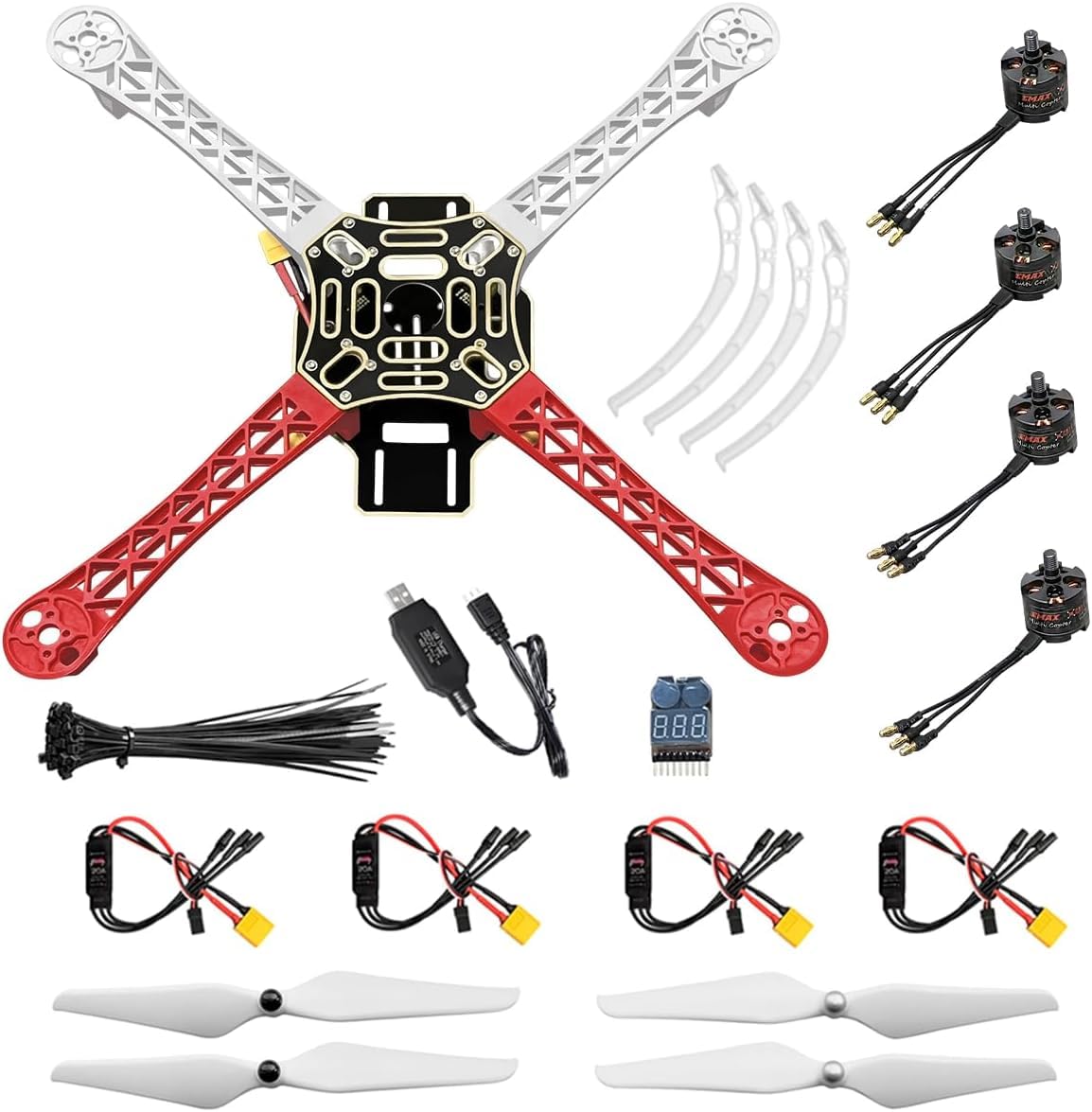
The HAWK’S WORK F450 kit is a beginner-focused bundle that includes the frame, four brushless motors, four ESCs, propellers, and basic accessories—everything except the flight controller and battery. The 450mm wheelbase provides generous real estate for mounting a flight controller, Raspberry Pi, or additional sensors, making it a popular choice for educational builds and research projects. The included quick-start guide walks new builders through assembly and calibration, reducing the learning curve significantly.
This is not a high-performance freestyle frame. The plastic construction is noticeably less rigid than carbon fiber alternatives, and the maximum takeoff weight of 1.8 kg limits payload options. The kit uses branded parts for reliability, and the 3-month free replacement warranty covers quality defects, which is unusual at this price point. Experienced builders will find the plastic arms too flexible for aggressive flying, but for learning the fundamentals of drone assembly and repair, the forgiving nature of plastic is actually an advantage—it bends rather than shatters.
The flight controller is not included, which is clearly stated in the listing but still catches some buyers off guard. Users report that the frame is easy to repair after crashes, and the confidence gained from building from scratch is the kit’s real value. One pilot noted that the “return home” switch functioned correctly on their first flight test, confirming the basic electronics work as intended. For someone who has never soldered a power distribution board or mounted a flight controller, this kit is the safest entry point into the FPV world.
Why it’s great
- Complete beginner kit with frame, motors, ESCs, and props—just add flight controller and battery
- Quick-start guide and video support reduce the learning curve for first-time builders
- Plastic frame is forgiving—bends rather than shatters in crashes, easy to repair
Good to know
- Plastic construction is not suitable for aggressive freestyle or high-speed FPV flying
- Flight controller is NOT included—must be purchased separately for a functional build
FAQ
Can I use a 3D-printed frame for FPV racing?
How do I know if a frame fits the DJI O3 Air Unit?
Final Thoughts: The Verdict
For most users, the best 3d printed drone winner is the FPVDrone 295mm 7 inch frame because its 5mm arms provide genuine crash protection at a price that undercuts every premium competitor while keeping weight low enough for efficient long-range cruising. If you want a purpose-built DJI HD frame with better Air Unit integration, grab the FPVDrone Mark4-HD 5 inch. And for pure videography stability, nothing beats the YoungRC DC5 with its asymmetrical arm design and insulating inserts.