
The volatile organic compounds (VOCs) and ultrafine particles released during ABS, ASA, and resin printing don’t just smell unpleasant — they accumulate in your lungs and workspace over time, turning a creative hobby into a genuine health hazard. A dedicated filtration solution is no longer optional; it’s the single most important accessory for any serious maker.
I’m Min — the co-founder and writer behind Gadgets Feed. I’ve spent hundreds of hours analyzing the engineering behind filtration media, fan static pressure ratings, and enclosure compatibility to separate real solutions from marketing gimmicks in the 3D printing ecosystem.
This guide breaks down the best options to keep your air clean, covering carbon beds, HEPA H13 media, and enclosure integration so you can find the best 3d printer air purifier for your specific setup and materials.
How To Choose The Best 3D Printer Air Purifier
Selecting the right air purifier for your 3D printer comes down to three interconnected factors: the filtration media type, the airflow volume relative to your enclosure, and how the unit integrates with your specific machine. Generic room purifiers move air too slowly to capture printer emissions at the source, so a purpose-built unit is essential.
Filtration Media: Carbon vs. HEPA vs. Both
Activated carbon is non-negotiable for adsorbing VOCs like styrene from ABS and acetaldehyde from resin. A thick, chemically-activated carbon bed is far more effective than a thin carbon sheet. HEPA H13 media captures 99.97% of ultrafine particles down to 0.3 microns, which is critical for PLA, PETG, and nylon printing. The best units combine both in a multi-stage system — pre-filter, carbon, then HEPA — to extend media life and ensure complete protection.
Airflow and Static Pressure
Look for an airflow rating of at least 150 m³/h to achieve 3-4 air exchanges per minute inside a typical 50-liter enclosure. High static pressure is equally important; a centrifugal fan maintains suction through dense filter media and ductwork, whereas axial fans stall under restriction. Units with adjustable speed let you balance noise against extraction efficiency.
Enclosure Compatibility and Mounting
Some purifiers are designed to mount directly onto brand-specific printers like the Bambu Lab P1S or X1C, using pre-existing ports or back-panel cutouts. Others are standalone units that sit on the bench with a flexible hose. Verify the hose diameter matches your enclosure port, and check if adapter kits or printable files are available for your printer model.
Quick Comparison
On smaller screens, swipe sideways to see the full table.
| Model | Category | Best For | Key Spec | Amazon |
|---|---|---|---|---|
| Mintion V1 Filtration System | Recirculation | Bambu Lab P1S/X1C | 60 m³/h, H13 HEPA + Carbon | Amazon |
| KINGSOM KS01 | Desktop | Multi-material workshops | 180 m³/h, H13 HEPA + Carbon | Amazon |
| KOTTO Smoke Absorber | Desktop | Soldering & 3D printing | 52 CFM, 40W, Carbon/HEPA | Amazon |
| KQZ-W1 | Desktop | Quiet continuous operation | 168 m³/h, H13 HEPA + Carbon | Amazon |
| M-T MT308 | Desktop | Budget-conscious hobbyists | 168 m³/h, H13 HEPA + Carbon | Amazon |
| Makacces Enclosure | Integrated Tent | All-in-one enclosure + vent | 12V fan, fire-resistant fabric | Amazon |
| Hocenway 3-in-1 Tent | Integrated Tent | Resin + FDM combo users | Fireproof, 75mm exhaust port | Amazon |
In‑Depth Reviews
1. Mintion V1 3D Printer Filtration System
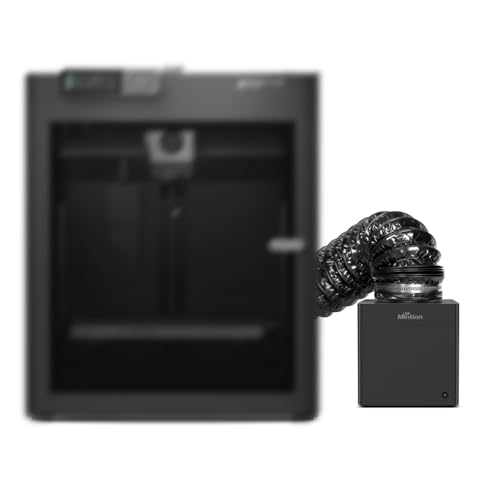
The Mintion V1 is engineered specifically for enclosed 3D printers, with a default connector that bolts directly onto Bambu Lab P1S and X1C machines. Its triple-layer system — pre-filter, true HEPA H13, and a chemically-activated carbon bed — targets both the ultrafine particles from PLA and the toxic VOCs like styrene from ABS, which generic purifiers miss entirely. The centrifugal fan delivers a steady 60 m³/h, maintaining consistent negative pressure inside the chamber without disrupting thermal stability during long prints.
Installation is genuinely tool-free: the manual is well-illustrated, filters snap in and out without fuss, and the unit mounts cleanly to the back panel. Independent testing confirms significant reductions in airborne particle counts and VOC concentrations both inside and outside the enclosure. Users report nearly complete odor elimination during ABS prints when paired with the optional P2S exhaust fan in recirculation mode.
The fan is audible at higher settings — you’ll want it on medium for overnight prints — and the outer shell does pick up fingerprints quickly. Replacement filters run about , which is reasonable for the media quality. If you own a Bambu Lab printer or any enclosed model with a printable adapter, this is the most thoughtfully designed additive-manufacturing-specific purifier on the market.
Why it’s great
- True HEPA H13 plus chemically-activated carbon targets both UFPs and VOCs
- Tool-free filter swaps and clear installation guide
- Centrifugal fan maintains stable negative pressure without affecting chamber temperature
Good to know
- Fan noise is noticeable at the highest speed setting
- Some older printer models require a printed adapter or new back panel
- The outer shell is prone to visible fingerprints
2. KINGSOM KS01 Solder Fume Extractor

The KINGSOM KS01 packs a brushless motor that spins up to 8608 RPM, moving 180 m³/h of air through its dual-stage filtration system. The pre-filter catches coarse rosin fumes and metal dust, while the main HEPA H13 cartridge with an activated carbon layer handles VOCs and fine smoke particles. That airflow volume is enough to exchange the air in a typical 50-liter enclosure more than four times per minute — well above the threshold needed for effective fume capture.
Three physical speed buttons with LED indicators make adjustments straightforward, and the 0.8-meter flexible hose articulates 360 degrees to park the suction hood exactly where fumes are generated. Build quality is solid, with a metal frame reinforcing the housing, and the included soundproofing sponge keeps noise manageable even at higher speeds. The package includes five pre-filters and one main filter, which extends the usable life before you need to buy replacements.
The hose coupling can be a bit stiff to position initially, and the unit works best when the hood is within three to four inches of the emission source. Some users have reported that it helps but doesn’t completely clear a room of heavy ABS fumes without active ventilation. For a desktop unit that balances suction power with a compact footprint, the KS01 is a versatile choice that handles 3D printing, soldering, and even nail salon fumes equally well.
Why it’s great
- Brushless motor delivers 180 m³/h for rapid air exchange
- Includes five pre-filters plus one main HEPA + carbon filter
- Three speed settings with clear LED indicators and soundproofing
Good to know
- Hose is stiff and takes effort to bend into precise positions
- Needs the hood within 4 inches of the fume source for best results
- Heavy ABS fumes may still linger without active room ventilation
3. KOTTO Strong Suction Smoke Absorber

The KOTTO is a veteran in the fume extraction space, having been on the market since 2019 with a proven track record for soldering and 3D printing applications. Its 40W motor generates 52 CFM of airflow through a 24-inch flexible hose with a pre-attached hood, so it’s ready to run out of the box with zero assembly. The carbon filter handles odors effectively, while the optional HEPA upgrade layer captures finer particulate matter from filament emissions.
Fan speed is adjustable via a dial, and the unit runs at a reasonable 55 dB at top speed — audible but not deafening. The metal housing feels substantial for a desktop device, and the included brush makes cleaning the pre-filter area straightforward. KOTTO backs it with US-based customer support and a 30-day return policy, which adds peace of mind for first-time buyers.
The filter tray is made of cardboard, which is a minor fire-safety concern if you run the unit unattended for long periods, and some users have 3D-printed replacement trays to improve airflow. The carbon-only filter does little for VOC smell without the HEPA layer, so budget for that upgrade if you’re printing ABS or resin. For the price point, it’s a solid entry-level extractor that gets the job done for occasional use.
Why it’s great
- Ready to use immediately with pre-attached hose and hood
- Adjustable 6000 RPM fan with manageable 55 dB noise level
- US-based support and 30-day full satisfaction return
Good to know
- Filter tray is cardboard, which is a potential fire hazard
- Carbon-only filter is ineffective for VOCs without HEPA upgrade
- Gets loud at the highest speed, requiring headphones or distance
4. KQZ-W1 Solder Fume Extractor
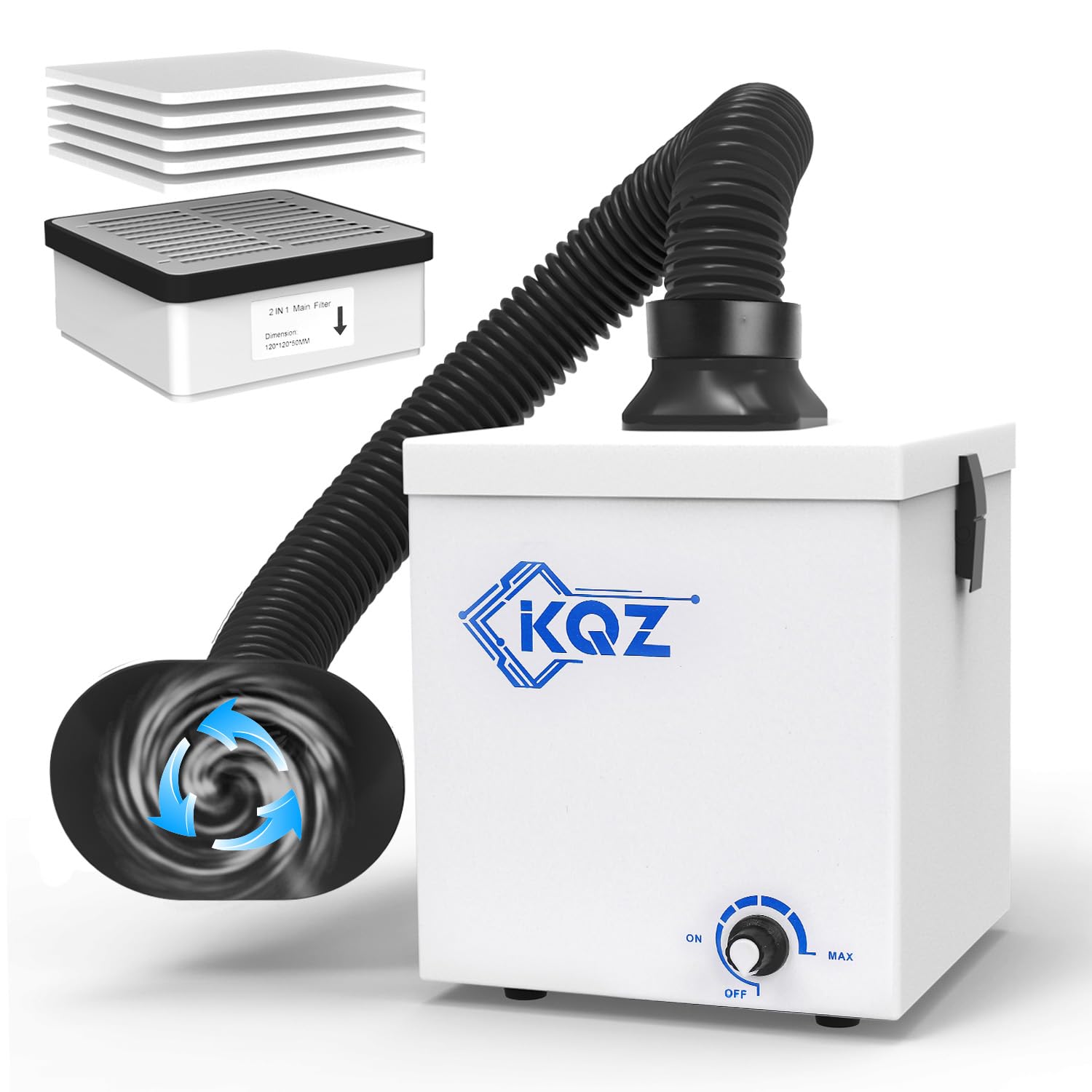
The KQZ-W1 distinguishes itself with a 9mm pre-filter paired with a dense H13 HEPA cartridge that uses coal-based activated carbon — a heavier, more porous carbon source that adsorbs VOCs more effectively than coconut-shell carbon. The centrifugal motor moves 168 m³/h of air, and the 66mm swan-neck hose can be rotated 360 degrees to aim the intake precisely at the print head or soldering iron. The aviation-grade metal alloy housing is corrosion-resistant and feels significantly more premium than the plastic competition.
Users consistently praise the quiet operation; even at higher speeds, the motor doesn’t produce the annoying vibration that plagues cheaper units. The inverter technology supports a wide voltage range from 110V to 220V, making it a viable option for international shipping or travel. The package includes five pre-filters and one main filter, with the main filter rated for approximately 2500 hours of use.
The hose coupling requires a bit of force to secure initially, and the unit’s compact size means the intake area is relatively small — you need to position it within three to four inches of the fume source. Some users have modified the coupling to fit larger-diameter ducts for laser cutters. For someone who values whisper-quiet operation and build quality over raw air-moving capacity, the KQZ-W1 is an excellent mid-range choice.
Why it’s great
- Coal-based activated carbon offers superior VOC adsorption
- Aviation-grade metal alloy housing is durable and corrosion-resistant
- Very quiet operation even at higher fan speeds
Good to know
- Hose coupling is stiff and hard to attach initially
- Small intake area requires placement very close to the fume source
- May need modifications to fit larger ductwork for laser cutters
5. M-T MT308 Solder Fume Extractor
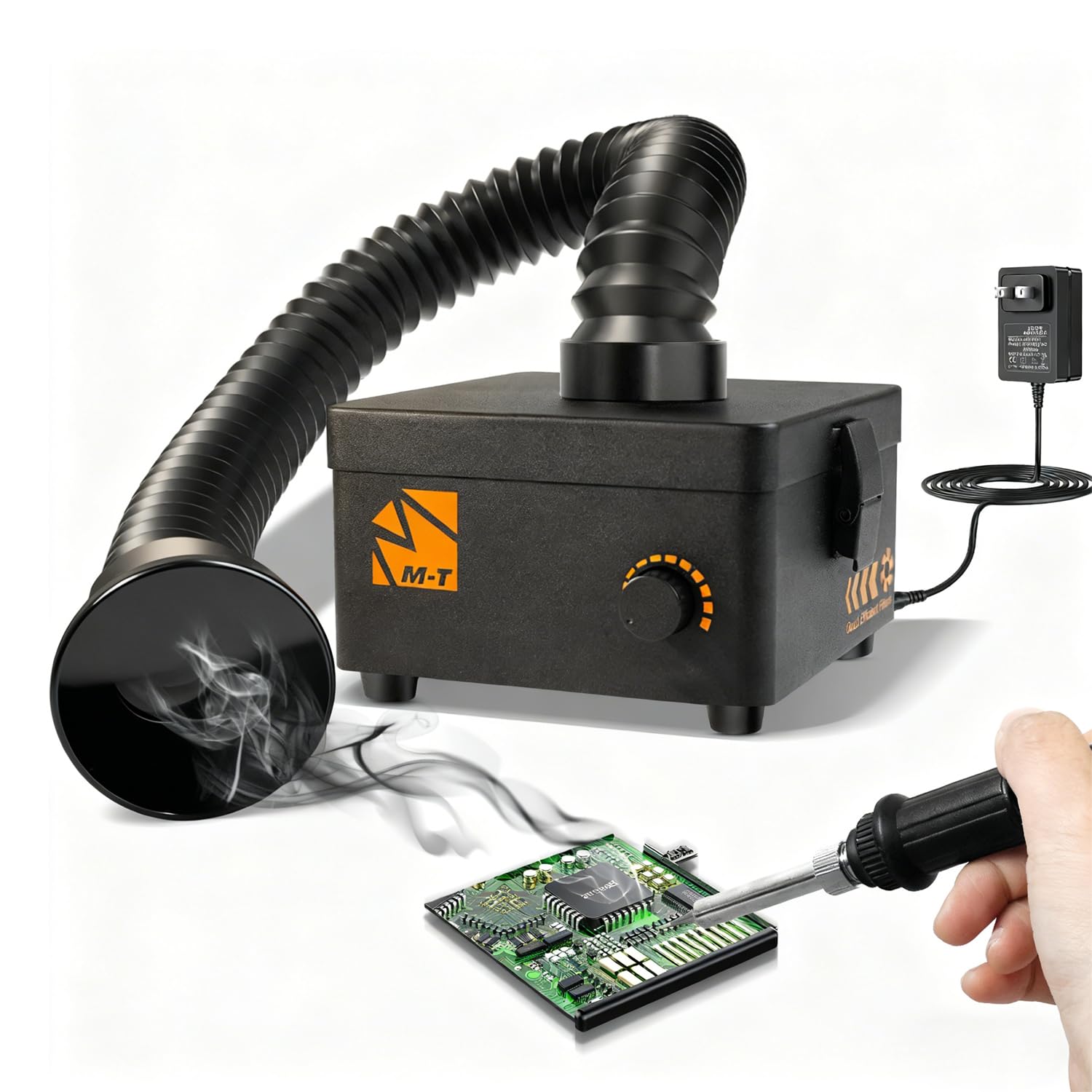
The M-T MT308 delivers 168 m³/h of airflow from a 15,000 RPM motor, backed by an 80W power supply that provides surge and voltage spike protection. The three-stage filtration system — high-density fiber pre-filter, carbon cotton, and H13 HEPA — removes 99.99% of dust, mold, bacteria, and heavy metals. The metal housing and 5-foot power cord keep it stable on the workbench, and the 360-degree adjustable hose extends from 7 to 25 inches for flexible positioning.
Customer feedback highlights its effectiveness for soldering and 3D printing; PM10 meters stop triggering when the MT308 is running, and users report significant odor reduction from ABS and resin fumes. The noise level is under 60 dB at maximum speed — comparable to a conversation — and the low hum is less annoying than the whine of smaller axial fans. The three-year warranty is unusually generous for this price tier, and the company has a reputation for responsive customer support.
The fan gets noticeably loud at the highest setting, and some users recommend running it at medium-high to balance extraction with noise. It works best as a targeted source-capture unit rather than a room-scale air purifier, so position the hood within five inches of the emission point. For hobbyists on a tight budget who still want genuine HEPA-grade filtration, the MT308 offers the best performance-per-dollar ratio in the segment.
Why it’s great
- 80W motor with 168 m³/h airflow at an entry-level price
- Three-stage filtration including genuine H13 HEPA
- Three-year warranty and reliable customer support
Good to know
- Loud at the highest speed — best used at medium-high
- Targeted source capture only; not effective for whole-room purification
- Some users report it handles smoke well but not invisible fumes
6. Makacces Resin 3D Printer Enclosure with Ventilation
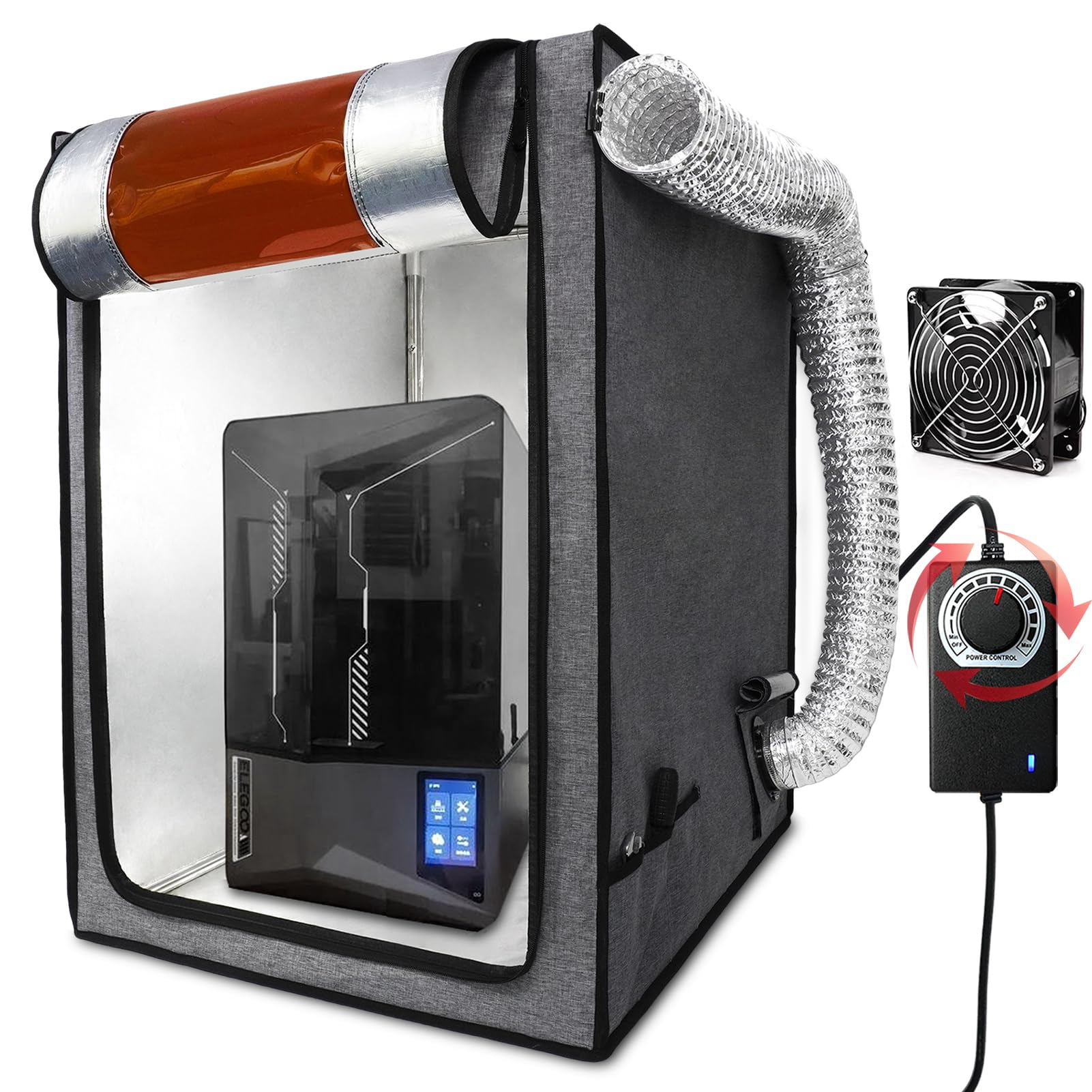
The Makacces enclosure is a complete tent system that combines physical isolation with active ventilation, making it ideal for resin printers that off-gas during the entire curing process. The fire-resistant fabric and stainless steel frame create a 25 x 21 x 29.5-inch chamber, compatible with most consumer LCD and FDM printers. A pre-installed 12V fan with an adjustable speed controller pulls fumes through a 75mm ventilation port, which you can route out a window using the included pipe.
The brown UV-blocking window prevents premature curing of resin prints by filtering out most UV rays, while the smoke and odor extraction system effectively contains the chemical smell that resin printing produces. Users report that after a year of use, the tent still seals well, and the zippers remain functional. The kit includes tool and storage bags to keep the workspace organized, and setup takes about 15 minutes with basic tools.
The included fan works adequately but is not as powerful as standalone fume extractors — if you want negative pressure inside the tent, you may need to upgrade the fan later. The instruction manual is minimal, with some steps requiring intuition rather than explicit guidance. Also, the vent window kit for routing the pipe through an actual window is sold separately. For resin printer owners who need a complete enclosure-plus-ventilation solution, this tent provides excellent value as a single-purchase starter system.
Why it’s great
- Fire-resistant fabric and steel frame provide physical isolation and fire safety
- UV-blocking brown window prevents resin curing during printing
- Includes fan, ventilation pipe, and storage bags for a complete kit
Good to know
- Included fan may need upgrading for effective negative pressure
- Assembly instructions are sparse and require some guesswork
- Window vent kit for exterior exhaust is sold separately
7. Hocenway 3-in-1 Multifunctional 3D Printer Enclosure

The Hocenway 3-in-1 enclosure serves triple duty as a printer cover, fume extractor platform, and filament dryer storage. The fireproof canvas exterior with a brown UV filter membrane protects against both laser engraver light and resin-curing UV rays. Two side ventilation ports and a front 75mm round port allow you to attach the included 1.5-meter smoke exhaust pipe, creating a direct path for fumes out of your workspace.
The internal dimensions — 500W x 635L x 750H mm — fit most consumer resin printers like the Anycubic Mars 5 Ultra and Elegoo Saturn series, as well as FDM machines like the Ender 3 and CR6 SE. An integrated 5W USB LED light provides interior visibility, and the package includes a brown filter membrane, exhaust pipe, and light. Users report approximately 99% odor reduction when the ventilation system is properly set up, making it night-and-day better than printing in open air.
The ventilation fan is sold separately, which is a critical omission for first-time buyers who may not realize the tent is just a passive shell without a fan. The instructions are vague, and you’ll need to 3D-print a fan adapter or purchase a separate kit to connect a standard fan to the 75mm port. The door placement on the narrow side also makes rear access to the printer awkward. Despite these quirks, it’s an inexpensive way to contain fumes if you already own a compatible fan and some duct tape.
Why it’s great
- Triple-purpose design: printer enclosure, fume extraction base, filament dryer storage
- Fireproof canvas with UV filter membrane for resin and laser safety
- Significantly reduces odor — up to 99% — with proper fan setup
Good to know
- Ventilation fan is NOT included — must be purchased separately
- Vague instructions require 3D-printed fan adapter for proper connection
- Door is on the narrow side, making rear printer access difficult
FAQ
Can I use a standard room air purifier for my 3D printer?
How often should I replace the filters in a 3D printer air purifier?
Is a fume extractor necessary for PLA filament?
Can I vent a fume extractor directly out a window?
What is the difference between recirculating and exhaust purifiers?
Final Thoughts: The Verdict
For most users, the best 3d printer air purifier winner is the Mintion V1 Filtration System because it integrates seamlessly with popular enclosed printers, uses genuine H13 HEPA plus chemically-activated carbon, and maintains chamber temperature stability. If you need raw airflow for a multi-printer workshop, grab the KINGSOM KS01 with its 180 m³/h brushless motor and abundant pre-filters. And for resin printer owners who want a complete isolation tent with fume routing, the Makacces Enclosure provides a fireproof, UV-blocking shelter that keeps chemical odors out of your living space entirely.