
Our readers keep the lights on and my morning glass full of iced black tea. As an Amazon Associate, I earn from qualifying purchases.
Specs are compiled from manufacturer listings and verified buyer reviews and can change over time — please confirm the key details on the product page before buying.
That first layer of a new spool leaves a perfect, glossy finish. A week later, the same spool gives you a rough, stringy surface and bits of bubbling. The culprit isn’t your printer — it’s moisture trapped inside the filament. A filament dryer is the tool that removes that moisture and prevents the failed prints, and this guide is built around the only question that matters: which dryer actually gets your spools dry enough to make a difference.
I’m Min — the founder and writer behind Gadgets Feed. This guide is built by comparing the manufacturers’ published specifications and the patterns across verified customer reviews, so you get each pick’s real strengths and trade-offs instead of marketing spin.
You’ll see exactly which models dry fast, which hold multiple spools, and which are built to last, so you can pick the 3d printer filament dryer that solves your specific printing headache.
Our Picks at a Glance

How To Choose The Best 3D Printer Filament Dryer
To get dry filament, you need a dryer that matches the heat, airflow, and size to the spools you actually print with. PLA and PETG (a common, slightly tougher plastic) dry well at lower temperatures, but tough filaments like Nylon and Polycarbonate need more heat to push out moisture. A dryer that tops out at 50°C will handle PLA fine, but it will never properly dry the engineering spools, so your prints may come out weak or brittle.
Heating Power and Temperature Range
The single most important spec is the heater. Dryers use PTC heaters, which self-regulate and heat up fast. Look at the wattage: a 110W unit gets a single spool dry, while a 350W unit can handle four spools at once. The maximum temperature matters too. A range up to 65°C or 70°C covers most materials and gives you a buffer for the demanding ones.
Airflow and Heating Coverage
A heater is only half the story. The best dryers circulate hot air with a fan, often described as 360° airflow, so heat reaches every part of the spool evenly. Without good airflow, you get a hot center and cold edges, leaving moisture in the filament. This even heating is what actually prevents stringing and clogging.
Capacity and Workflow
Think about how many spools you need to dry at once. A single-spool dryer is compact and fits on top of most printers, so it’s easy to store. A four-spool dryer lets you dry a whole batch and often print from them directly, saving you time. Before you buy, check that the dryer fits your spool sizes — 1kg spools are standard, but some dryers handle wider or taller rolls, so measure your filament first.
Quick Comparison
| Model | Best For | Heating Power | Max Temp | Capacity | Amazon |
|---|---|---|---|---|---|
| Creality Space Pi★ Best Overall | Multi-spool drying with presets | 110W | 70°C | 4 spools | Amazon |
| Creality Space Pi SEBest Value | Fast single-spool drying | 80W | 65°C | 1 spool | Amazon |
| Comgrow Dryer BoxCompact Pick | Budget-friendly PLA drying | — | 50°C | 2 spools | Amazon |
| SUNLU S2 | Simple touchscreen single-spool | — | 70°C | 1 spool | Amazon |
| JAYO J1 | Hot, fast drying in small spaces | 150W | 70°C | 1 spool | Amazon |
| Sovol SH02 | Dual-spool drying with one-key presets | 150W | 70°C | 2 spools | Amazon |
| Polymaker Polydryer | Dry, store, and seal in one system | — | 60°C | 1 spool | Amazon |
| SUNLU S4 | Large batch drying and printing | 350W | 70°C | 4 spools | Amazon |
In‑Depth Reviews
1. Creality Space Pi Filament Dryer
Our pick — over 4.5★ from 550+ verified ratings; the strongest balance of quality and price.
The multi-spool powerhouse that dries four rolls at once with even heat.
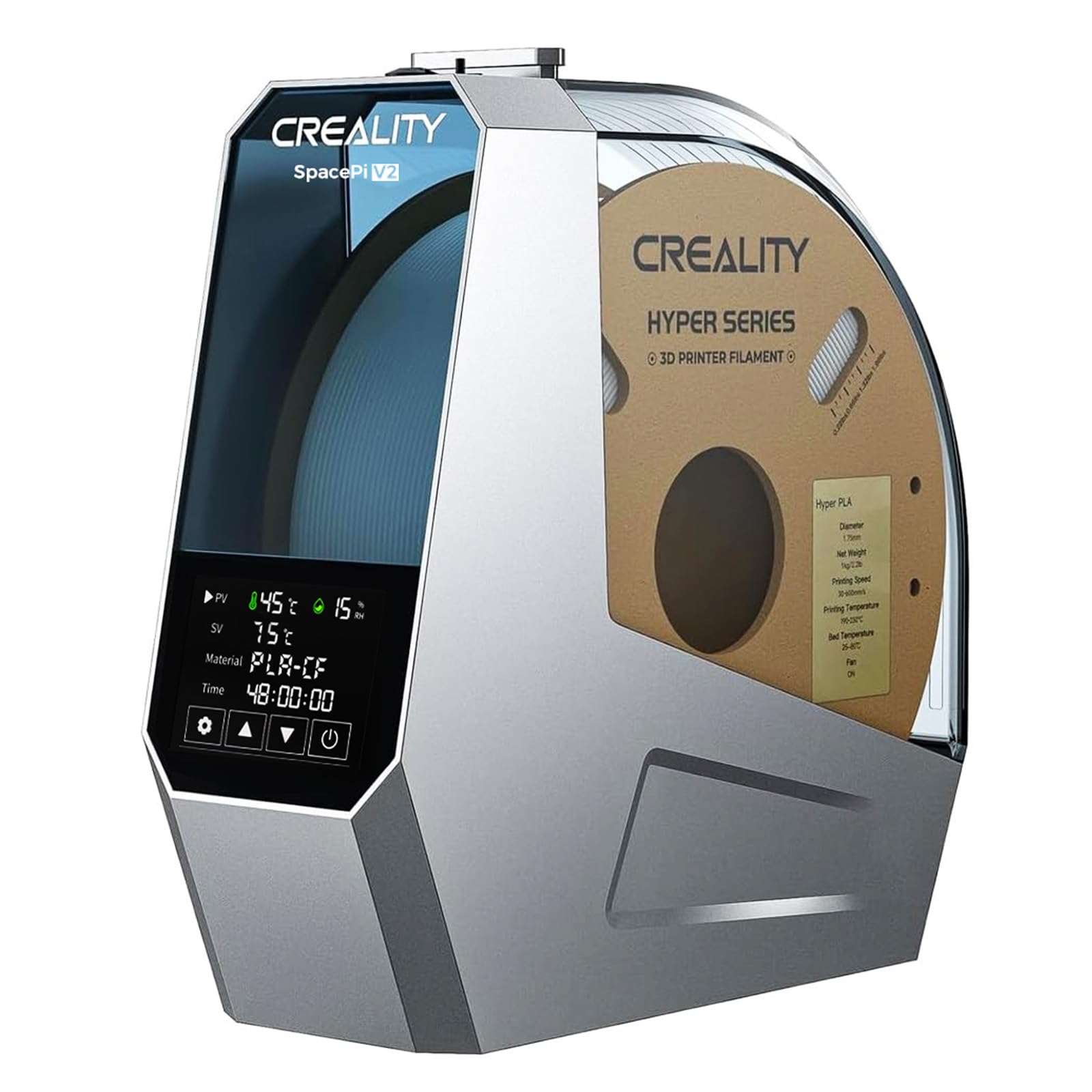
If you print across several materials, this dryer earns its keep by handling four spools at once. Its 110W PTC heater and built-in fan push hot air around the chamber in a 360° cycle, so every spool gets even drying instead of hot spots. Buyers report better print quality and far less stringing after a cycle, making it a genuine workhorse for a busy setup.
The control setup is refreshingly simple. A 3.7-inch touch screen lets you pick from 12 filament types — PLA, ABS, TPU, PETG, and composites like PLA-CF included — or dial in a custom temperature between 45°C and 70°C. You can set the heating time anywhere from 0 to 48 hours, and it remembers your settings after a power cut, so you don’t have to reprogram a long overnight dry.
There is a real trade-off here. The stronger heating draws more power than the smaller SE model below, and a few owners note reliability concerns after several months of use. The review pages sum it up for engineering filaments: “must-have.” If you print mostly PLA and want a lighter footprint, this much capacity may be overkill.
What Owners Love
- Dries four spools at once, so batch drying is fast
- Dual independent heating zones for even results
- Requires no enclosure for great prints, per owner reports
The Honest Catch
- Reliability questions surface after months of use
- The 45°C minimum is too warm for some delicate filaments
Reach for this if: you run multiple spools and want one machine that dries them all with preset simplicity.
Look elsewhere if: you only print PLA occasionally and need the smallest footprint possible.
2. Creality Space Pi SE Filament Dryer
A fast-heating single-spool dryer that revives flexible filaments without fuss.
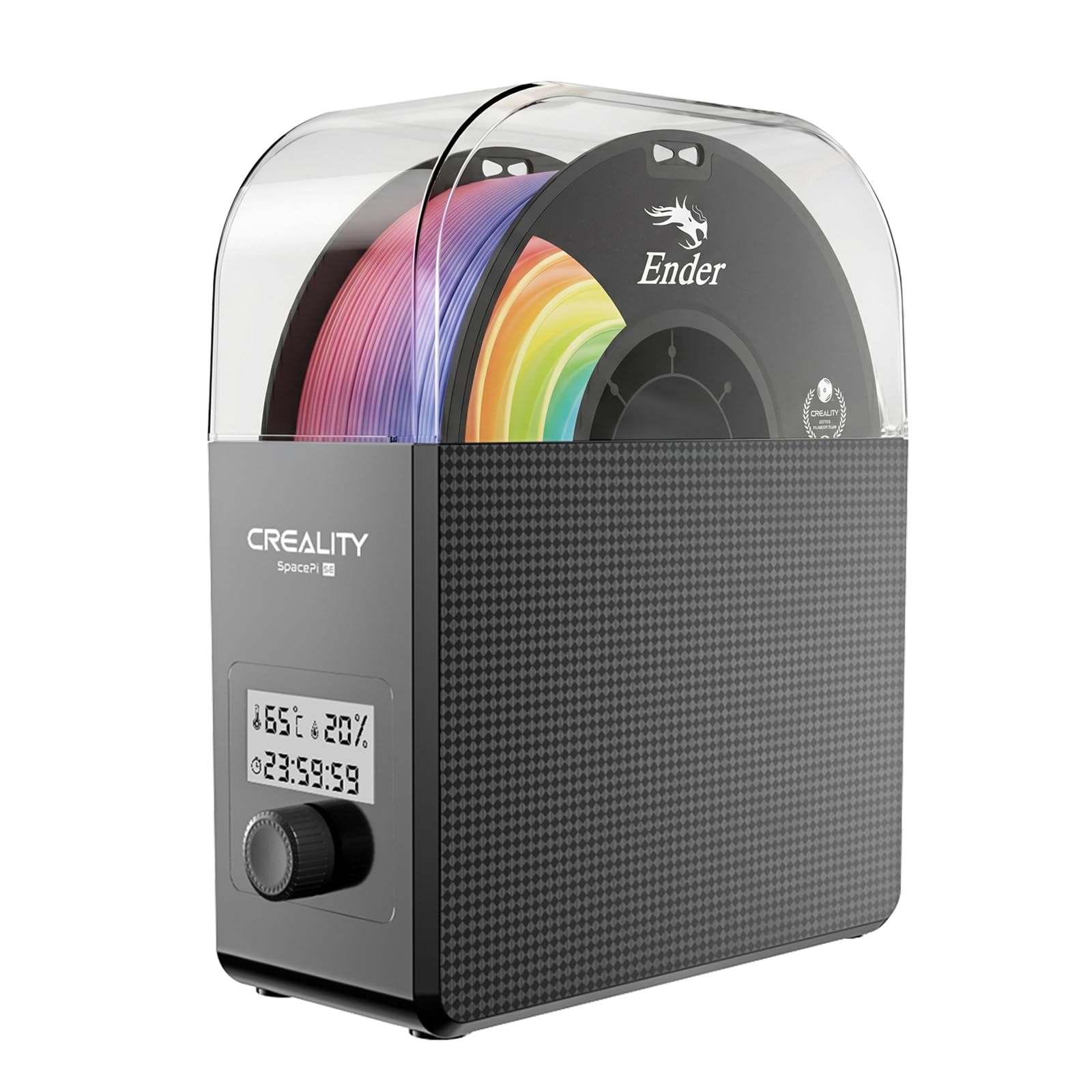
This is the dryer owners reach for when TPU stringing gets out of hand. The 80W PTC heater warms the chamber to 65°C within 15 minutes, and a built-in fan circulates hot air 360° around the spool for even drying. One owner saw zero stringing on TPU after a cycle, exactly the result you want from a dedicated dryer.
It’s a no-assembly design with a display and knob for controls, and it offers 12 presets, a 48-hour timer, and power-off memory so your settings stick. The adjustable range runs 45°C to 65°C with drying times from 0 to 24 hours. Thermal insulation cotton lines the inner wall, which keeps the heat in and the outside cool to the touch while printing.
The honest limits: it handles one 1kg spool at a time, and the knob interface earns mixed feedback for intuitiveness. Also, at 1 kg it weighs exactly half of the Comgrow box, making it the lighter pick if you plan to move it between printers. For TPU and PETG, this is the value pick that gets the job done.
Performance first: quick heat, effective drying, and a price that undercuts most rivals.
One key note: the single-spool design means batch drying isn’t an option here.
3. Comgrow Filament Dryer Box
A budget-friendly dual-spool dryer built for PLA and simple setups.
If your printing life is mostly PLA and SILK, this box gets you sorted without spending much. Its internal space measures 9.29 x 6.49 x 9.13 inches and holds up to two 1kg spools at once. A display screen gives real-time temperature and humidity readings, and the function button (M) cycles through your settings so you know exactly what the dryer is doing.
The temperature range is 40°C to 50°C with drying durations from 6 to 12 hours. That’s perfect for PLA, which needs gentle heat, but it means tougher materials like ABS and Nylon won’t get the high temperatures they need. Owners find it simple to set up and quiet in use, praising it as a solid entry-level tool.
The main gripe is the base, which gets noticeably hot during operation and benefits from added feet. Durability reports are mixed, so treat it as a starter unit rather than a forever machine. It weighs 1.5 kg, matching the JAYO J1 in heft, so it’s not the lightest option to move around.
Best for PLA: this dryer uses gentle heat to dry PLA effectively, and its price is tough to top for the performance you get.
Who to skip: anyone printing PETG, Nylon, or other high-temperature filaments.
4. SUNLU Filament Dryer S2

A tall, touchscreen single-spool dryer that tops out at a hot 70°C.
For drying the demanding filaments, this unit reaches temperatures the Comgrow box can’t touch. It heats up to 70°C and lets you customize drying time anywhere from 0 to 99 hours. A built-in spindle spins the filament continuously for even drying, and the large touch screen makes setting a cycle a straightforward tap-and-go affair.
The S2 has a spacious chamber at 265x274x118mm, and its translucent lid means you can check on the spool without opening it. It takes filaments of 1.75mm, 2.85mm, and even 3.00mm, which adds flexibility. Owners note it fits on top of a printer, so you can dry and print at the same time, and several mention a big jump in print quality on PLA after a cycle.
The trade-offs are minor but real. It tips over easily because of its slim profile, and there’s no dedicated desiccant space. Also, a few owners wish it could hit 80°C for the toughest engineering materials. It’s a strong single-spool choice that leans toward simplicity and good results.
Why It Stands Out
- Rapid heating with free-spinning spools for even drying
- Dual heating zones and a Bowden feed for smooth paths
- Translucent lid shows spool status at a glance
What to Watch
- Slim base tips over more easily than wider boxes
- No desiccant compartment for long-term storage
Grab it for: single-spool drying with wide material support and a simple touchscreen.
Pass if: you need a stable, stash-friendly box with desiccant storage.
5. JAYO J1 Filament Dryer
A hot, ultra-slim dryer that fits inside tight printer enclosures.
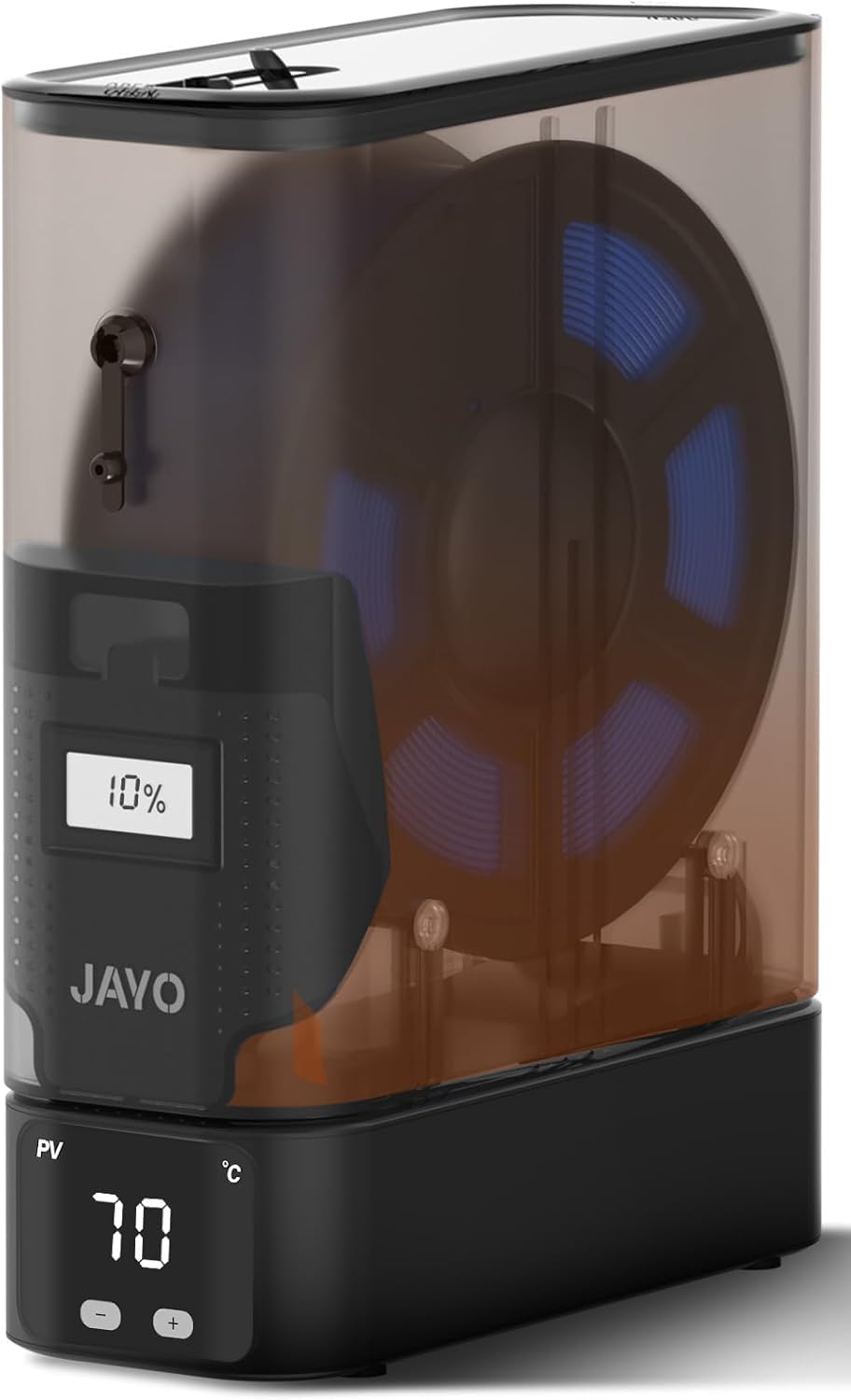
This one brings serious heat in a small package. The 150W PTC heating system reaches up to 70°C in minutes, drying even moisture-soaked PLA, PETG, and ABS spools evenly. Owners describe it as aggressive drying, and its ultra-slim profile lets it fit inside enclosures where bulkier dryers won’t go.
The split design is the clever part. Each unit works independently, or you can stack multiple units for a multi-printer setup without eating up bench space. It supports drying and printing at the same time, so you feed filament directly from the box while it holds optimal humidity. Internal humidity stays stable within ±5% over 21 days thanks to the built-in desiccant.
A built-in humidity window lets you check conditions without opening the lid, and dual hardware protection adds safety. The catch is a small gap that benefits from a gasket, plus no locking clips on the lid. For a compact, high-temp solution, this is the one that punches above its size.
The hot pick: 150W of heat in a slim body that slides into tight spots.
Only if: you value enclosure fit and stackable design over extra capacity.
6. Sovol SH02 Filament Dryer

A dual-spool dryer that reaches 70°C fast and keeps heat even.
This dryer wins on speed. Its 150W PTC heater gets the chamber to 50°C within 7 minutes and up to 70°C within 25 minutes, with a built-in fan circulating hot air 360° for uniform heating. Owners note the difference the 150W heater makes, and it dries two 1kg spools at once, so you can run two printers from one box.
The one-key temperature setting covers nine filament types — PLA, TPU, PETG, ABS, ASA, PVA, PC, PA, and PP — each with a default drying temperature and time pre-set. A touchscreen gives you control over manual settings too, and the improved sealing over the older SH01 keeps moisture out even when it’s powered off. You can stash four bags of desiccant inside to boost drying.
Safety features are a highlight: heating cuts off above 130°C, resumes below 90°C, and an alarm sounds if the fan stops to protect the PTC module. The downsides are a fan whine that some find noticeable and angled outlets that can be awkward. It’s a fast, smart dual-spool option with strong safety controls.
Built Smart
- Reaches 70°C in 25 minutes for quick turnaround
- One-key presets for nine filament types
- Strong sealing plus four desiccant spots
Minor Gripes
- Fan noise can be noticeable in quiet rooms
- Temperature control isn’t perfectly precise
Pick this for: fast dual-spool drying with preset simplicity and solid safety.
Think twice if: fan noise bothers you during overnight cycles.
7. Polymaker Polydryer

A modular dry-and-store system that keeps spools sealed between prints.
This isn’t just a dryer — it’s a complete moisture-control system. The modular design pairs a Dry Dock heater with a sealed storage box, so you dry a spool, then move it to sealed storage with reusable, color-changing desiccant. One owner measured humidity dropping from 54% to 29% over 22 hours using a mix of 6-hour heated runs and desiccant.
The built-in hygrometer lets you judge filament status without guesswork, and the unit works with PA Nylon, PLA, PVB, PETG, ABS, ASA, and TPU in 1.75mm, 2.85mm, or 3.00mm. It supports printing directly from the box, so you can dry and print at the same time. The sealed case protects spools between sessions, which is the real value here.
There are honest limits. The maximum temperature is 60°C, which owners say falls short for Nylon and PPA, and the unit is loud at roughly 60dB. The latches take some force to close, and the desiccant arrives saturated and needs microwaving to reactivate. For PLA, TPU, and PETG with a continuous drying mode, it does the job well.
The complete system: drying plus sealed storage with desiccant support.
Not for: high-temperature filaments that need more than 60°C of heat.
8. SUNLU S4 Filament Dryer

A four-spool drying station with 350W of heat and eight feed holes.
When you need to dry a whole batch, this is the machine. The 350W PTC heater offers 50% higher heating efficiency than the S2, and three circulation fans keep temperature consistent across the entire chamber with 360° surround heating. It dries up to four 1kg spools at once, and owners say it dries four rolls as fast as their old single-spool dryer handled one.
Eight filament exit holes let you feed multiple printers from different angles, making it a true drying-and-printing hub. The temperature range is 35°C to 70°C with a timer from 0 to 99 hours, and owners highlight the ability to override pre-programmed profiles for different filaments. It’s also DIY-friendly, with mods available to dry 3kg rolls or even function as a shoe dryer.
External dimensions run 460(L) x 220(W) x 310(H)mm and it weighs 4kg, so it’s a substantial piece of gear. A few owners note the small top latches could be better, but they call it a great deal and praise its reliability. For serious multi-spool users, this is the top-tier pick.
Batch Drying King
- Dries four spools as fast as a single-spool unit
- Three fans ensure even 360° heating
- Eight exit holes feed multiple printers smoothly
Size Check
- Large footprint needs dedicated bench space
- Top latches feel small and benefit from printed fixes
Choose this if: you print multiple spools daily and need one station to dry them all.
skip it if: bench space is tight or you mostly dry one spool at a time.
Understanding the Specs
PTC Heater Wattage
PTC stands for Positive Temperature Coefficient, a self-regulating heater that boosts wattage when cold and drops it as it warms. Higher wattage means faster heat-up and the ability to dry more spools at once. A 110W unit works well for a single spool, while a 350W unit like the SUNLU S4 handles four. The wattage also tells you how hard the unit can push heat against cold, damp filament.
Temperature Range and Presets
The maximum temperature a dryer reaches decides which filaments it can properly dry. PLA dries fine at 45°C to 50°C, while PETG and ABS need 65°C, and Nylon often wants more. Many dryers offer one-key presets for common filament types, which set the right temperature and time automatically. A wider adjustable range, like 35°C to 70°C, gives you more control over tricky materials.
FAQ
How long should I dry PLA filament in a dryer?
Can I print directly from a filament dryer?
What temperature do I need for PETG filament?
Is a filament dryer better than a dry box with desiccant?
How many spools can a filament dryer hold?
Will a filament dryer work with 2.85mm filament?
Why does my printer keep stringing even after drying?
How long does a filament dryer take to heat up?
Is a filament dryer noisy enough to disturb sleep?
Final Thoughts: The Verdict
For most people, the 3d printer filament dryer winner is the Creality Space Pi because it balances four-spool capacity with 110W of even 360° heating and 12 one-touch presets. If you want fast single-spool drying at a lower cost, grab the Creality Space Pi SE — its 80W PTC heater hits 65°C in 15 minutes. And for large batch workflows, the SUNLU S4 is the one to reach for, drying four spools with a hefty 350W of heat.
How We Picked
We do not accept paid placement. Every pick is matched to a real buyer and a real use-case; we do not hands-on test units.
Sources & Methodology
Specifications: manufacturer listings and product documentation. Review insights: verified customer reviews, as of August 2026. Pricing: not shown on this page (it changes often); check the current price via the retailer link.
As an Amazon Associate, Gadgets Feed earns from qualifying purchases. This does not affect which products we feature.