
Our readers keep the lights on and my morning glass full of iced black tea. As an Amazon Associate, I earn from qualifying purchases.
Specs are compiled from manufacturer listings and verified buyer reviews and can change over time — please confirm the key details on the product page before buying.
You print a bracket for the garden, a trim piece for the car, or a mount for the deck railing. Three months later it is chalky, cracked, or just crumbles when you touch it. That is the difference between a filament built for the shelf and one built for the sky. ASA (Acrylonitrile Styrene Acrylate, a tough plastic cousin of ABS with added UV stabilizers) is the material that weathers the real world without losing its nerve. This guide lines up nine ASA spools rated for direct sun, rain, and summer heat — every one proven to hold its color and its strength outdoors.
I’m Min — the founder and writer behind Gadgets Feed. This guide is built by comparing the manufacturers’ published specifications and the patterns across verified customer reviews, so you get each pick’s real strengths and trade-offs instead of marketing spin.
The only way to keep outdoor prints from failing is to start with the right material. Here is the breakdown of the best 3d printer filament for outdoor use you can actually trust.
Our Picks at a Glance


How To Choose The Best 3D Printer Filament For Outdoor Use
Not every spool that says “ASA” is the same. You need one that is UV-stabilized, heat-resistant to at least 90°C, and vacuum-sealed so moisture hasn’t spoiled it before you open the bag. Here are the three specs to check first.
UV & Weather Resistance
The whole point of outdoor filament is that it does not degrade in sunlight. ASA naturally resists UV rays because of its acrylate rubber content — unlike ABS, which turns brittle. Look for a filament that mentions “UV resistant” or “weather resistant” in the description itself. That wording tells you the additives are already in the plastic.
Heat Deflection Temperature (HDT)
A part sitting in a black car dashboard or facing direct summer sun can easily hit 80°C to 100°C (176°F to 212°F). If the filament’s heat deflection temperature is below 90°C, the part will sag or warp. Most ASA filaments on this list handle 100°C (212°F) or very close to it, which is well above what ABS or PETG can manage.
Printing Requirements (Enclosure & Bed Temp)
ASA shrinks as it cools, and that shrinkage causes warping if the print environment is drafty. An enclosed printer is strongly recommended — it keeps the chamber warm so the layers cool evenly. Bed temperatures around 90°C to 110°C (194°F to 230°F) and nozzle temperatures between 240°C and 270°C (464°F to 518°F) are standard for ASA. If your printer can’t reach those numbers, you will struggle with layer separation.
Quick Comparison
| Model | Best For | Heat Resistance | Dimensional Accuracy | Spool Weight | Amazon |
|---|---|---|---|---|---|
| Polymaker ASA★ Best Overall | Best Overall | 100°C (212°F) | — | 1 kg (35.3 oz) | Amazon |
| SUNLU ASARunner Up | Runner-Up / Value | 230-260°C nozzle | ±0.02 mm | 1 kg (1296 ft) | Amazon |
| ELEGOO ASAHighest Rated | Highest Rated | 99°C (210°F) | — | 1 kg (2.2 lbs) | Amazon |
| Anicubic ASA | Low Warp | 90°C | ±0.02 mm | 1 kg (35.3 oz) | Amazon |
| iSANGHU ASA | Budget Pick | 100°C (212°F) | — | 2.2 lbs (35.3 oz) | Amazon |
| Geeetech ASA | Clog-Free | 100°C (212°F) | ±0.02 mm | 2.2 lbs (35.3 oz) | Amazon |
| Creality ASA | High-Speed | 100°C | ±0.03 mm | 2.2 lbs | Amazon |
| iSANMATE CF ASA | Carbon Fiber | 240-270°C nozzle | ±0.02 mm | 1 kg (35.3 oz) | Amazon |
| ERYONE Light ASA | Lightweight | — | — | 0.75 kg | Amazon |
In‑Depth Reviews
1. Polymaker ASA Filament 1.75mm Black 1KG
Our pick — 4.5★ from 2,000+ verified ratings; the strongest balance of quality and price.
The crowd-favorite ASA that balances outdoor toughness with print reliability.
Polymaker’s ASA is a benchmark for a reason. It withstands temperatures up to 100°C (212°F) and resists UV rays and environmental stress cracking, so a part left in the sun or on a hot dash stays dimensionally stable. Buyers report that printing at 250°C nozzle and 90°C bed delivers excellent layer adhesion and surface finish — even at fast speeds on machines like the Elegoo Centauri Carbon. The crowd favorite, with tens of thousands of owners.
You get a spool made from fully recycled cardboard (upgraded 3.0 packaging), so less plastic waste ends up in a landfill. The material is made in the USA, which keeps quality control and consistency high. Some owners mention that bed adhesion can be hit or miss — a brim or glue stick fixes it — and a few call the jet black variant brittle, but the overwhelming consensus is that this prints clean and strong.
What wins people over
- Excellent print quality — the most-praised aspect with over 200 owners calling it out
- UV and weather resistant for real outdoor use, survives rain and sun without fading
- Recycled cardboard spool reduces plastic waste
The honest trade-offs
- Bed adhesion can be inconsistent; a brim or glue stick is often needed
- Some users found the black variant more brittle than expected
- Large prints really need an enclosed printer to prevent warping
Reach for this if: you want the most proven, widely-used ASA with a strong owner community and a maker that stands behind the product.
Think twice if: your printer is wide open and you cannot control drafts — you may fight warping even with glue.
2. SUNLU ASA Filament 1.75mm 1KG Black
Tough, easy-printing ASA that delivers ABS strength with PETG ease.
SUNLU’s ASA filament is built for functional outdoor mechanical parts. It is resistant to UV, rain, and heat, and prints at a wide temperature range of 230-260°C (446-500°F) with a bed at 80-120°C (176-248°F). The 1.75mm diameter holds a tight tolerance of ±0.02 mm, which means smooth feeding and no clogs. Buyers describe it as having “most of the benefits of ABS, with the ease of printing of PETG, and very low odor.”
The spool itself is upgraded — a 3rd-gen high-temperature white spool with a multi-hole design for full drying, sized to fit AMS and AMS Lite units. The package even includes a weight and temperature scale printed on the spool. One common point is that the 1 kg spool now gives you more material per dollar than older 0.8 kg spools, making it more economical. A few users mention that an enclosure is still ideal, but many report success on open machines with careful bed leveling.
The standout spec: ±0.02 mm dimensional accuracy means consistent extrusion from start to finish — no sudden under-extrusion mid-print.
The honest trade-off: “recommend printing at 50-100mm/s,” so it is not a hyper-speed filament; pushing past those speeds may cause layer adhesion issues.
Who this fits: anyone who wants a reliable, widely-tested ASA that prints well on both enclosed and (with care) open printers.
Who should pass: if you need sub-25 mm/s speed or extremely low odor — ASA always has some fume, vent the room.
3. ELEGOO ASA Filament 1.75mm Gray 1KG
The top-scoring ASA on paper and in owner hands — minimal fuss, maximum durability.
ELEGOO’s ASA filament is engineered to endure prolonged sun, rain, and harsh outdoor conditions without fading or yellowing. The heat deflection temperature is listed at 99°C (210°F) and it offers excellent water resistance, keeping dimensional stability in high-humidity environments. The 1.75mm diameter is vacuum-sealed with desiccant to stay dry out of the bag. Owners consistently report that it prints “no issue at all” on enclosed printers like the Centauri Carbon and Bambu P1S, with great layer adhesion and no tangling.
The filament’s high impact strength makes it a solid choice for functional parts like drone frames and automotive components. A small number of users note a noticeable odor when printing (standard for ASA) and that color can vary slightly between rolls — one white roll was described as more “natural” than true white. But the consensus is clear: this prints cleanly and holds up outdoors better than most.
The big wins
- Highest owner rating in the list — owners praise the print quality and consistency
- Excellent UV & weather resistance with a 99°C (210°F) heat deflection temperature
- Vacuum-sealed with desiccant — ready to print straight from the package
The small catches
- Strong odor during printing — not a filament for an open living room setup
- Color may vary slightly between production batches
Best for: anyone who wants the highest-rated outdoor ASA on this list and is willing to run it in an enclosed printer with ventilation.
Skip if: you print in a shared space where the fume would be a problem, or you need exact color matching across multiple orders.
4. ANYCUBIC ASA Filament 1.75mm Black 1KG

A well-rounded ASA that prints cleanly with low shrinkage and reliable bed adhesion.
ANYCUBIC’s ASA filament is engineered to resist UV rays, water, and aging, and it holds a heat deformation temperature of 90°C (194°F). That is a solid 15°C higher than standard ABS and 27°C higher than PETG, so it won’t sag on a hot deck or a car trunk. The 1.75mm diameter is held to ±0.02 mm tolerance, which means consistent extrusion and no clogs. Buyers printing on the Anycubic Kobra S1 and S1 Max report “flawless” prints for outdoor use, though they emphasize drying the spool for at least 3 hours at 80°C first.
The low shrinkage rate reduces the risk of warping and cracking, and the material can handle moderate impact forces without deforming. A few owners mention that the black color is rich and consistent. The main advice from the community is to slow the print speed down and dry thoroughly; if you skip drying, layer adhesion suffers. This filament is a strong option if you want something that behaves predictably on a wide range of FDM printers.
The edge over the pack: low shrinkage means you are less likely to fight curling corners, even on a non-enclosed printer if you use a brim.
The honest trade-off: “slow down the speed” is the repeated advice — do not expect blistering 350 mm/s prints with this spool.
Reach for this if: you have a mid-range enclosed printer like the Kobra S1 Max and want reliable outdoor prints without constant calibration.
Think twice if: you need the highest possible heat resistance (100°C+) — the 90°C mark is fine for most but not extreme dashboards.
5. iSANGHU ASA Filament 1.75mm Gray 1kg
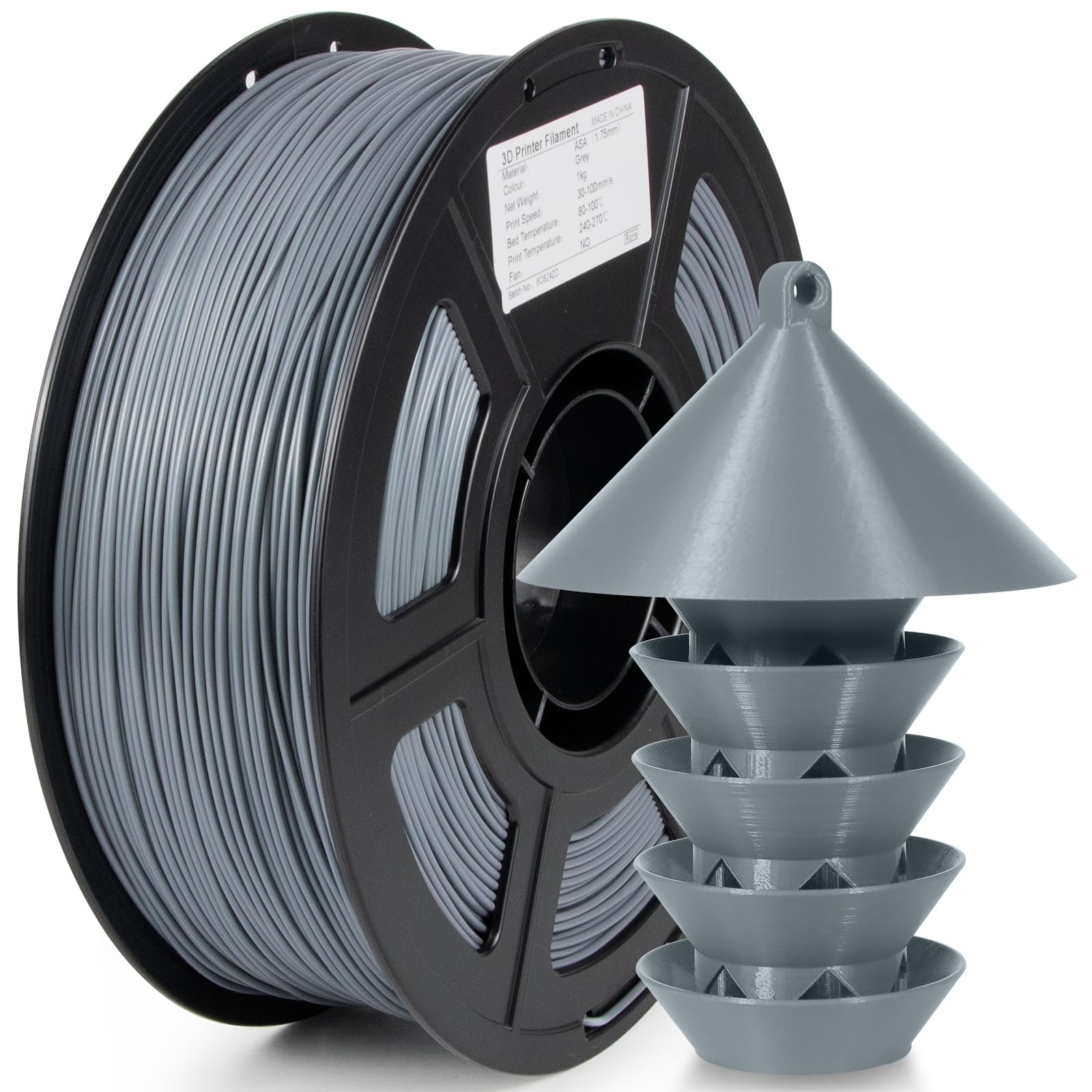
A budget-friendly ASA that punches above its price — if you dial the settings in.
iSANGHU’s ASA filament claims UV protection and can withstand temperatures up to 100°C (212°F). It is designed for high-exposure outdoor environments like roof coverings, car grilles, and marine applications. The 1.75mm diameter is vacuum-sealed after a 24-hour drying process, so it arrives moisture-free. Customers note that it prints “as easily as PETG” on machines like the Bambu X1C and K2 Plus, with consistent quality and no clogs after an 8-hour dry at 80°C.
The spool itself is flimsy — several owners note that the cardboard edges can warp in a filament dryer. There are also mixed reports on the color: the white variant is described as “translucent, not solid,” and layer splitting has occurred for a few users on complex prints. For the price, though, the consensus is clear: this is excellent value ASA that works great for garden tools, junction boxes, and outdoor fixtures. Just dry it thoroughly before use.
Why it stands out
- Budget-friendly, per owner feedback — a real money saver for large projects
- Withstands 100°C (212°F) and is resistant to rain, cold, and seawater
- 24-hour pre-drying and vacuum-sealed packaging preserves quality
Where it cuts corners
- Spool is flimsy — can warp if you dry it on the spool at high temperatures
- Mixed reports on color consistency (white is translucent, not solid)
- Some users experienced layer splitting when settings were not dialed in perfectly
Best for: the budget-conscious maker who needs functional outdoor parts (garden, automotive, marine) and is comfortable tweaking ASA settings.
Who should pass: anyone who needs a plug-and-play ASA straight out of the bag without a drying step.
6. Geeetech ASA Filament 1.75mm Purple 1kg
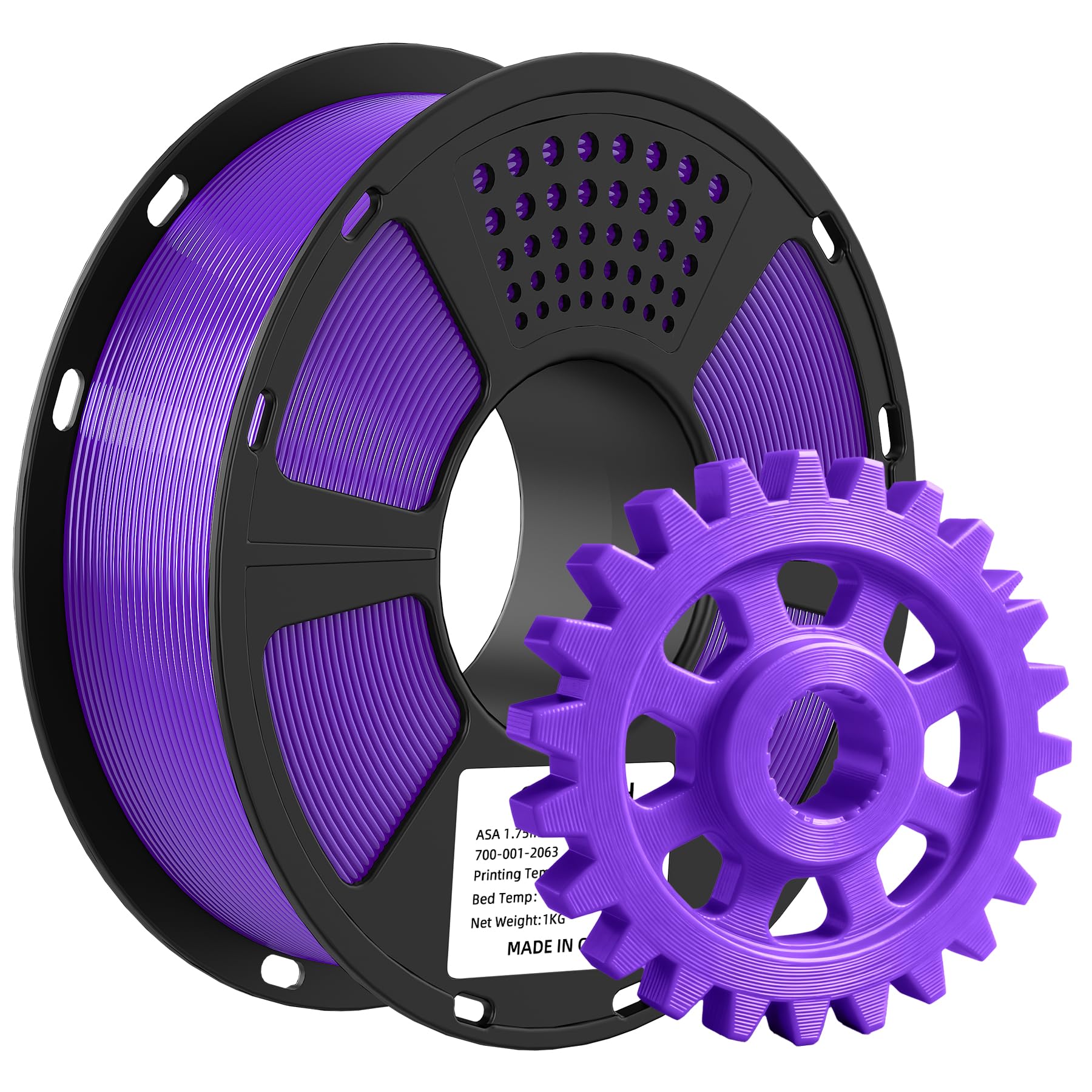
Bright colors and a patented anti-clog formula mean you get fewer jams and less fiddling during outdoor prints.
Geeetech’s ASA filament is formulated with a patented anti-clog additive and pre-dried for 24 hours, so you do not get bubbles or jams mid-print. It handles temperatures up to 100°C (212°F) and resists UV and weather damage, making it suitable for RC vehicle parts, outdoor signage, and automotive accessories. The diameter tolerance is tight at ±0.02 mm, with 98% consistency guaranteed. Buyers praise the vibrant purple color and report “no stringing at all” and prints that are “very sturdy” on PEI beds.
The spool is 100% recycled cardboard (upgraded 3.0 packaging) — the same eco-friendly approach as Polymaker. A small number of owners note that the spool can warp if left in a filament dryer, and initial moisture issues are common if the resealable bag is not sealed properly. Once dried, though, the feedback is overwhelmingly positive for both quality and appearance. This is the filament to grab when you want a specific bright color that holds up outdoors.
The standout feature: the “patented anti-clog formula” is not marketing fluff — reviewers point out zero jams even at higher speeds.
The honest trade-off: moisture sensitivity means you must dry it before first use if the package seal has been broken; do not skip that step.
Reach for this if: you want a reliable anti-clog ASA in a fun color (purple, bright green) for outdoor projects where visibility matters.
Think twice if: you print from an open spool holder and cannot control humidity — moisture leads to surface defects with this filament.
7. Creality ASA Filament 1.75mm Black 1kg

Creality’s ASA can print at 350 mm/s without clogging — a speed demon for outdoor parts.
Creality HP ASA filament resists UV, aging, and corrosion, so your parts stay fresh-looking even under direct sun. It handles temperatures up to 100°C (212°F) and prints at up to 350 mm/s — the fastest speed on this list. The 1.75mm diameter holds a tolerance of ±0.03 mm, which is slightly looser than the ±0.02 mm competition, but owners still report smooth prints with “no issues with clogs.” The filament works with Creality’s K1, K1 Max, and Ender-5 S1, plus other high-speed machines.
Adhesion gets mixed feedback — some users find it sticks well to PEI textured plates, others needed glue. The toughness is praised for garage organization prints and interior car parts. Durability is the most-praised aspect, and owners call it “an excellent alternative to ABS and PETG.” The 1-year warranty adds confidence. Just note that high-speed printing generates more fumes; ventilation is essential.
What makes it fast
- Up to 350 mm/s print speed — ideal for batch production of outdoor parts
- UV resistant and maintains form at up to 100°C (212°F)
- 1-year warranty from Creality adds confidence
The speed trade-offs
- Adhesion is mixed — some users needed glue on textured PEI plates
- ±0.03 mm tolerance is slightly looser than some competitors (±0.02 mm)
- Higher print speeds generate more fumes — ventilation is critical
Best for: Creality printer owners or anyone running a high-speed machine who wants outdoor durability without sacrificing speed.
Skip if: you print on a slow, non-enclosed printer — you won’t benefit from the speed, and the looser tolerance might show up in layer lines.
8. iSANMATE Carbon Fiber ASA Filament 1.75mm Black 1kg
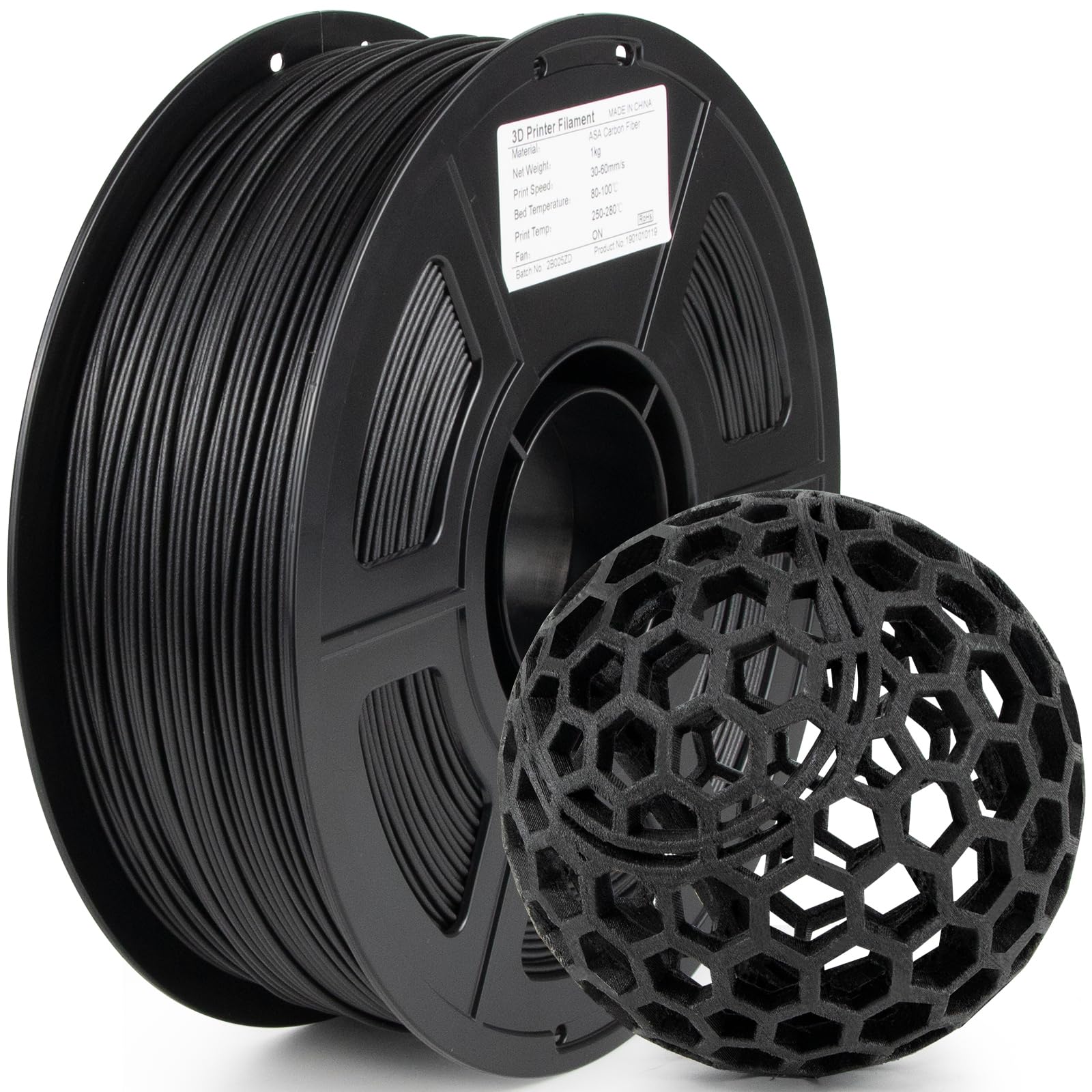
Carbon-fiber-reinforced ASA that boosts stiffness and gives a premium matte finish.
iSANMATE’s ASA Carbon Fiber blend adds chopped carbon fiber to the ASA base, which increases rigidity and reduces warping compared to standard ASA. It resists UV, rain, and heat, and prints at 240-270°C (464-518°F) with a bed at 80-100°C (176-212°F). The 1.75mm diameter holds a ±0.02 mm tolerance, and the filament is vacuum-sealed with desiccant. Owners using it on Bambu X1C and P1S machines report “perfect” prints with sharp details and no stringing after minimal tuning.
The carbon fiber gives the surface a uniform matte finish that hides layer lines well, and the black color is described as “true black.” However, the abrasiveness of carbon fiber means you should use a hardened steel nozzle — standard brass nozzles will wear quickly. There are mixed reports on layer adhesion: some owners praise it, others have had brittleness and poor interlayer bonding. The value is high, with one buyer calling it “a great filament at a great price.”
The CF advantage
- Increased stiffness and reduced warping compared to standard ASA
- Premium matte surface finish that hides layer lines
- Excellent value — 600+ owners rate it highly
The abrasive reality
- Requires a hardened steel nozzle — brass nozzles will wear down quickly
- Mixed feedback on layer adhesion; some users experienced brittleness
- Printing at the high end of the temperature range (270°C) may challenge some printers
Reach for this if: you want outdoor parts with extra stiffness and a clean matte look, and you have a hardened nozzle available.
Think twice if: you only have brass nozzles or you print long, thin parts where layer adhesion is critical — the brittleness may cause cracking.
9. ERYONE ASA Light Weight Filament 1.75mm White 0.75kg
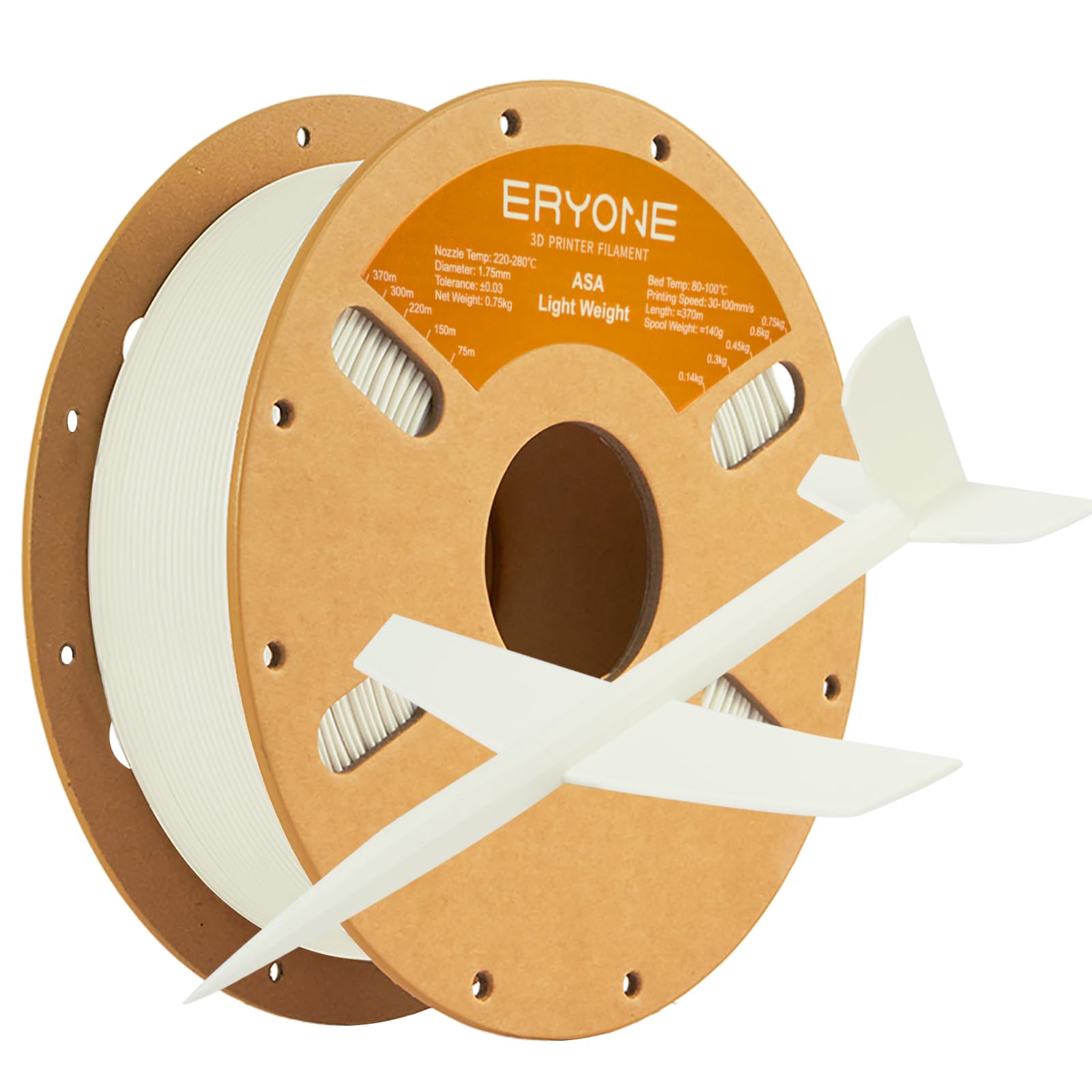
A lightweight ASA that prints like PLA — perfect for RC planes and weight-sensitive outdoor prints.
ERYONE’s Light Weight ASA filament is a lower-density variant designed for applications where every gram matters, such as model airplanes and ship models. It offers UV and weather resistance, low shrinkage, and strong interlayer adhesion. The 1.75mm diameter is vacuum-packed to prevent moisture absorption. Shoppers say that it “prints as easily as PLA” on machines like the Bambu P1S, and that parts are “extremely strong” with no creaking or cracking when thin sections are twisted or flexed.
The trade-off is that the spool is 0.75 kg instead of the standard 1 kg, and the price is higher per gram than standard ASA. The low density means parts are lighter, but they may not have the same impact resistance as a standard-density ASA. One buyer used it for UV and heat-resistant fence post tops in Florida and reports it held up perfectly. Ventilation is still required — the fumes are similar to standard ASA.
What makes it different: “low density, light weight” is the key spec — this is the only filament on the list that explicitly targets weight reduction for flying or floating parts.
The honest trade-off: 0.75 kg spool at a premium price means you pay more per gram; only buy if your project absolutely needs the weight savings.
Best for: RC hobbyists, drone builders, and anyone making lightweight outdoor parts where grams matter.
Who should pass: anyone printing dense structural parts (brackets, mounts, tools) where standard-density ASA offers more impact resistance at a lower cost.
Understanding the Specs
Heat Deflection Temperature (HDT)
This is the temperature at which a material begins to soften under a load. For outdoor parts, you need an HDT of at least 90°C (194°F) — that is the temperature a black part can reach on a sunny dashboard. ABS typically handles 75°C, PETG 63°C, and PLA only 53°C. A filament rated for 100°C (212°F), like many of the picks here, will hold its shape in summer heat without sagging.
Dimensional Accuracy (± mm)
This spec tells you how consistently the filament’s diameter is held as it comes off the spool. A tolerance of ±0.02 mm means the diameter stays between 1.73 mm and 1.77 mm. Tighter tolerances reduce the chance of clogs, under-extrusion, or inconsistent layer lines. For outdoor functional parts, ±0.02 mm or better is preferred. ±0.03 mm (like the Creality) is still workable but may require more calibration.
FAQ
Can I print ASA on an open-frame printer, or do I need an enclosure?
What bed temperature and nozzle temperature should I start with for ASA?
Does ASA need to be dried before printing, even straight from the package?
How long will an ASA print last outdoors?
Is ASA harder to print than PLA?
Will ASA damage my brass nozzle?
Can ASA be painted or glued after printing?
What is the difference between ASA and ABS for outdoor use?
Is ASA safe to print in a bedroom or living area?
What is the cheapest ASA filament that still works well outdoors?
Final Thoughts: The Verdict
For most people, the 3d printer filament for outdoor use winner is the Polymaker ASA because it combines proven UV stability, 100°C heat resistance, and a massive owner base that consistently praises its print quality and durability. If you want high-speed printing, grab the Creality ASA. And for the best bang for your buck, the iSANGHU ASA delivers functional outdoor parts at a budget-friendly price.
How We Picked
We do not accept paid placement. Every pick is matched to a real buyer and a real use-case; we do not hands-on test units.
Sources & Methodology
Specifications: manufacturer listings and product documentation. Review insights: verified customer reviews, as of July 2026. Pricing: not shown on this page (it changes often); check the current price via the retailer link.
As an Amazon Associate, Gadgets Feed earns from qualifying purchases. This does not affect which products we feature.