
You want to 3D print functional parts, cosplay props, or toys, but the biggest barrier isn’t the printer itself — it’s the hours spent fighting with bed-leveling, failed first layers, and tangled filament. Entry-level 3D printing used to mean accepting tinkering as a hobby separate from the hobby of 3D printing. That’s no longer true. The machines below deliver reliable results right out of the box, with auto-leveling, fast print speeds, and ecosystems designed to minimize the learning curve, so your first print isn’t your last.
I’m Min — the co-founder and writer behind Gadgets Feed. I’ve spent countless hours analyzing market specifications, user reliability reports, and firmware ecosystems across more than forty current-production FDM printers to separate the genuinely beginner-friendly machines from the ones that still demand an engineering mindset.
This guide distills thousands of hours of community feedback and spec-sheet analysis into your single, trusted source for the best 3d printer for beginners, whether you are buying for a child, a classroom, or your own first foray into additive manufacturing.
How To Choose The Best 3D Printer For Beginners
The wrong beginner printer can turn a creative hobby into a frustrating troubleshooting exercise. Focus on four pillars: the leveling system, the extruder design, the build plate surface, and the software ecosystem. A printer that scores well in all four will have you printing successfully within your first hour, not your first weekend.
Auto Leveling is the Deciding Factor
A manual leveling process — loosening and tightening springs under the bed with a piece of paper — is the single biggest cause of beginner drop-off. Look for full-auto leveling that uses a sensor (CR Touch, strain sensor, or inductive probe) to map the bed across 16 to 49 points and compensates for any tilt or warp automatically. Machines like the Entina Tina2 Plus offer pre-calibrated ready-to-print setups that skip leveling entirely.
Direct Drive vs. Bowden Extruder
A direct-drive extruder mounts the motor directly above the nozzle, giving you better control over flexible filaments like TPU and reducing retraction stringing. For beginners, a direct drive translates to fewer failed prints when experimenting with different materials. The Creality Ender-3 V3 KE and the Flashforge Adventurer 5M both use Sprite-style direct drives that handle PLA, PETG, and TPU with minimal profile tuning.
Build Plate Surface and Adhesion
A flexible PEI spring-steel build plate is the gold standard for beginners. It provides excellent adhesion during the print and pops off easily when bent. Textured PEI sheets also eliminate the need for glue sticks or painter’s tape on most PLA prints. The ELEGOO Centauri Carbon features a dual-sided plate with a specific PLA-optimized surface that lowers the required bed temperature while maintaining strong adhesion.
Software Ecosystem and Slicer Compatibility
Closed ecosystems lock you into a single slicer or app, which can limit learning and upgrade paths. Open machines that work with Orca Slicer, Cura, or PrusaSlicer give you flexibility as your skills grow. Look for printers that support WiFi or cloud printing with a mobile app so you can start prints and monitor progress without sitting at your desk. The Bambu Lab P1S runs on Bambu Studio and offers deep community integrations through MakerWorld.
Quick Comparison
On smaller screens, swipe sideways to see the full table.
| Model | Category | Best For | Key Spec | Amazon |
|---|---|---|---|---|
| Flashforge Adventurer 5M | Premium Entry | Fast reliable printing with minimal tinkering | 600mm/s speed, full auto-leveling, CoreXY | Amazon |
| Creality Ender-3 V3 KE | Premium Mid-Range | Versatile performance with large modding community | 500mm/s, 300°C nozzle, Sprite direct extruder | Amazon |
| Anycubic Kobra X Multicolor | Premium Multi-Color | Low-waste 4-color printing out of the box | 600mm/s, built-in 4-color system, AI camera | Amazon |
| Bambu Lab P1S | Premium Enclosed | Advanced materials and hands-off reliability | 500mm/s, 20000mm/s² accel, enclosed, 16-color AMS | Amazon |
| Creality K1C | Premium Carbon Fiber | Carbon fiber filaments and silent operation | 600mm/s, 300°C nozzle, AI camera, 45dB silent mode | Amazon |
| ELEGOO Centauri Carbon | Mid-Range Enclosed | Fully enclosed CoreXY with automated calibration | 500mm/s, 320°C nozzle, die-cast frame, camera | Amazon |
| Creality Ender 3 V3 SE | Mid-Range Value | Budget-friendly with Sprite extruder and auto leveling | 250mm/s, 2500mm/s² accel, Sprite direct extruder | Amazon |
| Entina Tina2 Plus | Budget-Friendly | Kids and classroom with WiFi cloud printing | 250mm/s, ceramic hotend, PEI plate, Poloprint app | Amazon |
| Geeetech M1 Mini | Budget-Friendly | Small, safe enclosed printer for young beginners | 250mm/s, 16-point auto-leveling, fully enclosed | Amazon |
In‑Depth Reviews
1. Flashforge Adventurer 5M

The Flashforge Adventurer 5M hits the sweet spot between speed and simplicity. Its CoreXY motion system allows a blistering 600mm/s print speed with 20000mm/s² acceleration, yet the entire setup — from unboxing to first print — takes under ten minutes thanks to one-click full-auto leveling. The 0.4mm nozzle heats to 200°C in 35 seconds, and the vibration compensation algorithm eliminates ghosting at high speeds.
Print quality is consistently smooth on PLA, PETG, and TPU with the dual-sided PEI coating plate providing excellent adhesion without glue. The 220x220x220mm build volume is adequate for most beginner projects, and the open-frame design is easy to access for cleaning and maintenance. Power loss recovery and a filament runout sensor mean even overnight prints finish without babysitting.
Community feedback over 12-plus months shows remarkable reliability — dozens of prints with zero hardware failures on properly maintained units. The main tradeoffs are a small build volume compared to larger bed-slingers and WiFi connectivity issues on 5GHz networks, but a 2.4GHz band connection resolves those consistently. Flashforge’s tech support is notably responsive, often sending replacement parts within days.
Why it’s great
- True 10-minute setup with one-click auto leveling
- 600mm/s CoreXY with vibration compensation eliminates ghosting
- Runs PLA, PETG, and TPU reliably with excellent bed adhesion
- Responsive customer support with rapid replacement part shipping
Good to know
- Build volume limited to 220mm³ which may restrict larger projects
- WiFi can be finicky on 5GHz networks
- Enclosure kit sold separately for advanced materials
- Touchscreen interface occasionally freezes during long prints
2. Creality Ender-3 V3 KE

The Ender-3 V3 KE is Creality’s most refined beginner-oriented machine, combining the massive aftermarket ecosystem of the Ender line with genuine out-of-box improvements. The 500mm/s print speed and 8000mm/s² acceleration are backed by a Sprite direct extruder that hits 300°C, making it compatible with PLA, PETG, ABS, TPU, and ASA. The CR Touch sensor performs automatic bed leveling across multiple points, and the 0.1mm printing accuracy is visible in the clean first layers.
Assembly is a swift 10-minute process with the all-in-one design, and the intuitive touch UI with real-time model preview removes guesswork. The X-axis carriage uses ball bearings for smooth motion, while smart algorithms mitigate ringing through acceleration control. The 220x220x250mm print volume is slightly taller than the Adventurer 5M, helpful for vertical models like vases or articulated figures.
User reports consistently praise its reliability as a workhorse — one reviewer logged over 40 prints in six months with zero failures. The dual-fan cooling system ensures sharp overhangs, and power-loss recovery adds safety for long prints. The main criticism is noise level: the cooling fans are audible during operation, and some units arrive with the PSU set to 240V, requiring a simple switch flip for US users.
Why it’s great
- Sprite direct extruder handles flexible filaments up to 300°C
- CR Touch auto leveling ensures consistent first layers every time
- Large Creality community provides endless modding guides and support
- 10-minute assembly with tool-free parts
Good to know
- Fans are loud during printing
- Requires checking and flipping PSU voltage switch for US power
- Some units arrive with gantry alignment issues needing manual correction
- Touchscreen interface lacks the responsiveness of more expensive models
3. Anycubic Kobra X Multicolor
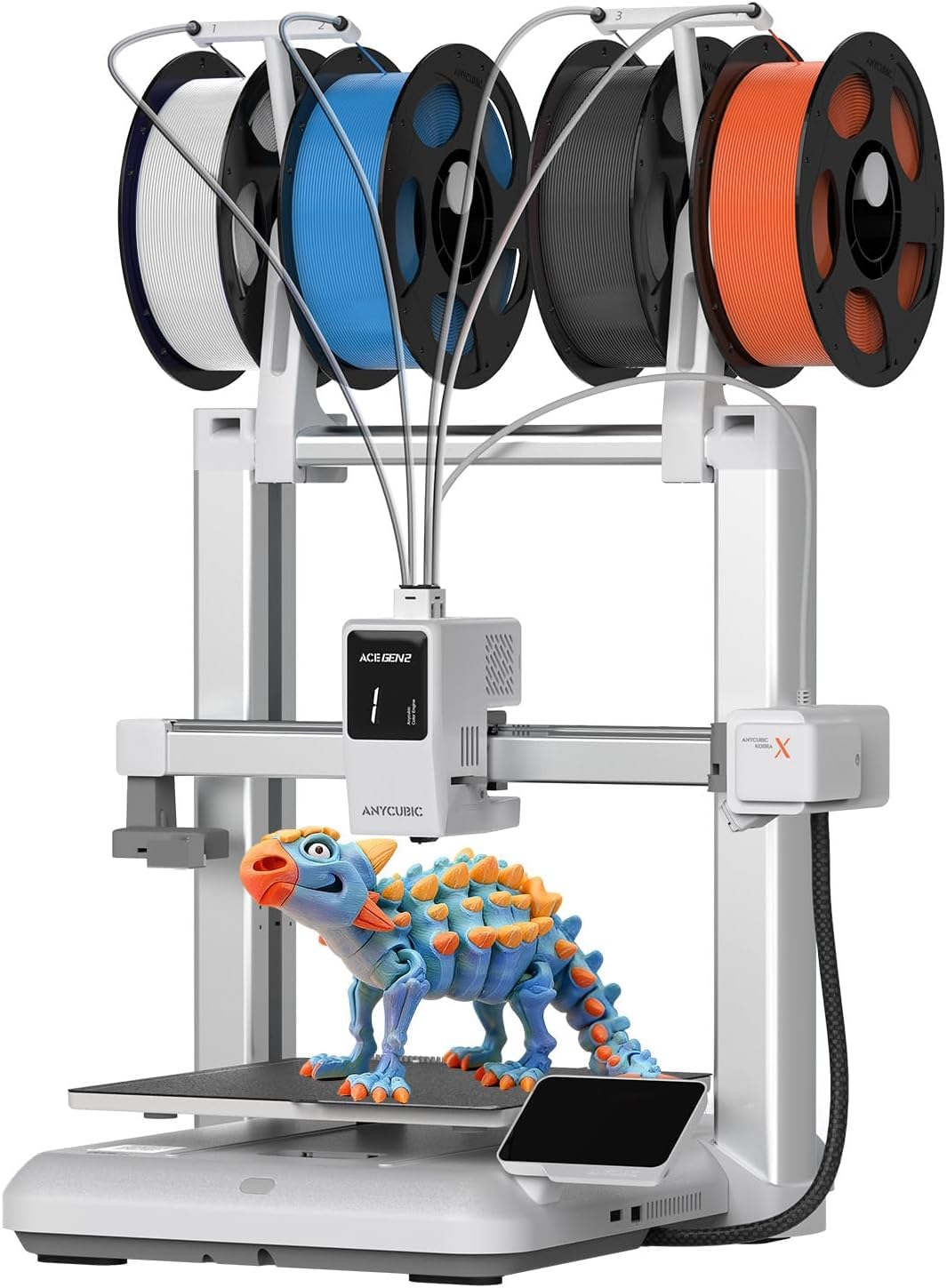
The Anycubic Kobra X shatters the assumption that multi-color printing belongs to premium tiers. It ships with a built-in 4-color system that reduces purge waste by 81.25% compared to traditional multi-material units, making it cost-effective for beginners who want vibrant prints without manual filament swaps. The LeviQ 3.0 auto leveling uses 49-point calibration to guarantee bed flatness, and the open-frame machine reaches full print speed of 600mm/s with vibration compensation for smooth layers.
The 260mm³ build volume is generous for the price, and the hardened steel nozzle handles PLA, PETG, TPU, PVA, and ASA up to 300°C. Dual-band WiFi (2.4GHz and 5GHz) enables remote monitoring via the Anycubic app, which also includes a library of over 10,000 models. The AI camera detects spaghetti failures and foreign objects, pausing prints automatically — a feature typically found on machines costing twice as much.
User reviews highlight near-flawless first 100 hours of printing, with excellent bed adhesion and crisp layer lines. The ACE 2 Pro system can be daisy-chained to expand to 19 colors, making this a future-proof platform for growing skills. The primary downside is the app interface, which reviewers describe as less polished than Bambu Studio, though desktop slicer compatibility remains open.
Why it’s great
- Native 4-color printing with 81% less purge waste than competitors
- LeviQ 3.0 49-point auto leveling ensures perfect first layers
- AI camera with spaghetti detection for unattended operation
- Expandable to 19 colors with additional ACE 2 Pro units
Good to know
- Mobile app interface is less polished than desktop alternatives
- ACE 2 Pro and ACE Pro are not cross-compatible
- Build plate requires occasional isopropyl alcohol cleaning for consistent adhesion
- Some users report stone PLA produces visible layer lines
4. Bambu Lab P1S

The Bambu Lab P1S is the benchmark for hands-off reliability in an enclosed format. Its fully enclosed body supports advanced filaments like ABS and ASA without warping, while the auto bed leveling system measures the bed before every print to compensate for thermal expansion. The 500mm/s print speed and 20000mm/s² acceleration are delivered by a CoreXY mechanism that maintains consistency across the 256mm³ build volume.
Setup takes under 30 minutes. The Bambu Studio slicer integrates deeply with the printer, offering pre-tuned profiles for PLA, PETG, TPU, PVA, ABS, and ASA. The AMS (Automatic Material System) supports up to 16 colors, and the enclosed print chamber keeps dust and drafts away from the print surface. Users consistently report 95/100 print quality scores with zero adhesion issues.
Quiet operation makes it suitable for shared spaces, and the built-in camera allows remote monitoring through the mobile app. The MakerWorld community provides thousands of ready-to-print models with one-click slicing. The main drawbacks are the closed ecosystem — Bambu Studio is excellent but the printer’s full potential is best realized within it — and the price of the AMS units for multi-color printing. TPU printing can be finicky due to the enclosed design trapping heat.
Why it’s great
- Fully enclosed chamber enables ABS and ASA without warping
- Auto leveling before each print ensures flawless first layers
- Bambu Studio slicer offers deep pre-tuned profiles for multiple materials
- Quiet operation and compact footprint in a premium package
Good to know
- Closed ecosystem limits slicer flexibility
- AMS units are sold separately for multi-color
- TPU printing can be challenging due to heat buildup
- Security-conscious users may prefer intranet-only mode over cloud connectivity
5. Creality K1C

The Creality K1C is the fastest fully enclosed printer in this lineup for beginners who want to experiment with carbon fiber filaments. The CoreXY system hits 600mm/s and 20000mm/s² acceleration, and the tri-metal “Unicorn” nozzle combines a hardened steel tip with a titanium alloy heatbreak to prevent clogs even with abrasive PLA-CF, PA-CF, and PET-CF. The enclosed chamber with activated carbon air purification makes it suitable for odor-sensitive environments.
Hands-free auto calibration handles leveling, vibration compensation, and dynamic balancing with a single tap. The AI camera monitors for foreign objects and spaghetti failures in real time, and the silent mode drops noise to 45dB without sacrificing travel speed. The 300°C hotend and hardened nozzle expand material compatibility well beyond what typical beginner machines handle.
User feedback is generally positive, with many praising the fast print speeds and the ability to print carbon fiber parts for drone and automotive projects. The Creality OS is based on Klipper, which is fully open source and supports custom optimizations. However, some users find the multicolor printing workflow with the CFS confusing and poorly documented, and the printer/slicer integration can occasionally desync, causing unexpected cancellations. This machine is best for beginners who are comfortable with a modest learning curve in exchange for advanced material capabilities.
Why it’s great
- Tri-metal “Unicorn” nozzle resists clogs with carbon fiber filaments
- 600mm/s CoreXY with silent mode at 45dB
- AI camera monitors prints and captures time-lapses
- Open-source Klipper firmware allows custom tuning
Good to know
- Multicolor setup with CFS is complex and poorly documented
- Printer and slicer can desync, causing cancellation errors
- Air purification requires periodic replacement of carbon bags
- Some users report lockups requiring full power cycles
6. ELEGOO Centauri Carbon
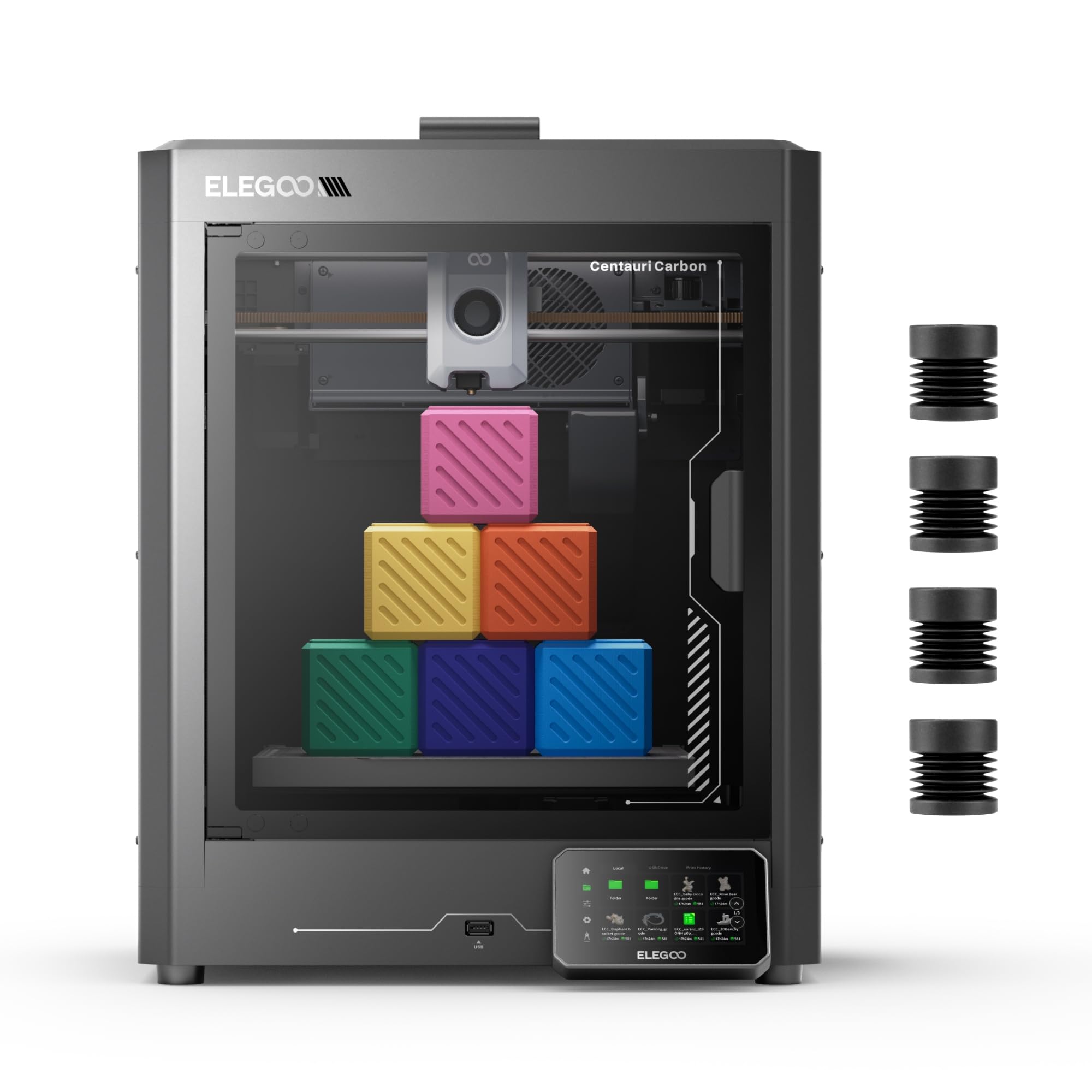
The ELEGOO Centauri Carbon is a fully enclosed CoreXY printer that arrives pre-calibrated and ready to print within minutes. Its rigid die-cast aluminum frame minimizes vibration during high-speed printing up to 500mm/s and 20000mm/s² acceleration. The 320°C brass-hardened steel nozzle is rated for carbon fiber reinforced filaments, and the enclosed chamber with enhanced cooling ensures consistent layer adhesion.
The auto bed leveling and vibration compensation systems work automatically every print, and the dual-sided build plate features a PLA-specific surface that delivers strong adhesion without high bed temperatures. The 256mm³ build volume is spacious for mid-sized projects, and the built-in camera with dual LED lighting enables real-time monitoring and time-lapse capture from the ELEGOO app.
Users consistently praise the print quality and reliability, with several reporting hundreds of hours without a single failure. The ELEGOO slicer integrates with WiFi for wireless file transfers, and the printer supports remote adjustments. The main concern is inconsistent quality control — some units experience hotend communication errors within the first week, and the USB-C connection can be unreliable on the initial batch. ELEGOO’s tech support is responsive but can be slow for US customers due to time zone differences.
Why it’s great
- Fully enclosed, pre-calibrated, and ready in minutes
- 320°C hotend handles carbon fiber and advanced filaments
- Dual-sided PEI/PLA-specific plate reduces bed temperature needs
- Rigid die-cast frame minimizes vibration for crisp details
Good to know
- Some units ship with unreliable USB-C connections
- Tech support response time can be slow for US customers
- ELEGOO slicer crashed on complex models on older computers
- Heavy at 38.5 pounds; not easily portable
7. Creality Ender 3 V3 SE

The Ender 3 V3 SE is the budget-conscious beginner’s gateway into the Creality ecosystem. It offers 250mm/s print speed with 2500mm/s² acceleration, which saves 73% of print time compared to older Ender models. The Sprite direct extruder handles PLA, PETG, and TPU without the Bowden tube complications of previous generations, and the CR Touch sensor with strain sensor provides automatic z-offset and bed leveling.
The PC spring steel build plate is flexible and sticky, allowing easy model removal by bending. Assembly takes three steps and about 20 minutes, and the auto filament loading/unloading system makes material swaps effortless. The 220x220x250mm build volume matches the V3 KE, providing sufficient height for functional prints.
Community feedback is overwhelmingly positive for the price — users report high-quality prints that rival machines costing twice as much. The V3 SE retains the Ender’s massive aftermarket support for upgrades like glass beds, stiffer springs, and dual-z kits. The primary issue is power switch positioning: US buyers must manually flip the internal switch from 240V to 110V before powering on, and a small number of units arrive with defective mainboards that crash on startup, requiring a return.
Why it’s great
- Sprite direct extruder prints PLA, PETG, and TPU reliably
- Auto leveling with z-offset sensor eliminates manual paper-leveling
- Flexible PC spring steel bed allows easy print removal
- Massive Creality modding community for future upgrades
Good to know
- PSU voltage switch must be manually set to 110V for US power
- Small number of units arrive with defective mainboards
- Fans are audible during high-speed printing
- Build plate adhesion requires clean surface for consistent results
8. Entina Tina2 Plus

The Entina Tina2 Plus is purpose-built for the youngest makers. It arrives fully assembled — no calibration, no paper-leveling, no tools — and the included TF card with preloaded models lets a child start printing within minutes. The ceramic hotend heats to printing temperature in 40 seconds, and the PEI spring steel platform provides consistent adhesion for small PLA models like animals, keychains, and action figures.
WiFi connectivity through the Poloprint Cloud app grants access to a library of 1,500+ models and supports remote monitoring. The partially enclosed frame protects moving and hot components from direct contact, making it safer for supervised home and classroom use. Dual Z-axis construction improves print stability, and the auto-leveling system removes the most common point of beginner frustration.
Users report solid print quality for the size and price, with one reviewer noting it captivated a 10-year-old and inspired a math fair project. The compact footprint (11.4 x 8.6 x 8.6 inches) fits easily on a desk. The main complaints are the mobile app’s limited model library and occasional WiFi disconnections that require re-registration. The included filament spool is small (500g), so larger project spools need a printable adapter kit.
Why it’s great
- Fully assembled and ready to print in minutes — no setup required
- Ceramic hotend reaches temperature in 40 seconds
- PEI spring steel plate provides strong adhesion for small models
- Partially enclosed frame improves safety for children
Good to know
- Mobile app library of 1,500 models is limited compared to desktop alternatives
- WiFi can disconnect, requiring re-registration in the app
- Larger 1kg spools require a printed adapter kit
- Customer service contact is a personal cell phone with limited availability
9. Geeetech M1 Mini
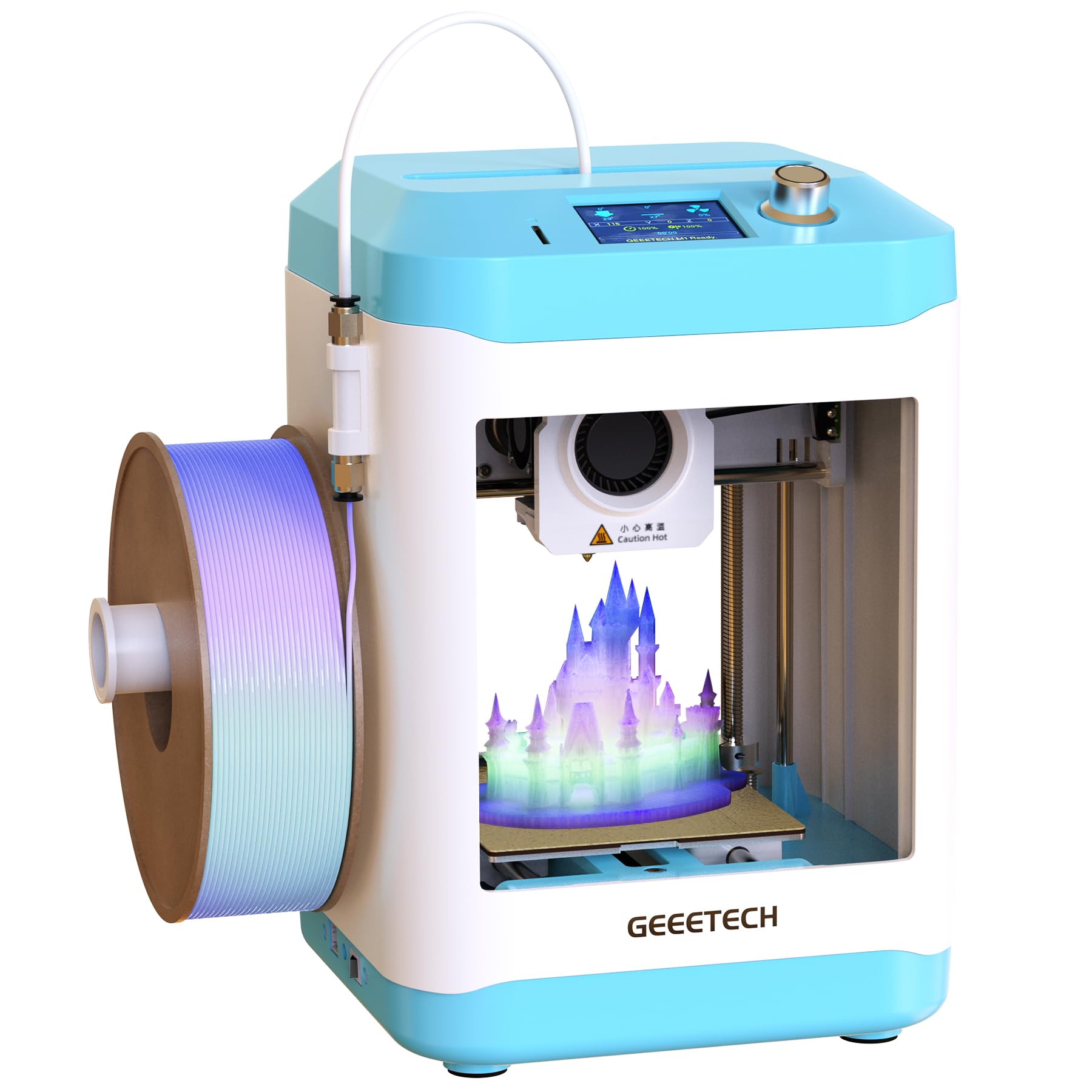
The Geeetech M1 Mini is a compact enclosed printer designed specifically for kids and beginners who need a safe, small-form-factor machine. The fully enclosed body keeps hot and moving parts away from curious fingers, and the bright interior lighting makes it easy to watch prints progress through the transparent cover. The 16-point full-auto leveling and flexible magnetic build plate ensure reliable first layers and simple part removal.
The direct-drive extruder uses a 1:5 dual-drive metal gear system for consistent extrusion force, and the 50W heating rod brings the nozzle to temperature quickly. Print speed reaches 250mm/s, and the open-source firmware works with Orca Slicer or Cura for full software flexibility. The 100x110x100mm (3.94 x 4.33 x 3.94 inches) build volume is small but sufficient for toys, jewelry, and small functional parts.
User reviews highlight the excellent value — it prints better out of the box than some upgraded budget machines — and the portability with its built-in handle. The 2.4-inch LCD color screen and knob operation make navigation simple enough for a 7-year-old to manage. The main drawbacks are the tiny build volume that limits project scope, and a poorly positioned filament holder near the power cable that can cause jams if not managed carefully.
Why it’s great
- Fully enclosed for safe operation with kids around
- 16-point auto leveling with flexible magnetic build plate
- Open-source firmware compatible with Orca Slicer and Cura
- Portable with built-in handle for easy movement
Good to know
- Very small build volume (100 x 110 x 100 mm) limits project scope
- Filament holder position near power cable can cause jams
- Pausing and resuming prints can cause layer shifts or clogs
- Only compatible with small filament spools (500g included)
FAQ
Do I need to manually level the bed on a beginner 3D printer?
What filament should a beginner start with on their first 3D printer?
Final Thoughts: The Verdict
For most users, the best 3d printer for beginners winner is the Flashforge Adventurer 5M because it combines CoreXY speed with 10-minute setup and the most reliable auto-leveling system in its price class. If you want multi-color printing without the complexity of separate AMS units, grab the Anycubic Kobra X Multicolor. And for a fully enclosed machine that prints carbon fiber composites straight out of the box, nothing beats the Creality K1C.