
Printing carbon fiber reinforced filaments like CF-PLA or CF-Nylon requires a machine that can handle extreme abrasion and sustained high temperatures without degrading over time. The hardened steel nozzles, all-metal hotends, and rigid CoreXY frames that define this category are non-negotiable for consistent results with these composites.
I’m Min — the co-founder and writer behind Gadgets Feed. I’ve spent hundreds of hours analyzing the thermal profiles, extrusion systems, and real-world reliability data behind today’s capable carbon fiber 3D printers to help you make a technically sound purchase.
After sorting through user reports on hotend clogging, chamber heating consistency, and build plate adhesion with abrasive filaments, I’ve narrowed the field to the five machines that genuinely earn the title of best 3d printer that prints carbon fiber on the market right now.
How To Choose The Best 3D Printer That Prints Carbon Fiber
Not every printer labeled “carbon fiber compatible” can reliably print CF-PLA or CF-Nylon day after day. The fine carbon strands in these filaments are highly abrasive, meaning a standard brass nozzle will wear out in a single roll. A capable machine must combine hardened hotend components with sufficient hotend temperature to melt high-temp matrices like nylon or polycarbonate.
Hotend Temperature & Nozzle Material
A printer must reach at least 280°C to reliably print CF-Nylon and CF-PC, with 300°C or higher providing breathing room for engineering composites. The nozzle must be hardened steel, ruby-tipped, or another abrasion-resistant material — brass nozzles will deform and ruin print quality within hours when running carbon fiber filament.
Chamber Heating & Enclosure
Printing carbon fiber reinforced nylon or PC requires a warm chamber to prevent warping and delamination. An actively heated enclosure (60°C or higher) dramatically improves layer adhesion for these materials. Passive enclosures help with PLA-CF but struggle with engineering-grade filaments that have higher glass transition temperatures.
Extrusion System & Motion Platform
A direct-drive extruder with hardened steel gears is essential for pushing abrasive filaments smoothly through the hotend without slipping. The CoreXY motion platform provides the rigidity needed for high-speed carbon fiber printing without introducing ringing or ghosting into the final part. Look for all-metal frames and linear rails for long-term dimensional stability.
Quick Comparison
On smaller screens, swipe sideways to see the full table.
| Model | Category | Best For | Key Spec | Amazon |
|---|---|---|---|---|
| QIDI Q1 Pro | Premium | Engineering filaments & open source | 350°C bimetal nozzle, 60°C active chamber | Amazon |
| Creality K2 Combo | Premium | Multi-color carbon fiber prints | 300°C hardened steel nozzle, CFS 4-color system | Amazon |
| ELEGOO Centauri Carbon 2 | Mid-Range | Multicolor CF with closed ecosystem | 350°C nozzle, 4-color CANVAS system | Amazon |
| Creality K1C | Mid-Range | Fast carbon fiber with AI monitoring | 300°C tri-metal nozzle, AI camera | Amazon |
| Flashforge Adventurer 5M Pro | Budget-Friendly | Beginner CF printing on a budget | 280°C full-metal hotend, 600mm/s speed | Amazon |
In‑Depth Reviews
1. QIDI Q1 Pro 3D Printer

The QIDI Q1 Pro delivers the highest hotend temperature in this lineup at 350°C, paired with an actively heated chamber that reaches 60°C. This combination allows it to handle CF-Nylon, CF-PC, and even glass fiber filaments without warping or delamination. The 600mm/s CoreXY motion system and independent dual Z-axis motors keep layers precise even at speed.
Running on an open-source Klipper firmware base, the Q1 Pro supports custom optimization and direct slicer control without being locked into a proprietary ecosystem. Users report flawless out-of-box prints with PLA, ASA, PA612-CF15, and PETG-CF after minimal tuning. The 1080p HD camera provides real-time monitoring and time-lapse capture through the mobile app.
The power supply consistently delivers stable heat to the 350°C bimetal hotend, and the hardened steel nozzle withstands hundreds of hours of abrasive carbon fiber printing without noticeable wear. The Q1 Pro’s active chamber control dramatically reduces the risk of layer separation in tall ABS and PC prints — a common pain point with passively enclosed machines.
Why it’s great
- 350°C bimetal nozzle handles CF-Nylon and glass fiber
- Actively heated 60°C chamber prevents warping in engineering filaments
- Fully open-source Klipper firmware for advanced tuning
Good to know
- No built-in activated carbon air filter — needs printed enclosure upgrades
- Side spool mount is flimsy; stable on filament at rear
2. Creality K2 Combo 3D Printer
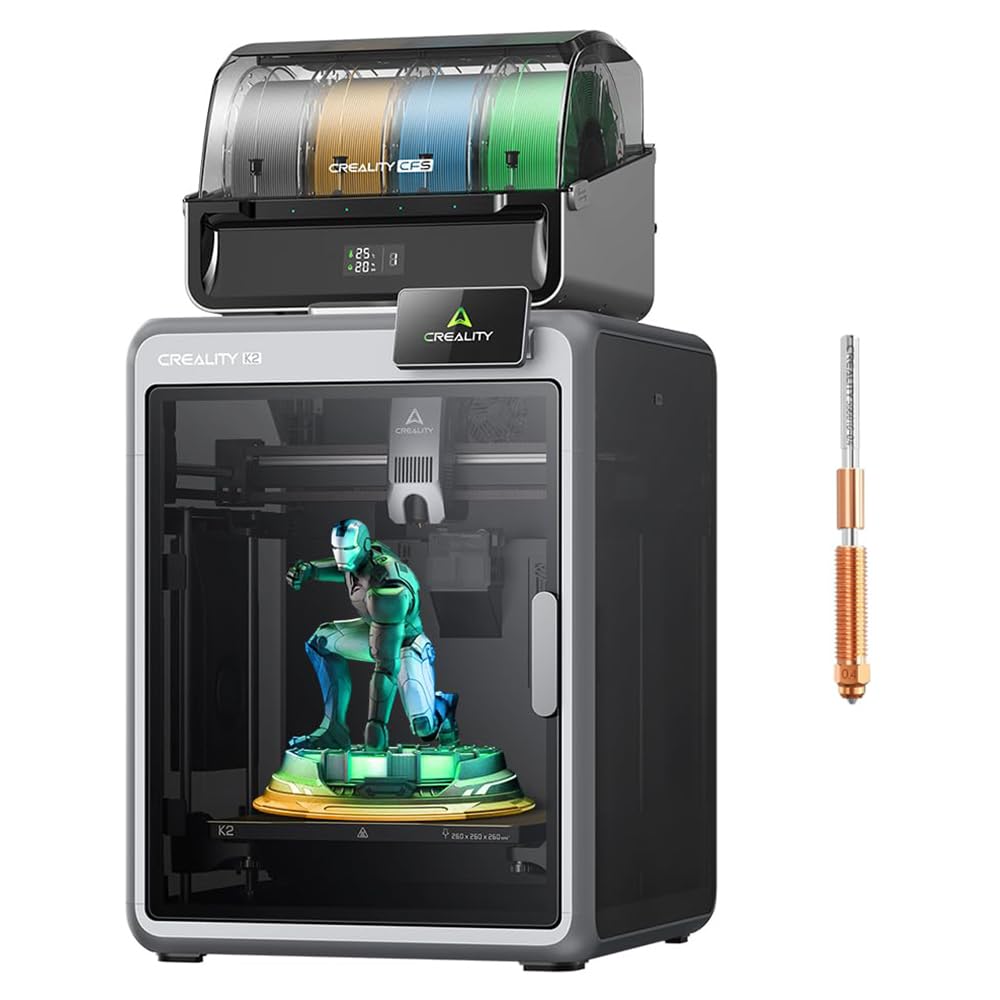
The Creality K2 Combo combines a 300°C hardened steel hotend with the CFS multi-color system, enabling up to 16-color prints using carbon fiber filament across a sizable 260mm³ build volume. The 80W heater achieves an ABS flow rate of 40mm³/s at 280°C, making it one of the fastest high-flow systems available for engineering composites.
The industry-grade 3-step servo motors on the extruder and X/Y axes deliver consistent extrusion pressure, which is critical when pushing abrasive carbon fiber filament through the hotend without grinding or inconsistent output. The Chamber AI camera monitors for spaghetti failures, foreign objects, and idling, then alerts the user to intervene or exclude failed parts from batch prints.
The matrix frame constructed from aerospace aluminum alloy provides the structural rigidity needed for 600mm/s printing without resonance artifacts. Users note that the magnetic PEI bed provides excellent first-layer adhesion for CF-PLA, though some prefer a glass bed for perfectly flat surfaces on larger prints. The CFS system’s intelligent management handles filament changes automatically without user intervention.
Why it’s great
- CFS multi-color system supports up to 16 colors with carbon fiber filament
- 40mm³/s high-flow hotend with hardened steel gears
- Large 260mm cubic build volume for helmets and large parts
Good to know
- Assembly takes around one hour with manual alignment needed
- Some units shipped with incorrect voltage setting out of the box
3. ELEGOO Centauri Carbon 2 Combo
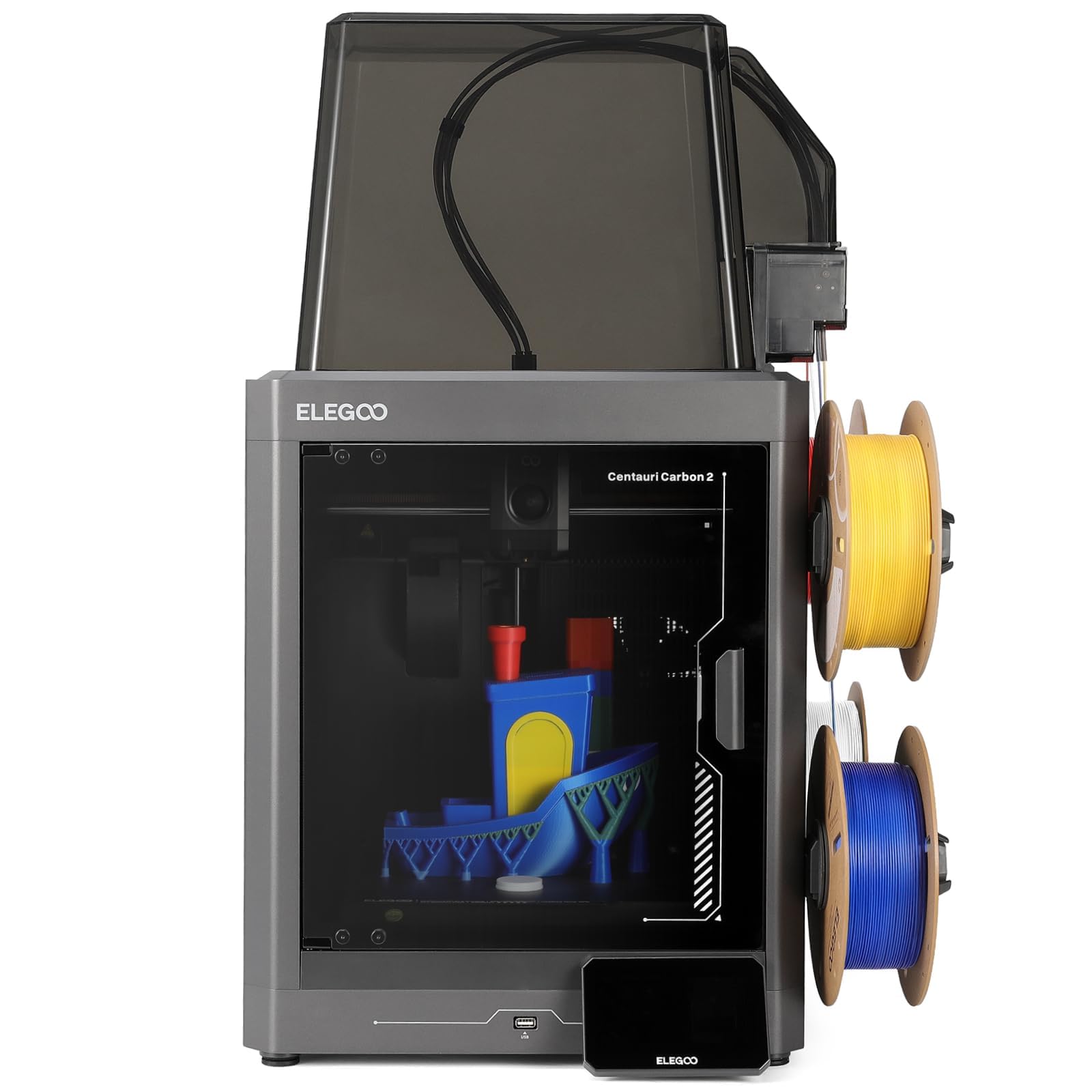
The ELEGOO Centauri Carbon 2 Combo features a 350°C high-temp nozzle paired with the CANVAS 4-color auto-switching system, offering seamless multicolor carbon fiber printing. Its 500mm/s top speed and 20,000mm/s² acceleration are backed by a rigid aluminum CoreXY frame and active vibration compensation, producing smooth surfaces with crisp detail.
The fully automated calibration suite handles bed leveling, pressure advance, and input shaping with a single tap on the touch screen. The 31 on-board sensors continuously monitor for filament tangle, auto-refill, and jam conditions, making this a genuinely walk-away printer for long CF-PLA runs. The 256mm cubic build volume sits between the K1C and K2 Combo, offering a balanced footprint.
Users praise the out-of-box reliability and the CANVAS system’s instant color switching, which avoids the purge waste typical of other multi-filament systems. The closed ecosystem uses a proprietary slicer and firmware, which limits custom Klipper-based tuning but simplifies the experience for users who prioritize reliability over tinkering. The chamber light and camera work through the mobile app for remote monitoring.
Why it’s great
- 350°C high-temp nozzle with 4-color CANVAS auto-switching
- Walk-away reliability with 31 onboard sensors and auto calibration
- Active vibration compensation produces crisp surface finishes
Good to know
- Closed ecosystem locks you to proprietary slicer and firmware
- Some firmware updates have caused connectivity and print failures
4. Creality K1C 3D Printer

The Creality K1C upgrades the original K1 platform with a 300°C tri-metal nozzle specifically designed for 1,000 hours of clog-free carbon fiber extrusion. The quick-swap nozzle and thermal barrier unit combine to block heat creep — a common failure mechanism when running high-temperature engineering filaments. The 600mm/s top speed and 20,000mm/s² acceleration deliver 12x faster prints than typical bed-slinger machines.
The built-in AI camera provides real-time monitoring with proactive failure alerts, and the silent mode keeps noise at or below 45dB for comfortable around-the-clock operation. The active carbon filter purifies compounds and particles from molten filaments, a useful feature when running CF-Nylon which can emit fumes during long prints. The K1C runs on Creality OS based on Klipper, offering open-source flexibility.
For carbon fiber printing, the hardened steel nozzle tip and enclosed chamber handle PLA-CF and PETG-CF reliably. Users transitioning from Ender-style machines praise the auto-leveling and self-calibration that eliminate manual bed leveling entirely. The 220x220x250mm build volume is compact but adequate for most functional prototyping and end-use parts.
Why it’s great
- Tri-metal nozzle rated for 1,000 hours of clog-free carbon fiber use
- AI camera with proactive failure detection and time-lapse
- Silent mode at ≤45dB for undisturbed overnight operation
Good to know
- Documentation is limited — beginners should watch setup videos
- Some units arrive missing spool holder or require vibration tuning for first layers
5. Flashforge Adventurer 5M Pro 3D Printer

The Flashforge Adventurer 5M Pro brings carbon fiber capability to the lower end of the market with a 280°C full-metal direct extruder and support for PLA-CF and PETG-CF materials. While it lacks the 300°C+ ceiling of premium machines, it handles the most common carbon fiber filaments reliably at an entry-level price. The 600mm/s top speed and 20,000mm/s² acceleration come from the CoreXY all-metal frame.
Setup takes about 10 minutes from unboxing to first print, making it the most beginner-friendly option here. The pressure-sensing auto bed leveling detects platform height with multi-point precision and eliminates any need for Z-axis calibration or print rafts. The dual-sided PEI platform allows tool-less model removal — flex the bed and parts pop off cleanly.
The Flash Maker mobile app provides remote video monitoring, real-time tracking, parameter adjustments, and notifications. The dual circulation system reduces dust inside the chamber during CF printing. Multiple nozzle sizes (0.25mm, 0.4mm, 0.6mm, 0.8mm) offer flexibility between speed and detail. The main limitation is the 280°C ceiling, which prevents printing higher-temperature CF-Nylon and CF-PC blends.
Why it’s great
- Budget-friendly entry point for PLA-CF and PETG-CF printing
- 10-minute unbox-to-print setup with tool-less PEI bed removal
- Dual circulation system reduces dust during carbon fiber printing
Good to know
- 280°C maximum nozzle temp limits CF-Nylon and CF-PC compatibility
- 220mm build volume is smaller than premium competitors
FAQ
Can any 3D printer print carbon fiber filament?
Is a heated chamber necessary for carbon fiber printing?
What bed adhesion method works best for carbon fiber filaments?
Final Thoughts: The Verdict
For most users, the winner of the 3d printer that prints carbon fiber category is the QIDI Q1 Pro because its 350°C hotend and actively heated 60°C chamber provide the widest material compatibility at a price that undercuts industrial alternatives. If you want multi-color carbon fiber prints without sacrificing build volume, grab the Creality K2 Combo. And for easy PLA-CF printing on a tight budget, nothing beats the Flashforge Adventurer 5M Pro.