
The 3D printer under $900 market has matured past the era of finicky bed leveling and slow, single-color output. Today, you can buy a machine with enclosed chambers, multi-material systems, and speeds over 500 mm/s without breaking into the four-figure territory. The challenge now isn’t finding a capable printer—it’s picking the right one among the many that actually deliver on their promises.
I’m Min — the co-founder and writer behind Gadgets Feed. My analysis of this market involved cross-referencing print speeds, layer resolutions, material compatibility, and real-world reliability data from hundreds of user sessions across nine distinct models to separate the true workhorses from the firmware headaches.
Whether you are prototyping for a small business or building your first workshop, this guide evaluates build volume, nozzle temperature floors, and chamber heating to help you find the best 3d printer under $900 that fits your specific material and workflow needs.
How To Choose The Best 3D Printer Under $900
When you are searching for a 3D printer under $900, the key is understanding which advanced features are non-negotiable for your specific print goals. At this budget, the margin for error shrinks; a printer with a low max nozzle temperature will lock you out of engineering-grade filaments, while a bed-slinger lacking a heated chamber will make ABS prints a constant struggle against warping.
Print Volume vs. Material Enclosure
A larger build volume, like the 400 mm³ on the Ender 5 Max, is a clear advantage for batch production or oversized prototypes. However, that open frame design makes it nearly impossible to maintain the stable ambient temperature required for materials like ABS or polycarbonate. If you prioritize engineering-grade materials, a smaller enclosed printer with active chamber heating—like the QIDI Q2 with its 65°C heated chamber—will deliver far higher success rates than a larger open-frame unit.
Speed Versus Vibration Compensation
Claimed speeds of 600 mm/s or more are common in this bracket, but raw acceleration numbers mean little without proper vibration compensation and a rigid frame. The Anycubic Kobra X and Ender 3 V3 Plus both advertise 600 mm/s, but their success depends on automatic input shaping algorithms. Look for printers that calibrate resonance compensation before every print to avoid ringing artifacts on vertical surfaces, especially if you plan to print tall, detailed models.
Quick Comparison
On smaller screens, swipe sideways to see the full table.
| Model | Category | Best For | Key Spec | Amazon |
|---|---|---|---|---|
| Anycubic Kobra X | FDM / Multi-Color | Multicolor without AMS cost | 600mm/s Max Speed, 4-Color Native | Amazon |
| Creality Ender 3 V3 Plus | FDM / Large Bed | Larger prints on a budget | 300x300x330mm Build Volume | Amazon |
| ELEGOO Centauri Carbon | FDM / CoreXY | Out-of-box reliability | 500mm/s, 320°C Nozzle, Die-Cast Frame | Amazon |
| Flashforge Adventurer 5M Pro | FDM / Enclosed | HEPA-filtered safety | 600mm/s, 280°C Nozzle, HEPA Filter | Amazon |
| Bambu Lab P1S | FDM / Enclosed | Fast, enclosed reliability | 500mm/s, 16-Color AMS Ready | Amazon |
| Bambu Lab A1 Combo | FDM / Multi-Color | Easiest multi-color setup | 10,000mm/s² Acceleration, AMS Lite | Amazon |
| QIDI Q2 | FDM / Heated Chamber | Engineering-grade filaments | 65°C Heated Chamber, 370°C Nozzle | Amazon |
| ELEGOO Saturn 4 Ultra 16K | Resin / MSLA | Ultra-fine detail prints | 16K Resolution, 150mm/h Print Speed | Amazon |
| Creality Ender 5 Max | FDM / Large Format | Massive print farm production | 400x400x400mm, 700mm/s, 64-Point Leveling | Amazon |
In‑Depth Reviews
1. QIDI Q2
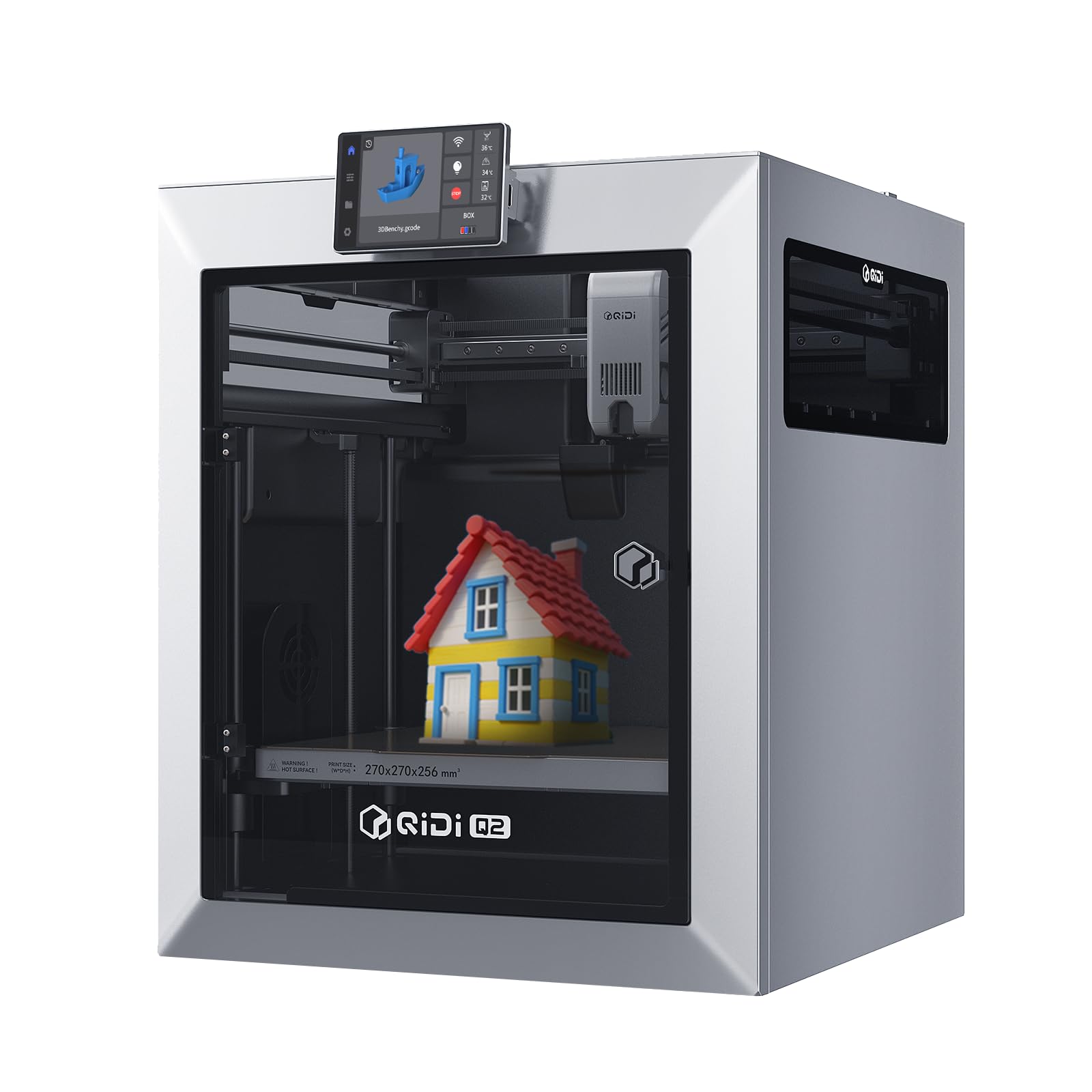
The QIDI Q2 sets a new benchmark for a 3D printer under $900 by offering a genuine 65°C active heated chamber, something typically reserved for machines costing twice as much. Its 370°C all-metal hotend opens up high-temperature materials like polycarbonate and carbon-fiber composites without the need for an upgrade path. The 270 mm³ build volume is generous for an enclosed unit, and the second-generation PTC heating system ensures uniform temperatures to eliminate warping on tall ABS prints.
On the precision side, the Q2 uses the nozzle itself as the bed-leveling sensor, which delivers unmatched first-layer accuracy regardless of surface texture or debris. The CoreXY kinematics paired with 1.5GT synchronous belts reduce vibration artifacts (VFA) to produce nearly invisible layer lines even at speeds up to 600 mm/s. The triple filtration system—G3 pre-filter, H12 HEPA, and activated carbon—makes it safe for indoor use without the strong fumes typical of ABS or ASA printing.
The AI camera monitors for spaghetti failures and supports time-lapse capture. The QIDI BOX accessory (sold separately) enables 16-color multi-material printing with active drying, but even without it, the Q2 handles PLA, PETG, TPU, and flexible materials right out of the box. The touchscreen interface is responsive, and firmware updates have addressed early complaints about UI language and network stability. For anyone needing engineering-grade durability from an enclosed workhorse, this is the strongest value in the bracket.
Why it’s great
- Active 65°C heated chamber enables warp-free ABS, ASA, and PC
- Nozzle-touch auto leveling eliminates bed surface interference
- Triple HEPA/carbon filtration for safe indoor use
Good to know
- AI spaghetti detection can trigger false positives with certain filament colors
- Early units required a printed riser to prevent PTFE tube rubbing on the glass top
2. Anycubic Kobra X
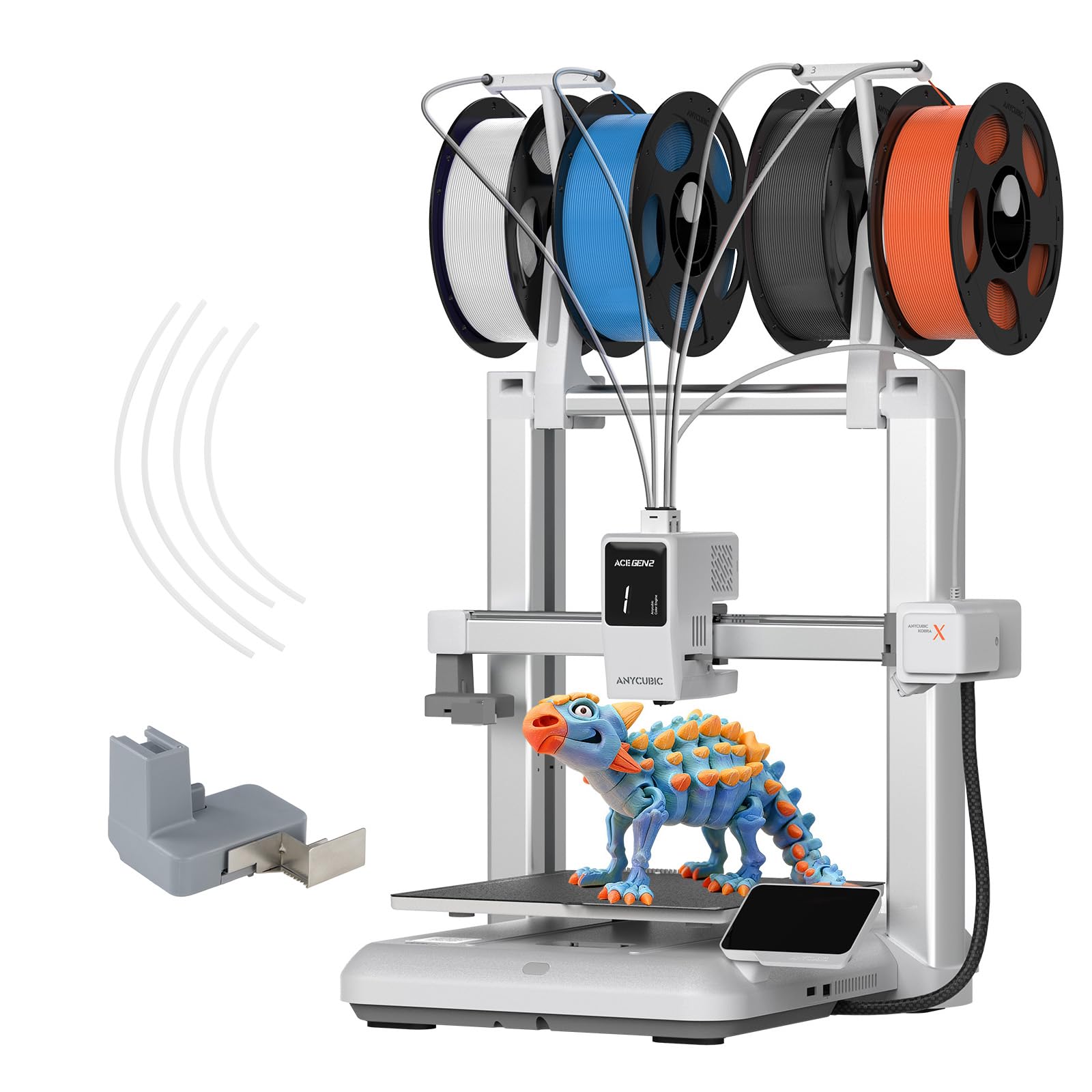
The Anycubic Kobra X brings native four-color printing to the 3D printer under $900 space without requiring an expensive add-on system. The integrated four-in-one print head allows color changes mid-print without manual filament swaps, and it can be expanded to 19 colors by connecting up to four ACE 2 Pro units. The travel path reduction design purges 81.25% less filament between color changes, directly reducing waste compared to earlier multi-color implementations.
The LeviQ 3.0 auto bed leveling system uses a 49-point calibration algorithm that compensates for even significant bed warping, ensuring that the first layer sticks across the entire 220 mm³ bed. The hardened steel nozzle handles abrasive filaments like glow-in-the-dark or carbon-fiber-infused PLA without degrading. The built-in AI camera detects spaghetti failures and foreign objects, sending alerts to the Anycubic mobile app over dual-band Wi-Fi (2.4 GHz and 5 GHz).
Noise levels are rated at 45 dB, which makes the Kobra X one of the quieter printers in this tier for overnight or office use. The top-mount spool holder frees up desk space, and the printer is fully enclosed enough for basic fume reduction. The library of over 10,000 pre-configured models and the seamless cloud integration through the Anycubic Slicer make it a strong pick for beginners who want multicolor capability without a steep learning curve.
Why it’s great
- Native 4-color printing without an expensive external AMS unit
- 81.25% reduction in filament purge waste during color changes
- 45 dB noise level for quiet overnight operation
Good to know
- ACE 2 Pro is not compatible with older ACE Pro units
- Third-party filament may cause binding in the multi-material unit
3. Bambu Lab A1 Combo + LED Lamp Kit
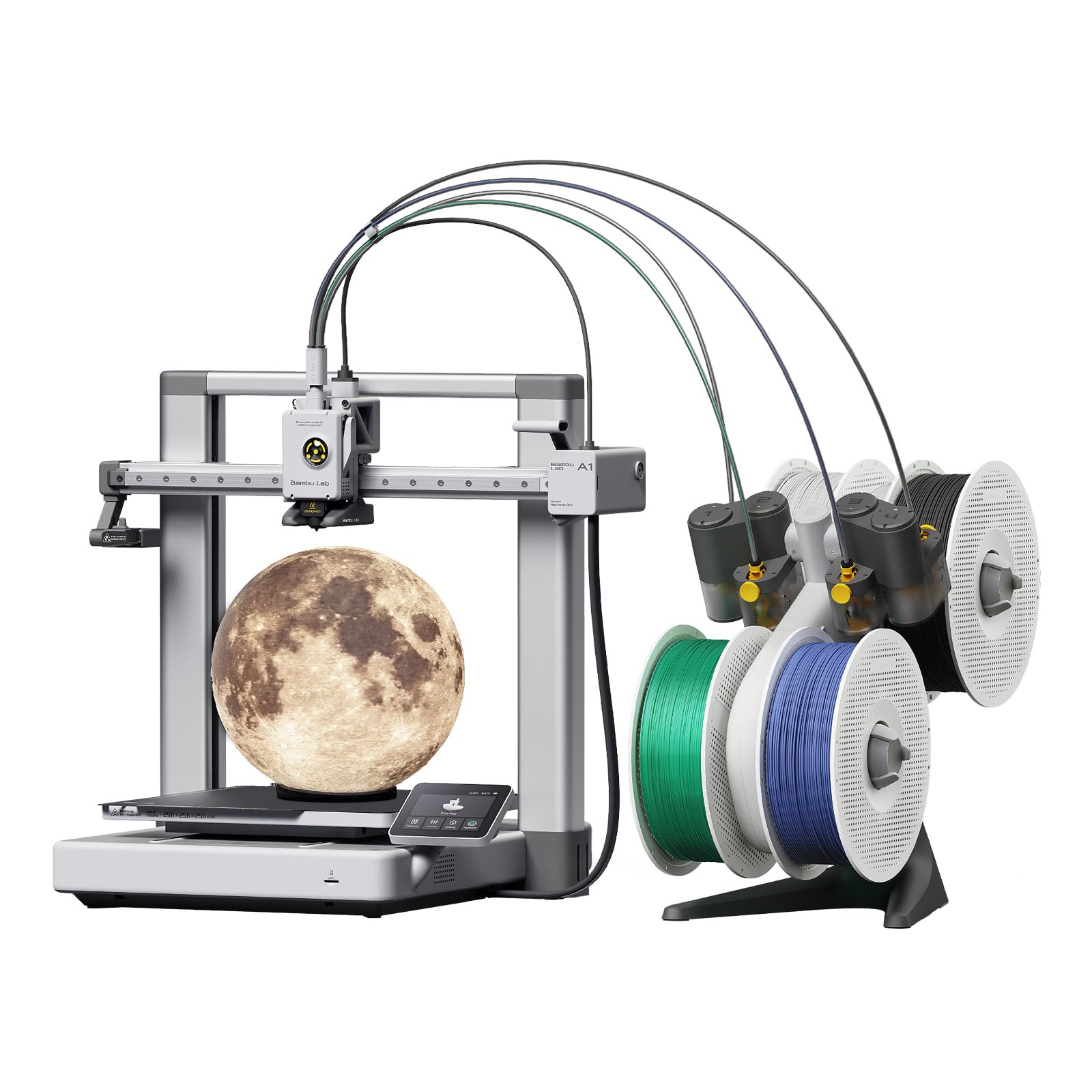
The Bambu Lab A1 Combo comes fully calibrated out of the box, skipping the usual assembly and tuning process that plagues many 3D printers under $900. The full-auto calibration covers Z-offset, bed leveling, resonance compensation, and flow rate compensation, ensuring the first print is as clean as the hundredth. The included AMS Lite system supports up to four colors or material types, reloading filaments automatically during multi-material prints with minimal waste.
The Active Motor Noise Canceling keeps operation at or below 48 dB, and the 1-Clip quick-swap nozzle makes material changes between a 0.4 mm standard and a 0.6 mm abrasive nozzle nearly instant. The 10,000 mm/s² acceleration figure translates to real-world speed; the printer completes a standard Benchy in under 20 minutes without sacrificing layer adhesion. The A1’s build volume is 256 mm³, which is slightly smaller than the P1S but sufficient for most consumer and cosplay prints.
The LED Lamp Kit bundled with this combo allows you to print illuminated models directly, making it a unique creative tool for custom decor and gifts. The Bambu Handy app provides live camera feed, time-lapse recording, and print controls from anywhere. The community-driven Maker World library gives access to thousands of user-uploaded designs with one-click printing profiles, effectively removing the learning barrier for first-time users.
Why it’s great
- Full-auto calibration eliminates manual bed leveling and Z-offset setup
- AMS Lite enables seamless multi-color and multi-material switching
- 48 dB active noise canceling suitable for shared spaces
Good to know
- Open-frame design limits materials to PLA, PETG, and TPU
- AMS Lite is not enclosed, so hygroscopic filaments may need separate drying
4. Bambu Lab P1S

The Bambu Lab P1S builds on the open-frame A1 concept by adding a fully enclosed chamber, enabling reliable printing with ABS, ASA, and polycarbonate without the warping issues that plague unenclosed designs. The CoreXY kinematics and 500 mm/s max speed are identical to the more expensive X1 series, making this one of the fastest enclosed printers in the under $900 bracket. The 260 mm³ build volume is paired with automatic bed leveling that uses a load sensor on the nozzle for precise first-layer calibration.
The P1S can be upgraded with the AMS (Automatic Material System) for up to 16 colors, which operates through a four-unit stacking system that manages filament humidity with integrated desiccant chambers. The enclosed design stabilizes chamber temperature, which is critical for high-temperature materials that shrink and warp if exposed to drafts. The Bambu Studio slicer supports advanced features like variable layer height and seamless support generation, and the printer connects via dual-band Wi-Fi for cloud-based remote management.
The P1S supports a wide range of filaments, from PLA and PETG through to PA, PC, and even flexible TPU. The all-metal hotend reaches 300°C, sufficient for high-temperature engineering materials. The 38.9-pound weight and stiff aluminum frame minimize vibration even at high accelerations, producing clean overhangs and sharp corners. For users who want a plug-and-play enclosed printer that can handle both cosmetics and functional parts, the P1S is a strong contender.
Why it’s great
- Fully enclosed chamber enables reliable ABS/ASA printing without warping
- Scalable AMS system handles up to 16 colors with desiccant drying
- CoreXY 500 mm/s speed with automatic resonance compensation
Good to know
- AMS is sold separately, adding to the total cost
- Not recommended for carbon/glass fiber reinforced materials
5. ELEGOO Centauri Carbon

The ELEGOO Centauri Carbon stands out for its rock-solid die-cast aluminum frame, which minimizes vibration at high speeds far better than welded sheet metal designs. The CoreXY structure hits 500 mm/s and 20,000 mm/s² acceleration, and the integrated automatic vibration compensation (AVC) algorithm tunes the resonance profile before every print. The 256 mm³ build volume is compact but perfectly balanced for tabletop use, and the enclosed chamber maintains temperature for PLA, PETG, and ABS.
The 320°C brass-hardened steel nozzle is capable of handling carbon-fiber-reinforced filaments without issue, making this a candidate for producing lightweight drone parts and automotive components. The dual-sided PEI build plate has a dedicated PLA Specific Surface that provides strong adhesion without heating the bed above 50°C for PLA, reducing thermal creep and edge lifting. The built-in camera with dual LED lighting supports real-time monitoring and time-lapse recording through the ElegooSlicer software.
The Centauri Carbon ships fully assembled and pre-calibrated, requiring only spool loading and filament purging before the first print. The intuitive touchscreen guides users through the Wi-Fi setup and calibration checks. The enclosed filtration system keeps UFPs and VOCs inside the chamber, though some users report that the door seal could be tighter. For a user who wants a compact, high-speed enclosed printer that can handle advanced composites, this is a competitive option.
Why it’s great
- Die-cast aluminum frame reduces vibration for smoother surfaces
- 320°C nozzle handles carbon fiber and glass-filled materials
- Dual-sided PEI plate with PLA-specific adhesion surface
Good to know
- Early units had USB-C cable failure issues requiring replacement
- Slicer performance is sluggish on older laptop hardware for complex models
6. Creality Ender 3 V3 Plus

The Creality Ender 3 V3 Plus brings a generous 300x300x330 mm build volume to the 3D printer under $900 market, giving users the space to print full-size helmets, vases, or multiple parts in a single batch. The CoreXZ architecture with Y-axis dual motors pushes the maximum speed to 600 mm/s and acceleration to 20,000 mm/s², making it one of the faster large-format options. The self-tensioning XZ belt system eliminates manual tension adjustments, maintaining belt alignment across thousands of print hours.
The direct-drive extruder features a spring-and-ball-plunger mechanism that grips filament tightly without slipping, paired with a powder-metallurgy lever that resists deformation under constant load. The tri-metal “Unicorn” all-metal nozzle integrates the throat and nozzle tip into one piece, reducing oozing and making nozzle swaps a quick operation. The auto-calibration suite handles Z-offset, bed leveling, and input shaping in a single one-tap sequence, removing the need for manual paper-leveling routines.
The 1000-hour clog-free extrusion claim is backed by the hardened steel nozzle tip, and the dual 500 mN.m motors on the Y-axis handle heavy prints without belt slipping. The bolted support rods between the base and the top gantry reduce Z-axis shaking when printing tall objects. The default PSU ships set to 235V; US buyers must flip the switch to 110V before powering on. For users focused on large-format production without an enclosed chamber, the V3 Plus offers significant value.
Why it’s great
- Large 300x300x330 mm build volume for oversized prints or batch production
- Self-tensioning belts and powder metallurgy lever reduce maintenance
- Auto-calibration suite covers Z-offset, leveling, and input shaping in one tap
Good to know
- Open-frame design limits reliable printing to PLA and PETG
- Power supply defaults to 235V; must be manually switched to 110V for US outlets
7. Flashforge Adventurer 5M Pro

The Flashforge Adventurer 5M Pro prioritizes air quality with a dual circulation system that combines a HEPA filter and activated carbon layer to trap ultrafine particles and volatile organic compounds during printing. The Core XY all-metal frame supports speeds up to 600 mm/s with 20,000 mm/s² acceleration, and the nozzle reaches 200°C in just 35 seconds thanks to the ceramic heater design. The 220 mm³ build volume is more compact than many competitors, but the enclosed design makes it one of the safer options for indoor use.
The pressure-sensing auto bed leveling system detects platform height at multiple points without requiring Z-axis calibration or a print raft. The dual-sided PEI platform allows tool-less model removal—flex and pop for PLA prints. The Adventurer 5M Pro supports a wide range of nozzle diameters (0.25 mm, 0.4 mm, 0.6 mm, 0.8 mm), allowing users to switch between fine detail work and fast functional prototyping by swapping the quick-detachable 280°C nozzle assembly.
The Flash Maker mobile app provides remote video monitoring, progress tracking, and parameter adjustments. The auto-shutdown function turns off the printer after completion, and the filament detection system pauses prints when the spool runs out. The HEPA filter reduces visible fumes during ABS printing, though some users note that the door and top-panel seals could be tighter to fully contain emissions. For a home or classroom environment where fume control is a priority, this is a strong choice.
Why it’s great
- Built-in HEPA and carbon filter reduces UFPs and VOCs during printing
- 35-second nozzle heat-up to 200°C minimizes wait time
- Swap-friendly nozzle system supports 0.25 mm to 0.8 mm diameters
Good to know
- Chamber door and top panel seals could be tighter for full containment
- Software may have compatibility issues on macOS Sequoia; an older macOS version may be needed
8. ELEGOO Saturn 4 Ultra 16K
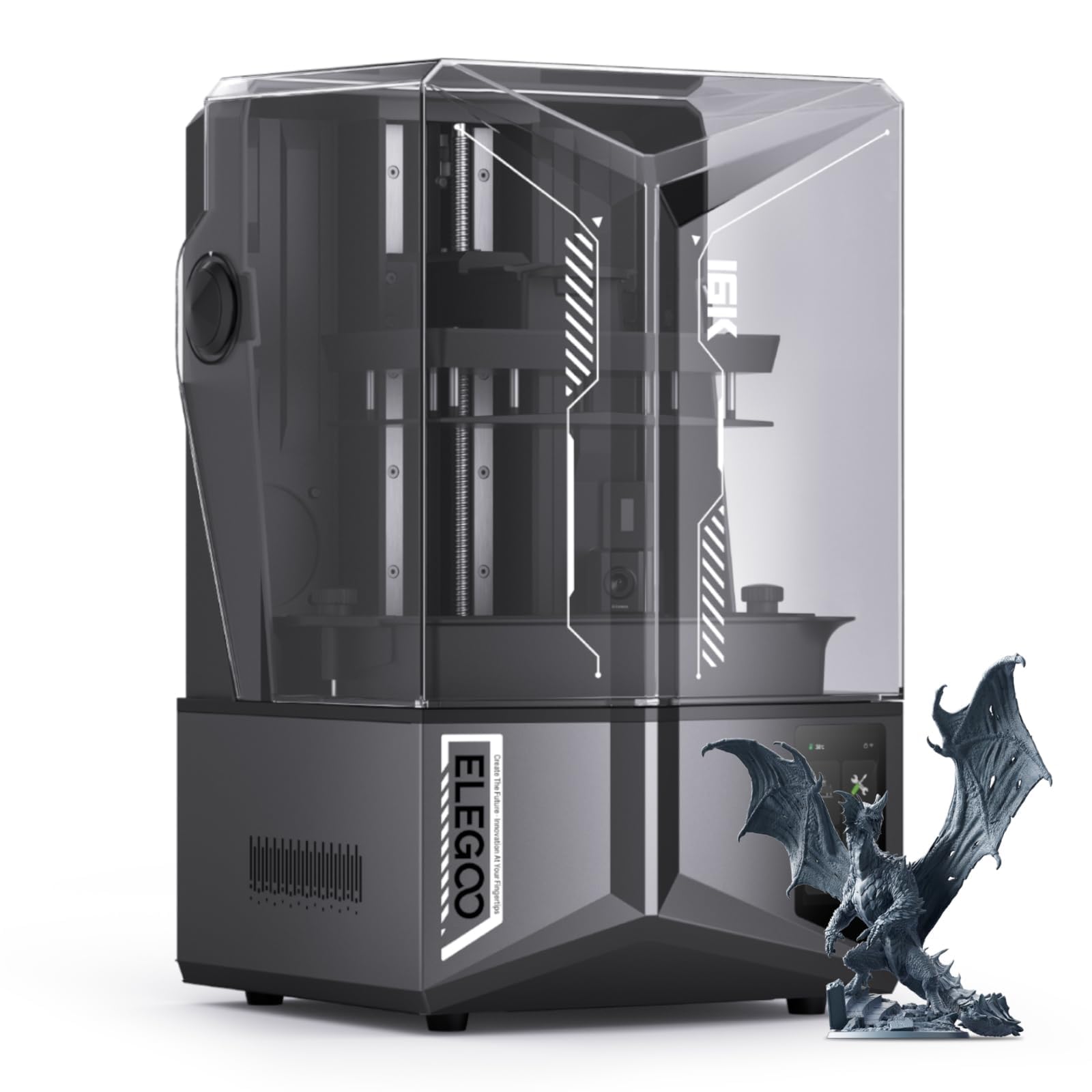
The ELEGOO Saturn 4 Ultra 16K is a resin 3D printer that achieves extraordinary detail through its 10-inch 16K monochrome LCD screen, which delivers a pixel resolution of 19 microns. This level of precision captures individual hairs, fabric weave, and small text on miniatures, making it the go-to choice for tabletop wargaming, jewelry prototyping, and dental models. The 8.33 x 4.66 x 8.66 inch build volume is large for a resin printer, allowing multiple full-size figurines in one batch.
The intelligent tank heating system maintains the resin at 30°C, which improves fluidity and reduces defects like air bubbles and layer separation. The tilt release technology peels cured layers from the FEP film by tilting the vat rather than lifting the build plate, reducing peel forces and allowing print speeds of up to 150 mm/h. The AI camera with built-in LED light monitors for empty build plates and warped models, sending alerts to the ELEGOO app over Wi-Fi.
The auto-leveling system eliminates the manual four-point leveling routine that older resin printers require—simply tighten the plate screws and press calibrate. The smart mechanical sensor detects resin shortages and foreign objects on the LCD, preventing damage to the screen from cured resin. The Saturn 4 Ultra ships with a UV-blocking flip-up lid and a built-in charcoal filter to reduce resin odor. For anyone needing hyper-detailed prints, this is the best option in the under $900 resin category.
Why it’s great
- 16K resolution at 19-micron pixel size captures microscopic detail
- Intelligent tank heating maintains 30°C resin for consistent prints
- Tilt release technology reaches 150 mm/h without heavy peel forces
Good to know
- Resin handling requires a well-ventilated workspace and gloves
- Firmware updates have occasionally reset slicer settings
9. Creality Ender 5 Max
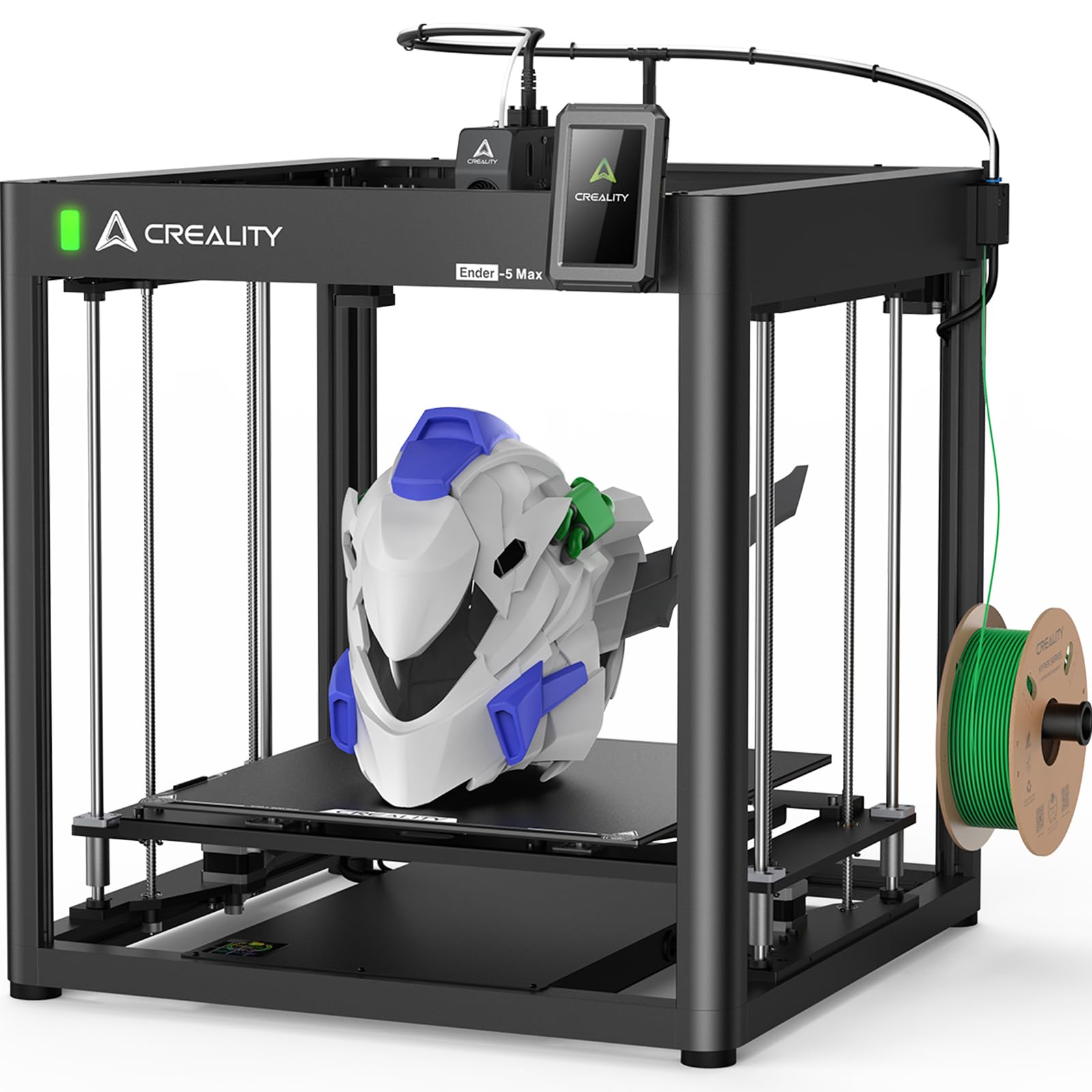
The Creality Ender 5 Max is built for scale, with a 400x400x400 mm build volume that is the largest in this lineup, capable of printing full-size drone frames, automotive ducts, or dozens of smaller parts in one pass. The CoreXY structure and high-torque motors push the maximum speed to 700 mm/s, and the 1000W rapid-heating bed reaches working temperature in under three minutes. The 64-point auto-leveling system with automatic Z-offset ensures consistent first-layer adhesion across the massive bed area.
The reinforced die-cast aluminum frame uses a rigid triangle bracing system that minimizes vibration even at peak acceleration, which is essential for tall prints that sway on lighter frames. The direct-drive dual-gear extruder features hardened gears for continuous 24/7 operation, making it a candidate for print-farm environments. WLAN multi-printer control allows grouped management from a single interface, with a tri-color status indicator that lets you scan the room for print completion status.
The all-metal frame supports PLA, PETG, ABS, ASA, and PA, though the open design means ABS prints require additional enclosure solutions to prevent warping on the larger print surface. The Nebula USB camera provides basic monitoring, though some users note that the Creality AI detection is less reliable than Bambu or QIDI systems. For a user prioritizing maximum build volume and print-farm productivity over material versatility, the Ender 5 Max delivers unmatched scale in this price bracket.
Why it’s great
- Massive 400x400x400 mm build volume for oversized prototypes and batch jobs
- 1000W rapid-heating bed reaches working temperature in minutes
- WLAN multi-printer control with tri-color status for farm management
Good to know
- Open-frame design requires additional enclosure for ABS/ASA printing
- Build plate adhesion can be inconsistent without manual isopropyl alcohol cleaning
FAQ
What is the real difference between FDM and resin printers in this budget?
Do I need an enclosed printer to print ABS successfully?
How important is auto bed leveling for a first-time buyer?
Final Thoughts: The Verdict
For most users, the 3d printer under $900 winner is the QIDI Q2 because its active 65°C heated chamber, 370°C nozzle, and triple filtration system deliver engineering-grade capability at a consumer-friendly price. If you want the easiest multi-color setup without an external AMS, grab the Anycubic Kobra X. And for hyper-detailed miniatures and jewelry models, nothing beats the ELEGOO Saturn 4 Ultra 16K in this bracket.