
Choosing a 3D printer today means navigating a maze of speed claims, build volumes, and technology types — FDM versus resin, CoreXY versus bedslinger, auto-leveling versus manual paper-slipping. The wrong pick leads to failed prints, wasted filament, and a machine that collects dust after two weeks. This guide cuts through the marketing to match you with the hardware that actually fits your workflow, whether you’re printing miniatures, functional parts, or your first benchy.
I’m Min — the co-founder and writer behind Gadgets Feed. I’ve spent hundreds of hours analyzing the mechanical specs, extrusion systems, and real-world failure points across dozens of 3D printer models to build this guide around what actually determines print success and long-term reliability.
After deep-diving into build plate adhesion, hotend temperature ceilings, layer resolution, and motion system stability, I’ve assembled the definitive resource for finding the best 3d printer that fits your skill level and project demands without overpaying for features you don’t need.
How To Choose The Best 3D Printer
The right 3D printer hinges on three core decisions: technology type (FDM vs. resin), motion system (bedslinger vs. CoreXY), and build volume. Beginners often over-prioritize speed numbers while ignoring the importance of a rigid frame, auto-leveling reliability, and available material compatibility. Nail these pillars first, and everything else — from software to extras — falls into place.
FDM vs. Resin: Matching Technology to Your Projects
FDM (Fused Deposition Modeling) printers melt filament spools and lay down layers to build parts. They excel at functional prototypes, larger objects, and materials like PLA, PETG, TPU, and carbon-fiber composites. Resin (MSLA) printers cure liquid photopolymer with a UV screen, achieving much higher detail at smaller layer heights. Choose FDM for strength, part size, and material variety. Choose resin for miniature figurines, jewelry patterns, and smooth surface finishes where layer lines are unacceptable. FDM printers generally run quieter and produce no liquid waste, while resin printers require ventilation, gloves, and isopropyl alcohol for cleaning.
Motion System: Bedslinger vs. CoreXY vs. CoreXZ
Bedslinger designs move the print bed forward and backward along the Y-axis while the print head moves on X and Z. They are simpler and cheaper but limit speed because the heavy bed must accelerate and decelerate. CoreXY printers move the print head in both X and Y using two stationary motors and a belt system, allowing much higher accelerations (20,000 mm/s² or more) without shifting the bed. CoreXZ variants, like the Creality Ender 3 V3 Plus, combine principles to handle heavy gantries at high speed. For fast prototyping and large volumes, a CoreXY or CoreXZ machine delivers significantly shorter print times with better surface quality at speed.
Build Volume, Auto-Leveling, and Nozzle Temperature
Build volume determines the maximum object size you can print in one piece. A 220 x 220 x 250 mm volume covers most hobbyist projects, while 300 x 300 x 330 mm unlocks helmet-sized cosplay parts and batch production. Auto bed leveling is now table stakes — sensors that map the build plate’s surface and compensate for unevenness during the first layer. Machines using the nozzle itself as the leveling probe, like the QIDI Q2, achieve superior first-layer accuracy. Nozzle temperature range dictates material compatibility: 280°C handles PLA/PETG/TPU, 320°C unlocks carbon-fiber composites and polycarbonate, and 370°C opens Nylon and exotic blends. Match the temp ceiling to the filaments you intend to use regularly.
Quick Comparison
On smaller screens, swipe sideways to see the full table.
| Model | Category | Best For | Key Spec | Amazon |
|---|---|---|---|---|
| Bambu Lab P1S | FDM CoreXY | Enclosed multi-color workhorse | 500 mm/s, 20,000 mm/s² accel | Amazon |
| Bambu Lab A1 Combo | FDM Bedslinger | Ultra-quiet multi-color printing | ≤48 dB noise, 10,000 mm/s² | Amazon |
| QIDI Q2 | FDM CoreXY | High-temp enclosed engineering | 370°C nozzle, 65°C chamber | Amazon |
| Creality Ender 3 V3 Plus | FDM CoreXZ | Large build volume on a budget | 300 x 300 x 330 mm volume | Amazon |
| ELEGOO Centauri Carbon | FDM CoreXY | Pre-assembled carbon-fiber ready | 320°C nozzle, die-cast frame | Amazon |
| FLASHFORGE Adventurer 5M | FDM CoreXY | Beginner-friendly high-speed FDM | 600 mm/s, 20,000 mm/s² accel | Amazon |
| ELEGOO Mars 5 Ultra | Resin MSLA | High-resolution resin miniatures | 9K LCD, 18 μm XY resolution | Amazon |
| ANYCUBIC Photon Mono 4 Ultra | Resin MSLA | Ultra-fine detail resin printing | 10K screen, 17 μm pixel size | Amazon |
| Entina Tina2 Plus | FDM Bedslinger | Kids and classroom entry-level | 250 mm/s, 40-sec hotend | Amazon |
In‑Depth Reviews
1. Bambu Lab P1S 3D Printer

The Bambu Lab P1S sets the benchmark for enclosed CoreXY FDM printers in this price bracket. It hits a maximum print speed of 500 mm/s with 20,000 mm/s² acceleration, and the fully enclosed chassis allows reliable printing with ABS, ASA, and polycarbonate — materials that warp on open-frame machines. The 260 x 260 x 256 mm build volume is generous, and the auto bed leveling system consistently delivers a perfect first layer every time.
Multi-color printing requires the optional AMS unit, which supports up to 16 colors and simplifies filament changes mid-print. The P1S pairs with Bambu Studio, a slicer that streamlines workflow from model import to print start. Real-world users report setup in under 30 minutes, consistent quality with PLA and PETG, and minimal layer lines even at high speeds. The enclosed design also reduces noise compared to open-frame competitors.
TPU printing is more finicky than on open machines due to the enclosed chamber, but the hotend clears clogs in minutes with basic disassembly. The chamber includes a carbon filter for odor reduction, and the machine supports remote monitoring via the built-in camera. For users who want a fast, reliable, enclosed FDM machine with upgrade potential to multi-color, the P1S is the current sweet spot.
Why it’s great
- Consistent auto-leveling eliminates first-layer failures
- Enclosed chamber enables ABS/ASA without warping
- Bambu Studio slicer is intuitive and highly optimized
Good to know
- AMS for multi-color is an additional purchase
- TPU can be difficult with the enclosed design
- Firmware security limits to intranet-only control
2. Bambu Lab A1 Combo + LED Lamp Kit
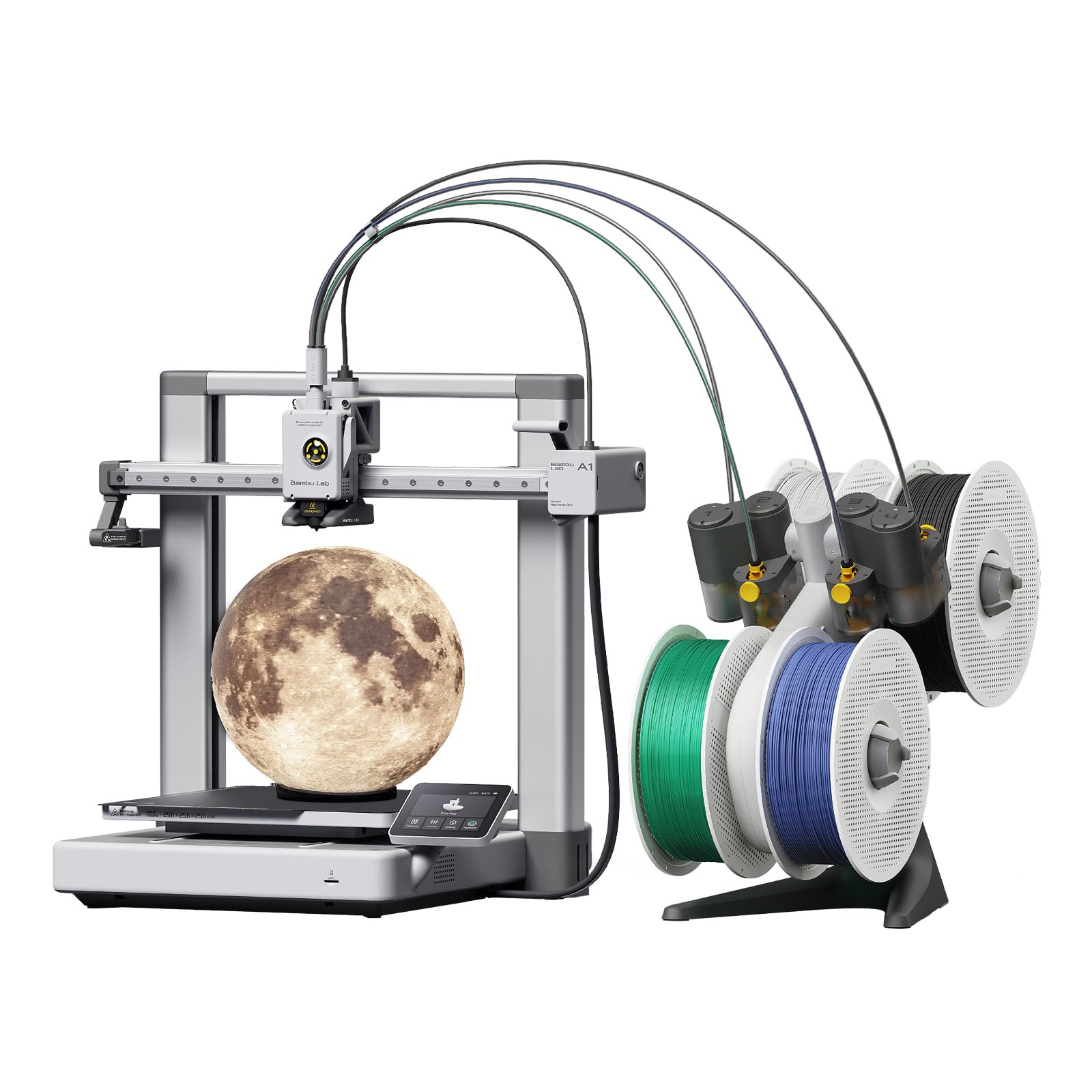
The Bambu Lab A1 Combo includes the AMS Lite unit for multi-color printing out of the box, making it the most accessible entry point to vibrant, four-color PLA prints. It uses a bedslinger motion system with 10,000 mm/s² acceleration, and active noise cancelation keeps operation at or below 48 dB — quiet enough to run in a shared office or bedroom without disturbance.
Full-auto calibration handles Z-offset, bed leveling, and flow rate compensation actively during the print. The 1-Clip quick-swap nozzle simplifies material changes, and the included LED Lamp Kit lets you print functional lighting projects directly from the bundled designs. The machine prints reliably with PLA, PETG, and TPU, though the open-frame design limits high-temp materials like ABS without a separate enclosure.
Users consistently highlight the intuitive touchscreen, robust MakerWorld community with thousands of free models, and the onboard camera for time-lapse recording. The build volume is 256 x 256 x 256 mm, matching the P1S in footprint. Some leftover screws and parts in the box confuse first-time assemblers, but the core assembly takes minutes. For beginners who want multi-color from day one without tinkering, this combo delivers exceptional value.
Why it’s great
- AMS Lite included for multi-color printing
- Active noise canceling keeps sound below 48 dB
- Full-auto calibration with active flow compensation
Good to know
- Open frame limits ABS/ASA printing
- Only includes a few filament strands to start
- Nozzle can be noticeably noisy during operation
3. QIDI Q2 3D Printer
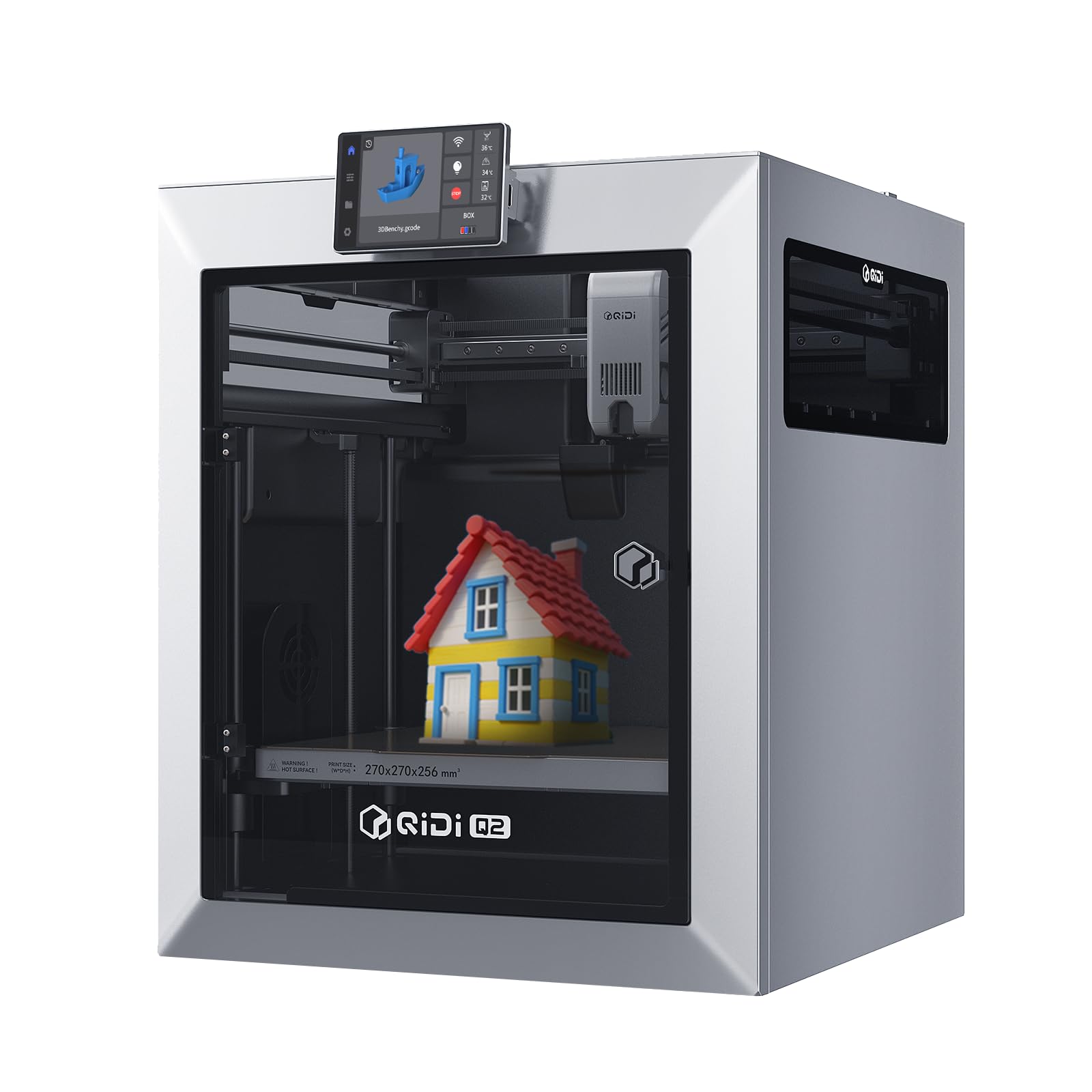
The QIDI Q2 targets users who need engineering-grade materials without a five-figure budget. Its 370°C all-metal hotend and 65°C actively heated chamber make it capable of printing Nylon, polycarbonate, and carbon-fiber composites — filaments that destroy standard PTFE-lined hotends and warp on unheated beds. The CoreXY motion system reaches 600 mm/s with full-metal linear rails for vibration resistance.
Auto leveling uses the nozzle itself as the probe, measuring the actual build surface with no sensor offset errors. The triple filtration system (G3 pre-filter, H12 HEPA, activated carbon) keeps ABS fumes and particulates under control, making indoor use safer than most enclosed machines. The 270 x 270 x 256 mm build volume is generous, and the 1.5GT synchronous belts reduce VFA (Vibration Frequency Artifacts) for smoother surface finishes.
Early firmware releases had some rough edges, including mixed-language UI elements and network connectivity drops, but QIDI has responded with updates. Some users report that PTFE tube routing inside the chamber needs adjustment with a printed riser to prevent scraping. The AI camera’s spaghetti detection triggers false alarms on complex overhangs. For those who prioritize material versatility and chamber temperature over out-of-box polish, the Q2 punches well above its price tier.
Why it’s great
- 370°C hotend unlocks Nylon, PC, and composites
- 65°C heated chamber eliminates ABS warping
- Triple HEPA/charcoal filtration for safe indoor use
Good to know
- Firmware UI had early mixed-language issues
- AI spaghetti detection false alarms frequently
- PTFE tube routing may require a printed riser
4. Creality Ender 3 V3 Plus

The Creality Ender 3 V3 Plus delivers the largest build volume in this roundup at 300 x 300 x 330 mm, enabling one-piece helmet prints and batch production of larger parts. It employs a CoreXZ motion system with dual Y-axis motors for stable bed movement at speeds up to 600 mm/s and 20,000 mm/s² acceleration. The all-metal direct drive extruder uses a bolster spring and ball plunger to maintain consistent grip on filament for over 1,000 hours of clog-free operation.
Auto calibration handles Z-offset, bed leveling, and input shaping automatically. The tri-metal “Unicorn” nozzle combines hardened steel at the tip with an all-metal throat, allowing safe printing of abrasive filaments like glow-in-the-dark or carbon-fiber reinforced PLA. Two 500 mN·m motors on the Y-axis plus rigid support rods connecting the base and gantry top reduce Z-axis wobble during high-speed prints.
Some units ship with the power supply set to 235V requiring a manual switch to 110V for North American users — a common oversight. The fans are loud compared to enclosed competitors, and a few users reported gantry alignment issues out of the box. The open-frame design means ABS and ASA are impractical without an aftermarket enclosure. For users who need the biggest print volume for the money and are willing to do minor setup checks, this is the standout choice.
Why it’s great
- Class-leading 300 x 300 x 330 mm build volume
- Tri-metal Unicorn nozzle for abrasive filaments
- Auto calibration handles Z-offset and input shaping
Good to know
- Power supply needs manual 110V/235V switch
- Loud fans compared to enclosed printers
- Open frame limits high-temp materials
5. ELEGOO Centauri Carbon 3D Printer
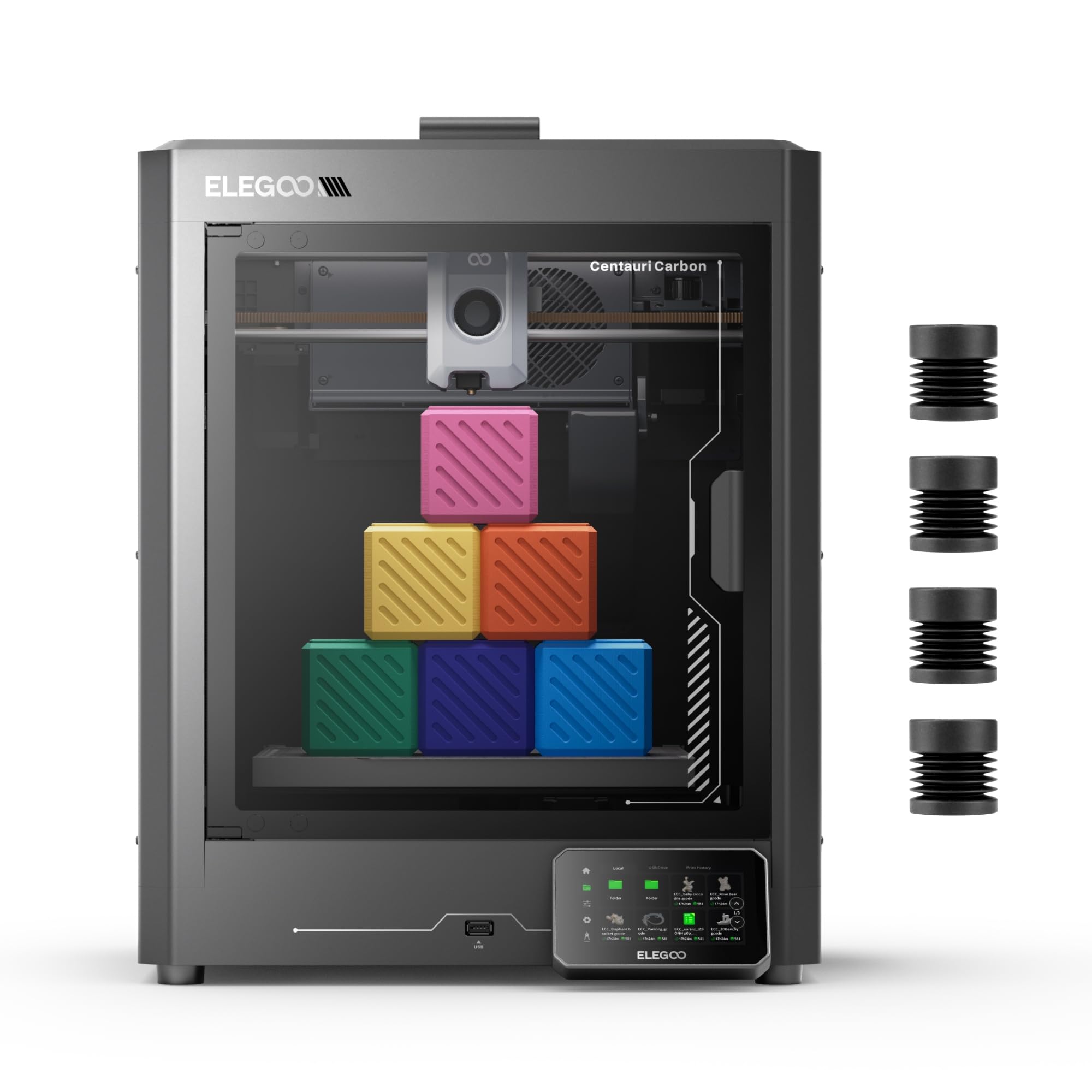
The ELEGOO Centauri Carbon arrives fully assembled and pre-calibrated, reducing unboxing-to-first-print time to under 20 minutes. Its die-cast aluminum frame minimizes vibration at 500 mm/s print speeds and 20,000 mm/s² acceleration, producing clean corners and sharp details. The 320°C brass-hardened steel nozzle and enclosed chamber with enhanced cooling prepare it for carbon-fiber reinforced filaments, polycarbonate, and other advanced materials out of the box.
Auto bed leveling, vibration compensation, and pressure advance are all handled automatically. The dual-sided build plate features a PLA-specific surface for excellent adhesion at lower bed temperatures, reducing energy use. The built-in chamber camera with dual LED lighting supports real-time monitoring and time-lapse capture. The 256 x 256 x 256 mm build volume offers a true cubic footprint for consistent part orientation.
Early units had some cable connector issues that caused failures, though replacement units have addressed the design flaw. The slicer can crash on complex STL files with hundreds of thousands of polygons. The machine shakes noticeably during high-speed moves, but the rigid frame absorbs the vibration before it reaches the print surface. For users who want a premium CoreXY experience with advanced material support and minimal setup, this is a strong contender.
Why it’s great
- Pre-assembled with die-cast aluminum frame
- 320°C nozzle supports carbon-fiber composites
- Built-in camera with remote monitoring
Good to know
- Early units had cable connector reliability issues
- Slicer can crash on complex high-poly models
- Noticeable shaking at maximum acceleration
6. FLASHFORGE Adventurer 5M

The FLASHFORGE Adventurer 5M is a CoreXY machine that prioritizes raw speed and simplicity. It reaches 600 mm/s with 20,000 mm/s² acceleration — zero to speed in 0.025 seconds — and includes vibration compensation to eliminate ghosting artifacts at high velocities. The one-click auto leveling system calibrates the bed in under two minutes, and the 50W heating power brings the 280°C nozzle to 200°C in just 35 seconds.
The direct-drive extruder delivers a consistent flow of 32 mm³/s and supports PLA, PETG, TPU with the 0.4 mm nozzle, plus PLA-CF and PETG-CF with the optional 0.6 mm nozzle. The dual-sided PEI spring steel plate provides excellent adhesion for PLA and PETG. A filament run-out sensor pauses prints automatically when spools empty, and power-loss recovery resumes from the last layer after an outage.
The firmware has occasional freezes that require a power cycle, and the touchscreen can be finicky after prolonged use. The open-frame design means it requires a well-ventilated area for ABS printing. Some users report early hardware failures after a few months, though FLASHFORGE’s tech support responds quickly with replacement parts. For budget-conscious buyers who want CoreXY speed without the premium price tag, the Adventurer 5M delivers solid value.
Why it’s great
- 600 mm/s CoreXY with vibration compensation
- 35-second nozzle heat-up to 200°C
- Filament run-out sensor and power-loss recovery
Good to know
- Firmware freezes occasionally need power cycle
- Open frame requires ventilation for ABS
- Touchscreen can become less responsive over time
7. ELEGOO Mars 5 Ultra 9K

The ELEGOO Mars 5 Ultra pairs a 9K monochrome LCD (8,520 x 4,320 px) with a tilt-release mechanism that achieves print speeds up to 150 mm/h — significantly faster than traditional resin printers. The 18 x 18 μm XY resolution captures fine detail in miniature faces, jewelry patterns, and dental models. Internal COB light source achieves 92% light uniformity, reducing layer-to-layer dimensional errors.
Built-in AI camera detects empty build plates and model warping in real time, and supports time-lapse recording for sharing prints. The smart mechanical sensor using a spring-loaded probe performs one-click calibration and alerts you to low resin, foreign objects in the vat, or high light board temperature. WiFi with 2.4G and 5G support enables remote file transfer and cluster printing of multiple Mars 5 Ultras on the same LAN.
Some users experienced LCD cracking within the first 90 days, though ELEGOO customer service replaced screens quickly. The manual is minimal, and the Chitubox slicer has a noticeable learning curve for new resin users. Resin and build plate must be warm (above 67°F) for reliable first layers — cold ambient temperature causes immediate print failures. For miniaturists who want 9K resolution with fast print times, this is a compelling pick.
Why it’s great
- 9K LCD with 18 μm XY resolution for extreme detail
- Tilt-release mechanism enables 150 mm/h printing
- AI camera for failure detection and time-lapse
Good to know
- LCD can crack within 90 days in some units
- Chitubox slicer has a steep learning curve
- Ambient temperature must be above 67°F
8. ANYCUBIC Photon Mono 4 Ultra

The ANYCUBIC Photon Mono 4 Ultra pushes resin resolution to 10K with a 7-inch monochrome LCD at 9,024 x 5,120 pixels. Each pixel measures just 17 x 17 μm on the XY axes — a 105% increase in print precision compared to the Mono 2. The COB light source combined with Fresnel lenses keeps light dispersion within a 3-degree angle, eliminating stray light interference and achieving over 90% light uniformity across the build area.
The ACF release film and Intelligent Release Algorithm enable a maximum print speed of 120 mm/h. The 4.3-inch HD touchscreen uses an all-new UI with 8 language options. Five intelligent detection modes cover printer auto-inspection, residual resin detection, leftover resin monitoring, failed print detection, and lifespan management for the screen and light source. The 8 mm T-type screw rod and precision guide rails maintain Z-axis accuracy over hundreds of prints.
Resin odor is strong — a well-ventilated area or enclosure with a carbon filter is essential. The FEP film on the vat ships fragile and can be punctured easily with a plastic spatula. Some users reported minor residue on the screen that clears after a burn-in exposure. For jewelers, miniature painters, and anyone who needs the highest detail density in a small form factor, the Photon Mono 4 Ultra delivers class-leading XY resolution.
Why it’s great
- 10K LCD with 17 μm pixel size for extreme detail
- COB light source with Fresnel lens uniformity
- Five intelligent detection systems prevent failures
Good to know
- Strong resin odor requires good ventilation
- FEP film is fragile and easy to puncture
- Print volume is compact at 6.04 x 3.42 x 6.49 inches
9. Entina Tina2 Plus

The Entina Tina2 Plus targets absolute beginners and younger users with a fully assembled design that requires zero setup. It prints at 250 mm/s using a ceramic hotend that heats to operating temperature in 40 seconds. The PEI spring steel magnetic build plate simplifies print removal, and the auto-leveling system with dual Z-axis structure ensures consistent first layers without manual adjustment. The 1500+ model library in the Poloprint Cloud app provides immediate access to printable projects.
The compact footprint (11.4 x 8.6 x 8.6 inches) fits on standard desks, and the partially enclosed frame structure separates hot components from direct contact for supervised use with kids. WiFi connectivity supports remote start and monitoring via the app. The machine works with standard PLA filament spools, though larger spools require a printed adapter. Windows, macOS, Linux, and Chromebook are all supported.
The mobile app has reliability issues — some users report registration errors and WiFi disconnects after two prints. Only white filament is included in the box, so budget for extra colors and a trim kit. Customer support has been unresponsive in some cases, with voicemail boxes reported as full. For a zero-hassle introduction to 3D printing for young makers, the Tina2 Plus gets kids printing within minutes, but the app and support limitations are real tradeoffs.
Why it’s great
- Fully assembled, ready to print in minutes
- Ceramic hotend heats in 40 seconds
- WiFi cloud with 1,500+ preloaded models
Good to know
- Mobile app can drop WiFi connection
- Only one spool of white filament included
- Customer support responsiveness is inconsistent
FAQ
What layer height should I use for detailed miniatures?
Can I print ABS on an open-frame 3D printer?
How do I choose between a 4K and 10K resin printer?
Final Thoughts: The Verdict
For most users, the best 3d printer winner is the Bambu Lab P1S because it combines a fully enclosed CoreXY chassis, consistent auto-leveling, and reliable high-speed printing with ABS and PLA in a package that works out of the box. If you want multi-color printing from day one at lower noise levels, grab the Bambu Lab A1 Combo. And for engineering-grade materials like Nylon and carbon-fiber composites, nothing beats the QIDI Q2 with its 370°C hotend and heated 65°C chamber.