
Choosing your first 3D printer is a minefield of contradictory specs, gimmicky marketing claims, and wildly different print technologies. You are deciding between FDM for functional parts or resin for miniature detail, between a CoreXY speed demon and a budget bed-slinger, between an open-source ecosystem and a walled garden. The wrong choice means weeks of failed prints and frustration instead of reliable prototyping.
I’m Min — the co-founder and writer behind Gadgets Feed. Every product here has been researched against hundreds of verified reviews, cross-referenced for genuine failure rates, and ranked by actual print quality, real-world speed, and build volume you can actually use, not just the number on the box.
This guide cuts through the noise to deliver the best 3d printing equipment for your workflow, budget, and skill level so you can start printing with confidence on day one.
How To Choose The Best 3D Printing Equipment
The 3D printer market is split between FDM (fused deposition modeling) and resin (MSLA) technologies. FDM machines melt filament and lay it down in layers — ideal for functional prototypes, jigs, and large parts. Resin printers cure liquid photopolymer with UV light, delivering astonishing detail at the cost of post-processing and smaller build volumes. Your first decision is which technology fits your actual output.
Print Speed Versus Print Quality
Speed numbers like 600 mm/s look impressive, but real throughput depends on acceleration (measured in mm/s²) and the part geometry. A CoreXY frame with high acceleration can print a Benchy in under 20 minutes, but that same part may show ringing and ghosting without input shaping compensation. Resin printers use tilt-release mechanisms to speed up layer separation — the ELEGOO Mars 5 Ultra claims 150 mm/h, but colder resin or inadequate layer cure times can kill that speed. Always correlate speed claims with actual user print times.
Build Volume and Material Capabilities
Build volume defines how large a single part you can produce. FDM printers range from compact 256mm cubes to industrial sizes, while resin printers are typically much smaller — the Phrozen Sonic Mini 8K S offers just 6.5 x 2.8 x 6.7 inches. If you plan to print engineering-grade filaments like nylon, polycarbonate, or carbon-fiber composites, an enclosed printer with a heated chamber becomes non-negotiable to prevent warping and delamination. The QIDI Q2 reaches a 65°C chamber temperature, enabling reliable ABS and PA prints without the usual curling.
Automation and Ease of Use
Fully automatic bed leveling, filament run-out sensors, power-loss recovery, and AI camera monitoring separate genuinely beginner-friendly printers from frustrating tinker machines. The Bambu Lab A1 handles full-auto calibration including Z-offset and bed-leveling without any user input — you unbox, load filament, and press print. Resin printers like the ELEGOO Mars 5 Ultra now include smart mechanical sensors that detect low resin or foreign objects and pause the print automatically. These features are not luxuries — they are the difference between a 95% success rate and a 50% one.
Quick Comparison
On smaller screens, swipe sideways to see the full table.
| Model | Category | Best For | Key Spec | Amazon |
|---|---|---|---|---|
| Bambu Lab A1 | FDM | Beginners & Multi-Color | 10,000 mm/s² acceleration | Amazon |
| Bambu Lab P1S Combo | FDM | Enclosed Multi-Material | 500 mm/s, enclosed body | Amazon |
| Creality K2 Combo | FDM | Multi-Color Efficiency | 16-color CFS support | Amazon |
| QIDI Q2 | FDM | Engineering Filaments | 65°C heated chamber | Amazon |
| ELEGOO Centauri Carbon | FDM | Out-of-Box Speed | 500 mm/s, CoreXY | Amazon |
| FLASHFORGE Adventurer 5M | FDM | Family & Home Use | 600 mm/s travel speed | Amazon |
| ELEGOO Mars 5 Ultra | Resin | High-Detail Miniatures | 9K LCD, 18μm XY | Amazon |
| Phrozen Sonic Mini 8K S | Resin | Detail on a Budget | 22μm XY resolution | Amazon |
| Original Prusa MK4S | FDM | Professional Reliability | Input shaping, open-source | Amazon |
In‑Depth Reviews
1. Bambu Lab A1 3D Printer

The Bambu Lab A1 redefines what entry-level means with a 256mm³ build volume, full-auto calibration that handles Z-offset and bed leveling without user input, and an active flow rate compensation algorithm that maintains extrusion accuracy during high-speed moves. Its 10,000 mm/s² acceleration is not a marketing figure — it translates to a 14-minute Benchy that is dimensionally accurate with sharp corners, something older bedslingers cannot match without visible ringing.
The AMS Lite add-on unlocks true multi-color printing for under , making this the most affordable path to vibrant, multi-material models. The 1-Clip quick-swap nozzle design and intuitive touchscreen further reduce friction. At ≤48 dB in silent mode, the A1 is quiet enough to run in a shared office or bedroom without causing fatigue.
There is no heated enclosure, which limits the A1 to PLA, PETG, and TPU — ABS and polycarbonate are off the table without a chamber. Additionally, the AMS Lite is sold separately, and the bed requires some fore-aft clearance that may catch new users off guard. For pure print-to-dollar value, however, the A1 is the undisputed king of the sub- FDM segment.
Why it’s great
- Full-auto bed leveling and flow rate compensation deliver flawless first layers every time
- Multi-color printing via AMS Lite at an unbeatable entry price
- Remarkably quiet operation at ≤48 dB with active motor noise canceling
Good to know
- No heated chamber blocks advanced materials like ABS and polycarbonate
- AMS Lite sold separately — budget for the combo if you need color
2. Bambu Lab P1S Combo
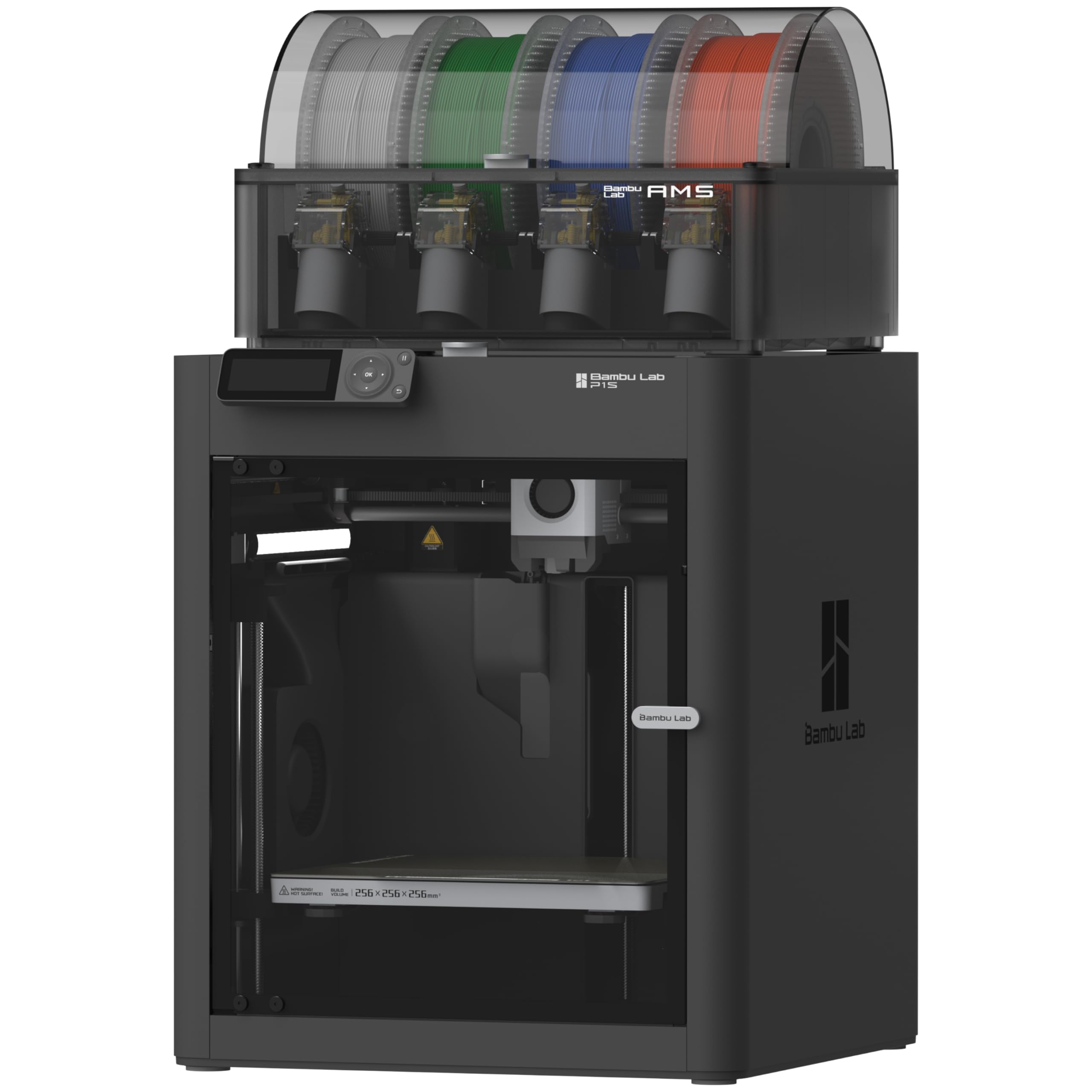
The P1S Combo pairs Bambu’s proven CoreXY speed platform (500 mm/s, 20,000 mm/s² acceleration) with a fully enclosed body and the AMS unit for up to 16-color multi-material printing. The enclosure is the critical upgrade over the A1: it enables reliable printing of ABS, ASA, PETG, TPU, and even PA/PC at the high end of their temperature ranges, dramatically expanding material compatibility for functional parts and engineering prototypes.
Setup is genuinely 15 minutes — the printer arrives nearly assembled, with auto bed leveling handling the rest. User reviews consistently report a 95% success rate across hundreds of prints, with failures almost entirely attributed to operator error like unsupported overhangs or wet filament. The AMS automatically feeds and retracts filaments, and the enclosed design keeps drafts and temperature fluctuations from ruining tall prints.
The camera is 720p and the AI spaghetti detection can be hit-or-miss, failing to catch some bed adhesion failures. Carbon and glass-fiber reinforced filaments are officially not recommended due to nozzle wear concerns. Despite these caveats, the P1S Combo is the single most reliable enclosed printer at this price point for users who need both speed and material versatility.
Why it’s great
- Enclosed body unlocks ABS, ASA, and polycarbonate printing without warping
- AMS supports up to 16 colors with automatic filament swapping
- Under 20-minute setup with auto bed leveling and seamless app integration
Good to know
- Camera resolution is low and AI failure detection is not reliable enough to trust unattended
- Reinforced filaments like carbon fiber are not officially supported
3. Creality K2 Combo (A) 3D Printer
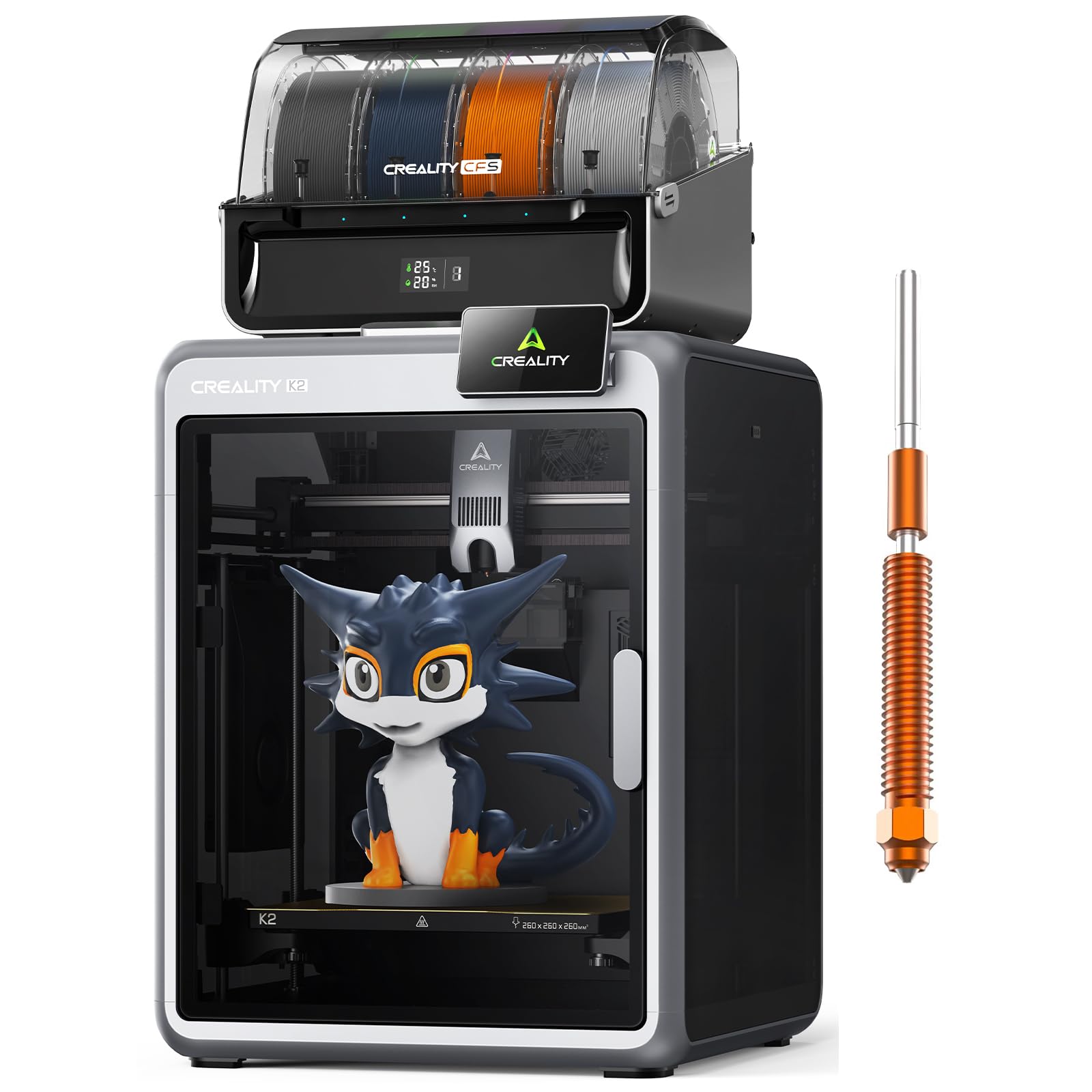
Creality’s K2 Combo leapfrogs the competition by bundling the CFS (Creality Filament System) for multi-color printing with a 260mm³ build volume and step-servo motors that adjust torque dynamically in under a millisecond. The result is extrusion consistency and print accuracy that rival printers costing twice as much. The CFS supports up to four units linked together for a staggering 16 colors, plus it doubles as a dry box to keep hygroscopic filaments like PETG and PA6 print-ready.
The silent mode is genuinely library-quiet — step-servo motors eliminate the high-pitched whine typical of traditional steppers, and the dynamically balanced fans add minimal acoustic noise. The smart auto leveling probes only the bed area relevant to the print, completing the process in seconds rather than minutes. The included AI camera monitors for spaghetti failure and idling in real time, though some users report that detection accuracy varies.
Assembly is advertised as plug-and-play, but several buyers noted the process took over an hour and one reported a defective power cord. The CFS does not accept standard spools — you must print adapters (4 to 5 hours each) or buy Creality’s proprietary refills. The 5GHz Wi-Fi omission is baffling for a printer at this price tier and effectively disables the camera if you only have a 5GHz network. For users who can work around the CFS spool limitation, the K2 delivers remarkable multi-color capability.
Why it’s great
- 16-color multi-material via CFS with integrated drying for engineering filaments
- Step-servo motors enable ultra-quiet operation and dynamic torque adjustment
- Smart auto leveling probes only the print area for faster setup
Good to know
- CFS requires printed adapters for non-Creality spools — no standard-spool compatibility
- No 5GHz Wi-Fi support limits app and camera functionality on modern routers
4. QIDI Q2 3D Printer
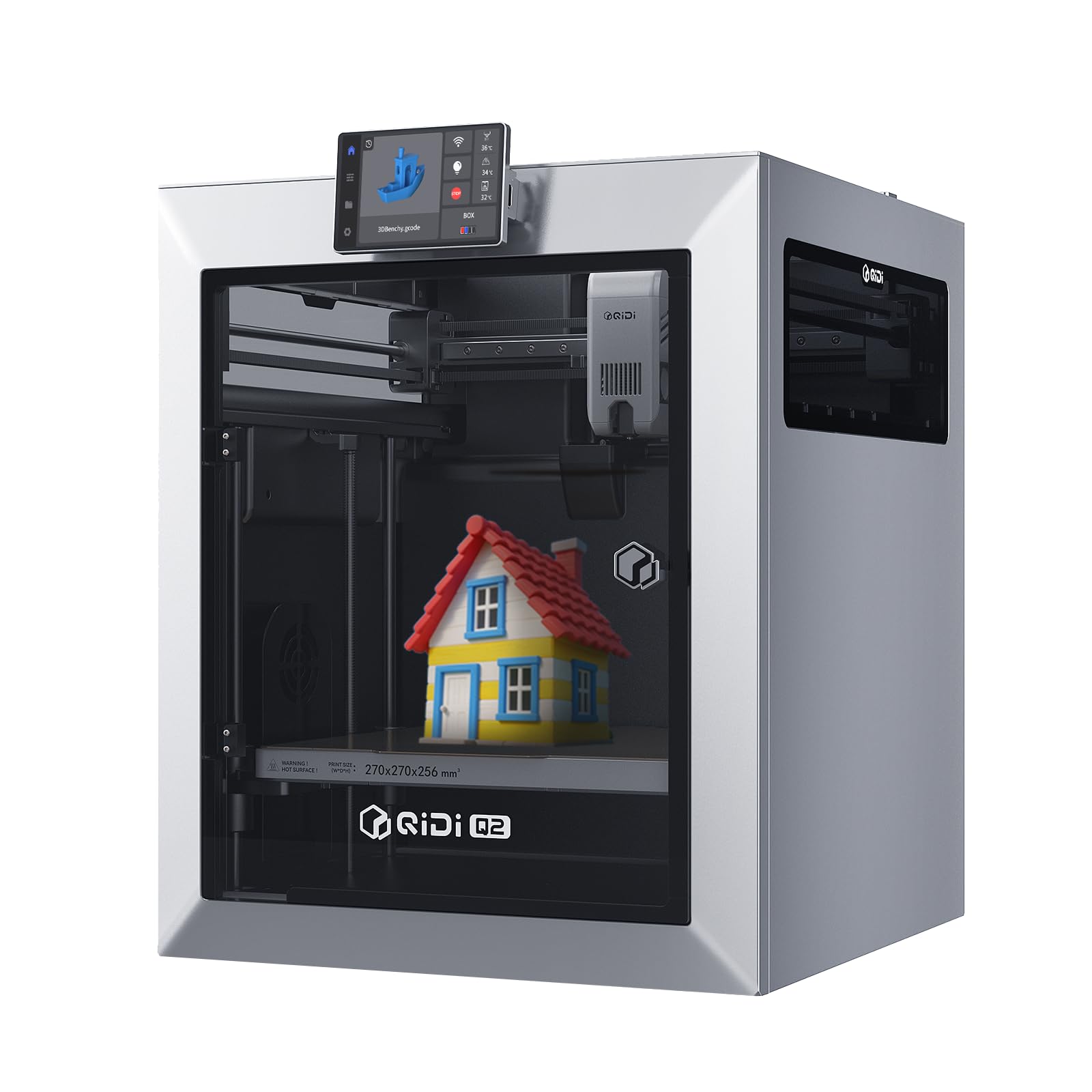
The QIDI Q2 is engineered specifically for users who need a heated chamber. Its 2nd-generation PTC heater reaches 65°C, which is the threshold for reliable ABS and polycarbonate printing without the curling and layer separation that plague open-frame printers. The nozzle itself acts as the leveling sensor, delivering first-layer accuracy that is unaffected by bed surface irregularities — a genuinely unique approach that eliminates one of the most common sources of failed prints.
With a 270x270x256mm build volume, a full-metal CoreXY frame with precision linear rails, and a 370°C high-temp nozzle, the Q2 supports everything from basic PLA to carbon-fiber and glass-fiber composites. The triple filtration system (G3 pre-filter, H12 HEPA, and activated carbon) makes printing advanced materials indoors safer, as it effectively reduces VOCs and particulates. The 1.5GT synchronous belt minimizes vibration artifacts (VFA), producing smoother surfaces than most printers in this class.
The AI spaghetti detection is overly sensitive and triggers false alarms frequently. Some users report that the stock slicer profiles set speeds too high for optimal quality, requiring manual tuning. Additionally, the firmware on early units shipped with Mandarin text in the UI and network connectivity issues that required updates to resolve. For engineering-grade filament production, however, the Q2’s chamber temperature and filtration are unmatched at this price.
Why it’s great
- 65°C heated chamber enables reliable printing of ABS, polycarbonate, and composites
- Nozzle-based leveling is unaffected by bed surface defects for perfect first layers
- Triple HEPA/activated carbon filtration makes indoor advanced-material printing safer
Good to know
- AI false positives require users to disable or tune spaghetti detection
- Firmware and UI polish lag behind competitors — expect some early-adopter quirks
5. ELEGOO Centauri Carbon 3D Printer
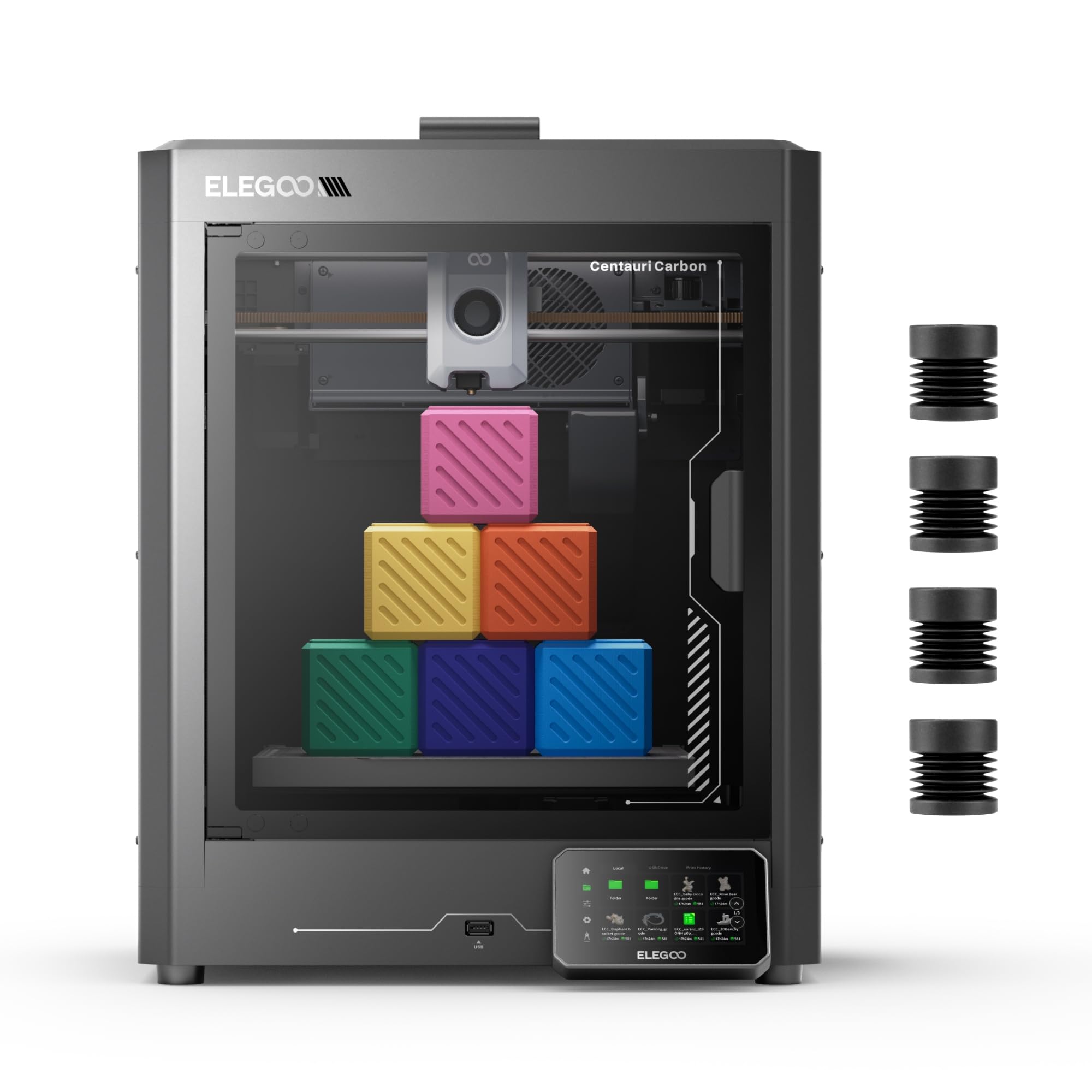
The Centauri Carbon arrives fully assembled and pre-calibrated — you unbox, plug in, load filament, and print within minutes. Its CoreXY structure hits 500 mm/s with 20,000 mm/s² acceleration, and the 320°C brass-hardened steel nozzle handles carbon-fiber reinforced filaments out of the box. The integrated die-cast aluminum frame minimizes vibration even at high speeds, and automatic vibration compensation plus pressure advance ensures clean first layers without the usual ringing artifacts.
The heated bed with a PLA Specific Surface provides excellent adhesion at lower bed temperatures — users report flawless PLA printing without glue or tape. The built-in 1080p camera with dual LED lighting enables real-time monitoring and time-lapse capture, and the intuitive touchscreen with preconfigured ElegooSlicer profiles means you can be printing within 20 minutes of unboxing. The filament run-out sensor and power-loss recovery provide basic reliability without the premium price tag.
Reliability concerns surface in some early units — one user reported a hotend communication error after six days and a lengthy support process for a replacement. The printer is heavy (38.5 pounds) and shakes noticeably at full speed, requiring a sturdy, vibration-absorbing surface for best results. Despite these issues, the Centauri Carbon delivers CoreXY performance at a price that undercuts most competitors by a significant margin.
Why it’s great
- Fully assembled with pre-calibrated auto leveling for immediate out-of-box printing
- 320°C hardened nozzle supports carbon-fiber and glass-fiber composites
- Die-cast aluminum frame and vibration compensation reduce ringing artifacts
Good to know
- Heavy frame causes noticeable shaking at high speed — needs a stable table
- Early units reported communication errors and a lengthy support process for replacements
6. FLASHFORGE Adventurer 5M 3D Printer

The Adventurer 5M uses a CoreXY all-metal structure to achieve a staggering 600 mm/s travel speed with 20,000 mm/s² acceleration, cutting print times by over 70% compared to typical bed-slinger designs. The 32 mm³/s high-flow nozzle heats to 200°C in just 35 seconds and maintains consistent melt for high-speed extrusion. The built-in vibration compensation intelligently reduces spillage and print resonance, resulting in smoother model details than any previous Flashforge printer at this price point.
One-click automatic leveling and a dual-sided PEI platform make setup truly effortless — you unbox, level, load filament, and print with no manual shimming or paper tests. The dual-channel effective cooling fan system handles overhangs and bridges well even at high speeds. Nozzle diameters from 0.25mm to 0.8mm are swappable, supporting everything from ultra-fine detail work to rapid functional parts in PLA, PETG, ABS, ASA, and even carbon-fiber blends.
The Bluetooth and app control work reliably for many users, but some report significant connectivity issues, including failure to connect to Orca Slicer and auto-updates that bricked the printer entirely — a dealbreaker for users who need consistent cloud connectivity. The PEI platform requires an initial adhesion learning curve, and some users note that adhesive is necessary for certain materials. For users who value raw speed above all else and can tolerate occasional software hiccups, the 5M is a value leader.
Why it’s great
- 600 mm/s travel speed with 20,000 mm/s² acceleration for extremely fast prints
- Multi-nozzle support from 0.25mm to 0.8mm for precision and speed modes
- One-click auto leveling and dual-sided PEI platform for easy first layers
Good to know
- Bluetooth and slicer connectivity can be unreliable — auto updates have bricked some units
- PEI surface requires adhesive for many materials, adding a step to every print
7. ELEGOO Mars 5 Ultra 9K MSLA Resin 3D Printer

The Mars 5 Ultra is the most refined resin printer in ELEGOO’s lineup, combining a 9K LCD with 18μm XY resolution and a tilt-release mechanism that achieves printing speeds up to 150 mm/h. The tilt-release innovation separates the model from the FEP film faster than traditional z-axis movements, reducing layer exposure time without sacrificing accuracy. This is critical for users printing large batches of miniatures or dental models where throughput matters.
The smart mechanical sensor detects printing issues like low resin, foreign objects on the build plate, or excessive light board temperature and pauses the print automatically. The built-in AI camera provides real-time monitoring and time-lapse photography, and WiFi cluster printing allows multiple Mars 5 Ultras on the same LAN to be controlled simultaneously — a boon for small print farms. The 7-inch monochrome 9K LCD with 92% light uniformity ensures that edges of the build plate receive the same energy as the center, eliminating the uneven curing that plagues cheaper screens.
Several users reported the LCD cracking within 90 days, requiring a replacement part that customer service covered but the process took time. The included Chitubox software has a steep learning curve, and the printer struggles with light supports — larger models need heavy supports that increase cleanup time. Resin temperature is also critical: cold resin (below 20°C) causes failures, and the build plate must be warmed separately. For high-detail miniature production with a controlled workflow, the Mars 5 Ultra excels.
Why it’s great
- 9K LCD with 18μm XY resolution delivers near-invisible layer lines on miniatures
- Tilt-release mechanism achieves 150 mm/h print speed with excellent surface quality
- WiFi cluster printing enables simultaneous control of multiple printers on a LAN
Good to know
- LCD screen is fragile and may crack within months — replacement cost is significant
- Resin and build plate must be warmed to 20°C+ or prints will consistently fail
8. Original Prusa MK4S High-Speed 3D Printer
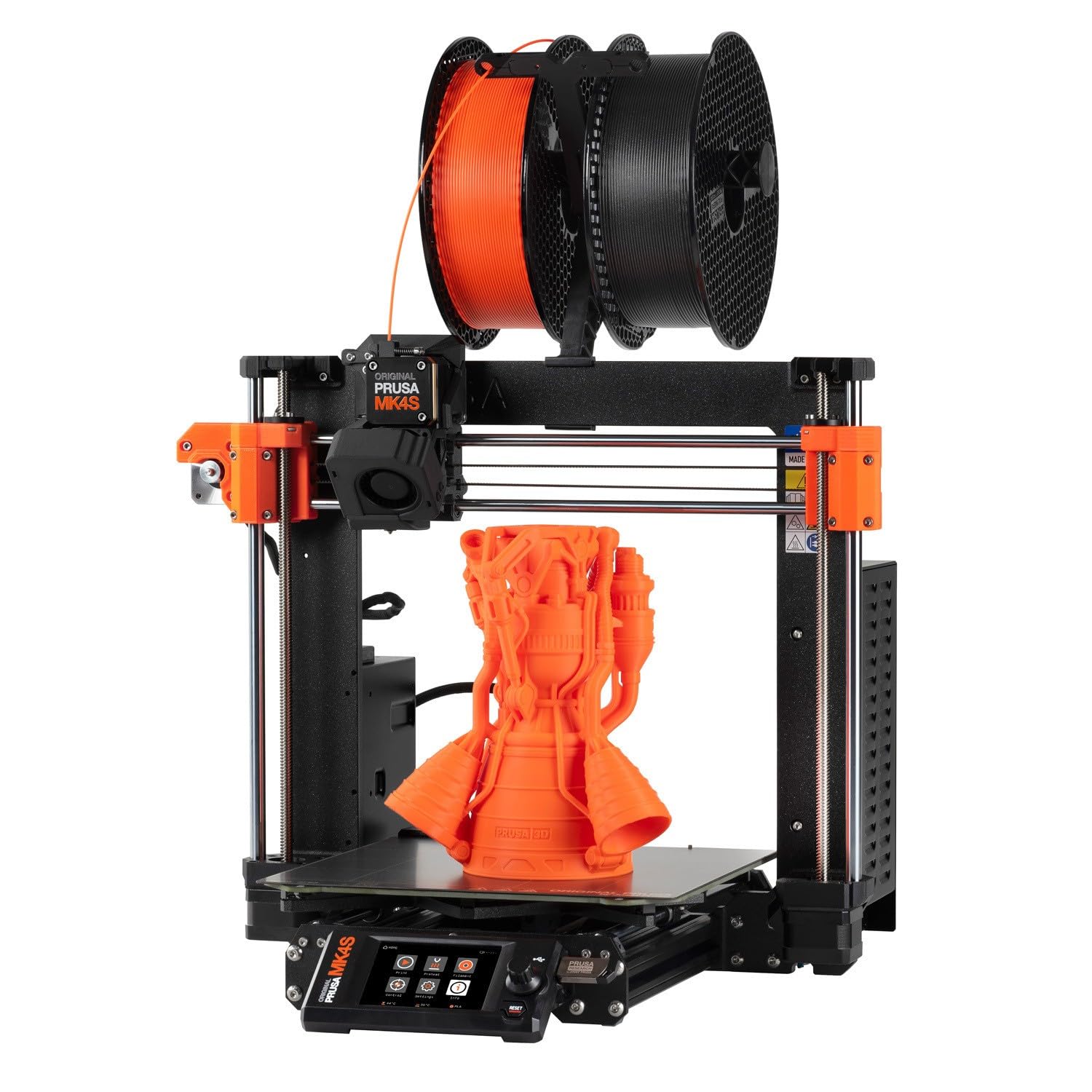
The Prusa MK4S is the benchmark for reliability in the desktop FDM space. Its input shaping algorithm actively compensates for frame resonance, delivering sharp corners and clean surfaces at higher speeds without the ringing that plagued earlier Prusa models. The 9.84 x 8.3 x 8.6-inch build volume is modest by modern standards, but the printer’s consistency is legendary — users routinely print hundreds of hours with zero hardware failures, and the open-source firmware means you can fix, tune, or upgrade any component.
The fully assembled version ships with a 1 kg spool of Prusament PLA Galaxy Black and includes lifetime technical support. Setup is genuinely plug-and-play: the self-check routine verifies every axis, the filament sensor, and the bed leveling in a few minutes. The MK4S prints PLA, PETG, ABS, and TPU with equal precision using the default PrusaSlicer profiles. Users report that even cheap generic filament works flawlessly with minimal tuning — a testament to the machine’s forgiveness.
The price is the obvious barrier — more than triple that of the Bambu Lab A1 with no multi-color capability. The build volume is also smaller than many competitors, forcing users to split large parts or skip the MK4S entirely. The print speeds, while faster than the MK4, still lag behind CoreXY printers in the same price class. For professional prototyping, small production runs, and users who prioritize uptime and support over raw speed, the MK4S is the safest investment in the market.
Why it’s great
- Input shaping delivers ringing-free prints at higher speeds than previous Prusa models
- Open-source design with lifetime support ensures unlimited upgradeability
- Flawless out-of-box experience with pre-configured PrusaSlicer profiles
Good to know
- Price is premium — no multi-color capability included at this cost
- Build volume is modest; large parts may need to be split or printed on a different machine
9. Phrozen Sonic Mini 8K S LCD Resin 3D Printer

The Sonic Mini 8K S is the most affordable entry point into high-resolution resin printing. Its 8K monochrome LCD delivers a 22μm XY resolution, which is sufficient for tabletop miniatures, action figures, and dental models with sharp detail that belies the printer’s compact size. The printing volume of 6.5 x 2.8 x 6.7 inches is small but practical for batch-casting small parts or hobbyist figure production.
Open-source slicer compatibility (Lychee, Chitubox, Tango) means you are not locked into proprietary software, and the precise Z-axis calibration ensures even curing across the build plate. Users consistently report that the printer is a workhorse — reliable, quiet, and producing impressive detail right out of the box. The included build plate is sturdy and the vat is well-sealed, minimizing leaks and cleanup time.
Print files must be transferred via USB — there is no Wi-Fi or network printing, which is a notable omission in 2025. The 22μm resolution, while excellent for the price, is behind the 18μm of the ELEGOO Mars 5 Ultra, and the build volume is significantly smaller. The included scraper is known to damage the build plate if used carelessly. For budget-conscious resin newcomers who want immediate, high-quality results, the Mini 8K S delivers exceptional value.
Why it’s great
- 8K monochrome LCD with 22μm XY resolution produces sharp, detailed miniatures
- Open-source slicer compatibility (Lychee, Chitubox) avoids software lock-in
- Reliable Z-axis calibration and consistent light distribution for even curing
Good to know
- USB-only file transfer — no wireless or network printing capability
- Build volume is small (6.5 x 2.8 x 6.7 inches) — not suitable for larger models
FAQ
Should I get an FDM or resin printer for my first 3D printer?
How important is an enclosed printer for printing ABS?
What is the real-world difference between 22μm and 18μm XY resolution on a resin printer?
Why am I getting failed first-layer adhesion on my new printer?
Final Thoughts: The Verdict
For most users, the best 3d printing equipment winner is the Bambu Lab A1 because it combines the fastest auto calibration system available, a 256mm³ build volume, multi-color capability, and under-48 dB noise in a package that beginners can use confidently from the first print. If you need an enclosed printer for engineering materials, grab the QIDI Q2 with its 65°C heated chamber and triple filtration. And for high-detail resin printing, nothing beats the ELEGOO Mars 5 Ultra with its 18μm XY resolution and tilt-release speed.