
Our readers keep the lights on and my morning glass full of iced black tea. As an Amazon Associate, I earn from qualifying purchases.
Specs are compiled from manufacturer listings and verified buyer reviews and can change over time — please confirm the key details on the product page before buying.
Wet filament is the quiet saboteur of good prints. It hisses and pops at the nozzle, strings across the part, and leaves weak layer adhesion you only discover after a long job. The fix is a drying box that holds your spools at a steady low heat and keeps ambient moisture away. But these boxes are not all the same: some dry two spools at once, some four, some reach 85℃ for engineering nylon, and others top out around 70℃. Pay attention to how many spools you run in a week, whether the chambers heat independently, and what maximum temperature your materials actually need.
I’m Min — the founder and writer behind Gadgets Feed. This guide is built by comparing the manufacturers’ published specifications and the patterns across verified customer reviews, so you get each pick’s real strengths and trade-offs instead of marketing spin.
Below are nine boxes ranked so the strongest all-rounder sits first and budget-friendly picks come last, with the trade-offs spelled out before you buy. This breakdown of the best 3d printing filament dry box options covers spool capacity, max temperature, and the real dry times each unit delivers.
Our Picks at a Glance

How To Choose The Best 3D Printing Filament Dry Box
Most buyers start by hunting the cheapest box, then discover it dries one spool at a time and caps at 70℃ — which is fine for PLA but useless for nylon. The right box depends on how many spools you keep in rotation and which materials you actually print. Here is what to weigh before you pick.
Spool capacity sets your throughput
A single-spool box is fine if you print one material at a time. But if you run PETG on one printer and PLA on another, a four-spool unit like the Creality Space Pi X4 or SUNLU S4 saves you the round-robin juggling. The number of filament exit holes matters too — a box with eight holes lets you feed four printers at once without re-threading. For buyers running a single printer, a two-spool box gives you headroom to pre-dry your next roll while the current one prints.
Maximum temperature decides which filaments you can revive
Every material has its own hygroscopic (moisture-absorbing) threshold. PLA responds to 45–55℃, PETG to roughly 60–65℃, and engineering filaments like PA (nylon) and PC want 80℃ or higher. A box that tops out at 70℃ handles everyday PLA and PETG well, but a unit reaching 85℃ is worth it if you print polyamide, PAHT, or PC. Check the maximum temperature first, then confirm the timer range — a box that only runs six hours won’t fully dry a soaked nylon spool.
Independent chambers, seals, and humidity readouts
Dual independent chambers let you dry two different filament types at once — say PETG on the left at 65℃ and PLA on the right at 50℃ — without one material cooking at the other’s setting. The lid seal is the other make-or-break: a box that leaks lets ambient moisture back in as soon as it powers off. A built-in hygrometer (humidity gauge) or desiccant chamber keeps spools stable between jobs, and reusable desiccant can be dried and dropped back in.
Quick Comparison
| Model | Best For | Spool Capacity | Max Temperature | Unit Count | Amazon |
|---|---|---|---|---|---|
| Official Creality Space Pi X4 (DB-05)★ Best Overall | Printing four spools at once | 4 spools | 85℃ | 4 Count | Amazon |
| SUNLU Filament Dryer S2, BlackBest Value | Entry-level single-spool drying | 1 spool | 70℃ | 1 Count | Amazon |
| JAYO J1 Filament Dryer BoxCompact Pick | Stackable split setup | 0.25kg / 0.5kg / 1kg | 70℃ | 1 Count | Amazon |
| Creality Space Pi SE (Dry Box 2.0) | One-key single-spool drying | 1 spool | 65℃ | 1 Count | Amazon |
| Creality Space Pi Filament Dryer | PLA-CF and PA-CF composites | 1 spool | 70℃ | 1 Count | Amazon |
| Polymaker Polydryer (Dry Dock + Box) | Sealed dry-store-print workflow | 1 spool | — | 1 Count | Amazon |
| Sovol SH02 Filament Dryer | Dual-spool sealed drying | 2 spools | 70℃ | 1 Count | Amazon |
| SUNLU S4 Filament Dryer, Black | Four-spool active drying | 4 spools | 70℃ | 1 Count | Amazon |
| Chitu Systems E1 Filament Dryer | Auto-humidity four-spool control | 4 spools | 70℃ | 4 Count | Amazon |
In‑Depth Reviews
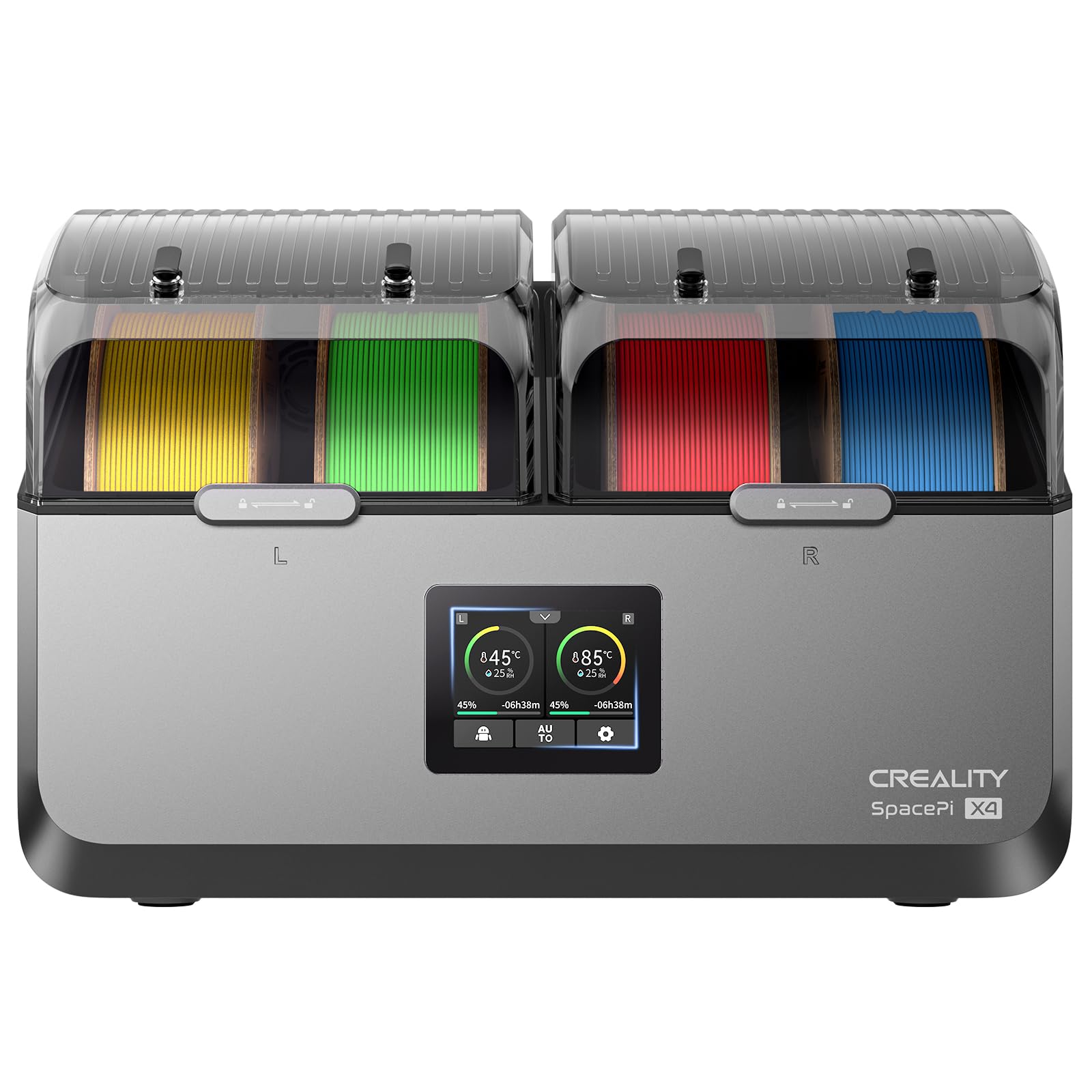
1. Official Creality Filament Dryer, Space Pi X4 Filament Storage Box, 85℃ Max Temperature, Dual Independent Heating Chambers, DB-05
Our pick — over 4.5★ from 550+ verified ratings; the strongest balance of quality and price.
The dual-chamber heavyweight that hits 85℃ for the engineering filaments most boxes can’t touch.
If you print PA, PAHT, or PC — materials that soak up moisture fast and demand serious heat to revive — this is the box built for you. The two independent PTC heaters (self-regulating ceramic heaters that hold temperature on their own) each deliver 200W, and because the chambers are insulated they climb to 85℃. Compared to the SUNLU Filament Dryer S2’s 70℃ ceiling, that 15℃ headroom is what lets you dry polyamide properly instead of half-reviving it. You get four spools drying and printing at once through eight filament holes and PTFE tubing, so four printers can feed simultaneously.
The dual chambers aren’t just about capacity — they let you run PETG at 65℃ on the left while PLA sits at 50℃ on the right, each on its own independent temperature control. Creality also built in a power-saving single-chamber mode that saves up to 40% energy when you’re only running one side. The touchscreen is responsive, setup takes minutes, and the 360° hot air circulation gets heat into every corner of both chambers. Weighing 1 kg and coming as a 4 Count unit, it is the heaviest-duty option here — the SUNLU S2 by comparison is 1.51 kg but dries a single spool rather than four.
What wins people over is drying performance — the thing owners rave about most is how evenly it revives PETG and nylon, cutting the stringing and popping that ruin surface finish. That said, an occasional unit reports a reliability hiccup after a month, and one owner hit a snag where two spools fused at the PETG default of 65℃ over 24 hours. One owner reported two spools fused at the PETG default of 65℃ over 24 hours, causing failed prints, with no issues since. Treat that as a nudge to dial temperature down for long soaks on thin-walled spools. The larger footprint and a loud completion beep are the other small things to know going in.
What Earns Its Top Spot
- Reaches 85℃ — 15℃ more than the SUNLU S2 — so it drys PA, PAHT, and PC the everyday boxes can’t.
- Dual independent PTC chambers dry four spools at once, each side at its own temperature.
- Eight filament holes and PTFE tubing let four printers feed simultaneously.
- Single-chamber mode saves up to 40% energy when you only need one side running.
Where It Asks For Care
- A small share of units report a reliability failure around the one-month mark.
- Loud completion beep, and a larger footprint than single-spool boxes.
- Long 24-hour soaks at 65℃ can fuse thin-walled spools — drop the temperature on long runs.
Land it if: you run engineering filaments or multiple printers and want four spools dried at independent temperatures.
Weigh first: the bulk and the beep — and it costs the most here, so single-spool PLA printing is where a smaller box wins.
2. SUNLU Filament Dryer S2, Black
The single-spool starter that gets a soggy TPU roll printing again without a big spend.
For a first filament dryer, this is where most people land — a single-spool box that heats to 70℃ with a large touchscreen and a translucent lid you can peek through without breaking the seal. It handles 1.75mm, 2.85mm, and 3.00mm filament, so it’s not tied to one printer brand. The internal cavity runs 265x274x118mm, big enough to take a full 1kg spool, and the built-in spindle spins the roll continuously for even drying rather than cooking one spot.
Set it up and it’s running in under ten minutes — the touchscreen remembers your last setting, so you dial in your material once and it sticks. Owners dry TPU, PLA, PETG, and ABS with it, feeding filament straight to the printer while the box keeps conditioning the roll. In a humid Florida summer, one owner held TPU at 19% humidity and saw prints improve, with PLA and wood filament printable immediately. Drying performance is the standout — the thing everyone raves about is how reliably it pulls moisture out, with ease of use a close second.
The honest catch: 70℃ is the ceiling, so PA (nylon) and PC owners will want more heat. Some owners wish it reached 80℃, and the drying time is fixed at 6 hours max on the timer in some usage, which is tight for soaked nylon. The lid hole can also feel rough, and the LED is bright enough that a few owners turn it off. For a sub-70℃ filament like PLA or PETG, though, it does exactly what it promises.
The value read: it dries one spool at a time but does it well, and the 24-hour-plus runtime several owners rely on means you can set a long dry and walk away.
One thing to know: the 70℃ cap is the limit — nylon printers should look at the Creality Space Pi X4 above for the 85℃ ceiling.
Reach for it if: you print PLA, PETG, or TPU on a single printer and want a dependable budget-friendly box.
Look elsewhere if: you print PA or PC — the 70℃ max won’t fully dry them.
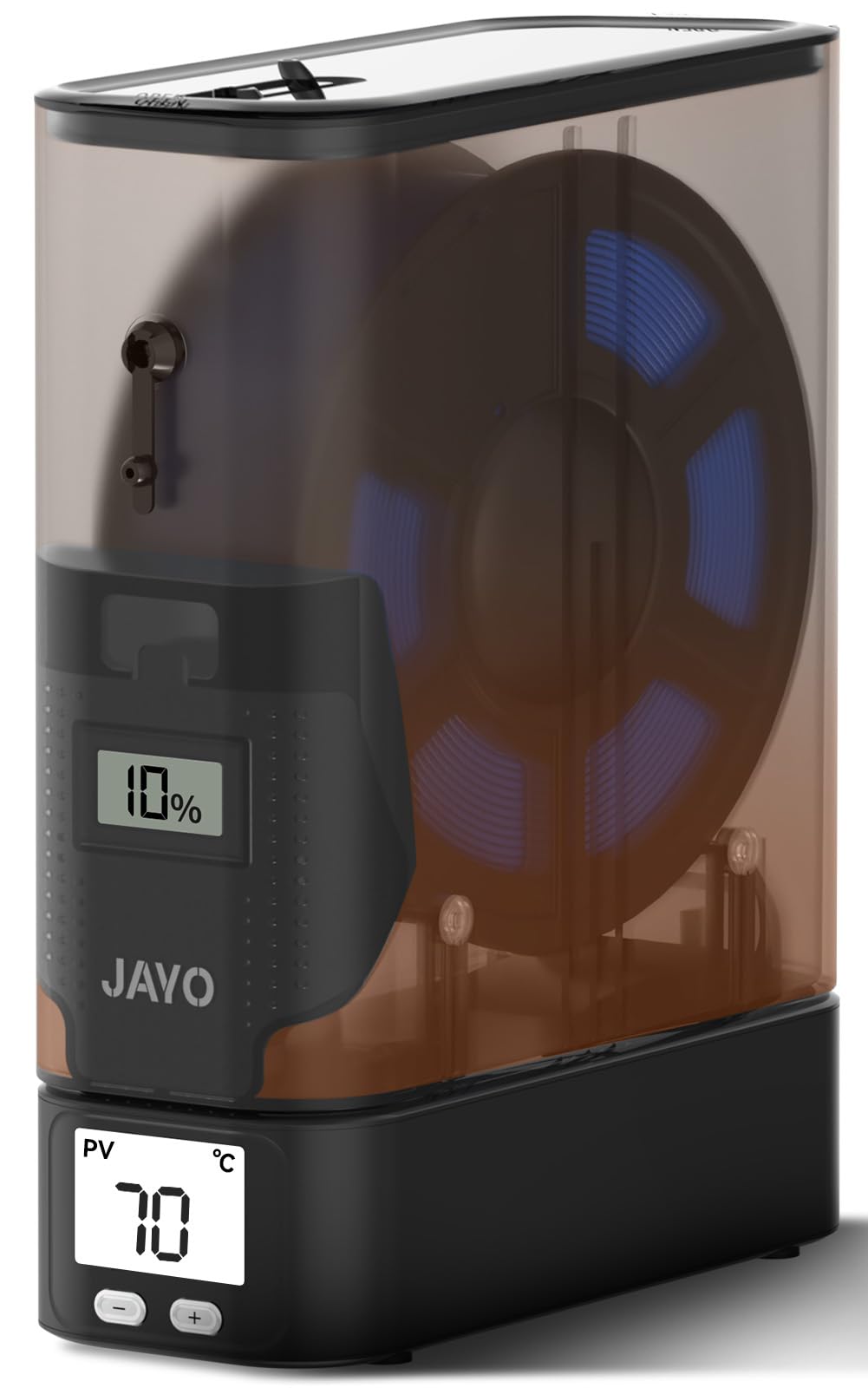
3. JAYO J1 Filament Dryer Box for 3D Printer Filaments, 150W PTC, Up to 70°C
A slim split-design box you can stack or spread across a bench to fit any printer layout.
The J1’s trick is its modular split design — you can run one unit standalone or stack multiple together for a multi-printer bench, keeping every spool dry without eating shelf space. The 150W PTC heater (a self-regulating ceramic element) reaches its 70℃ ceiling in minutes and dries even moisture-soaked PLA, PETG, and ABS evenly. It supports 0.25kg, 0.5kg, and 1kg spools and works with 1.75mm filament, so both small sample rolls and full spools fit.
You can dry a spool, close the lid, and leave it print-ready between sessions — handy if your printer lives in a humid basement or garage. That’s because built-in desiccant (a moisture-absorbing packet) inside the sealed body keeps internal humidity stable within ±5% over 21 days. You can also dry and print at the same time, feeding filament directly from the box while it holds at optimal humidity. The humidity window lets you check conditions without opening the box, and dual hardware protection with real-time monitoring watches the temperature.
Owners like the drying power for its size — it’s a compact, aggressive dryer. Two fit-and-finish notes come up: there’s a small gap between the heater and the canister you can seal with a gasket or 1mm foam tape, and there are no clips to lock stacked units together. The moisture-holding performance is the strong suit — a sealed box that keeps spools dry for weeks at a time even powered off.
Why stackers like it: the split design scales from one printer to several without a single large footprint.
The small print: add your own sealing tape and locking clips if you plan to stack — the box ships without them.
Good fit for: hobbyists running multiple printers who want spools stored and dried in one sealed box.
Think twice if: you want factory clips and a sealed heater chamber from the start.
4. Creality 2026 New Upgrade Filament Dryer Box Pro, Space Pi SE with High PTC Efficiency & Precision Sensor for 1KG Spools 45~65℃
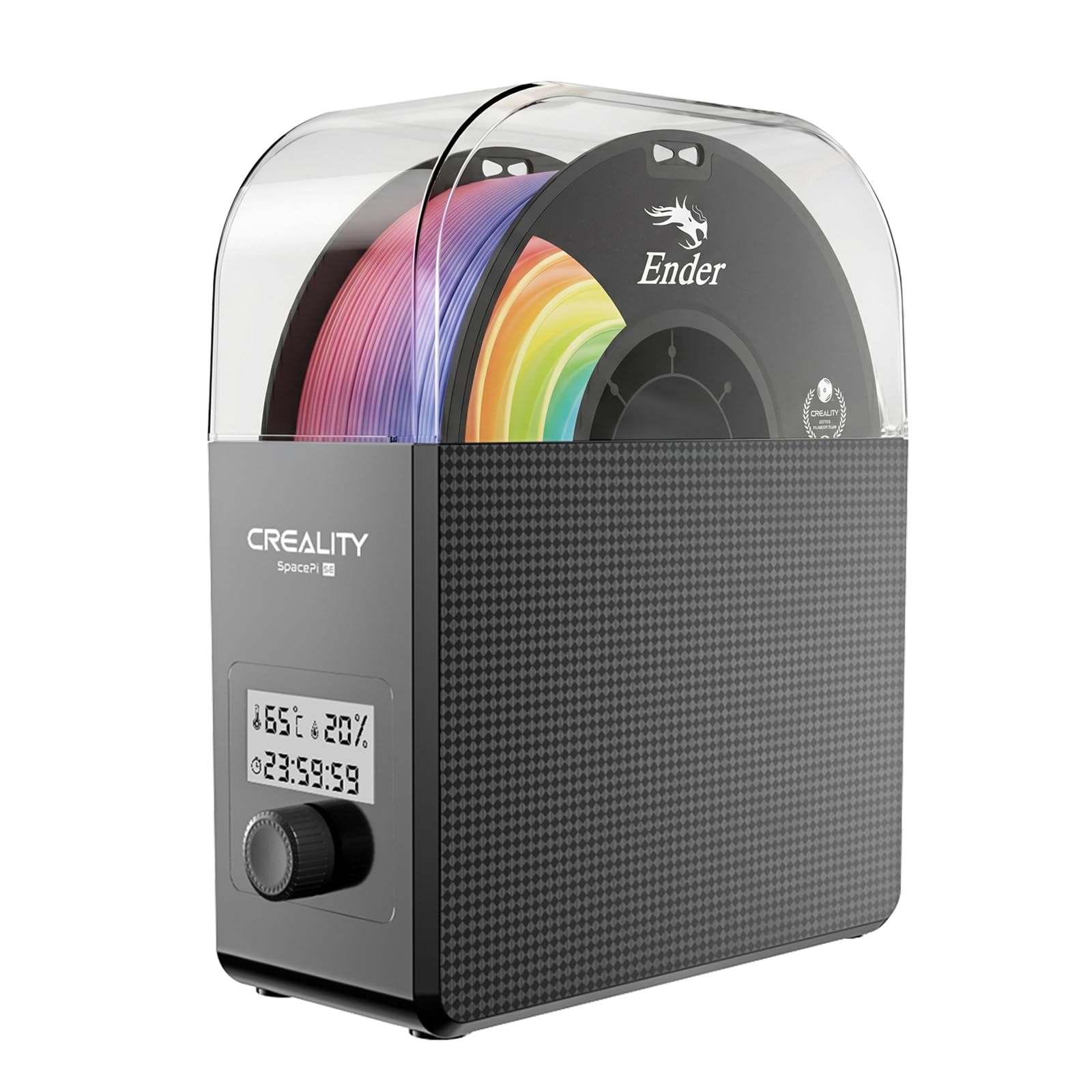
A no-assembly single-spool box that hits 65℃ in about 15 minutes with a knob you barely touch.
This is the box for someone who wants to plug in, set a temperature, and forget it. The Space Pi SE heats to 65℃ within 15 minutes using an upgraded PTC heater and a fan that pushes hot air 360° around the spool. Thermal insulation cotton on the inner wall keeps the heat in and the surface cool to touch. The input is 110V 50/60Hz, and you set anything from 45℃ to 65℃ for a timer range of 0 to 24 hours.
There’s no assembly — it works right from the start. A display screen and knob handle everything, with real-time humidity monitoring and a countdown timer showing drying hours. It fits most 1kg spools at 1.75mm and 2.85mm diameters, and it dries PLA, PLA+, PETG, TPU, ABS, ASA, PP, PC, and PA (nylon). Pair it with a PTFE tube and filament feeds to the printer smoother. Owners running PA12-CF report a significantly higher success rate, and one notes it stays quiet in the living room.
Owners praise the straightforward knob-and-screen interface — it simply does its job. The trade-offs: the display viewing angle is poor if the box sits low on a shelf or floor, the fan is somewhat noisy, and the humidity sensor draws recurring gripes about reliability — a hydrometer (a humidity gauge) that never reads below 15% leaves some guesswork. The single-spool limit is also a real ceiling if you run more than one printer.
What Buyers Appreciate
- No assembly — plug in and it’s ready; knob plus screen keep operation simple.
- Heats to 65℃ in about 15 minutes with 360° hot-air circulation.
- Adjustable 45℃ to 65℃ and 0 to 24-hour timer covers PLA, PETG, TPU, ABS, ASA, and PA.
- Thermal insulation keeps the outer wall cool to touch.
Trade-Offs to Weigh
- The built-in hydrometer never reads below 15% on some units — humidity reading can be imprecise.
- Display viewing angle is poor when the box sits low.
- Fan noise is noticeable for a unit sitting in a living space.
- Single-spool only, and no PTFE fitting from the start.
Pick this if: you want a single-spool box with zero assembly and a knob you can set in seconds.
Second-guess it if: you run multiple spools at once or need a reliable humidity readout for moisture-sensitive nylon.
5. 2026 New Creality Space PI Filament Dryer, 3D Printer Filament Dryer Box with 360° Heating, Support Nylon ABS PETG PLA TPU 1.75/2.85mm
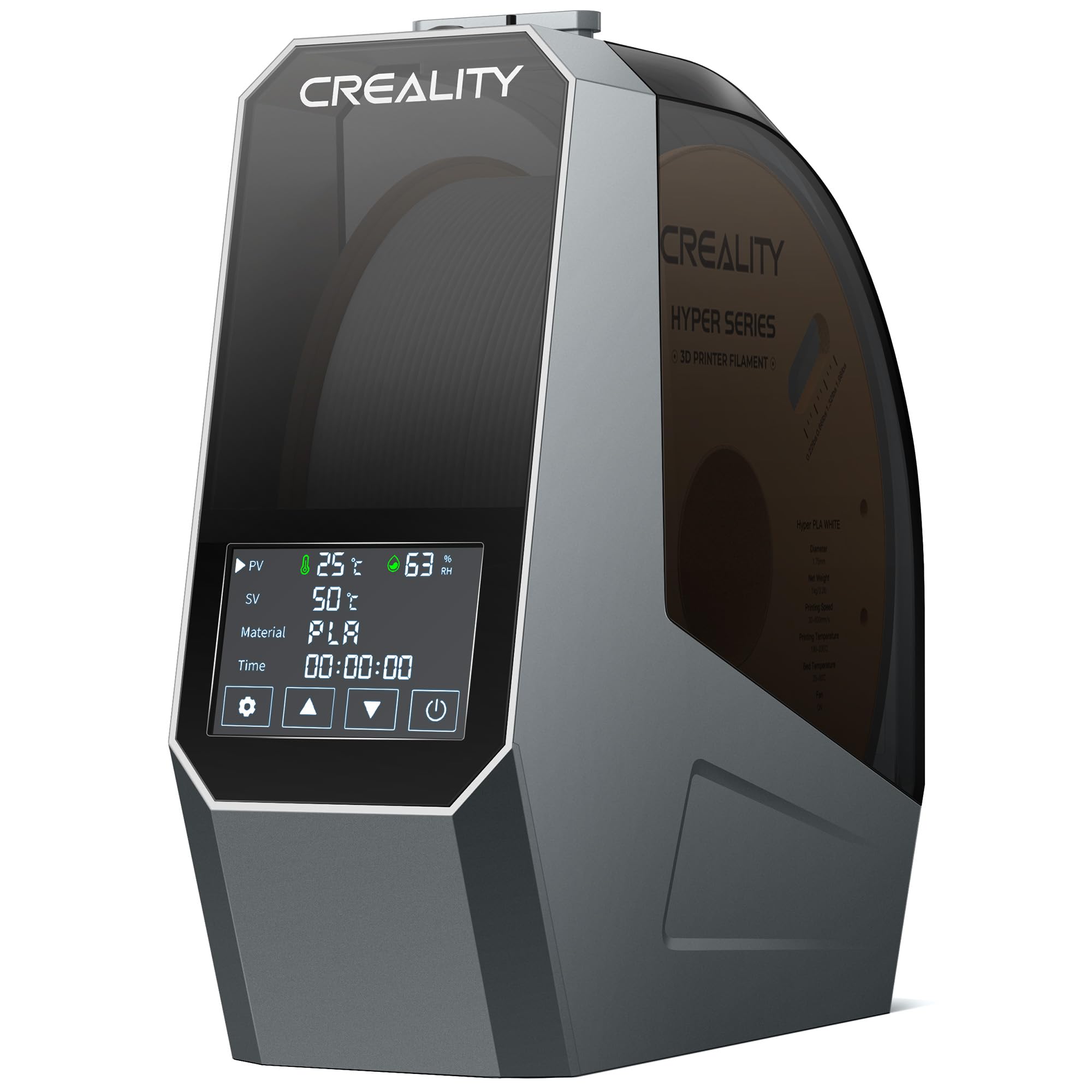
The composite-material box — 12 one-key presets and a 48-hour timer for PLA-CF and PA-CF.
The Space Pi earns its place for printing composites. A 110W PTC heater warms the chamber faster than a traditional PI heating pad and — crucially — drys more evenly, avoiding the hot and cold bands you get with a pad. There’s one-key temperature settings for 12 filament types, including composites like PLA-CF, PA-CF, and ASA, and you can adjust freely between 45℃ and 70℃. The 48-hour timer lets you fully dry a soaked nylon spool without restarting the cycle overnight.
The 3.7-inch touchscreen lets you switch between ℃ and ℉, and the power-off memory function means if the plug is pulled mid-dry, it restarts and remembers your previous material and temperature settings. It fits 1.75mm and 2.85mm filament and runs common materials (PLA, PETG, TPU, ABS) plus high-performance composite like PLA-CF and PA-CF. Buyers report a fan quiet enough to be inaudible over the printer’s cooling fan, and the box feeds filament directly during printing.
Functionality again is the headline — it’s a box that simply works, with 12 presets doing the thinking for you. But the touchscreen is the recurring gripe: some find it unresponsive and awkward to press, and several owners describe it plainly as awful to use. Fan noise opinions split — some say it’s quiet, others find it obnoxiously loud — so a unit that’s responsive for one owner may need a firmer press for another. The lid doesn’t keep humidity out on its own, so plan to store the spool in a bag after drying.
Where it leads: 12 presets and a 48-hour timer make it the composite-printing workhorse, handling PLA-CF and PA-CF the simpler boxes skip.
The tempered read: the touchscreen splits opinion — plan to press firmly and don’t expect the lid to hold dry air between sessions.
Suits you if: you print composite filaments like PLA-CF or PA-CF and want one-key presets plus a long timer.
Not for you if: you want a crisp, instantly responsive touchscreen and a lid that seals without extra storage.
6. Polymaker Filament Dryer & Storage Box Polydryer for 1kg PA Nylon PLA PETG
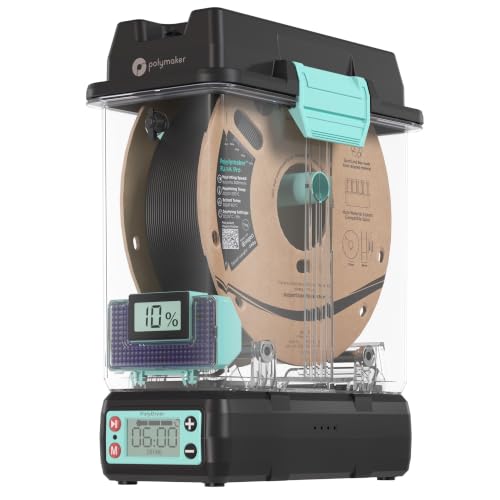
A modular dry-store-print system that swaps a sealed storage box onto a heating dock.
Polymaker’s approach is different: rather than one sealed chamber, you get a reusable storage box plus a separate heating dry dock. The system dries, then stores the sealed box, then feeds the printer — all without breaking the seal. That matters because a sealed box locks in dry conditions between prints, and a built-in hygrometer shows you the filament status without guesswork. It’s built for PA nylon, PLA, PVB, PETG, ABS, ASA, and TPU across 1.75mm, 2.85mm, and 3.00mm diameters.
The heat-and-seal-and-desiccant combo does the real work: heated drying via the dock, sealed storage with desiccant support, and 360° airflow inside the drying chamber. Owners who get on with it keep spools dry for weeks, storing multiple boxes for different materials and swapping them onto the dock as needed. It weighs 1.3 kg and is a 1 Count setup, though you can add extra storage boxes for a larger material library.
The honest split is on drying performance — some owners find it keeps filaments dry for weeks while others find it barely effective, and value opinions divide the same way. One owner rated it 1 star: a six-hour PETG cycle dropped humidity only 2% while the temperature climbed to max. Latches can be stiff, and the manual assumes you unplug the dock, which a few find awkward. It’s a system for buyers who want sealed storage as much as drying — not the fastest single-spool heater.
What it nails: the sealed, stackable storage approach means your filament stays dry between jobs without re-drying every time.
Be honest about: drying performance and value both get mixed reactions — buy it for the storage system, not the fastest dry cycle.
Made for you if: you want a sealed storage box plus a drying dock in one modular system.
Look elsewhere if: you want the fastest, most predictable moisture drop for the money.
7. Sovol Filament Dryer, SH02 Dry Box 3D Printer Sealed Filament Storage Box

The two-spool sealed box that holds a pair of 1kg rolls dry even when it’s powered off.
If you run a single printer with two materials, the SH02 hits a balance — it dries two 1kg spools at once in one compact footprint. The 150W PTC heater (a self-regulating ceramic heater) climbs to 50℃ within 7 minutes and 70℃ within 25 minutes, and you can set anything from 40℃ to 70℃. A built-in fan circulates hot air 360° for even heating, so there’s no cold corner cooking one side of a roll. Two filament holes with PTFE tubing (a slippery plastic tube that guides filament) let you feed two printers or one printer from two spools simultaneously, saving space and tidying the bench.
Sealing is the upgrade over Sovol’s earlier SH01 — thicker sealing material means the box protects filament from moisture and dirt even when it’s switched off. You can drop in four desiccant bags (not included) to boost drying efficiency, and the box holds 2 spools at 15-20% humidity versus the 25%+ of an unprotected rack. There’s one-key temperature setting for nine filament types (PLA, TPU, PETG, ABS, ASA, PVA, PC, PA, PP), each with a factory default for temperature and time. The safety side cuts the heater above 130℃ and resumes below 90℃, and alarms if the fan stops.
Owners rave about the drying performance, with print quality and one-key presets right behind. The recurring gripes are the vent and the heat: the top vent can be small enough to trap moisture unless you prop the lid, humidity only displays when powered on, and some find the bottom runs hot while fan noise splits opinion. A few note the front LED stays lit, and feeding filament through the lid holes can be finicky the first time. None of that stops it being a strong value for drying two spools at once.
Why two-spool buyers choose it: sealed storage plus dual-spool drying in one box is a combination the single-spool units here simply don’t offer.
Small print to know: if you load high-temp material, watch the bottom heat and prop the lid to let trapped moisture escape.
Best for: owners running a single printer with two materials who want sealed, off-when-idle protection.
Not ideal if: you need a large vent, a powered-on humidity readout at all times, or a cool-running base.
8. SUNLU S4 3D Printer Filament Dryer, Black

The four-spool workhorse with three fans and a 350W heater that dries a full rack at once.
If you keep four spools in rotation, the S4 turns a chore into one pass — it dries up to four 1kg rolls at the same time. A 350W PTC heater runs 50% hotter than the FilaDryer S2, and three circulation fans push air around the whole 450(L) x 175(W) x 207(H)mm internal chamber for even drying. Eight filament exit holes let you feed multiple printers from different angles. Temperature adjusts from 35℃ to 70℃ with a timer from 0 to 99 hours, covering PLA, PLA Plus, PLA Meta, PETG, ABS, TPU, PA, PC, Nylon across 1.75mm, 2.85mm, and 3.00mm filament.
Reliability is the feature owners rave about — it’s the quality it’s known for, followed closely by build quality, with drying capacity close behind. It runs quiet enough for overnight use thanks to smooth bearings, and loading is simple. Mode 2 holds a set relative humidity for absorbent filaments during printing, and you can override the presets for your own material profile. It also docks directly to an Elegoo CC2 or feeds a Prusa MK4S MMU, and the box can be modified — with video instructions — to dry 3kg large rolls or even act as a shoe dryer.
The one honest caveat: it’s big and heavy at 4 kg, which is the price of drying four spools at once, and a few owners mention it won’t climb past 55 Celsius on some units despite the 70℃ spec. The top door latches are also small. For the space and capability, though, owners describe it as essential for successful multi-material printing, and it holds its value against the cheaper single-spool boxes.
Why It’s a Favorite
- Dries four 1kg spools at once with a 350W PTC heater — 50% higher heating efficiency than the FilaDryer S2.
- Three circulation fans spread heat evenly across the large chamber.
- Eight exit holes feed multiple printers at different angles.
- Quiet enough for overnight drying on smooth bearings, with adjustable presets.
The Fine Print
- Large and heavy at 4 kg — it needs bench real estate.
- Some units reportedly won’t exceed 55 Celsius despite the 70℃ rating.
- Top door latches are small.
The fit: multi-material and multi-printer owners who want a full rack dried in one cycle.
The miss: tight benches and anyone who doesn’t need four spools dry at once — you’ll pay in space for capacity you won’t use.
9. Chitu Systems E1 Filament Dryer 4 Spools, Auto-Humidity Hold, Independent Control with 2 Removable Chambers
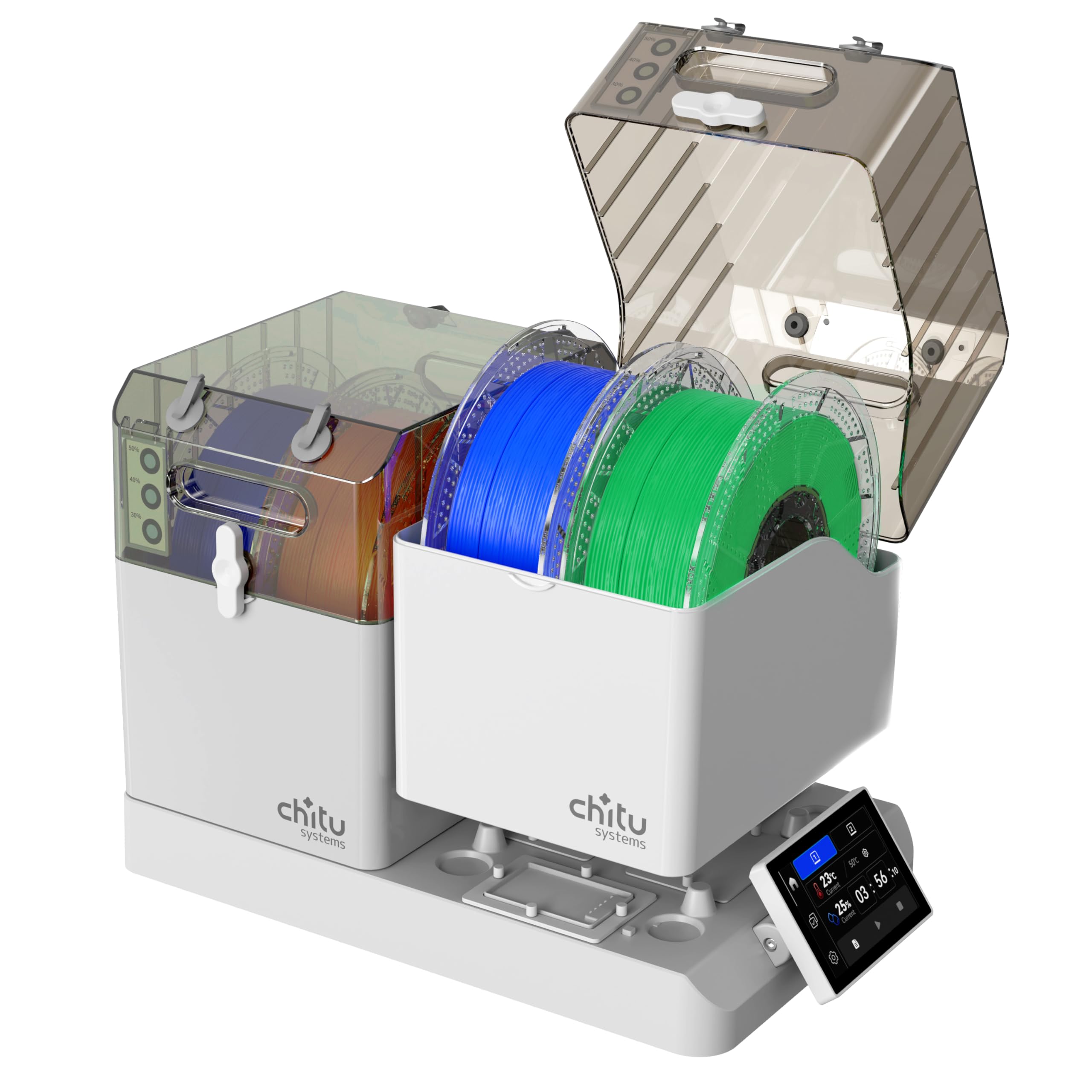
A four-spool pod system that switches itself on the moment humidity climbs past 50%.
The E1’s headline feature is automatic drying: a high-precision humidity sensor watches the chamber, and even in standby the box kicks on when internal humidity hits 50% or higher. That means it doubles as a storage box that defends itself against secondary moisture — you don’t have to remember to run a cycle. Two removable chambers each hold a pair of 1kg spools, and both are independently controlled, so you can set different temperatures and durations per side for different filament types. With 8 filament holes and PTFE tubes, it feeds multiple printers at once.
Heat comes from two 120W PTC heaters with dual fans circulating 360° for even drying, and customers note it can hold temperatures up to 70℃ — enough for CF nylon and engineering filaments. A 4-inch touchscreen with preconfigured PLA, ABS, PETG, PA, and PC presets keeps setup short. The removable pods are stackable and reversible, so you can build a compact drying and storage rack that fits beside the printer. It’s 3.5 kg and comes as a 4 Count unit.
Owners praise the drying itself — the auto-humidity trigger plus fast cycles is the draw. The caveats are real but fixable: the lid handles are weak and the latch can fail, the pod bottoms have open holes some owners tape over, and the rollers lack bearings, which can cause feed issues on very light spools. The resistive touchscreen (a screen you press firmly, not a light tap) needs a firm press, humidity monitoring drew a few negatives, and one unit arrived with a cracked LCD. Even with those, owners who need a four-spool-deep form factor call it excellent value.
The standout: the auto-dry-at-50% trigger is the peace-of-mind feature — the box tends itself between prints.
The honest side: fit-and-finish needs a little DIY love — weak lid latches and open pod holes are the recurring notes.
Choose it if: you want four spools managed automatically and independently, with self-starting humidity control.
Pass if: you want a firm-feeling touchscreen and factory-sealed pod bottoms without taping holes yourself.
Understanding the Specs
PTC heater wattage and max temperature
PTC stands for positive temperature coefficient — a self-regulating ceramic heater that holds its temperature instead of overheating. Wattage sets how fast the chamber climbs: a 110W unit is gentle, a 350W unit like the SUNLU S4 heats a four-spool rack fast. Max temperature is the number that decides your materials. A 70℃ box covers PLA, PETG, and TPU; an 85℃ box like the Creality Space Pi X4 handles PA, PAHT, and PC, which need higher heat to release absorbed moisture. Match the ceiling to your filament, not to the biggest number.
Spool capacity, chambers, and drying time
Capacity is how many 1kg spools fit and dry at once — one, two, or four. Independent chambers let you run two materials at different temperatures in the same machine, so a PLA roll isn’t cooked at a nylon setting. Drying time runs from a 6-hour cap on some single-spool boxes to 99 hours on the larger units — useful when a soaked spool needs a long, gentle soak. Humidity monitoring and a reversible or translucent lid let you watch conditions without opening the box and letting moist air back in.
FAQ
What temperature should I dry PLA vs PETG vs nylon filament at?
Can I print while the filament is in the dry box?
How long does a spool stay dry in a sealed box?
Do I need a four-spool dryer or is a single-spool box enough?
What is the difference between a filament dryer and a dry box?
Can a filament dryer revive old damp filament?
Is a filament dryer safe to leave running overnight?
Do I need independent dual chambers in a filament dryer?
How many spools should a filament dry box hold for a single printer?
Should I re-dry desiccant and how often?
Final Thoughts: The Verdict
For most people, the 3d printing filament dry box pick is the Official Creality Space Pi X4 — it dries four spools at independent temperatures and reaches 85℃, the highest ceiling here, so it handles PETG and engineering nylon that the 70℃ boxes can’t. According to the maker, single-chamber mode saves up to 40% energy when you only need one side running, and four spools at once is the throughput no single-spool box matches. If your printing is PLA, PETG, and TPU on one machine, the SUNLU Filament Dryer S2 does dependable single-spool drying for far less. And if you run multiple printers and want four spools managed automatically, the Chitu Systems E1 switches itself on the moment humidity climbs past 50%, so your filament never sits wet between jobs.
How We Picked
We do not accept paid placement. Every pick is matched to a real buyer and a real use-case; we do not hands-on test units.
Sources & Methodology
Specifications: manufacturer listings and product documentation. Review insights: verified customer reviews, as of September 2026. Pricing: not shown on this page (it changes often); check the current price via the retailer link.
As an Amazon Associate, Gadgets Feed earns from qualifying purchases. This does not affect which products we feature.