
Pouring a fresh bottle of photopolymer is a moment of hope. The printer hums, the UV array flashes, and hours later you peel a miniature or a functional bracket from the build plate. But that moment sours fast when the first delicate wing snaps off or the part warps before it ever sees paint. Viscosity, UV absorption rate, shore hardness, and shrinkage ratio — not brand names — are the real predictors of whether that bottle earns a permanent spot on your shelf or becomes another failed experiment in the bin.
I’m Min — the co-founder and writer behind Gadgets Feed. I spend dozens of hours cross-referencing material datasheets, user exposure logs, and real-world failure reports to separate marketing claims from genuine performance in the photopolymer market.
Whether you’re casting jewelry, printing functional prototypes, or batch-production miniatures, the single wrong resin choice can cost you days of tuning and cleanup. I wrote this guide to help you identify the best 3d printing resin for your exact workflow, from high-toughness ABS-like blends to precision castable compounds and flexible Shore 80A formulations.
How To Choose The Best 3D Printing Resin
Every resin category — standard, ABS-like, tough, flexible, and castable — trades off a different set of mechanical properties. You pick by matching your part’s functional demands to the resin’s measured performance rather than relying on a brand’s generic “strong” claim.
Match Shore Hardness to Part Purpose
Shore D measures rigid plastics (60D–90D range for most standard and ABS-like resins), while Shore A measures flexible materials (80A is typical for rubber-like prints). A miniature that needs bending without snapping demands a Shore A resin; a structural bracket that resists creep demands high Shore D. Ignoring this leads to parts that either shatter on first drop or flex too much under load.
Evaluate Elongation at Break and Impact Resistance
Elongation at break tells you how far a cured piece can stretch before tearing. Standard resins often sit below 10 percent, ABS-like blends push 15–25 percent, and flexible resins can exceed 100 percent. Pair this with impact resistance values when printing parts that face repeated stress — hinges, snap-fit enclosures, or wearable prototypes — otherwise even “tough” formulations can fracture along layer lines under cyclic load.
Consider Burnout Profile for Casting Workflows
Castable resins must leave ash residue below a specific threshold and expand in a controlled ramp during burnout, or they crack investment molds. Waxy formulations burn cleaner and faster than standard polycast materials, which is why jewellers and dental labs prioritize resins with documented burnout curves rather than generic “castable” labels.
Quick Comparison
On smaller screens, swipe sideways to see the full table.
| Model | Category | Best For | Key Spec | Amazon |
|---|---|---|---|---|
| ANYCUBIC Tough Resin 2.0 | Tough | Functional parts, thin components | High elongation, low flexural fracture | Amazon |
| SUNLU ABS-Like Resin 2KG | ABS-Like | Miniatures, durable prints | Low shrinkage, high toughness | Amazon |
| ELEGOO 8K ABS-Like Resin 3.0 | ABS-Like | High-precision detailed models | 8K resolution, 25-47% lower viscosity | Amazon |
| YOUSU Flexible Tough 80A | Flexible | Rubber-like parts, bending applications | Shore 80A, high elongation | Amazon |
| SUNLU Standard Resin 4KG | Standard | High-volume general prints | 4000g bulk pack, low viscosity | Amazon |
| Siraya Tech Cast True Blue | Castable | Jewelry casting, metal parts | Wax-based clean burnout | Amazon |
| ELEGOO Mars 5 Ultra Printer | Printer | Machine for resin prints | 9K LCD, 150mm/h speed | Amazon |
In‑Depth Reviews
1. ANYCUBIC Tough Resin 2.0

ANYCUBIC’s Tough Resin 2.0 redefines the “tough” category by combining flexural strength with elongation — a rare pairing that lets thin miniature components bend under stress rather than shatter. Multiple verified users report that this resin survives drops from workbench height, and several note it enables print speeds roughly double their previous resin’s lift speeds because of superior build plate adhesion.
The low-odor formulation significantly reduces volatile organic compounds compared to standard photopolymers, making it viable for indoor setups without dedicated ventilation. It prints cleanly on LCD, DLP, and SLA platforms within the 365-405nm range, and post-processing leaves no sticky film residue — a common complaint with ABS-like blends.
One tradeoff is the perceptible smell, which some reviewers note is stronger than competitor “low odor” claims, though still well below typical standard resin levels. The grey color reads slightly greenish-yellow under incandescent light, which matters if you shoot for true-white aesthetics without primer. For functional prototypes, brackets, and wear-prone parts, this remains the most balanced tough resin at this tier.
Why it’s great
- High toughness with real flexibility on thin walls
- Faster print speeds due to excellent bed adhesion
- Low VOC content and easy cleanup
Good to know
- Smell stronger than some “low odor” competitors
- Color shifts greenish-yellow under certain lighting
2. SUNLU Upgraded 2KG ABS Like Resin
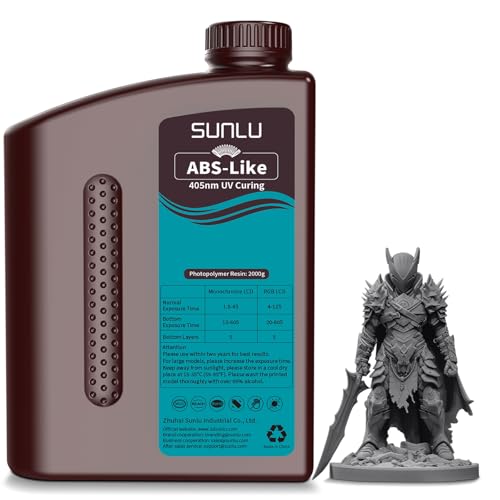
SUNLU’s ABS-Like resin delivers enhanced toughness at a per-kilogram cost that undercuts premium competitors — verified users describe prints surviving drops that would shatter standard photopolymers. The fast-curing formula under 405nm UV light produces stable parts even in humid conditions, a frequent pain point for budget resins that soften or warp in ambient moisture.
Low shrinkage during cure is critical here: dimensional accuracy holds well enough for interlocking mechanisms and tight slot fits. The 2kg bottle uses a leak-proof cap and air-bag cushioning in shipping, a practical advantage when ordering in volume since a single leakage ruins a batch. Compatibility spans 4K and 8K LCD, DLP, and SLA machines.
One reviewer reported that the resin requires a longer cure time (8 seconds versus 2.5–3 seconds on a Creality LD-002H) compared to faster-setting brands, and noted minor cured-tray residue. Sanding resolves the flakes, but it adds a post-processing step. The dark grey color cures to a slightly beige tone that reverts to white within hours, so plan your painting schedule accordingly.
Why it’s great
- Excellent impact resistance for miniatures
- Large 2kg bottle with secure packaging
- Low odor rated by multiple users
Good to know
- Longer cure time than some ABS-like peers
- Minor beige shift after curing
3. ELEGOO 8K ABS-Like Resin 3.0
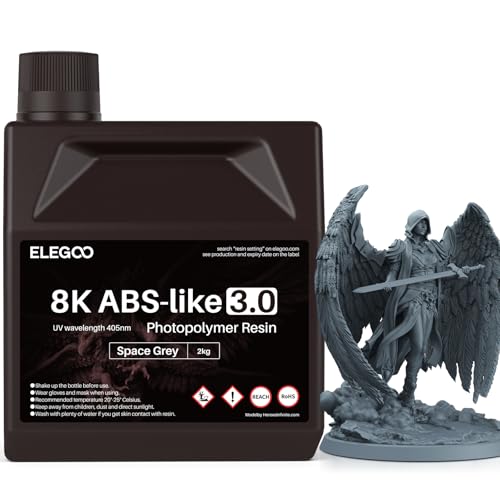
ELEGOO’s 8K ABS-Like Resin 3.0 targets precision through a viscosity reduction of 25–47 percent compared to its 1.0 and 2.0 predecessors. Lower viscosity improves fluidity into tight cavities and reduces print failures on delicate lattice structures and fine organic details. Verified users highlight that the resin prints tiny weapon parts and cables that snapped with other ABS-like blends.
The fast-curing profile reduces overall layer time, and the ultra-low odor formula makes prolonged printing sessions less unpleasant. The resin resists delamination after sitting in the vat for days — a common cause of streaky prints — and cleans well in ultrasonic baths with water, dish soap, and oxalic acid. A reviewer noted that the cured print withstands a soldering iron at approximately 600°F without melting, useful for heat-resistant jigs.
On the downside, several users describe the cured material as very brittle — “explodes into many bits” when dropped, according to one. For display-only miniatures and static dioramas this matters less than for functional hinges or snap-fit connectors. Heat curing causes slight yellowing over time, so factor that into your finishing plan.
Why it’s great
- Exceptional fine detail capture for 8K screens
- Drastically lower viscosity for fewer vat failures
- Heat resistant to soldering temperatures
Good to know
- Very brittle — not drop-safe for functional parts
- Long UV curing causes gradual yellowing
4. YOUSU Flexible Tough (Shore 80A)
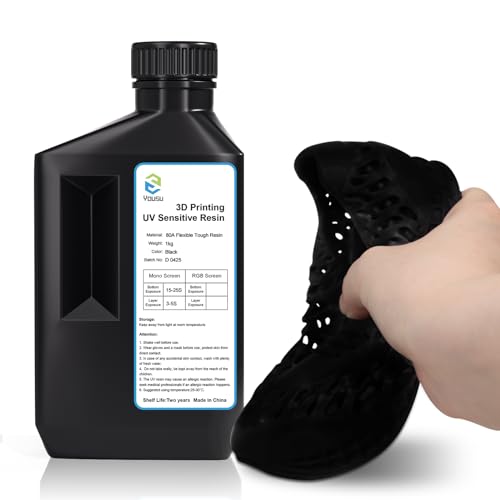
YOUSU’s Shore 80A flexible resin fills the gap between rigid ABS-like materials and true elastomers. At 80A, cured parts can be folded repeatedly without cracking — a property verified by users printing insulin pump cases and rubber bumpers on older Elegoo Saturns. The high elongation before break makes it suitable for phone cases, seals, insoles, and other parts that need to compress and rebound.
The printed surface remains smooth with minimal impurities, and the resin resists water absorption better than many flexible alternatives, which is critical for wearable devices that contact perspiration. Compatibility is broad across LCD and DLP printers, though users stress that tuning exposure and retraction speed (one reported 40mm/min retraction at 10mm with 8-second layer exposure) is essential — the resin’s behavior changes significantly outside its optimal cure window.
One limitation is that the material feels less rubbery than the product photos suggest; it bends and rebounds but does not behave like a true TPU. Mixing it with ABS-like resin increases flexibility of the ABS blend, but pure YOUSU output is more of a hard rubber than a soft gel. The price per kilogram sits at a slight premium over standard flexible offerings, so consider mixing ratios if you only need partial flex in your parts.
Why it’s great
- Genuine Shore 80A for repeatable bending and rebound
- Smooth finish with low water absorption
- Blends well with rigid resins for custom durometer
Good to know
- Less rubbery feel than marketing images suggest
- Requires careful tuning on each printer
5. SUNLU Standard Resin 4KG
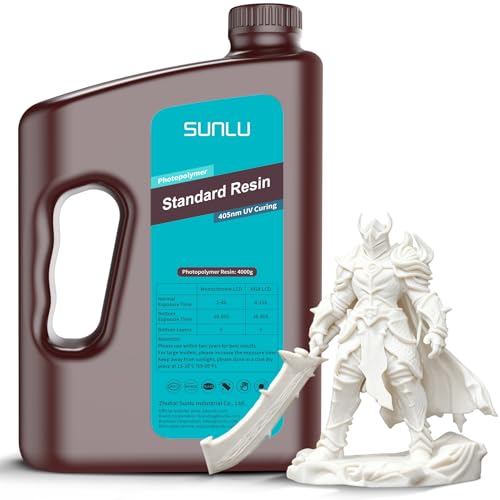
For high-volume prints where mechanical extremes don’t apply, SUNLU’s 4KG standard resin offers the lowest cost per gram among the reviewed products. The low-viscosity formula flows easily and is forgiving for beginners; multiple users report near-zero failures once exposure is dialed in, and the bottle’s leak-proof patent design prevents the messy disasters that plague cheap bulk packaging.
Standard resin trades impact resistance for detail clarity — parts cure hard with smooth surfaces and take paint without primer in many cases. The 365-405nm wavelength compatibility covers 99 percent of consumer printers. One user ran it on a Phrozen Sonic Mighty 4K and noted it is “smooth and forgiving” with only a single user-error failure across several prints.
Where standard resin falls short is structural precision: reviewers report that circles can warp oval, preventing interlocking parts from fitting accurately. The support side of prints exhibits a bubbly texture requiring extensive sanding and putty work. For tabletop wargaming terrain, decorative props, and prototypes where fit tolerances are loose, this is an excellent workhorse — but it is not for dimensional-critical assemblies.
Why it’s great
- Lowest cost per gram in the roundup
- Leak-proof bottle and forgiving beginner formula
- Wide printer compatibility with low failure rate
Good to know
- Poor structural precision for fitting parts
- Support sides need heavy post-processing
6. Siraya Tech Cast True Blue

Siraya Tech’s Cast True Blue is engineered for clean burnout casting — the wax-based formulation leaves significantly less ash than non-wax castable resins, which is critical for jewelry, dental parts, and metal component investment casting. Verified jewelers report that it burns out reliably in thick designs like bracelets and large pendants without cracking the investment, a common failure point with standard casting resins.
The true blue color prints with high gloss and captures ultra-fine details — one user describes it as “the gold standard for jewelry casting” after multiple production runs. It prints at standard 405nm UV wavelengths and works on LCD, DLP, and SLA platforms. The resin is softer than Siraya’s Cast Purple, which reduces model fragility during handling before burnout but makes it more prone to damage during post-processing.
Multiple users note a steep learning curve compared to ABS-like resins: ambient temperature must be stable around 75°F, and the print settings require careful tuning (Mars 3 users reported 5.5-second exposure at 0.05mm layer height). Some received bottles containing fragments of previous prints — likely repackaged returns — though the company’s customer support sent replacements promptly. If your workflow demands burn-clean patterns, the Siraya Tech Cast delivers the most consistent burnout of any product reviewed here.
Why it’s great
- Clean burnout with very low ash residue
- High gloss surface detail for jewelry masters
- Widely trusted by professional casters
Good to know
- Steep learning curve for printing parameters
- Pre-cure parts are very fragile
7. ELEGOO Mars 5 Ultra 9K Printer

The Mars 5 Ultra 9K is ELEGOO’s current flagship consumer printer, and it changes the resin equation by enabling print speeds up to 150mm/h through a Tilt Release mechanism that reduces Z-axis travel time. The 9K monochrome LCD delivers 18×18μm XY resolution — detailed enough to capture fingerprint-scale texture on a 32mm miniature — and the integrated AI camera monitors for empty build plates or model warping during prints.
Users consistently praise the print quality for tabletop miniatures (Dungeons & Dragons and Warhammer scale), with detail that rivals much larger machines. The smart mechanical sensor provides one-click calibration, and the WiFi cluster printing feature lets multiple printers operate simultaneously from one LAN — a workflow upgrade for those running production farms. The 7-inch screen’s 9H tempered glass protects against accidental damage during vat cleaning.
The main complaint is temperature sensitivity: cold resin and build plates cause repeated failures until the operator warms both. One user needed a hair dryer to preheat the build plate before successful prints. The Chitubox slicer has a learning curve — expect early misprints while dialing in layer exposure and support density. A fractured LCD after 90 days required a paid repair, though customer service replaced the screen quickly. For those ready to manage thermal setup and calibrate supports, this machine elevates resin quality to its highest potential.
Why it’s great
- Exceptional 9K resolution for ultra-fine details
- Tilt release cuts print times dramatically
- WiFi cluster printing for multi-unit workflows
Good to know
- Very sensitive to ambient temperature — preheat required
- Chitubox slicing software has a steep learning curve
FAQ
Can I mix different resin brands or types together?
What temperature should my resin and build plate be before printing?
How do I identify the right exposure time for a new resin on my printer?
Final Thoughts: The Verdict
For most users, the best 3d printing resin winner is the ANYCUBIC Tough Resin 2.0 because it combines genuine impact resistance with affordable pricing and broad printer compatibility, making it the safest choice for both functional prototypes and intricate miniatures. If you want maximum detail fidelity for static display models, grab the ELEGOO 8K ABS-Like Resin 3.0. And for jewelry casting that demands clean burnout and professional results, nothing beats the Siraya Tech Cast True Blue.