
Our readers keep the lights on and my morning glass full of iced black tea. As an Amazon Associate, I earn from qualifying purchases.
Specs are compiled from manufacturer listings and verified buyer reviews and can change over time — please confirm the key details on the product page before buying.
Scanning the human body is a whole different game than scanning a statue or a car part. You are dealing with complex curves, subtle skin textures, hair, and the need for the scanner to be safe for use on people. The right tool lets you capture a lifelike digital twin for 3D printing custom-fit prosthetics, designing ergonomic products, creating digital avatars for animation, or preserving a moment in time.
I’m Min — the founder and writer behind Gadgets Feed. This guide is built by comparing the manufacturers’ published specifications and the patterns across verified customer reviews, so you get each pick’s real strengths and trade-offs instead of marketing spin.
Whether you are a professional designer or a curious hobbyist, finding a reliable 3d scanner for human body means weighing accuracy, speed, and how well it handles tricky things like dark hair or outdoor light without needing special spray.
Our Picks at a Glance

How To Choose The Best 3D Scanner For Human Body
Picking a body scanner boils down to a few critical specs. You need accuracy good enough to capture your fingerprints, a light source that is safe for eyes and skin, and software that can handle messy data from a living subject. Here is what to look for.
Accuracy and Precision: The Make-or-Break Spec
Accuracy tells you how close the scanner’s 3D model is to the real object. For human bodies, a single-frame accuracy of 0.1mm is a solid baseline for clothing design or general modeling. Go down to 0.05mm or 0.02mm if you need detailed anatomy for prosthetics or medical-grade applications. Precision (usually the smaller number, like 0.03mm) describes how repeatable that accuracy is from scan to scan.
Light Source: Structured Light vs. Laser vs. Infrared
Structured light (projecting a pattern) is fast and great for medium objects, but can struggle outdoors. Infrared (IR) is safe for eyes — all the scanners here use Class 1 IR — and handles difficult surfaces like dark or reflective items without spray. Laser scanners achieve the highest accuracy (down to 0.02mm) and can capture fine details, but the laser dots can be less forgiving on live subjects if they move. Many premium units combine multiple sources.
Scanning Speed and Tracking
A human body does not stay perfectly still. You need a scanner with a fast capture rate (frames per second, or fps) and solid anti-shake or anti-shock tracking to stitch frames together without glitches. A speed of at least 10-15 fps is comfortable for a full-body scan; 20 fps or higher gives you much better results on moving targets.
Compatibility and Portability
Check if the scanner works with your computer or tablet. Most require a Windows PC with a dedicated GPU and plenty of RAM. Wireless models are liberating because you can move freely around a subject, but the extra hardware (a Wi-Fi box or a battery handle) adds bulk. Weight matters too — a 190g or 105g scanner is much easier to wave around someone’s head for a face scan than a 3.6-pound unit.
Quick Comparison
| Model | Best For | Accuracy | Light Source | Weight | Amazon |
|---|---|---|---|---|---|
| Creality Otter★ Best Overall | Versatile small-to-large objects | — | 8 IR LEDs + 2 White LEDs | 3.6 lbs | Amazon |
| Creality Raptor ProPro Grade | Wireless on-the-go body scanning | — | 17 Blue Laser + VCSEL IR | 5.72 lbs | Amazon |
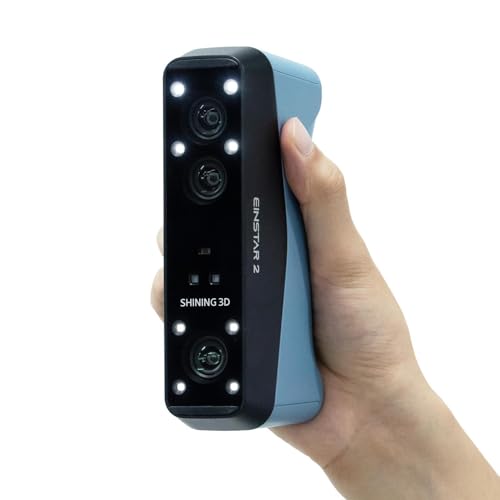
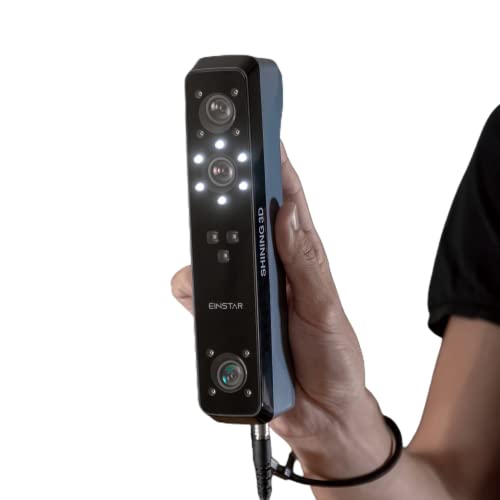
| Shining 3D EinstarHair & Body Expert | Hair & body scanning | 0.1mm points | 3 IR VCSEL Projectors | 3.08 lbs | Amazon |
| Revopoint POP3 Plus | Detailed face & medium objects | 0.05mm | Class 1 IR Structured Light | 190 g | Amazon |
| Revopoint INSPIRE 2 | Outdoor body & face scanning | 0.05mm | IR + Multi-Line Laser | 190 g | Amazon |
| Creality Ferret Pro | Entry-level body scanning | 0.1mm | — | 105 g | Amazon |
| EinScan SE v2 | Precision desktop body parts | 0.1mm | — | 8.8 lbs | Amazon |
In‑Depth Reviews
1. Creality CR-Scan Otter 3D Scanner
The middleweight champion — it balances size, speed, and image quality for body scanning while staying affordable.
With both a long-focal and a short-focal lens, the Otter scans objects from a tiny 10 x 10 x 10mm coin all the way up to a 2000 x 2000 x 2000mm car. That flexibility means you can capture a full body in one scan and then zoom in on a hand or face in another. It scans at up to 20 fps using 8 infrared LEDs, 2 white LEDs, 4 stereo depth cameras, and 1 RGB camera. The anti-shake tracking and One-Shot 3D imaging technology help reduce tracking loss on moving subjects.
One of its strongest features is the ability to scan black and metal objects without any spray. The 3600 dpi color resolution and a million-pixel full-color RGB camera reproduce realistic textures. The main downside: it weighs 3.6 pounds, which is manageable but heavier than some competitors like the POP3 Plus (190g). Also, note that direct Android connection is not supported — you will need the optional Otter Scan Bridge accessory for wireless use with an Android phone.
Versatile performer: This handles everything from a small face detail to a full-body scan with reliable anti-shake and vivid colors, all without spray.
The real limitation: Heavier than most handheld-only scanners and requires a workaround for direct Android use.
Perfect all-rounder: Choose the Otter if you need one scanner that can handle varied human body projects — from large furniture to small anatomical parts.
Skip if: You want an ultra-light handheld for casual face scanning only — the Ferret Pro or POP3 Plus are lighter choices.
2. Creality 3D Scanner CR-Scan Raptor Pro
True wireless scanning with a built-in swappable battery lets you walk around a subject without tripping over cables.
It uses 17 parallel lines of blue laser for small-to-medium parts at up to 60 fps and VCSEL infrared light for larger objects at up to 20 fps. This dual-light system lets you scan black or reflective objects directly, no spray needed — a huge convenience when scanning dark hair or shiny skin.
It handles tough outdoor conditions too. Laser HD mode works up to 110,000 lux, and IR Rapid mode up to 70,000 lux, so you can take it outside the studio. The EXstar Hub PC software is intuitive, but some owners mention that running wirelessly can be a bit finicky if Wi-Fi interference occurs — though a cable connection is always an option.
Why it stands out
- Built-in swappable battery for true wireless scanning
- High-speed scanning up to 90 fps in laser mode
- Scans black and reflective objects directly, no spray needed
What to watch for
- Wireless connection can be unstable in crowded Wi-Fi environments
- At 5.72 lbs, it is still a substantial unit, not an ultra-portable wand
Mobile scanning pro: Ideal for field work or scanning live subjects in different rooms without being tethered to a laptop.
Not for you if: You need extreme portability — the included battery and laser array make it heavier than handheld-only units.
3. Shining 3D Einstar Handheld 3D Scanner
The scanner that does not flinch when it meets hair — a dedicated ‘Hair Mode’ makes head scanning genuinely possible.
Most handheld scanners struggle with hair because the dark, fine strands absorb light. The Einstar solves this with a built-in “Hair Mode” that adjusts the data capture to get sufficient hair data. It uses 3 infrared VCSEL projectors and 2 stereo depth cameras, collecting point cloud data with a point distance down to 0.1mm. The scanning speed reaches 14 fps, which is steady if your subject can sit still for a few seconds.
Buyers like the EXstar software’s intelligent algorithm, which provides automatic alignment and a data quality indicator that guides you during the scan. It connects with a single USB cable for both data and power, making setup clean. The downside: it weighs 3.08 pounds, heavier than pure handheld wands, and the overall unit is a bit more bulky than the Revopoint competitors. It also requires a more powerful PC (i7 Gen 10 or better recommended) for smooth data processing.
Smart features that help
- Dedicated Hair Mode for capturing head scans with hair
- Data quality indicator guides you during scanning for better results
- Single USB cable for power and data keeps setup simple
Potential issues
- Heavier construction (3.08 lbs) compared to pure handheld units
- Needs a powerful Windows PC for optimal performance
Hair scanning specialist: This is your scanner if full-head scans with realistic hair are critical for your project, whether for avatars or wig design.
Not ideal for: Very small, high-detail face work where sub-0.1mm accuracy is needed — the Raptor Pro or POP3 Plus are sharper.
4. Revopoint POP3 Plus 3D Scanner

An ultra-light 190g wand that puts pro-level precision in your hand for detailed face and medium object capture.
The POP3 Plus achieves a precision of 0.04mm and a point distance of 0.05mm, making it among the most detailed scanners in its price tier. It uses class 1 infrared light — safe for eyes and skin — so you can scan faces and full bodies without worry. The new optical zoom (1.5x and 2x magnification) lets you capture 30% more point cloud detail, according to the manufacturer, which helps with intricate facial features like a nose or ears.
It scans at up to 18 fps with a 9-axis IMU that stabilizes the scan and prevents faulty frames from shaking. The HD RGB camera, advanced pixel mapping, and Flash LED system produce lifelike full-color models. It weighs only 190g — lighter than most smartphones. However, at 190g it is heavier than the Ferret Pro (105g), so while both are lightweight, the Ferret Pro is significantly airier for long sessions.
Why it is a value standout
- High precision of 0.04mm for detailed face and body scans
- Ultra-light at 190g (about 0.42 lbs) — easy to hold steady
- Safe Class 1 IR light for scanning people
Where it falls short
- tune for medium objects (20x20x20mm to 2x2x2m) — not for very large items
- Software only compatible with x86_64 architecture (no native ARM support)
Detail-focused creator: Best for you if you need extremely fine detail on a budget, especially for face scans, jewelry, or small sculptures.
Better choices exist for: Scanning very large objects like a full car — the RANGE or Raptor Pro have larger capture volumes.
5. Revopoint INSPIRE 2 3D Scanner
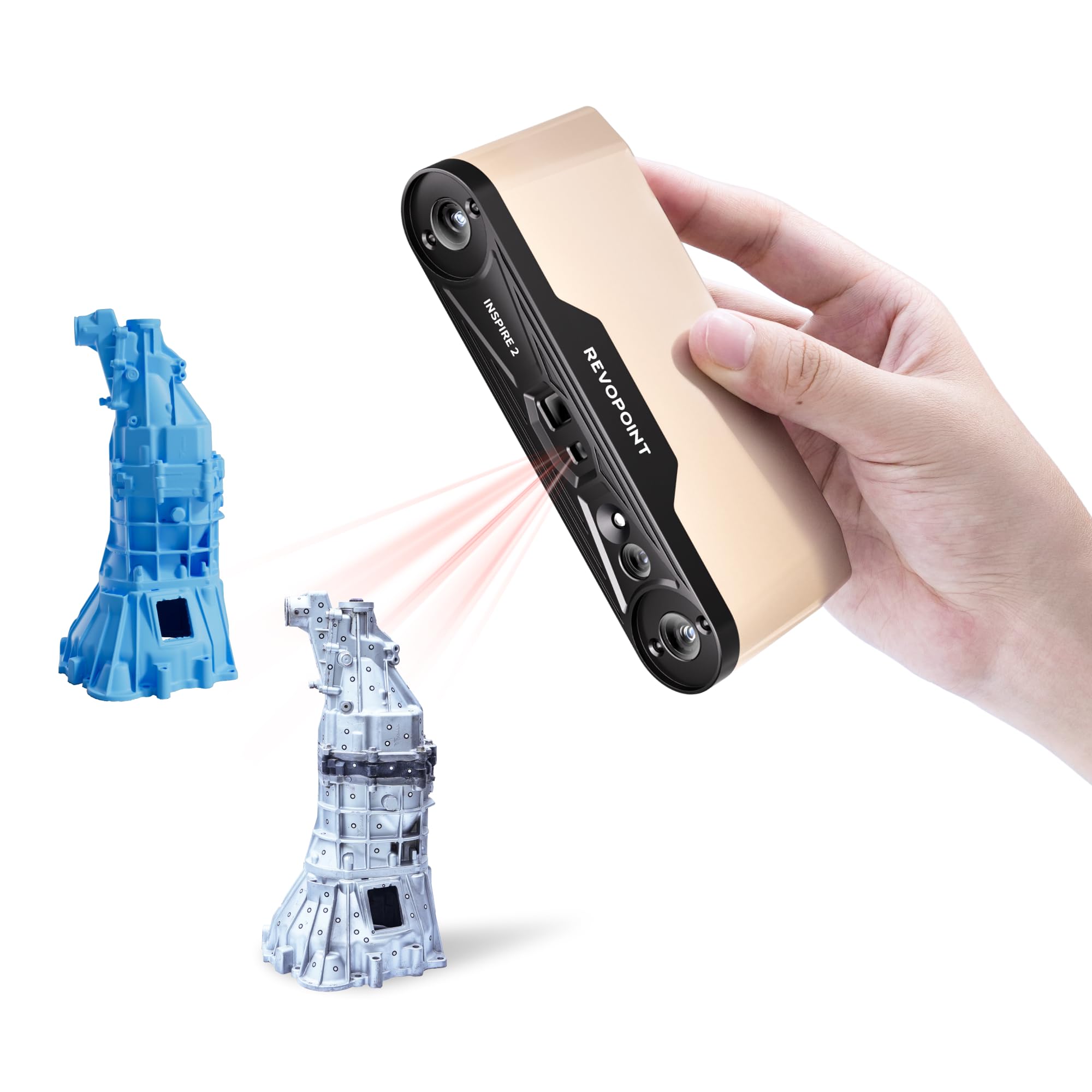
Dual scanning modules — infrared structured light and multi-line laser — let you switch modes to handle different body surfaces.
The INSPIRE 2 gives you two scanning methods in one device: infrared structured light for general body shapes and multi-line laser for capturing reflective or dark surfaces. Its precision reaches up to 0.03mm, and accuracy is up to 0.05mm. The included high-precision calibration board boosts point cloud accuracy by 75%, according to Revopoint, ensuring consistent data for 3D printing or reverse engineering.
Wireless scanning over Wi-Fi 6 is a key feature, letting you stream scans to a phone or tablet in real time. It can handle outdoor environments with up to 20,000 lux, making it suitable for shaded outdoor shoots. At 190g, it is just as portable as the POP3 Plus. An adjustable optical zoom (1.5x, 2x magnification) helps capture fine detail on mixed-geometry surfaces. One caveat: the included tripod and mini turntable are more suited for small objects, not full bodies — you will need a solid tripod for human scanning.
Standout features
- Dual scanning modules for versatile surface handling
- High precision of 0.03mm — close to pro-level detail
- Lightweight (190g) with wireless Wi-Fi 6 streaming
Things to be aware of
- Outdoor limit of 20,000 lux is lower than laser-based competitors
- Revo Design paid software (sold separately) is Windows-only
Flexible scanner: Great for users who need one device that can handle both structured-light and laser scanning without buying two separate units.
Not your first pick if: You work exclusively in bright sunlight — look at the EINSTAR 2 or Raptor Pro for higher lux tolerance.
6. Creality 3D Scanner CR-Scan Ferret Pro

The lightest scanner on the list at just 105g — featherlight enough to hand to a child for a face scan.
The Ferret Pro is designed for entry-level users, DIY creators, and 3D printing enthusiasts. It offers 0.1mm accuracy with full-color 24-bit scanning and anti-shake technology. The built-in Wi-Fi 6 provides smooth wireless scanning to Windows, macOS, Android, and iOS devices. Its scanning range covers objects from 50mm to 2000mm — enough for a full adult torso but not tiny jewelry.
At 105g, it is incredibly portable, and the kit includes a Wi-Fi box, tripod, power bank, phone holder, and carrying case. The main trade-off for body scanning is the accuracy: 0.1mm is decent but not as sharp as the 0.04mm of the POP3 Plus or the 0.02mm of the Raptor Pro. It also struggles with reflective, transparent, or very dark surfaces — you may need to use scanning spray on dark hair or shiny skin, which is a hassle for living subjects.
Why beginners love it
- Incredibly light at 105g — easy to hold and move
- Easy wireless setup with Wi-Fi 6 and cross-platform support
- Comprehensive kit includes tripod, power bank, and carrying case
Where it falls short
- 0.1mm accuracy is entry-level — misses very fine details
- Not suitable for dark, reflective, or transparent surfaces without spray
Starter pick: Perfect if you are new to 3D scanning and want a low-cost, ultra-portable way to learn the basics of body scanning.
Trade up if: You need finer detail or want to scan dark features like hair without spray — the POP3 Plus or Einstar handle those better.
7. Newest EinScan SE Desktop 3D Scanner

Not a handheld — a desktop turntable scanner that delivers exact, repeatable scans of isolated body parts like hands or feet.
The EinScan SE v2 is a fundamentally different approach to body scanning. It uses a dual-mode system: Auto Scan rotates the object on a turntable, and Fixed Scan lets you capture individual frames from different angles. Single-shot accuracy is <0.1mm with a point distance of 0.17-0.2mm. This design means you cannot scan an entire living person in one piece, but it gives incredibly precise scans of isolated parts like a hand, a foot, or a cast for prosthetic design.
Buyers love the user-friendly ExScan software, which offers automatic calibration and one-click scanning. It can handle objects as small as 30mm in Auto Scan mode. The main limitation is obvious: it cannot scan a full person because the subject needs to stay still on a turntable. It is also heavy at 8.8 pounds, so it lives on a desk. For a stationary body-part-only workflow, it is tough to top the cost per unit of accuracy.
Strengths for body parts
- Dual-mode scanning (Auto and Fixed) for flexible part capture
- High accuracy (<0.1mm) for detailed hand, foot, or face cast scans
- User-friendly software with one-click scanning and automatic calibration
Real-world constraints
- Cannot scan a full, living human body — designed for small parts on a turntable
- Heavy at 8.8 lbs and non-portable due to the turntable mechanism
Body-part specialist: Choose this if your work revolves around scanning individual body parts like hands, feet, or dental molds with high precision.
Wrong tool for: Full-body or face scanning in a live setting — a handheld scanner like the RANGE or Otter is necessary for living subjects.
Understanding the Specs
Accuracy vs. Precision: What Is the Difference?
Accuracy is how close the scanned model is to the real-world dimensions. Precision is how repeatable that measurement is across multiple scans. A scanner might be accurate to 0.1mm (good enough for a face) but have a precision of 0.03mm (meaning each scan is very consistent). For body scanning, you want both to be as low as possible, but precision becomes critical if you are doing reverse engineering or medical fitting.
Structured Light vs. Laser vs. Infrared
Structured light projects a pattern onto the subject and measures how it deforms. It is fast and works great indoors but struggles in bright light. Laser scanners fire dots or lines at the object and measure the return time — they achieve the highest accuracy (0.02mm) but can be slower and more sensitive to movement. Infrared (IR) light is invisible and safe for eyes, making it ideal for scanning people. Many modern scanners combine two or three of these technologies to get the best of all worlds.
FAQ
Are 3D body scanners safe to use on people?
Can these scanners capture hair like on a head?
What is a good accuracy for scanning a human face?
Can I scan my whole body in one go?
Do I need to use scanning spray on dark or shiny skin?
How important is scanning speed for body scanning?
Will these scanners work with my Mac or phone?
What file formats do they output?
How much does a good body scanner cost?
Can I use these scanners for reverse engineering human anatomy?
Final Thoughts: The Verdict
For most people, the 3d scanner for human body winner is the Creality CR-Scan Otter because it offers a superb balance of dual-lens versatility, anti-shake tracking, and no-spray-required scanning without needing a top-tier PC. If you want the absolute highest detail for professional work, grab the Creality CR-Scan Raptor Pro. And for a lightweight, budget-friendly start to human scanning, the standout is the portability of the Creality CR-Scan Ferret Pro.
How We Picked
We do not accept paid placement. Every pick is matched to a real buyer and a real use-case; we do not hands-on test units.
Sources & Methodology
Specifications: manufacturer listings and product documentation. Review insights: verified customer reviews, as of July 2026. Pricing: not shown on this page (it changes often); check the current price via the retailer link.
As an Amazon Associate, Gadgets Feed earns from qualifying purchases. This does not affect which products we feature.