
Our readers keep the lights on and my morning glass full of iced black tea. As an Amazon Associate, I earn from qualifying purchases.
Specs are compiled from manufacturer listings and verified buyer reviews and can change over time — please confirm the key details on the product page before buying.
If you want the short answer: the Bose QuietComfort (2nd Gen) is the safest pick for most people, because its TrueSpatial processing works on anything you play — movies, games, podcasts — without needing a special app or a wired connection. But spatial audio is not one feature; it is a whole family of tricks, and the right headphone depends entirely on where you will use it.
I’m Min — the founder and writer behind Gadgets Feed. This guide is built by comparing the manufacturers’ published specifications and the patterns across verified customer reviews, so you get each pick’s real strengths and trade-offs instead of marketing spin.
A TV-first listener, a PS5 gamer, and a commuter all need different hardware to get that out-of-your-head feeling. Below you’ll find the specs that actually matter, sorted by how you’ll really use them — this is the honest shortlist of 3d sound headphones.
Our Picks at a Glance


How To Choose The Best 3D Sound Headphones
The single biggest mistake buyers make here is assuming “3D sound” means the same thing on every box. It does not. Some headphones virtualize a surround field from ordinary stereo, some track your head so the sound stays anchored in space, and some need a specific app or console to switch the effect on at all. Get that match wrong and you pay for a feature you never hear.
Source first: what are you plugging into?
If your TV is the source, check its ports before anything else. A set built around HDMI ARC (the audio return channel on newer TVs) connects with one cable and often lets you run a soundbar at the same time as your headphones. Older TVs without that port usually need optical or AUX — both are still common on TV headphones. For consoles, the PS5 and PC handle spatial processing in software, so a wired headset like the Sony INZONE H3 can do the job without a separate transmitter.
Does the 3D effect need an app?
Often, yes. Sony’s 360 Spatial Sound for Gaming asks you to upload a photo of your ear to a phone app so it can tune the field to your head. Baseus’s SoundFit personalization only open up after both the app and the headphone firmware are updated. That is fine if you like setup — but if you want plug-and-play, pick a set where the spatial mode is a button or a fixed default.
The battery tax on rich modes
Turning on spatial audio costs runtime, and the spec sheets say so plainly. The Bose QuietComfort (2nd Gen) runs up to 24 hours with noise cancelling on, but up to 18 hours once TrueSpatial rich Audio is engaged. Plan around the rich number, not the headline one, if 3D is the reason you are buying.
Weigh the trade-off you can live with
Head-tracking and virtual surround are processor-heavy, and cheap sets sometimes lean on the effect to cover thin drivers. Read what the set does outside 3D mode too. A headphone that sounds flat in plain stereo will sound worse, not better, once the spatial layer is switched on.
Quick Comparison
| Model | Best For | Spatial Tech | Battery | Connection | Amazon |
|---|---|---|---|---|---|
| Bose QuietComfort (2nd Gen)★ Best Overall | All-round spatial listening | Bose TrueSpatial | 24h (18h rich) | Bluetooth 5.4 / USB-C | Amazon |
| Sony INZONE H3Gaming Value | PS5 and PC gaming | 360 Spatial Sound for Gaming | — | Wired | Amazon |
| Baseus Inspire XH1Battery King | Long-haul battery + Dolby | Dolby Spatial Audio | 100h (65h ANC) | Bluetooth 6.1 | Amazon |
| Skullcandy Hesh 540 ANC | Runtime champions | THX Spatial Audio | 65h | Bluetooth 5.3 | Amazon |
| Noise Master Buds Max | Adaptive ANC + spatial | rich Spatial Audio | 60h | Bluetooth 5 | Amazon |
| Avantree Crescendo 3D | TV viewing with soundbar | Bongiovi V3D | 60h | HDMI ARC / Optical / BT 5.3 | Amazon |
| Sennheiser RS 255 | Late-night TV clarity | Virtual Surround Sound | 50h | Transmitter / Bluetooth 4.2 | Amazon |
| Bose QuietComfort Ultra | Premium immersion | Bose rich Audio | 24h (18h rich) | Bluetooth 5.3 | Amazon |
| Audeze Mobius | Head-tracked gaming | Full 3D emulation + head tracking | 10h | Wired / Bluetooth 5 | Amazon |
In‑Depth Reviews
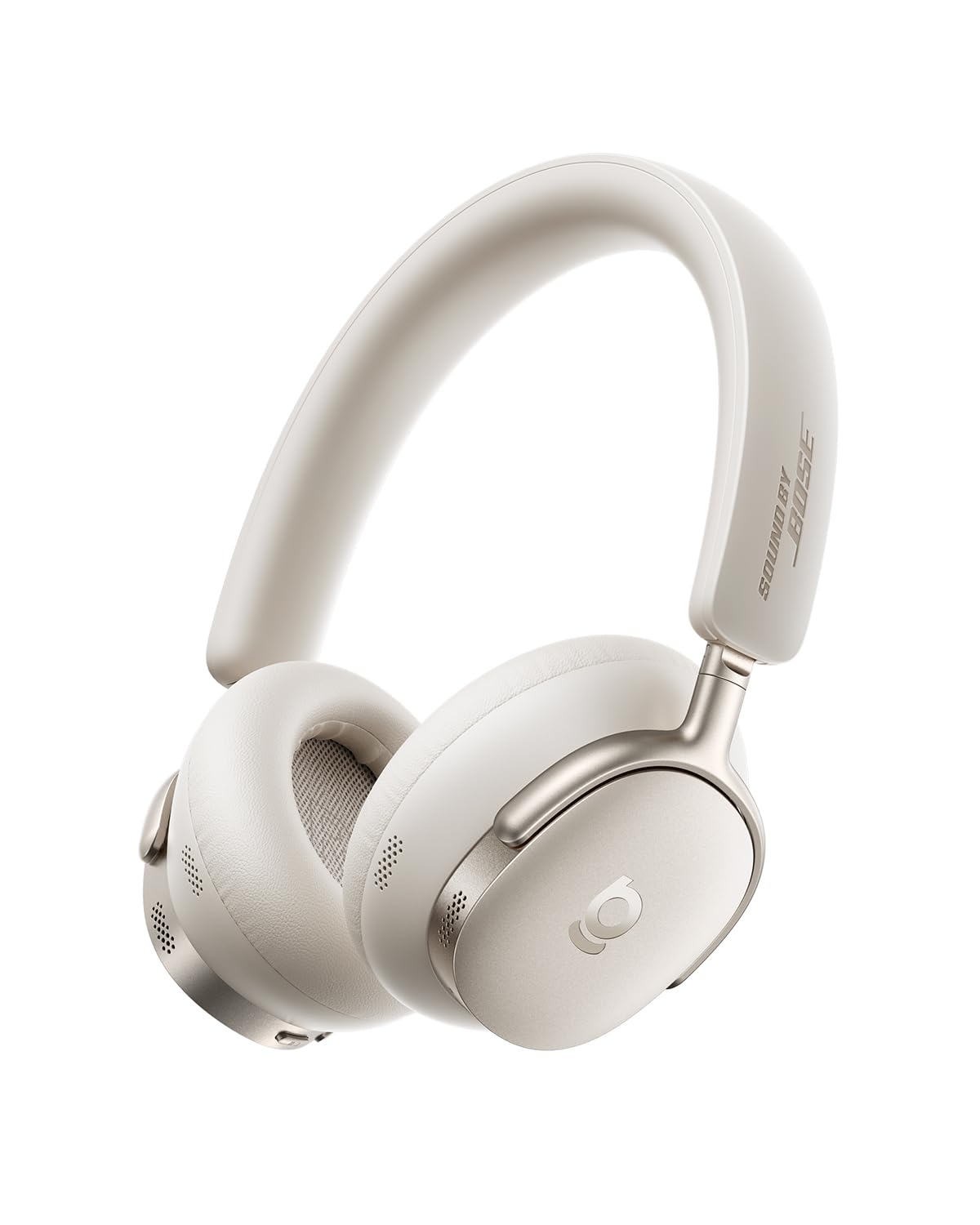
1. Bose QuietComfort Headphones (2nd Gen)
Our pick — 4.5+★ from 300+ verified ratings; the strongest balance of quality and price.
Bose TrueSpatial widens any stereo source — laptop, tablet, or phone — with no app or special file.
The headline addition here is Bose TrueSpatial Technology, which adds a sense of width and depth to whatever is playing — no special source file, no console setting. That matters if you switch between a laptop, a tablet, and a phone all day, because the effect travels with you. The set carries 4.5+ stars from a crowd of hundreds of owners, and sound quality is what wins them over: it is the most-praised thing about this model by a wide margin, with noise cancellation a distant second.
Runtime is where you need to read the fine print. Bose lists up to 24 hours with noise cancelling engaged, but that drops to 18 hours once TrueSpatial rich Audio is on. Compare that to the Skullcandy Hesh 540 ANC, which quotes 65 hours with ANC off versus 18 hours for the Bose with its spatial mode engaged. If you plan to leave rich mode on all day, the Bose will need charging more often than the Skullcandy will.
For wired quality, plug in the USB-C cable and you get high-fidelity lossless audio, which is a real step up from a standard Bluetooth stream. The earcups are a new pill shape, the headband is wider than the previous generation, and five listening modes — Quiet, Aware, Immersion, Cinema, and ANR off — give you a genuine reason to use the on-ear buttons. Cinema Mode in particular layers sound for video, which is the mode most people will leave on for movie nights.
What earns its place up top
- TrueSpatial works on any content, not just specially encoded tracks
- USB-C lossless playback plus a detachable cable and hard-shell case
- Five listening modes including Cinema for video and Immersion for spatial
- Bluetooth 5.4 with a quoted 30-foot range
Where it asks you to compromise
- rich mode cuts runtime from 24 hours to 18
- A full charge takes 3 hours, though 15 minutes buys 2.5 hours of playback
- Adjustability draws a split verdict, so fit your head shape first
Made for: anyone who wants spatial audio on tap across phones, tablets, and laptops without hunting for a menu.
Pass if: you refuse to charge more than once a week — the 65-hour Skullcandy stretches far further.
2. Sony INZONE H3 Wired Gaming Headset
A wired PS5 headset whose 360 mode is tuned by a photo of your ear.
Sony’s pitch here is Personalised 360 Spatial Sound for Gaming, and the way it gets personal is unusual: you photograph your ear with the 360 Spatial Sound Personalizer app, and the headset tunes the sound field to that shape. On a PS5 or PC, that means directional cues — footsteps behind you, fire from your left — land where they should. The 3.94-foot cable keeps latency at zero, which is a real advantage over Bluetooth for competitive play.
Comfort is the clear strength, since soft headband padding and smooth nylon ear pads are built for long sessions. The rest is mixed, and honestly so. Durability is the recurring weak spot, and connectivity draws criticism too — a fair warning for anyone who treats a headset roughly or expects one cable to last seasons. Sound quality splits buyers down the middle, with some reporting perfect, echo-free team chat and others hitting a dead left channel.
What sets this apart from a bare-bones gaming headset is the software layer. INZONE Hub lets you adjust the equalizer, spatial sound, dynamic range control, and mic settings, and the flip-to-mute mic carries Discord certification for clear calls. For a wired set, that is a real toolkit.
The honest read: at 4.0+ stars the average buyer is content, and the comfort story holds up. The audio story is less consistent, so buy this for positional gaming and clear chat, not for music fidelity.
Choose it if: you game on PS5 or PC and want zero-latency directional audio on a budget.
Think twice if: you want durable build for travel — this is a desk-dweller’s headset.
3. Baseus Inspire XH1 Adaptive ANC
Dolby Spatial Audio plus 100 hours of playtime with ANC off.
The number that jumps off the spec sheet is 100 hours of playtime with ANC off, or 65 hours with it on — the kind of gap that lets you fly long-haul and land with charge to spare. Charging is barely a chore either: a 10-minute top-up returns 12 more hours. As owners put it, “over 20 hours of playtime on a 5-minute charge.”
For 3D sound specifically, this set carries Dolby Spatial Audio for a 360-degree field, plus Hi-Res certification and LDAC for three times the audio detail of standard Bluetooth. Sound quality is what most people praise here, with overall build quality a close second in the feedback — 35-millimeter angled drivers sit inside tune chambers, and SuperBass 3.0 and SuperBalance 3.0 tuning keep the low end deep without burying the mids. Bluetooth 6.1 flies past the Skullcandy’s 5.3 — a newer wireless standard that generally means a more stable link.
Two things to note before you commit. SoundFit personalization needs the Baseus app at version 2.8.9 or higher plus updated firmware, so budget a few minutes for setup. And fit is the one place opinions split — the velvet-like protein leather and memory foam suit most heads, but it is the most-discussed soft spot in the reviews. The 4-mic ENC call system holds up in busy streets and noisy cafés, which is a genuinely useful everyday bonus for a set this focused on rich playback.
Why it earns the battery crown
- 100 hours with ANC off, 65 with it on, plus 12 hours from a 10-minute charge
- Dolby Spatial Audio, Hi-Res certification, and LDAC detail
- Bluetooth 6.1 — a newer standard than most rivals ship
Small print worth knowing
- SoundFit needs a specific app version and firmware update to open up
- Fit is the recurring split in owner feedback
Best when: you want weeks between charges and Dolby spatial on flights or commutes.
Skip if: you prefer a set that works perfectly without ever touching an app.
4. Skullcandy Hesh 540 ANC

65 hours with ANC off, plus THX Spatial Audio for movies and games.
Sixty-five hours of battery with ANC off is the reason this set shows up on so many desks — it will outlast a work week without a cable in sight, and Rapid Charge adds 4 hours from a 10-minute plug-in. THX Spatial Audio handles the 3D side, widening movies and games into a three-dimensional field. Wear detection pauses the audio the moment you lift the cups off, which removes the whole “why is it still playing” annoyance.
Comfort is the standout in owner feedback, thanks to plush memory foam ear cushions, and the long battery is the close second. The audio itself, though, is a fit question rather than a sure thing — sound quality is the most-discussed aspect of this model and opinions lean mixed. That is worth knowing if 3D playback is your main reason for buying, because the spatial layer only sounds as good as the drivers underneath it.
The Skullcandy app lets you tune THX Spatial Audio, apply Personal Sound by Mimi, and switch between Active Noise Canceling, Stay-Aware, and Sidetone modes. Bluetooth 5.3 is a generation behind the 6.1 Baseus, which is a fair note if you keep a lot of wireless devices fighting for the airwaves.
The trade being offered: unrivaled battery and cozy foam in exchange for audio that some ears love and some find merely fine. If your priority is going days without charging, this is the set.
Reach for this if: runtime is your top concern and you want spatial movies on the move.
Look elsewhere if: you need reliable noise cancellation as a hard requirement — that verdict splits too.
5. Noise Master Buds Max
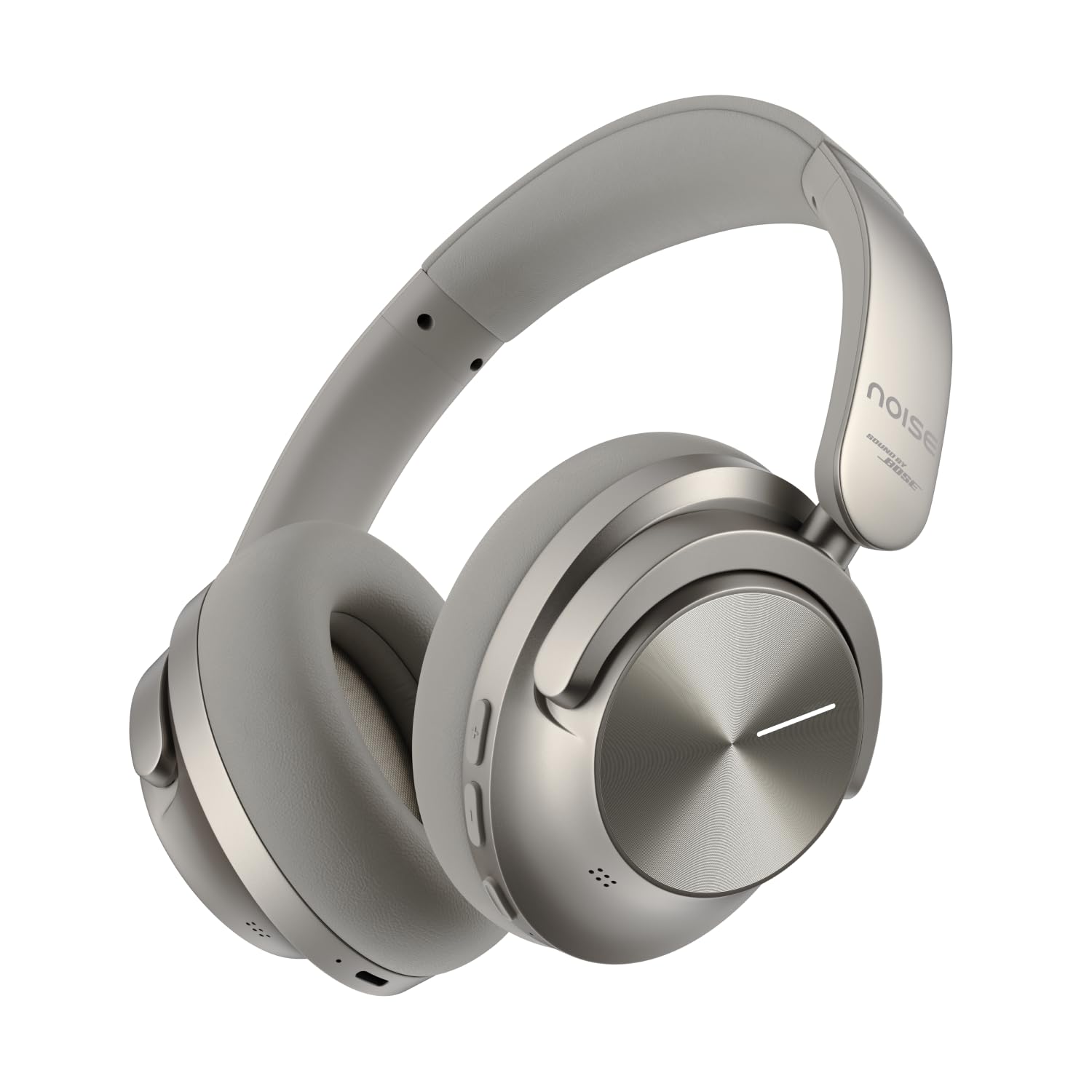
Adaptive ANC that adjusts across frequencies, with a Dynamic EQ that holds the balance as volume rises.
This set is built around Adaptive ANC, which reads your surroundings and adjusts the cancellation across frequencies — handy when you move from a quiet office to a rattling train. The spatial layer is rich Spatial Audio, and LHDC 5.0 handles high-resolution streaming from compatible phones. Dynamic EQ keeps the balance steady as you push the volume up, which is the sort of thing you notice when a loud track suddenly stops sounding harsh.
Tuned with Sound by Bose, the sound profile aims at deep bass, clear mids, and crisp highs. That tuning is doing heavy lifting, because sound quality is the aspect buyers disagree on most here — some describe it as lousy, others rate it highly. Overall quality is the thing most people praise, so the build and finish land well even where the acoustics divide opinion. Up to 60 hours of playtime and smart wear detection that pauses the audio when you lift the cups round out the package.
Comfort gets real attention, with soft vegan leather cushions and a memory foam headband meant for long wear. One quirk to plan for: there is no headphone jack on this model, so wired listening is off the table entirely — Bluetooth 5 is the only road in.
Standout touches
- Adaptive ANC that adjusts across frequencies
- rich Spatial Audio plus LHDC 5.0 for high-res streams
- 60 hours of playtime with wear detection
Points to weigh
- Sound quality is the split in the feedback, so audition if you can
- No headphone jack, so there is no wired fallback
Solid pick for: commuters who want smart noise cancelling and spatial audio in one wireless set.
Not for: anyone who wants a wired backup or needs reference-grade sound.
6. Avantree Crescendo 3D
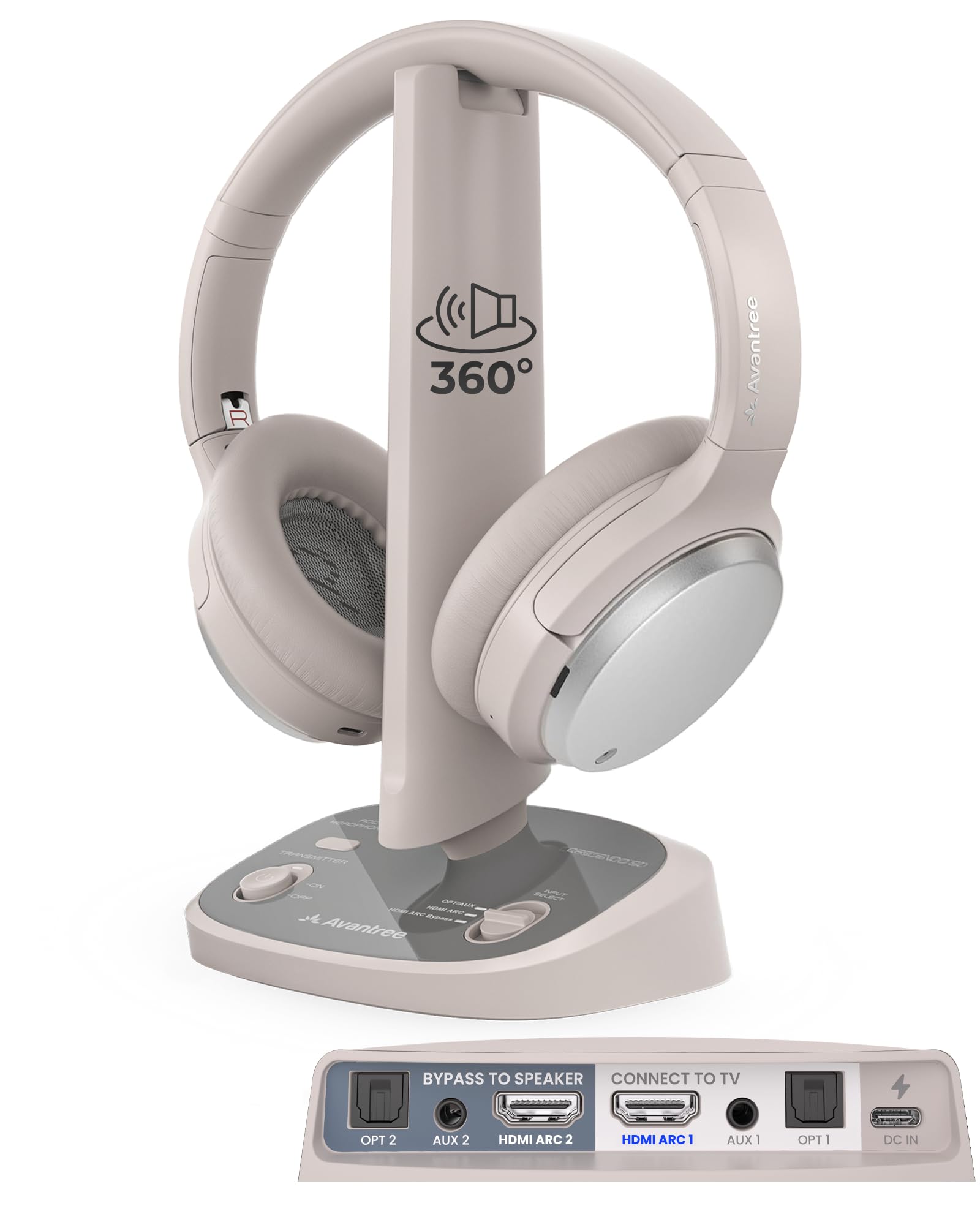
HDMI ARC headphones that let you hear the movie while the room keeps hearing the soundbar.
This is the one on the list built for a living room, not a commute. It connects straight to a TV’s HDMI ARC port — the audio channel on newer TVs that replaces older optical and AUX outputs — and crucially, it lets you listen through the headphones while your family keeps hearing the HDMI soundbar. Your headphone volume adjusts independently of theirs, which solves the classic late-night volume war.
The 3D side is handled by Bongiovi V3D processing, which widens the soundstage and adds depth to dialogue-heavy shows and movies. Sound quality is comfortably the most-praised aspect of this model, and it is backed by 60 hours of listening per charge. ANC trims background noise, and the battery, ear pads, and headband are all replaceable — a genuinely useful detail for a set that lives by the sofa.
Setup is the honest caveat, since opinions split between “easy” and “needs better instructions” — connect the transmitter, dock the headphones, and give yourself ten quiet minutes for the first pairing. Connectivity is a minor split too, so keep the manual handy on day one. Multiple people can each add a Crescendo 3D headphone and set their own volume, which makes this a strong pick for a household where more than one person wants in.
Where it fits: a 4.0+ star set that nails the twin jobs of rich dialogue and private TV listening without disturbing the room.
Pick it if: you have an HDMI ARC TV and want your shows loud while everyone else stays undisturbed.
Hold off if: your TV lacks ARC and you want a same-minute setup.
7. Sennheiser RS 255 TV Headphones

Speech Clarity pulls dialogue forward, with Virtual Surround Sound for a wider stage.
Sennheiser’s biggest selling point is not the surround field — it is the Speech Clarity feature that pulls character dialogue forward and cuts through background music and effects. Pair that with Virtual Surround Sound for a wider, more theater-like stage, and you have a set aimed squarely at people who watch a lot of TV and want to hear every word of it. The 50-hour battery means a week of evening viewing between charges.
The bedroom-couch details are thoughtful. Automatic levelling smooths sudden volume spikes — the ad break that blasts out of nowhere — and hearing profiles let you tune the sound to your own ears. The transmitter can broadcast to multiple HDR 275 headphones or other Auracast-enabled devices, each with its own settings, so two people can watch together and still control their own volume.
Connectivity runs through a dedicated transmitter with the included optical and analog cables, and classic Bluetooth lets you pair the headset with a phone or tablet when the TV is off. Bluetooth 4.2 with a quoted 50-meter range is older than the 5.3 and 6.1 sets on this list, though the range is generous for moving around the house. The ear cups are plush, the headband adjusts, and the battery is user-replaceable.
Built for: TV watchers who want crisp dialogue and a wide virtual stage, and who plan to keep the set for years.
Not the one if: you need modern Bluetooth for multi-device swapping — 4.2 is aging.
8. Bose QuietComfort Ultra

4.0+ stars across 10,000+ owners, with CustomTune and Immersion Mode.
This is the most visible set on the list, and the numbers explain why: 4.0+ stars across 10,000+ owners. CustomTune is the tech hook — it shapes the sound to your ears each time you put the headphones on — and Immersion Mode combines full noise cancellation with Bose rich Audio for the deepest 3D effect in the lineup. Playtime is 24 hours, or 18 with rich Audio running, and a 15-minute charge returns 2.5 hours.
The spatial experience is the whole reason to pick this over the cheaper QuietComfort (2nd Gen). Both list 24 hours standard, but the Ultra pairs rich Audio with the company’s strongest noise cancelling — Quiet Mode, Aware Mode, and the combined Immersion Mode all live here. Sound quality and comfort both rank near the top of owner feedback, and the build quality is the single most-mentioned positive across the reviews. Soft ear cushions spread pressure evenly, and touch controls on each earcup handle volume, tracks, calls, and modes.
The follow-up question every buyer has is reliability, and it is the honest soft spot. Connectivity draws a mixed verdict, with Bluetooth flawless for many and intermittent for others, and value for money splits too. None of that changes the fact that this is the safest premium pick for immersion — just go in knowing the Bluetooth link is the thing to watch.
The case for the upgrade
- rich Audio combined with the strongest noise cancelling Bose offers
- CustomTune shapes sound to your ears every session
- Bluetooth 5.3, SimpleSync soundbar pairing, and head-motion controls
Where the caution lies
- rich Audio drops runtime from 24 hours to 18
- Connectivity and value both split opinion in owner feedback
Right for: buyers who want the strongest spatial-plus-ANC combo and don’t mind paying for it.
Wrong for: anyone who mainly plays TV — the Crescendo 3D does that job for less.
9. Audeze Mobius

The only set here that tracks your head a thousand times a second.
Head tracking is the Mobius’s whole identity: integrated tracking samples your head position 1000 times per second, so sounds stay anchored in space as you turn. That is a different feeling from virtualized stereo — turn your head in a game and the action stays to your left, as it would in real life. Full 3D emulation runs over wired USB and supports popular surround modes at 7.1 and 5.1, so consoles and PCs get the full effect.
The drivers set it apart from the dynamic drivers used elsewhere on this list. Planar magnetic drivers are the audiophile choice, and sound quality is what people praise most here — a wide soundstage is the phrase that keeps coming up, and gaming performance is the clear second strength. If you are chasing the most convincing directional cue in a competitive shooter, this is the physics-heavy answer.
The trade-offs are real and this is the lowest-rated pick, at 3.5+ stars. Build quality is a split — excellent for some, weak plastic for others — and durability is the recurring problem, with the headband fracturing and some units failing after a few days. Battery life is just 10 hours, well behind the 60-hour and 65-hour sets here, and it needs a cable for the 3D modes anyway. Buy it for the planar sound and head tracking; handle it with care.
The specialist’s call: class-leading 3D spatial realism for gaming, in a body that demands gentle handling and frequent charging. It is a tool for one job done exceptionally well.
For the gamer who: wants true head-tracked, planar-driver immersion and will keep it on a desk.
Steer clear if: you need rugged build, long battery, or wire-free 3D.
Understanding the Specs
Head Tracking vs Virtual Surround
These are two different ways to get sound outside your head. Virtual surround, like the Bongiovi V3D in the Avantree Crescendo 3D, widens a stereo mix to simulate speakers around you — it stays fixed no matter how you turn. Head tracking, like the Mobius’s 1000-samples-per-second system, anchors the sound in physical space so it moves relative to your head. For gaming and VR, head tracking usually feels more convincing. For movies and music, virtual surround is simpler and needs no sensor.
rich Mode and Your Battery
Spatial processing burns power. Bose is upfront about it: the QuietComfort (2nd Gen) and QuietComfort Ultra both list 24 hours of standard playtime but 18 hours once rich Audio is on. If 3D is the reason you are buying, plan your charging around the shorter figure. Quick-charge ratings help here — 15 minutes returns 2.5 hours on the Bose sets, and 10 minutes returns 12 hours on the Baseus Inspire XH1.
Why the Source Port Matters
A spatial set is only as good as the connection feeding it. HDMI ARC on a TV carries a full digital signal and lets a soundbar and headphones run side by side. Optical and AUX are fallbacks for older TVs. Wired USB on a headset like the Mobius open up surround modes that Bluetooth cannot carry. If your TV or console lacks the right output, the 3D effect may never switch on.
Driver Type and What It Changes
Most sets here use dynamic drivers, which are efficient and battery-friendly. The Audeze Mobius uses planar magnetic drivers instead, a design favored for detail and soundstage. The trade is weight, cost, and power draw, which is why the Mobius lists 10 hours while the Baseus lists up to 100. Neither is better in the abstract — match the driver to how you listen.
FAQ
Do 3D Sound Headphones need a special source file to work?
Will the Avantree Crescendo 3D work with my older TV?
Can I use 3D Sound Headphones while gaming online with voice chat?
How much battery does spatial audio actually use?
Can two people watch TV through the same headphone set?
Is head tracking worth it over virtual surround for movies?
What does the Sony INZONE H3 ear-photo setup actually do?
Can I use Bluetooth on a set that also does 3D over a wire?
Do I need an app to open up spatial audio on these headphones?
Which connection gives the lowest latency for gaming?
Final Thoughts: The Verdict
For most buyers, the 3d sound headphones winner is the Bose QuietComfort (2nd Gen), because TrueSpatial works on any content and the option of USB-C lossless gives you real fidelity when you want it. If you want the deepest immersion and the strongest noise cancelling, go up to the Bose QuietComfort Ultra. And if your 3D listening happens on the sofa, the Avantree Crescendo 3D is the one that lets you keep the volume up without disturbing the room.
One practical nudge: the QuietComfort (2nd Gen) holds 4.5+ stars from a few hundred owners, while the Ultra has 10,000+ ratings behind its 4.2. Both are proven — pick the one that matches your room, not the larger number.
How We Picked
We do not accept paid placement. Every pick is matched to a real buyer and a real use-case; we do not hands-on test units.
Sources & Methodology
Specifications: manufacturer listings and product documentation. Review insights: verified customer reviews, as of November 2026. Pricing: not shown on this page (it changes often); check the current price via the retailer link.
As an Amazon Associate, Gadgets Feed earns from qualifying purchases. This does not affect which products we feature.