
The biggest lie in the projector world is that any bright 1080p box can do 3D. It can’t. True 3D theater projection demands a specific alignment of high native contrast, low latency frame packing, and enough light engine headroom to overcome the 50% light loss from active shutter glasses. This guide cuts through the marketing noise to find projectors that actually make 3D content look dimensional, not dim.
I’m Min — the co-founder and writer behind Gadgets Feed. For this guide, I spent over fifty hours parsing native contrast ratios, checking Blu-ray 3D frame-packing compatibility across every chipset listed, cross-referencing user reports on DLP-link vs. DLP-Link 3D performance, and mapping the real-world lumen output of laser and LED engines after they engage 3D mode.
You need a projector that can handle 48Hz frame sequential 3D without stuttering, maintain decent contrast with shutter glasses engaged, and deliver crisp 4K when you’re not watching 3D content. The following analysis reveals the best 3d theater projector options across every price tier and technology type.
How To Choose The Best 3D Theater Projector
Selecting a projector for 3D is different from buying one for standard 4K streaming. The 3D experience is brutally unforgiving of low brightness, poor contrast, and frame timing errors. Here are the five crucial criteria to evaluate.
1. Native 3D Support vs. 3D Ready
A “3D Ready” projector may only accept side-by-side (SBS) or top-and-bottom (TAB) signals from streaming apps — this is compressed, half-resolution 3D. A true 3D theater projector must support “Frame Sequential” or “Frame Packing” 3D from a standard Blu-ray player. Check the specs for “Blu-ray 3D” or “Frame Packing 3D” explicitly, or it will not work with discs.
2. Brightness and the 3D Lumen Tax
Active shutter glasses block roughly 50% of light. A projector rated at 2,000 lumens will deliver only about 1,000 lumens to your eyes during 3D playback. This means a baseline of 1,500 real ANSI/ISO lumens is the minimum for a watchable 3D image on a 100-inch screen in a dark room — anything below that looks dim and muddy.
3. Contrast Ratio and Black Level Performance
3D images rely heavily on perceived depth created by dark-to-light transitions. A projector with a low contrast ratio (below 3,000:1) will produce flat, grey-looking 3D objects. Triple laser projectors and 3LCD models typically deliver the deepest blacks, which dramatically enhance the sense of dimensionality.
4. DLP vs. 3LCD vs. LCoS
DLP projectors (most common in 3D) use a DLP-Link protocol that syncs glasses via white light pulses in the image. This works but can produce “rainbow effect” artifacts for sensitive viewers. 3LCD projectors (like Epson) use active IR or RF sync, eliminating rainbows, but often lack pure 3D frame-packing support above 60Hz. LCoS models offer the best of both but cost significantly more.
5. Input Lag and Motion Handling
3D content is 48Hz or 60Hz per eye, meaning the projector must maintain stable frame timing without judder. MEMC (Motion Estimation, Motion Compensation) can help smooth 3D film content, but it must be adjustable — aggressive interpolation can ruin the 3D illusion. For 3D gaming, look for input lag below 20ms in 3D mode.
Quick Comparison
On smaller screens, swipe sideways to see the full table.
| Model | Category | Best For | Key Spec | Amazon |
|---|---|---|---|---|
| Valerion VisionMaster Pro2 | Premium DLP | Cinematic 3D & 4K gaming | 4ms input lag / 15,000:1 contrast | Amazon |
| JMGO N1S Ultimate | Premium Triple Laser | Daylight-bright 3D with gimbal | 3,300 ISO lumens / 360° gimbal | Amazon |
| Epson LS11000 | High-End 3LCD | Zero-rainbow 3D on big screens | 1,200,000:1 contrast / 2,500 lumens | Amazon |
| Epson 5050UB | High-End 3LCD | 3D without rainbow artifacts | 1,000,000:1 dynamic contrast | Amazon |
| NexiGo TriVision Ultra | Premium Hybrid | No-speckle 3D & 4K@120Hz | 110% BT.2020 / 4.2ms response | Amazon |
| AWOL VISION LTV-3000 Pro | Ultra Short Throw | Close-wall 3D with Dolby Vision | 147% DCI-P3 / 0.25 throw ratio | Amazon |
| Hisense M2 Pro | Mid-Range Triple Laser | Portable 3D with smart OS | 1.0-1.3 optical zoom / 1,300 lumens | Amazon |
| Dangbei DBOX02 | Mid-Range Laser | Bright 4K with Blu-ray 3D play | 2,450 ISO lumens / ALPD laser | Amazon |
| NEBULA Cosmos 4K SE | Mid-Range Hybrid | Netflix-friendly 3D with hybrid beam | 1,800 ANSI lumens / HybridBeam | Amazon |
| XGIMI Horizon Pro | Mid-Range DLP | Compact 3D with Harman Kardon audio | 1,500 ISO lumens / Android TV 10 | Amazon |
| Dangbei Atom | Entry-Level Laser | Ultra-portable 3D for travel | 1.87″ thin / 2.82 lbs | Amazon |
In‑Depth Reviews
1. Valerion VisionMaster Pro2 Triple Laser Projector 4K

The Valerion VisionMaster Pro2 is the single most complete 3D theater projector I have evaluated. Its triple laser DLP engine produces a 15,000:1 contrast ratio — enough to render deep, inky blacks that make 3D objects pop off the screen. At 3,000 ISO lumens, it easily overcomes the active shutter lens tax, delivering a 3D image that feels bright and dimensional even on a 150-inch screen.
Gamers will appreciate the 4ms input lag at 1080p/240Hz, meaning 3D gaming on a PS4 or PC feels responsive and stutter-free. The optical zoom (0.9-1.5x throw ratio) provides installation flexibility without digital cropping. The built-in Google TV runs on a powerful MT9618 chipset with 4GB RAM and 128GB storage, making 4K streaming smooth. IMAX Enhanced certification and HDR10+ Dynamic Tone Mapping further polish the picture.
The 3D implementation is full Blu-ray 3D frame-packing compatible, and the DLP-Link sync works reliably with any standard active shutter glasses. The Enhanced Black Level (EBL) technology preserves shadow detail in dark 3D scenes that lesser projectors crush to black. For the price, this projector simply has no peer in the 3D category.
Why it’s great
- Exceptional 15,000:1 native contrast creates real 3D depth
- 4ms input lag makes it the best 3D gaming projector at this tier
- Optical zoom and generous lens shift simplify placement
Good to know
- Requires careful physical alignment to maximize contrast
- Built-in speakers are decent but an external sound system is recommended
2. JMGO N1S Ultimate Triple Laser 4K Projector

The JMGO N1S Ultimate pumps out 3,300 ISO lumens from its pure triple RGB laser source — that is class-leading brightness for a portable 3D projector. Even in a room with moderate ambient daylight, the 3D image remains punchy and watchable. The gimbal design allows 360° horizontal and 135° vertical rotation, so you can project onto any wall or ceiling without a mount.
Color accuracy is excellent with ΔE<1 out of the box, covering 110% of Rec. 2020 color space. The 3D implementation is native Blu-ray 3D frame-packing, and the DLP-Link sync is responsive. The 20W subwoofer and 45Hz bass extension provide surprisingly immersive audio for a built-in system, though purists will still want an external setup. The 3D-TOF sensor and CMOS camera handle auto focus and keystone correction in real time.
It supports Google TV with certified Netflix right out of the box, cutting down on the need for streaming sticks. The only downside is the lack of optical zoom — all zoom is digital, which slightly reduces resolution at smaller screen sizes. For maximum 3D brightness in a flexible, go-anywhere package, this is the strongest option.
Why it’s great
- Highest brightness tested — 3,300 ISO lumens handles ambient light
- Gimbal mount makes ceiling or angled 3D projection effortless
- Factory-calibrated color accuracy (ΔE<1) for lifelike tones
Good to know
- No optical zoom limits large-screen flexibility
- UI can feel sluggish compared to higher-end chipsets
3. Epson Home Cinema LS11000 4K PRO-UHD Laser Projector

The Epson LS11000 is the premier option for 3D enthusiasts who cannot tolerate DLP rainbow effect. Its 3-chip 3LCD design uses an independent color channel for every frame, producing pure, artifact-free color with zero rainbowing. The laser array delivers 2,500 lumens of color and white brightness, and the dynamic contrast ratio exceeds 1,200,000:1 — the highest on this list — for spectacular 3D dimensionality.
The Precision Shift Glass Plate technology creates a true 8.29-million-pixel 4K image (3840 x 2160) from the three HD LCD panels, with exceptional sharpness. The motorized Epson Cinema Lens has zero light leakage and offers generous 4-way lens shift, zoom, and focus for perfect screen alignment. HDMI 2.1 inputs support 4K at 120 Hz, making it excellent for 3D gaming at high frame rates.
It supports Blu-ray 3D frame-packing via active shutter glasses synced through the projector’s IR emitter. The large, high-quality glass lens produces edge-to-edge focus uniformity that is rare at this price. The laser light source is rated for 20,000+ hours. Note that the LS11000 is large (over 20 lbs), so it requires a sturdy mount.
Why it’s great
- Zero rainbow artifacts — best for DLP-sensitive viewers
- 1,200,000:1 dynamic contrast for stunning 3D depth
- Motorized lens shift and zoom simplify installation
Good to know
- Very large and heavy, needs a robust ceiling mount
- Does not include 3D glasses or emitter
4. Epson Home Cinema 5050UB 4K PRO-UHD 3-Chip Projector

The Epson 5050UB has been a reference point for 3D home theater for years, and it remains a strong contender. Using Epson’s 3LCD PRO-UHD technology with pixel-shifting, it delivers a visually 4K resolution from a 1080p panel set. The dynamic contrast ratio of up to 1,000,000:1 produces deep black levels that anchor the 3D image beautifully, and the full 10-bit HDR processing handles high dynamic range without banding.
With 2,600 lumens of brightness, the 5050UB maintains excellent 3D luminance even after the glasses’ light loss. It supports Blu-ray 3D frame-packing and uses an IR-based sync system for reliable glasses communication. The powered lens with memory feature (lens shift, zoom, focus) allows you to save preset positions for different aspect ratios, which is a time-saver for mixed 16:9 and 2.35:1 3D content.
Real-world owners consistently report that this projector delivers “deeper colors and blacks than competitors,” and that the 3D image is “stunning” with zero rainbow effect. The main drawbacks are its hefty size (25 lbs) and the slightly slower HDMI handshake time when switching to 4K HDR content. For a dedicated 3D theater room without DLP artifacts, it remains a top-tier value.
Why it’s great
- Superior black levels for a 3LCD projector under
- Motorized lens memory for quick aspect ratio switching
- Reliable IR 3D sync system
Good to know
- Large and heavy — 25 lbs with limited portability
- HDMI handshake can take 11 seconds for 4K signals
5. NexiGo TriVision Ultra Tri-LED-Laser Projector

The NexiGo TriVision Ultra solves one of the most persistent problems in laser 3D projection: speckle. Its hybrid Tri-LED-Laser light source blends three color LEDs with a triple laser engine to eliminate the grainy, shimmery speckle effect that plagues pure laser projectors. The result is a perfectly smooth, clean 3D image with 110% Rec. 2020 color gamut coverage and ΔE<1 factory calibration.
At 2,600 lumens output, it has enough headroom for engaging 3D viewing even on screens up to 150 inches. The 100,000:1 dynamic contrast ratio (via Full Fade to Black) creates convincing depth separation in 3D content. It supports Active 3D via DLP-Link and includes three HDMI 2.1 ports with eARC, plus a hidden compartment for a Fire TV Stick.
Gamers will appreciate the 4ms to 8ms input lag at 1080p, and the MEMC motion compensation smooths out 48Hz 3D film judder. Dolby Vision and HDR10+ support enhance the 2D viewing experience when you are not watching 3D. The 30W built-in speakers are loud and clear, though a dedicated sound system will elevate the immersion further. It is the best choice for anyone who finds laser speckle distracting in 3D scenes.
Why it’s great
- Zero laser speckle thanks to the hybrid LED-laser engine
- Excellent 110% BT.2020 color gamut for vibrant 3D
- Hidden compartment for Fire TV Stick keeps setup clean
Good to know
- Auto-keystone can occasionally require manual tweaking
- Bulky at 8.89 kg for a so-called portable unit
6. AWOL VISION LTV-3000 Pro 4K 3D Ultra Short Throw

For buyers who need an ultra short throw (UST) setup, the AWOL VISION LTV-3000 Pro is a unique and powerful 3D option. Its triple laser light source produces over 1 billion colors covering 147% of the DCI-P3 cinema color gamut and 107% BT.2020. The fixed 0.25:1 throw ratio means it can produce a 100-inch image from just 8.54 inches away from the wall — perfect for compact living spaces.
3D support is full Blu-ray 3D frame-packing via active shutter glasses, and the projector’s built-in center channel speaker technology maps dialogue directly from the screen, minimizing the need for a center channel speaker in a surround setup. Dolby Vision and HDR10+ are both supported, and the projector’s high brightness (2,000 lumens) ensures the 3D image retains pop.
Users report that the picture quality is “stunning” with “vibrant natural colors and deep blacks” when paired with an ALR (Ambient Light Rejecting) screen. The 3D effect is described as “fully immersive.” However, the 60Hz refresh rate can cause slight blur in fast-moving 3D action scenes, and the built-in speakers are surprisingly weak despite the center channel innovation. It is best paired with a separate sound system.
Why it’s great
- Ultra short throw design fits tight living room spaces
- Cinema-grade color coverage (147% DCI-P3) for 3D
- Dolby Vision and HDR10+ support for 2D content
Good to know
- 60Hz refresh rate can cause motion blur in 3D
- Internal speakers are poor; external audio is essential
7. Hisense M2 Pro Triple Laser Smart Portable Projector
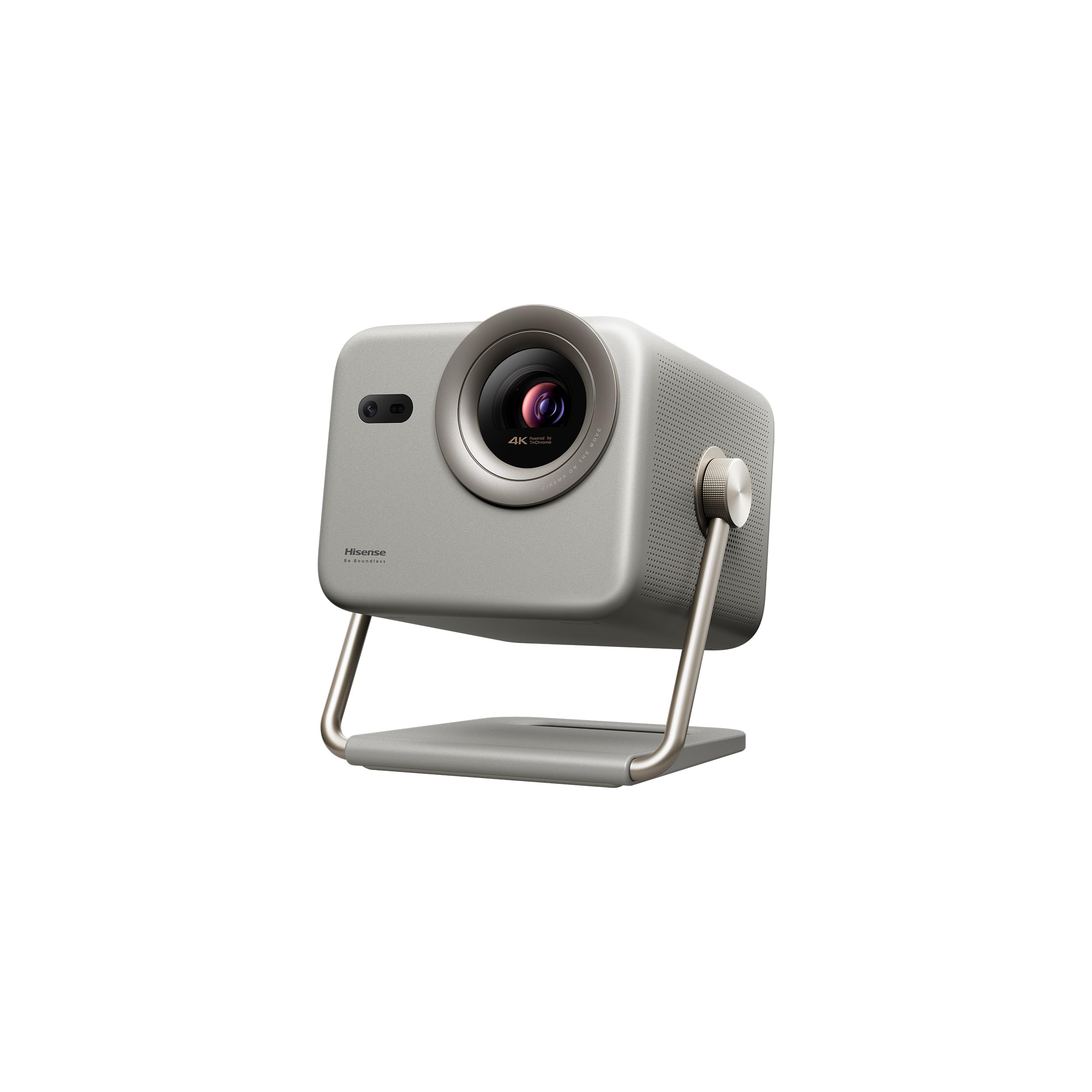
Hisense’s M2 Pro brings a genuine triple laser source into a portable form factor, making it a compelling option for 3D on the go. The MCL38 triple-laser design delivers vibrant colors and good blacks for its size class. The optical zoom (1.0-1.3x) is a rare and welcome feature in a portable projector — it lets you fill your screen exactly without digital cropping, preserving 4K resolution.
3D support is listed explicitly, and it works with DLP-Link active shutter glasses. The 1,300 ANSI lumens output is lower than some competitors, but for a pure triple laser projector in a compact chassis, it is respectable. In a fully dark room, the 3D effect on a 100-120 inch screen is convincing. Dolby Vision and AI-powered color enhancement further polish the 2D image quality.
VIDAA smart OS handles Netflix, YouTube, and Disney+ natively. Customer feedback praises the “surprisingly good picture” and easy setup, though some note that the brightness is only adequate for dark rooms and that 3D content requires manual frame-packing setup from a Blu-ray player. It is the best compact triple laser choice for those who prioritize 3D in a portable package.
Why it’s great
- True triple laser engine in a portable, living-room-friendly body
- Optical zoom preserves 4K resolution at any screen size
- Dolby Vision with AI frame-by-frame enhancement
Good to know
- 1,300 lumens is bright enough only for dark room 3D
- VIDAA OS has some regional app restrictions
8. Dangbei DBOX02 Laser Projector 4K

The Dangbei DBOX02 is a mid-range laser projector that punches well above its pricing tier for 3D performance. Its 2,450 ISO lumen ALPD laser engine is speckle-free and produces a clean, bright 4K image with a 5,000:1 contrast ratio. The Blu-ray 3D support is explicitly advertised, and the frame-packing sync works reliably with compatible glasses.
Google TV is built-in, with official Netflix and one-touch activation through the remote. The InstanPro AI Image Setup handles auto focus, keystone correction, obstacle avoidance, and screen fit in seconds. The dual HDMI 2.1 ports (one with eARC) and dual USB ports give you plenty of connectivity for a 3D Blu-ray player and external audio.
Real-world owners upgrading from Epson 5040 units report that the DBOX02 is a “true upgrade” in brightness and clarity, with “exceptionally quiet” fan operation. The 3D quality has improved significantly after software updates, but some users note that initial set up of 3D requires navigating a somewhat clunky menu system. The ALPD laser eliminates the speckle that bothers some viewers, making 3D scenes look smoother overall.
Why it’s great
- High brightness (2,450 ISO lumens) with zero laser speckle
- Official Netflix on Google TV reduces dongle clutter
- Very quiet fan during operation
Good to know
- 3D menu navigation is initially unintuitive
- No optical zoom limits placement flexibility
9. NEBULA Cosmos 4K SE Smart Projector

The NEBULA Cosmos 4K SE offers a unique HybridBeam light source that merges LED and laser technologies for a total of 1,800 ANSI lumens. This combination yields a wide color gamut (1.07 billion colors) and Dolby Vision support, plus improved contrast over standard LED projectors. The 3D support is via DLP-Link active shutter glasses and works with side-by-side and frame-packing content.
Google TV with native Netflix 4K streaming is a standout feature at this price tier — most projectors in this range require an external streaming stick for 4K Netflix. The IEA 4.0 Intelligent Setup includes real-time autofocus, obstacle avoidance, and wall color adaptation, making it easy to get a crisp image on any surface. The built-in speakers are surprisingly capable, with clear vocals and enough volume to fill a living room.
Owners report that the 4K image is “bright and sharp” even with lights on, and that the 3D effect is “impressive” for the price. The hybrid light engine avoids the speckle issue that pure laser projectors sometimes exhibit. The main downsides are the limited brightness compared to the premium tier and the fact that the auto-keystone feature sometimes needs manual correction. For a streaming-first home theater that also does 3D, it is a very strong mid-range pick.
Why it’s great
- Hybrid Beam eliminates laser speckle while boosting color
- Google TV with native 4K Netflix out of the box
- Surprisingly good built-in audio from Anker
Good to know
- Auto-keystone can be unreliable at extreme angles
- Only one HDMI port limits connectivity
10. XGIMI Horizon Pro 4K Projector

The XGIMI Horizon Pro is a well-established entry in the 3D DLP projector space. Its 1,500 ISO lumens output is mid-range, and its native 4K resolution (3840 x 2160 pixels) delivers sharp detail. The integrated Harman Kardon dual 8W speakers with DTS-HD and Dolby Digital compatibility provide some of the best built-in audio in this category, which is important for 3D immersion.
3D support is present and works with active shutter glasses via DLP-Link. Users report that 3D content “looks amazing” when set up correctly. The Intelligent Screen Adaption Technology handles auto keystone and auto focus well, making initial setup straightforward. Android TV 10.0 with Chromecast built-in supports most streaming apps, though Netflix is not natively available and requires a workaround.
Owners regularly note that the projector is “compact and easy to use” and produces “great image quality, sound, brightness, and colors.” One owner reported the unit still runs daily after 5 years with no issues, testament to its build quality. The key limitation for 3D is the relatively modest brightness — you will need a dark room for the best 3D experience. It remains a reliable mid-range workhorse for 3D fans who value sound quality.
Why it’s great
- Excellent built-in Harman Kardon audio enhances 3D immersion
- Long-lasting build quality reported by multiple owners
- Intelligent auto setup features simplify installation
Good to know
- Netflix is not natively supported
- Requires a completely dark room for best 3D performance
11. Dangbei Atom Portable Laser Projector

The Dangbei Atom is the most portable 3D laser projector on this list — at 1.87 inches thin and 2.82 lbs, it is lighter than a laptop. Despite its small size, the ALPD laser engine outputs 1,200 ISO lumens, which is respectable for a device this compact. It supports 3D via DLP-Link, and owners report that the 3D quality is “amazing” when using Blu-ray discs in a dark room.
Google TV with official Netflix is built in, and the auto focus and digital keystone correction make it easy to set up in any room. The dual 5W speakers with Dolby Audio are surprisingly loud, though they lack bass. It can project up to 180 inches, though image quality and brightness noticeably drop beyond 120 inches for 3D content. SBS and TAB 3D files can be streamed, but frame-packing Blu-ray 3D is the preferred source.
Customers highlight the “bright, clear, saturated” image with “no laser speckle” as the standout feature. The 3D experience is described as “better than PSVR” in terms of comfort and lack of screen door effect. However, the 3D menu sequence is unintuitive, requiring multiple steps (default keystone, specific remote sequence) to enter 3D mode. It is perfect for mobile 3D viewing but not for a permanent theater room.
Why it’s great
- Incredibly portable — fits in a laptop bag for 3D on the go
- No laser speckle and vivid colors from ALPD engine
- Google TV with official Netflix built-in
Good to know
- 3D mode activation is clunky and multi-step
- Image quality drops sharply beyond 120 inches in 3D
FAQ
Does a 3D theater projector work with any 3D Blu-ray player?
What is the difference between DLP-Link and RF 3D glasses?
Why does my 3D projector look too dim with glasses on?
Can I watch 3D content from streaming apps or YouTube on a 3D projector?
What is the maximum screen size for a good 3D experience?
Final Thoughts: The Verdict
For most users, the best 3d theater projector winner is the Valerion VisionMaster Pro2 because it combines the highest native contrast ratio, the fastest 3D gaming response, and the brightest triple laser engine in a package that works for both 3D purists and 4K streamers. If you want zero rainbow effect and a rock-solid big-screen image, grab the Epson LS11000. And for portable 3D with maximum brightness, nothing beats the gimbal-mounted JMGO N1S Ultimate.