
Our readers keep the lights on and my morning glass full of iced black tea. As an Amazon Associate, I earn from qualifying purchases.
Specs are compiled from manufacturer listings and verified buyer reviews and can change over time — please confirm the key details on the product page before buying.
Capturing true depth—where a photo feels like a window instead of a flat print—is the whole point of a 3D video camera. The catch is that “3D” means very different things on the shelf, from pocket point-and-shoots to automated real-estate scanners. This guide breaks down the three most distinct approaches so you can pick the one that matches how you actually want to shoot.
I’m Min — the founder and writer behind Gadgets Feed. This guide is built by comparing the manufacturers’ published specifications and the patterns across verified customer reviews, so you get each pick’s real strengths and trade-offs instead of marketing spin.
You want a 3d video camera that fits how you actually shoot—whether that means watching clips instantly without glasses or letting the camera scan a room for you. The key is matching the lens technology to your habits.
Our Picks at a Glance

How To Choose The Best 3D Video Camera
The first decision isn’t about resolution—it’s about what kind of 3D you want. True stereoscopic cameras use two lenses spaced like human eyes to create real depth. 360° cameras spin a single lens rig to capture an entire room, which you can view in VR but isn’t the same “pop-out” depth.
Real Depth vs. 360° Scenes
If you want to shoot your family and watch them back with visible dimension, you need a stereoscopic camera with two lenses. If you’re a real-estate agent capturing a whole room for a virtual tour, a 360° panoramic camera automates that job far better. Knowing which one you need will save you money and frustration.
Instant Playback Matters
The real payoff of 3D is seeing depth right away. Some cameras include an autostereoscopic screen (a display that shows 3D depth without needing glasses), while others require a separate viewer or a phone app. Decide if you want to show friends the effect on the spot or just review it later on a VR headset.
Heat and Battery Reality
3D imaging is processing-heavy. That means heat and battery drain are real concerns, not afterthoughts. A camera that overheats after ten minutes can’t be your primary shooter, and one that dies in under an hour will need spare batteries. Check the rated battery life before you commit.
Quick Comparison
| Model | Best For | Resolution | Video Spec | Battery Life | Amazon |
|---|---|---|---|---|---|
| Fujifilm FinePix Real 3D W3★ Best Overall | Authentic stereoscopic stills | 10MP Photos | 720p @ 24fps | — | Amazon |
| KanDao QooCam EGO | Instant glasses-free 3D playback | 24MP Photos / 8K | 4K @ 60FPS (3840×1080) | 48 minutes | Amazon |
| Trisio Lite 2 | Automated 360° room scans | 32MP Photos / 8K | Photo-only (no video) | 200 minutes | Amazon |
In‑Depth Reviews
1. Fujifilm FinePix Real 3D W3
Our pick — over 4★ from 300+ verified ratings; the strongest balance of quality and price.
The enthusiast’s compact that puts true 3D stills in your pocket.
Before the QooCam existed, this Fujifilm was the definitive consumer 3D camera, and enthusiasts still swear by it. The reason is control. It offers manual ISO, shutter, and aperture settings, plus non-destructive parallax adjustment (a tool that lets you fine-tune the 3D depth effect after you’ve shot). That’s a level of creative command neither newer camera here gives you, and it’s why owners call it “excellent for 3D veterans.”
The hardware is dated but special. Dual 10-megapixel CCD sensors (a classic sensor type known for clean color) with a 3x optical zoom lens produce sharp default 3D stills, thanks to a near-ideal 75mm lens separation. The 3.5-inch widescreen autostereoscopic LCD displays images in 3D instantly—no glasses required—which remains a joy to show friends. A mini-HDMI output lets you connect to a compatible 3D HDTV for living-room viewing. It shoots 720p video at 24fps, though the frame rate can feel a bit jerky during motion.
The caveats are practical. The 3D viewfinder is genuinely hard to see in bright sunlight, the twin lenses are easily covered by fingers if you aren’t deliberate about your grip, and battery life is short enough that a spare is recommended. A few owners note the off-center tripod mount and need for MJPEG codec support for video, but the consensus is clear: it’s a fun, capable way into 3D photography and offers excellent value for what it does.
Enthusiast appeal
- Full manual controls for ISO, shutter, and aperture
- Glasses-free 3D viewing on the built-in screen
- Near-ideal 75mm lens separation for natural depth
Buyer watch-outs
- 3D screen washes out in bright sunlight
- Lenses are easy to cover with fingers
- Short battery life calls for a spare
Best for: photographers who want hands-on control and authentic stereoscopic stills they can print or display.
Not for: anyone needing high-resolution video or a screen that works outdoors.
2. KanDao QooCam EGO
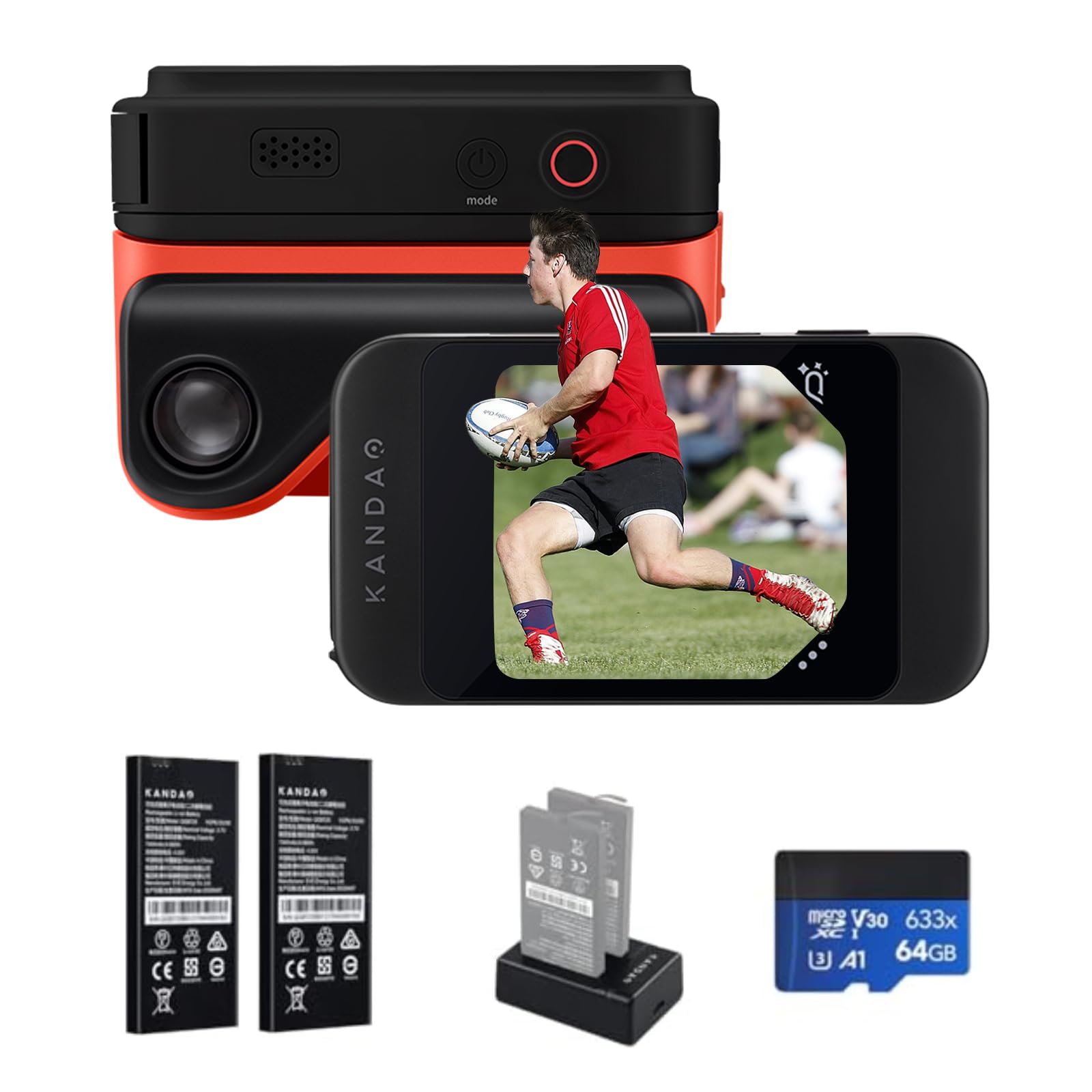
The pocket camera that snaps on a magnetic viewer for instant depth.
This is the one that feels like the future. The QooCam EGO is the world’s first portable digital 3D camera with an attached magnetic viewer, so you can watch your footage pop into three dimensions the second you finish shooting—no headset, no computer, no waiting. The two lenses sit 65mm apart, which mimics the average human eye spacing (the distance between your eyes), so the depth you capture looks natural and true-to-life rather than exaggerated or flat.
This camera tops the list for resolution. You get 24-megapixel effective stills with photos up to 8000×3000, and video that hits 3840×1080 at 60 frames per second—smooth enough for fast sports action and sharp enough for large screens or VR headsets. A built-in IMU sensor (a motion-tracking chip) plus image stabilization lets you shoot handheld without a gimbal, a real plus for action-style 3D clips. It’s also a 2.4x resolution leap over the classic Fujifilm’s 10MP sensor, so fine detail like foliage and fabric texture stays clear.
The honest trade-off is heat and battery. Buyers report the camera “over heated very fast” during use, and the rated battery life is just 48 minutes—so you’ll want that bundled replacement battery and SD card in your pocket for any real outing. Startup also takes 15-20 seconds, which means it can miss a spontaneous moment. What everyone agrees on is the “outstanding 3D effect” and how magical the instant playback feels.
What wins people over
- Instant stereoscopic playback through the magnetic viewer
- 60fps smoothness for fast action, a step above the competition
- Small enough to carry everywhere
The trade-offs to know
- Battery life rated at just 48 minutes
- Runs hot during extended use
- Slow 15-20 second power-up
Grab it for: a fun, portable way to capture 3D moments and watch them instantly, or to feed content to a VR headset.
Think twice if: you need all-day battery life or fast startup for grabbing fleeting shots.
3. Trisio Lite 2 VR Camera

A hands-free room scanner that builds 3D scenes while you sip coffee.
This is a completely different breed of 3D camera, and it’s the one to pick if your job is spaces, not selfies. The Trisio Lite 2 is a 360° panoramic camera built for real estate agencies, home decoration, renovation, hydropower engineering, and automotive interiors. You press one button and it captures every detail of a room, automatically generating high-quality 3D and VR scenes that look far more factual than traditional spherical video.
The secret is nodeRotate technology, which spins the optical lens 360° automatically with high precision. That means it captures the room’s lighting conditions too, feeding an anyScene self-adaption system that evens out dark and bright areas better than traditional HDR tech (a method that balances light in one shot). The result is distortion-free VR scenes ready for platforms like Cloud Pano. It’s a photo-only camera, but it does stills at an effective 32MP resolution with 8K display—that’s the highest still resolution on this list.
Battery life is the standout practical spec: up to 200 minutes of continuous work, which wipes the floor with the QooCam’s 48-minute rating. Built-in 8GB eMMC flash memory (7.1GB free) stores your photos on the device. The main limitations, noted by owners, are no manual controls, no RAW format, and HDR-only shooting—so you trade creative freedom for pure automation.
Automation ace: ideal for tight spaces like car interiors where a nodal rotation beats a handheld sweep.
Choose this when: your goal is fast, consistent 360° real-estate or renovation tours rather than artistic video.
Look elsewhere if: you want manual exposure control, RAW files, or any video capture at all.
Understanding the Specs
Lens Separation (Baseline)
This is the distance between the centers of the two lenses, measured in millimeters. The human eyes sit roughly 65mm apart, so a camera with a 65mm baseline (like the QooCam EGO) captures depth that matches your natural perception. A wider separation can exaggerate depth for effect, while a narrower one looks flatter. It’s the single most important spec for how “real” the 3D looks.
Resolution vs. Frame Rate
3D cameras split their sensor across two images, so resolution numbers can mislead. The QooCam’s 4K video is actually 3840×1080 per frame (two 1920×1080 halves), while its 8K photo spec refers to the combined 8000×3000 still. Frame rate matters for motion: 60fps (frames per second) looks smooth for action, while 24fps (like the Fujifilm) has a classic, slightly stuttery film feel.
FAQ
What is the difference between a stereoscopic 3D camera and a 360 camera?
Do I need a VR headset to view 3D video from these cameras?
Why does my 3D camera overheat during use?
How long does the battery last on these 3D cameras?
Can I watch 3D video on my regular TV?
Is a 3D camera good for real estate photography?
What memory card do I need for 3D video recording?
Why do my close-up 3D photos look distorted?
Final Thoughts: The Verdict
For the majority of shoppers, the 3d video camera winner is the KanDao QooCam EGO because its magnetic viewer delivers instant glasses-free depth that no other portable camera matches. If you’re a real-estate pro wanting automated room tours, grab the Trisio Lite 2 with its 200-minute battery. And for hands-on enthusiasts who love manual control, the Fujifilm FinePix Real 3D W3 remains the classic choice for authentic stereoscopic stills.
How We Picked
We do not accept paid placement. Every pick is matched to a real buyer and a real use-case; we do not hands-on test units.
Sources & Methodology
Specifications: manufacturer listings and product documentation. Review insights: verified customer reviews, as of August 2026. Pricing: not shown on this page (it changes often); check the current price via the retailer link.
As an Amazon Associate, Gadgets Feed earns from qualifying purchases. This does not affect which products we feature.