
The gap between a usable 3D video card and one that stutters through modern textures comes down to more than just a model number. VRAM capacity, memory bandwidth, ray tracing core count, and the thermal solution determine whether your frame rates hold steady or crater the moment a scene gets complex.
I’m Min — the co-founder and writer behind Gadgets Feed. I have spent many hours analyzing GPU architectures, memory interfaces, and real-world benchmark data to understand exactly how a card’s technical specifications translate into on-screen performance for gaming and 3D workloads.
This guide breaks down nine current-generation contenders with hard specs and genuine user feedback to help you identify the best 3d video card for your build, resolution target, and budget without getting lost in marketing language.
How To Choose The Best 3D Video Card
Picking the right GPU means matching your monitor’s resolution and refresh rate to the card’s memory subsystem and compute units. A card that crushes 1080p can choke at 4K if its VRAM bus or bandwidth is too narrow.
VRAM Capacity and Memory Bus Width
Texture-heavy modern titles at 1440p ultra routinely consume 8GB to 12GB of video memory. A 128-bit memory interface paired with 4GB GDDR5, as found on entry-level cards, will bottleneck texture streaming in open-world games. Look for at least 12GB on a 192-bit bus for 1440p high refresh, or 16GB on a 256-bit bus if you plan to drive 4K displays with high-detail assets.
Cooling Design and Power Connectors
A triple-fan cooler with a large vapor chamber or nickel-plated copper baseplate sustains higher boost clocks longer than a single-fan blower. Check your case clearance for length and slot thickness. Also verify your power supply has the correct PCIe connectors — many mid-range cards now require a single 12V-2×6 or dual 8-pin setup, and older budget PSUs may lack these.
Quick Comparison
On smaller screens, swipe sideways to see the full table.
| Model | Category | Best For | Key Spec | Amazon |
|---|---|---|---|---|
| Sapphire Nitro+ RX 9070 XT | Premium | 4K Ultra Gaming | 16GB GDDR6 / 256-bit | Amazon |
| ASRock RX 9070 XT Taichi | Premium | Max Overclock Headroom | 16GB GDDR6 / 3100 MHz Boost | Amazon |
| MSI RTX 5070 Gaming Trio OC | Premium | 1440p High FPS + DLSS 4 | 12GB GDDR7 / 192-bit | Amazon |
| ASUS Prime RTX 5070 | Premium | SFF Builds + Quiet Operation | 12GB GDDR7 / Dual BIOS | Amazon |
| PNY RTX 5070 Epic-X ARGB OC | Mid-Range | 1440p Ray Tracing Value | 12GB GDDR7 / 2685 MHz Boost | Amazon |
| GIGABYTE RTX 5070 WINDFORCE OC | Mid-Range | Quiet 1440p Upgrade | 12GB GDDR7 / SFF-Ready | Amazon |
| GIGABYTE RX 9060 XT Gaming OC | Mid-Range | 1080p/1440p Balanced Build | 16GB GDDR6 / PCIe 5.0 | Amazon |
| ASUS Dual RX 9060 XT | Mid-Range | Compact 1440p Gaming | 16GB GDDR6 / 2.5-Slot | Amazon |
| MSI GTX 1650 Ventus XS 4G OC | Budget | Low-Power / Entry-Level 1080p | 4GB GDDR5 / 128-bit | Amazon |
In‑Depth Reviews
1. Sapphire Nitro+ AMD Radeon RX 9070 XT

The Sapphire Nitro+ RX 9070 XT delivers 16GB of GDDR6 on a 256-bit memory bus running at 20 Gbps, providing the bandwidth needed for high-detail 4K textures without frame drops. Its GPU clock reaches a factory boost of 3060 MHz, and the triple-fan Nitro+ cooler keeps thermals in check even during extended ray-traced sessions. Real-world benchmarks show a 60-90% uplift over the previous-gen 6750 XT at 1440p and 4K, with noticeably improved 1% low framerates that eliminate hitching in open-world titles.
Users consistently praise its quiet operation and lack of coil whine, with many calling it the coolest-running card they have owned. The dual HDMI and dual DisplayPort outputs support multi-monitor setups, and the VRM design handles overclocking and undervolting gracefully through AMD Adrenaline software. Build quality feels substantial, with a metal backplate and a clean 12V cable routing channel under the shroud.
The primary trade-off is physical size — this card measures over 330mm and occupies nearly 3.5 slots, so it requires a wide case and careful clearance planning. The included anti-sag bracket is adequate, but some users recommend a dedicated GPU support arm for vertical orientations. Despite the large footprint, the thermal and acoustic performance justifies the space for anyone targeting consistent 4K 120Hz gaming.
Why it’s great
- Exceptional 4K 120Hz sustained performance with high texture fidelity
- Quiet and cool under load, even with factory overclock applied
- 256-bit memory bus paired with 16GB GDDR6 prevents VRAM bottlenecks
Good to know
- Very large 3.5-slot design may not fit smaller cases
- Requires an 850W power supply with 12V-2×6 connector
2. ASRock Radeon RX 9070 XT Taichi 16GB OC

The ASRock Taichi RX 9070 XT pushes factory boost clocks to 3100 MHz, one of the highest out-of-the-box overclocks available on RDNA 4. Its 16GB GDDR6 memory runs across a 256-bit bus at 20 Gbps, and the 16-phase SPS power delivery handles voltage regulation cleanly for ambitious manual tuning. The Taichi 3X cooling system uses three 100mm striped ring fans with reverse spin technology that reduces turbulence and improves static pressure across the large fin array.
Customer feedback highlights stable performance at 1440p max settings with no stuttering, and several users report successful undervolting through Adrenaline that lowers power draw without sacrificing frame rates. The dual BIOS switch lets you toggle between Performance and Silent modes, and Polychrome SYNC RGB allows full lighting customization. The metal backplate and reinforced frame prevent PCB flex even with the card’s considerable 330mm length.
ASRock’s RGB software has been cited as occasionally buggy, with the lighting controller losing connection on some systems. The card also requires a 12V-2×6 power connector and an 800W power supply as a minimum, which may necessitate a PSU upgrade for older builds. If peak factory clock speed and robust VRM design are your priorities, this Taichi variant delivers the highest boost frequency in this roundup.
Why it’s great
- Industry-leading 3100 MHz boost clock out of the box
- 16-phase SPS VRM provides clean power delivery for extreme overclocking
- Triple 100mm fans with reverse spin reduce noise and improve airflow
Good to know
- ASRock RGB software can be unreliable and lose device connection
- Large 3-slot, 330mm length requires careful case and PSU selection
3. MSI RTX 5070 12G Gaming Trio OC

The MSI Gaming Trio OC leverages NVIDIA’s Blackwell architecture with 12GB of GDDR7 memory on a 192-bit bus, delivering memory bandwidth up to 672 GB/s. Its TRI FROZR 4 thermal solution combines STORMFORCE fans with claw-textured blades and a nickel-plated copper baseplate that captures heat directly from the GPU and memory modules. Square-shaped core pipes maximize contact area with the baseplate, allowing the card to maintain its 2625 MHz boost clock under sustained gaming loads.
Users upgrading from 30-series cards report dramatic temperature drops, with idle temps around 42°C and load temps staying well under 75°C even in warm cases. The card handles 1440p ultra settings with ray tracing enabled, and with DLSS 4 frame generation it pushes well past 144 FPS in competitive titles. Build quality is premium, with a clean aesthetic that lacks excessive RGB gaudiness.
The 12GB VRAM is sufficient for current 1440p gaming, but future titles with heavy 4K texture packs may push against that ceiling. The card’s 2.5-slot width is moderate, but it does extend 326mm in length, so measuring your case clearance is wise. Overall, this is the strongest NVIDIA option in the roundup for balanced 1440p high-refresh gaming with access to DLSS 4 and Reflex technologies.
Why it’s great
- Excellent 1440p high-refresh performance with DLSS 4 support
- Nickel-plated copper baseplate and square core pipes deliver superior heat transfer
- STORMFORCE fan design remains quiet even under full load
Good to know
- 12GB VRAM may limit 4K ultra texturing in future titles
- Length of 326mm needs case compatibility verification
4. ASUS SFF-Ready Prime RTX 5070

The ASUS Prime RTX 5070 is designed specifically for SFF (Small Form Factor) systems while still packing 12GB of GDDR7 memory and Blackwell architecture. Its 2.5-slot width and axial-tech fans with a smaller hub allow longer blades that push more downward air pressure through a compact heatsink. The phase-change GPU thermal pad improves heat transfer from the die, which keeps temperatures around 67°C under gaming load in user-reported benchmarks.
Competitive gamers pair this card with CPUs like the 7800X3D and report smooth 1440p gameplay in titles like R6 Siege and Overwatch at high refresh rates. The dual BIOS switch offers a Quiet profile for silent light gaming and a Performance profile for demanding AAA scenarios. The card’s 2542 MHz boost clock has good overclocking headroom, with users achieving an extra 10% performance through the NVIDIA app.
Some users note the card runs warm in cases with restricted airflow, so a well-ventilated SFF chassis is recommended. The 12V-2×6 power connector means you will need a compatible PSU or adapter. For builders prioritizing a compact footprint without sacrificing Blackwell features, this ASUS Prime model is the most SFF-friendly RTX 5070 available.
Why it’s great
- Designed for SFF builds with 2.5-slot profile and compact length
- Dual BIOS offers both quiet and performance operating modes
- Phase-change thermal pad improves die-to-heatsink heat transfer
Good to know
- Runs warmer in restricted airflow cases
- Requires 12V-2×6 power connector and modern PSU
5. PNY NVIDIA GeForce RTX 5070 Epic-X ARGB OC
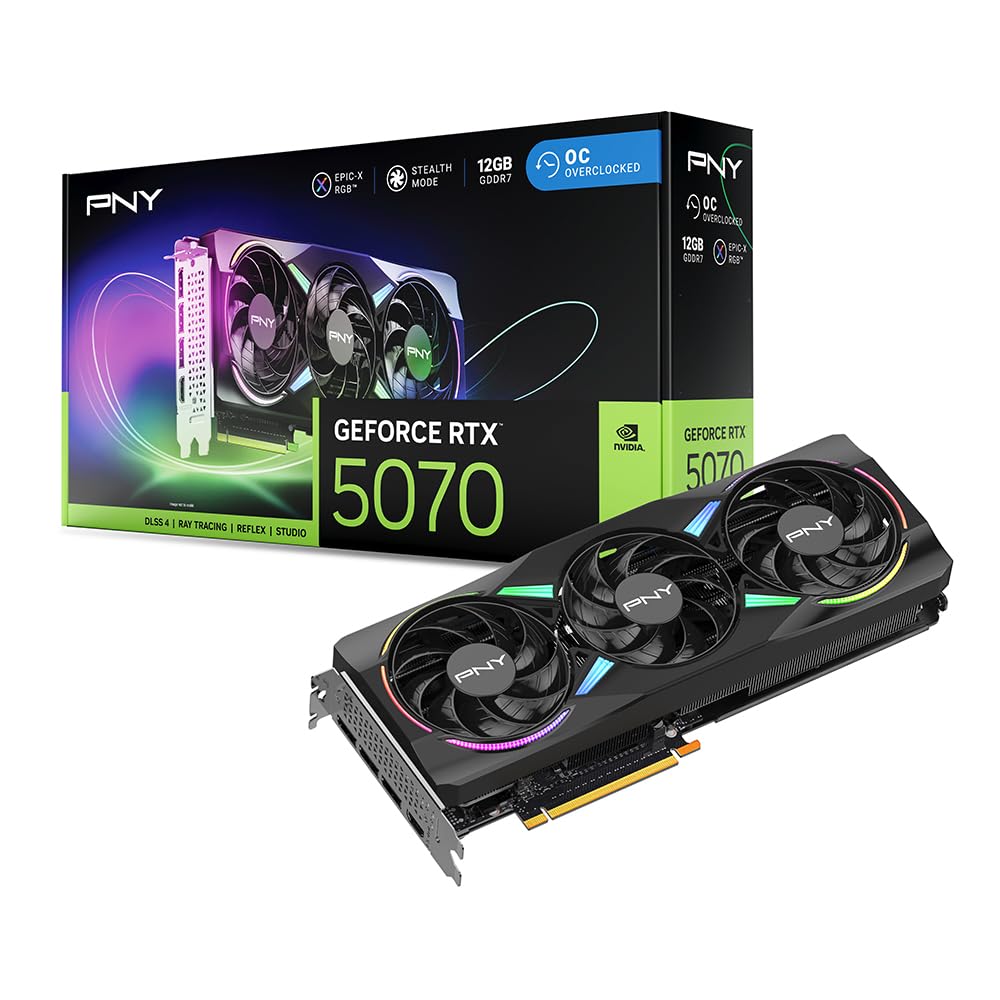
PNY’s Epic-X ARGB OC delivers a 2685 MHz boost clock on the RTX 5070 platform, using 12GB of GDDR7 memory across a 192-bit bus. Its triple-fan cooler keeps thermals under control while the factory overclock provides performance that users consistently describe as noticeably better than the previous-gen RTX 4070 Super. The card includes all 80 ROPS, which users have verified through GPU-Z testing, ensuring full rasterization throughput.
Buyers report smooth 1440p gaming with high FPS using DLSS 4 and frame generation, and the card’s power draw is efficient enough to run on a 750W power supply using the included 12-pin to dual 8-pin adapter. The ARGB lighting adds visual flair without being overwhelming, and the compact footprint fits in mini tower cases like the HP Z4 G4 with proper clearance.
Some users mention the cooler lacks the premium materials found on higher-end MSI or ASUS models, but the thermal performance is still adequate for the 250W TDP. For buyers who want RTX 5070 performance at a competitive price point with minimal frills, PNY offers a solid value proposition that does not compromise on core specs.
Why it’s great
- Factory overclock to 2685 MHz outperforms 4070 Super consistently
- Compact triple-fan design fits most mid-tower and some mini cases
- Compatible with 750W PSU using included adapter
Good to know
- Cooler construction uses fewer premium materials than flagship models
- ARGB lighting is basic compared to customizable RGB solutions
6. GIGABYTE GeForce RTX 5070 WINDFORCE OC SFF 12G

The GIGABYTE WINDFORCE OC SFF is an NVIDIA SFF-Ready card that packs 12GB of GDDR7 and a 2600 MHz boost clock into a compact 4.33-inch wide, 11.1-inch long package. The triple WINDFORCE fan system runs quietly even under sustained load, with users upgrading from older cards like the 2080 Super noting dramatically lower noise profiles. The card stays under 75°C during max-settings 1440p gaming without aggressive fan curves.
Buyers running 1440p 180Hz monitors confirm the card reaches their display’s refresh rate limit in modern titles at ultra preset, making it a solid choice for competitive and immersive gaming alike. The clean, professional design lacks RGB, which appeals to builders who prefer an understated look. Installation is straightforward, and the included support bracket helps prevent sag in standard ATX cases.
The main limitation is that the WINDFORCE cooler, while effective, does not offer dual BIOS switching or advanced thermal features like vapor chamber cooling. For users who want a reliable, quiet, SFF-compatible RTX 5070 without paying a premium for RGB or extra thermal headroom, this GIGABYTE model delivers dependable performance at a reasonable mid-range price.
Why it’s great
- Very quiet triple-fan operation even during extended gaming sessions
- SFF-ready compact design fits smaller cases easily
- Understated professional aesthetic with no RGB
Good to know
- No dual BIOS switch for custom fan profiles
- Cooler lacks vapor chamber found on premium models
7. GIGABYTE Radeon RX 9060 XT Gaming OC 16G

The GIGABYTE RX 9060 XT Gaming OC provides 16GB of GDDR6 memory on a PCIe 5.0 interface, giving it a VRAM advantage over similarly priced NVIDIA options. The WINDFORCE cooling system with Hawk fans and server-grade thermal conductive gel keeps the GPU cool during extended sessions, and users report zero-RPM fan mode for silent operation at idle. The 2700 MHz boost clock delivers solid 1440p performance in RDNA 4 architecture.
Buyers highlight the card’s ability to handle 1440p ultra settings reliably with good frame rates, while the 16GB VRAM buffer helps with texture-heavy mods and video editing tasks. The dual fan design is more compact than triple-fan alternatives, fitting comfortably in mid-tower cases. AMD’s FSR upscaling and AV1 encoding support add versatility for both gaming and content creation.
Ray tracing performance lags behind NVIDIA’s Blackwell cards at this price tier, and the 128-bit memory interface, while paired with ample VRAM, does not match the bandwidth of wider bus designs found on higher-tier cards. For users who prioritize VRAM capacity and PCIe 5.0 forward-compatibility over raw ray tracing throughput, this GIGABYTE card offers excellent value.
Why it’s great
- Generous 16GB GDDR6 VRAM handles heavy texture loads and mods
- PCIe 5.0 interface provides bandwidth for future motherboard upgrades
- WINDFORCE cooling with zero-RPM mode runs silently at low loads
Good to know
- Ray tracing performance trails NVIDIA Blackwell counterparts
- Memory bandwidth limited by interface width
8. ASUS Dual Radeon RX 9060 XT 16GB
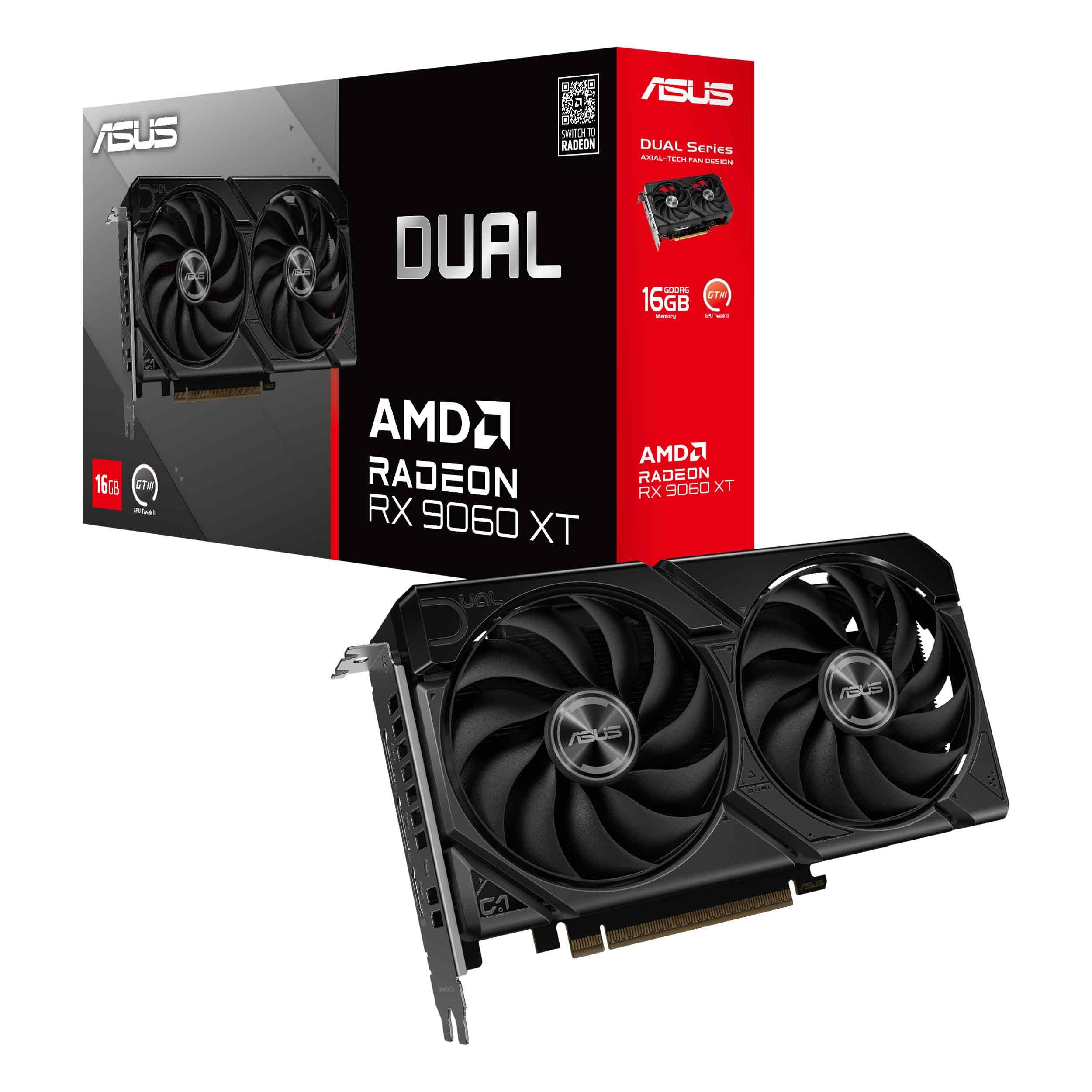
The ASUS Dual RX 9060 XT compresses 16GB of GDDR6 into a compact 8-inch length with a 2.5-slot profile, making it one of the most space-efficient 16GB cards in this guide. The axial-tech fans feature a smaller hub that accommodates longer blades and a barrier ring for increased downward air pressure. The dual BIOS switch lets you toggle between Quiet and Performance modes, and 0dB technology stops fans entirely during light gaming.
Users consistently praise the card’s quiet operation and stable 1440p performance, with Destiny 2 hitting 180 FPS paired with an i5-12600K. The compact size fits easily in ITX and SFF cases, and the absence of RGB lighting appeals to minimalist builders. AMD Adrenaline software provides extensive tuning options, enabling fine-grained control over power and clock settings.
Some users note the plastic backplate feels less premium compared to metal alternatives, and the price, while competitive, has crept up due to market conditions. For those building a compact 1440p gaming rig or media workstation who want 16GB of VRAM without the bulk of triple-fan designs, this ASUS Dual card is a strong, space-conscious pick.
Why it’s great
- Compact 8-inch length fits ITX and SFF cases easily
- Dual BIOS switch offers Quiet and Performance fan profiles
- 16GB GDDR6 provides ample VRAM for 1440p texture-heavy gaming
Good to know
- Plastic backplate is less durable than metal alternatives
- Not ideal for 4K ultra gaming due to memory bandwidth constraints
9. MSI Gaming GeForce GTX 1650 Ventus XS 4G OC

The MSI GTX 1650 Ventus XS represents the entry-level tier of 3D video cards, offering 4GB of GDDR5 on a 128-bit memory interface. It is powered directly from the PCIe slot, requiring no external power connectors, which makes it compatible with older or proprietary power supplies that lack GPU cables. Users report running Destiny 2, League of Legends, and War Thunder at 1080p 60 FPS with moderate settings, and the card fits in refurbished office PCs with ease.
Linux users appreciate the driver compatibility, noting that after installing NVIDIA drivers, the card handles triple-monitor setups and HDMI switches smoothly. The card runs cool under load, with idle temperatures below 30°C and gaming max around 60°C. The compact single-fan design is 748 grams and fits in almost any case.
The primary limitation is the 4GB VRAM buffer, which will bottleneck modern AAA titles at higher texture settings. Some users report the fan is slightly loud at idle, and the 128-bit bus limits memory bandwidth for 1440p gaming. For budget builds, lightweight 1080p gaming, or media PCs that need HDMI 2.0b and DisplayPort outputs, this GTX 1650 is a functional and affordable option.
Why it’s great
- No external power connectors required, works with proprietary PSUs
- Excellent Linux driver support with triple-monitor compatibility
- Low power draw keeps thermals low without aggressive cooling
Good to know
- 4GB GDDR5 VRAM limits modern AAA game texture quality
- 128-bit memory interface bottlenecks 1440p performance
FAQ
Can I use a PCIe 5.0 GPU in a PCIe 4.0 motherboard slot?
Why does the memory bus width matter more than VRAM capacity alone?
Final Thoughts: The Verdict
For most users, the best 3d video card winner is the Sapphire Nitro+ RX 9070 XT because it delivers uncompromised 4K gaming with 16GB of VRAM on a wide 256-bit bus, all while running quiet and cool. If you want DLSS 4 and superior ray tracing, grab the MSI RTX 5070 Gaming Trio OC. And for a budget-friendly 1080p entry point, nothing beats the MSI GTX 1650 Ventus XS for low-power builds.