
Our readers keep the lights on and my morning glass full of iced black tea. As an Amazon Associate, I earn from qualifying purchases.
Specs are compiled from manufacturer listings and verified buyer reviews and can change over time — please confirm the key details on the product page before buying.
Before you buy a 3D video recording camera, decide how you want to watch the footage: with your own eyes, on a headset, or on a TV. This guide covers both paths, from a camera with a glasses-free screen to a companion device built for AR glasses.
I’m Min — the founder and writer behind Gadgets Feed. This guide is built by comparing the manufacturers’ published specifications and the patterns across verified customer reviews, so you get each pick’s real strengths and trade-offs instead of marketing spin.
You want a 3d video recording camera that matches your viewing setup, and this guide breaks down the top options that actually deliver depth without the gimmick.
Our Picks at a Glance

How To Choose The Best 3D Video Recording Camera
Three different buyers want three different 3D cameras. One wants to press a button and watch the clip instantly on a small screen. Another wants files that load into a VR headset. A third wants to document a room for a client. Match the camera to how you will actually watch the footage.
Check the playback path first
The camera is only half the system. Ask yourself where the video will end up. A glasses-free screen on the camera itself is the easiest way to see depth instantly, while a model built for AR glasses needs a separate headset to view. A 360 panorama camera produces an entirely different kind of 3D scene that suits VR headsets and virtual tours.
Look at lens separation and resolution
Lens separation is the distance between the two lenses, and it mimics the space between your eyes. A wider separation close to the human average makes depth look more natural. Video resolution tells you how sharp the final clip will be on a big screen — a 720p clip looks fine on a small LCD but soft on a television, while a 3840×1080 frame holds up far better.
Battery life is the quiet killer
3D cameras drain power quickly because they run two sensors and often a second screen. If a camera manages only a short runtime per charge, you will be carrying spares or topping up constantly. Check the stated battery life in minutes before you commit, and expect real-world numbers to run shorter than the optimistic rating.
Quick Comparison
| Model | Best For | Video Resolution | Photo Resolution | Playback Method | Amazon |
|---|---|---|---|---|---|
| Fujifilm FinePix Real 3D W3★ Best Overall | Glasses-free viewing | 720p HD movies | 10MP | Built-in 3.5-inch LCD | Amazon |
| KanDao QooCam EGO | VR headset sharing | 3840×1080 @ 60FPS | 8000×3000 | Magnetic 3D viewer | Amazon |
| XREAL Beam Pro | AR glasses companion | Full HD spatial video | Dual 50MP | AR glasses / 3D screen | Amazon |
| Trisio Lite 2 | Real estate walkthroughs | 8K panorama photos | 32MP | VR headset / app | Amazon |
In‑Depth Reviews
1. Fujifilm FinePix Real 3D W3
Our pick — over 4★ from 300+ verified ratings; the strongest balance of quality and price.
The rare camera that shows you its own 3D depth on the back screen, no glasses needed.
You see the 3D effect instantly on this camera’s 3.5-inch widescreen autostereoscopic LCD (a screen that shows 3D without glasses), so you confirm depth before you leave the room. That instant feedback makes it the crowd favorite — the dual 10-megapixel CCD (a type of image sensor) and lens system captures sharp stills and HD 3D movies at 720p resolution, so your footage looks clear on the spot.
It earns its Best Overall spot against the QooCam EGO because it plays back on a 3D HDTV through the mini-HDMI output jack — you are not locked into a headset or a small attached viewer. The 3x optical zoom lens with optical image stabilization helps you frame cleaner shots, and it accepts SD/SDHC memory cards so storage is your choice.
The honest trade-off appears quickly in the review pages: battery life comes up as the recurring gripe, and the sheer number of settings can feel complex until you learn them. Video is also not perfectly smooth — buyers report it can look jerky, not full 24fps — so this is a stills-first 3D camera that also records clips, not a cine rig. The 4.4-star crowd favorite across 300+ owners tells you the depth quality wins people over anyway.
Depth That Delivers
- Glasses-free 3D screen makes depth instantly visible
- Near-ideal lens separation for natural-looking depth
- Mini-HDMI jack connects straight to a 3D TV
Real-World Friction
- Battery life runs short — plan to carry a spare
- Menus pack in many settings that take time to master
- Video can look jerky rather than a full 24fps
The right fit: anyone who wants the simplest path from capture to seeing depth with their own eyes.
Fair warning: heavy video shooters should expect to top up power often mid-session.
2. KanDao QooCam EGO
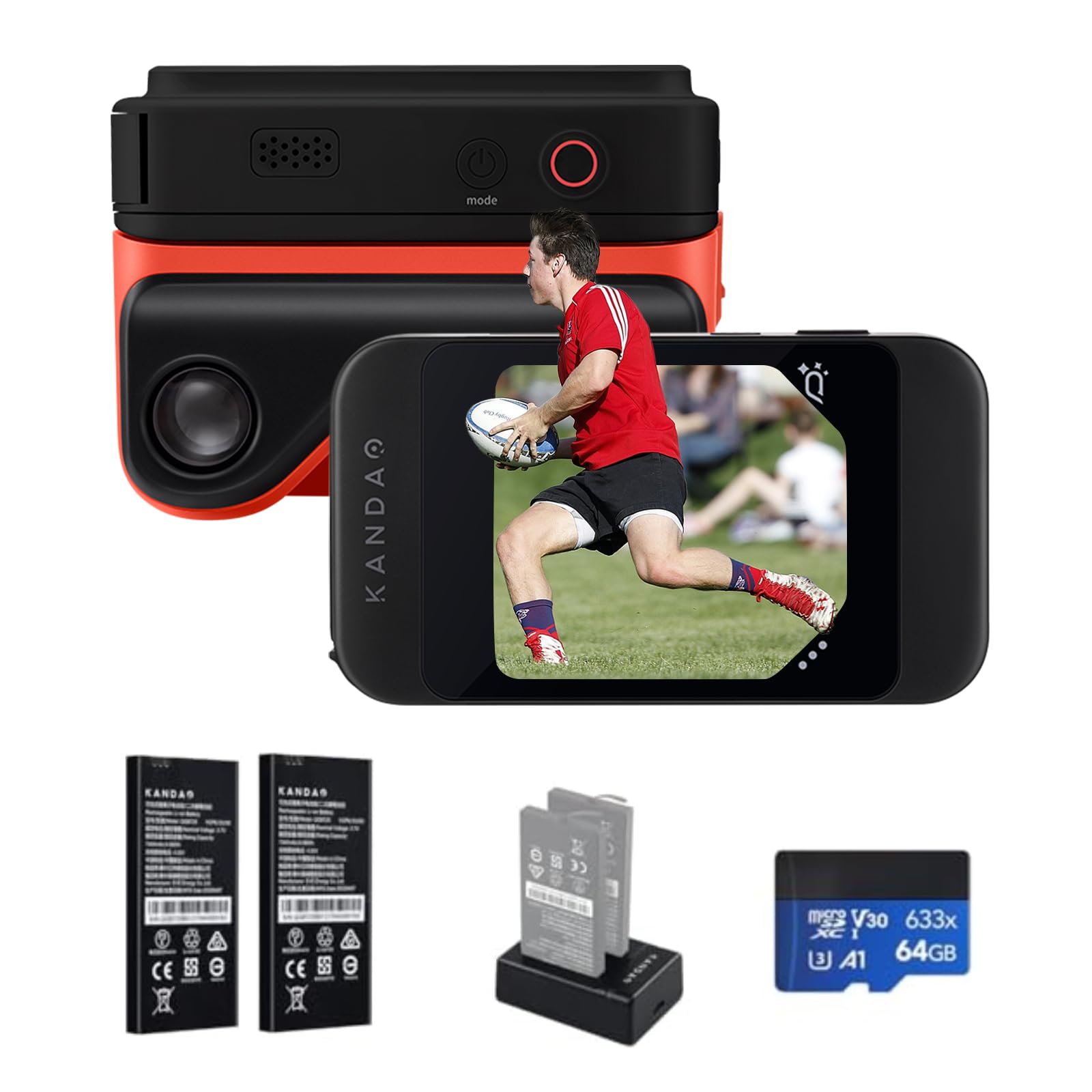
A magnetically attached viewer snaps on for instant 3D playback in the field.
The headline here is the world’s-first portable 3D camera with an attached magnetic viewer — you shoot, snap the viewer on, and watch stereoscopic depth right there without a headset. Under the hood it records at a true 3840×1080 resolution at 60 frames-per-second, which makes it the sharper video option compared to the Fujifilm’s 720p, and it captures 8000×3000 photos too. The 65mm distance between the two lenses mirrors the space between your eyes for natural depth.
It also leaves the Fujifilm behind for action because a built-in IMU sensor (a motion-tracking unit) plus image stabilization lets you shoot without a gimbal. Output is side-by-side MP4 video that transfers cleanly to major VR headsets like Oculus, and the QooCam app handles editing and sharing to Facebook or YouTube. The attached viewer makes it a portable, affordable alternative to a VR headset.
The catch is stamina and handling. Battery life is rated at 48 minutes, and the review pages note it can overheat quickly during longer sessions. The body is small — a few owners find it too small to handle comfortably and warn about fingers drifting over the lenses. As owners put it, close-ups under three feet cause a “Pinocchio nose” effect while landscapes look excellent, so it rewards distance shots over macro work.
Sharpness champion: the highest video resolution in this lineup at 3840×1080 and 60 frames per second, so fast motion stays clear on a big screen.
Who should pass: long-form recorders who cannot live with a short battery and quick heat-up.
3. XREAL Beam Pro

Dual 50MP ASPH cameras put spatial capture into a pocketable Android device.
Unlike a dedicated camera, this is a spatial computing companion that runs Android 14 and pairs with XREAL AR glasses, so it doubles as your 3D capture tool and your media player. The dual 50MP ASPH 3D cameras capture full HD spatial images and videos in 3D, and the built-in display shows them back crisply — it functions like a phone with a bright LCD. It also runs every Google Play Store app, which the other picks here cannot do.
It beats the others purely on versatility. You get WiFi 6 (a fast, modern wireless standard) and a 90Hz refresh rate (meaning the screen redraws 90 times per second) for low-latency streaming with Netflix, Amazon Prime, Hulu, and Disney Plus. Cloud gaming runs through Xbox Game Pass, Amazon Luna, and Steam Link. A 4300 milliamp-hour battery powers the whole thing, and you can keep it charged while it is in use.
The honest weakness is software polish, not hardware. Hardware earns the most praise by far, but the user experience gets mixed reactions — owners describe the AR software as buggy with occasional crashes, and an erratic spatial mouse. Battery life runs about two hours with the glasses connected and around five hours without, so the AR mode is a short-session tool. This is the right pick only if you already own or plan to own XREAL glasses.
Ecosystem Muscle
- Runs the full Google Play Store, not a closed camera OS
- Dual 50MP cameras capture high-detail spatial photos
- WiFi 6 and 90Hz screen keep streaming smooth
Ecosystem Friction
- AR software can crash or glitch during use
- Around two hours of battery with glasses attached
- Needs XREAL glasses to see the full 3D experience
Grab it for: combining 3D capture, streaming, and gaming in one pocketable Android device.
Look elsewhere if: you need a standalone camera that shows depth without buying extra glasses.
4. Trisio Lite 2

Press one button and it captures a whole room as a distortion-free 3D VR scene.
This is the automated workhorse of the group, designed so beginners can capture professional pan-shots by just pressing the shooting button. Its a neat extra is nodeRotate technology — the camera rotates 360° automatically with high precision and captures the room’s lighting to build distortion-free VR scenes. That makes it the clear choice for real estate agencies, home renovation, and tight spaces like car interiors where a handheld camera struggles.
You get a 32MP effective still resolution and 8K panoramic photos saved as JPEG files, so you can capture wide, detailed scenes. The anyScene self-adaption system (a feature that balances exposure) evens out dark and bright areas for unified brightness. Storage and power are its strongest practical features: a built-in 8GB eMMC flash memory (a type of storage chip) gives you 7.1GB of free space for photos, and the battery runs a continuous 200 minutes — far longer than the QooCam EGO’s 48 minutes. Owners pair it with Cloud Pano for virtual tours and report excellent results viewed on a Quest 2.
The trade-off is that this is a photography-first 360 camera, not a video recorder. There are no manual settings and no RAW output, and the HDR-only mode can be slow. Occasional stitching artifacts appear near the zenith (the point directly overhead). But buyers who need walkthroughs say the ease of use is the whole point — as one owner put it: “I like the ease of use. Perfect for real estate photography!”
Room-scan specialist: automated nodal rotation captures tight interiors more accurately than a traditional spherical video camera.
Know the limit: stills only — if you want moving 3D video, one of the other three picks is the better fit.
Understanding the Specs
Lens Separation
This is the distance between the two lenses, and it mimics the gap between your eyes — about 65mm. The closer a camera gets to that spacing, the more natural the depth looks. Too narrow and scenes feel flat; too wide and depth looks exaggerated. A 65mm separation, like the QooCam EGO uses, delivers the most true-to-life stereo effect.
Video Resolution
This tells you how sharp the final 3D clip looks on a screen. A 720p frame is fine on a small camera LCD but soft on a television. A 3840×1080 frame splits that width across two eyes, so each eye gets a 1920×1080 image — sharp enough for VR headsets and projectors. Match the resolution to where you will actually watch.
FAQ
Can I watch 3D video without a VR headset or 3D TV?
Will 3D video from these cameras play on a VR headset?
Why does close-up 3D video look weird?
How long does the battery last on a 3D camera?
Is a 3D camera better for photos or video?
Do I need a computer to edit 3D footage?
What memory card do I need for 3D video?
Can I use a 3D camera for real estate or work?
What is the difference between the XREAL Beam Pro and a regular 3D camera?
Final Thoughts: The Verdict
Across the board, the 3d video recording camera winner is the Fujifilm FinePix Real 3D W3 because it is the only one that shows you depth instantly on its own glasses-free screen. If you want the sharpest video that transfers straight to a VR headset, grab the KanDao QooCam EGO. And for automated room walkthroughs, the Trisio Lite 2 is the one to reach for.
How We Picked
We do not accept paid placement. Every pick is matched to a real buyer and a real use-case; we do not hands-on test units.
Sources & Methodology
Specifications: manufacturer listings and product documentation. Review insights: verified customer reviews, as of August 2026. Pricing: not shown on this page (it changes often); check the current price via the retailer link.
As an Amazon Associate, Gadgets Feed earns from qualifying purchases. This does not affect which products we feature.