
Our readers keep the lights on and my morning glass full of iced black tea. As an Amazon Associate, I earn from qualifying purchases.
Specs are compiled from manufacturer listings and verified buyer reviews and can change over time — please confirm the key details on the product page before buying.
Choosing a 3D virtual reality camera is a different game than picking a normal camcorder. You need two lenses that work perfectly together to create depth you can feel when you put on a VR headset (a head-mounted display for virtual reality). Get the alignment wrong or the resolution too low, and your memories look flat instead of rich. This guide compares stereoscopic 3D shooters (cameras that mimic how your two eyes see), 360-degree action cams, and professional rigs so you know the trade-offs.
I’m Min — the founder and writer behind Gadgets Feed. This guide is built by comparing the manufacturers’ published specifications and the patterns across verified customer reviews, so you get each pick’s real strengths and trade-offs instead of marketing spin.
This roundup of the best 3d virtual reality camera options helps you match the right hardware to your specific project and budget, whether you are filming travel clips for a VR headset or capturing action sports that you can reframe later.
Quick Picks
- Insta360 X5 — Top Performer
- DJI Osmo 360 Camera Adventure Combo — Best Overall
- GoPro MAX 360 HD Video Waterproof Action Camera — Simple & Solid
- KanDao QooCam EGO – Viewer-Integrated 3D VR — True 3D Pick
- AKASO 360 Action Camera Creator Combo — Budget Champion
- Ricoh Theta Z1 360 Camera — Pro Still Suite
How To Choose The Best 3D Virtual Reality Camera
Not all 3D VR cameras work the same way. Some capture a full 360-degree sphere that you reframe later, while others shoot a fixed stereoscopic 3D view meant for immediate headset playback. Knowing which type matches your use saves you money and frustration.
Stitching vs. Instant 3D
A 360-degree action camera (like the DJI Osmo 360 or Insta360 X5) records everything around you using two fisheye lenses, then stitches the footage together in its app. You choose the angle after recording. A true stereoscopic 3D camera (like the KanDao QooCam EGO) keeps the left-eye and right-eye images separate from the start, which delivers depth without any stitching artifacts but locks you into a narrower field of view. If your priority is reliving moments in a VR headset with convincing depth, go stereoscopic. If you want the freedom to reframe later for social media or flat-screen viewing, pick a 360-degree action cam.
Resolution and Sensor Size
Resolution determines how sharp the image looks when you magnify it inside a VR headset. Entry-level 5.7K video (AKASO 360) looks decent on a phone but can appear soft on large VR screens. An 8K resolution (DJI Osmo 360, Insta360 X5) gives you more detail to zoom into without visible pixels. Sensor size also matters — the DJI Osmo 360 uses a 1-inch sensor, which captures more light and produces cleaner low-light footage than the smaller 1/2-inch sensors found in budget cameras.
Battery Life and Storage
VR content tends to be long — you do not want the camera dying mid-scene. The Insta360 X5 claims a 208-minute battery life, while the KanDao QooCam EGO runs only about 48 minutes on a single charge. Some cameras, like the DJI Osmo 360, come with three batteries in the Adventure Combo, effectively tripling your runtime. Internal storage is another hidden spec: the DJI Osmo 360 packs 105GB built-in, so you never need to buy a memory card to start shooting.
Quick Comparison
| Model | Best For | Video Resolution | Still Resolution | Battery Life | Amazon |
|---|---|---|---|---|---|
| Insta360 X5 | Pro-level 360 with low-light | 8K | 72 MP | 208 min | Amazon |
| DJI Osmo 360 Adventure Combo | Best overall 8K 360 capture | 8K | 120 MP | 100 min | Amazon |
| GoPro MAX 360 (2025) | Simple 360 with accessory kit | 5.6K | 16 MP | 5 Hours | Amazon |
| KanDao QooCam EGO | True stereoscopic 3D on a budget | 3840×1080 | 24 MP | 48 min | Amazon |
| AKASO 360 Creator Combo | Entry-level 360 value | 5.7K | 48 MP | — | Amazon |
| Ricoh Theta Z1 | Professional still-centric 360 | 3840 Pixels | 20 MP | — | Amazon |
In‑Depth Reviews
1. Insta360 X5

The 360 action cam that finally handles low light without looking grainy.
Dual 1/1.28-inch sensors and a triple AI chip design do the heavy lifting here — the X5 captures 8K30fps 360-degree video with noticeably better clarity in dim conditions than any previous Insta360 model. You get the invisible selfie stick effect that makes it look like a drone is following you, plus FlowState Stabilization and full 360-degree Horizon Lock that keeps footage level even when you flip the camera fully around. Video resolution reaches 7680 × 4320 pixels, and still photos hit 72 MP.
Buyers report the camera mounts securely on motorcycles and handles outdoor adventures without breaking a sweat. The replaceable lenses are a practical touch — scratch one on a rock, swap it in seconds instead of sending the whole unit for repair. Battery life is rated at 208 minutes, which beats the DJI Osmo 360 by a wide margin (100 minutes), so you can film a full day out with fewer charges. The built-in Wind Guard on the four-microphone array also helps vloggers capture clearer voice audio on breezy days.
What Powers It Up
- 8K 360° video with sharp low-light performance from triple AI processing
- 208-minute battery outlasts most competitors on a single charge
- Replaceable scratch-resistant lenses add years of life
Where It Holds Back
- Premium price sits above the mid-range tier
- Requires the Insta360 app for reframing; desktop workflow less direct
Grab it when: you want the best low-light 360 video and the longest battery life in a rugged, lens-swappable body — the X5 is built for serious adventurers.
Think twice if: you need a true stereoscopic 3D camera for VR-headset playback rather than a reframable 360 sphere.
2. DJI Osmo 360 Camera Adventure Combo
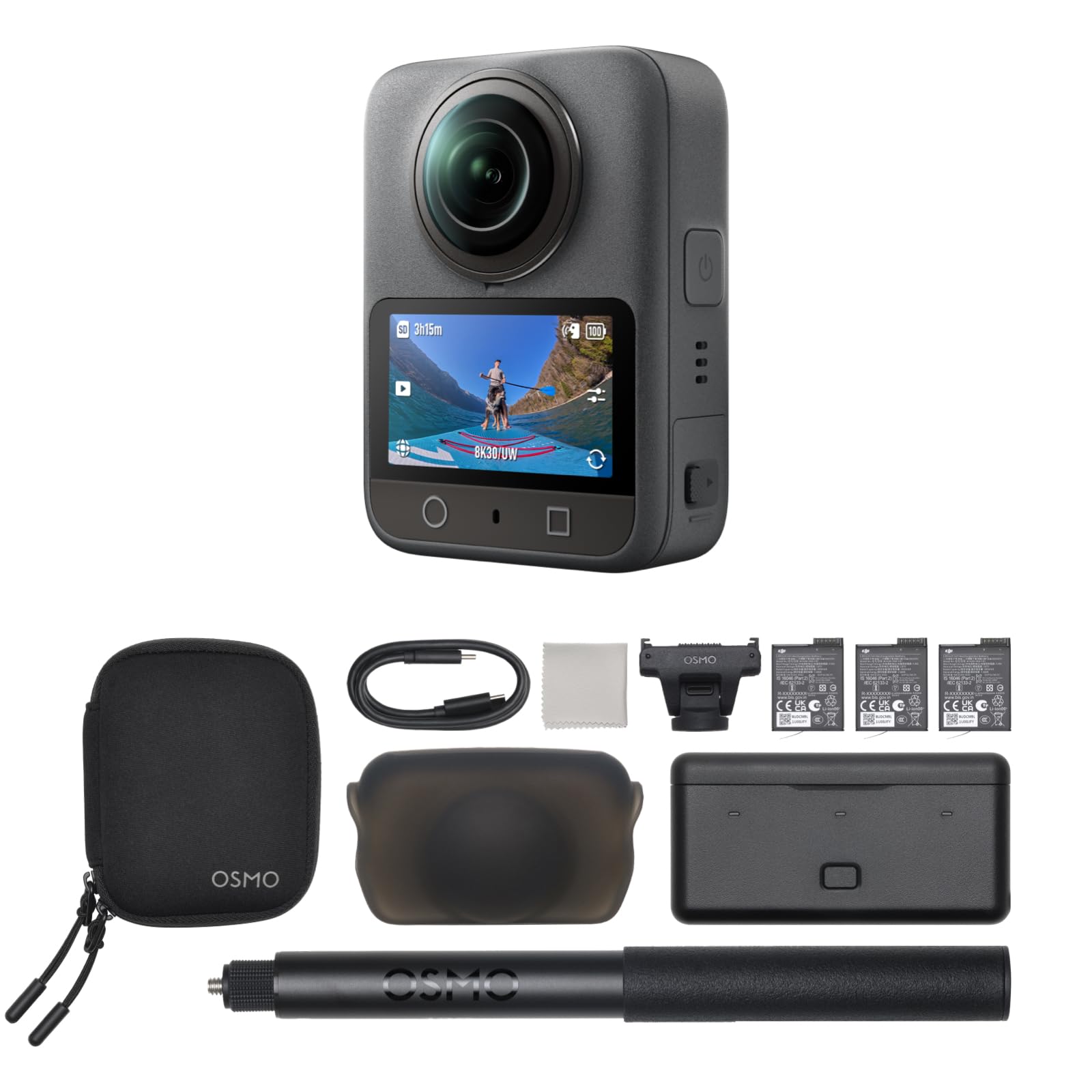
The 1-inch sensor 360 cam that shoots native 8K and carries its own storage.
DJI packed a 1-inch sensor into a 360-degree action camera, and that bigger sensor makes a real difference — it pulls in more light than the 1/2-inch sensors on the AKASO 360, so your evening city walks or sunrise ski runs stay sharp and colorful instead of noisy. The Adventure Combo includes three 1950mAh batteries and a multi-functional battery case, extending total runtime well beyond the 100 minutes per battery.
Owners mention it as a solid budget-friendly action cam with great accessories. The 105GB of built-in storage means you can start recording right from the start without hunting for a memory card. Four microphones capture directional audio, and the camera can connect wirelessly to two DJI microphone transmitters via OsmoAudio — no dongle needed. Just keep in mind that the exposed lenses can scratch if you drop it, and a few customers note it heats up during continuous recording.
Why It Earns the Top Spot
- 8K 360° video and 120MP photos from a larger 1-inch sensor
- 105GB built-in storage — no memory card required to start shooting
- Adventure Combo includes three batteries and a charging case for all-day power
The Trade-Offs
- Lens elements are exposed and vulnerable to scratches
- Single-battery life (100 minutes) falls short of the Insta360 X5’s 208 minutes
Ideal for: anyone who wants the best image quality from a 1-inch sensor in an 8K 360 camera and appreciates not needing to buy a memory card or extra batteries upfront.
Skip if: you need longer continuous recording on a single battery; the Adventure Combo solves it with swappable packs, but each cell alone is shorter than the X5.
3. GoPro MAX 360 HD Video Waterproof Action Camera (2025)
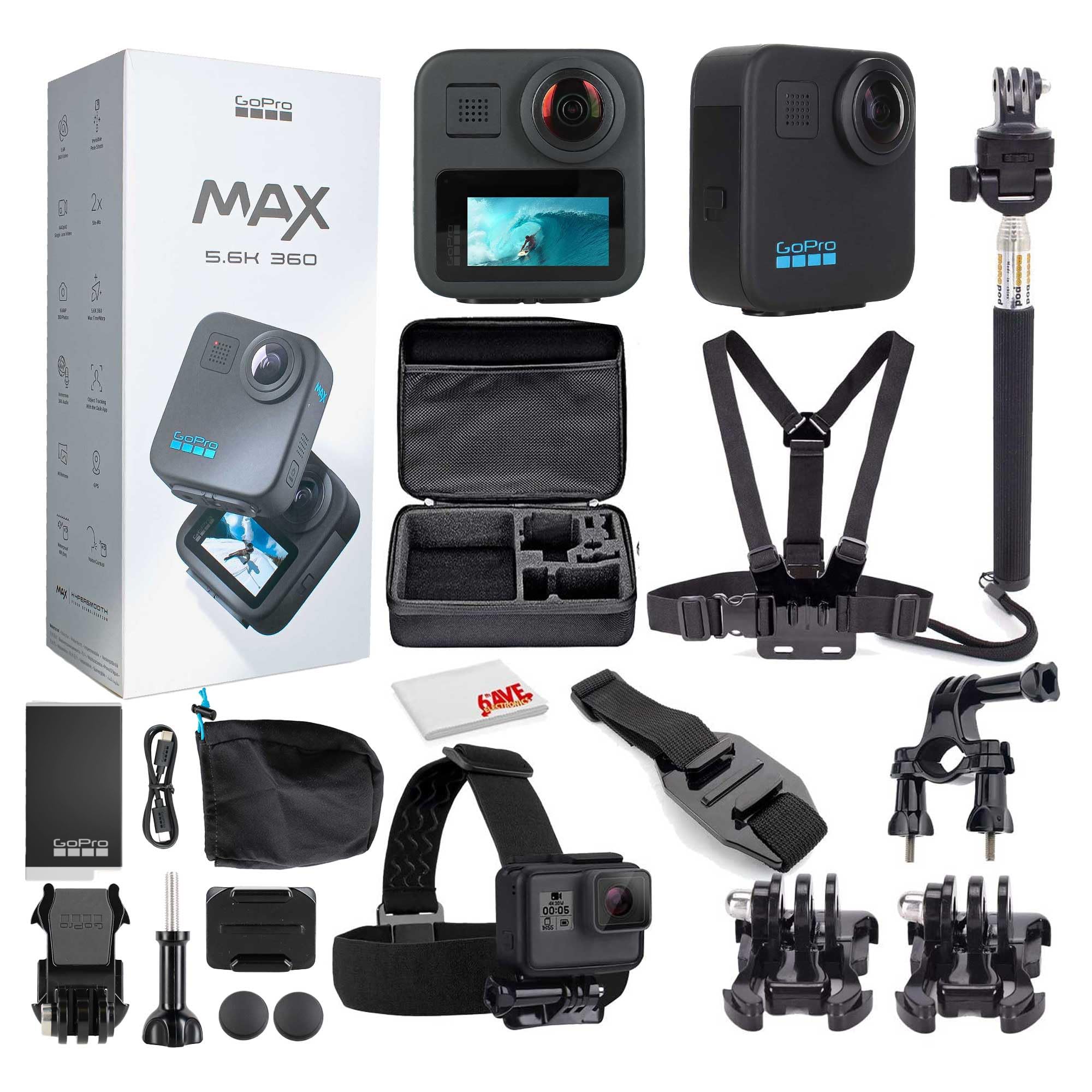
The entry point for GoPro fans who want simple 360 without the learning curve.
The 2025 GoPro MAX captures rich 5.6K30 360-degree video and comes with a Mega Go Pro accessory kit that includes a microfiber cloth. It uses a 1/4-20 mounting system, which is the standard thread found on most photography tripods and monopods, making invisible-pole shots straightforward without proprietary gear. Six microphones capture 360 audio with advanced wind-noise reduction, and in-camera stitching means you can offload and edit footage directly in the GoPro Quik app without extra desktop software. Battery life is rated at 5 hours (1600mAh Enduro battery), and the camera is waterproof to 16 feet (5 meters).
Reviewers point out the GoPro MAX itself is excellent, but recommend buying it without the third-party accessory kit — one reviewer noted the tripod spindle broke after three days of light use. The 2x digital zoom and 16 MP effective still resolution are modest compared to the 72 MP Insta360 X5 or the 48 MP AKASO 360, so this is better for quick 360 clips than high-resolution still photography.
Smart Simplicities
- In-camera stitching saves post-production time
- 1/4-20 mount is compatible with standard tripod gear
- Rated 5 hours battery with the Enduro pack
Noticeable Limits
- 5.6K video and 16 MP stills trail behind the 8K/72 MP competition
- Bundled accessory kit quality is unreliable per buyer feedback
Reach for this when: you already own GoPro accessories and want the simplest 360 workflow with in-camera stitching and solid battery life.
Look elsewhere if: you need high-resolution 8K 360 video or 3D stereoscopic capture — the MAX is a capable 360 action cam, not a VR depth camera.
4. KanDao QooCam EGO – Viewer-Integrated 3D VR Camera

The only budget-friendly 3D point-and-shoot that shows you depth instantly on camera.
This is the odd one out in the roundup — a true stereoscopic 3D camera rather than a 360-degree action cam. The dual lenses are spaced 65mm apart (matching average human interpupillary distance), so the left and right images mimic how your eyes naturally see the world. The magnetic 3D viewer snaps onto the camera body, letting you watch playback in stereoscopic depth right after shooting. Photo resolution is 8000×3000 (24 MP effective), and video hits 3840×1080 at 60 FPS. Pay attention to the 48-minute battery life — that is a 2.1x gap shorter than the DJI Osmo 360’s 100 minutes, and buyers confirm you will want two to four spare batteries for a full outing.
Shoppers say that the QooCam EGO is the only sub- 3D point-and-shoot available as of late 2023. The image quality is average at 4000×3000 JPEGs, but the 3D effect is genuinely magical for landscape shots. The catch: subjects closer than three feet cause a “Pinocchio nose” distortion, the camera takes 15-20 seconds to power up and may miss spontaneous moments, and it can overheat after ten minutes of continuous use. This is a specialty tool for making 3D memories to watch on VR headsets, not an action camera for fast sports.
Standout trick: the magnetic viewer gives instant 3D playback on the camera itself — no computer, no headset required.
Biggest limit: 48-minute battery life and slow startup mean you must plan shots carefully; not a grab-and-go camera.
5. AKASO 360 Action Camera Creator Combo
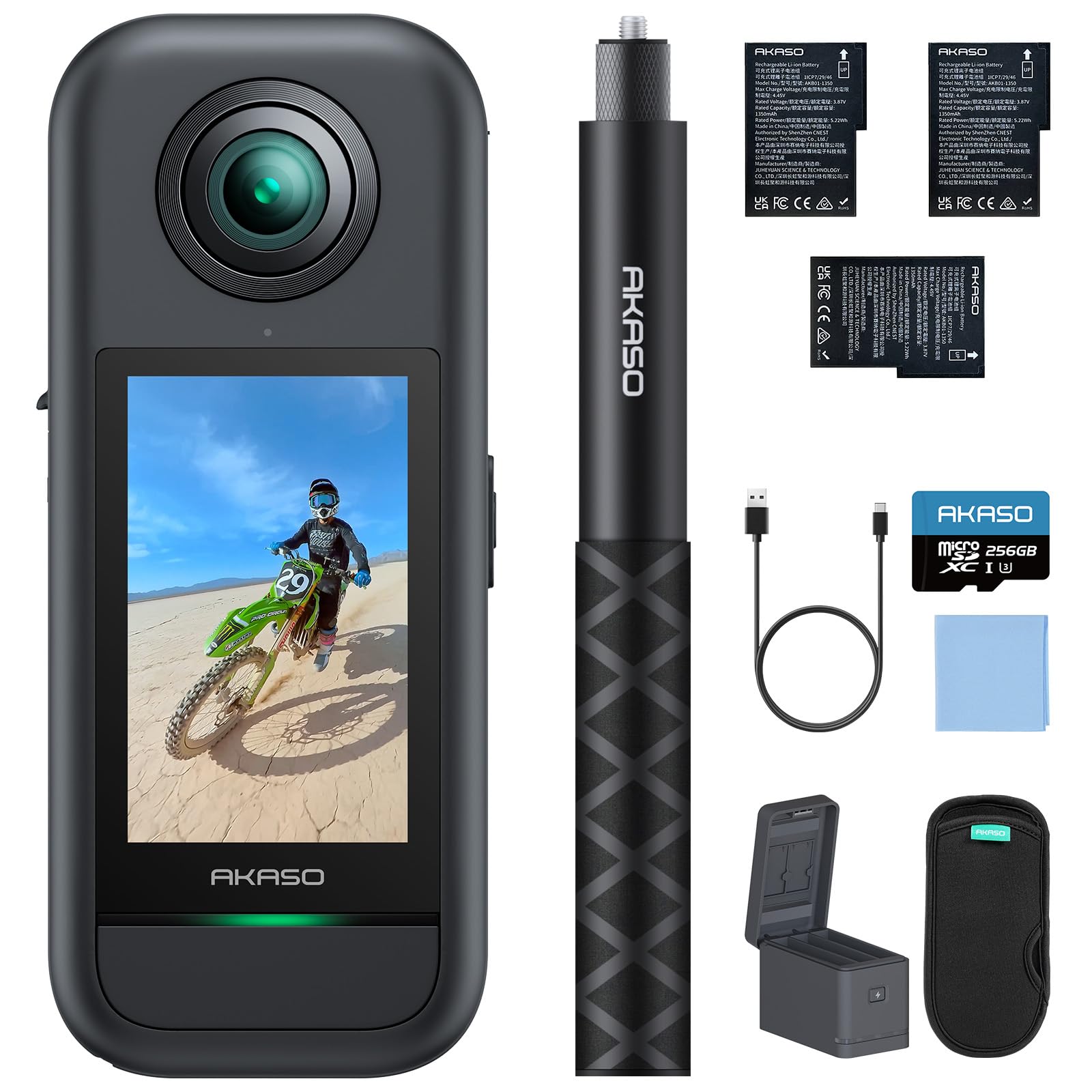
The entry-level 360 camera that includes a 256GB card and invisible selfie stick.
Dual 1/2-inch 48MP sensors capture 5.7K 360-degree video and 72MP 360-degree photos — the same still resolution as the Insta360 X5 but at a much lower price point. Buyers report it is a great value 360 camera, similar to Insta360 but about less. The invisible selfie stick works well for third-person shots, and the 360-degree Horizon Lock keeps footage level even when you spin the camera. This Creator Combo comes with a 256GB microSD card, so you do not need to buy storage separately.
Owners mention that stabilization performs better than expected and the weatherproof design handles rain and dust well. The honest trade-off is low-light performance: the smaller 1/2-inch sensors lose detail after sunset, and battery life is mediocre (buyers specifically call it “awful” for extended use). The app can feel slow or limited for complex edits, and you need a high-quality U3 microSD card if you upgrade beyond the included 256GB (max 512GB).
What You Gain
- 5.7K 360 video and 72MP photos at the lowest entry cost
- 256GB microSD card and invisible selfie stick included
- Weatherproof build with solid daylight image stabilization
Where You Compromise
- Battery life is poor — plan for spare packs or short shoots
- Low-light footage loses detail compared to the DJI Osmo 360 or Insta360 X5
Pick this if: you are curious about 360 video but want to test the waters without a big investment — the AKASO 360 gives you the core features (invisible stick, horizon lock, 5.7K) at a budget-friendly price with a free SD card.
skip it if: you shoot mostly at night or need long battery life for full-day outings.
6. Ricoh Theta Z1 360 Camera

The 360 stills specialist that prioritizes DNG RAW and highlight detail over video.
Ricoh built the Theta Z1 for photographers who want maximum image quality in a 360 still camera, not for action videographers. The high-performance image processing algorithm automatically decides highlight compensation (DR compensation) in auto mode, reducing blown highlights while pulling up shadow detail in harsh lighting. The camera captures DNG RAW, JPEG, and regular RAW files, giving you the editing flexibility of a high-end mirrorless camera inside a 360 body. Internal storage is 51GB, and connectivity runs through Bluetooth and USB.
Buyer feedback is polarized. Enthusiasts praise the handheld HDR mode for producing better results than the Ricoh Theta X, and Lightroom plugin integration makes editing a breeze. But several reviewers warn that the promised bundle software was not delivered and that the battery life is inadequate for a device — one buyer mentioned it failed to finish a 4,000 sq ft house scan on a full charge. The camera also takes a long time to charge, and since the battery is internal, you cannot swap in a fresh pack for back-to-back shoots.
Photographer’s Edge
- DNG RAW capture with excellent highlight compensation for tricky lighting
- 51GB internal storage and Lightroom plugin for smooth editing
- Handheld HDR mode reduces blur compared to the Theta X
Frustrations
- Internal battery cannot be swapped; slow recharge prevents back-to-back shoots
- Bundle items and software not reliably delivered per buyer reports
Choose this when: you are a still photographer who needs high-quality 360 real-estate scans or rich HDR landscapes with full RAW editing control.
Look away if: you want video-centric 360 capture or the convenience of hot-swappable batteries.
Understanding the Specs
Stitching vs. Native 3D
Every 360-degree action camera (like the DJI Osmo 360 or Insta360 X5) records two fisheye views and stitches them together inside an app to create a spherical video. That process takes time and sometimes leaves visible seam lines. A native 3D camera (like the KanDao QooCam EGO) keeps left-eye and right-eye images separate from the lens to the display, giving you clean stereoscopic depth with no stitching — but it captures a narrower field of view because the lenses face forward rather than in opposite directions.
Sensor Size and Pixel Density
The sensor is the light-gathering chip inside the camera. A larger sensor, like the 1-inch sensor in the DJI Osmo 360, collects more light per pixel, which means cleaner images in twilight or indoor settings. Smaller 1/2-inch sensors, like those in the AKASO 360, do fine in bright sunlight but struggle when the sun drops. In the 3D VR camera world, bigger sensors directly translate to less grainy footage when you blow up the image on a VR headset screen.
FAQ
Can I watch 360 camera footage directly in a VR headset without extra software?
What is the difference between a 3D VR camera and a regular 360 action camera?
How much storage do I need for 8K 360 video?
Is 5.7K resolution good enough for VR headsets?
Do I need a gimbal for 360 camera stabilization?
Can I use a 3D VR camera for live streaming?
How long do the batteries last on these cameras?
What is the invisible selfie stick effect?
Final Thoughts: The Verdict
Across the board, the best 3d virtual reality camera is the Insta360 X5 because it combines 8K 360 video, 208-minute battery life, replaceable lenses, and excellent low-light processing in one rugged package. If you want true stereoscopic depth for VR headset playback on a budget, grab the KanDao QooCam EGO — it is the only affordable way to shoot and instantly view 3D content. And for the best image quality from a 1-inch sensor with 105GB built-in storage, the standout is the DJI Osmo 360 Adventure Combo.
How We Picked
We do not accept paid placement. Every pick is matched to a real buyer and a real use-case; we do not hands-on test units.
Sources & Methodology
Specifications: manufacturer listings and product documentation. Review insights: verified customer reviews, as of July 2026. Pricing: not shown on this page (it changes often); check the current price via the retailer link.
As an Amazon Associate, Gadgets Feed earns from qualifying purchases. This does not affect which products we feature.