
Our readers keep the lights on and my morning glass full of iced black tea. As an Amazon Associate, I earn from qualifying purchases.
Specs are compiled from manufacturer listings and verified buyer reviews and can change over time — please confirm the key details on the product page before buying.
Picking a 3HP electric motor means choosing between raw speed, high torque, and a frame (the bolt pattern and size) that fits your machine — get it wrong and you are stuck with a 50-pound paperweight that won’t spin. The real challenge is matching the motor’s rotation (CW or CCW, viewed from the shaft end), voltage (115V or 230V), and shaft size to your compressor, saw, or pump without guessing. This guide walks you through the specs that actually matter and the six best options for the money.
I’m Min — the founder and writer behind Gadgets Feed. This guide is built by comparing the manufacturers’ published specifications and the patterns across verified customer reviews, so you get each pick’s real strengths and trade-offs instead of marketing spin.
If you are looking for a replacement motor that delivers enough grunt for an air compressor, table saw, or pump without wasting time on returns, this breakdown of the best 3hp electric motor is exactly where you need to start.
Quick Picks
- Leeson Saw Motor, 3 HP, 3450 RPM — Premium Pick
- EMZ 3 HP 3450 RPM Single Phase 56 Frame (EM-03) — Best Overall
- VEVOR 3 HP Electric Motor, 1750RPM, 184T Frame — Torque Champion
- EDGE INDUSTRIAL EMZ 3 HP Compressor Duty Motor — Solid Runner
- FAHKNS 3HP SPL 3450 RPM Air Compressor Motor — Budget Friendly
- TINVHY 3HP SPL 3450 RPM Electric Motor 56 Frame — Compact Option
How To Choose The Best 3HP Electric Motor
Buying the wrong motor wastes a weekend — the shaft won’t line up, the rotation spins backward, or the voltage kills the start capacitor. Focus on these four specs and you avoid the headache.
RPM: Speed vs Torque
Most 3HP motors run at either 3450 RPM (fast spinning, good for saw blades and compressors that need high airflow) or 1750 RPM (slower, with higher torque for heavy pumps and grinding wheels). Pick the speed that matches the original motor you are replacing. A 3450 RPM motor spins at 3450 RPM while a 1750 RPM motor spins at 1750 RPM; putting the wrong one on a compressor can cause overheating or poor pump performance.
Frame Size and Shaft Dimensions
The frame number — usually “56” or “184T” — tells you the bolt pattern and face-mount dimensions. A 56 frame is the most common for smaller compressors and table saws. You also need the shaft diameter (usually 5/8 inch for 56 frames) and shaft length (typically 1.88 inches or 2.5 inches). If any of these numbers is off, the motor pulley won’t sit correctly or the mount holes will miss.
Rotation Direction
Many 3HP motors are labeled CCW (counter-clockwise) when viewed from the shaft end. Some, like the VEVOR 184T, let you switch between CW and CCW. If your compressor pump expects clockwise rotation, a fixed CCW motor will spin backward and never build pressure. Check the rotation before you order, or buy a reversible model.
Quick Comparison
| Model | Best For | RPM | Frame | Weight | Amazon |
|---|---|---|---|---|---|
| Leeson 120728.00 | Heavy table saws | 3450 RPM | — | 54 lbs | Amazon |
| EMZ EM-03 | Air compressor replacement | 3450 RPM | 56 | 36 lbs | Amazon |
| VEVOR 184T | Low-speed torque applications | 1750 RPM | 184T | 50.7 lbs | Amazon |
| EDGE INDUSTRIAL EMZ | Compressor duty replacement | 3450 RPM | 56 | 40 lbs | Amazon |
| TINVHY 3HP | Budget table saw or compressor | 3450 RPM | 56 | 28.9 lbs | Amazon |
| FAHKNS 132720 | Entry-level compressor fix | 3450 RPM | 56 | 29.8 lbs | Amazon |
In‑Depth Reviews
1. Leeson Saw Motor, 3 HP, 3450 RPM, 230V (120728.00)
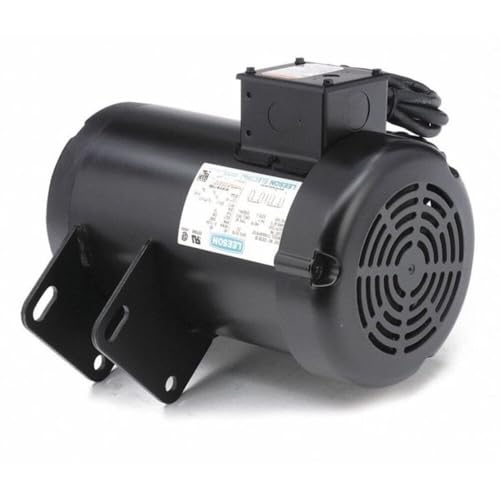
The American-made beast that chews through saw cuts without breaking a sweat.
If you are restoring a vintage table saw — like a 1950s Delta Unisaw — this is the motor that bolts right in and never complains. The Leeson spins at 3450 RPM on 230V, and at 54 pounds it is the heaviest 3HP motor here, which translates directly to mass and stability under load. Buyers report: “I haven’t been able to bog this beast down yet”, using it in a 50s model Delta Unisaw. That kind of headroom means you can feed hardwood through a 10-inch blade without the RPM sagging (the speed dropping).
The trade-off is real — this costs about four times what a budget 3HP motor runs — and it is non-reversible, so it comes as a fixed CCW (counter-clockwise) rotation. Check your saw’s pulley alignment before you buy. One reviewer noted the fan cover arrived cracked with adhesive patching, so inspect the packaging immediately. But the made-in-USA build quality and the fact that it runs “smooth, quiet and immensely powerful” as one long-time owner put it, make this the go-to for serious woodworkers who plan to keep their saw another 25 years.
Shop-floor verdict: The Leeson is built for the person who owns a vintage saw and wants a motor that will outlast the next two generations of tools. skip it if your budget is tight or your application needs reversible rotation.
Who it works for: Anyone restoring a cabinet saw who wants a drop-in replacement with proven muscle.
One honest catch: At 54 pounds and fixed CCW, it is overkill and direction-locked for light-duty use or projects that need CW spin.
2. EMZ 3 HP 3450 RPM Single Phase 56 Frame (EM-03)
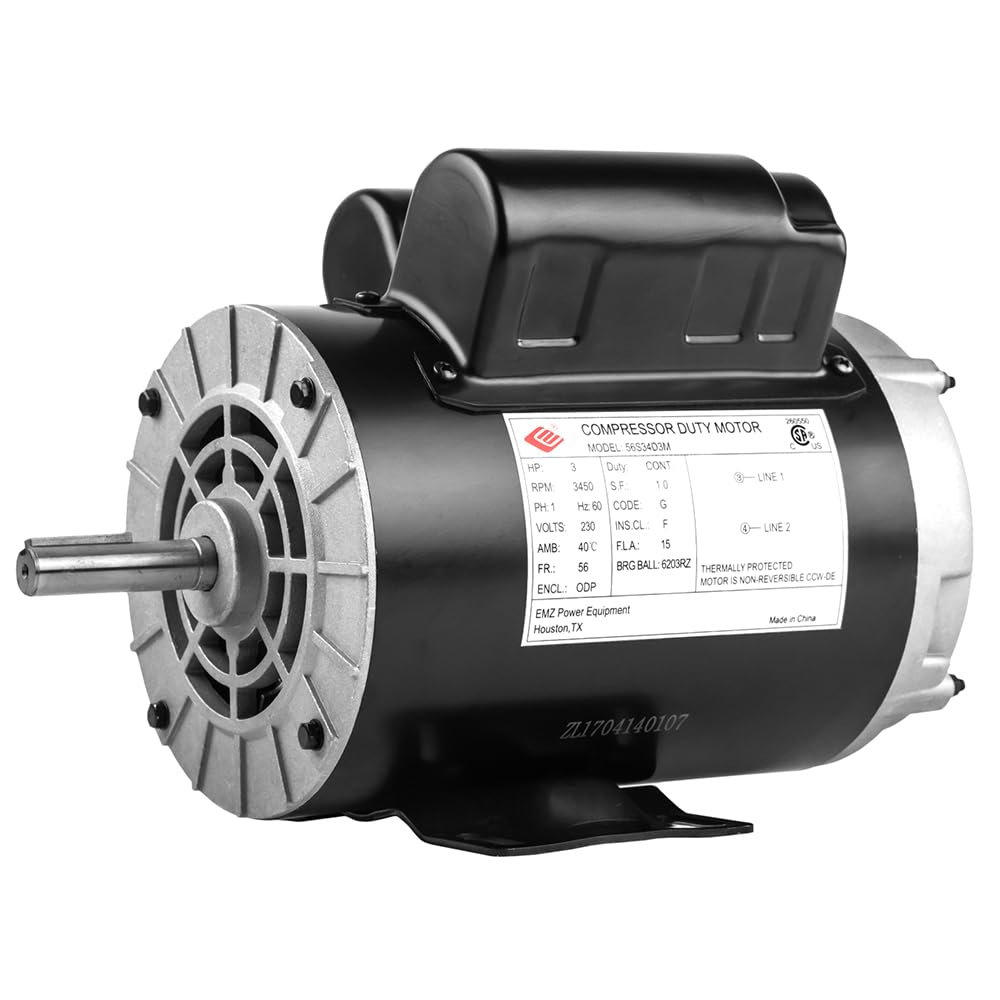
The 36-pound replacement that makes an old compressor feel new again.
This EMZ motor is the balance for anyone swapping a dead compressor motor without spending on a whole new unit. It runs at 3450 RPM, draws 15 full-load amps at 230V, and has a 2.5-inch shaft length — longer than the common 1.88 inches, so it reaches pulleys that sit deeper on the pump. One buyer mentioned: “This 15 amp motor powers the pump just fine, reaches cutout pressure without a struggle, runs smooth, no excessive heat buildup.” That confirms the open drip-proof (ODP) design keeps it cool even in a dusty shop.
It is lighter than the EDGE INDUSTRIAL EMZ (36 pounds vs 40 pounds) and the shaft is keyed at 5/8 inch, so you can swap your existing pulley without machining. The downside: it is non-reversible CCW only, and a couple of buyers received damaged boxes, which might indicate packing is not the strongest. Check the shaft for any bending before mounting. At roughly the same price as the EDGE INDUSTRIAL motor, the longer shaft and slightly lighter weight give it a practical advantage for older compressors.
What works
- Longer 2.5-inch shaft fits non-standard pulleys easily
- 15 amp draw matches most 230V shop circuits without tripping
- Buyers confirm it runs cool and reaches cutout pressure
What to watch
- Fixed CCW rotation cannot be reversed
- Some units arrive with packing damage — inspect right away
Who this fits: You are reviving a Kobalt or Century compressor and want a smooth runner that bolts on with minimal fuss.
Where it falls short: If you need a reversible motor or a CW-only shaft, look at the VEVOR 184T instead.
3. VEVOR 3 HP Electric Motor, 1750RPM, 184T Frame
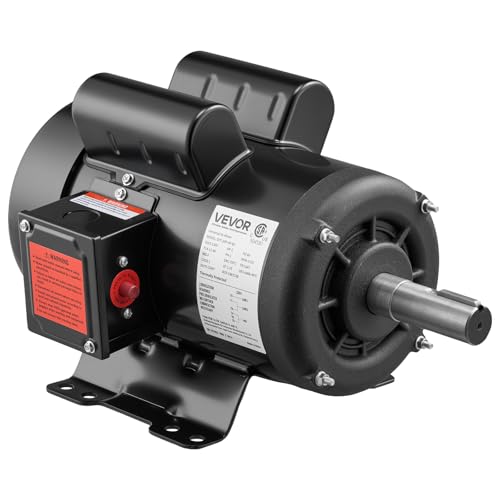
The slow-spinning torque monster that reverses direction at the flip of a switch.
While most 3HP motors scream at 3450 RPM, this VEVOR turns at 1750 RPM, which provides a rated torque of 12 N.m for jobs that need pulling power rather than cutting speed. The 184T frame is larger than the common 56 frame: the shaft is 1.125 inches in diameter and 2.75 inches long, with a keyway (a slot for a key that locks the pulley), so it is meant for bigger pulleys on water pumps, grinders, and heavy agricultural equipment. Another key distinction from the fixed-rotation picks above: you can switch between CW and CCW, so it works no matter which direction your pump spins.
The catch is real — one owner reported the motor “struggles to start and as it is starting it sounds as if something is dragging internally,” which suggests quality control can be hit-or-miss on some units. The TEFC (totally enclosed fan-cooled) housing is a plus for dusty environments, but at 50.7 pounds it is heavy enough that mounting needs a sturdy base. If you need the torque of a 1750 RPM motor and the flexibility of reversible rotation, this is the only pick in this roundup that delivers both — just inspect it thoroughly on arrival.
Strengths
- Reversible rotation (CW/CCW) fits any application
- TEFC cooling keeps dust out of the windings
- 12 N.m torque handles pumps and heavy equipment
Risks
- Some units arrive with internal dragging sounds — test before mounting
- 184T frame is bigger than standard 56, measure your mount holes first
Perfect for: A pump or grinder that needs slow, high-torque power and the option to reverse direction.
Look elsewhere if: You have a standard 56-frame compressor or saw — the 184T frame may not bolt onto your existing base.
4. EDGE INDUSTRIAL EMZ 3 HP Compressor Duty Motor

A capacitor-start, capacitor-run motor (using two electrical capacitors for a strong start and efficient run) that takes over where Ingersoll Rand left off.
This 3HP motor is specifically designed for continuous-duty compressor use, with a capacitor-start and capacitor-run system that helps it handle repeated start cycles without overheating. It pulls 15 amps at 230V and spins at 3450 RPM on a standard 56 frame with a 5/8-inch shaft. One customer observed that “Ingersoll wanted four times for the same motor,” which nails the value proposition: you get a compressor-duty motor with copper windings and a 40-pound build at a fraction of the premium-brand price.
There is a rough edge here — the motor runs only on 230V, not 208V, and a buyer reported: “No manual included; key was press-fit, required grinder to remove.” That key (a small metal piece that locks the pulley) issue means you may need a puller or some careful grinding to free the shaft key before you install your pulley. Also, the rotation is fixed CCW. If you are comfortable wiring a 230V line and handling a stubborn keyway, this motor delivers serious bang for the buck on a compressor rebuild.
Bottom line: A very well-priced continuous-duty motor for 230V compressors, provided you have a plan for the tight keyway and do not need reversible rotation.
Who should buy: Shops running a 230V-only compressor who want copper windings and capacitor-start reliability.
Who should skip: Anyone on 208V power, or anyone who wants plug-and-play installation with a full manual included.
5. FAHKNS 3HP SPL 3450 RPM Air Compressor Motor (132720)
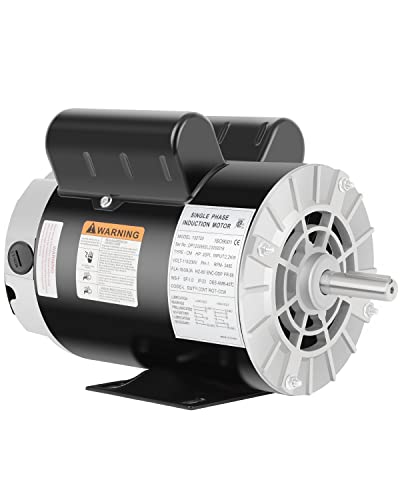
The entry-level 3HP that runs on both 115V and 230V right from the start.
If you do not have a 230V outlet in your garage yet, this FAHKNS motor gives you the flexibility to run on a standard 115V circuit at 18 amps or switch to 230V at 9 amps for less line draw. It is a 56-frame open drip-proof (ODP) motor spinning at 3450 RPM, with a 5/8-inch keyed shaft and 1.88-inch shaft length — the standard specs for most home compressor pumps. One user highlighted: “Works great and all the instructions are there to wire it up as 110 or 220. Great value.”
There is a reliability split in the reviews — several owners mention it runs perfectly on their compressor, but one noted: “Hooked up the motor and instantly tripped the reset.” That suggests that while the wiring instructions are clear, some units may have a defective start capacitor or thermal overload. The rolled steel shell and S1 continuous-duty rating (designed to run non-stop) are solid for the price, but inspect the motor’s start behavior before you bolt it down permanently.
Why it appeals
- Dual-voltage wiring (115V or 230V) suits shops without 230V
- Instructions are clear, buyers confirm easy wiring changeover
Potential issues
- Some units trip the reset immediately on startup
- ODP housing is not sealed against dust or moisture
Best for: Someone on a 115V circuit who needs a motor now and may upgrade to 230V later without buying a new motor.
Not ideal for: Wet or very dusty environments — the open drip-proof design lets particles into the windings.
6. TINVHY 3HP SPL 3450 RPM Electric Motor 56 Frame

A 28.9-pound 3HP that is light enough to maneuver into a tight saw cabinet.
This motor weighs 28.9 pounds compared to the Leeson’s 54 pounds, making it the most portable 3HP option here. That weight difference matters when you are lifting a motor into a table saw cabinet or a tight compressor frame by yourself. It runs at 3450 RPM on a standard 56 frame with a 5/8-inch shaft and the usual 1.88-inch shaft length, so most pulleys from your old motor will swap directly.
The problems show up in the wiring detail — one shopper added: “the markings on the wires are very hard to read. the wires are so brittle they break when I tried to wire to 220.” If you are not comfortable figuring out unlabeled wires or repairing brittle insulation, this may cause a frustrating afternoon. Another buyer received a unit that “arrived quickly, but won’t run.” The motor is definitely a budget-weight class, but the QC on wire clarity and startup reliability seems uneven.
Final thought: The light weight and low cost make it tempting for a quick swap on a table saw or compressor, but brittle wiring and no-start units are a gamble you should be ready for.
Ideal if: You need the lightest 3HP motor to fit in a cramped space and are comfortable sorting out unclear wire labels.
Consider another motor if: You want plug-and-play wiring and zero risk of a dead-on-arrival unit.
Understanding the Specs
RPM — Speed vs Torque
Rotations per minute (RPM) tell you how fast the shaft spins. A 3450 RPM motor moves fast, which is ideal for table saw blades and compressors that need to push a lot of air quickly. A 1750 RPM motor spins at 1750 RPM and delivers higher torque, making it a better match for pumps and heavy grinding wheels where you need to maintain power under load.
Frame Size and Shaft Dimensions
The frame number — usually “56” or “184T” — is a standard that tells you the exact bolt pattern, face height, and mounting hole positions. A 56 frame is common for home compressors and saws and pairs with a 5/8-inch shaft diameter. The shaft length (usually 1.88 inches to 2.5 inches) determines how deep your pulley or blade sits. If the frame or shaft size is wrong, the motor simply will not mount to your machine.
FAQ
Can I run a 3HP motor on a standard 115V household outlet?
What does SPL mean on a 3HP electric motor?
Will a 56 frame motor fit my old Ingersoll Rand compressor?
What is the difference between ODP and TEFC motor housings?
How do I know if my motor spins clockwise or counter-clockwise?
Can I use a 3HP 3450 RPM motor on a 1750 RPM pump?
What does capacitor start and capacitor run mean?
Why does my motor trip the breaker immediately after wiring?
Final Thoughts: The Verdict
If you want one dependable pick, the 3hp electric motor winner is the EMZ EM-03 because it gives you a smooth-running replacement that reaches compressor cutout pressure without overheating, at a price that makes sense for a home shop. If you need reversible rotation and higher torque for a pump or farm equipment, grab the VEVOR 184T. And for a vintage saw restoration where long-term reliability matters, the standout is the Leeson 120728.00.
How We Picked
We do not accept paid placement. Every pick is matched to a real buyer and a real use-case; we do not hands-on test units.
Sources & Methodology
Specifications: manufacturer listings and product documentation. Review insights: verified customer reviews, as of July 2026. Pricing: not shown on this page (it changes often); check the current price via the retailer link.
As an Amazon Associate, Gadgets Feed earns from qualifying purchases. This does not affect which products we feature.