
Our readers keep the lights on and my morning glass full of iced black tea. As an Amazon Associate, I earn from qualifying purchases.
Specs are compiled from manufacturer listings and verified buyer reviews and can change over time — please confirm the key details on the product page before buying.
If you are buying a 3mm carbon fiber sheet, the only thing that really matters is whether the panel is genuinely 100% carbon fiber — not a fiberglass core dressed up to look like it. The second thing is whether it actually measures 3mm, because a sheet that arrives at 3.12mm will not drop into a slot you already cut. This guide covers five real options at that thickness, what each one is genuinely good at, and where the honest catches sit.
I’m Min — the founder and writer behind Gadgets Feed. This guide is built by comparing the manufacturers’ published specifications and the patterns across verified customer reviews, so you get each pick’s real strengths and trade-offs instead of marketing spin.
Carbon plate is a material you work with your own hands, so the details that decide it are cuttability, true thickness and resin quality. Below you will find the honest differences between each 3mm carbon fiber sheet here.
Our Picks at a Glance


How To Choose The Best 3Mm Carbon Fiber Sheet
A 3mm carbon fiber sheet is the middleweight of the carbon plate world — thick enough to hold a threaded bolt without crushing, thin enough to still cut with hand tools. Because almost every listing here advertises the same 200x300mm panel, the decision depends on three things: what the laminate is made of, how the surface is finished, and how close the real thickness lands to 3mm.
Check what is inside the laminate, not just the label
“100% carbon fiber” means every layer of the stack is carbon — no glass fiber or filler plies hidden in the middle. A filler core keeps the price down and the panel still looks identical from the outside, but it behaves differently when you drill it, since glass and carbon cut at different rates.
Twill versus plain weave, and what the finish does to your project
Twill weave gives you the diagonal basket pattern most people picture when they think of carbon fiber, and it drapes the weave in a softer diagonal line. Plain weave is a tighter over-under grid that reads more uniform across a large flat panel. A matte finish hides scratches and fingerprints and takes paint or clear coat evenly; a glossy finish is the one you leave bare as the visible face of a dash panel or pickguard.
Thickness tolerance is the spec nobody advertises
A nominal 3mm sheet is a target, not a guarantee. Where your part has to slide into an existing slot or sit flush in a recess, a few tenths of a millimeter of extra thickness turns into hours of sanding. Buy a millimeter rule along with your sheet if the fit is critical.
Quick Comparison
| Model | Best For | Panel Size | Thickness | Surface Finish | Amazon |
|---|---|---|---|---|---|
| FAKILO Carbon Fiber Sheets 200X300X3MM★ Best Overall | All-round DIY and RC builds | 200 x 300mm | 3mm | Matte, both sides | Amazon |
| cncarbonfiber 3mm 200x300mm PlateTop Performer | Machining and precision cutoff work | 200 x 300mm | 3mm | 3K twill matte | Amazon |
| Readytosky 3K Carbon Fiber Plate Sheet | Drone frames and RC crawlers | 200 x 300mm | 3mm | Plain weave | Amazon |
| Lanstics 100% 3K Carbon Fiber Sheet | Interior trim and flat panels | 200 x 300mm | 3mm | Glossy | Amazon |
| Kalolary Carbon Fiber Sheet 200 X 300 X3MM | Budget small-part cutting | 200 x 300mm | 3mm | Glossy, twill | Amazon |
In‑Depth Reviews
1. Carbon Fiber Sheets 200X300X3MM – FAKILO 100% 3K Twill Matte Carbon Fiber Plate
Our pick — over 4.5★ from 550+ verified ratings; the strongest balance of quality and price.
A hand-laid, vacuum-infused 3K twill panel that RC builders reorder for pit boards and quadcopter mounts.
Start with how this one is made, because it is the difference you feel in the cut. Each composite stack is laid up by hand rather than machine-fed, then vacuum-infused with a clear epoxy resin matrix so the fiber alignment stays consistent through every layer. That hand work is what gives you high bending stiffness and axial strength — in plain terms, the panel resists flexing along its length without going brittle, which is what you want under a bolted bracket.
Both faces arrive in a matte finish under a peel-off plastic surface protection sheet, and the panel is press-cured for carbon density. You get 200x300mm at a true 3mm thick, sold as a single rectangular sheet in the commercial/industrial grade. One owner cutting a 1/10 RC pit board reports the 300mm to 400mm cars “fit perfectly for ride hight measurements” — a good sign the edges stay true after trimming. Another ran theirs through a 2mm titanium-coated rotary burr end mill for quadcopter motor and flight-controller mounts and had it machine cleanly, with the weight and electrical continuity confirming it is real carbon through all layers.
Owners single out the straight, uniform weave and edges that do not crumble at the cut. Bear in mind it is genuinely stiff material — one buyer found it “pretty hard to cut,” which is the trade-off you accept for a sheet that will not tear or rip. If your project needs a panel to conform to a curve, this is the wrong category of material entirely and you want a thin veneer instead.
What earns the top spot
- Hand-laid stacks with vacuum-infused epoxy deliver consistent fiber alignment layer to layer
- Matte finish on both faces, so either side can be your visible surface
- Cuts cleanly with a saw or water jet without crumbling at the edge, per the maker’s own description
What to plan around
- Stiff by design — it will not bend to a curved shape, so plan your part flat
- Cutting takes real tool pressure; a fresh abrasive blade and patience help
Reach for this if: you are building RC chassis parts, pit boards, backing plates or dash fillers and want a panel that holds a bolt without flexing.
Look elsewhere if: your project needs the sheet to wrap or curve — flat is the only shape this one does.
2. cncarbonfiber 3mm 200x300mm 100% Carbon Fiber Sheet Plate
A 1.6-1.7g/cm³ filler-free laminate that routes to clean edges with a Dremel or woodworking tool.
Here is a number worth carrying around the workshop: this plate is rated at 1.6-1.7g/cm³. For scale, the maker lists water at 1.0g/cm³ and aluminum at 2.7g/cm³ — so you get a material roughly midway between the two in density but with carbon’s stiffness. That density figure comes with a claim attached: pure carbon fiber, no fillers and no glass fiber layers anywhere in the stack. If you have ever tried to slot a panel that turned out to have a glass core, you know why that matters, because the two materials cut at different rates and the bit wanders.
You get a 3K twill surface (a weave of 3,000 filaments per bundle) with a matte finish and a clear, readable texture across a 200x300x3.0mm panel. Workability is the standout. One project used the panel as a switch plate for a Ram 1500 dash slot under the nav screen, cut with ordinary woodworking tools, then hand-shaped and polished at the edges to match the interior. A boat owner filled the hole left by an old Lowrance HDS 10 in a front console and bolted it in with titanium hardware before mounting a new double bracket for two Humminbird Xplore 10 units — the panel took the load without complaint. A third owner simply needed a photo backdrop and got a flat, smooth one.
The finishes and the low weight get the most appreciation across the listings, and the durability claim holds up in a specific way: no delamination showing up even after the sheet has been cut and reworked. Treat the thickness as nominal rather than exact, the same as every 3mm laminate here, and measure before you commit to a slot.
Where it pulls ahead: the listed 1.6-1.7g/cm³ with no glass in the stack is the clearest material claim in this set, and it is backed up by a sheet that routes to clean straight edges with a Dremel or woodworking tool.
The honest catch: there is one panel per pack at 200x300mm, so a project needing a larger single piece means seaming two sheets or sizing your part to fit.
Best suited to: anyone routing precise slots, switch plates or recessed panels where a wandering bit would ruin the part.
Think twice if: you need a continuous surface wider than the single 200x300mm sheet provides.
3. Readytosky 3K Carbon Fiber Plate Sheet 200mm X 300mm X 3MM Carbon Fiber Board

A 0.18 kg plain-weave blank for drone frames and RC crawler framerails, with thickness that runs about 0.2mm over nominal.
For multicopter and RC airplane builders, the panel is the airframe — every gram and every fraction of a millimeter compounds. This one is a single 200mm x 300mm x 3mm sheet weighing 0.18 kg per the listing, in a plain weave with no glass fiber contents, landing in the industrial grade tier. Plain weave gives you the tight over-under grid rather than the diagonal twill look, which reads flatter and more uniform across a large blank you are about to route a frame out of.
Owners plan around the thickness honestly. The most useful thing anyone can tell you about a laminate like this is that the real number drifts: one sheet measured 3.12mm instead of 3mm, which left extra finishing work on slotted pieces that had to slide together. The same buyer still rated the carbon itself clean, free of voids and free of dry lamination, and kept using it. Another notes thickness varying by about 0.2mm across the panel but staying consistent enough for most uses, with dimensions close to but not exactly 200x300mm, and the sheet arriving with a protective film already on for cleaner cuts. RC crawler framerails and motorcycle airbox covers are the kinds of parts being made from it.
Packaging holds up too — panels show up undamaged with dimensions landing inside tolerance. If your build has any slot-and-tab joinery, budget a few minutes with a file per joint, because if the sheet runs thick you will be sanding slots open rather than shimming them tight.
Why builders rate it
- Plain weave face on a genuine 3K carbon blank with no glass fiber contents
- 0.18 kg per panel keeps the weight penalty off a small airframe
- Ships with a protective film on the sheet, so the surface arrives ready to work
Where it demands patience
- One panel measured 3.12mm rather than a true 3mm, so finish slot fit by hand
- Thickness can drift about 0.2mm across the sheet — not an issue for flat parts, fussy for joinery
Pick this one if: you are routing a drone frame or RC crawler framerail and want plain weave with no glass mixed in.
Skip ahead if: your part needs to slot precisely into a 3.00mm channel without any hand fitting.
4. Lanstics 100% 3K Carbon Fiber Sheet Plate Plain Weave Panel

A glossy plain-weave panel for dash trim and door handles, where the visible face is the point.
Some sheets are structural and never seen; this one is the reverse — the glossy surface is the point. The listing frames it for car exteriors and interiors, door handles, dash trim and flat aesthetic upgrades, all in pure carbon fiber with no fillers or composite layers. The weave is plain, and the panel is a single sheet at 3mm in the industrial grade tier, backed by a corporate-blank rating that edges ahead of everything else here.
Owner builds show what the spec sheet does not: UV-stable color and cut edges that polish to match the face. There is outdoor use in the mix, and the panel holds its color rather than fading under UV. Cutting is straightforward — trim, drill and shape go as expected, and the cut edges take a polish to match the face. Golf club repair shows up as a real application, using the sheet to restore the plastic layer on a driver head at the right thickness, with decent quality at the surface. Automotive use is the other recurring one, with panels fitted into an interior and holding up in service.
Two honest notes worth knowing before you buy. First, this material is genuinely stiff and will not conform to a curve — if your project needs the sheet to wrap, it will not, and you should look at a flexible veneer instead. Second, “glossy” is judged in degrees: the finish is well made but reads more satin than mirror to some eyes, so if you need a deep wet-look shine, plan on a clear coat over the top.
What it is genuinely good at: visible flat work — dash panels, interior trim, club heads — where a blemish-free face matters as much as the strength underneath.
What you should count on: adding a clear coat if the out-of-the-wrap sheen does not read deep enough for your eye.
The right call for: trim, dash and handle parts where the panel is on show and you want UV stability with it.
Not your sheet if: the part has any curve in it — a flat panel is all this one will be.
5. Kalolary Carbon Fiber Sheet 200 X 300 X3MM, 3K Real Carbon Fiber Board Plate
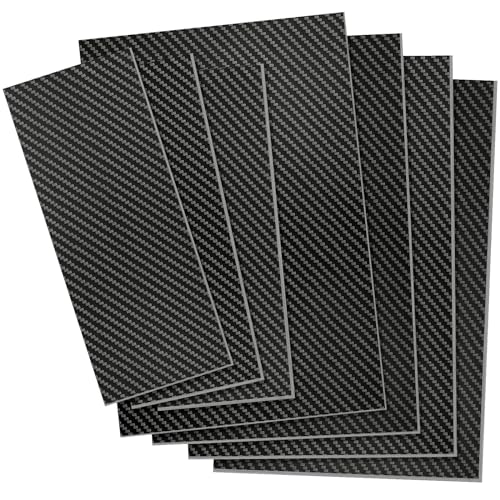
A twill-weave, glossy 200x300x3mm board for first carbon projects and decorative trim.
The low price leaves budget for the rotary tool and abrasive blades a first carbon cut requires. The Kalolary sheet is a 200x300x3mm twill-weave board with a glossy, clear-textured surface, marketed as strong yet light with corrosion resistance for the long haul. The same line spans 0.5mm through 5mm and comes in 250x100mm and 300x200mm sizes, so once you find a thickness you like you can restock without changing suppliers.
Where it shines is appearance, and buyers report so directly — the finish reads factory-made, and the pattern is exactly what people picture when they hear carbon fiber. The guitar crowd is well represented: a builder bought both the 1mm and the 3mm 200×300 panels and used the thicker sheet for a custom Epiphone Les Paul Jr pickguard with a five-screw humbucker route, and the thinner sheet for a truss rod cover — both shaped easily with a rotary tool. Start-to-finish, the carbon plus parts upgraded a guitar that started out modest, which is the whole appeal of working in this material.
The caveat is the laminate composition. Several owners question whether the sheet is truly 100% carbon fiber, and the quality feedback is mixed rather than unanimous — not a reason to avoid it, but a reason to set expectations. If you want absolute certainty on the material spec, the FAKILO at the top of this list and the cncarbonfiber sheet above are the safer evidence-based picks. For a decorative trim panel or a first pickguard, this one earns its keep.
Why it earns a slot
- Twill glossy finish that owners describe as factory-grade in appearance
- Wide size and thickness range means easy restocking across projects
- Trims cleanly with a rotary tool for pickguards, covers and small panels
The honest trade-off
- Several owners question whether the laminate is 100% carbon fiber
- Quality feedback is mixed, so this is not the pick if you need verified material
Good starting point for: first-time carbon projects, decorative trim and pickguards where looks lead and the exact layup is not critical.
Move up the list if: your part is load-bearing or you need the Carbon content confirmed beyond doubt.
Understanding the Specs
What 3K Actually Means
The “3K” in the listing title refers to the filament count in each tow, or bundle, of carbon — a 3K tow holds 3000 individual filaments, which is why the weave reads as a fine, tight pattern rather than a coarse one. Finer tows mean smoother curves in the pattern and a more uniform surface after you trim the edge.
Matte vs Glossy Finish
A matte panel scatters light, so it hides fingerprints, sanding marks and small scratches, and takes paint or clear coat evenly. A glossy panel is the one you leave bare as the visible face of a part. Both are the same carbon underneath — the resin surface is the only difference, and it is a choice about how the piece will be seen.
Real Panel Density
One panel here is rated at 1.6-1.7g/cm³, set against the maker’s own figures of 1.0g/cm³ for water and 2.7g/cm³ for aluminum. That published density is the closest thing to proof of a filler-free laminate, because a sheet bulked out with glass or resin filler will not weigh what solid carbon should.
Thickness Tolerance
Treat 3mm the way you would treat a nominal lumber size rather than a precision measurement. Across this category, panels routinely arrive a few tenths of a millimeter over or under, and one owner here measured 3.12mm on a 3mm sheet. For anything that has to slot or sit flush, cut and fit by hand rather than by trust.
FAQ
Is a 3mm carbon fiber sheet strong enough for a drone frame?
Can I cut 3mm carbon fiber with a Dremel or rotary tool?
Will a 200x300mm sheet be big enough for my project?
What is the difference between 3K twill and plain weave carbon fiber?
Does the nominal 3mm thickness actually measure 3mm?
Can a 3mm carbon sheet be bent or curved to fit a shape?
Which finish should I pick, matte or glossy?
How do I drill and tap a 3mm carbon plate without cracking it?
Final Thoughts: The Verdict
For most people working in carbon, the 3mm carbon fiber sheet winner is the FAKILO 200X300X3MM because the hand-laid, vacuum-infused build keeps the fiber alignment consistent through every layer, which is what makes it cut clean and hold a bolt without flexing. If your project is precision routing — slots, switch plates, recesses — the cncarbonfiber 3mm 200x300mm plate is the better tool for the job, with a filler-free stack and a density figure published right on the listing. And if it is drone or RC airframe work, reach for the Readytosky 3K plate, accepting that you will hand-fit the thickness at the slots.
One thing to check before you order any of them: if your part involves slot-and-tab fitment, keep a file and a millimeter rule on the bench — a nominal 3mm laminate is a target, not a guarantee.
How We Picked
We do not accept paid placement. Every pick is matched to a real buyer and a real use-case; we do not hands-on test units.
Sources & Methodology
Specifications: manufacturer listings and product documentation. Review insights: verified customer reviews, as of September 2026. Pricing: not shown on this page (it changes often); check the current price via the retailer link.
As an Amazon Associate, Gadgets Feed earns from qualifying purchases. This does not affect which products we feature.