
Our readers keep the lights on and my morning glass full of iced black tea. As an Amazon Associate, I earn from qualifying purchases.
Specs are compiled from manufacturer listings and verified buyer reviews and can change over time — please confirm the key details on the product page before buying.
Filling a 3×3 tent evenly with light is the real challenge—most fixtures create a bright center and dim corners. This guide breaks down the top grow lights that deliver uniform PAR across that whole footprint, so your canopy grows dense from edge to edge, not just in the middle. You’ll see exactly how wattage, diode quality, and coverage specs translate into healthier plants.
I’m Min — the founder and writer behind Gadgets Feed. This guide is built by comparing the manufacturers’ published specifications and the patterns across verified customer reviews, so you get each pick’s real strengths and trade-offs instead of marketing spin.
This roundup focuses on fixtures that genuinely cover a 3×3 area, comparing real power draw, spectrum quality, and canopy penetration to help you pick the right 3×3 grow light for your grow tent.
Our Picks at a Glance


How To Choose The Best 3×3 Grow Light
Choosing a light for a 3×3 tent is about balance. You want enough power to penetrate the canopy without scorching your plants or running up your electric bill. Focus on the actual wattage drawn from the wall, not the equivalent HPS wattage the box claims.
Actual Power vs. Marketing Numbers
Don’t trust the name on the box—a light marketed as “2000W” might only draw 200 watts from the wall. For a 3×3 tent, a fixture pulling 200-300 watts of efficient LED power is usually the balance, giving you strong growth without excessive heat. This real draw determines your coverage and electrical costs, so check the “Light Source Wattage” spec, not the name.
Spectrum and Diodes
Full-spectrum lights that include deep red (around 660nm) and sometimes IR (around 730nm) LEDs support flowering and fruiting. The quality of the diodes—like Samsung LM301H or Bridgelux 3030—dictates efficiency and longevity. Efficient diodes convert more electricity into usable light and less into wasted heat, meaning lower cooling needs and a higher performing spectrum.
Coverage and Uniformity
The fixture’s physical shape and diode layout determine how evenly it spreads light. Bar-style fixtures generally offer more uniform coverage across a 3×3 space, reaching corners better than a single square panel. Look for consistent PAR distribution to avoid dark edges where buds would stay larfy.
Quick Comparison
| Model | Best For | Actual Wattage | Coverage (Veg) | Dimmer | Amazon |
|---|---|---|---|---|---|
| VIPARSPECTRA P2000★ Best Overall | High-yield value | 240 watts | 4’x3′ | Yes | Amazon |
| VIPARSPECTRA XS1500 ProCompact Pick | Compact efficiency | 150 watts | 3×3 ft | Yes | Amazon |
| KingLED KP2000Best Value | Veg & bloom modes | 200 watts | 3×3 ft | No | Amazon |
| Sonlipo SPF2000 PRO | Sunrise/sunset simulation | 200 watts | 4×4 ft | Yes | Amazon |
| VIVOSUN AeroLight A150SE | Smart app control | 150 watts | 2×4 ft | Yes | Amazon |
| Spider Farmer SF2000 PRO | Proven reliability | 200 watts | — | Yes | Amazon |
| VIVOSUN AeroLight AW200SE | Integrated airflow | 200 watts | 2×4 ft | Yes | Amazon |
| Mars Hydro FC-3000 | Commercial-grade output | 300 watts | 3×3 ft | Yes | Amazon |
| Spider Farmer SE3000 | App-based automation | 300 watts | 3×3 ft | Yes | Amazon |
| VIPARSPECTRA XS3000 Pro | Wide 4×3 coverage | 300 watts | 4×3 ft | Yes | Amazon |
| AC Infinity IONFRAME EVO4 | Maximum efficiency | 300 watts | 4×4 ft | Yes | Amazon |
In‑Depth Reviews
1. VIPARSPECTRA P2000
Our pick — over 4.5★ from 5,000+ verified ratings; the strongest balance of quality and price.
The 240-watt workhorse that proves bigger light output leads to noticeably faster growth.
This panel pulls 240 watts from the wall to cover a 4’x3′ vegetative area, giving you plenty of headroom for a packed 3×3 tent. Its newer diode layout is built to push light deep into the canopy, and the feedback backs it up—growers report plants adding a solid 6 inches in just two weeks under it. The dimmer knob lets you dial brightness down to zero for seedlings, which keeps leggy growth in check.
The P2000 runs silently thanks to a fanless design that relies on large aluminum heat sinks, so you won’t hear a hum over your tent fans. It also daisy-chains with up to 20 units, which makes scaling up to a commercial rack simple later. Owners consistently call out the brightness and solid performance as the reasons it earns its keep in small tents, and many note it handles seed starting to flowering without complaint.
Measured against the smaller XS1500 Pro, the P2000 gives you a 60% jump in wattage for denser, heavier harvests. The trade-off is a bigger chassis at 23.6 inches long, which demands a bit more hanging space—though it still fits a 3×3 comfortably. The main caveat is the short power cord and lack of a built-in timer, so plan to use a smart plug if you want automated schedules.
Why growers love it
- Covers 4’x3′ veg footprint with strong canopy penetration
- Dimmer knob turns off completely for delicate seedlings
- Silent fanless cooling keeps tent temps manageable
- Daisy-chains up to 20 lights for future expansion
Things to plan around
- Short power cord limits placement options
- No built-in timer—you’ll need a smart plug
- Slightly heavy at 7.7 pounds for thin tent bars
The pick for: growers who want maximum yield from a 3×3 and don’t mind a larger panel to get it.
Look elsewhere if: you need a built-in timer or very low profile; this one needs accessories for scheduling.
2. VIPARSPECTRA XS1500 Pro
A 150-watt panel with optical lenses that squeeze impressive PAR from a compact frame.
At just 14.2 inches long, this light is over 66% shorter than the P2000 above, yet it still covers a 3×3 veg footprint. The secret is its optical lens design, which concentrates light and reduces loss to deliver an even PPFD across corners—owners measured an excellent PAR reading of 747 at 50% power from 13 inches away. That kind of uniformity means no dark spots in your tent.
The full spectrum mixes white 3000K and 5000K with red 660nm and IR 730nm, giving plants everything they need from seed to flower. A built-in dimmer knob lets you fine-tune intensity, and it turns off completely at 0%. It’s also daisy-chainable with up to 20 units, and the build quality earns consistent praise for surviving daily use in shelving setups.
Quality is the aspect owners bring up most, followed closely by brightness, and the 120-degree beam angle helps spread light wide. The recurring comment about heat is split—some find it cool, others say it runs hot. It also lacks a dedicated off switch, which feels minor but can annoy. For a 3×3, this is an efficient, low-profile option that pairs well in multiples for larger tents.
Best suited to: growers who want efficient, even light in a compact body or plan to run several fixtures across shelves.
Worth noting: no off switch, and heat output opinions vary, so keep a fan on it.
3. KingLED KP2000
A 200-watt fixture with dedicated Veg and Bloom switches that guide beginners through every stage.
You get strong, even coverage for your 3×3 tent because the KP2000 packs 1176 LEDs into a 200-watt package to hit a PPFD (a measure of usable light for plants) of 1900 μmol/㎡/s at 6 inches—plenty of punch for a 3×3 tent. what separates it is the three-mode control: flip to VEG mode for leafy greens and seedlings, BLOOM mode for tomatoes and peppers, or run both for full-cycle growth. No controller needed—just raise or lower it with the included ratchet hangers.
The full-spectrum output spans 460nm blue and 660nm red plus 3000K-5000K white, delivering a natural sunlight feel that supports tight node spacing. It’s energy efficient and quiet, with cooling fans that keep it from overheating. Owners rate the build quality and functionality highly, and one notes it works well beyond its 3×3 rating in a larger 5×5 space.
Unlike the fanless panels above, this one uses fans, which adds a slight hum but helps manage heat. The trade-off for that low price is no dimmer knob—you adjust intensity only by moving the light height. Some buyers flagged reliability concerns, though the 3-year warranty and 90-day free return take the sting out of that risk.
What stands out
- Dedicated Veg and Bloom modes simplify stage-based growing
- High PPFD with only 200W draw keeps energy bills low
- 3-year warranty and 90-day free return protect your purchase
- Uniform coverage with deep canopy penetration
Consider this
- No dimmer—intensity changes require adjusting hanging height
- Fans add a little noise compared to fanless designs
- Reliability has a few mixed owner reports
Reach for this if: you want a budget-friendly, stage-guided light with strong output and solid warranty backing.
Think twice if: precise dimming is essential to your setup; height adjustment is your only control here.
4. Sonlipo SPF2000 PRO

The 200-watt fixture that mimics a real sunrise and sunset to ease plants into each day.
This is the one light on the market with built-in sunrise and sunset simulation, which slowly ramps light up and down instead of snapping on and off. It runs on a timer you set, giving your plants a gentler, more natural daily rhythm. The 200-watt panel delivers a PPFD up to 1460 μmol/m².s while covering a max 4×4 area, so a 3×3 is well within its comfortable zone.
Three full-spectrum modes—Seeding, Vegetative, and Flowering—are controlled from a simple panel, and the dimmer adjusts intensity across a 25% to 100% range. Build quality is solid with built-in wiring to eliminate loose cable hazards, and the reflective lampshade boosts light intensity by 30%. Buyers report plants growing noticeably faster, with bright output that impresses for the price.
It draws just 200W to replace a traditional 600W HPS, which can cut a significant chunk off your electric bill. The main gripe in reviews is reliability—a few units reportedly stopped working randomly, though many owners run them for years without issue. The E27 bulb base and app control add flexibility, but the app setup takes a little patience.
The draw: sunrise/sunset dimming creates less plant stress and more natural light cycles than any other pick here.
Keep in mind: occasional reports of units failing mean the 3-year warranty is worth registering.
5. VIVOSUN AeroLight A150SE
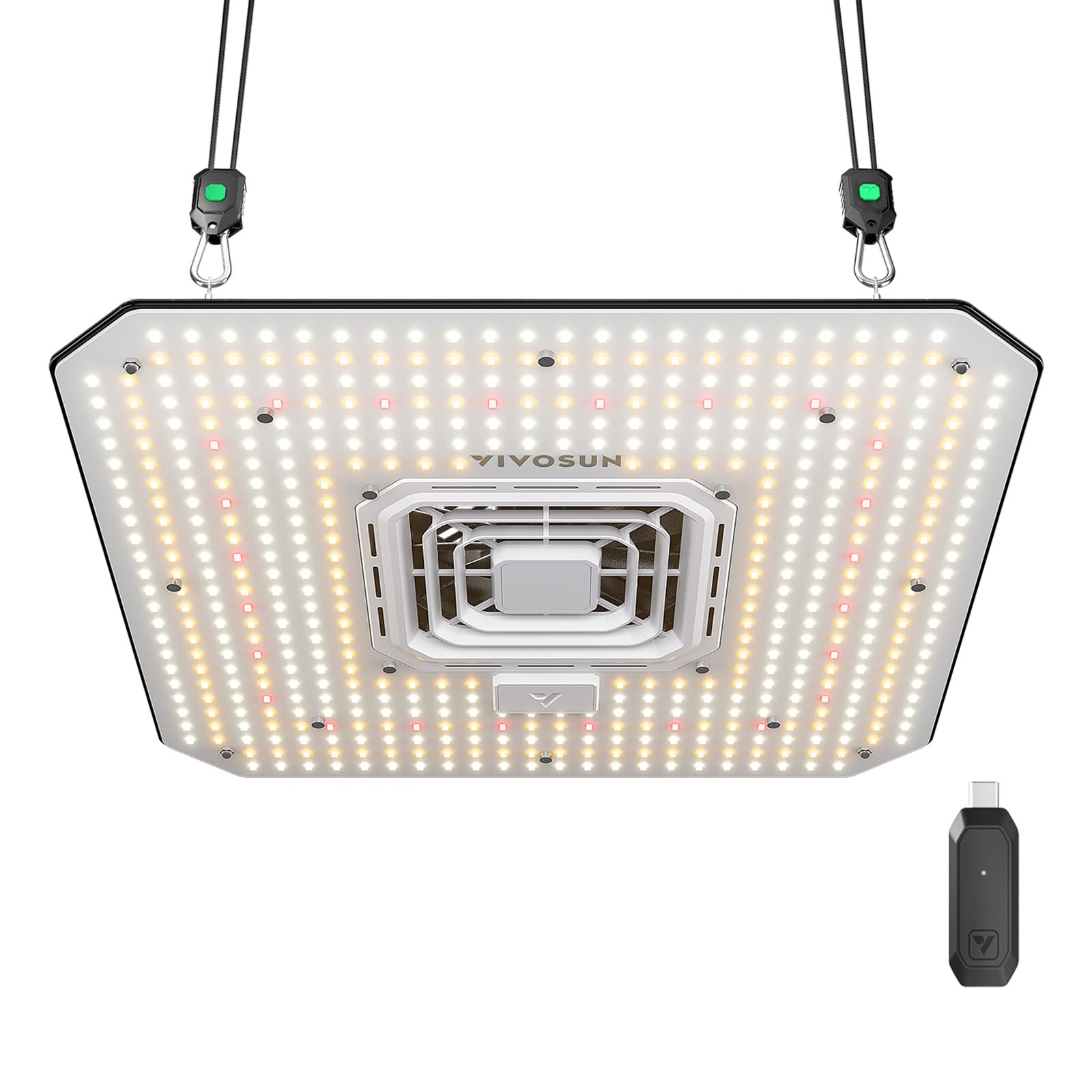
The world’s first grow light with a built-in circulation fan, blending 150W output with airflow control.
The AeroLight’s a neat extra is the integrated circulatory fan that moves air across the canopy, balancing temperature and humidity right where your plants need it. At 150W, it covers a 2×4 or 3×3 area with a sunlike spectrum spanning 380-780nm, including 660nm red for blooms. The Red Dot 2022 design award reflects the thoughtful engineering packed into this slim 1.77-inch-tall fixture.
It pairs with the Vivosun GrowHub E25 controller, letting you run everything from the Vivosun App—scheduling, intensity, fan speed, and custom Grow Recipes from seed to harvest. You can even manage it remotely from anywhere. Owners rave about the ease of app setup and the fan’s ability to keep plants cool and air moving, calling it a a standout upgrade for small tents for small tents.
The one real limitation is WiFi: it only supports 2.4 GHz connections, so your router needs that band enabled. A few buyers also noted the hanging cables feel cheap. But for the price, you get Samsung 301 diodes, a built-in fan, and full smart control in a package that owners consistently describe as well-made and stable.
The smart advantages
- Integrated fan improves airflow and canopy temps
- App control with Grow Recipes automates your whole grow
- Slim design fits tight tent spaces easily
- Samsung 301 diodes deliver efficient, full-spectrum light
Watch out for
- WiFi only works on 2.4 GHz networks
- Hanging cables are a noted weak point
Choose this if: you want app-based automation and built-in airflow without buying a separate controller right away.
skip it if: your router lacks 2.4 GHz support or you prefer a fully manual fixture.
6. Spider Farmer SF2000 PRO
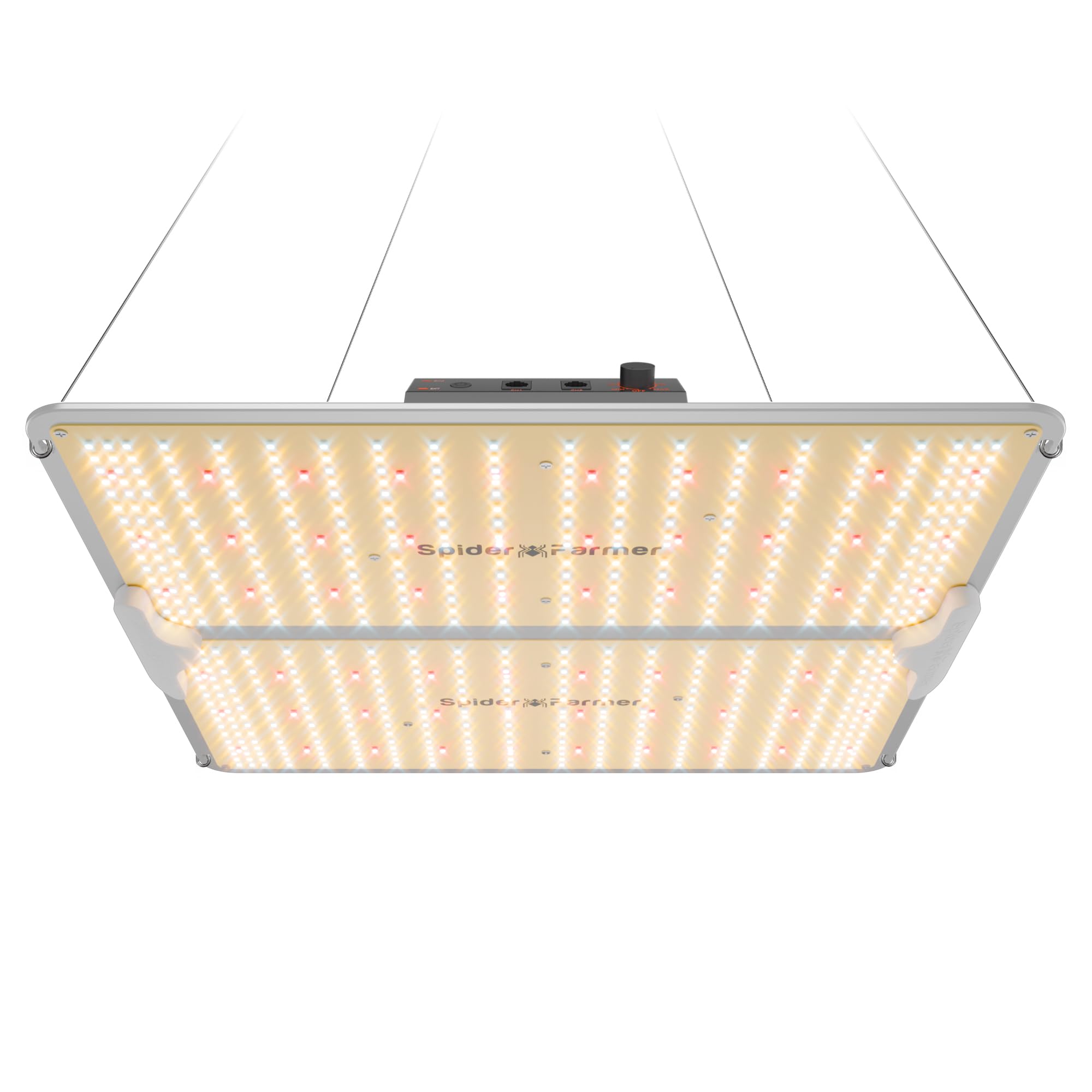
A 200-watt bar-style light with a 2.7 µmol/J efficiency rating that owners trust for consistent results.
The SF2000 PRO pairs a new-gen diode layout with a fanless silent design, delivering uniform PPFD across your 3×3 canopy. Its 2.7 µmol/J system PPE means it converts power into usable light very efficiently, keeping heat low and electric bills modest. The potent blue spectrum supports strong vegetative growth and root development, while 660nm red and IR 760nm speed up flowering.
This is the crowd favorite—with over 12,000 owners sharing their experiences, the lighting quality and brightness dominate the praise. The dimming knob adjusts intensity freely, and it’s compatible with GGS controllers (external devices that let you schedule on/off cycles). Buyers frequently note it’s cheap on energy costs while being super bright, and the 5-year warranty through local service centers adds real confidence.
It’s a bar-style design measuring 16.37 inches square, which spreads light more evenly than a single panel. One of the biggest draws is the brand’s reputation: owners consistently describe the build as solid and the customer support as responsive. The main mixed feedback is heat output—some find it cool, others warm—and durability has a few reports of units failing within weeks, though these are rare against the vast majority of happy growers.
Why it sells: proven reliability and top-tier efficiency at a wattage perfectly matched to a 3×3 tent.
Bear in mind: heat output varies by environment, so keep adequate tent ventilation.
7. VIVOSUN AeroLight Wing AW200SE
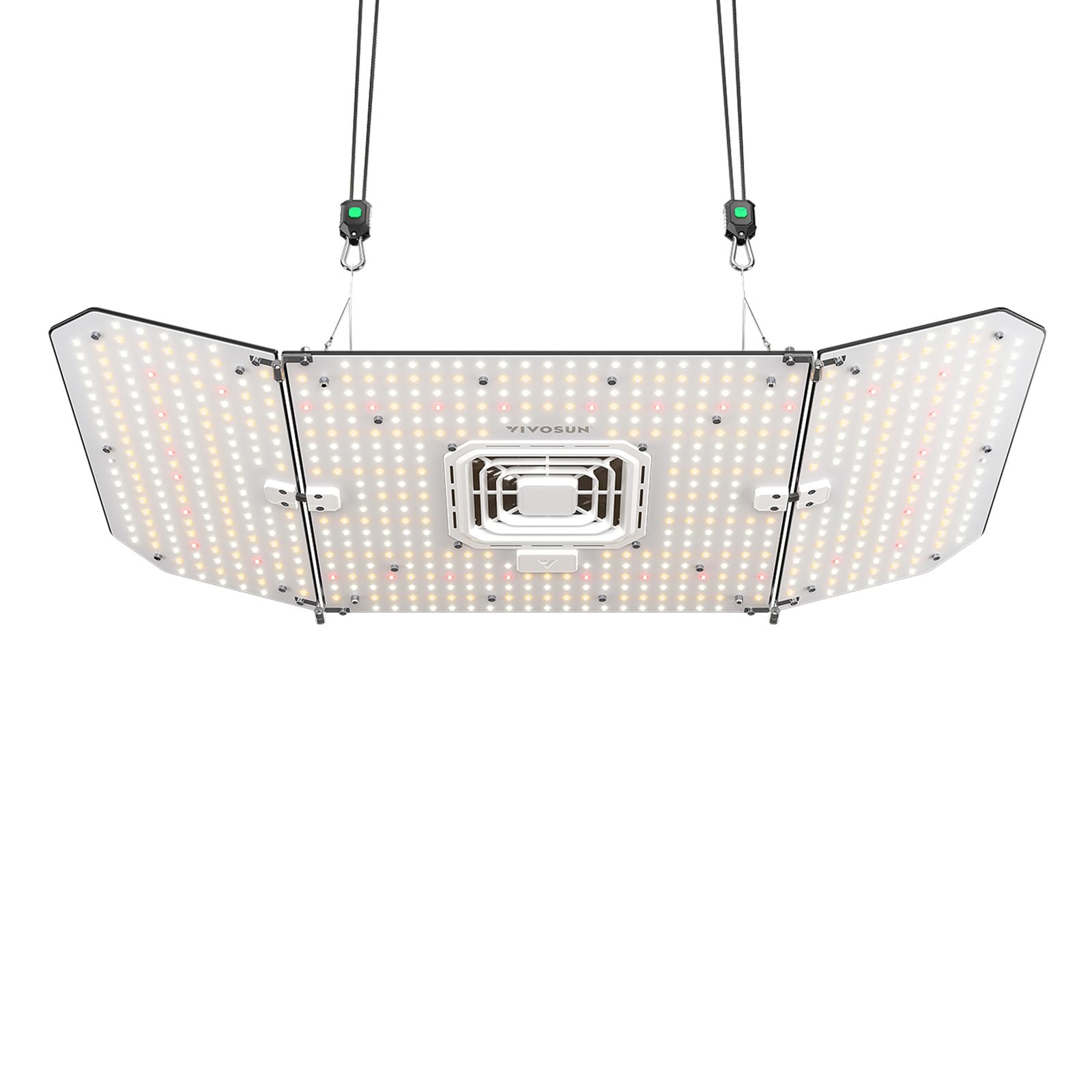
A 200-watt wing-style light with a central fan that pushes air where other fans can’t reach.
The AW200SE’s hollow design and centrally located circulation fan create uniform airflow across the canopy, letting more air reach plants directly. It covers a 2×4 or 3×3 area with full-spectrum sunlike lighting spanning 380-780nm, including 660nm for flowering. The wider LED coverage and air-guiding angles work together to distribute both light and wind evenly.
Owners call out the brightness most often, with fast growth reported for autoflowers in 3×3 tents. The fan runs quietly thanks to industrial-grade dual ball bearings, and the aluminum alloy heatsink extends the lifespan past 50,000 hours. Setup is easy with pre-installed hanging hooks, and the wings let you adjust coverage width to fit your tent perfectly.
Smart control comes via the Vivosun GrowHub Controller (E42, E42A, or E25), but that’s sold separately—factor that into your budget. Also note the schedule mode can’t drop below 25% brightness, so low-light seedlings need the manual 1% mode with manual on/off. Despite that, the balance of light, airflow, and value keeps buyers coming back.
Best features
- Central fan improves canopy airflow and temp balance
- Wings adjust coverage for flexible tent fit
- Quiet operation with industrial-grade fans
- Over 50,000-hour lifespan from efficient cooling
Plan for
- Controller purchased separately for smart features
- Schedule mode limited to 25% minimum brightness
Ideal for: growers who want integrated airflow plus solid 200W output and don’t mind buying the controller separately.
Not ideal if: you need app scheduling down to very low light levels without manual intervention.
8. Mars Hydro FC-3000
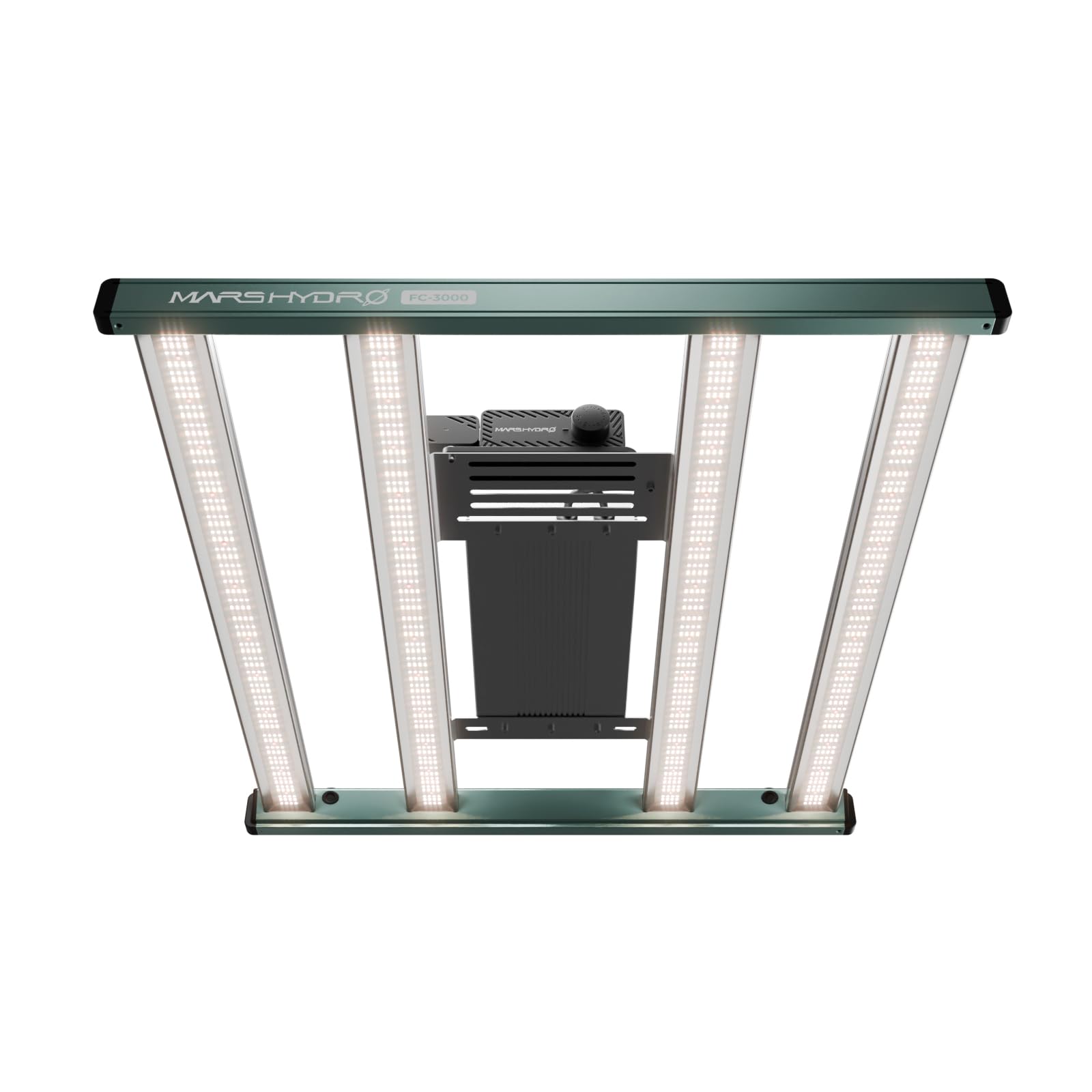
A 300-watt bar light with Bridgelux diodes and a 2.85 μmol/J PPE for dense, commercial-style harvests.
The FC-3000 steps up to 300 watts with premium Bridgelux 3030 diodes delivering an impressive 2.85 μmol/J efficiency. That raw power translates to a PPF of 855 μmol/J, driving serious bud weight and crop density in a 3×3 footprint. The bar structure ensures optimal heat dissipation, and the detachable driver can be mounted outside the tent to keep temperatures down.
Its precision full spectrum adds Osram CSSRM6.24 red chips at 660nm, which boosts photosynthetic efficiency and accelerates flowering. Owners measure strong results—one app reading showed 800-1000 PPFD at the center of a 3×3 from 12-14 inches away. The coverage is remarkably uniform, with reliable performance over years of continuous use for many buyers.
There’s a catch: this is not plug-and-play. You’ll need to manually install the bars and driver before first use, which takes a few minutes. The 5-year warranty covers you, though one owner reported it lasting only a single harvest—unusual against the many 4-year success stories. For the power and commercial-grade performance, it’s a favorite among serious growers.
The payoff: high-efficiency diodes and uniform 3×3 coverage that rival much pricier commercial setups.
Setup note: manual assembly required, and a small minority have had durability issues.
9. Spider Farmer SE3000
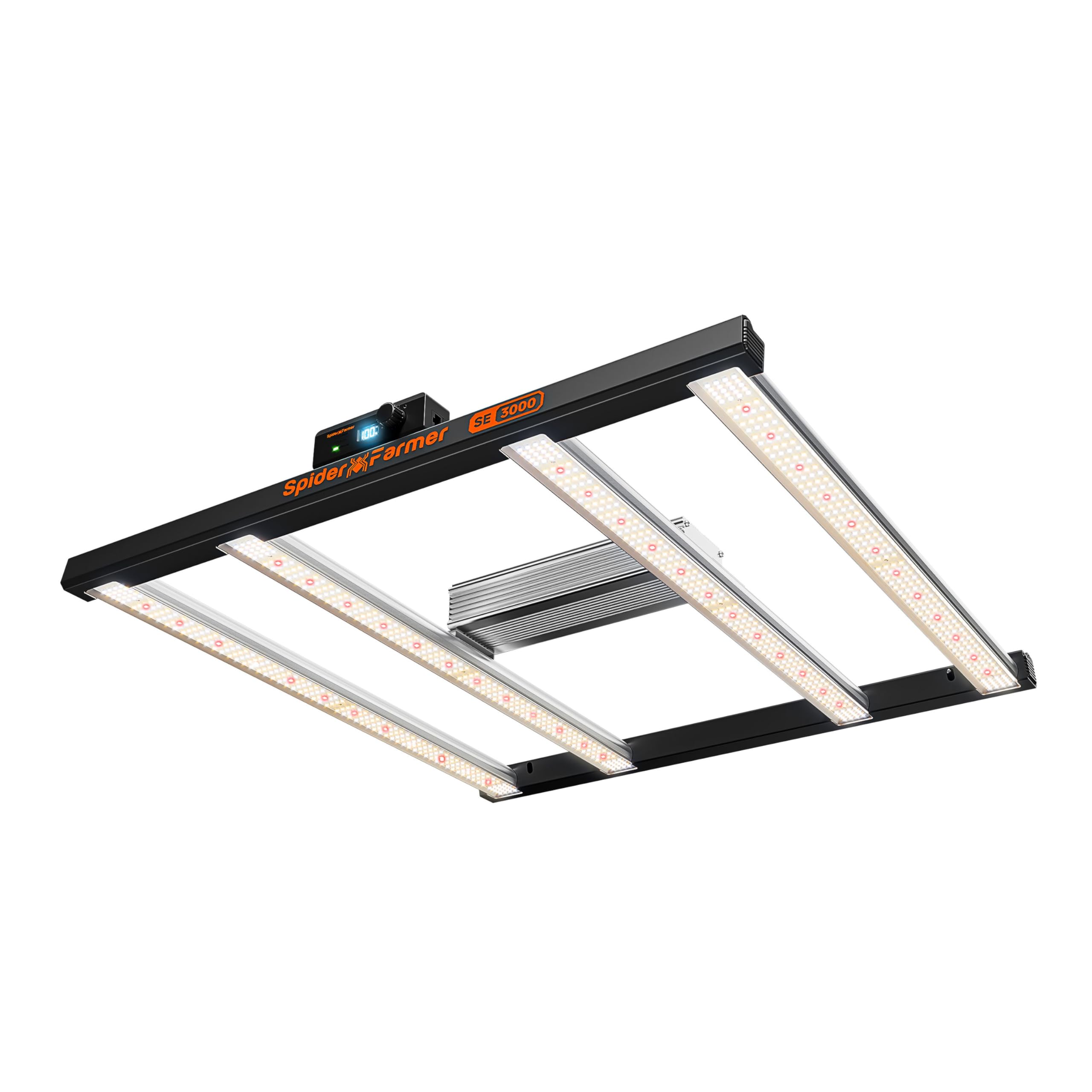
A 300-watt app-controlled bar light with a digital display for precision dimming from your phone.
The SE3000 delivers 826 µmol/s from 300 watts using premium Bridgelux diodes, with a bar-style design that ensures uniform PPFD even at the tent edges. Its plant-centric spectrum focuses on 437nm blue for root and foliage growth, plus 50-55% deep red at 660-665nm for maximum photosynthesis. It’s tuned for full-cycle growing from seedling to harvest in a 3×3.
What makes it special is the app control: set custom light schedules, simulate sunrise and sunset, and adjust brightness from anywhere, even on vacation. The electronic digital display dimming box gives beginners an easy manual dial option too. Owners praise the minimal heat output and note the driver can be mounted outside the tent to further reduce temps.
The 5-year warranty through local repair centers in the US, Canada, UK, and Germany backs the build quality. One buyer pulling 292 watts from the wall confirms the efficiency claims, and multiple owners mention synchronizing dimming across up to 50 lights for larger setups. The main gripes are a short ballast cord and limited secure mounting options for the driver—minor against the overall value.
Why it shines
- App control with sunrise/sunset simulation
- Digital display dimming box for precise adjustment
- Uniform edge-to-edge coverage in 3×3
- 5-year warranty with local service centers
Small frustrations
- Short ballast cord limits driver placement
- Driver mounting could be more secure
Grab this for: app-driven automation and precise dimming backed by a strong warranty and efficient Bridgelux output.
Pass if: you dislike app dependence or need a longer ballast cord for your tent layout.
10. VIPARSPECTRA XS3000 Pro

A 300-watt lensed bar light stretching 38.4 inches to cover wide 4×3 veg footprints easily.
The XS3000 Pro’s long 38.4-inch body spreads light across a 4×3 veg area, so a 3×3 tent gets generous overlap and no dark corners. Its optical lens design concentrates light with minimal loss for uniform PPFD, promoting balanced growth and higher yields. The full spectrum includes white 3000K and 5000K plus red 660nm and IR 730nm for complete plant coverage.
It draws just 300W compared to a traditional 500W HPS, significantly cutting energy costs while boosting output. Owners describe rapid growth—peppers and tomatoes “take off like a rocket,” with clones rooting in days and marigolds outgrowing the light in 2.5 weeks. The daisy-chain feature connects up to 20 units for unified dimming, and the aluminum heatsink keeps it cool and quiet.
Build quality earns consistent praise, with a remote-mountable driver that runs without coil whine. The 3-year limited warranty provides coverage, though the 11.6-pound weight means sturdy tent bars are a must. It’s a slightly higher investment than the P2000, but the extra wattage and wider coverage justify it for serious 3×3 and 4×3 growers.
The appeal: wide coverage and high output in a slim, daisy-chainable package that plants visibly thrive under.
Check first: your tent bars can handle 11.6 pounds hanging weight.
11. AC Infinity IONFRAME EVO4

The 300W efficiency king, pairing Samsung LM301H EVO diodes with a hefty 1819 PPFD output.
The IONFRAME EVO4 uses Samsung LM301H EVO LEDs rated at 3.14 µmol/J PPE—the highest efficiency among LM301B, LM301H, and Bridgelux 3030 chips. With 896 diodes driving a 300W output and 1819 PPFD, it floods a 3×3 flower canopy with intense, uniform light. The bar-style fixture spaces diodes algorithmically to reduce hotspots and push light deep into the canopy.
It’s programmed with schedule controls, sunrise and sunset dimming, and 10 brightness levels, all accessible via the UIS platform for WiFi app control. The passive cooling driver is removable to balance heat, and it daisy-chains with up to 80 grow lights for serious commercial scale. An IP-65 rating means it shrugs off humid grow environments without worry.
Owners upgrading from smaller lights call it “much brighter” and praise the professional build quality. At 17.5 pounds, it’s the heaviest pick here, demanding solid mounting. Some note the 10% dimming increments limit fine PAR tuning, and heat output gets mixed feedback depending on tent airflow. For those who want top-tier efficiency and are willing to pay, this is the definitive 3×3 fixture.
The elite advantages
- Highest diode efficiency at 3.14 µmol/J PPE
- 1819 PPFD for intense, deep canopy coverage
- IP-65 rating handles humid conditions
- Daisy-chains up to 80 lights for expansion
The premium trade-offs
- Heavy at 17.5 pounds, needs sturdy tent bars
- 10% dimming increments limit fine-tuning
- Heat output varies with tent ventilation
Worth the upgrade for: serious growers who want maximum efficiency, IP-65 durability, and professional-grade output in a 3×3.
Consider a lighter pick if: your tent frame is flimsy or you need finer than 10% dimming steps.
Understanding the Specs
Actual Wattage and PPE
Actual wattage is the real power drawn from the wall, which determines your coverage and energy cost. PPE (Photosynthetic Photon Efficacy) measures how efficiently the light converts electricity into usable plant light, measured in µmol/J. Higher PPE means more growth per watt, less heat, and lower bills—look for 2.7 µmol/J or higher for efficient modern LEDs.
PAR, PPFD, and PPF
PAR (Photosynthetically Active Radiation) is the light spectrum plants use for photosynthesis, measured in µmol. PPFD is the amount of that light hitting a surface, measured in µmol/m²/s—it tells you how intense the light is at canopy level. PPF is the total light emitted by the fixture per second. These three together explain why one 300W light outperforms another.
Full Spectrum with Deep Red
A full spectrum mimics natural sunlight by including blue, white, and red wavelengths. Deep red around 660nm is critical for flowering and fruiting, while IR around 730nm supports the Emerson effect for photosynthesis efficiency. Lights with these dedicated diodes (like 660nm red) generally produce denser buds and faster flower development than generic white-only panels.
Dimmer, Daisy Chain, and App Control
A dimmer knob lets you match light intensity to plant stage—low for seedlings, high for flowering. Daisy-chaining connects multiple lights to one power source and control, ideal for scaling up. App control adds scheduling, sunrise/sunset simulation, and remote management, but often requires an additional controller hub and WiFi setup.
FAQ
What wattage do I need for a 3×3 grow tent?
Will a light marketed for 2×4 tents work in a 3×3?
Is full spectrum better than red-blue LED grow lights?
How far should I hang my 3×3 grow light from plants?
Do grow lights with fans run cooler than fanless ones?
Can I daisy-chain different grow light models together?
What does the PAR reading at the canopy actually tell me?
Does a 300W grow light run up my electricity bill?
Final Thoughts: The Verdict
For most buyers, the 3×3 grow light winner is the VIPARSPECTRA P2000 because it pairs 240 watts of output with a dimmer and daisy-chain capability at a crowd-pleasing price that thousands of owners back with strongratings. If you want app-based automation with a built-in fan, the VIVOSUN AeroLight A150SE is the smart pick. And for maximum efficiency and commercial-grade output, the AC Infinity IONFRAME EVO4 is the premium choice worth every watt.
How We Picked
We do not accept paid placement. Every pick is matched to a real buyer and a real use-case; we do not hands-on test units.
Sources & Methodology
Specifications: manufacturer listings and product documentation. Review insights: verified customer reviews, as of August 2026. Pricing: not shown on this page (it changes often); check the current price via the retailer link.
As an Amazon Associate, Gadgets Feed earns from qualifying purchases. This does not affect which products we feature.