
A 4.1 surround sound system sits in a sweet spot many buyers overlook. Unlike a soundbar that fakes width with digital processing, a proper 4.1 setup uses four discrete satellite speakers plus a dedicated subwoofer to create a tangible sound field you can actually locate. The missing center channel means dialog locks to the front left and right, but the trade-off delivers a wider, more musical stereo image that purists prefer for concerts and gaming over a 5.1 system.
I’m Min — the co-founder and writer behind Gadgets Feed. I’ve spent hundreds of hours dissecting the measured frequency responses, driver materials, amplifier topologies, and wireless latency figures that separate a forgettable 4.1 system from one that transforms your living room into a proper listening space.
Whether you are upgrading from TV speakers or stepping up from a soundbar, the best 4.1 surround sound system balances channel separation, bass extension, and driver quality without forcing you into a receiver-and-speaker rabbit hole.
How To Choose The Best 4.1 Surround Sound System
The 4.1 format drops the dedicated center channel found in 5.1 systems. This makes dialog imaging dependent on the front left and right speakers, which benefits music playback by preserving a true stereo stage. The four satellites — two front, two rear — handle the directional audio while the subwoofer manages everything below the bass crossover point.
Driver Materials and Cabinet Construction
Paper cone drivers are cheap and lightweight but distort at higher volumes and degrade faster. Aluminum-magnesium alloy drivers with reinforced ribs, commonly found in higher-tier systems, deliver faster transient response, lower distortion, and better thermal dissipation. Cabinet material also matters — MDF and real wood panels reduce standing waves and cabinet resonance better than thin plastic enclosures. Solid wood cabinets with internal bracing produce tighter bass and cleaner midrange separation.
Wireless Rear Speaker Implementation
Wireless rear speakers eliminate long cable runs but introduce potential interference and latency. Systems using dedicated 2.4GHz or 5GHz wireless bands — rather than standard Bluetooth — maintain stable sync and avoid the lip-sync delays that plague budget wireless setups. The most reliable designs use a hybrid approach: the rear speakers connect wirelessly to the main unit but link to each other with a single cable, ensuring reliable data throughput and eliminating pairing headaches over time.
Subwoofer Size and Frequency Extension
Subwoofer cone diameter directly correlates with the ability to pressurize a room. A 5.25-inch driver can reach down to about 45Hz, which handles most movie effects adequately. An 8-inch driver extending below 30Hz delivers tactile chest-thump for explosions and deep synth bass in music. Ported enclosures extend low-end response at the cost of transient precision, while sealed enclosures produce tighter, more controlled bass. For a 4.1 system in a medium living room, look for a subwoofer that extends to at least 40Hz without significant distortion.
Quick Comparison
On smaller screens, swipe sideways to see the full table.
| Model | Category | Best For | Key Spec | Amazon |
|---|---|---|---|---|
| ULTIMEA Skywave X50 | Premium | Cinema-grade wireless Atmos | 8″ subwoofer, 28Hz extension | Amazon |
| TCL Q85H | Premium | Room-shaking 7.1.4 immersion | 860W power, AI Sonic tuning | Amazon |
| Hisense HT Saturn | Premium | Devialet-tuned balanced sound | 6.5″ sub, 3-way surrounds | Amazon |
| HiMuses M514 | Mid-Range | True Hi-Fi with Dolby Atmos | 16 drivers, 25Hz sub response | Amazon |
| ULTIMEA Poseidon D80 | Mid-Range | Wired surround stability | 460W, 40Hz frequency response | Amazon |
| Amazon Fire TV Soundbar Plus | Mid-Range | Ecosystem integration | 5.1 ch, Dolby Atmos + DTS:X | Amazon |
| LG S40TR | Budget-Friendly | Entry-level wireless surround | 4.1 ch, wireless rear speakers | Amazon |
| Hiwill-Audio N512 | Budget-Friendly | Solid wood build, low cost | 11 drivers, 5.25″ down-firing sub | Amazon |
In‑Depth Reviews
1. ULTIMEA Skywave X50 5.1.4ch
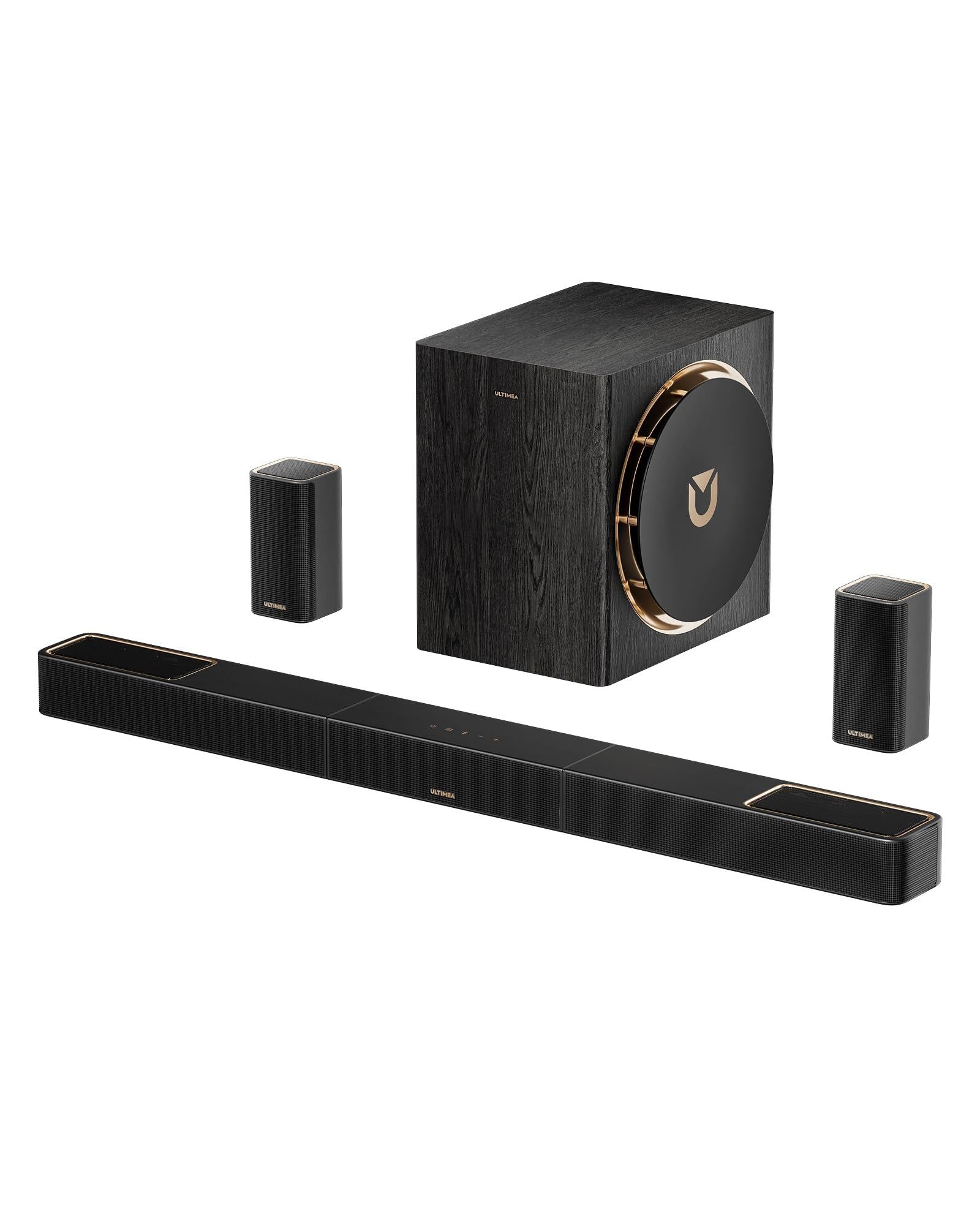
The Skywave X50 represents a serious leap for anyone who wants genuine wireless rear speakers without the constant pairing anxiety. This system uses dual 5GHz wireless bands to connect its surround speakers to the main unit, bypassing Bluetooth entirely. The result is stable, low-latency audio that stays locked to your video source. The GaN amplifier inside delivers up to 98 percent efficiency, meaning the 760W peak power comes with barely any heat buildup — a real advantage for long movie nights or gaming sessions that run for hours. Wood-crafted subwoofer with an 8-inch driver extends down to 28Hz, producing bass you feel in your chest without distortion.
Dolby Atmos support is handled by up-firing drivers in the soundbar itself, and the NEURACORE multi-channel audio engine processes up to 17 channels at 24-bit/192kHz with less than 0.5 percent total harmonic distortion. The app gives you granular control over individual channel levels, EQ bands, and sound profiles. The 4K HDR passthrough via HDMI eARC means your video signal reaches the TV without compression or lag — a feature gamers with high-refresh-rate displays will appreciate.
Build quality is exceptional for the price bracket. The main bar uses a metal grille with rose gold accents, and the subwoofer enclosure is real wood, not vinyl-wrapped particle board. If you want a system that sounds massive, stays connected, and doesn’t force you to run speaker wire across the room, this is the one to beat.
Why it’s great
- Dual 5GHz wireless rear speakers with zero dropout issues
- GaN amplifier produces clean power with minimal heat
- 8-inch subwoofer reaches 28Hz for tactile bass
- Full Dolby Atmos with dedicated up-firing drivers
- App includes 10-band EQ and individual channel control
Good to know
- No DTS:X support at this price
- Rear speakers require separate power outlets
- Atmos height effects are subtle unless ceiling is under 10 feet
2. TCL Q85H 7.1.4ch

TCL packed the Q85H with a full 7.1.4 channel count that pairs front, side, and rear up-firing drivers to create a sound bubble that most 5.1 systems simply cannot match. The rear speakers each have both a front-firing and up-firing driver, so overhead effects like rain or helicopter rotors land believably above your listening position. With 860W of peak power on tap, this system can fill a large living room without strain — the 6.5-inch subwoofer produces deep, controlled bass that rumbles the floorboards.
Dolby Atmos and DTS:X are both supported natively, which is rare at this price. The AI Sonic optimization uses the TCL app to measure your room acoustics through your phone’s microphone and adjusts the channel delays and EQ curves accordingly. This feature saved me from having to manually tweak distances and levels when I set it up in an irregularly shaped room with furniture on one side. The HDMI eARC connection handles 4K passthrough, though note that it caps at 60Hz, not 120Hz — a limitation for competitive gamers on PS5 or Xbox Series X.
Dialog clarity in non-Atmos content is the Q85H’s biggest compromise. Standard 5.1 game audio and older TV shows can sound recessed in the center, with voices sitting behind the effects. TCL does not offer individual channel volume adjustment, so you are stuck using the preset EQ modes. If your content diet is mostly Dolby Atmos movies and modern games, this system is exceptional. If you watch a lot of broadcast TV or legacy content, look elsewhere.
Why it’s great
- Genuine 7.1.4 channel layout with up-firing rears
- Supports both Dolby Atmos and DTS:X natively
- AI Sonic tuning optimizes audio for your specific room
- Enormous power headroom for large spaces
Good to know
- No 4K@120Hz passthrough — capped at 60Hz
- Non-Atmos content has recessed dialog
- No individual channel volume controls
3. Hisense HT Saturn 4.1.2ch
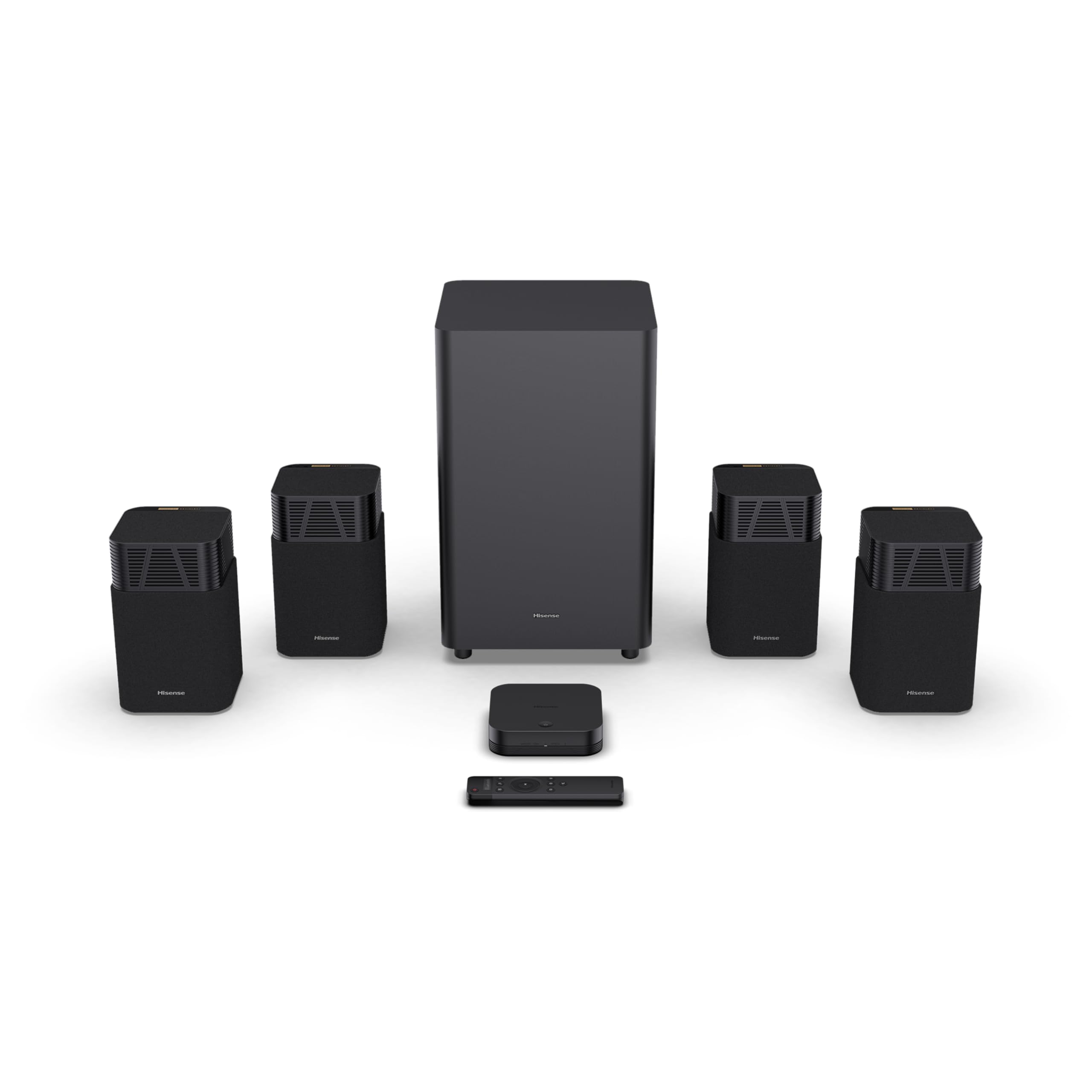
The HT Saturn is tuned by Devialet, and you can hear the French audio house’s signature voicing from the first listen. The sound signature is neutral and balanced with an emphasis on clarity across the frequency range rather than artificially boosted bass. The 4.1.2 channel configuration uses two up-firing drivers for height effects, a 6.5-inch wireless subwoofer, and 3-way surround speakers that each contain two drivers and a dedicated tweeter. This three-way design gives the surrounds genuine high-frequency extension that most budget satellites lack, resulting in cleaner separation between ambient effects and dialog.
The wireless implementation uses three frequency bands — 2.4GHz, 5.2GHz, and 5.8GHz — which automatically switch to avoid interference from Wi-Fi routers and other wireless devices. I tested this in a dense apartment building with overlapping networks, and the connection stayed rock solid. The Hi-Concerto feature lets the system combine its speakers with compatible Hisense TVs to create a wider sound field, though this only works with 2025 Hisense models. Setup took under ten minutes with HDMI eARC, and the TV remote handles volume and input switching without needing a second remote.
At , this is a premium ask for a 4.1.2 system. The subwoofer, while articulate, does not pressurize a large room like the 8-inch drivers in the Skywave X50 or TCL Q85H. The app is also noticeably absent — manual adjustments happen through the remote or the TV menu. If you value refined, reference-level tuning over raw power, the HT Saturn delivers a listening experience that rewards critical listening as much as casual movie watching.
Why it’s great
- Devialet tuning provides reference-level neutral sound signature
- Tri-band wireless rear speakers prevent interference
- 3-way surround speakers with dedicated tweeters
- Compact design hides easily in any room
Good to know
- Hi-Concerto only works with 2025 Hisense TV models
- No dedicated control app for EQ adjustments
- Subwoofer lacks chest-thump for very large rooms
4. HiMuses M514 5.1.4ch
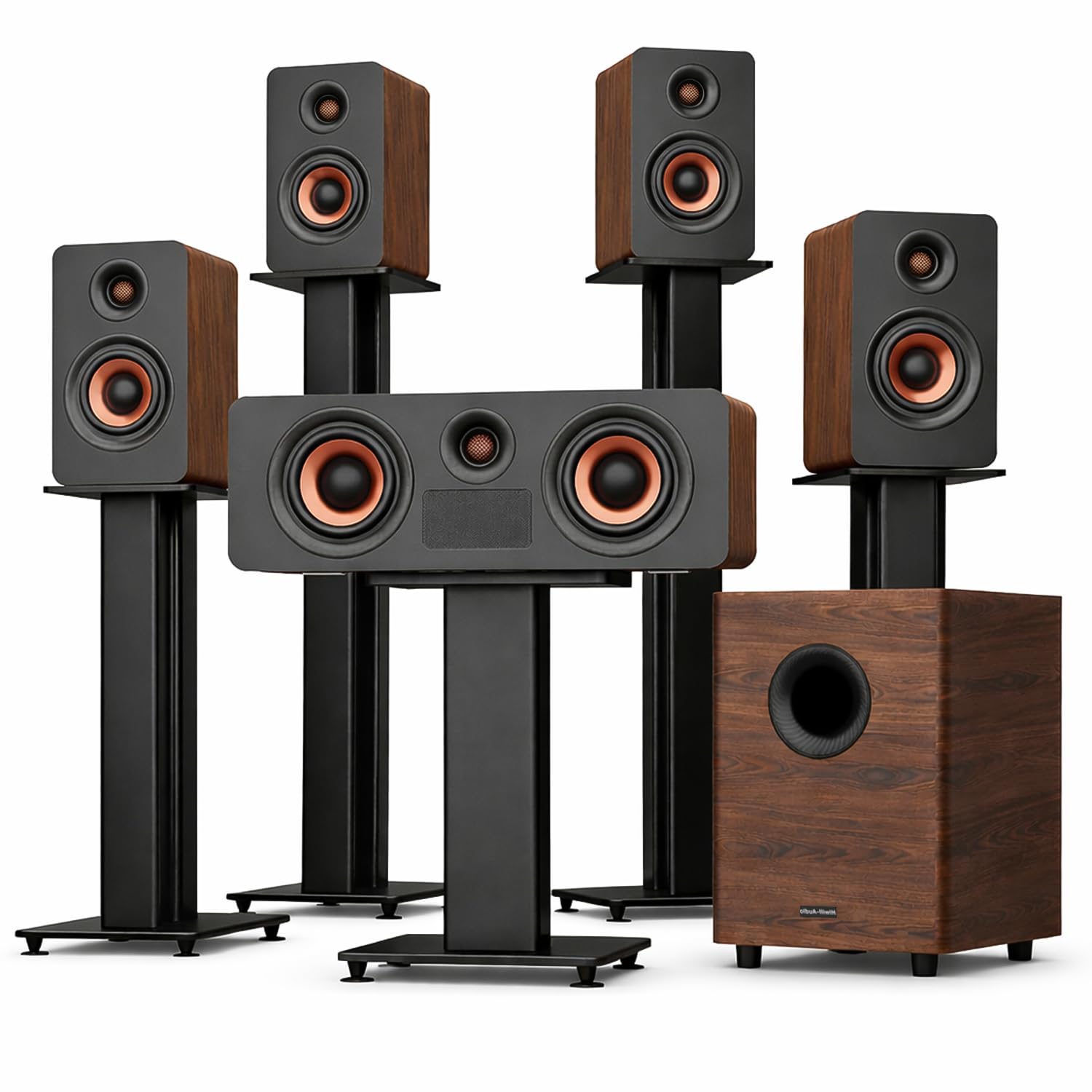
HiMuses built the M514 as a genuine Hi-Fi speaker system disguised as a home theater package. Each of the 16 drivers uses an aluminum-magnesium alloy diaphragm with copper rings and neodymium magnets — the same materials found in many high-end floorstanding speakers. The center channel is a dedicated Hi-Fi design with its own crossover network, ensuring dialog stays locked to the screen even during complex action sequences. The wired subwoofer reaches down to 25Hz, which means you feel subsonic content like deep synth bass and LFE effects that most budget subs simply omit.
The Dolby Atmos implementation here is true 5.1.4, with four dedicated up-firing height channels. This is not virtualized processing — the system physically directs sound upward to reflect off the ceiling. Combined with the four surround speakers and the center channel, the M514 produces precise object-based audio placement that competes with systems costing twice as much. The handcrafted wooden cabinets add acoustic warmth and reduce the metallic resonance that plagues all-plastic systems. Frequency response is rated to 45Hz on the satellite channels, but the sub handles everything below that seamlessly.
The downside is the wired rear speakers. You need to run cables from the main unit to the back of the room, which limits placement flexibility. The included 90-degree HDMI adapter is also a single unit — if you wall-mount the system, you will need to buy a second adapter. For listeners who prioritize sound quality over convenience and want a true Hi-Fi foundation for their home theater, the M514 rewards with depth and precision that no soundbar can match.
Why it’s great
- 16 aluminum-magnesium alloy drivers with Hi-Fi crossovers
- True 5.1.4 Dolby Atmos with dedicated height channels
- Wired subwoofer extends to 25Hz for deep bass
- Wooden cabinets reduce resonance for cleaner sound
Good to know
- Rear speakers are fully wired — requires cable management
- Included HDMI adapter is a single 90-degree unit
- No wireless option for rear satellites
5. ULTIMEA Poseidon D80 7.1ch

The Poseidon D80 is an upgraded version of ULTIMEA’s popular D60, adding two front surround speakers to create a true 7.1 channel layout with a 6.5-inch wireless subwoofer. The wired rear and front surround speakers connect with color-coded cables that make setup straightforward even for first-time buyers. The 460W peak power figure supports the system’s ability to fill a medium room with dynamic range, and the Dolby Atmos processing uses 3D positioning algorithms to create a 360-degree sound field without dedicated up-firing drivers.
The ULTIMEA Smart App is the real differentiator here. It provides 121 expert EQ presets across genres, a 10-band customizable equalizer, and six tailored sound modes for Movie, Music, Voice, Sport, Game, and Night. The app also delivers OTA firmware updates, which fixed the initial flaky rear speaker volume issue that early adopters reported. Post-update, the surround speakers deliver immersive directional audio that places effects accurately around the room.
The 4K HDMI input with eARC handles modern consoles and streaming sticks without signal degradation. Bass response is punchy and well-defined for a 5.25-inch subwoofer, though it does not reach as low as the larger drivers in premium systems. If you want a wired surround system with app-based control and the flexibility to tune the sound to your exact preferences, the Poseidon D80 delivers performance that punches above its weight.
Why it’s great
- App provides 121 EQ presets plus 10-band custom EQ
- Color-coded cables make wired setup simple
- OTA firmware updates fix early bugs
- Dolby Atmos processing creates 360-degree sound field
Good to know
- Does not support DTS decoding
- No up-firing drivers for overhead effects
- Rear speaker volume was low before app update
6. Amazon Fire TV Soundbar Plus 5.1ch

The Fire TV Soundbar Plus takes a different approach by integrating tightly with Amazon’s Fire TV ecosystem. The soundbar, subwoofer, and rear speakers pair automatically out of the box — you plug them into power and they find each other without pressing any buttons. The dedicated center channel processes dialog through Clear Voice Plus, which offers a five-level dialogue boost that isolates speech from background effects. This makes it a strong choice for anyone who struggles with muffled dialogue in movies.
Dolby Atmos and DTS:X are both supported, but there are no up-firing speakers. The height effects are entirely virtualized through the soundbar’s processing, which means the overhead dimension is more subtle than systems with physical height drivers. The subwoofer delivers crisp, punchy bass that handles action sequences well, though it requires at least 12 inches of clearance from the wall to avoid muddy low-end response. The remote is minimalistic with dedicated buttons for dialogue boost, bass, and treble adjustment — no app required.
The Fire TV ecosystem integration means you can control the soundbar from the Fire TV menu and adjust audio settings alongside your video settings. This convenience comes with a limitation: the system is designed primarily for Fire TV users. If you use a different streaming platform, the UI integration is less useful. Build quality is decent but not premium — the satellites use plastic enclosures that feel lightweight. For Amazon loyalists who want a no-fuss 5.1 setup, this system delivers reliable performance with minimal friction.
Why it’s great
- Auto-pairing out of the box with zero configuration
- Five-level dialogue boost for clear vocals
- Supports Dolby Atmos and DTS:X processing
- Seamless Fire TV ecosystem integration
Good to know
- No physical up-firing drivers for Atmos height effects
- Subwoofer needs 12+ inches from wall for clean bass
- Plastic satellite enclosures feel less durable
7. LG S40TR 4.1ch

The LG S40TR is the most affordable entry point into wireless surround sound from a major brand. The 4.1 channel configuration uses a soundbar, a wireless subwoofer, and two wireless rear speakers that connect to each other with a single cable before linking wirelessly to the main unit. This hybrid approach eliminates the need for a receiver while maintaining reliable signal integrity. The subwoofer thumps loudly enough to fill a small to medium room, and the rear satellites produce convincing positional effects for movies and games.
Dolby Audio and DTS Digital are supported, though there is no Dolby Atmos processing. The WOW Orchestra feature lets you use the soundbar speakers in tandem with compatible LG TV speakers, creating a wider front soundstage. The LG Soundbar App provides a 3-band equalizer for bass, treble, and mid-range adjustment. Clear Voice Plus processes center-channel information through the soundbar to improve dialogue clarity. The Crest Design on the soundbar uses a metal grille that keeps dust out while maintaining a sleek profile.
Setup is straightforward via HDMI ARC or optical, and the system responds to the LG TV remote for volume and power control. The rear speakers require a dedicated power outlet, and positioning them within 30 feet of the soundbar is recommended for optimal wireless performance. The S40TR lacks the power and refinement of higher-tier systems, but for its price, it delivers genuine 4.1 surround sound that transforms the TV listening experience without requiring a separate AV receiver.
Why it’s great
- Wireless rear speakers with hybrid wired connection
- Clear Voice Plus improves dialogue intelligibility
- WOW Orchestra combines with LG TV speakers
- Metal grille design keeps dust out of drivers
Good to know
- No Dolby Atmos or DTS:X support
- Rear speakers require nearby power outlets
- Limited power output for large rooms
8. Hiwill-Audio N512 5.1.2ch
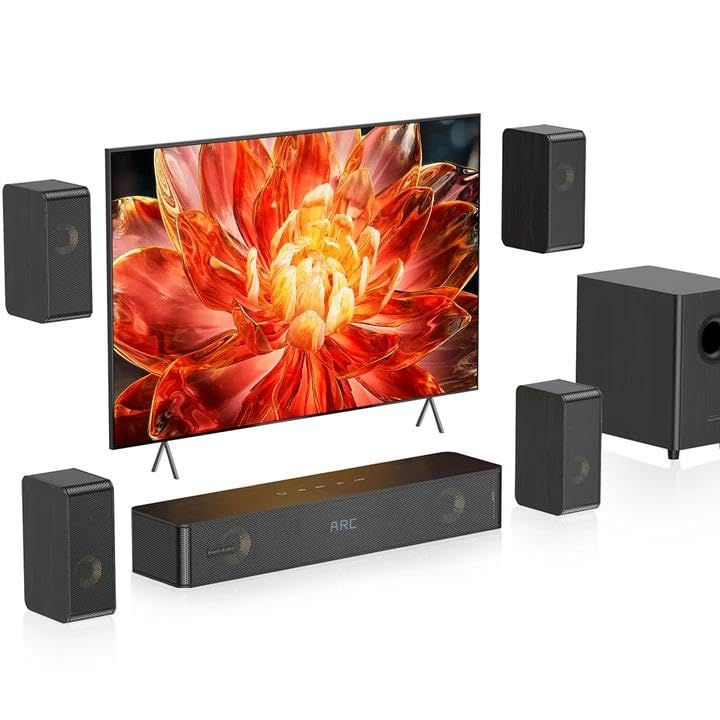
Hiwill-Audio took a contrarian approach with the N512: instead of cutting costs on materials, they used solid wood cabinets and 11 aluminum-magnesium alloy drivers at a price point where competitors use paper cones and plastic enclosures. The 5.1.2 channel layout includes four wired surround speakers, a center channel, two up-firing drivers for height effects, and a 5.25-inch down-firing subwoofer. The wood construction gives the system a warm, resonant character that plastic systems cannot replicate, with reduced cabinet resonance and cleaner midrange reproduction.
The proprietary Discrete Spatial Expansion Technology processes audio to widen the soundstage and improve spatial direction without relying on Dolby Atmos licensing. This means the system delivers immersive surround sound even with standard stereo content like YouTube videos and music streaming. The rear speakers can be repositioned for flexible placement within the same floor, which is useful for rear-heavy content. The subwoofer includes adjustable bass control from -6 to +6, letting you dial in the low-end punch based on your room acoustics and neighbors’ tolerance.
The N512 does have quirks. Some units produced a loud pop in the rear speakers during initial setup, though a firmware update from the manufacturer resolved the issue. The soft pop that remains appears to be related to Bluetooth interference and is generally tolerable at normal listening levels. The wired surround configuration requires running 20-foot speaker cables to the rear of the room, which may not work for all living room layouts. For buyers who value acoustic materials and build quality over brand-name features, the N512 offers a genuinely different value proposition.
Why it’s great
- Solid wood cabinets with aluminum-magnesium alloy drivers
- Discrete Spatial Expansion enhances non-Atmos content
- Adjustable subwoofer control for bass customization
- Upward-firing drivers for height dimension
Good to know
- Rear speakers are fully wired with long cables
- Some units had popping issues fixed by firmware update
- No Dolby Atmos or DTS:X license support
FAQ
What is the difference between 4.1 and 5.1 surround sound?
Do I need a receiver for a 4.1 powered soundbar system?
Can I add rear speakers to an existing soundbar to make a 4.1 system?
Does Dolby Atmos work with a 4.1 system without height speakers?
Final Thoughts: The Verdict
For most users, the best 4.1 surround sound system winner is the ULTIMEA Skywave X50 because it combines genuine wireless rear speakers, a room-shaking 8-inch subwoofer, and stable Dolby Atmos height effects in a single integrated package that requires no external receiver. If you want true Hi-Fi quality with physical wood cabinets and wired surrounds for the cleanest possible signal path, grab the HiMuses M514. And for the best balance of features and price with app-based tuning, nothing beats the ULTIMEA Poseidon D80.