
A dead battery on the water isn’t just an inconvenience — it’s a safety risk. Managing four separate 12V batteries, whether for a trolling motor, house bank, or dual starting systems, demands a charger that delivers consistent, independent power to each bank without cross-talk or imbalance. The wrong unit leaves you with one fully charged battery and three that barely turn over.
I’m Min — the co-founder and writer behind Gadgets Feed. I’ve spent countless hours analyzing the charging algorithms, waterproofing standards, and per-bank amperage ratings across the marine charger market to separate the units that genuinely protect battery health from those that just push voltage.
Whether you’re outfitting a bay boat or a cruising yacht, the right 4 bank marine battery charger keeps every bank at peak readiness season after season without overtaxing your electrical system.
How To Choose The Best 4 Bank Marine Battery Charger
A four-bank setup is only as strong as the weakest charging algorithm in the system. You need independent channels that can handle different battery chemistries simultaneously, enough per-bank amperage to recharge deep-cycle banks overnight, and an enclosure that survives salt spray without corroding internal components.
Per-Bank Amperage vs. Total Rated Output
A charger marketed as “40A total” means very little if each bank only delivers 2A. For trolling motor batteries (often 100Ah or more), you want at least 10A per bank to avoid spending two days recharging after a full day of fishing. Lower-amperage units work as maintainers but will frustrate anyone who drains batteries regularly.
Waterproofing and Enclosure Durability
Onboard chargers live in bilges, lockers, and open console compartments. Look for an IP67 or IP68 rating — IP65 is splash-resistant but won’t survive a hose-down or a flooded bilge. The housing should also be vibration-resistant and built with potted electronics that prevent moisture ingress through seams.
Battery Chemistry Compatibility and Independent Banks
Many boaters run a lead-acid starting battery alongside LiFePO4 house or trolling batteries. Each bank must be independently selectable for the correct absorption voltage — a one-size-fits-all charging profile will damage lithium cells or undercharge flooded batteries. Force start mode is a plus for reviving lithium batteries that have entered BMS protection shutdown.
Quick Comparison
On smaller screens, swipe sideways to see the full table.
| Model | Category | Best For | Key Spec | Amazon |
|---|---|---|---|---|
| FORM Fusion 10X4 | Premium | Saltwater boats, mixed chemistries | IP67, 10A per bank | Amazon |
| Minn Kota MK-440PCL | Premium | Precision multi-chemistry charging | 10A per bank, temp compensation | Amazon |
| LiTime 4-Bank 10A | Mid-Range | LiFePO4 focused setups | 10A per bank, IP65 | Amazon |
| VEVOR 4-Bank 10A | Mid-Range | Large boats, RVs, value | IP68, 10A per bank | Amazon |
| Schumacher DSR125 | Mid-Range | Garage/shop multi-bank | 10A per bank, 6V/12V | Amazon |
| FirstPower Pro 3-Bank | Mid-Range | Compact RVs, 3-battery boats | IP68, 10A per bank | Amazon |
| Clore PL4020 | Budget | Winter storage, light maintenance | 2A per bank, desulfator | Amazon |
| Extreme Max Battery Buddy | Budget | Seasonal battery storage | 2A per bank | Amazon |
| Minn Kota MK-460 PCL | Premium | High-capacity 15A per bank systems | 15A per bank, 60A total | Amazon |
In‑Depth Reviews
1. FORM Fusion 10X4 4-Bank Marine Battery Charger
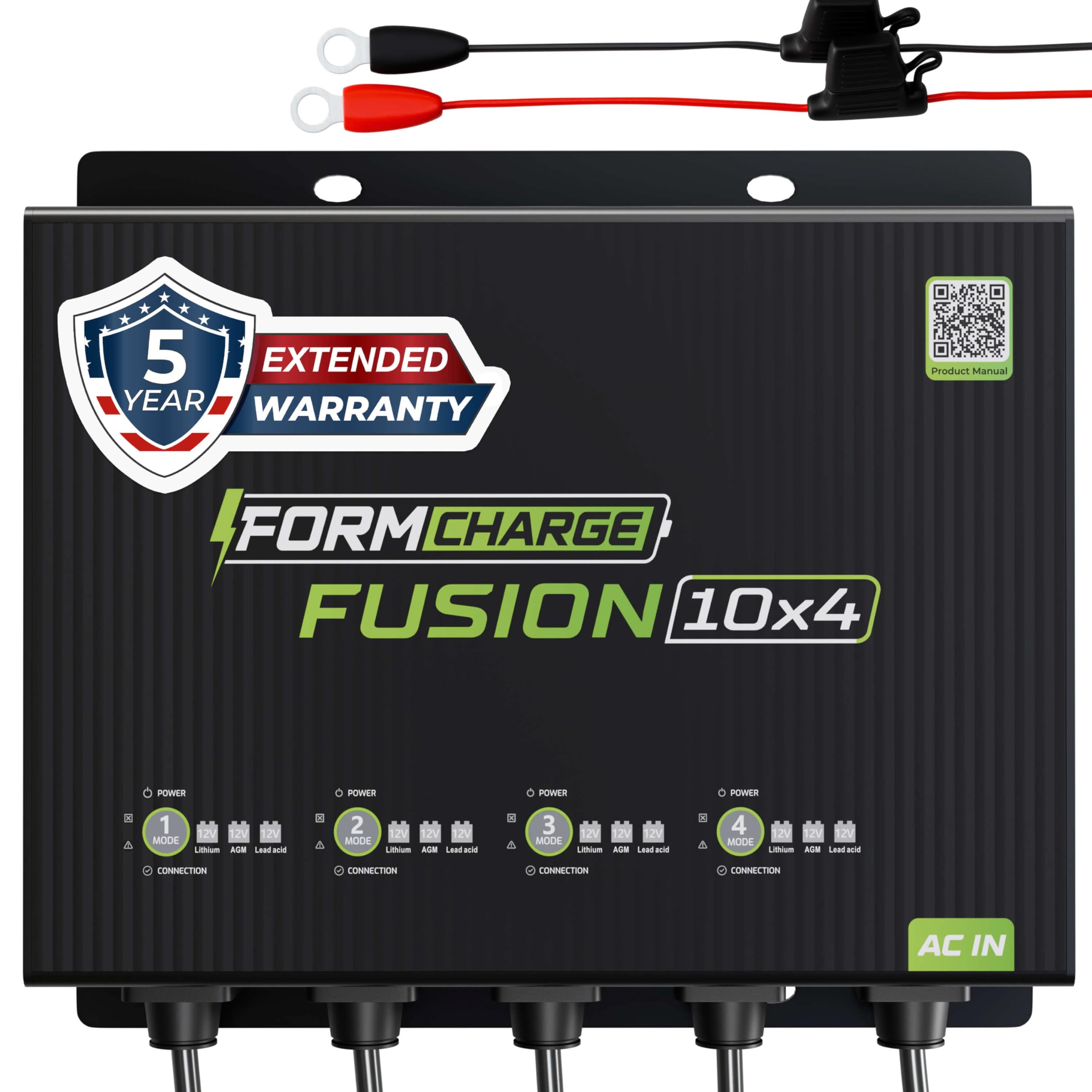
The FORM Fusion 10X4 hits the sweet spot between marine-grade durability and intelligent charging. Each of the four banks delivers a full 10A, and the WeatherShield IP67 coating means this unit can be mounted in an open bilge without worrying about saltwater intrusion. The internal coating protects circuit boards better than a simple gasket seal, which is critical for boats that see regular spray or washdowns.
Force Start mode is a standout feature for lithium users — it sends a timed low-amp boost to wake LiFePO4 batteries that have dropped into BMS protection, then automatically transitions to full multi-stage charging. The unit supports lead-acid, AGM, and lithium profiles, and the 24-month warranty with USA-based tech support adds peace of mind for liveaboard or frequent-use scenarios.
Some users have reported the charger entering a sleep mode from which it doesn’t recover without a full power cycle. While this appears to be an outlier issue, it’s worth noting that the charger lacks an always-on battery status display when unplugged, which some competitors offer. For the majority of installations, the FORM delivers reliable, set-and-forget performance in harsh conditions.
Why it’s great
- True IP67 waterproofing with internal conformal coating
- Force Start revives deeply discharged lithium batteries
- Independent per-bank chemistry selection
Good to know
- Occasional sleep mode lockout reported by some users
- No battery status display when AC power is disconnected
2. Minn Kota Precision MK-440PCL

Minn Kota’s MK-440PCL is the benchmark for precision charging in the marine world. Each of the four 10A banks can be independently configured for AGM, flooded, gel, or lithium (LiFePO4) chemistries, and the microprocessor-based control adjusts voltage and current dynamically throughout the charge cycle. The automatic temperature compensation is a genuine advantage for boats stored in unheated environments where ambient temperature swings can cause over- or under-charging.
The push-button battery equalization cycle is a specific benefit for flooded lead-acid users — it applies a controlled overvoltage to desulfate plates and balance cell voltages, extending battery life. The shock-resistant, vibration-resistant construction and waterproof housing are designed for permanent onboard mounting, and the LED indicators clearly communicate charge stage and error conditions without needing a smartphone app.
The form factor is noticeably larger than the previous generation, so measure your mounting space before committing. Some users report needing cable extensions to reach batteries in larger hulls, and the ring terminal connectors require a permanent wiring approach rather than quick-connect alligator clips. For boaters who want UL-listed reliability and per-bank customization, this is a top-tier choice.
Why it’s great
- Independent chemistry selection per bank (AGM, flooded, gel, LiFePO4)
- Automatic temperature compensation for consistent charging
- UL, CE, and FCC certified for marine safety
Good to know
- Larger footprint than previous Minn Kota models
- Ring terminal connectors only — no included alligator clips
3. Minn Kota Precision MK-460 PCL

The MK-460 PCL is the heavy lifter of the Minn Kota lineup, delivering 15A per bank for a total of 60A. This is the charger to choose when you’re managing large-capacity batteries — think 200Ah+ house banks or multiple deep-cycle trolling batteries that need a full recharge between tournament days. It wakes lithium batteries from BMS standby automatically, a feature that saves the hassle of jump-starting dead cells.
Digital control with multi-stage charging means the unit applies bulk, absorption, and float phases independently per bank. The low-line voltage compensation is a subtle but valuable feature for boats plugged into older marina pedestals where voltage can dip below 120V. The waterproof, shock-resistant construction and three-year replacement warranty reflect confidence in long-term marine use.
A small number of users have reported premature failure within the first six months, with warranty claims needing to go through the original retailer rather than directly to Minn Kota. This adds a potential friction point if you encounter a defect. The charger is also physically larger and heavier than standard 10A models, so plan your mounting location accordingly.
Why it’s great
- 15A per bank for fast recharge of large-capacity batteries
- Auto-wake for lithium BMS-protected batteries
- Low-line voltage compensation for inconsistent shore power
Good to know
- Warranty must be processed through the original retailer
- Large footprint requires careful pre-installation measurement
4. LiTime 4-Bank 10A Smart Battery Charger
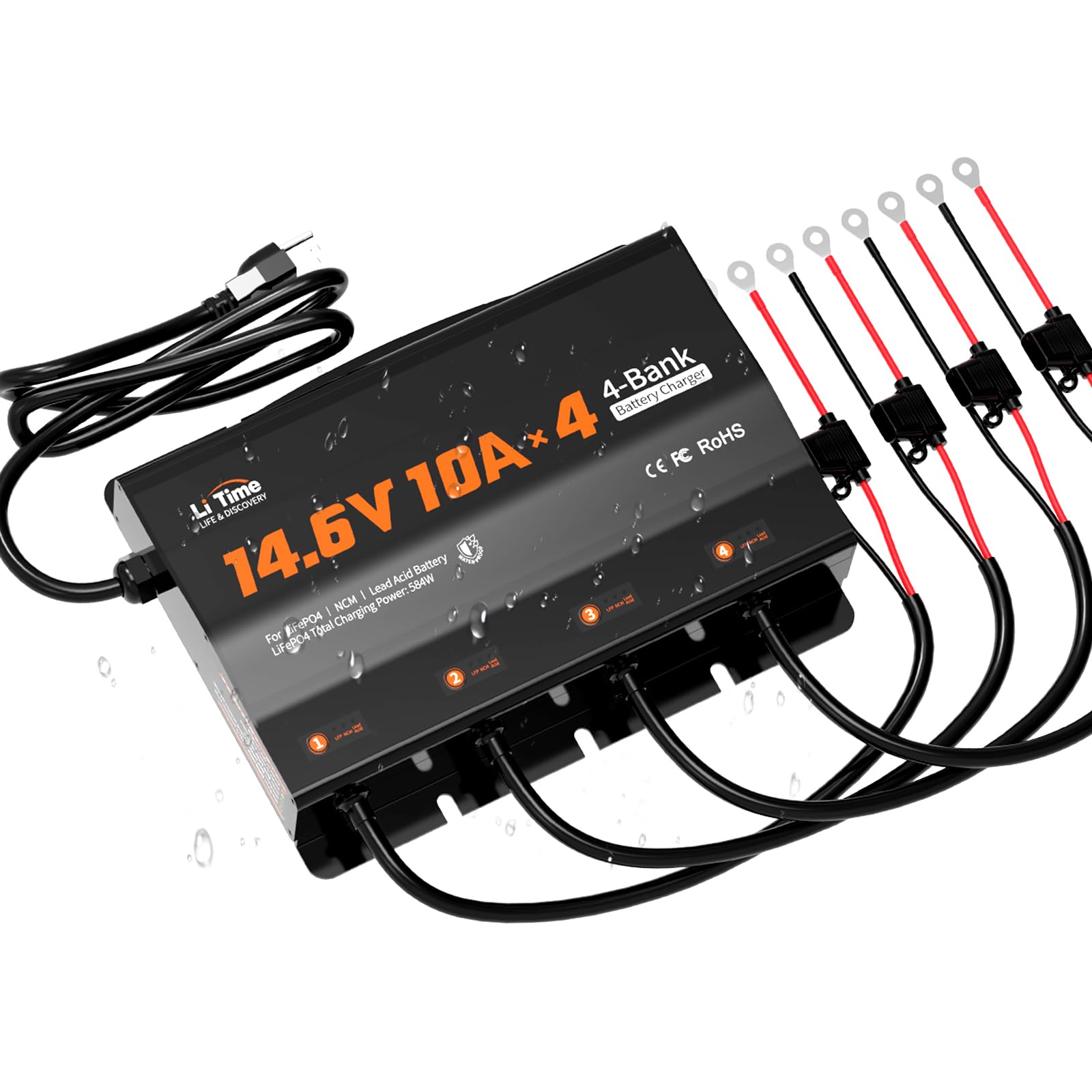
LiTime designed this charger with lithium battery users as the primary audience, and it shows in the 14.6V absorption voltage tailored specifically for LiFePO4 chemistry. Each of the four banks pushes 10A independently, and the charger can also handle NCM (16.8V) and lead-acid (14.7V) profiles, making it versatile for mixed-chemistry setups. The 3-second jump start for BMS-protected batteries eliminates the dead-battery panic common with lithium systems.
The IP65 rating is splash-proof and dust-resistant, suitable for dry compartments but not for direct bilge exposure. LED indicators clearly show standby, charging, full, and error states without ambiguity. The unit feels robust at over 12 pounds, with a compact form factor that fits in tighter spaces than some competitors.
One limitation is that battery chemistry selection isn’t saved after power loss — you must press and hold the mode buttons again after each AC disconnect. This is a minor inconvenience for permanent installations but could be frustrating if you frequently unplug the charger for storage. Additionally, the input voltage is listed at 220V AC for some markets, though the unit works on standard 120V household current as well.
Why it’s great
- Optimized 14.6V profile for LiFePO4 batteries
- 3-second BMS jump start for deeply discharged lithium
- Compact, rugged build at 12.35 pounds
Good to know
- Chemistry selection resets after AC power loss
- IP65 rating limits installation to dry compartments
5. VEVOR 4-Bank 10A Marine Battery Charger
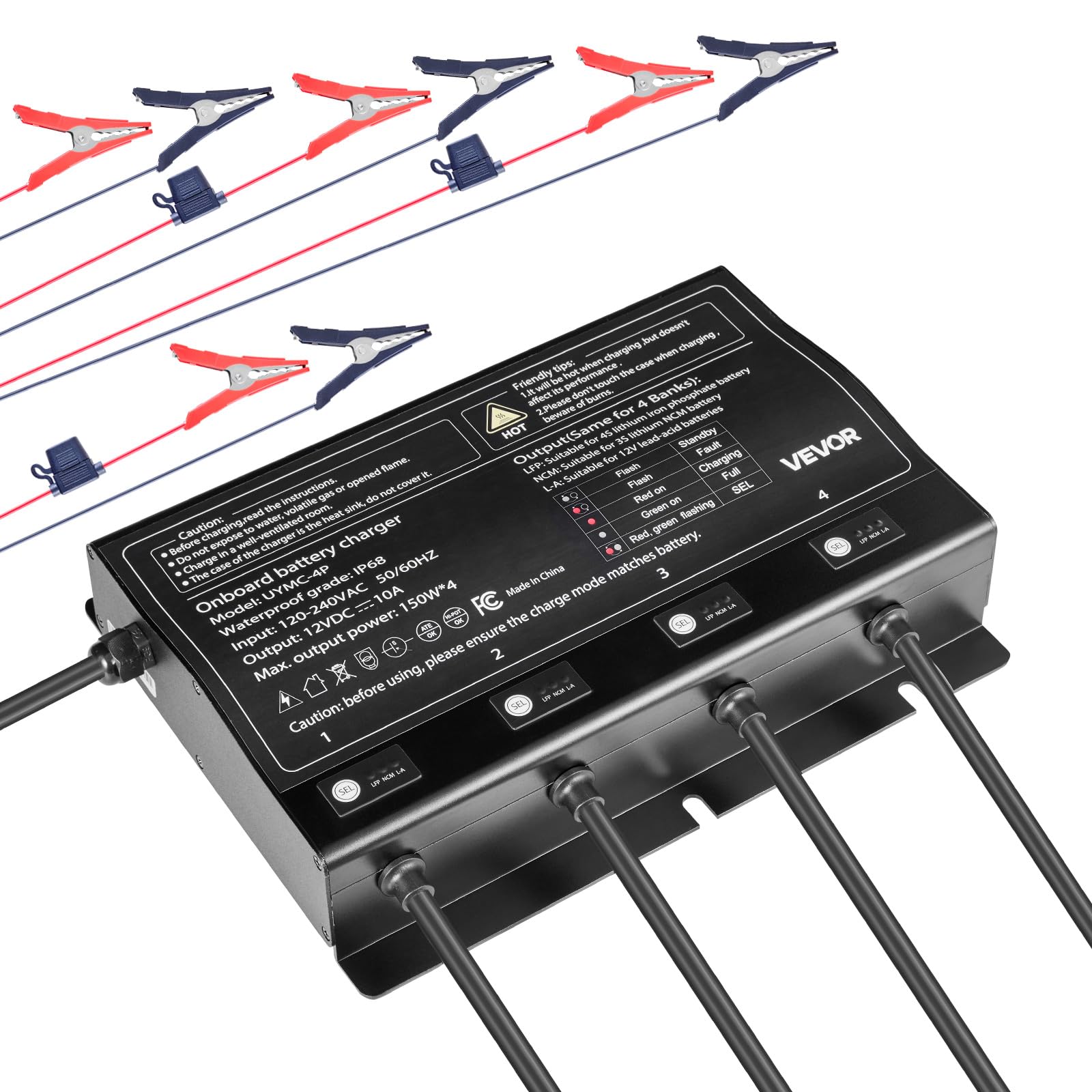
VEVOR’s 4-bank charger brings IP68 waterproofing — fully submersible protection — at a price point that undercuts most competitors with similar environmental ratings. Each bank delivers 10A with three charging modes (LFP, NCM, L-A) that are compatible with the major marine battery chemistries. The charger can revive batteries from 0V, a critical feature for seasonal boats where batteries may sit fully discharged over winter.
The multi-stage charging management adjusts power dynamically based on battery state, and the metal housing provides structural rigidity that plastic units lack. The 12.8-pound weight and compact 11.9″ x 9.1″ footprint make it manageable for DIY installation. Users report it works well with interconnected lithium batteries in RV and motorhome setups, outperforming factory charging systems.
Some users noted that the charger runs hot during extended charging cycles, though the included temperature warnings confirm this is expected behavior. Replacing the stock alligator clips with ring terminals is a common upgrade for permanent installations. For boaters seeking an affordable IP68 solution without compromising on per-bank amperage, this is a compelling option.
Why it’s great
- True IP68 waterproofing for wet bilge installation
- Charges from 0V for deeply discharged batteries
- Sturdy metal housing with three chemistry profiles
Good to know
- Runs hot during extended charging cycles
- Alligator clips may need replacement with ring terminals
6. FirstPower Pro 3-Bank 10A Marine Battery Charger

The FirstPower Pro is configured as a 3-bank unit delivering 10A per bank (30A total), making it ideal for boats or RVs with three battery systems — a starting battery plus two trolling or house batteries. The IP68 fully sealed construction allows permanent onboard mounting in wet environments, and the 5-grid power display shows charge percentage (20%, 40%, 60%, 80%, 100%) at a glance, which is more informative than simple LED color changes.
Force Mode enables manual charging of batteries below 1V by holding the MODE button for five seconds, while the auto repair mode initiates desulfation without user intervention. The integrated thermal sensor adjusts charge voltage based on ambient temperature, preventing over- or under-charging in extreme climates. The 3-year warranty is among the longest in this category.
Some users reported the charger doesn’t display battery voltage when unplugged from AC power, which was a disappointment for those expecting always-on monitoring. The unit is also heavier than expected at over 10 pounds — check dimensions before mounting in tight spaces. For 3-battery setups, the FirstPower Pro offers excellent value with premium waterproofing.
Why it’s great
- IP68 fully sealed for wet marine environments
- 5-grid power display shows charge percentage per bank
- 3-year warranty and thermal sensor compensation
Good to know
- No voltage display when unplugged from AC
- Heavier and larger than typical 3-bank units
7. Schumacher Electric DSR125 4-Bank Charger
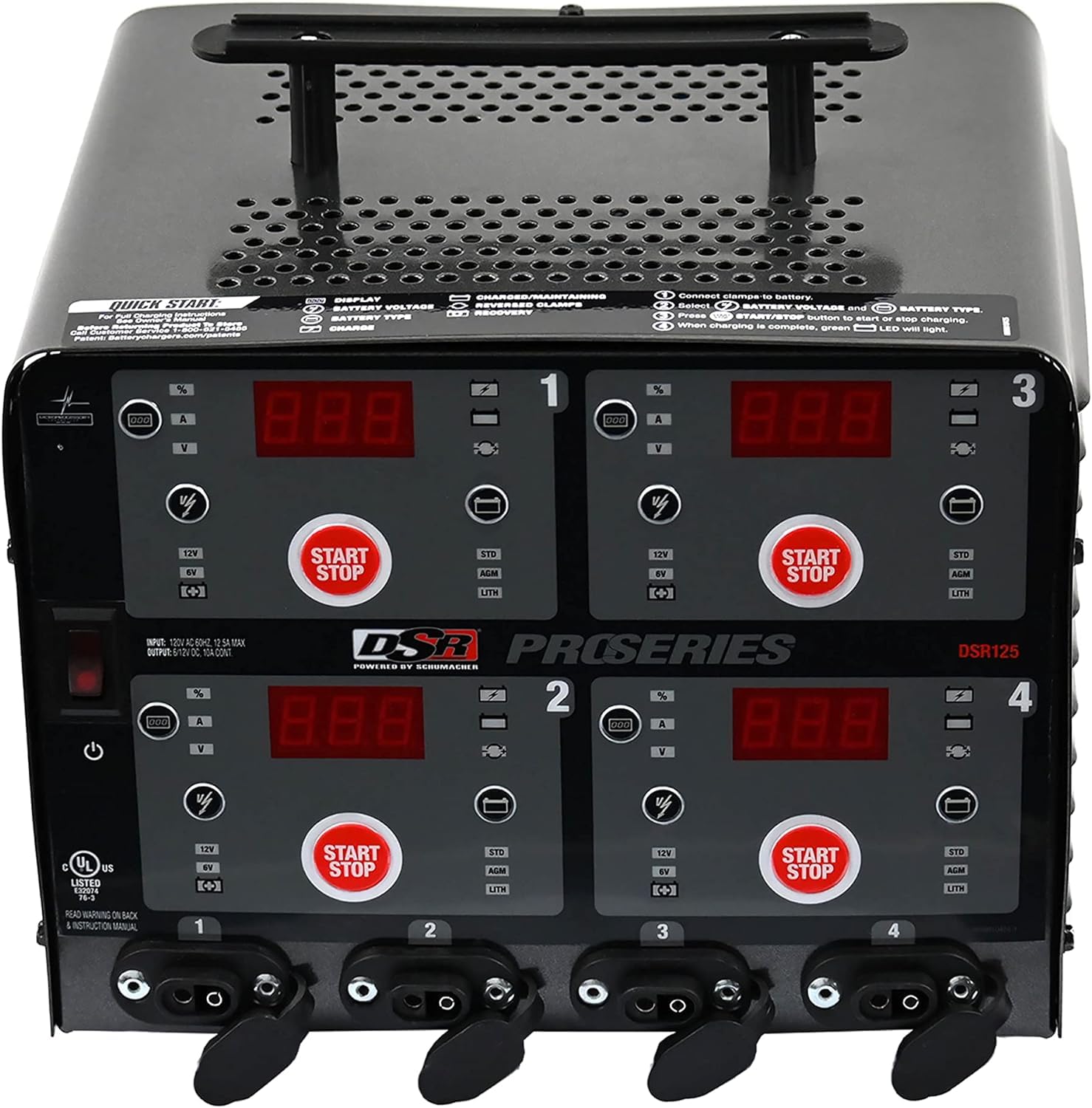
Schumacher’s DSR125 is a 4-bank charger designed for shop and garage use rather than permanent onboard marine installation, but its versatility earns it a spot for boaters who work on multiple vehicles. Each bank supports both 6V and 12V batteries, and you can combine two banks on a single battery to double the charge speed — a unique feature for quickly reviving a deeply discharged starting battery.
The multi-stage charging with thermal runaway protection and float-mode monitoring works across standard, AGM, gel, deep-cycle, and LiFePO4 batteries. The fan-cooled operation and heavy-duty steel case with a carry handle make it portable for moving between boats, cars, and equipment. The 75-amp color-coded clamps on 6-foot cables provide good reach for a stationary installation.
Some buyers have reported individual bank failures, with one bank ceasing to charge while the others continue functioning. Schumacher’s warranty support has received mixed feedback, so this is worth considering if you need all four banks to be flawless. For garage use where absolute marine waterproofing isn’t required, the DSR125 offers strong multi-battery flexibility.
Why it’s great
- Dual-bank combine mode for faster single-battery charging
- 6V and 12V compatibility per bank
- Fan-cooled steel case with carry handle for portability
Good to know
- Not IP-rated for onboard wet installation
- Individual bank failure reported by some users
8. Clore Automotive PL4020 Pro-Logix 4-Bank

The Clore PL4020 is a 4-bank maintainer with 2A per channel, positioning it as a long-term storage solution rather than a rapid recharger. It’s built around a fully automatic multi-phase process that includes desulfation — a pulsed waveform that breaks down sulfate crystals on lead-acid plates to extend battery life. The enhanced maintenance mode provides stable float charging indefinitely without over-drying cells.
The unit works reliably with a wide range of battery sizes, from small 8Ah UPS batteries up to large 1300CCA AGM starting batteries, though the 2A rate means large batteries take 12+ hours to fully recharge. The independent channels allow mixing normal and AGM modes across different banks, and the temperature compensation adjusts the charge voltage as ambient conditions change.
The main limitation is the inability to charge deeply discharged batteries below a certain voltage threshold — you’ll need to jump-start the battery first if it’s completely dead. Some users also report that after a power outage, the unit doesn’t always restart all channels automatically, requiring manual monitoring. For winter storage and seasonal maintenance, the PL4020 is a reliable, budget-friendly option.
Why it’s great
- Built-in desulfator extends lead-acid battery life
- Temperature compensation for accurate float voltage
- Independent normal/AGM mode selection per bank
Good to know
- 2A per bank — very slow for large battery recharge
- Cannot charge completely dead batteries without jump start
9. Extreme Max 1229.4023 Battery Buddy 4-Bank

The Extreme Max Battery Buddy offers a no-frills approach to 4-bank battery maintenance at a budget-friendly price point. Each of the four 12V banks delivers 2A, suitable for maintaining fully charged batteries in storage rather than recharging deeply discharged ones. The LED indicators per bank show charging status at a glance, and the built-in protection against wrong connections and short-circuits prevents accidental damage.
The compact form factor and 3.8-pound weight make it easy to move between storage locations, and the 4-foot 10-inch cable sets provide reasonable reach for a garage or shed setup. Users report reliable performance over multiple winter seasons, keeping car, motorcycle, and ATV batteries ready for spring. The unit handles smaller 8Ah batteries as well as standard automotive sizes.
Some units have arrived with a faulty bank, and given the straightforward design, there’s no independent chemistry selection or temperature compensation. The 2A per bank is genuinely slow for any battery larger than 50Ah — expect overnight or longer charge times. For basic storage maintenance where you just need to keep four batteries topped off, the Battery Buddy does the job without complications.
Why it’s great
- Simple, reliable maintenance for seasonal battery storage
- LED indicators per bank for quick status checks
- Lightweight and portable at 3.8 pounds
Good to know
- 2A per bank — very slow recharge rate
- Occasional faulty bank reported on arrival
FAQ
Can I charge LiFePO4 and lead-acid batteries simultaneously on different banks?
What does Force Start mode do on a marine charger?
Do I need temperature compensation on a marine battery charger?
Final Thoughts: The Verdict
For most boaters, the 4 bank marine battery charger winner is the FORM Fusion 10X4 because it combines true IP67 waterproofing, independent per-bank chemistry selection, and Force Start for lithium compatibility at a price that doesn’t require a second mortgage. If you need precision charging with temperature compensation and UL certification, grab the Minn Kota MK-440PCL. And for high-capacity systems where 15A per bank is non-negotiable, nothing beats the Minn Kota MK-460 PCL.