
Our readers keep the lights on and my morning glass full of iced black tea. As an Amazon Associate, I earn from qualifying purchases.
Specs are compiled from manufacturer listings and verified buyer reviews and can change over time — please confirm the key details on the product page before buying.
Walk into a garage lit by four tired fluorescent tubes and you already know the problem: half the room is dim, the tubes hum, and one of them flickers until you tap it. The fix is a four-bulb LED setup — four lamps working together, either as individual tubes you swap into an existing fixture or as a complete four-lamp fixture that arrives with the tubes already in it. The catch is that “four bulbs” means four loose tubes in one listing, a four-lamp housing in another, and four separate ceiling lights in a third.
I’m Min — the founder and writer behind Gadgets Feed. This guide is built by comparing the manufacturers’ published specifications and the patterns across verified customer reviews, so you get each pick’s real strengths and trade-offs instead of marketing spin.
Some of these are bare tubes that slide into a shop fixture you already own. Others are sealed four-lamp housings, wafer-thin ceiling discs, or a high-bay unit built to hang over a workshop floor. Below you get the honest split between them, starting with the four-inch wafer that owners describe as the least painful lighting upgrade in the house and working down to the commercial-grade fixtures where the wiring decides everything.
Whether you are swapping tubes in an old shop fixture or starting fresh, this breakdown of the 4 bulb led light market shows which four-lamp setup fits your ceiling and wiring.
Our Picks at a Glance


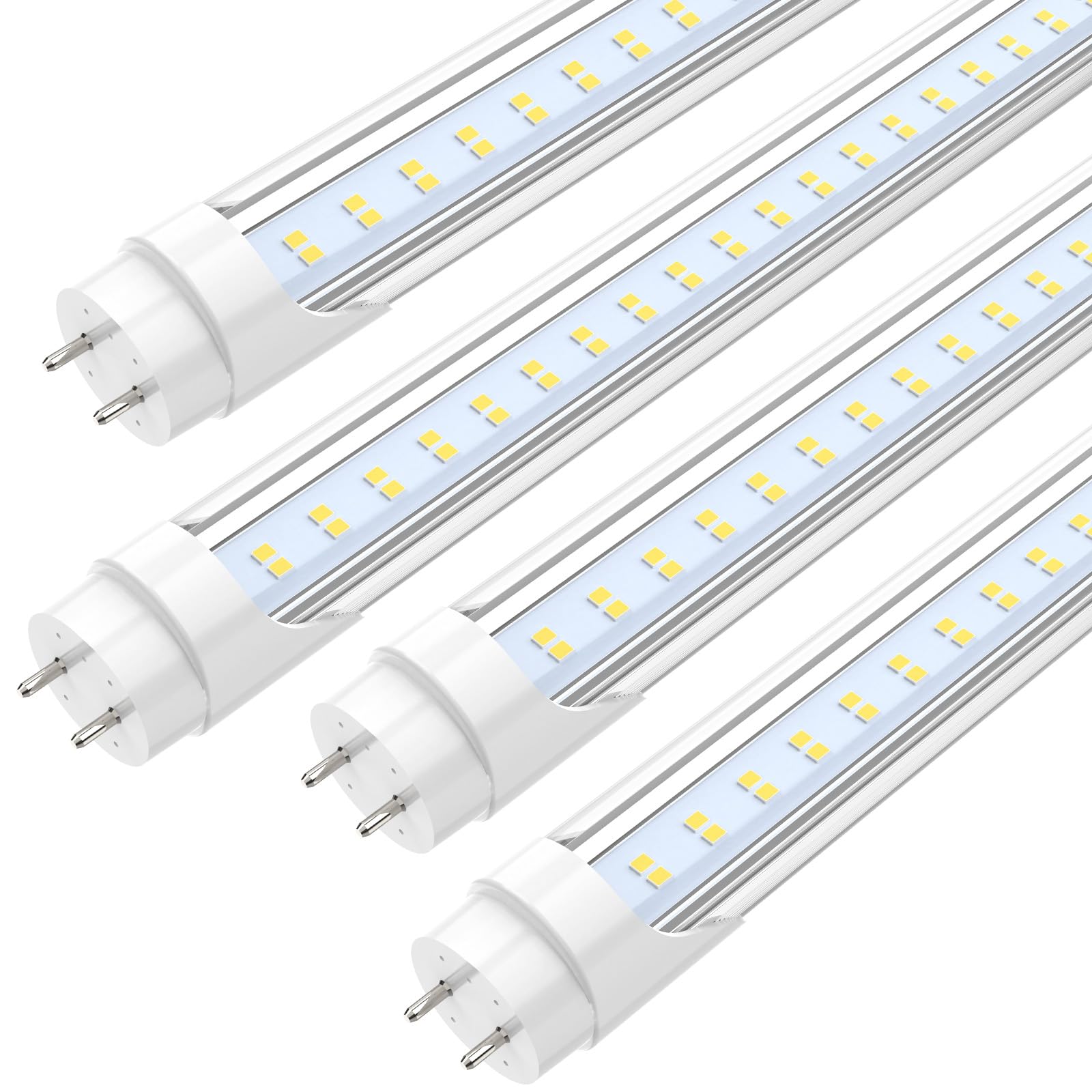
How To Choose The Best 4 Bulb LED Light
The single biggest mistake buyers make is assuming every four-bulb listing is a tube swap for an existing fixture. It is not. Three completely different products hide behind the same phrase, and each one asks something different of your ceiling, your wiring, and your patience.
First, decide which kind of “four” you are buying
A four-pack of loose T8 tubes assumes you already own a fixture with four sockets. Those sockets are called tombstones, and the tube ends are G13 bi-pin bases — two small pins that twist into place. A complete fixture, by contrast, arrives as a housing with the lamps already inside, so you are replacing the whole light rather than feeding one.
Then there is the third type: four separate ceiling lights in one box, like wafer downlights or flush-mount discs. Here the “four” describes how many rooms you can light, not how many lamps share a housing. Count your existing four-socket fixtures before ordering a tube four-pack, or you will end up with spares gathering dust.
Ballast or no ballast is the decision that bites
An old fluorescent fixture runs a ballast — a small box that regulates the current through the tube. Some LED tubes are built to work with that ballast still in place, which makes the swap a straight plug-and-play. Others need the ballast bypassed, meaning you rewire so line voltage feeds the sockets directly.
Bypassing is not hard, but it means cutting the ballast out and direct-wiring the tombstones, which is live-circuit work. If you are not comfortable doing it, buy a tube rated to work with your existing ballast, or buy a fixture where the ballast has been removed from the equation entirely.
Match the color temperature to the room’s job
A color temperature is measured in Kelvin, and it describes how warm or cool the white looks. Around 3000K reads warm and inviting, which suits a kitchen or break room. The 4000K to 5000K band feels neutral and crisp, which is what you want over a workbench. Anything at 6000K and up looks blue-white and clinical — great for a shop floor, harsh in a living space.
Do not buy on wattage alone
Lumens measure actual light output, and that is the number that matters. A 28W tube pushing 3360 lumens beats a tube that burns more power for less visible light. Wattage tells you what it costs to run; lumens tells you how bright the room gets.
Check the physical fit before anything else
T8 is the tube diameter, and 4FT is the length — a nominal four-foot tube. If your fixture is a 2-foot or an 8-foot unit, none of these tubes will seat. For ceiling discs, the cutout size decides it: a 4-inch wafer needs a 4-inch hole, and a 5/6-inch retrofit can needs a can that size already in the ceiling.
Quick Comparison
| Model | Best For | Brightness | Color Temperature | Lifespan | Amazon |
|---|---|---|---|---|---|
| Amico 4 Pack 4 Inch 5CCT Ultra-Thin LED Recessed Ceiling Light★ Best Overall | Kitchens, baths, basements | 800 lm | 2700K–5000K selectable | — | Amazon |
| TRLIFE 4FT LED Light Bulbs, T8 4FT LED Tube Lights 28W 5000KBrightest Tubes | Shop and workshop tube swaps | 3360 lm | 5000K | 30,000 hours | Amazon |
| JESLED 4FT LED T8 Type A+B Tube Lights, 24W, 3200LM, 6000KEasiest Swap | Fast plug-and-play conversions | 3200 lm | 6000K | 50,000+ hours | Amazon |
| LED Garage Lights 4 Pack, 28000LM 6500K | Whole-garage daylight | 28000 lm | 6500K | 50,000 hours | Amazon |
| Feit Electric 4ft T8 LED Light Bulbs, 32/40W Eq, Warm White | Warm light with existing ballast | — | 3000K | 50,000 hours | Amazon |
| hepside 4Pack LED Flush Mount Ceiling Light Fixture, 13 Inch 24W | Low ceilings and hallways | 3200 lm | 3000K–6500K selectable | 25,000 hours | Amazon |
| LUXRITE 5/6 Inch LED Recessed Retrofit Downlight, 14W, 1100 LM | Retrofitting old can lights | 1100 lm | 2700K–5000K selectable | 50,000 hours | Amazon |
| PrimeLights 4 Lamp High Bay T8 LED Fixture, 11,000 Lumens | High ceilings and cold shops | 11,000 lm | 5000K | 50,000+ hours | Amazon |
| FAITHSAIL 60W LED Wraparound Light 4FT, 7200 Lumens 4000K | Offices, shops, big garages | 7200 lm | 4000K | — | Amazon |
In‑Depth Reviews
1. Amico 4 Pack 4 Inch 5CCT Ultra-Thin LED Recessed Ceiling Light
Our pick — 4.5+★ from 750+ verified ratings; the strongest balance of quality and price.
Four wafer-thin discs that slide into a ceiling hole and settle the color question on the spot.
The part that sells this four-pack is the little slider on the side of the junction box. Flip it and you pick one of five color temperatures — 2700K, 3000K, 3500K, 4000K, or 5000K — before you ever push the light into the ceiling. That single switch is why you are not ordering a second set after discovering 5000K looks like an operating room in your hallway. Each disc runs 800 lumens off 10 watts, which the maker frames as the equivalent of a 60W halogen, and buyers report these wire up in under an hour for a whole room.
Installation is the thing that wins people over — far and away the most-praised trait on these lights. The housing is only 1.18 inches tall and needs as little as 2 inches of ceiling space, so they drop into joist cavities where a traditional can housing would never squeeze. They are IC rated too, which means the junction box is thermally protected and permitted to sit in direct contact with ceiling insulation. No fire hazard from buried insulation is the practical upshot.
Where this asks something of you is in the ceiling itself: this is a 4-inch wafer, so it wants a 4-inch cutout, and the damp rating covers bathrooms, basements, and covered soffits but explicitly not direct water spray or standing water. The fit rating sits mixed in the review data, which tracks with any recessed light — a slightly ragged drywall hole shows at the trim edge. As a ceiling-lighting value play, though, few four-packs do this much adjusting for the money.
What earns the top spot
- Five selectable color temperatures (2700K to 5000K) end the guess-and-return cycle
- Only 1.18 inches deep and needs as little as 2 inches of ceiling clearance
- IC rated, so it can touch insulation without a thermal problem
- 800 lumens from 10 watts, with a damp rating for baths and basements
Set your expectations here
- Needs a full 4-inch cutout, and a rough hole shows at the trim
- Damp rated only — no direct spray or standing water
- Four lights means four holes, so plan the layout before the first cut
The right call when: you are cutting fresh holes in drywall or replacing old cans and want the color nailed down before the ceiling closes up.
Think again if: your ceiling is finished and you would rather not cut into it at all — a retrofit can light below is the gentler path.
2. TRLIFE 4FT LED Light Bulbs, T8 4FT LED Tube Lights 28W 5000K Daylight White, 3360 Lumens
The tube swap that outshines its own four-lamp competition before you even leave the box.
Put these 3360-lumen tubes next to the JESLED set below and the gap is real: 3360 lumens against 3200, a 5% edge in visible output from a package that throws a two-row chip layout into the same four-foot span. The color sits at 5000K daylight white, which is the neutral-to-crisp band that keeps a workshop readable without going blue. CRI lands at 80 on the standard color-fidelity scale, so painted parts and wire colors read reasonably true.
Then there is the wiring question, and this is where you need to pay attention. These tubes are dual-end powered, which means power feeds both ends of the tube rather than one, and they require a ballast bypass — the old ballast must be cut out and the fixture direct-wired. That is a 15-minute job for someone comfortable with a screwdriver and a wire nut, and a stop-and-call-an-electrician job for someone who is not. The frosted-style cover takes the edge off the glare, which matters when the fixture hangs at eye level in a shop. As the listing puts it: “These LED chips service life is 30,000 hours, the 4ft led tube light will help you to save on your electricity bill.”
The output rating is the loudest thing about these — brightness is the trait reviewers return to again and again, with build quality the consistent second note. Lifespan is rated at 30,000 hours, which is the shorter end among the four-foot tubes here, and the value verdict is genuinely split in the review pages. Buyers who wanted a cheap, bright shop light rate it highly; buyers who hit a wiring snag on their particular fixture did not. Check your fixture’s wiring diagram before the order, not after.
Where it wins: this is the lumen leader of the four-foot tube group, delivering 3360 lumens per tube at 5000K and 80 CRI from a dual-row chip layout.
Where it costs you: the ballast must go. Dual-end powered means direct wiring, so budget the rewire time or hire it out — and understand the 30,000-hour rating is shorter than the 50,000-hour tubes further down this list.
Grab these if: your fixture already has a ballast you are happy to cut out and you want the most visible light per tube here.
Leave them for later if: you want a plug-and-play drop-in with the ballast untouched — that is the Feit set’s whole pitch.
3. JESLED 4FT LED T8 Type A+B Tube Lights, 24W, 3200LM, 6000K
Four tubes that will meet your fixture where it stands — ballast or no ballast, one end or two.
JESLED’s Type A+B label is doing the heavy lifting here, and it means something specific: these tubes can run with the existing ballast still installed (Type A, plug and play) or with the ballast bypassed (Type B, direct wire). You also get a choice of single-ended or double-ended power. That flexibility is why owners mention these working right from the start with no fixture modification — the tube adapts to what you already have instead of demanding a rewire.
The numbers back up the convenience. Each tube pushes 3200 lumens at 24 watts, which the maker rates as a 65W fluorescent replacement, and the color sits at 6000K bright white with an 83 CRI. Output lands just under the TRLIFE tubes above — 3200 lumens against 3360 — but this set carries a 50,000+ hour life rating against TRLIFE’s 30,000, so you trade a sliver of brightness for a much longer advertised run. One caveat from the spec sheet: these are non-dimmable, and the maker explicitly warns against pairing them with a dimming ballast.
What owners keep coming back to is simple functionality — that is the most-discussed trait by a wide margin, followed by the value. The fit and compatibility side is more even, with some buyers finding their ballast on the compatibility list and others finding it was not. Lifespan drew a mixed read too: plenty report years of service, while a minority had one quit inside a month. The three-year warranty and 60-day refund window are the backstop if you draw the short straw.
The real draw: a fork-in-the-road tube that works either way — Type A with the ballast, Type B without — so you are not gambling on your fixture’s wiring before the box arrives.
Reach for this if: you have no idea what ballast your old shop fixture is running and you want a tube that copes either way.
skip it if: you need dimming — these are non-dimmable and the maker warns off dimming ballasts entirely.
4. LED Garage Lights 4 Pack, Garage Lights Ceiling LED 28000LM 6500K
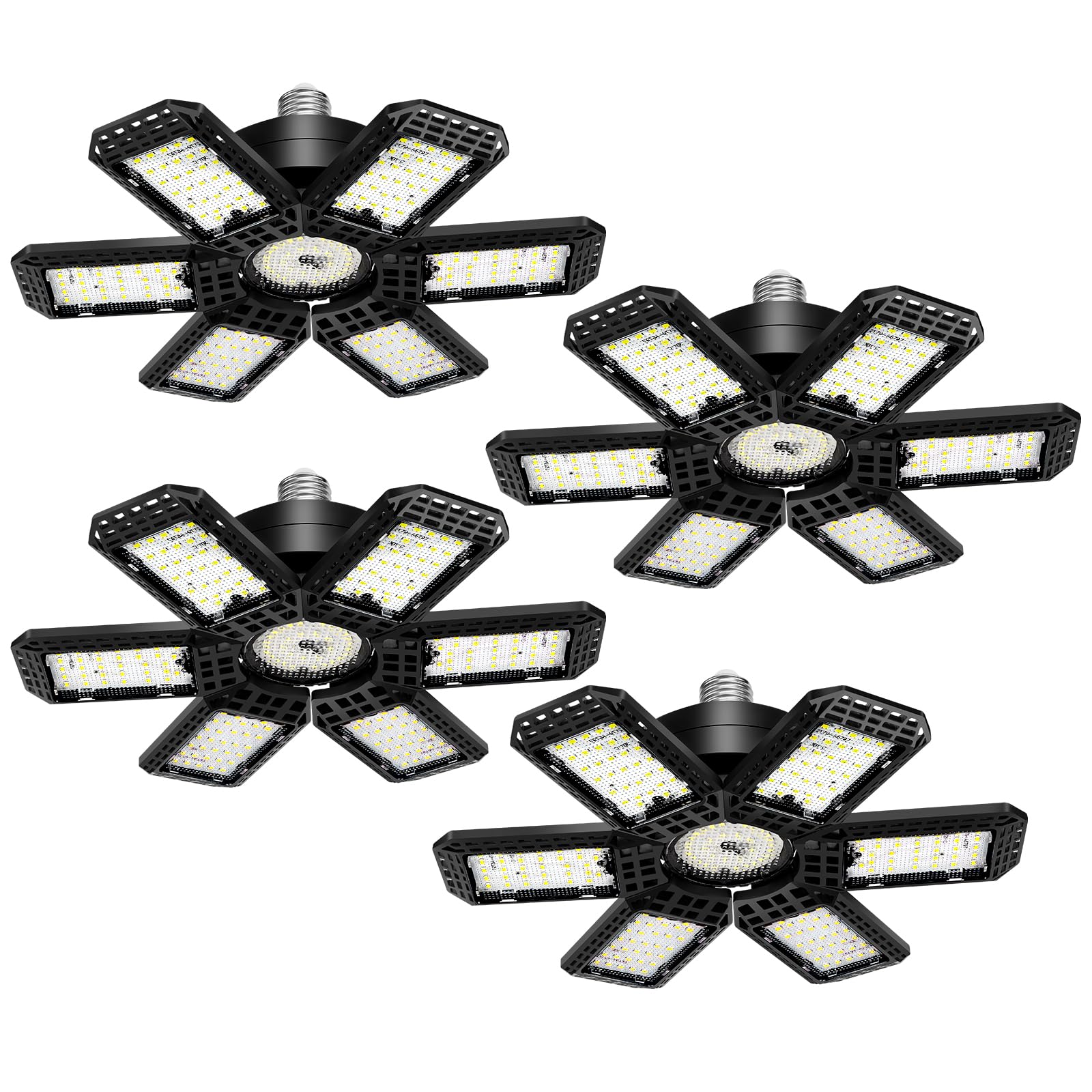
Four screw-in panels that turn a dark garage into a workshop floor you can actually work on.
Here is the head-to-head that matters: this setup throws 28,000 lumens against the Amico wafers’ 800 lumens. That is not a small trim difference — it is a 35-fold gap in raw output, and it is the reason a full-garage install looks like daylight instead of a dim corner. Each unit carries six deformable LED panels plus a center panel, and every one of those panels swivels from 0° to 90°, so you aim light at a workbench or a shadowed corner instead of hoping the bounce covers it.
The install is the party piece for anyone who has stared at a junction box before: screw it into a standard E26 socket exactly like a bulb, no electrician, under 15 seconds per unit by the maker’s count. It runs 160W against the traditional 1000W incandescent it is meant to replace, and the whole unit weighs 3.9 pounds, which a normal ceiling socket handles without complaint. 6500K is cool and clinical — perfect over tools, unforgiving over a dinner table.
Brightness and build quality are the two notes that dominate the feedback, and owners compare these favorably to four-foot fluorescent fixtures in raw coverage. Where the story sours is longevity: the lifespan rating drew negative feedback as the single most-discussed negative, even though the maker advertises 50,000 hours and a five-year warranty. Treat the advertised figure as a ceiling rather than a promise, and buy knowing four units means four separate failure points over time.
Why a garage owner picks it
- 28,000 lumens — 35x the output of the Amico wafers, aimed exactly where you need it
- Six panels per unit, each adjustable from 0° to 90°
- Screws into any standard E26 socket in seconds, no electrician
- 160W replacing a traditional 1000W bulb
The honest trade-off
- Lifespan is the most-discussed complaint — the 50,000-hour figure has not held for every unit
- 6500K is very cool and blue-white; it is not a living-space light
- Four separate units means four chances of a dud over the years
Buy this when: the room is a garage, attic, or workshop and you want maximum light from sockets you already have.
Not for you if: the space is a kitchen or bedroom — 6500K at this output will feel like a stadium, not a home.
5. Feit Electric 4ft T8 LED Light Bulbs, 32/40W Eq, Warm White, 4 Pack

The rare four-foot tube that leaves your ballast alone and still reads warm instead of surgical.
Almost every four-foot LED tube on this list asks you to deal with the ballast. This one does not. It is a Type A plug-and-play replacement for traditional 32W or 40W fluorescent tubes, built to work with most electronic ballasts, and it goes in with no rewiring at all. That single design choice makes it the pick for anyone who wants the swap done before their coffee cools — and it is why installation is the second most-praised trait here behind raw brightness.
The color is the other differentiator. At 3000K warm white with 80 CRI, these tubes cast the soft, welcoming tone you would expect in a kitchen, break room, or retail floor, and they do it without the flicker, hum, or delayed start that old fluorescent tubes bring. The maker lists a 50,000-hour life rating and backs it with a five-year warranty, plus DLC certification and a UL listing — the two marks a commercial buyer checks before signing off on a fixture. Rated for damp locations as well, so a humid back room is fair game.
Reliability is where the feedback splits. The bulbs are consistently called bright — one line of praise puts it that they do not feel oppressive the way direct sun can — but the lifespan column drew negative notes, and reliability overall reads mixed rather than settled. Value also splits. The voltage spec narrows things too: this runs on 100 to 120 volts at 60 hertz, so a 277V commercial circuit is out. Know your supply before you order.
What you are really buying: a warm 3000K tube that drops into most electronic ballasts with zero rewiring, backed by a five-year warranty and a 50,000-hour rating.
The catch worth knowing: mixed reliability notes on lifespan and a hard 100–120V ceiling. It is a residential and light-commercial tube, not a 277V industrial one.
It suits you if: you want warm light over a break room or kitchen and refuse to touch the ballast wiring.
Keep looking if: your building runs 277V commercial power or you need the maximum lumens per tube — this one prioritizes easy and warm over raw output.
6. hepside 4Pack LED Flush Mount Ceiling Light Fixture, 13 Inch 24W, 5CCT Adjustable
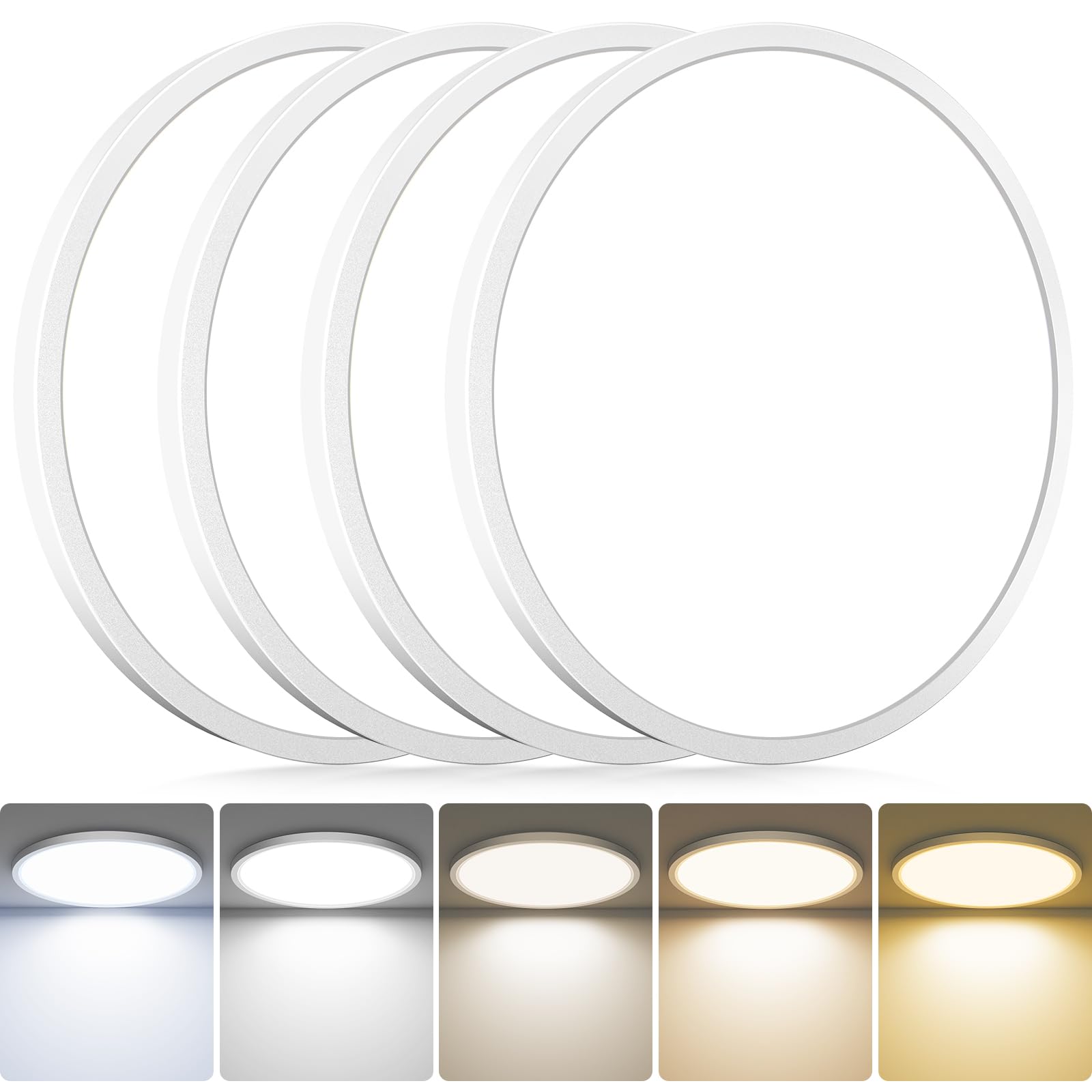
A half-inch-thick disc that hugs a low basement ceiling without eating the headroom.
The number note is 0.7 inches — that is the whole thickness of this 13-inch round fixture, and the maker pitches it as 15% thinner than comparable lights. In a basement with a duct running overhead or a hallway where a hanging fixture would clip a tall guest, that slimness is the entire point. It also means less dust collecting on top of the housing, which is a small thing you notice only when you stop having to clean the light.
Brightness runs 3200 lumens from 24 watts, and the color setting gives you five stops between 3000K and 6500K, so you can swing the same fixture from cozy hallway warmth to crisp task light. Dimming goes from 5% to 100%, and it plays with most dimmers on the market — dimmer itself not included, so budget for that separately. Owners describe these as minimalist discs that brighten a room fast, with light quality that one comparison likens to a solar tube under full sun.
The honest friction points are two. Flickering shows up as the loudest negative note, so pair it with a dimmer that suits LED loads specifically. The brightness adjustment drew mixed feedback as well, which usually means dimmer-matching rather than a fault in the light itself. Quality and installation both rate high — those are the two traits owners praise the most — and the three-step install gets each disc up in a few minutes.
Worth knowing before you buy
- 0.7-inch profile — 15% thinner than comparable fixtures, ideal for low ceilings
- 3200 lumens at 24 watts with 3000K–6500K selectable color
- Dims from 5% to 100% with most standard dimmers
- Three-step install gets each disc mounted in minutes
What could annoy you
- Flickering is the most-reported gripe — pick an LED-rated dimmer
- Dimmer is not included, so add that to the shopping list
- 25,000-hour lifespan is the shortest rating among the four-packs here
This one earns its place if: your ceiling is low, finished, and you need four lights that sit nearly flush against it.
Look elsewhere if: you want maximum lifespan or you are unwilling to buy a matching LED dimmer — flicker complaints trace back to that mismatch.
7. LUXRITE 5/6 Inch LED Recessed Retrofit Downlight, 14W=90W, 1100 LM (4 Pack)

It slides into an old can housing and adds nearly four times the light of the Amico wafer.
If your ceiling already has 5- or 6-inch recessed cans, you skip the drywall entirely: this retrofit kit screws into the existing E26 socket through an adapter, and metal tabs pull the trim flush against the ceiling. Each downlight puts out 1100 lumens — against the Amico’s 800, which is roughly four times on a per-light basis once you account for the housing difference, and the practical result is a kitchen that stops looking like a cave. Four of these replaced four tired incandescent floods is the whole job.
The adjustability is where it earns its keep. A switch on the back of each light cycles through 2700K, 3000K, 3500K, 4000K, and 5000K, and dimming runs from 100% down to 10% without flicker when paired with a compatible dimmer. Running 14W where a 90W incandescent used to sit is the energy story, and there is a foam gasket for a tighter ceiling seal plus a baffle trim to cut glare. CRI hits 90, which is high enough that paint samples and food look like themselves. The wet-location rating opens the shower, soffit, and covered porch.
Brightness and brightness adjustment are the two loudest positives in the feedback, with color control close behind — owners like being able to match new lights to the ones already in the ceiling. The friction is physical: ceiling mounting drew negative notes and fit sits mixed, so measure your existing can diameter first. A can that is not truly 5 or 6 inches will not take these cleanly, and no amount of dimming fixes a trim that will not seat.
Its strongest case: 1100 lumens per light with a 2700K–5000K switch and 90 CRI, dropped into existing cans with no drywall work.
Your homework: confirm your cans measure 5 or 6 inches before ordering. Fit is the recurring snag, and a badly seated trim is visible on a flat ceiling.
Reach for this if: you have existing 5- or 6-inch cans and want to swap the bulbs and trim in one motion, shower and porch included.
Not your pick if: your ceiling has no cans at all — you would be cutting holes, which puts the Amico wafers ahead.
8. PrimeLights 4 Lamp Bulb High Bay T8 LED Fixture, 11,000 Lumens

A steel high-bay housing with four tubes inside, built to hang over a shop floor and start in the cold.
The spec that matters here is the start temperature: negative 4 degrees. That is what lets this fixture fire up in an unheated garage or a cold-storage bay where a cheaper light would sit dark until the room warms. It ships as a complete housing — a 15 x 48 inch steel shell, a mirrored reflector thrown behind the lamps, and all four T8 LED tubes already installed — for 11,000 lumens of white light off 88 watts. Commercial-grade is the right label: this is a fixture, not a bulb.
The mirrored reflector is the quiet value. It bounces output back down toward the floor instead of letting it bleed into the ceiling structure, and the maker rates the package at 40% less energy than the fluorescent rig it replaces. Fixture is made in the USA and UL listed, with 120–277V input, so it copes with commercial voltage as well as residential. Removable lamps make a future tube swap a simple pull-and-click rather than a housing replacement.
What owners respond to is build quality first and brightness second — and the brightness consensus is that it turns a dark garage into daylight. Cold-weather operation and the hang-and-install process both get positive notes. The one seeded gripe is the electrical connection: the power supply connector drew mixed feedback, with several reporting issues at the splice. Plan to give that connector a good once-over before you power up, and the rest of the installation is straightforward.
Why a shop buyer commits
- 11,000 lumens across four included T8 tubes at 88 watts
- Starts at negative 4 degrees — cold garages and cold bays included
- Steel housing with mirrored reflector and UL listing, made in USA
- 120–277V input covers commercial and residential supply
The weakest link
- The power supply connector is the recurring complaint — inspect the splice before powering up
- At 15 x 48 inches this is a permanent ceiling mount, not a portable light
- 5000K is crisp, not warm — it is a work light, not a mood light
Built for you if: the ceiling is high, the shop runs cold, and you want a single housing doing the job of several smaller fixtures.
Two reasons to pass: a low residential ceiling wastes a high-bay fixture, and if you are not comfortable checking a power connector, have someone who is.
9. FAITHSAIL 60W LED Wraparound Light 4FT, 7200 Lumens 4000K, 4 Pack

Four four-foot wraps you can daisy-chain end to end in a line down a big room.
Most four-bulb setups stop at one housing. This one lets you knock out the hole on the end and connect them in a run — up to 20 fixtures end to end — so a 40-foot shop gets one continuous light line instead of 40 feet of dark gaps. Each 48-inch wraparound throws 7200 lumens from 60 watts at 4000K, a neutral white that suits an office or a workbench without drifting into blue or yellow. The maker rates it as a replacement for 160W traditional fixtures and pitches the savings as cutting an electric bill over 70%.
The prismatic acrylic lens wraps the fixture on the sides, which spreads light across the room rather than dumping it straight down. That spread is why owners compare the output to making a 25 by 40 foot garage look like daylight. There is no ballast to ever replace, which removes the single most common failure point of the fluorescent family, and the housing is shallow enough to read as a flat ceiling strip rather than a hanging box.
Brightness, quality, and installation are the three traits that dominate the feedback, and the install gets a direct comparison in the review pages: owners find it easier than retrofitting an old fluorescent fixture. Value lands high too, driven by the energy savings. The one soft spot is durability, which drew mixed notes — a wraparound is a long-time-commitment fixture, so hang it where you will not have to unbolt it later. It is also a flush overhead mount, not a bulb, so forget the socket entirely.
The case for it: 7200 lumens at 4000K per wrap, linkable up to 20 fixtures, and the ballast removed from the equation entirely.
Set your mind to this: it is a hardwired flush fixture, not a screw-in light. If your ceiling has no existing fixture wiring, that work comes first.
Choose this if: you are lighting a long shop, office, or big garage and want a clean matching run down the ceiling.
Choose something else if: you want lights that screw into sockets you already have — the garage panels up top are the far simpler install.
Understanding the Specs
Lumens and wattage
Lumens measure how much visible light a fixture actually emits; wattage measures how much electricity it draws. A four-lamp setup can hit 28,000 lumens while a four-pack of wafer discs gives 800 lumens each — the fixture type, not the bulb count, decides the output. When you compare, read the lumen figure first. The wattage tells you the running cost; the lumens tell you whether the room gets bright.
Kelvin (color temperature)
Kelvin describes the whiteness of the light. A 3000K tube reads warm and comfortable, a 4000K fixture reads neutral, and a 6500K light runs cool and clinical. A selectable fixture lets you slide between settings before installation, which removes the guesswork of ordering the wrong tone for a room.
Ballast bypass and Type A/B
An old fluorescent fixture uses a ballast to regulate power to the tube. A Type A tube works with that ballast in place; a Type B tube needs it bypassed so line voltage feeds the sockets directly. A tube labeled A+B works either way, which is the safest choice if you have not opened the fixture yet.
Base type and physical fit
A T8 tube uses a G13 bi-pin base — two pins you twist into a tombstone socket. A wafer disc needs a matching cutout size, and a retrofit downlight needs an existing can. Get the physical dimensions right before anything else, because no amount of good wiring fixes a 4FT tube that will not seat in a 2-foot fixture.
FAQ
Do I need to remove the ballast to install a 4 bulb LED light?
Will a 4FT T8 LED tube fit my old fluorescent fixture?
What is the difference between 3000K, 4000K, and 6000K in an LED tube?
Is a 4 bulb LED light bright enough for a two-car garage?
Can I use a dimmer with a four-foot LED tube?
How long do four-bulb LED fixtures actually last?
Do I need an electrician to install a 4 Bulb LED Light?
Can I link multiple four-foot LED fixtures together?
What is IC rated mean on a recessed ceiling light?
Is a 6500K light too harsh for a home?
Which four-bulb setup works in a cold garage?
Final Thoughts: The Verdict
For most people replacing a tired fixture, the 4 bulb led light that makes the most sense is the Amico 4 Pack 4 Inch 5CCT Ultra-Thin LED Recessed Ceiling Light, because its five selectable color temperatures and 1.18-inch housing solve the two things that go wrong most often — the wrong light tone and a ceiling cavity too shallow for a can. It is also the crowd favorite here, holding 4.5+ stars across 700+ ratings. If you want maximum output from sockets you already own, grab the LED Garage Lights 4 Pack at 28,000 lumens. And for a cold, high-ceiling shop, the PrimeLights 4 Lamp High Bay Fixture is the one to reach for, with its negative 4 degree cold start and 11,000-lumen steel housing.
How We Picked
We do not accept paid placement. Every pick is matched to a real buyer and a real use-case; we do not hands-on test units.
Sources & Methodology
Specifications: manufacturer listings and product documentation. Review insights: verified customer reviews, as of November 2026. Pricing: not shown on this page (it changes often); check the current price via the retailer link.
As an Amazon Associate, Gadgets Feed earns from qualifying purchases. This does not affect which products we feature.