
Our readers keep the lights on and my morning glass full of iced black tea. As an Amazon Associate, I earn from qualifying purchases.
Specs are compiled from manufacturer listings and verified buyer reviews and can change over time — please confirm the key details on the product page before buying.
A 4mm carbon fiber tube looks like a simple black stick, but the difference between a good one and a frustrating one is measured in tenths of a millimeter. Get the diameter slightly off, and your RC plane’s pushrod will bow, your kite frame will wobble, or your repair job will feel flimsy. The right tube is rock-stiff, cuts clean without fraying, and weighs practically nothing — the wrong one is a headache you feel every time you fly or build.
I’m Min — the founder and writer behind Gadgets Feed. This guide is built by comparing the manufacturers’ published specifications and the patterns across verified customer reviews, so you get each pick’s real strengths and trade-offs instead of marketing spin.
Whether you are reinforcing a foam wing or stiffening a long servo path, finding the best 4 carbon fiber tube depends on nailing the right diameter, length, and wall thickness for your project.
Our Picks at a Glance


How To Choose The Best 4mm Carbon Fiber Tube
Buying a 4mm carbon fiber tube is a small purchase that can make or break a large project. The specs that matter most are the diameter tolerance, the wall construction, and the overall length.
Solid Rod vs. Hollow Tube
A solid 4mm rod is your go-to for pushrods, wing spars, and any job where pure axial stiffness and easy cutting matter. A hollow tube (like the 4.0×2.0mm) saves weight — each piece weighs about 4.4 grams — and works beautifully for landing gear struts or frames where you need that weight reduction. The trade-off: hollow tubes are harder to cut perfectly without a rotary tool.
Length: 300mm, 400mm, or 420mm
Shorter rods (300mm) are ideal for multirotor arms and compact RC builds. Longer ones (400mm to 420mm) give you the freedom to cut down for wing reinforcement in bigger planes or to use as a single continuous spar in a kite. Buy the longest length your project budget allows — you can always cut down, but you cannot stretch.
Surface Finish and Cutability
A clean, smooth surface finish means the rod will pass through foam or a guide tube without snagging. It also means cuts are cleaner and produce less irritating carbon dust. Buyers consistently praise rods that arrive flawless and cut cleanly with no fraying — a sign of good pultrusion quality.
Quick Comparison
| Model | Best For | Length | Wall Type | Qty | Amazon |
|---|---|---|---|---|---|
| Fielect 4mm Rod★ Best Overall | RC Foam Planes | 400mm | Solid | 10 | Amazon |
| cncarbonfiber Hollow TubeLightweight Champ | Lightweight Frames | 300mm | Hollow | 8 | Amazon |
| VictorsHome 4mm RodBudget Workhorse | Tradition RC Builds | 300mm | Solid | 10 | Amazon |
| M METERXITY 10-Pack | Long Control Rods | 400mm | Solid | 10 | Amazon |
| MECCANIXITY 5-Pack | Quick Repairs | 400mm | Solid | 5 | Amazon |
| FAKILO 420mm Rod | Kite Spars & Pump Repair | 420mm | Solid | 10 | Amazon |
| uxcell 4mm Rod | Multirotor Support | 400mm | Solid | 5 | Amazon |
| Awclub 4mm Rod | Free Flight Models | 400mm | Solid | 10 | Amazon |
In‑Depth Reviews
1. Fielect 4mm Carbon Fiber Rod (10-Pack, 400mm)
Our pick — over 4.5★ from 100+ verified ratings; the strongest balance of quality and price.
The crowd favorite that cuts cleanly and arrives dimensionally spot-on.
If you are stiffening an EPP 3D foamie or replacing a bowed pushrod, this 10-pack of 4mm solid rods gives you the consistency that every RC builder craves. Each rod measures 400mm long and comes with a matte finish that buyers describe as flawless — no rough edges, no splinters, just a clean cylinder that cuts easily with a hobby saw. The reviews echo one theme: buyers find the rods to be very good quality, and they report that the size is consistent across every piece in the pack. That kind of uniformity is rare at this price level.
Compare this to the shorter 300mm hollow tube from cncarbonfiber — the Fielect rod measures 400mm versus the cncarbonfiber 300mm, plus a solid cross-section that is easier to sand down or thread into a tight foam slot. The surface quality is something owners rave about: “Good Rods with a clean surface finish and arrived flawless. Was able to cut cleanly with no fraying.”
Why it earns the top spot: An excellent balance of price, pack size, and consistent dimensions. The solid rod is the easiest to cut and glue — ideal for RC foam repairs and general DIY.
Reach for this if: You need reliable, clean-cutting rods for RC airplane reinforcement, jig sticks, or general craft builds.
Look elsewhere if: You specifically need hollow tubes for weight-critical multirotor frames — the solid rod is heavier per foot than a hollow alternative.
2. cncarbonfiber 8pcs Hollow Tube 4.0×2.0x300mm
The go-to hollow rod when every gram matters on your model.
This is a different animal from the solid rods above. The 4.0×2.0mm hollow tube has a wall thickness of just 1 millimeter, making each piece in this 8-pack weigh only 4.4 grams. That weight savings is critical if you are building long servo-to-surface pushrods for an RC plane, where a heavy rod causes tail-heaviness. Buyers confirm that these tubes are very stiff — one modeler reports that the rods “stiffened long servo-to-surface paths,” solving a bowing issue that was causing unpredictable flight behavior.
At 300mm, these are shorter than the Fielect rods, but they serve a different purpose. The hollow construction delivers high stiffness without the weight penalty of a solid bar — a direct advantage for competition or scale models where balance is everything. The brand also lists a tight tolerance of +/-0.1 mm, so you can trust the fit in a 4mm guide or bearing.
Honest trade-off: Hollow tubes are trickier to cut cleanly with simple tools. You will want a fine-tooth saw blade or a rotary tool, and you will need to seal the ends with a drop of CA glue to prevent edge fraying. A few buyers wished the rods were longer for larger builds.
Best suited for: RC flyers who need ultra-stiff, ultra-light pushrods or landing gear struts — the weight per rod is unbeatable for the strength you get.
Who should pass: General crafters who just need a solid rod to cut and glue fast — the solid Fielect or VictorsHome rods are easier to work with for everyday DIY.
3. VictorsHome Carbon Fiber Rods 4mm x 300mm (10-Pack)
A no-fuss 10-pack that ice fishermen and RC builders both swear by.
At 300mm long and 4mm in diameter, these solid VictorsHome rods hit a balance for compact builds. They are made via pultrusion (continuous fibers drawn through epoxy resin at high temperature), which gives them the high axial strength and stiffness you need for a wing spar or a model airplane pushrod. The commercial-grade rating means they are not quite as tightly toleranced as the industrial-grade Fielect rods, but the feedback from buyers is overwhelmingly positive: “used these to make jig sticks, worked great!” one ice fisherman reports, and another modeler says they are “small and light but very rigid.”
Where these shine is in their pure practicality. The 300mm length fits neatly inside a standard tube or a foam channel, and the solid construction means you can cut them with a simple miter box and hobby blade. They are not as long as the 400mm Fielect rods, but at this price, you get a full 10 rods that are exactly as described — no guesswork.
Who this serves best: Model airplane builders and DIY crafters who want a straightforward, budget-friendly rod for reinforcement and support poles. The quality is consistent enough for most hobby work, and the 10-count pack gives you spares.
Reach for this if: You need a reliable, solid rod for RC planes, kites, or ice fishing jig sticks — and you do not need the extra length of a 400mm rod.
Consider something else if: You require hollow tubes for weight reduction or need the tightest diameter consistency for a precision fit — the industrial-grade Fielect rods hold a tighter tolerance.
4. M METERXITY 10-Pack Carbon Fiber Rods (400mm)
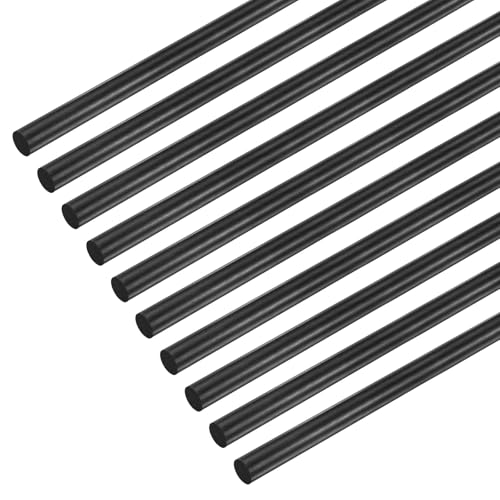
When your project demands the full 400mm length and a guaranteed straight rod.
This 10-pack from M METERXITY matches the Fielect set in both length and count, but it carves out its own niche with a slightly different material feel. The rods are solid carbon fiber, measuring 15.75 x 0.16 inches (400 x 4mm), and they come with a smooth surface that buyers report is exactly as described. One modeler who used them to fix a fishing pole reports they work well — just make sure you are ordering the right size for your tip diameter.
The key difference from the Fielect rods is that the M METERXITY set is a newer listing on the market, meaning you are getting fresh stock that has not sat in a warehouse. The feedback is consistent: “Great product, dimensions as stated. Perfectly suited for my application,” writes a buyer. For long control rod runs or kite spars, the 400mm length saves you from having to join two shorter rods together — always a weak point in a structure.
One thing to note: The brand recommends using carbon fiber cutting blades and storing the rods in a dry, flat place to prevent warping. This is good practice for any carbon rod, but it is a reminder to treat these as engineered materials, not disposable sticks.
Best for: Builders who need the full 400mm length for continuous wings spars or long pushrods — one piece is always stronger than a splice.
Skip if: You are on a tight budget and a shorter 300mm rod will do the job — the shorter VictorsHome is more budget-friendly.
5. MECCANIXITY Carbon Fiber Rod 4mm x 400mm (5-Pack)
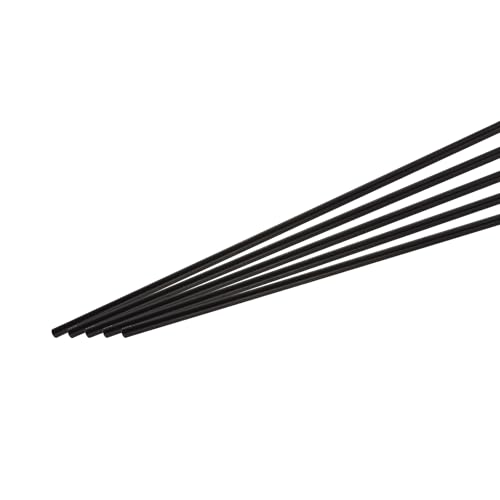
The smaller pack that proves five good rods can be exactly enough.
Not everyone needs a 10-pack. The MECCANIXITY set gives you five 400mm solid rods, which is the perfect count for a single repair job or a specific RC build. The carbon fiber is industrial-grade, and the 4mm diameter works smoothly for repairing a broken graphite fishing pole, as one buyer did, or reinforcing a quadcopter arm. Buyers consistently say the rods are “just as expected” and “exactly as advertised.”
At 400mm long, these are the same length as the Fielect and M METERXITY rods, but you get 5 sticks instead of 10. If you are someone who likes to buy only what you need and avoid surplus, this is a clean choice. The MECCANIXITY rods also come with a slightly higher stated tensile strength, though in practice all pultruded carbon rods of this diameter perform similarly under normal hobby loads.
Why choose this pack: Lower upfront cost and less unused inventory. Ideal for a one-off repair or for a builder who only needs to reinforce a single wing set.
Reach for this if: You are fixing one fishing pole or building one RC plane and do not want a stack of extra rods cluttering your bench.
Think twice if: You are stocking up for multiple projects — the 10-packs give you a better value per rod for the same length.
6. FAKILO Carbon Fiber Rod 4 x 420mm (10-Pack)
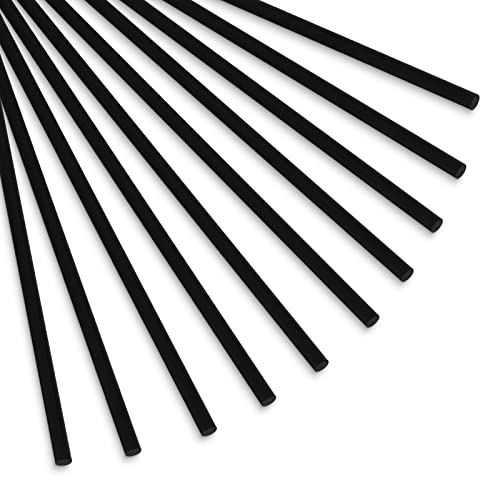
The extra 20mm that makes a real difference in larger wing spans.
At 420mm long, the FAKILO rods are the longest standard-size solid rods on this list. That extra 20mm over the 400mm options matters when you need a single, unbroken spar for a bigger kite or a wing that is just a bit wider than usual. The rods are high-hardness, pure carbon fiber with a smooth surface and uniform texture. One creative owner even used these to replace a broken shaft in a Danner water pump, cutting one to 7 inches — a repair that saved over buying a replacement impeller.
The 10-count pack gives you good value per rod, and owners mention they are “sturdier than the original” parts they replaced. The rods are also flexible enough for some applications — one user notes they are “strong, flexible, bendy” — so they can handle a bit of deflection without snapping, which is a useful trait for tent poles or kite spars that encounter wind gusts.
Honest caveat: A few buyers mention they wish the rods were even longer for their specific builds. At 420mm, this is the longest option here, but if you need a continuous rod for a 48-inch wing, you will need to join multiple pieces or step up to a larger diameter.
Best for: Kite builders and anyone repairing or building structures that need a bit more length than the standard 400mm — the extra 20mm is genuinely useful.
Not for: Builders who need short, compact rods for a tight foam slot — the 300mm VictorsHome rods are easier to handle in confined spaces.
7. uxcell Carbon Fiber Bar 4mm x 400mm (5-Pack)

A solid, anti-corrosion option for builds that live in harsh environments.
The uxcell rods are made from pultruded carbon fiber and are specifically noted for their corrosion resistance and resistance to aging. This makes them a strong candidate for outdoor applications — kite frames that face rain, tent poles that sit in damp ground, or multirotor arms that get splashed. At 400mm long, they offer the same reach as the M METERXITY and MECCANIXITY rods, but the uxcell set comes in a smaller 5-pack, which keeps the entry cost low.
Buyers in the RC community find them “very strong and very lightweight” for multiple uses in the flying world. However, there is a real mixed note: a couple of owners found that the rods arrived with a slight bend (up to 2mm end-to-end), and one noted that CA glue (cyanoacrylate) does not stick particularly well to the surface. For most builders, the straightness is fine — the majority report the rods as excellent — but if your project demands absolutely straight spars, inspect each rod on a flat surface before gluing.
Best fit: RC flyers and campers who need a corrosion-resistant rod that can stand up to moisture and outdoor exposure — the anti-aging properties are a real plus for long-term builds.
Consider carefully if: Your build requires perfectly straight rods with no deviation — the small chance of a slight bend means you may want to check each one before installation.
8. Awclub 4mm Carbon Fiber Bar 400mm (10-Pack)

The lightweight 10-pack that gets your kite or free-flight plane off the ground fast.
At 400mm long and 4mm thick, the Awclub rods are marketed for stunt kites, R/C cars, and helicopters — and the buyers confirm they deliver. The rods are described as lighter than aluminum yet stronger than steel, a classic carbon fiber promise that holds true in this set. One buyer used them to repair a broken hollow fishing rod tip, epoxying the carbon rod inside the fiberglass shaft and whipping the joint with thread and epoxy. Another modeler uses them for lightweight capacitor free-flight planes and reports the rods have done the job well.
The finish is matte and the rods are generally dimensionally accurate, though a couple of owners noted a slight bow in some pieces when rolled across a flat table. For most hobby applications — free-flight planes, kite frames, general reinforcement — this is not an issue. The fact that the rods are so light (the item weight is listed at 0.09 kilograms for the whole pack) means your model stays airworthy without unnecessary heft.
The main thing to be aware of: The 1mm rods in this brand’s lineup reportedly run small at 0.7-0.9mm, but the 4mm rods in this set appear to match the specification more closely. If you need absolute precision for a tight-fit application, measure each rod before you cut.
Who this works for: Free-flight and RC modelers who need a lightweight, strong rod for internal wing reinforcement — the low weight per rod helps keep the overall build light.
Who might want to skip: Anyone who needs guaranteed dead-straight rods for visible external bracing — inspect the set for slight bows before you commit to a visible installation.
Understanding the Specs
Pultrusion vs. Woven Carbon Fiber
Pultrusion is a manufacturing process where continuous carbon fibers are pulled through a heated die filled with epoxy resin. The result is a rod with all fibers aligned in one direction — the length of the rod. This gives it very high axial strength and stiffness, which is exactly what you need for a pushrod or wing spar. A woven or “twilled” carbon tube has fibers crisscrossing for multidirectional strength, but at 4mm diameter, almost all affordable rods are pultruded. That is perfectly fine for hobby use.
Solid vs. Hollow (Tube)
A solid 4mm rod is simple to cut, glue, and sand. It is the default choice for most repairs and reinforcement. A hollow tube (often marked as 4.0×2.0mm, meaning 4mm outer diameter and 2mm inner diameter) saves weight dramatically — around 4.4 grams per 300mm piece. That matters for tail-heavy planes or lightweight kites. The catch: hollow tubes require a fine-tooth saw and a careful cutting technique to avoid crushing the thin walls. Always seal the cut end with thin CA glue to prevent delamination.
FAQ
What is the difference between a 4mm carbon fiber rod and a 4mm carbon fiber tube?
Can I cut a 4mm carbon fiber rod with a regular hacksaw?
Will a 4mm carbon fiber rod fit inside a standard 4mm guide tube?
Which glue works best for bonding 4mm carbon fiber rods?
How much weight can a single 4mm solid carbon fiber rod support?
What does pultrusion mean for a 4mm carbon fiber tube?
Is a 4mm carbon fiber rod strong enough for a fishing rod repair?
Can I use a 4mm carbon fiber rod for a tent pole?
How do I store 4mm carbon fiber rods to keep them straight?
What is the difference between matte and glossy carbon fiber rods?
Final Thoughts: The Verdict
For most builders, the 4 carbon fiber tube winner is the Fielect 10-Pack because it delivers the best combination of dimensional accuracy, clean surface finish, and straightforward cutting — backed by a broad consensus of happy buyers. If you need the lightest possible hollow tube for a weight-critical model, grab the cncarbonfiber 8-Pack, which saves grams without sacrificing stiffness. And for a budget-friendly 300mm option that works across RC builds, ice fishing jig sticks, and general DIY, the VictorsHome 10-Pack is the one to reach for. The beauty of this category is that at 4mm, even the budget options are remarkably good — choose by length and wall type, and you will build something that lasts.
How We Picked
We do not accept paid placement. Every pick is matched to a real buyer and a real use-case; we do not hands-on test units.
Sources & Methodology
Specifications: manufacturer listings and product documentation. Review insights: verified customer reviews, as of July 2026. Pricing: not shown on this page (it changes often); check the current price via the retailer link.
As an Amazon Associate, Gadgets Feed earns from qualifying purchases. This does not affect which products we feature.