
Our readers keep the lights on and my morning glass full of iced black tea. As an Amazon Associate, I earn from qualifying purchases.
Specs are compiled from manufacturer listings and verified buyer reviews and can change over time — please confirm the key details on the product page before buying.
Marine amps get dunked, splashed, and baked in UV light — a regular car amp dies fast in that world. You need clean, loud music that survives water, salt, and UV on the dock, dunes, or trail. The right pick is a true 4-channel marine amp with an IP rating and RMS power matched to your boat’s speakers.
I’m Min — the founder and writer behind Gadgets Feed. This guide is built by comparing the manufacturers’ published specifications and the patterns across verified customer reviews, so you get each pick’s real strengths and trade-offs instead of marketing spin.
Every amp here is a true 4-channel unit rated for marine use, so this 4 channel marine amp shortlist helps you choose the right one for your boat or off-road rig.
Our Picks at a Glance


How To Choose The Best 4 Channel Marine Amp
Buying a marine amp means focusing on two things: clean RMS power and resistance to water, salt, and sun. A 4-channel amp powers two pairs of speakers, the standard setup for boats and off-road vehicles.
Look for the IP rating first
An IP rating (Ingress Protection) tells you exactly how much water and dust the unit can take. A rating like IPX6 or IP67 means the amp is built to handle direct spray or even temporary submersion — you want that if the amp sits exposed on a console or under a seat that takes waves.
Match the RMS power to your speakers
RMS (Root Mean Square) is the continuous wattage an amp delivers, not the peak number advertisers love. Match the amp’s RMS per channel to your speakers’ RMS rating — too little causes distortion, too much can blow a speaker if you crank the gain.
Consider the class of amplifier
Class D amps run cooler and draw less battery power, a big deal on a boat. Class A/B amps cost less and sound warm but generate more heat and drain batteries faster, suiting occasional use or short trips.
Quick Comparison
| Model | Best For | Power (RMS) | Water Rating | Weight | Amazon |
|---|---|---|---|---|---|
| Rockford Fosgate TM400X4ad★ Best Overall | High-output marine audio | 400W (100W x 4 @ 4Ω) | Element Ready | — | Amazon |
| Rockville RXM-S30Best Value | Budget-friendly power | 600W RMS (150W x 4 @ 2Ω) | Water-resistant | 8 lbs | Amazon |
| Pyle PLUTVRKBT200X4Bluetooth Bonus | Budget retrofits with Bluetooth | 600W Max | IP-X6 | 3.65 lbs | Amazon |
| Stinger MT-600.4M | Compact power with remote bass | 1000W RMS (250W x 4 @ 2Ω) | Marine-grade | 5.57 lbs | Amazon |
| NVX VADM4 v2 | Micro size for tight spaces | 500W RMS (125W x 4 @ 2Ω) | Marine-grade | — | Amazon |
| NVX MVPA4 | Waterproof micro power | 400W RMS (100W x 4 @ 2Ω) | IPX67 | 3.1 lbs | Amazon |
| DS18 NXL-N4 Hydro | Compact premium power | 720W Max | IP67 | — | Amazon |
| Garmin Fusion Signature | Full marine systems | 1400W | Die-cast chassis | 2.6 lbs | Amazon |
| Rockford Fosgate M5-800X4 | Ultimate rugged performance | 800W (200W x 4 @ 2Ω) | IPX6 | 4.2 lbs | Amazon |
In‑Depth Reviews
1. Rockford Fosgate Power TM400X4ad
Our pick — over 4.5★ from 300+ verified ratings; the strongest balance of quality and price.
The fortress of marine audio that packs serious muscle into a tiny chassis
You get true Rockford Fosgate build quality here, and it shows in the 400 watts of Constant Power that delivers 100 Watts x 4 @ 4-Ohm or 200 Watts x 2 @ 4-Ohm Bridged. The proprietary Class-AD technology runs efficiently, and the Element Ready design shields it against dust, UV, and corrosion — the exact trio that kills boat amps.
Owners routinely install this in side-by-sides and Harley fairings, running two 6.5″ Kickers up front and two 8″ Kickers in the rear with clean, detailed sound. What wins people over is performance, and the sound quality trails closely behind; the on-board Punch EQ with +18dB boost @ 45Hz and a 12dB/octave Butterworth crossover gives you serious tuning range without external gear.
The compact 1.6” x 4.3” x 8.3” footprint slides into tight fairings, but the high-level auto turn-on and CLEAN circuit clip detection save your speakers from distortion at high volume. The crowd favorite here earns its top spot — 4.6 stars across 300+ owners who report it holds up mile after mile.
What wins owners over
- Constant Power delivers more output where you hear it
- Compact size fits fairings and consoles with room to spare
- Soldered pigtail wires resist vibration loosening
Watch out for
- Ships with the wrong front input cord on some units
- Premium price for a smaller power figure than others here
The pick for: anyone who wants proven Rockford reliability and clean, powerful sound in a compact marine package.
Think twice if: you need the absolute highest wattage per dollar — cheaper units here deliver more raw power.
2. Rockville RXM-S30
The budget beast that rattles windows and shrugs off a hose-down
For pure power per dollar, this Dyno-Certified amp delivers 4x90W RMS @ 4Ω or 4x150W RMS @ 2Ω — and owners max it out running eight 6.5″ marine speakers plus tweeters with clean output. It’s a heavyweight at 8 pounds, more than double the Pyle below, but that heft comes with high-speed MOSFET supply and a >90dB signal-to-noise ratio for stable, distortion-free sound.
The water-resistant construction and conformal-coated PCB handle harsh outdoor life; one boat owner ran it two months flawlessly, and a side-by-side rider hosed the whole buggy down with no issues after a year mounted on the roof. Sound quality is what people praise most, with performance close behind — the bass is strong enough that one pontoon owner had to dial back the head unit’s bass setting.
Flexible configuration lets you run 4-channel stereo, 2-channel bridged, or 3-channel mixed-mono for a subwoofer setup, all in a 6.7″ x 1.98″ x 12.28″ micro footprint. It comes with a boating microphone for a PA system, though that mic can screech from interference — treat it as a bonus, not a feature you’ll rely on.
Raw power, real value: this is the loudest budget amp you can bolt to a boat, and the review pages sum it up as “great amp at a great price.”
The honest trade-off: it’s heavy, and the PA mic is a gimmick, not a tool.
Reach for this if: you want maximum SPL for the smallest spend and don’t mind extra weight bolted to the hull.
Look elsewhere if: you’re counting every ounce on a small watercraft or need true IP-rated waterproofing.
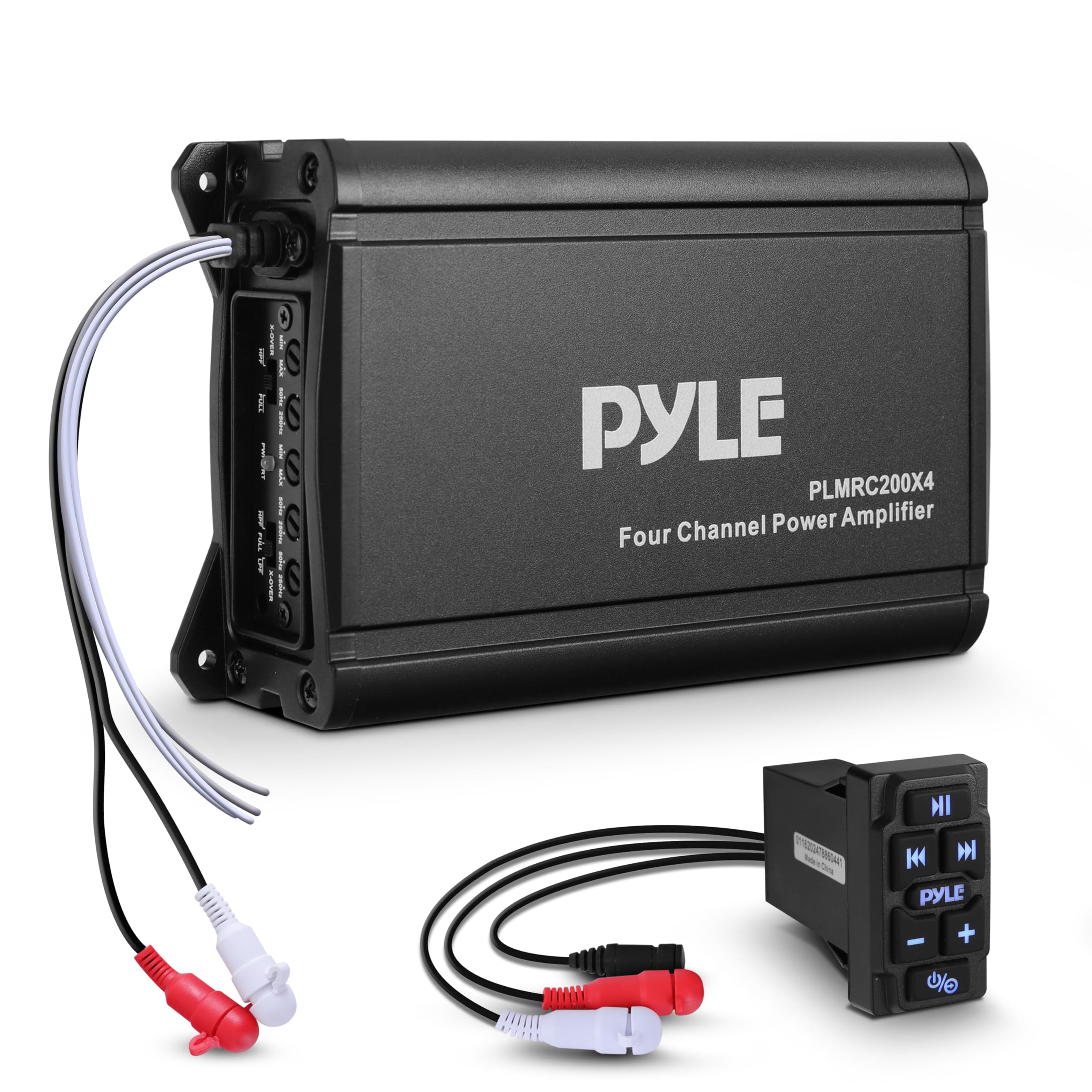
3. Pyle PLUTVRKBT200X4
The budget retrofit kit that streams music straight to an old pontoon
If you’re adding sound to a beat-up boat without ripping out the dashboard, this is the amp — it’s a 4-channel unit with a wireless Bluetooth receiver built in, so you skip the head unit entirely. It streams via BT 5.0 with a range up to 30+ ft, pairing to all of today’s devices, and it accepts wired RCA, AUX, and MP3 input for flexibility.
The waterproof and weatherproof build carries a marine-grade IP-X6 rating (an Ingress Protection rating meaning it withstands powerful water jets), plus rugged construction and an integrated power wiring harness. On a budget pontoon retrofit with a pair of Pyle 2-way outdoor speakers up front and a bridged 8-inch 4-Ohm Bazooka on the rear channels, the sound fills the deck.
It’s the lightest pick here at 3.65 pounds, under half the Rockville’s 8-pound heft, but reviews split sharply on one thing: heat. An occasional unit overheats during heavy use, so mount it in a well-ventilated spot, and the instructions can be vague.
Perfect for budget retrofits: wireless streaming plus weatherproofing in one lightweight box is rare at this price.
Keep it cool: ventilation is not optional with this one, and instructions demand patience.
Best for: old pontoons and side-by-sides where you want Bluetooth without a head unit and light weight matters.
skip it if: you plan to push it hard for hours — the heat complaints are real.
4. Stinger Audio MT-600.4M

The deck mount that puts subwoofer volume at your fingertips
The headliner feature here is the included remote bass knob with a dash bracket, so you control subwoofer volume from the driver’s seat on a console or dash panel. Underneath that, the compact Class D chassis delivers up to 250W x 4 @ 2 ohms, 150W x 4 @ 4 ohms, or 500W x 2 @ 4 ohms bridged — real headroom for a 4×4 or pontoon.
Built with advanced HEXFET power MOSFETs (metal-oxide-semiconductor field-effect transistors that switch fast and run cool), it works with both OEM and aftermarket systems. Cut the RCA connectors to use speaker-level high input, or connect preamp cables for low-level input — that flexibility saves you from buying a separate line converter.
Owners run 8-inch subs on channels 1 and 2, enough to hear over wind and a 250SHO engine, and the thing actually pushes what it claims. Sound quality leads the praise, with reliability close behind — it’s the sort of compact amp that disappears into a center console locker and just keeps playing.
The strengths
- Remote bass knob with flush dash mount
- High and low pass crossovers with multiplier
- Compact 6.10″ L x 9.29″ W x 2.09″ H chassis
The limits
- An occasional defective unit means a slow refund process
- No true IP waterproof rating
Who it suits: boat and 4×4 owners who want subwoofer control at the helm without aftermarket extras.
Who it doesn’t: anyone leaving an amp exposed to direct spray — keep this one in a dry locker.
5. NVX VADM4 v2
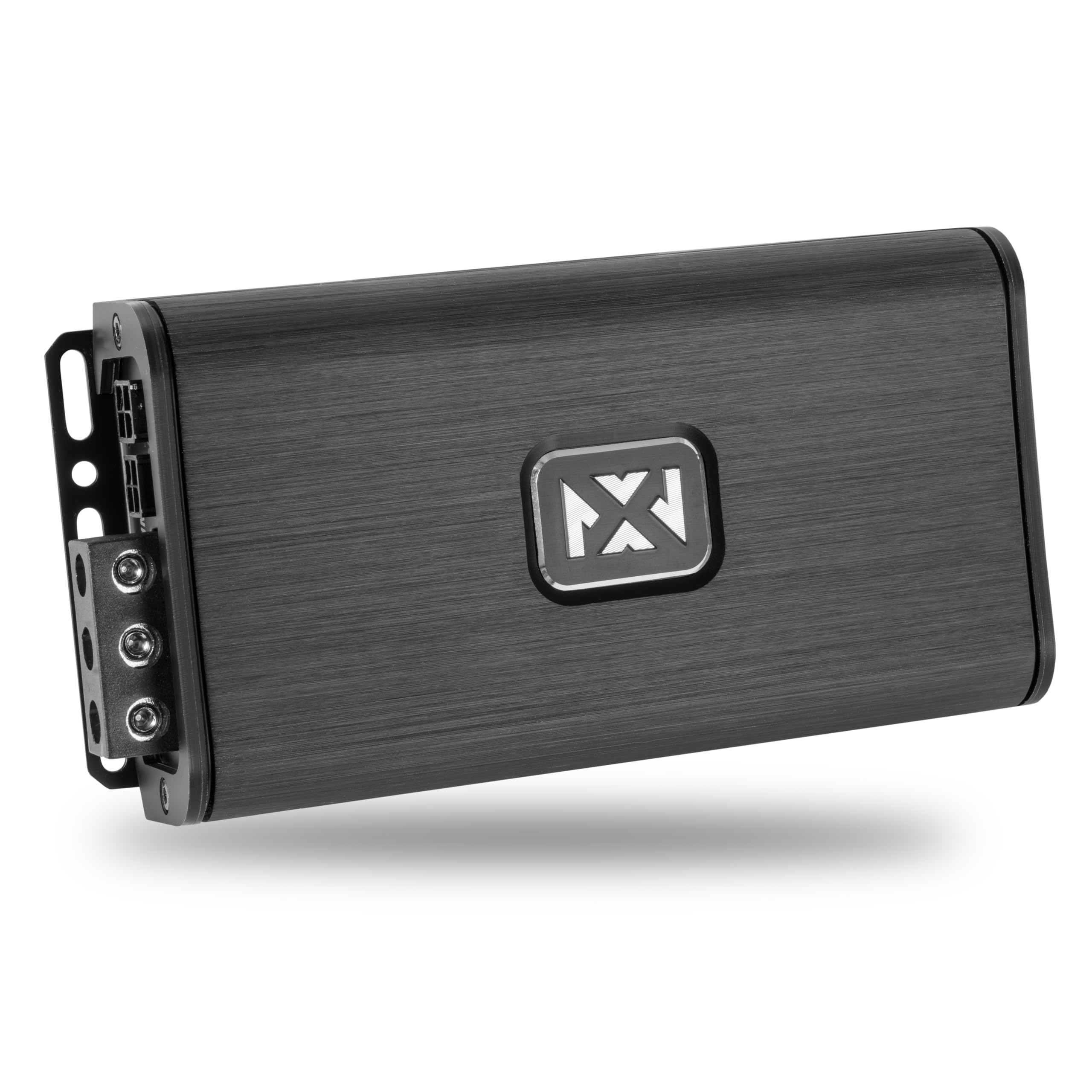
The 1.48-inch-tall amp that hides under a steering wheel and roars
This is the amp for tight spaces — at 6.49″ L x 3.3″ W x 1.48″ H, it’s roughly the size of three stacked phone cases, and owners tuck it behind dashboards in Jeeps and in Goldwing fairings. Micro Class D technology keeps it that small while delivering 80 watts x 4 channels at 4 ohms and 125 watts x 4 channels at 2 ohms.
The conformal coated marine-grade circuit board is built for water, dust, and vibration, with 4-way protection circuitry (thermal, overload, speaker short, and DC offset) to keep it alive in harsh conditions. Selectable crossover modes — FULL, HPF, LPF — with variable filters from 40-400 Hz give you real tuning control across a 20-20,000 Hz frequency range.
Size is the thing everyone raves about, and quality follows, but there’s a catch: this unit runs hot. Buyers report it needs airflow to prevent meltdown, and reliability gets mixed feedback — a few units failed within 60 days, though many others run fine for years.
The tiny mighty amp: if you need to hide an amp in a tight spot, this one fits where others won’t.
The real constraint: heat management is on you — give it airflow or it’ll punish you.
Reach for this if: you’re mounting behind a dash, under a seat, or in a fairing with minimal clearance.
Look elsewhere if: you want a fully sealed amp you can bolt to an exposed deck.
6. NVX MVPA4

The postcard-size amp that’s fully sealed and still drowns out your exhaust
You can bolt this amp to an exposed marine deck without worry because its IPX67 rating (a dust-tight seal that survives temporary submersion) keeps water out. At 7.09 x 5.91 x 2.28 inches and 3.1 pounds, it slips into tight spots—owners have fitted it into a 2010 Electra Glide fairing. They report it delivers roughly 115W RMS at 4Ω x 4 (about 115 watts per channel into 4-ohm speakers), beating its own 50W x 4 @ 4 ohms spec.
The Micro Class D design runs cool, which is rare for a marine amp, and the 100W x 4-Chan. @ 2 ohms output powers 2×6.5″ plus 2x6x9″ speakers on a Harley loud enough to drown out the pipes. Sound quality is the top praise, with build quality close behind — it’s a genuine set-and-forget unit for boaters and powersports riders.
A 2/4-channel input selector saves your head unit’s pre-outs, and owners mention no distortion or clipping even at 80 mph. The one recurring complaint is the wiring, which some find flimsy; treat the harness gently during install.
Truly waterproof, truly powerful: IPX67 sealing with real output in a package that hides on a postcard.
The catch: wiring quality is the weak link — secure it well and it’ll serve you for years.
Best for: boats, ATVs, and motorcycles where the amp sits outside the cabin and takes real weather.
pass on it if: you need more than 400W for a full-size boat with big subwoofers.
7. DS18 NXL-N4 Hydro
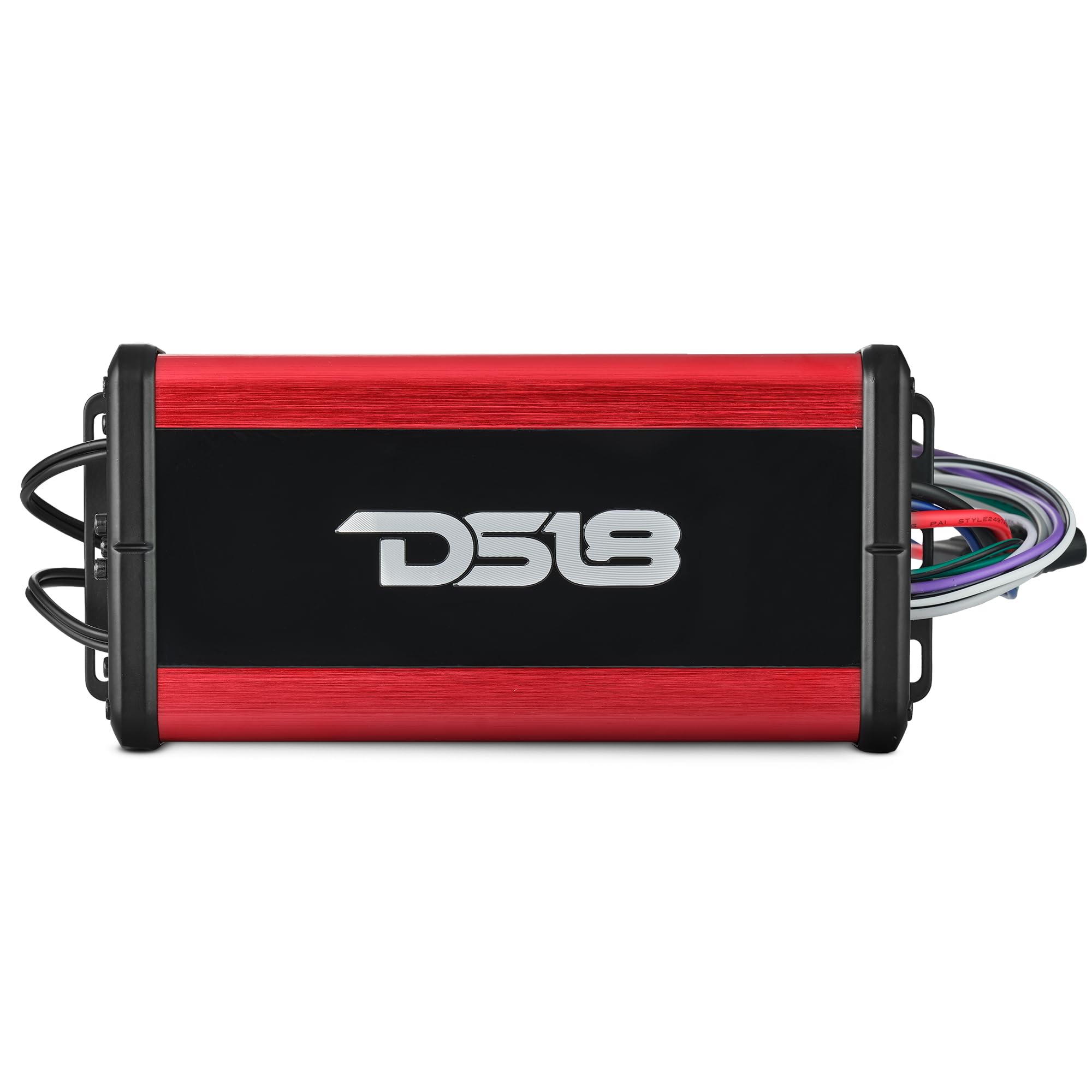
The little Hydro that fills a Spyder fairing with room to spare
DS18 built this ultra-compact 4-channel amp on a stable 4-layer PCB layout, and its IP67 waterproof rating makes it ideal for open-air power sports. Owners buy it in pairs — one for a Can-Am Spyder, one for a Ryker — and report it fits with space left over while delivering “little buck big on sound.”
The selectable X-Over feature gives you LPF (Low Pass Filter), FULL range, and HPF (High Pass Filter) options, so you can power an entire system from deep bass to crisp highs with one compact box. At 720W max, it’s not the biggest power figure here, but the engineering focus is on consistent performance in brutal conditions.
It sits between the 600W budget amps and the 1400W Garmin on power, but its true value is the sealed build in a tiny footprint. This is the premium pick for riders and boaters who want DS18’s reputation for toughness without a full-size chassis.
Small, sealed, serious: the Hydro is what you buy when you need IP67 confidence in a package that disappears into a fairing.
The trade-off: you pay a premium for the compactness, and power output is modest at this price.
Who it’s for: Spyder, Ryker, ATV, and compact boat owners who want waterproofing without a bulky amp.
Who it’s not for: anyone chasing maximum wattage — look at the Rockville or Stinger for that.
8. Garmin Fusion Signature Series
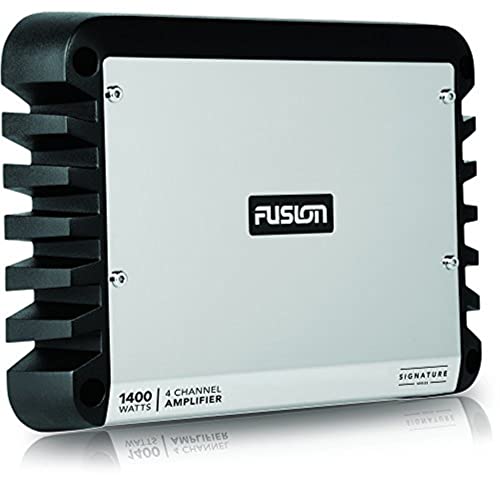
The 1400-watt powerhouse that turns a day boat into a concert venue
This is the amp for a complete Fusion marine system — pair it with a ud650 head unit and four 6-inch Fusion speakers and you get clean, clear sound at serious volume. The high-efficiency 1400-watt design keeps battery drain low while delivering enough power to feel like you’re at a concert on your own boat.
The 1-piece heavy-duty die-cast chassis provides strength, and 5-way circuitry protection covers thermal, reversed power polarity, DC offset, and high/low voltage — a serious safety net for a boat’s electrical system. At just 2.6 pounds, it’s surprisingly light for the power, though owners note it runs cool to the touch.
The honest catch: this is not waterproof, so owners warn to keep it in a dry location—unlike the IP-rated picks above. Pair it with Fusion’s ecosystem for smooth integration, but tuning it without a pro is genuinely difficult. it’s not for you if you need full water protection; choose it if stealth placement matters more.
Serious marine sound: the Fusion is the centerpiece for a full high-end boat audio build.
Read the fine print: it needs a dry mount and patience to tune — this is power for the dedicated.
Best for: boats with Fusion head units where you want maximum clean output and don’t mind a protected mounted spot.
Not for: exposed installs, because water here means a dead amp.
9. Rockford Fosgate M5-800X4

The IPX6-sealed flagship that’s built as rugged as the environment it lives in
This is Rockford’s next-level Element Ready design, with an IPX6 rating that stands up to water, dust, mud, and UV rays. Its 800-watt output comes with Dynamic Power ratings — 125 Watts x 4 @ 4Ω, 200 Watts x 4 @ 2Ω, or 400 Watts x 2 @ 4Ω bridged — delivering more output where you actually hear it.
The ultra-compact 1.7″ x 4.25″ x 8.41″ chassis carries the same Constant Power, Class-AD, and C.L.E.A.N. technologies as the Power Marine series, all engineered and validated in Tempe, Arizona. At 4.2 pounds, it’s the beefiest of the premium picks, and the full 2-year warranty backs the famous Rockford Fosgate build quality.
The highest-rated amp in this roundup at 4.7 stars, owners can’t stop calling it “the best amplifier of my life” and praise its build quality. It’s pure plug-and-play for boats and off-road rigs, though one buyer hit setup trouble — and at this price, you’d want a pro install if you’re not handy with wiring.
The flagship standard: genuine IPX6 sealing with Rockford’s proven sound — the safest premium bet here.
The price of entry: it’s the most expensive pick, and you’re paying for that rugged badge.
Reach for this if: you want the best-reviewed, most weatherproof amp that will outlast your boat.
Look elsewhere if: your budget tops out below this tier — the TM400X4ad gives you Rockford quality for less.
Understanding the Specs
Power: RMS vs Peak
RMS (Root Mean Square) is the honest power an amp delivers continuously, while peak is the brief maximum it can hit. A 1400W peak amp might only deliver 500W RMS — always compare RMS numbers when matching an amp to your speakers.
Waterproofing: IP Ratings
An IP rating (Ingress Protection) tells you exactly how much water and dust a unit survives. IPX6 handles powerful water jets, while IP67 adds full dust protection and temporary submersion — choose based on whether your amp sits exposed or in a dry locker.
FAQ
What is the difference between RMS and peak power on a marine amp?
How waterproof does a marine amp need to be for a boat?
Can I use a regular car amp on my boat?
What does bridging a 4-channel amp do?
How do I match a marine amp to my speakers?
What is the difference between Class D and Class A/B marine amps?
Will a marine amp work in my ATV or side-by-side?
Do I need a separate Bluetooth receiver with my marine amp?
What is a conformal-coated PCB?
How much power do I need for a pontoon boat?
Final Thoughts: The Verdict
For most buyers, the best 4 channel marine amp is the Rockford Fosgate TM400X4ad because it combines proven reliability, compact design, and Rockford’s famous build quality in a marine-rated package. If you want maximum wattage for your dollar, the Rockville RXM-S30 is the crowd-pleasing value king. And for the absolute top-tier weatherproof performance, the Rockford Fosgate M5-800X4 with its IPX6 rating and 4.7-star owner approval is the one to reach for.
How We Picked
We do not accept paid placement. Every pick is matched to a real buyer and a real use-case; we do not hands-on test units.
Sources & Methodology
Specifications: manufacturer listings and product documentation. Review insights: verified customer reviews, as of August 2026. Pricing: not shown on this page (it changes often); check the current price via the retailer link.
As an Amazon Associate, Gadgets Feed earns from qualifying purchases. This does not affect which products we feature.