
Our readers keep the lights on and my morning glass full of iced black tea. As an Amazon Associate, I earn from qualifying purchases.
Specs are compiled from manufacturer listings and verified buyer reviews and can change over time — please confirm the key details on the product page before buying.
You want to send music to different rooms or speakers from one box, but you are stuck choosing between overpaying for a brand name or risking a cheap amp that buzzes, hums, or dies. The real difference between a receiver that disappears into your setup and one that becomes your daily headache depends on four things: genuine channel count, real RMS power versus inflated peak numbers, the quality of the remote and Bluetooth, and how many sources you can actually plug in.
I’m Min — the founder and writer behind Gadgets Feed. This guide is built by comparing the manufacturers’ published specifications and the patterns across verified customer reviews, so you get each pick’s real strengths and trade-offs instead of marketing spin.
From power ratings that exaggerate to remotes that barely function, here is what actually matters when you choose a 4 channel stereo receiver and which models hold up under real daily use.
Quick Picks
- Pyle 300W 4-Channel Home Audio Power Amplifier — Best Overall
- Rockville RPA40BT 1000W 4 Zone Home Stereo — Best Value
- Pyle 4-Channel 1000W Power Amplifier — Top Performer
- Pyle 4 Channel Bluetooth Home Amplifier — Premium Pick
- Rockville Home Matrix 4-Zone 8-Channel 600W — Most Versatile
- Marantz M-CR612 Network CD Receiver — Hi-Fi Compact
How To Choose The Best 4 Channel Stereo Receiver
Before you compare models, understand that a 4-channel receiver is not about surround sound. It is about sending independent audio to different speakers or zones — think music in the kitchen and living room at once, or powering outdoor speakers from one central box. Your choice really depends on how many speakers you need to drive and how much control you want over each one.
Match Power to Your Speakers
The single biggest trap is chasing the peak wattage number printed in big bold letters on the box. That figure tells you almost nothing about how clean the amp sounds at normal listening levels. The RMS figure (the continuous power the amp can deliver without distortion) is what you should compare, and it is often far lower than the peak number. For most home setups, a receiver delivering solid RMS per channel will easily drive bookshelf or patio speakers; only large, power-hungry speakers need a higher RMS rating, not a higher peak number.
Count the Real Channels, Not the Labels
Some receivers advertised as 4-channel actually run in stereo mode only, which means you cannot independently control each pair of speakers. True multi-room flexibility requires independent volume control per zone. If you want separate music in different rooms, look for explicit zone volume knobs or app control. If you simply need more speaker pairs wired to the same sound source, a straightforward 4-channel amp works fine.
Prioritize the Annoying Details: Remote, Bluetooth, and Inputs
These are the things that determine your daily happiness more than any spec sheet. A flimsy remote with no power button will frustrate you every single day. Bluetooth that drops out when you walk across the room defeats the purpose of wireless streaming. And count your actual sources — if you have a TV, a turntable, and a phone, you need enough inputs like optical, RCA, and USB to connect them all without constantly swapping cables. Check the impedance rating (measured in ohms) matches your speakers, usually 4 or 8 ohms, to avoid overdriving them.
Quick Comparison
| Model | Best For | Peak Power | Zones / Speakers | Key Inputs | Amazon |
|---|---|---|---|---|---|
| Pyle PT390AU | Karaoke & simple whole-home sound | 300W | 4 pairs of speaker posts | USB, RCA, 2 Mic, FM | Amazon |
| Rockville RPA40BT | True independent multi-room zones | 1000W | 4 zones, up to 8 speakers | RCA, USB, SD, Optical, FM | Amazon |
| Pyle PD1000BA | All-in-one with CD/DVD & Bluetooth | 1000W | 4 channels + sub out | USB-A, FM, AUX, 2 Mic, CD/DVD | Amazon |
| Pyle PD3000BA | High-volume karaoke & events | 3000W | 4 channels | Optical, RCA, USB, 2 Mic, FM | Amazon |
| Rockville Home Matrix | Serious independent zone control | 600W RMS | 4 zones, 8 channels | Bluetooth, USB, Optical, Coaxial, RCA, Mic | Amazon |
| Marantz M-CR612 | Hi-fi streaming & CD in a compact box | — | 2 rooms / 4 channels (60W x 2 or 30W x 4) | Wi-Fi, Bluetooth, Optical, CD, USB | Amazon |
In-Depth Reviews
1. Pyle 300W 4-Channel Home Audio Power Amplifier (PT390AU)

The boardroom and pool-deck workhorse that keeps whole venues audible without a fuss.
This is the receiver you buy when you need loud, reliable sound for a community space — a town pool, a boardroom, a small club. The 300W peak power drives multiple speakers with a 4-16 ohm impedance range, which is wide enough to handle most commercial and home speakers you already own. Its real superpower is simplicity: the people running it day-to-day just need to turn it on, and the crowd-focused layout makes that easy.
It has 7 inputs covering phones, computers, iPads, USB drives, AM/FM radio, and DVD/CD players, plus 2 microphone inputs for karaoke and announcements. The mic echo, bass, treble, and volume controls give you full command over the output, and the blue LED-lit buttons and digital LCD display keep everything readable even in a dimly lit room. Buyers report the power and ease of use win people over immediately, and the phrase “This is the second one I’ve bought” sums up the loyalty it earns for institutional use.
The trade-off here is honest and important: sound quality gets mixed reviews, with some owners noting a hum across all channels. It has no Bluetooth from the start — you will need a cheap auxiliary adapter — and the FM/AM tuner can be fuzzy. The flimsy remote lacks a convenient power button, so treat it as a set-once-and-leave unit rather than a daily control surface.
What Wins People Over
- easy setup — the rare amp you can hand to staff and walk away
- Plenty of clean power for multi-speaker PA and karaoke setups
- Mic effects and EQ give you real control over live sound
Know Before You Buy
- Mixed sound quality — an occasional hum can show up on all channels
- No built-in Bluetooth; you will need an adapter for phone streaming
- Remote is flimsy and lacks a power button
Reach for it if: you run a venue or shared space and need an unkillable, easy-to-operate amp for announcements and background music.
Look elsewhere if: you demand pristine audiophile sound or refuse to add a separate Bluetooth adapter.
2. Rockville RPA40BT 1000W 4 Zone Home Stereo Bluetooth Amplifier Receiver

The budget multi-room brain that gives each corner of your home its own volume dial.
If your goal is music in the kitchen, living room, patio, and office — each at its own volume — this Rockville is the value play. It powers up to 4 independent zones with individual volume control and supports up to 8 speakers (2 per zone), which is a level of flexibility you rarely see at this price. It delivers 62.5W RMS per channel (250W total RMS) and 1000W peak power, with a 20Hz-20kHz frequency response for 4 or 8-ohm speakers.
Connectivity is genuinely versatile: RCA, USB, SD card, optical, and FM radio inputs cover both modern and older gear, and the built-in Bluetooth gives you a wireless range around 35 feet. It also has dual 1/4-inch mic inputs on the front with echo, bass, and treble controls, so karaoke night is covered. Owners running five sets of speakers throughout a house report they all sound terrific, and one setup success story had the amp driving 12 speakers via a switch/combiner with no hissing issues.
The honest downside is that this unit is a bit of a lottery on arrival. Several owners mention units arriving with no sound output at all, and some units show up scratched or dinged, suggesting quality control is inconsistent. One buyer’s verdict — “It works as expected except the remote control only works with BT or FM but not with digital/TV sound so I cannot adjust or mute my TV sound” — flags a real limitation if you wanted to use it as a TV hub. And for movie nights, an internal fan that is “so loud” can ruin the experience. This is a high-value pick if you get a good unit, but check it thoroughly on arrival.
The Multi-Room Appeal
- Independent volume per zone — rare control at this price point
- Solid 62.5W RMS per channel for daily listening
- Wide input selection including optical and SD card
The Arrival Lottery
- Some units arrive dead with no sound output
- Remote refuses to work with digital (TV) audio sources
- A loud internal fan can be audible during quiet scenes
Grab it for: the budget-conscious buyer who wants true per-zone volume control across a whole home without paying premium prices.
Think twice if: you need it to double as a TV sound bar replacement, given the remote’s incompatibility with digital TV audio.
3. Pyle 4-Channel 1000W Power Amplifier with Bluetooth (PD1000BA)

A one-box media hub with triple the peak power of the PT390AU, ready for garage and pool parties.
This Pyle gives you 1000W peak power — a full 3.3x step up from the PT390AU — across 2-8 ohm speakers, which means it can drive big outdoor and garage setups without breaking a sweat. Unlike the Best Overall pick, it has Bluetooth built in, so you can stream straight from your phone, tablet, laptop, or computer with low-maintenance receiver pairing. That alone solves the biggest complaint leveled at its smaller sibling.
It is a true all-in-one: 7 inputs including a front-loading CD/DVD player, USB-A with MP3 playback, an FM tuner, AUX, 2 microphone inputs with echo for karaoke, a dedicated headphone jack, 1 RCA preamp output, and 2 mono RCA outputs for a subwoofer. The digital fluorescent display shows your source and settings, and bass and treble rotary controls let you tune the sound to the room. The sound quality is what owners consistently praise — loud enough to hear a pin drop with extra wattage for a crisp, clean top end — and one buyer found it drives “4 speakers+sub” with surprisingly good results for the money.
The catch is reliability and fiddly operation. The manual is vague and Bluetooth pairing can be frustrating — one owner spent 2 hours getting it to pair with a Samsung Tizen TV. The remote is cheap, with a sensor that is easily blocked, and the CD/DVD drawer is flimsy. Multiple customers note units failing across different functions — one had a good CD player but dead Bluetooth, another the opposite. It is a lot of capability for the price, but be ready to troubleshoot and possibly exchange a defective unit.
Where It Shines
- Built-in Bluetooth and CD/DVD make it a complete media hub
- 1000W peak power easily drives multiple speakers plus a sub
- Owners agree the sound is crisp and loud for the price
The Fiddly Side
- Bluetooth pairing can be time-consuming, especially with TVs
- Reliability is a coin flip — some units arrive with dead functions
- Cheap remote and a flimsy disc drawer feel fragile
Pick it up for: a Bluetooth-first buyer who also wants a CD/DVD player and big peak power for parties, all in one chassis.
Be ready for: some setup friction and the possibility you may need to exchange for a fully working unit.
4. Pyle 4 Channel Bluetooth Home Amplifier (PD3000BA)
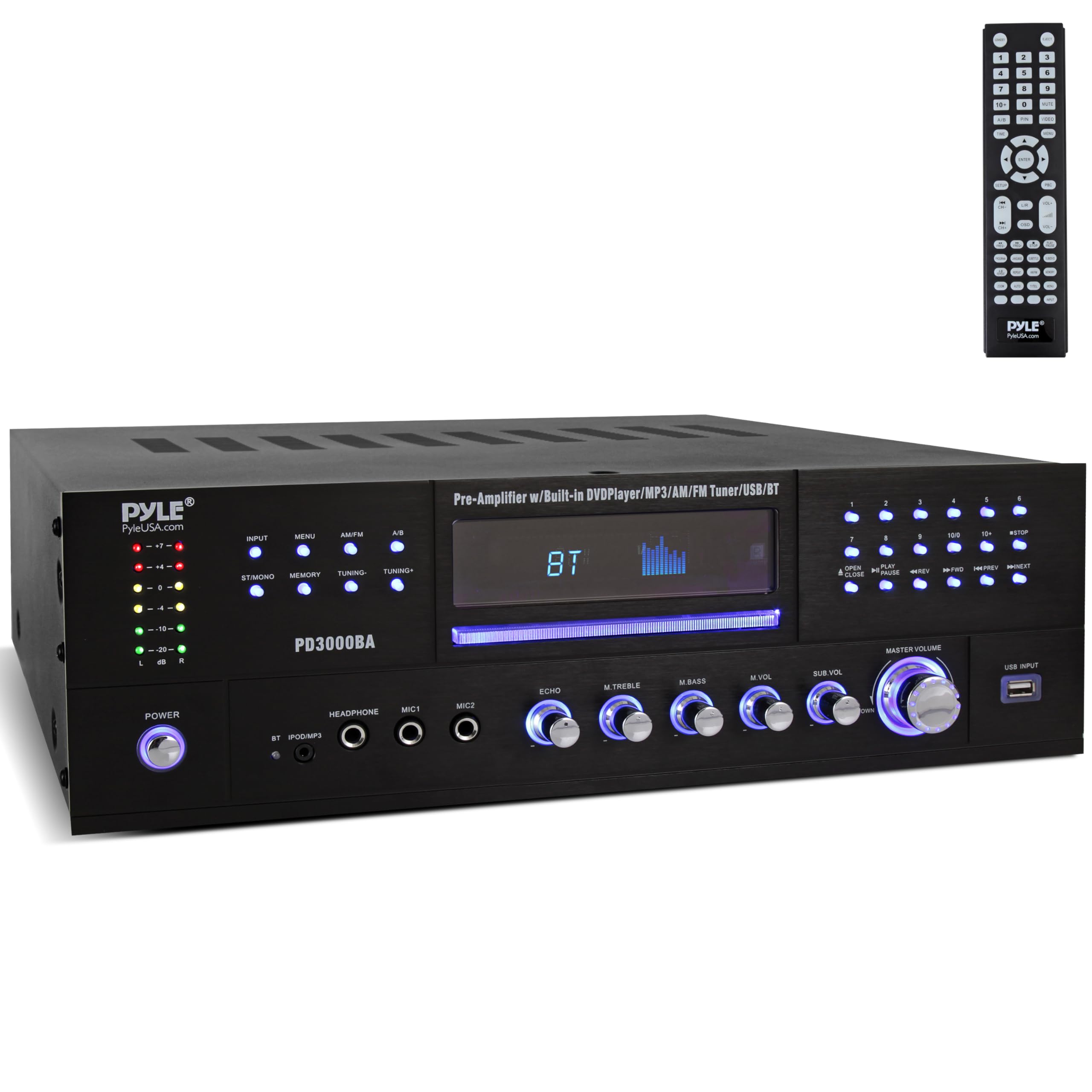
The living-room-friendly monster that brings serious headroom for karaoke nights and big speaker arrays.
This is the Pyle for buyers who want the maximum power ceiling without stepping into rack-mounted commercial gear. It pushes a claimed 3000W peak power and is recommended for speakers with 2-8 ohm impedance, so it handles big, power-hungry towers and outdoor speakers with obvious headroom to spare. The built-in front-loading CD/DVD player with a digital audio converter has its own fine-tuning via the included remote, and the LED level meter adds a nice retro-lit touch to a home setup.
The input count is emphatic: headphone, optical, RCA, component video, and S-Video inputs, plus a subwoofer output and front left/right RCA outputs for monitoring. Bluetooth streaming works hands-free up to 40+ feet away, which covers most of a house or a large garage. Reviewers point out that it plays at high volume levels without distortion and handles big speakers well — “way more impressive than I thought I was going to get” is the tone of many reviews, with karaoke fans finding the mic echo effects perfect for events.
The honest reality is that Pyle’s build quality shows. The remote is hard to read (dark blue on black) and the most-discussed stability issue is the FM section — some units lose stations or fail to hold presets. A few owners hit outright failures requiring an exchange, and one careful read of the power specs notes the real-world output is closer to 175W x 4 rather than the full 3000W peak. If you buy it, test every input and function within the return window.
Why It Excels
- 33000W peak power drives even the most demanding speakers clearly
- Bluetooth range up to 40+ feet covers a whole home or garage
- Massive input selection including optical, component, and S-Video
What to Watch
- Real-world output is far below the 3000W peak claim
- FM tuner can be unreliable with some units losing presets
- Hard-to-read remote and occasional outright unit failures
Choose it when: you need maximum power headroom and a wide input selection for karaoke-heavy home entertainment.
Keep in mind: the 3000W figure is a peak marketing number — expect closer to 175W x 4 in real use, and vet your unit early.
5. Rockville Home Matrix 4-Zone 8-Channel 600W Multi-Room Receiver Amp

The rack-mount matrix that hands you total source-to-zone routing for a serious whole-house system.
This is the one for the buyer who already knows they have a real multi-room system and wants professional-grade control. It delivers 600W RMS output — 75W RMS per channel across 8 channels, or 150W per zone — which is a genuinely honest continuous power figure, not a peak number. You get 4 zones you control independently, and you can assign different sources and different volume levels to each one for customized audio throughout a home, office, or even a large vehicle.
The connectivity story is the deepest on this list: Bluetooth, USB, optical, coaxial, RCA, FM radio, and mic inputs. The mic section is especially clever with volume, EQ, echo, and delay settings, plus a priority feature that automatically lowers the music when someone speaks — perfect for announcements in a retail space or office. It supports 4-8 ohm speakers, has RCA line outs for subwoofers or additional amps per zone, and the 19-inch rack-mountable design with detachable ears fits standard AV racks for a clean install.
Owners consistently call it heavy and well-built, handling all their speakers and subs easily, including one 48-foot trailer setup with three separate zones. The recurring gripes are specific: Bluetooth range is poor (some report connection dropping under a few feet), the remote is bad, and the AM/FM antenna is effectively useless. One owner found the optical input wouldn’t accept Dolby TV audio until switching the TV to PCM. If you want a matrix amp for amplification and zone control and plan to pair it with a separate DAC for streaming, this is a standout.
The Control Center
- True 75W RMS per channel — honest, continuous power across 8 channels
- Independent source and volume routing for each of 4 zones
- Mic priority ducking is ideal for announcements and events
The Shortfalls
- Bluetooth range is poor in a real-world environment
- Cheap connectors and a weak FM antenna undermine a quality chassis
- Optical input may need TV set to PCM instead of Dolby
Pick it for: a dedicated multi-room install where you want per-zone source routing and will bring your own streaming solution.
skip it if: you plan to rely on its Bluetooth as your primary way to play music.
6. Marantz M-CR612 Network CD Receiver
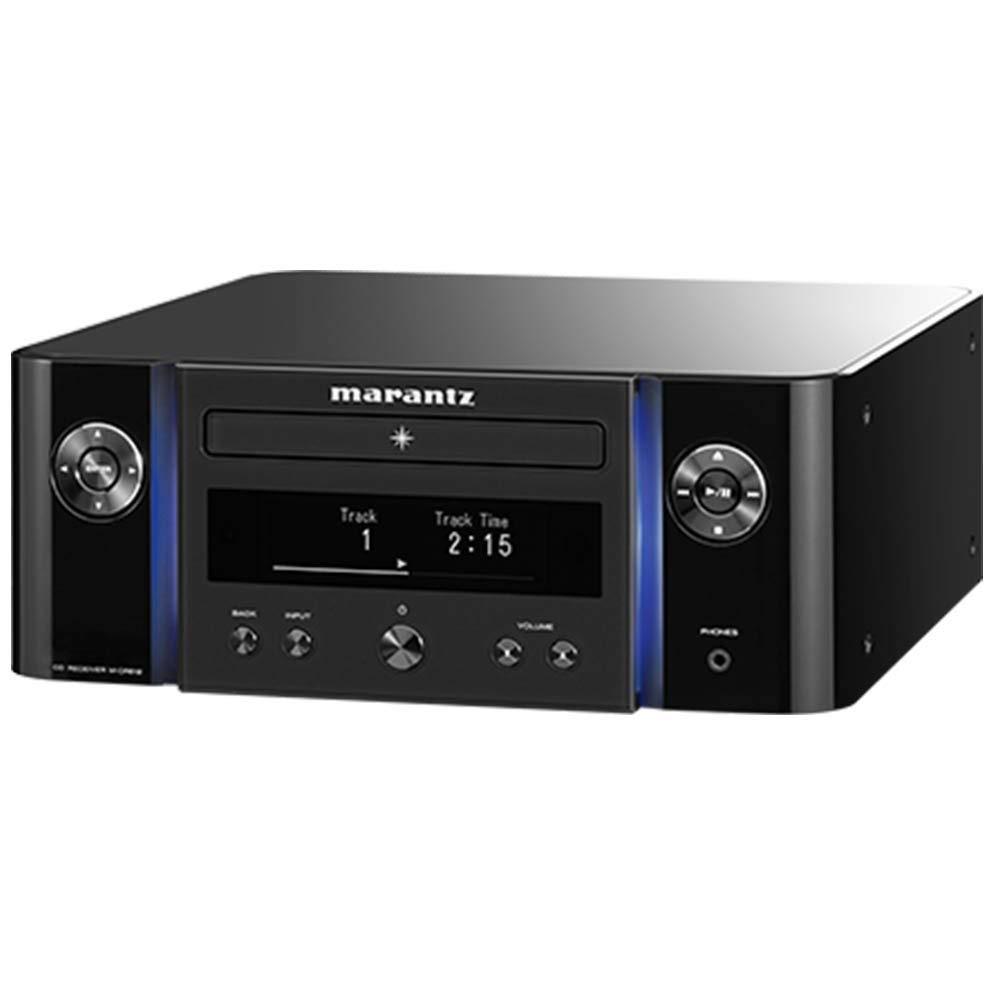
The network-savvy receiver that plays CDs, streams in high fidelity, and answers to voice commands.
This Marantz is a completely different philosophy from the Pyle and Rockville amps above — a compact, lifestyle-oriented network receiver that trades massive peak power for elegant streaming and hi-fi class. It runs as 60W x 2 or 30W x 4 channels, so in 4-channel mode you can configure a pair of speakers in one room or two sets of speakers in two separate rooms with independent volume control via HEOS. It weighs just 10.9 pounds and takes up very little shelf space, which is exactly what buyers here are looking for.
It is built for the digital music age: Wi-Fi, Bluetooth, AirPlay 2, and HEOS let you stream from Pandora, Spotify, SiriusXM, or internet radio stations from around the world. It has 2 optical digital inputs for a set-top box, Blu-ray, or DVD player, plays WMA/MP3 discs (CD-R/RW), and includes an AM/FM tuner. Voice support is the headline feature — you can use Amazon Alexa, Google Assistant, or Apple Siri to change tracks, turn the volume up, or switch inputs hands-free, and it is compatible with Amazon Alexa’s ecosystem.
The compact size is what buyers rave about most, and the built-in CD player is genuinely appreciated. But the sound quality gets mixed reviews — it is “not the greatest sounding” per one owner, though wireless HEOS speakers pair smoothly with the app. The biggest frustration is setup: the Marantz forces you through Wi-Fi, Bluetooth, and HEOS configuration before you can use it, and one owner’s CD player was defective from the start, reading discs but refusing to play past a few seconds. If you value Apple ecosystem integration and a tidy footprint over raw wattage, this is the refined choice.
The Lifestyle Appeal
- Compact design that disappears into a shelf — the standout praise
- Voice control via Alexa, Google Assistant, or Siri for hands-free use
- HEOS multi-room streaming with independent volume per room
The Trade-Offs
- Sound quality is mixed — solid, but not audiophile-grade
- Setup is tedious, forcing Wi-Fi and HEOS configuration first
- Occasional units arrive with a defective CD player
Choose it for: a tidy, voice-controlled streaming hub that also plays CDs and blends into a modern living space.
Pass it by if: you need serious power for big speakers or whole-venue karaoke volume levels.
Understanding the Specs
Peak vs. RMS Power
Peak wattage is the loud marketing number on the box, and it tells you the absolute burst an amp can survive for a split second. RMS (root mean square) is the continuous power the amp can deliver cleanly over time — this is the number that predicts how loud and clear your music will play without distortion. A receiver claiming 3000W peak might deliver only a fraction of that as RMS, so compare RMS figures when deciding if an amp can really drive your speakers.
Speaker Impedance
Impedance, measured in ohms, is the electrical resistance your speakers present to the amplifier. Most home speakers are rated at 4 or 8 ohms, and your receiver will list a range it can handle, like 4-16 ohms or 2-8 ohms. Matching your speaker’s impedance to the amp’s supported range prevents overdriving the amp or starving your speakers of power, and it is the single most common mismatch that causes receivers to shut down or sound thin.
FAQ
What does a 4-channel receiver actually do differently from a stereo receiver?
Can I use a 4-channel receiver for karaoke?
Will a 4-channel receiver work with my existing speakers?
What does peak power mean and why does it seem so high?
Do I need Bluetooth on a 4-channel receiver?
What inputs should a 4-channel receiver have for a modern TV setup?
How many speakers can a 4-channel receiver power?
Is the Marantz M-CR612 a good choice for a whole-home system?
Final Thoughts: The Verdict
For most buyers, the standout 4 channel stereo receiver is the Pyle PT390AU because it delivers the power, ease of use, and mic support that karaoke and community spaces need at a price that makes sense. If you want true independent volume per room, the Rockville RPA40BT is the value pick with its 4-zone control and Bluetooth. And for a refined, streaming-first home system, the Marantz M-CR612 is the compact, voice-controlled choice that plays CDs and fills two rooms with ease.
How We Picked
We do not accept paid placement. Every pick is matched to a real buyer and a real use-case; we do not hands-on test units.
Sources & Methodology
Specifications: manufacturer listings and product documentation. Review insights: verified customer reviews, as of September 2026. Pricing: not shown on this page (it changes often); check the current price via the retailer link.
As an Amazon Associate, Gadgets Feed earns from qualifying purchases. This does not affect which products we feature.