
Electric trolling motors have replaced the noise, fumes, and maintenance of gas outboards for anglers who value stealth and precision. Whether you are working a reef line, holding on a bass bed, or sneaking into a backwater cove, the right electric drive lets you do it without spooking the fish or smelling like a fuel dock. The difference between a frustrating day on the water and a banner day often comes down to thrust, battery management, and how well the unit integrates with your fish finder.
I’m Min — the co-founder and writer behind Gadgets Feed. I’ve spent hundreds of hours combing through technical datasheets, customer field reports, and cross-spec comparisons to separate the motors that deliver real-world performance from those that just look good on paper.
After analyzing thrust ratings, shaft lengths, GPS accuracy, battery requirements, and corrosion resistance across the market, I’ve narrowed the field down to the electric motors that actually earn a spot on your transom. This guide presents the best 4 cycle outboard engines for anglers who demand quiet power and reliable fish-holding technology.
How To Choose The Best Electric Trolling Motor
Selecting an electric outboard is more than picking the highest thrust number. You have to weigh voltage requirements against your boat’s existing battery setup, decide between a bow mount and a transom mount, and figure out whether GPS features like spot-lock justify the premium. The wrong choice leaves you either underpowered in a current or tethered to a battery bank that runs dry before noon.
Thrust vs. Boat Length
Thrust is measured in pounds and directly correlates to how much boat you can push. A rough rule of thumb is 2 pounds of thrust per 100 pounds of loaded boat weight. A 12-foot jon boat might do fine with 55 lbs of thrust, while a 21-foot fiberglass bass boat often needs 80 to 112 lbs. If you fish in tidal rivers or wind-exposed lakes, lean toward the higher end of the range.
Shaft Length and Mount Type
Bow-mount motors give you better boat control and are the standard for bass and walleye fishing. Transom-mount motors are simpler and work well on smaller boats or as auxiliary power. Shaft length must clear the bow in rough water — a 60-inch shaft is typical for deep-V hulls, while 45 inches often suffices for flat-bottom rigs. Measure from the mounting surface to the waterline and add 12 inches for safe clearance.
GPS Integration and Spot-Lock
GPS-enabled motors anchor you to a waypoint automatically, freeing your hands for fishing. The best systems hold position within a few feet even in wind or current. Some motors offer jog features to move your locked position by small increments. If you fish structure-heavy water, look for a motor that integrates with your fish finder brand — Minn Kota pairs with Humminbird, Lowrance works with its own ecosystem, and third-party adapters exist but add complexity.
Quick Comparison
On smaller screens, swipe sideways to see the full table.
| Model | Category | Best For | Key Spec | Amazon |
|---|---|---|---|---|
| Minn Kota Ulterra 80 lb | Premium | Auto deploy/stow convenience | 80 lbs thrust / 45 in shaft | Amazon |
| Minn Kota Riptide Terrova 112 lb | Premium | Heavy saltwater boats | 112 lbs thrust / 72 in shaft | Amazon |
| Minn Kota Riptide Terrova 80 lb | Premium | Saltwater bass/inshore | 80 lbs thrust / 60 in shaft | Amazon |
| Lowrance Ghost 47 in | Premium | Ultra-quiet sonar integration | 97-120 lbs thrust / 47 in shaft | Amazon |
| Newport NT300 | Mid-Range | Light dinghy/kayak electric | 110 lbs thrust / 24.6 in shaft | Amazon |
| 2 Stroke 18HP Short Shaft | Budget | High-power gas alternative | 246cc / 18 HP gas | Amazon |
| Short Shaft 12 HP 2 Stroke | Budget | Entry-level gas utility | 169cc / 12 HP gas | Amazon |
In‑Depth Reviews
1. Minn Kota Ulterra Freshwater Electric-steer Bow-Mount Trolling Motor with MEGA Down Imaging & i-Pilot Link GPS, 80 lbs Thrust
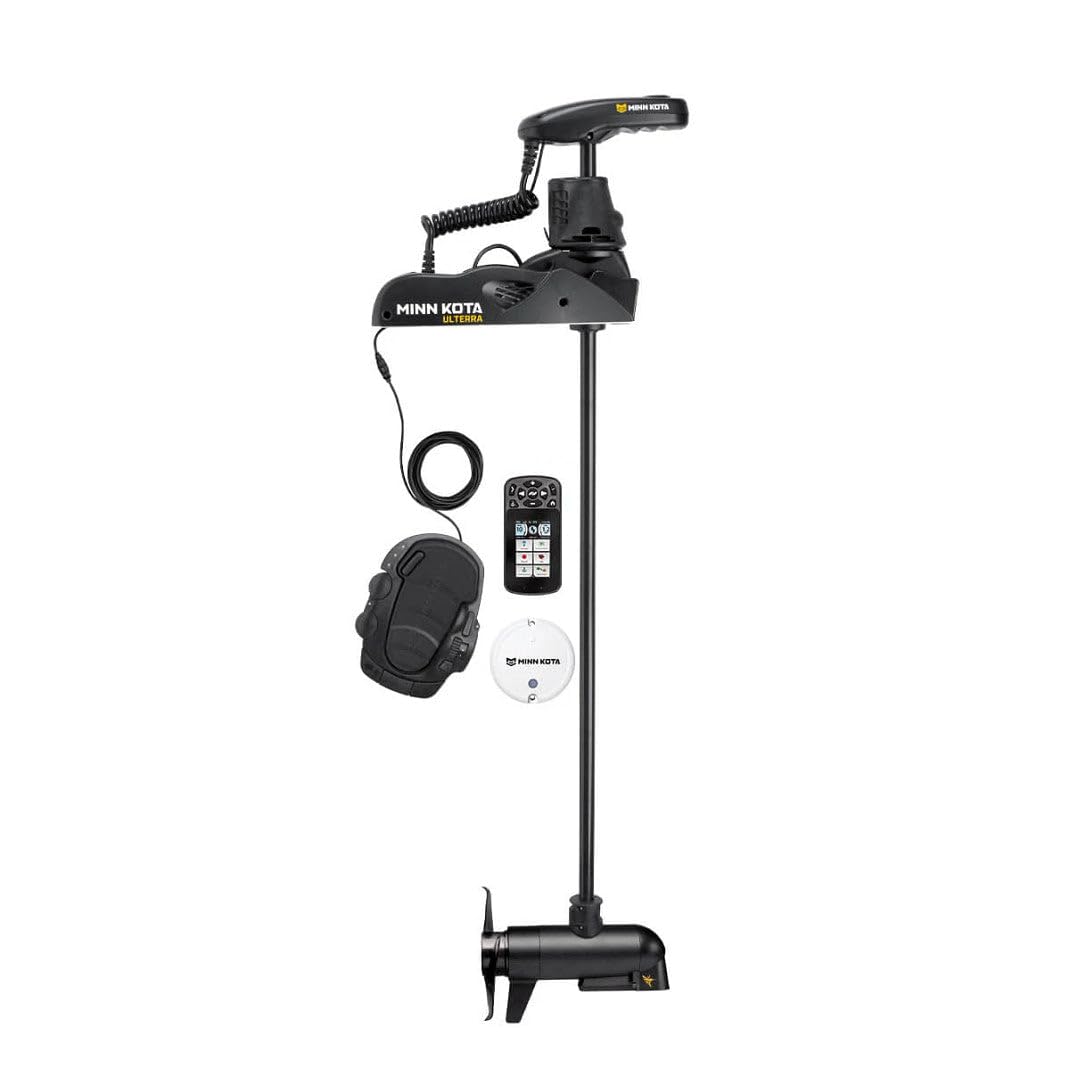
The Ulterra is the only motor on this list that stows and deploys itself at the push of a button. That feature alone transforms how you fish if you frequently move between spots or run a tiller boat where reaching the bow is awkward. The 45-inch shaft is best suited for freshwater hulls with moderate freeboard — expect clean clearance on most bass boats and aluminum deep-Vs under 20 feet.
GPS performance is flagship-grade: spot-lock holds within a few feet even in a stiff chop, and the jog function lets you nudge your position without resetting the lock. The built-in MEGA Down Imaging transducer gives you crystal-clear structure detail down to 125 feet, and the i-Pilot Link remote communicates flawlessly with Humminbird finders. The 24-volt system demands two deep-cycle batteries, but the Digital Maximizer stretches runtime up to five times longer than a standard variable-speed motor.
Customer reports confirm the spot-lock holds perfectly in waves at any depth, and the ability to remotely drive the boat to the dock is a game-changer for solo anglers. Networking cables are proprietary and priced high, but the integration quality justifies the ecosystem lock-in. Expect 69 pounds of weight on the bow — factor that into your trailer tongue balance.
Why it’s great
- Self-deploy/stow eliminates manual lifting
- Spot-lock holds in wind and current
- MEGA Down Imaging reads structure clearly
Good to know
- Expensive proprietary networking cables
- Freshwater only — no saltwater corrosion package
2. Minn Kota Riptide Terrova 112 lb. Thrust, 72″ Shaft, Wireless Remote

This is the most powerful saltwater Terrova in the lineup. The 112 pounds of thrust on a 36-volt system moves heavy fiberglass hulls — think 22- to 25-foot center consoles — without straining. The 72-inch shaft clears the high freeboard of offshore boats, and the indestructible composite shaft carries a lifetime guarantee. The Riptide treatment means the lower unit housing gets grit-blasted, coated in aluminum, and topped with powder coat to fight salt corrosion.
GPS features include spot-lock with jog, drift mode that automatically controls speed and course, and full compatibility with Humminbird fish finders via the One-Boat Network. The wireless remote has an easy-to-read LCD screen with four programmable buttons. Anglers report that spot-lock on this unit holds in heavy current where lesser motors would wander, and the drift mode eliminates the need for drift socks in moderate winds.
One customer noted spot-lock caught more fish in a single year than the previous five without it. The 38.6-kilogram head weight is substantial — make sure your bow mount deck is reinforced. Battery requirements are demanding: three 12V deep-cycle batteries in series, each with at least 100Ah. The Digital Maximizer still applies, giving up to five times longer runtime than a non-optimized motor.
Why it’s great
- Massive 112 lbs thrust for heavy saltwater hulls
- Corrosion-resistant Riptide construction
- Lifetime warranty on composite shaft
Good to know
- Requires 36V battery bank (three batteries)
- Heavy head weight needs reinforced deck
3. Minn Kota Riptide Terrova Bow-Mount Electric Trolling Motor with GPS, Spot-Lock – 80 Lb. Thrust, 60 in. Shaft, Saltwater

The 80-pound Terrova in saltwater trim hits the sweet spot for inshore bay boats and smaller center consoles up to 20 feet. The 60-inch shaft gives enough clearance for moderate chop without being unwieldy. The one-touch stow/deploy lever uses fall-away ramps that slide the motor into the water smoothly — no fighting with a heavy motor arm when you want to start fishing quickly.
GPS spot-lock performance is identical to the larger 112-pound sibling, with jog functionality and drift mode included. The wireless remote with LCD screen provides real-time battery status and allows you to program four One-Boat Network buttons. The Digital Maximizer extends runtime, and the heading sensor enables the jog feature that moves your locked position five feet in any direction — crucial when adjusting to a moving school or subtle current change.
Owners report the motor handles a 20-foot Carolina Skiff with no issues, and the spot-lock holds on reef structure even in ocean swells. The 24-volt system is easier to manage than the 36-volt setup, requiring just two batteries. Some units have arrived with assembly errors — always verify shaft length matches the bracket before installation. Rinse thoroughly after every saltwater trip to maximize the corrosion coating’s lifespan.
Why it’s great
- Ideal 80 lb thrust for 18-20 ft saltwater boats
- Saltwater corrosion protection package
- Wireless remote with battery level display
Good to know
- Occasional factory assembly errors reported
- Rinse required after every saltwater use
4. Lowrance Ghost – Freshwater Trolling Motor, Ultra Quiet, Bow Mount, 97/120 lbs Thrust with Configurable Foot Pedal
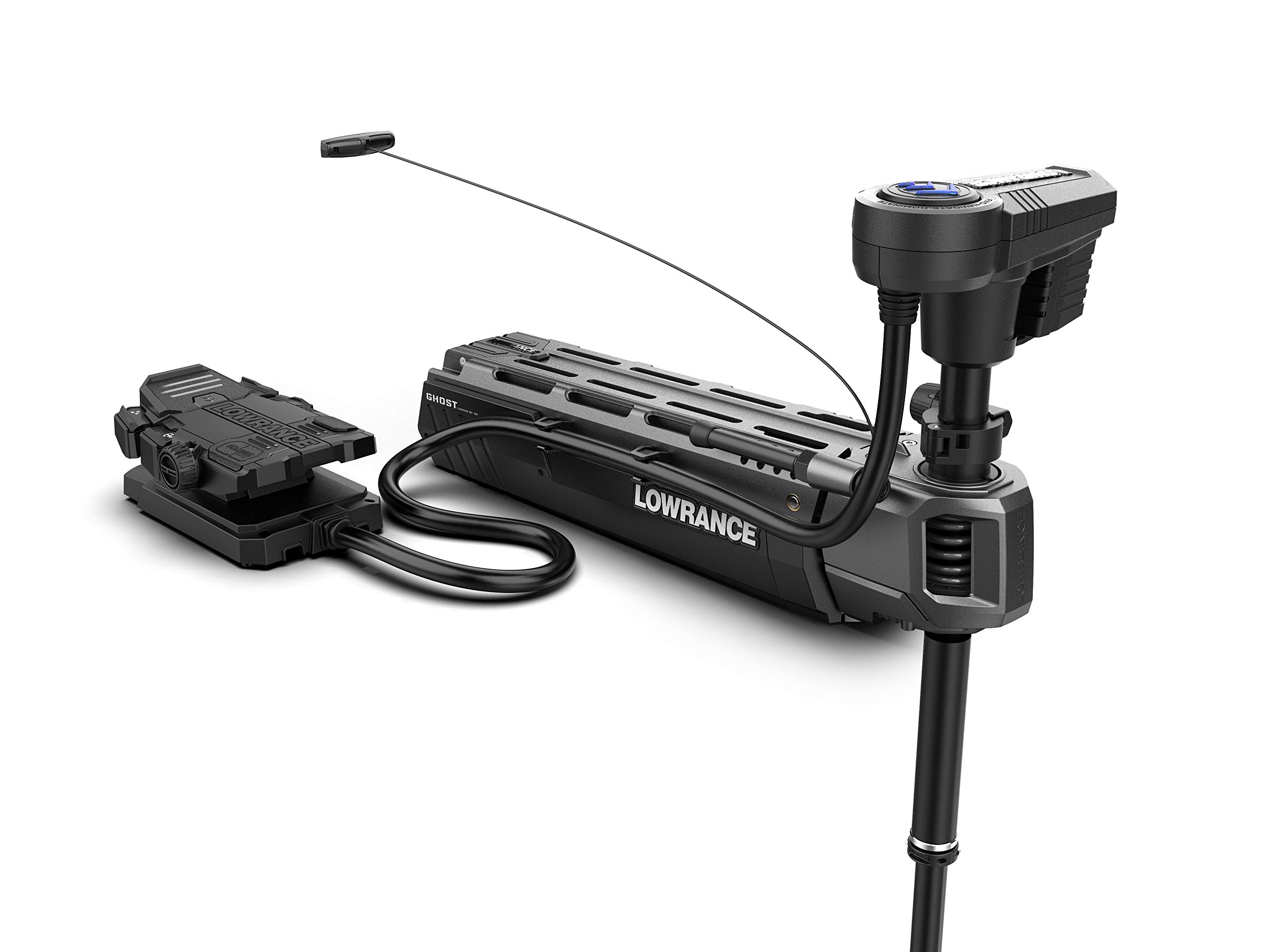
The Lowrance Ghost is built for anglers who treat noise discipline as a competitive advantage. Its brushless motor emits zero electromagnetic interference, which means your fish finder screen stays completely clean — no EMI fuzz masking bottom structure or individual fish arches. The 47-inch shaft is shorter than other entries here, so it fits best on boats with lower bow profiles where longer shafts become a handling nuisance.
Thrust comes in two power levels — 97 lbs and 120 lbs — depending on the configuration. The 120 lb version runs on 36 volts and handles boats up to the 24-foot range. The configurable foot pedal gives you shortcut buttons, a Flip Switch for anchor mode, and programmable keys that can drop waypoints or trigger a Power-Pole. Owners report that spot-lock holds perfectly in 20 mph winds and that the motor delivers ample power for a full day on the water with two 100Ah lithium batteries.
The integrated HDI nosecone transducer provides CHIRP sonar and DownScan Imaging out of the box, with an upgrade path to Active Imaging 3-in-1 for SideScan. Customer feedback is overwhelmingly positive on quietness and reliability, though one user noted a direction indicator arrow that never stayed calibrated and unresponsive customer service. At 38.56 kilograms, the weight is comparable to the Minn Kota units, so plan your bow mount reinforcement accordingly.
Why it’s great
- Zero EMI interference for clean sonar screens
- Ultra-quiet brushless motor
- Programmable foot pedal with shortcut keys
Good to know
- Direction indicator calibration issues reported
- Customer service responsiveness inconsistent
5. Newport NT300 Electric Outboard Motor

The Newport NT300 is a 36-volt electric outboard rated at 1300 watts, delivering 110 pounds of thrust in a lightweight 24-pound package. The 24.6-inch shaft is designed for transom mounting on smaller craft — think inflatable dinghies, kayaks, and lightweight skiffs where a heavy bow-mount motor would be impractical. The digital throttle includes an intuitive LCD display that shows speed and battery voltage at a glance.
Top speed reaches 6.5 mph, and Newport claims a range of up to 66 miles per charge under ideal conditions. Real-world owners pushing a Pelican Catch 100 with a 170-pound angler got 5 miles of travel while using just 27 percent of a 36V lithium battery. The motor is exceptionally quiet — owners describe it as perfect for dinghy runs and marina use where gas fumes would be unwelcome. The 23.8-pound total weight makes it one of the easiest motors to carry and store on this list.
Trim angles adjust from 0 to 70 degrees, and the field-oriented control technology provides smooth power delivery across the speed range. Some users note a throttle delay that takes getting used to, and the 24.6-inch shaft may pick up weeds in shallows if the motor is run at low trim angles. The motor requires an external 36V battery with a minimum of 30Ah, though most owners recommend 50Ah or higher for reasonable runtimes at full throttle.
Why it’s great
- Lightweight 24 lb portable design
- Very quiet operation with no fumes
- Digital throttle with voltage display
Good to know
- Throttle response has a slight delay
- Short shaft may pick up weeds in shallows
6. 2 Stroke 18HP Outboard Motor, Short Shaft 246CC Heavy Duty Fishing Boat Engine
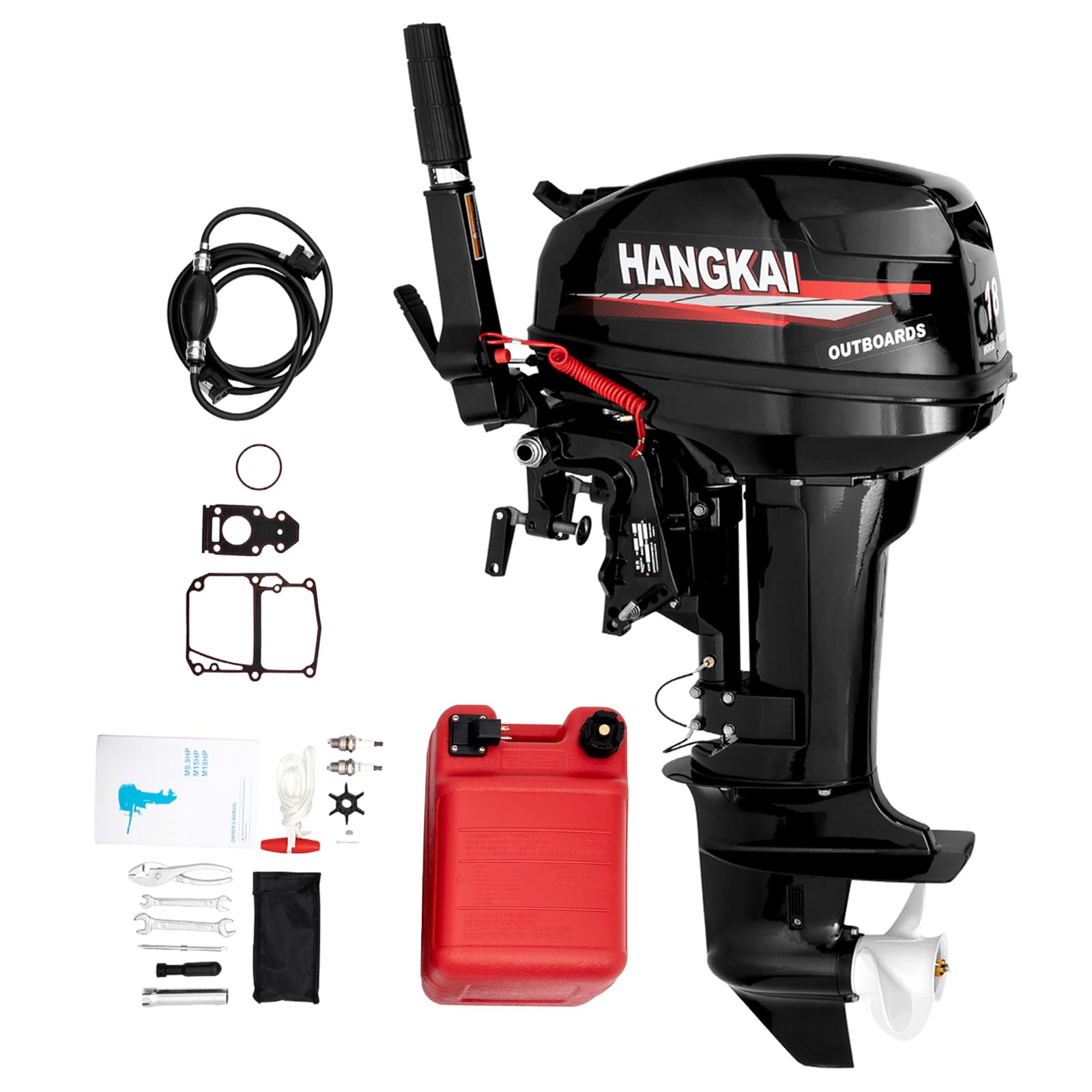
For anglers who need maximum horsepower on a tight budget and don’t mind mixing oil, this 246cc two-stroke delivers 18 HP from a compact short-shaft package. The 360-degree steering rotation allows reverse without a gear shift — a genuine convenience when maneuvering in tight quarters around docks or other boats. The water cooling system and CDI ignition keep the engine running reliably, though you must add gear oil manually before the first start.
The 24-liter external fuel tank provides enough range for a full day of fishing at moderate throttle. The engine weighs 38.6 kilograms, so mounting and removing it is a two-person job. The 50:1 fuel-oil ratio after break-in is standard for two-stroke outboards, but the initial 25:1 mix during the first 50 hours requires attention. Owners report the motor arrived early and ran perfectly out of the box, with no major issues noted in the first season of use.
The warranty is only 2 months, which is short compared to electric motor offerings. Spare parts availability may be limited since the brand is less established than Mercury or Yamaha. This motor is best suited for budget-minded owners of small inflatables, jon boats, and lightweight fishing skiffs who are comfortable with basic two-stroke maintenance and don’t need dealer network support.
Why it’s great
- 18 HP for a very entry-level price point
- 360-degree steering for easy reverse
- Large 24L fuel tank for extended runs
Good to know
- Short 2-month warranty period
- Requires manual gear oil fill before first use
7. Short Shaft Outboard Motor, 2 Stroke 12 HP Outboard Boat Motor, 169CC Heavy Duty Fishing Boat Engine

This 12 HP two-stroke from BJTDLLX targets the entry-level market with a 169cc engine that provides 661 to 1763 pounds of thrust at 8 to 30 km/h. The high-quality aluminum construction resists corrosion and deformation, and the water cooling system helps maintain consistent operating temperatures during long runs. The 6.34-gallon external fuel tank is smaller than the 18 HP model, so plan refueling stops accordingly on longer trips.
The three-speed gearbox offers forward, neutral, and reverse, with CDI ignition and manual start for quick firing. Owners report the motor starts on the second or third pull cold, and on the first half-pull when warm. One owner subjected this motor to a year of extreme abuse — sudden stops, stump hits, weed wraps — with zero maintenance except clearing the lower unit and no flushing. That level of durability at this price point is genuinely surprising for a motor often written off as a cheap Chinese knock-off.
Break-in requires patience: the manual calls for a specific break-in procedure, and the motor arrives without any grease or oil applied to moving parts. You must lubricate everything yourself before the first run. The 27-kilogram weight is manageable for one person to mount on a small transom, and the motor is best suited for boats under 19.69 feet and 661 pounds, such as inflatables, aluminum jon boats, and small fiberglass hulls.
Why it’s great
- Surprisingly durable despite low price point
- Quick starts even in cold conditions
- Corrosion-resistant aluminum construction
Good to know
- Requires full lubrication before first use
- Break-in period is lengthy and critical
FAQ
Can I use a 36V trolling motor on a 24V battery bank?
How do I calculate how many amp-hours I need for a full day of fishing?
What is the difference between a bow mount and a transom mount trolling motor?
How often should I replace gear oil in a gas outboard?
Final Thoughts: The Verdict
For most anglers, the best 4 cycle outboard engines winner for modern electric trolling is the Minn Kota Riptide Terrova 112 lb because it delivers maximum thrust with bulletproof saltwater corrosion protection and the most accurate spot-lock GPS in the market. If you want effortless auto deploy and stow with deep fish finder integration, grab the Minn Kota Ulterra 80 lb. And for inshore anglers running 20-foot boats who want premium GPS at a slightly lower voltage, nothing beats the Minn Kota Riptide Terrova 80 lb.