
Our readers keep the lights on and my morning glass full of iced black tea. As an Amazon Associate, I earn from qualifying purchases.
Specs are compiled from manufacturer listings and verified buyer reviews and can change over time — please confirm the key details on the product page before buying.
In a sewer vault, crawlspace or tank, oxygen can drop, combustibles can build and CO or H2S can rise before your nose notices — which is the gap a four-gas monitor fills. A four-gas monitor is a clip-on instrument that continuously sniffs the air for four separate hazards at once — oxygen (O2), combustible gas (LEL, the flammable stuff like methane or propane), carbon monoxide (CO) and hydrogen sulfide (H2S, the rotten-egg gas). Which one is worth buying depends less on brand hype and more on three honest questions: does it hold a charge through a full shift, does it alarm loudly enough that you actually notice, and can you keep it calibrated without a lab. This guide walks through eight real units, from budget-friendly clip-ons to premium confined-space instruments, so you can match one to the work you actually do.
I’m Min — the founder and writer behind Gadgets Feed. This guide is built by comparing the manufacturers’ published specifications and the patterns across verified customer reviews, so you get each pick’s real strengths and trade-offs instead of marketing spin.
You do not need the priciest meter on the shelf — you need one whose battery runtime, sensor set and alarm type match your shift. The picks below cover both ends, so start with the 4 gas monitors that fit how you work.
Our Picks at a Glance

How To Choose The Best 4 Gas Monitors
A four-gas monitor is not a gadget you buy once and forget. It is a life-safety instrument, and the difference between a good one and a frustrating one usually shows up in three places: how it samples the air, how it tells you something is wrong, and how much effort it takes to keep the sensors honest. Before you compare listings, work out which of those three matters most for your job.
Decide how the meter samples the air
Most clip-on monitors breathe the air around them, which is called natural diffusion — you wear it and it reads whatever drifts past. A pump-assisted model pulls air through a hose and probe, so you can sample the bottom of a manhole or the far corner of a tank before you put your head in there. If your work is pre-entry testing, the pump is the feature that changes your routine, not a bonus.
Match the alarm to your environment
A monitor only protects you if its alarm reaches you through noise, gloves or a welding hood. Look for audio, visual and vibration alarms working together, since a loud plant floor can drown out a beeper and gloves can hide a flashing light. Response time matters too — a meter that reacts within a second or two gives you a head start, while one that takes closer to half a minute leaves you standing in the hazard waiting for an answer.
Plan for calibration from day one
Every one of these instruments needs periodic bump tests and recalibration, and the sensors themselves wear out. Check whether the box includes a calibration certificate, a calibration cap or hose, and whether the brand sells replacement sensors. A meter you cannot recalibrate becomes a paperweight, while one with replaceable sensors and a calibration cap can run for years.
Quick Comparison
| Model | Best For | Battery | Weight | Alarm Type | Amazon |
|---|---|---|---|---|---|
| USA NIST Calibrated 4 Gas Monitor by Forensics★ Best Overall | All-round value with USA verification | 6 hours | 9.6 ounces | Audible, Vibration, Visual | Amazon |
| Aluminum Alloy Portable 4 Gas Detector (Sooguard)Budget Champion | DIY and appliance techs on a budget | 1800mAh lithium battery | 10.4 ounces | Vibration | Amazon |
| TopTes Guard-101Best Battery Life | Long-shift monitoring with 14h runtime | 14 hours | 0.6 kg | LED, Vibration, Sound | Amazon |
| TopTes Guard-156 | Fast charging for back-to-back shifts | 18 hours | 0.6 kg | LED, Vibration, Sound | Amazon |
| Gas Detector with Pump (Forsensal) | Pre-entry confined space testing | 3000mAh, standby >8h | 11.2 ounces | Audible, Visual, Vibration | Amazon |
| 4 Gas Meter for Confined Space (Forensics FD-4X) | Lightweight pocket monitoring | Battery Powered | 4.8 ounces | LED, Buzzer, Vibration | Amazon |
| Multigas Detector Analyzer + Pump (Forensics FD-4S-PUMP) | NIST-calibrated confined space entry | Battery Powered | 400 g | Audible, Visual | Amazon |
| BW Technologies GasAlertMicroClip XL | One-button simplicity for crews | Battery Powered | 1.4 pounds | Visual | Amazon |
In‑Depth Reviews
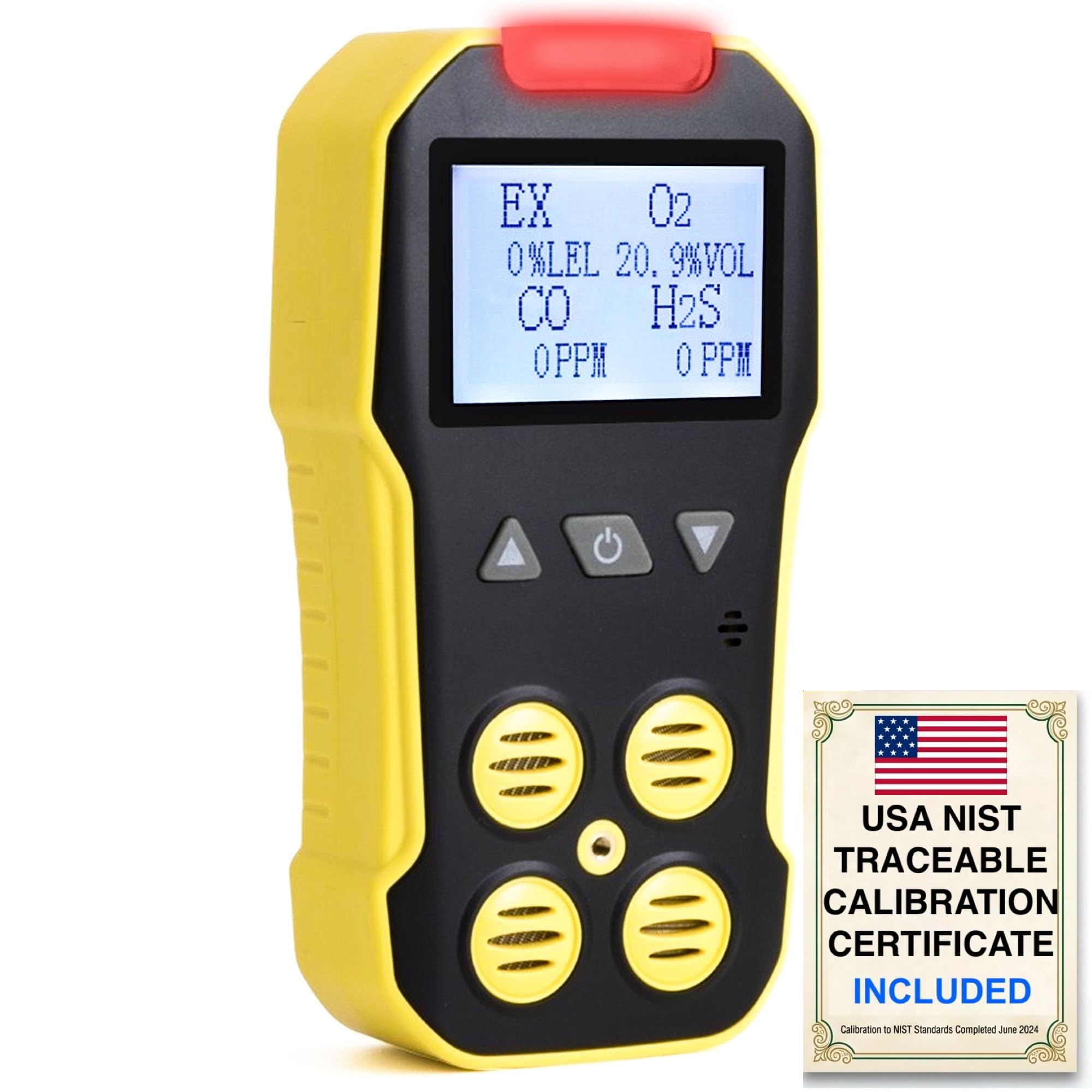
1. USA NIST Calibrated 4 Gas Monitor by Forensics | O2, CO, H2S, LEL | USB Recharge
Our pick — over 4★ from 100+ verified ratings; the strongest balance of quality and price.
NIST-traceable calibration in a pocket-sized clip-on you can trust on day one
If you need a monitor that arrives calibrated and tells you plainly which of the four gases is misbehaving, this is the one to anchor your shortlist on. It reads oxygen, carbon monoxide, hydrogen sulfide and combustibles (LEL) through electrochemical sensors, and every unit ships with a calibration and QA certificate — that paperwork is the difference between a meter you trust and a meter you have to re-verify yourself. Detection error lands at better than ≤±5% F.S. (a percentage of full scale — meaning the worst-case reading drift is small), and it responds in under 30 seconds.
What wins people over is the quality and the value together — it holds up as a genuine inline replacement for a far more expensive industrial unit, and one buyer who ran it professionally put it simply: “I’ve had this for just over a year, and it has performed flawlessly.” It is built from high-strength ABS with an anti-slip grip rubber shell, and it is rated waterproof, dust-proof and explosion-proof, so a splash or a drop in the mud is survivable. That said, the O2 sensor is the weak link here — a few buyers have had units arrive with a bad O2 sensor that needed replacing, and the build quality drew a couple of complaints about display fonts and manual errors.
The recurring gripe worth knowing is accuracy over time: it does not ship with a calibration kit, and the manual calls for a 12-month recalibration, so you need access to calibration gas to keep it honest. It carries the same response-time and accuracy claims as the Sooguard, but with the NIST certificate and USA verification that the budget pick doesn’t offer. If you’re professionally responsible for confined-space entry or running an appliance business, this is the sensible starting point.
The case for it
- NIST-traceable, factory-verified calibration certificate in the box
- Detects O2, CO, H2S and LEL together with ≤±5% F.S. accuracy
- Sub-30s response with adjustable audio, visual and vibration alarms
- Rugged ABS + anti-slip rubber shell rated waterproof and explosion-proof
Where it falls short
- The six-hour battery is short for a full day of continuous work
- Does not include a calibration kit, and needs annual recalibration
- A small number of units have arrived with a failed O2 sensor
- Accuracy is a recurring buyer concern that calibration resolves
Reach for this if: you want USA-verified calibration, honest multi-gas coverage and don’t mind recharging mid-shift.
Look elsewhere if: your days run longer than six hours or you need pump-assisted pre-entry sampling without a hose accessory.
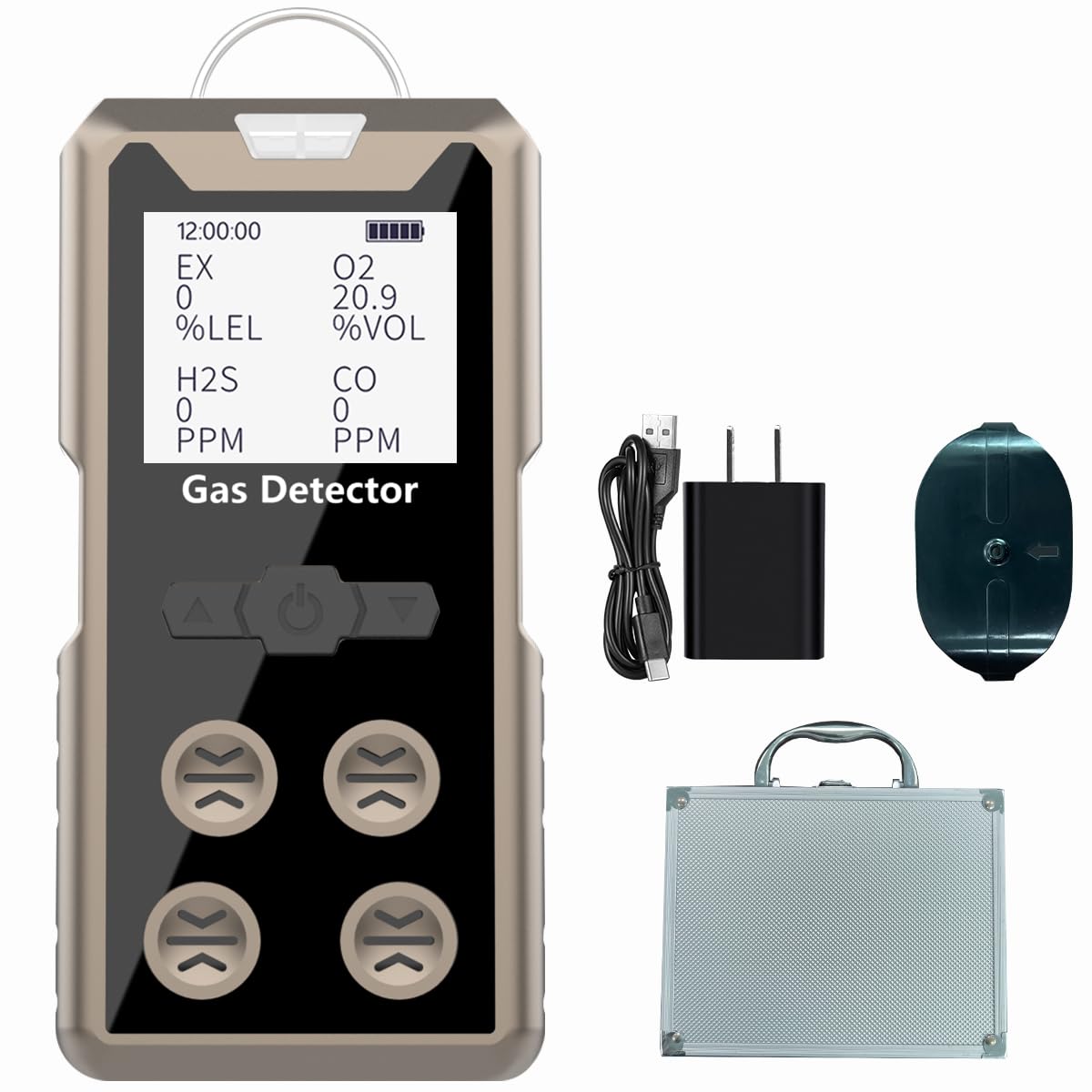
2. Aluminum Alloy Portable 4 Gas Detector, 4 in 1 Multi Gas Monitor Tester,H2S,O2,CO and EX Rechargeable LCD Display Gas Sniffer Alarm,Gas Clip Sound Light Shock Alarm (Grey)
A pocket-sized four-gas sniffer with the largest battery in this lineup
Appliance techs, DIY homeowners and anyone who works around gas lines will find the most value here, because it packs four sensors into the smallest-footprint body of the group. At 1.25″D x 2.85″W x 5.5″H it slips into a shirt pocket or clips onto coveralls, and the 1800mAh lithium battery is the largest capacity cell listed on any pick in this lineup — that’s a real longevity advantage if you’re running back-to-back service calls without a charging window.
What buyers consistently highlight is sensitivity: the LEL meter trips its alarm at 5% LEL — below the point where your nose would register anything — and one owner of this class of unit noted it “detects gas below smell threshold.” The response time is T<30s with ≤±5% F.S. detection error, and it uses high-strength ABS engineering plastic rated waterproof, dust-proof and explosion-proof. A professional appliance installer reviewed it as their daily work tool and found “quality is high worth its value.” One thing to flag: the sensor handles combustibility only, not toxicity — the catalytic LEL element measures flammable gas, and CO is handled by its own dedicated sensor, so don’t confuse the two readings.
The practical trade-off is the clip and the size. It’s the heaviest pick in the group at 10.4 ounces — roughly 8% heavier than the Forensics FD-4X — and the clip system, while convenient, is the kind of hardware that asks you to check it’s secure before you lean over a manhole. For homeowners double-checking a suspicious smell before calling the utility, this is more than enough monitor for the money.
Why it earns its spot: four-gas coverage, a 1800mAh cell and a clip-on form factor at an entry-level tier — with sensitivity buyers call out as a standout.
One thing to know: the catalytic LEL sensor measures combustibility, not toxicity, so low CO readings come from the dedicated carbon-monoxide sensor, and the meter needs periodic recalibration you supply.
Buy this one if: you’re a tech, a landlord or a homeowner who wants reliable four-gas coverage and doesn’t need a certificate package.
Hold off if: your job requires NIST documentation or a pump probe for pre-entry testing.
3. TopTes Guard-101 Gas Detector, 4 Gas Monitor for H2S, CO, LEL and O2, with Vibration, Visual and Audible Alarms, 14h Long Battery Life, Safety Explosion-Proof, for Work, Home – Orange
The shift-long runner that holds a charge while everyone else is hunting for a socket
If your problem is a meter that dies halfway through a twelve-hour day, the Guard-101 answers it directly: this is the 14-hour battery pick of the lineup. To put that in perspective, that’s more than double the runtime of the six-hour Forensics FD-4A, and for anyone monitoring a wood stove, a crawlspace or a long shift it means you stop worrying about whether the meter will still be alive at hour ten. It responds within 0.5 seconds — the fastest listed response in this group — and alarms through LED light, vibration and sound until the gas level returns to normal, with an alarm record storage function you can scroll back through later.
What owners praise most is that battery life and the sheer suitability for home or camping use — charge-and-forget simplicity. It’s built from high-strength ABS engineering plastic rated waterproof, dust-proof and explosion-proof, has a back clip for easy carry, and password protection (initial password “69”) stops anyone accidentally switching it off mid-shift. A buyer using it for home covered its strength well: it alarmed at 50 ppm when their wood-pellet stove smoked them out of a trailer.
But the honest caveat is calibration and the O2 reading. The calibration process confuses people — the instructions don’t make it obvious — and the oxygen sensor has produced readings around 25% in outdoor air on some units, which is well above the normal atmospheric figure. A few units have failed outright after a few months, though the replacement support behind them is genuinely responsive and the official service window runs three years. It remains a strong-value monitor, but it’s at its best as a first air monitor or a backup, not a certified instrument for regulated work.
What sold owners
- 14-hour battery — roughly 2.3x the FD-4A’s six-hour runtime
- 0.5-second response with LED, vibration and sound alarms
- Alarm record storage for after-the-fact review
- Waterproof, dust-proof, explosion-proof ABS body with back clip
Real-world gripes
- Calibration instructions are unclear and repeatedly flagged
- Oxygen readings around 25% have shown up in outdoor air
- Sensors become uneconomical to swap versus buying a new unit
- Alarm silence requires navigating settings — no dedicated off button
Lean toward this if: runtime is your top priority and you need a home or site backup that lasts a full shift.
skip it if: you need documented calibration accuracy for regulated confined-space work.
4. TopTes Guard-156 4 Gas Monitor Multi Gas Detector for H2S, CO, LEL, and O2, Triple Alarm Modes (Visual, Vibration, Sound), 0.5s Fast Response, Dust and Explosion Proof Design for Work and Home Safety

Four sensors, an 18-hour tank and a recharge fast enough for a double shift
The Guard-156 is the marathon runner of the TopTes pair: it pairs a 4-hour fast charge with 18 hours of rated battery life, so even a full shift plus overtime sits comfortably inside one charge. That’s a longer rated runtime than the Guard-101’s 14 hours, and it adds a real-time battery indicator plus a low-battery alert under 10% so you’re not guessing. It detects H2S, CO, LEL and O2 with the same 0.5-second response and triple-alarm setup — LED light, vibration and sound — and stores alarm history for later review.
Field buyers who spent a shift in a warehouse with propane trucks reported the unit reading 2 PPM CO at the start and 6 PPM by the end, alarming within a minute near vehicle exhaust — a practical demonstration of response speed in a live environment. It’s a compact, back-clip design in high-strength ABS rated waterproof, dust-proof and explosion-proof, and it ships with a standard gas hood for calibration.
The trade-offs worth flagging: charging uses a non-standard cable, not USB-C, which is inconvenient if you’ve standardized your kit, and the battery percentage has read inconsistently across identical 12-hour days. It’s also a model where a minority have seen the screen damage quickly and battery life disappoint, so treat it as a workhorse rather than a delicate instrument. Where it clearly beats the budget Sooguard is battery headroom and charge speed — the same four-gas coverage, but with several more hours of rated runtime and a fast charge that the smaller unit can’t match.
The honest read: a strong pick for shift workers who want long runtime and fast top-ups, at a mid-range tier with a 36-month service window behind it.
Worth noting: the charging cable is proprietary rather than USB-C, and a handful of units have seen screen damage under hard use — budget for a case if you’re rough on gear.
Pick this if: you charge between shifts and want maximum uptime with alarm history on hand.
Think twice if: you want USB-C convenience or need documented calibration paperwork for compliance.
5. Gas Detector with Pump, 4 Gas Monitor Multi Gas Detector CO EX O2 H2S Meter

Pull a sample from the far corner before you ever put a boot in there
For pre-entry testing of a manhole, tank or sewer line, you want a pump — and this one gives you pump suction and natural diffusion in the same body, switchable with just four screws. The 3000mAh lithium battery is the largest cell listed on any pick here, with a standby time of over 8 hours, and the package is unusually complete: calibration cap and hose, a natural-diffusion cap, a USB-C cable and charger, and a calibration certificate in the box. It detects CO, O2, H2S and combustibles (EX) with a response time under 30 seconds and audible, visual and vibration alarms — including the option to mute the sound when you need to.
A professional in the field calibrated it against independent gases and reported matching Honeywell and MSA readings with no discrepancies, surviving two hard drops in the process. That’s the kind of field validation that matters, and it’s the value story of this pick. The recurring caveat is sensor performance — the CO sensor has read zero on some units even when actual CO was present, and one buyer’s O2 sensor drifted to 13.5% in normal atmosphere within six months, which points to an expired cell. Out-of-box O2 and sensor variance is the thing to test on arrival.
It’s also heavier than it looks — 11.2 ounces — and a couple of buyers found it a little cumbersome for prolonged wear, with the graph lines on the display thin enough to be hard to read. The 1-year quality guarantee and easy-to-read manual help offset those concerns. For anyone who needs to sample where they aren’t standing, this is the only true pump-equipped pick at this tier and worth the trade-off in weight.
Why it stands out
- Pump suction plus natural diffusion — switchable with four screws
- 3000mAh lithium battery with >8h standby
- Complete kit: calibration cap, hose, cert, USB-C cable and charger
- Sub-30s response with three alarm types and sound mute option
Where it needs care
- CO sensor has read zero on some units despite real CO present
- O2 sensor has drifted in normal atmosphere on individual units
- 11.2 ounces is heavy for all-day wear
- Thin graph lines on the display are hard to read
Reach for this if: you test confined spaces before entry and want pump sampling with a full calibration kit included.
Look elsewhere if: you only need clip-on wear monitoring and want to save weight.
6. 4 Gas Meter for Confined Space | USA NIST Calibration | O2, CO, H2S, LEL
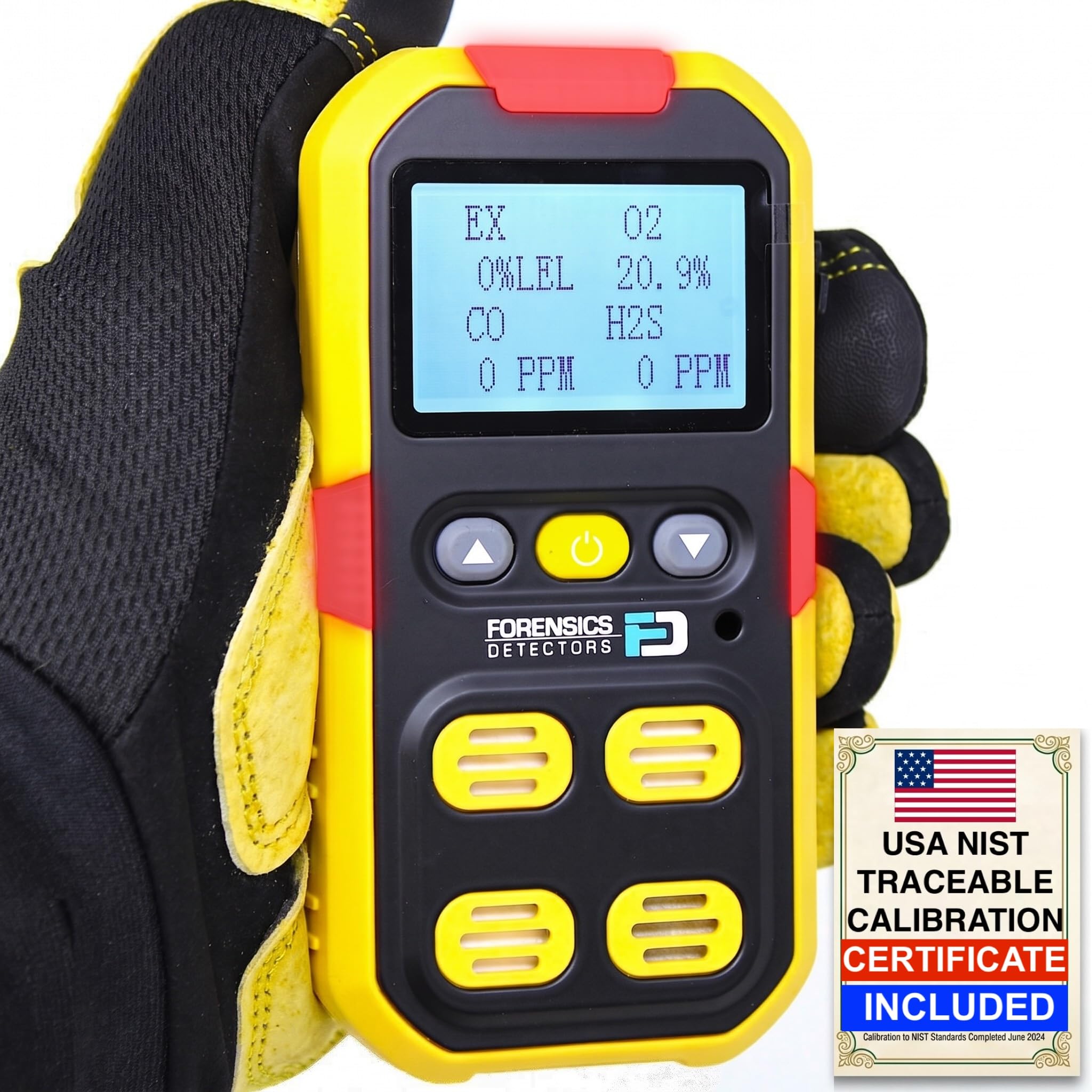
Barely heavier than a phone, yet it watches all four gases for a full shift
It uses nano sensors for O2, CO, H2S and combustibles (LEL), comes factory-calibrated with a NIST certificate in the box, and ships with a metal belt clip, calibration cover and manual. Response time is under 30 seconds, and alarms are adjustable across audio, visual and vibration, so you can tune the thresholds to your environment.
The compactness doesn’t come at the cost of build — a rubber-feel, high-strength ABS body rated water-resistant, dust-proof and explosion-proof keeps it alive in the field. It’s also the highest-priced pick at a premium tier, which positions it as a professional instrument rather than a home spare. It has the zero and span calibration options you’d want in a meter you’ll keep re-calibrating over its life.
The honest caveat is calibration discipline: it must be calibrated in clean air first, or every reading downstream is off. A small hard case would be welcome for a tool at this level, and the battery has run closer to a real-world figure than the advertised maximum in some hands. Read the O2, CO, H2S and LEL numbers off the large, bright display and the meter does its job quietly — it’s the meter for someone who wants a professional-grade pocket instrument and will keep up with the recalibration schedule.
Why it earns the premium spot: the lightest body, nano-sensor accuracy and a NIST certificate — a genuinely portable instrument for confined-space entry.
The fine print: it needs a clean-air calibration before each use to be trustworthy, and there’s no hard case in the box despite the price tier.
Choose this if: you want the smallest, lightest meter with documented factory calibration for professional confined-space work.
Pass if: you want a rough-and-ready home spare — the premium tier is more than that job needs.
7. Multigas Detector Analyzer + Pump with Probe | USA NIST Calibration | Confined Space Entry Testing | USB Recharge | 4 Sensors – CO, H2S, O2, EX LEL | 4 Gas Monitor

The certified pre-entry tester that samples a space before you commit to entering it
This is the purpose-built confined-space monitor: a pump and probe for pre-entry testing with four nano sensors covering CO, H2S, O2 and combustibles (EX LEL), backed by USA NIST calibration and a certificate in the box. It’s designed around the “test before you enter” routine — you sample the space through the probe from a safe distance, then clip the meter on once you’re satisfied the air is clean. The body is high-strength ABS with anti-slip grip rubber, rated waterproof, dust-proof and explosion-proof, and it ships with a calibration and QA certificate.
An emissions-control engineer who tested it against a large gas oven leak found it genuinely useful, noting “this meter may not be as accurate but it really works,” and it arrived pre-calibrated and ready to use from the start. The natural-gas and hydrogen-sulfide detection work as advertised — it responds to combustibility, and one buyer even tested it on carbonated water and caught the CO2 discharge.
The honest limitation: it measures O2 only up to 30%, so if you’re checking oxygen concentrators or enriched-oxygen work above that, it’s the wrong tool — one buyer bought it for exactly that and had to look elsewhere. And while most field workers found it easy to use, one buyer found it wasn’t accepted for a specific certification standard. For confined-space entry at a professional level, this is the strongest combination of pump sampling and NIST paperwork in the group.
What it does best
- Pump and probe built for pre-entry confined-space testing
- Four nano sensors: CO, H2S, O2, EX LEL
- USA NIST calibration with certificate in the box
- sturdy ABS and anti-slip rubber shell, waterproof and explosion-proof
The trade-offs
- O2 measurement tops out at 30%, limiting oxygen-rich applications
- One buyer found it wasn’t accepted for a specific certification standard
- Premium tier makes it overkill for casual home use
- Pump adds bulk versus a clip-on meter
Go with this if: confined-space entry testing is your routine and you need pump sampling plus NIST documentation.
pass on it if: you only need a simple clip-on for home checks, or you measure oxygen above 30%.
8. BW Technologies MCXL-XWHM-Y-NA GasAlertMicroClip XL 4 Gas Detector, CO, H2S, LEL and O2, Yellow

The one-button tank of a meter that crews buy a few at a time
If you’re equipping a crew rather than one person, this is the meter built for that: one-button simplicity for easy training, a flashing green IntelliFlash for visual compliance at a glance, and an LCD that shows up to four gas concentrations alongside battery level, alarm condition, and calibration, bump and sensor self-test status. It monitors H2S, O2, CO and combustibles (LEL) in natural and industrial environments, and its rugged, impact-resistant, non-corrosive composite case is designed to survive being carried hard.
What owners praise most is that quality and the “buy it every couple of years” reliability — one buyer notes, “we buy these a few at a time every couple of years for our crews.” It’s the highest-tier instrument here and the one most often bought as a fleet standard. One caution called out repeatedly: it usually needs calibration right from the start, so if you don’t have the calibration gases on hand, buying from the manufacturer may be simpler.
The real sticking point is calibration durability. Across third-party 6-month tests, a notable share of units have failed — mostly on the O2 sensor — and that sensor’s lifespan has run shorter than expected on individual units, with repair costs that can approach the monitor’s own price. It’s also the heaviest pick at 1.4 pounds, so it’s a worn-on-the-belt meter rather than a pocket one. For organizations that run their own calibration program and want a recognizable, trainable fleet meter, it earns its place; for a solo homeowner, it’s more instrument than the job needs.
What earns it the premium nod: one-button operation, IntelliFlash compliance and a fleet-proven composite body that crews reorder every couple of years.
The honest caveat: O2 sensor failures show up in third-party calibration testing more often than buyers expect, and the heavy 1.4-pound body and out-of-box calibration requirement mean it suits program users, not casual ones.
Built for this: teams that run their own calibration and want a simple, uniform meter across many workers.
Not for this: a single homeowner wanting a light, ready-to-go pocket monitor.
Understanding the Specs
Sensor type and the four gases
A four-gas monitor watches four hazards at once: O2 (oxygen — too little or too much), LEL (the flammable gases like methane and propane, measured as a percentage of the lower explosive limit), CO (carbon monoxide, the silent toxic gas) and H2S (hydrogen sulfide, the rotten-egg gas). Most units here use electrochemical sensors for the toxic gases and a catalytic element for LEL. The catalytic LEL sensor measures combustibility, not toxicity — that’s why a dedicated CO sensor matters and why you should never read the LEL number as a toxicity reading.
Battery life and recharge time
Runtime decides whether the meter survives your shift or leaves you exposed. Rated battery life across these picks ranges from six hours up to 18 hours, and recharge time matters just as much — a four-hour fast charge keeps a rotation running, while a slow charge means you need two units. Real-world runtime usually lands below the advertised maximum, so treat the rating as a ceiling, not a guarantee, and favor a meter with a low-battery alert you’ll actually notice.
Alarms and response time
A monitor is only as good as its alarm, so audio, visual and vibration should work together. The strongest combination is audio, visual and vibration working together: sound for open areas, light for loud areas, and vibration for gloved or hands-on work. Response time tells you how fast the meter reacts once gas is present — some units respond in half a second, others closer to 30 seconds, and that gap is the difference between walking away and standing in it. Adjustable thresholds let you tune how sensitive the alarm is to your environment.
Pump versus diffusion sampling
Natural diffusion means the meter reads the air that drifts to it — fine for a clip-on you wear while working. Pump-assisted sampling pulls air through a hose and probe, so you can test the bottom of a sump or the far corner of a tank before you enter. If your job involves pre-entry confined-space testing, the pump changes what you can do safely; if you only need ambient monitoring around yourself, a diffusion clip-on is lighter and simpler.
FAQ
Do I need all four gases or can I get by with fewer sensors?
How often do I need to calibrate a four gas monitor?
What is the difference between a pump and a diffusion gas monitor?
What does NIST-traceable calibration actually mean?
Will these meters work for home use, or are they only for industry?
Why does my meter read a different oxygen level than expected?
How do I know when the sensors have expired?
Is LEL the same as the toxic gas reading?
Will a four gas monitor alarm even if I can’t smell the gas?
Can I use a four gas monitor while it’s charging?
Final Thoughts: The Verdict
For most buyers, the 4 gas monitors winner is the USA NIST Calibrated 4 Gas Monitor by Forensics, because it pairs USA-verified NIST calibration with four-gas coverage, a sub-30-second response and a rugged explosion-proof body — and its quality-to-value balance is what owners bring up most. If battery life is your bottleneck, reach for the TopTes Guard-101 with its 14-hour runtime. And if your work is confined-space entry, the Multigas Detector Analyzer + Pump is the one to clip on, since it’s the only pick built around pre-entry pump sampling with a NIST certificate in the box.
How We Picked
We do not accept paid placement. Every pick is matched to a real buyer and a real use-case; we do not hands-on test units.
Sources & Methodology
Specifications: manufacturer listings and product documentation. Review insights: verified customer reviews, as of September 2026. Pricing: not shown on this page (it changes often); check the current price via the retailer link.
As an Amazon Associate, Gadgets Feed earns from qualifying purchases. This does not affect which products we feature.