
Our readers keep the lights on and my morning glass full of iced black tea. As an Amazon Associate, I earn from qualifying purchases.
Specs are compiled from manufacturer listings and verified buyer reviews and can change over time — please confirm the key details on the product page before buying.
You need a thick, dependable electrical link from your battery to high-draw gear like an inverter (which turns DC battery power into AC household power), a winch, a sound system, or a solar bank. But not all 4-gauge cables are equal: the difference between one that lasts years and one that rusts in months depends on the copper purity, the lug (the metal connector at each end) quality, and how tight the crimp (the compressed joint) really is. This guide compares five real options so you know which set will carry the current without failing you.
I’m Min — the founder and writer behind Gadgets Feed. This guide is built by comparing the manufacturers’ published specifications and the patterns across verified customer reviews, so you get each pick’s real strengths and trade-offs instead of marketing spin.
Whether you are wiring up a car audio amp, a marine battery bank, or an RV solar system, the right cables keep your setup safe and efficient. Here is everything you need to confidently choose the 4 gauge battery cables that fit your project.
Our Picks at a Glance


How To Choose The Best 4 Gauge Battery Cables
Before you click “buy,” you need to match three things to your specific setup: the wire material, the terminal lug size, and the cable length. Get those right and your connections stay cool, powerful, and corrosion-free.
Pure Copper vs. Copper-Clad Aluminum (CCA)
Pure copper carries current far more efficiently than any blended wire. It also handles heat better and resists work-hardening (the cracking that happens when you bend a stiff wire repeatedly). Oxygen-free copper—often marked OFC—takes that one step further by removing impurities that raise resistance. If your data says “pure copper” or “OFC,” you are getting the real thing.
Lug Size and Terminal Fit
Every pre-made cable ends with a ring terminal, usually either 3/8-inch or 5/16-inch hole diameter. That size must match the stud on your battery, inverter, or distribution block. A 3/8-inch lug fits the standard automotive battery post clamp. A 5/16-inch lug is common on smaller terminals. Mixing them up means a loose connection that arcs and overheats.
Length and Flexibility
Measure your actual route—battery to device—before buying. A cable that is too short forces a tight bend that stresses the wire. Too long adds unnecessary resistance and clutter. For tight corners, look for “ultra-flex” or fine-strand wire that bends without kinking. Pre-assembled cables come in set lengths like 12 inches, 2 feet, and 4 feet, so you can pick exactly what your layout needs.
Quick Comparison
| Model | Best For | Wire Material | Length | Lug Size | Amazon |
|---|---|---|---|---|---|
| TUELETFU 4FT Cable Set★ Best Overall | Best Overall Value | Pure Copper | 4 Feet (pair) | 3/8-inch | Amazon |
| End Game Single CablePro Grade | Premium USA-Made Build | 99.9% Pure Copper | 3 Feet (single) | 5/16-inch | Amazon |
| A ABIGAIL 2FT Cable Set | Compact Versatile Pair | Pure Copper | 2 Feet (pair) | 3/8-inch | Amazon |
| Linkstyle 6PC Cable Set | Multi-Connection Kits | Pure Copper | 12 Inches (6 pieces) | 3/8-inch | Amazon |
| KeyLine Chargers 25FT Spool | Custom Lengths & Welding | Oxygen-Free Copper | 25 Feet (spool) | None (bare wire) | Amazon |
In‑Depth Reviews
1. TUELETFU 4FT Battery Cable Set
Our pick — over 4.5★ from 950+ verified ratings; the strongest balance of quality and price.
A ready-to-run pair that gives you pure copper performance at a price that is tough to beat.
You get two 4-foot cables—one red, one black—already fitted with 3/8-inch tinned copper lugs (connectors coated in tin to resist rust) on both ends. That means no crimping, no guessing, and no extra tools: just bolt them onto your battery and inverter. The copper is solid, and the tin plating on the lugs resists corrosion far better than bare copper alone, which matters in any engine bay or marine environment. The heat-shrink tubing over each connection also seals out moisture and adds heat protection.
Weight is a useful clue to the build quality here. At 0.71 kilograms (about 1.56 pounds), this pair is noticeably heavier than the Linkstyle six-pack which weighs 0.51 kilograms, suggesting thicker, more substantial wire construction inside the jacket. Buyers report the cables feel sturdy and the insulation is flexible enough to route around tight bends in a car or RV compartment. The main limitation is that you only get four feet, which may be too short for long runs like a rear-mounted battery bank or a truck-bed inverter.
If you have a standard automotive, boat, or small solar setup where the battery and device sit close together, this is the most straightforward, pick-it-and-go option in the list.
What Stands Out
- Solid pure copper wire with tinned lugs for corrosion resistance
- Pre-crimped and sealed with heat shrink—no assembly required
- Heavy 0.71 kg build suggests genuine copper content
One Thing to Check
- 4-foot length limits where you can place the battery and device
Grab this if: you want a no-tools-needed pair of pure copper cables for a close battery-to-inverter connection.
Look elsewhere if: your battery and device are more than four feet apart and you need a single longer run.
2. End Game 4 AWG Single Cable (3-Foot)
An American-made cable built with a 10-ton hydraulic crimp that outlasts any DIY job.
This is not your typical mass-produced cable. End Game uses 99.9% pure copper wire with an ultra-flex EPDM rubber jacket—EPDM stands for ethylene propylene diene monomer, a tough rubber that resists oil, fuel, and weathering far longer than standard PVC. The insulation stays flexible even in cold weather, so you can route it around sharp corners without the jacket cracking. The cable is rated for 60 Volts, reducing the risk of insulation breakdown under load.
What really sets this apart is the crimp. The company uses a 10-ton hydraulic press to attach the lugs, then seals them with adhesive-lined heat shrink. That is the same technique professional marine shops use to prevent moisture from wicking into the copper strands. The downside? It ships as a single cable in a 5/16-inch lug size—you need to buy separate positive and negative cables if you want a pair. It is sold in a 3-foot length, which is longer than the A ABIGAIL or Linkstyle options but still compact.
Owners mention the cable feels premium and the EPDM jacket is noticeably tougher than standard PVC-coated cables. If you are building a system where reliability in harsh conditions matters—an off-road truck, a salty marine environment, or an RV engine compartment—this cable is built to handle it.
The Professional Edge
- 99.9% pure copper with EPDM rubber jacket (oil and fuel resistant)
- 10-ton hydraulic crimp for a permanent, moisture-proof connection
- Rated for 60 Volts—high safety margin over standard 12V systems
Worth Noting
- Sold as a single cable—buy two for a positive/negative pair
- 5/16-inch lugs may need an adapter for standard 3/8-inch terminals
Reach for this when: you need the toughest, most weather-resistant single cable and a professional-grade crimp is non-negotiable.
skip it if: you need a ready-to-go positive/negative pair with standard 3/8-inch lugs.
3. A ABIGAIL 2FT Battery Cable Set

A short, stout pair that fits tight battery boxes and small inverter stations perfectly.
Each cable measures 24 inches (2 feet) long and comes terminated with 3/8-inch tinned copper lugs. The pure copper wire keeps resistance low, and the tinned lugs fight corrosion just like the TUELETFU set. The PVC insulation here is described as flexible, abrasion-resistant, waterproof, and flame-retardant—a solid combination for any enclosed space like a golf cart battery tray or a motorcycle side panel.
Rated for 48 Volts DC, this set comfortably handles 12V, 24V, and 36V systems without issue. The package includes one red and one black cable, so you have both positive and negative covered in one purchase. Buyers mention the 2-foot length is ideal for tight installations where you do not want extra cable looping around, but it is too short for any run that crosses a vehicle frame or goes to a rear battery.
If the TUELETFU 4-foot pair is more cable than you need, this is the trimmed-down alternative that keeps the same pure copper quality in a smaller, cleaner package.
Why It Works
- Short 2-foot length removes slack and keeps connections tidy
- Tinned copper lugs resist corrosion in damp or marine conditions
- Flame-retardant PVC jacket for added safety
The Limitation
- 2 feet is too short for longer chassis or vehicle-to-trailer runs
Choose this for: a clean, short connection in a battery box, golf cart, or motorcycle where every inch counts.
Not for: any setup that requires the battery and device to be more than two feet apart.
4. Linkstyle 6PCS 4 AWG Battery Cables (12-Inch)

A six-piece bundle that lets you wire parallel or series battery banks without buying extra jumpers.
This is the only set here that gives you six separate cables in one box. You get three red and three black 12-inch (30cm) cables, all fitted with 3/8-inch tinned copper lugs. That is enough to wire up a 24V or 48V solar battery bank that uses four or six batteries in series and parallel combinations—each jumper is pre-made and identical, so your wiring stays consistent and clean.
At 0.51 kilograms (about 1.12 pounds), the entire six-cable set is lighter than the single TUELETFU pair, which weighs 0.71 kilograms. That suggests the wire strands may be slightly thinner or the jacket more streamlined, but it still uses pure copper with tinned lugs. Customers note the 12-inch length is perfect for connecting batteries that sit side by side in a rack, though it is too short for any application where the batteries are spaced further apart.
If you are building a multi-battery solar or RV system, this kit saves you from buying a handful of individual jumper cables and guarantees all the lugs match.
Best Feature
- Six cables included—enough for complex series/parallel battery banks
- Consistent 12-inch length and 3/8-inch lugs across every cable
- Tinned lugs for corrosion resistance
Consider This
- Lighter build than the TUELETFU pair—may indicate less copper mass per cable
- 12-inch length limits use to closely-spaced batteries only
Ideal for: solar arrays, marine house banks, or RV battery racks where you need multiple identical jumper cables.
Not for: a single long run from battery to inverter—these are jumpers, not main power leads.
5. KeyLine Chargers 25FT 4 Gauge OFC Wire Spool
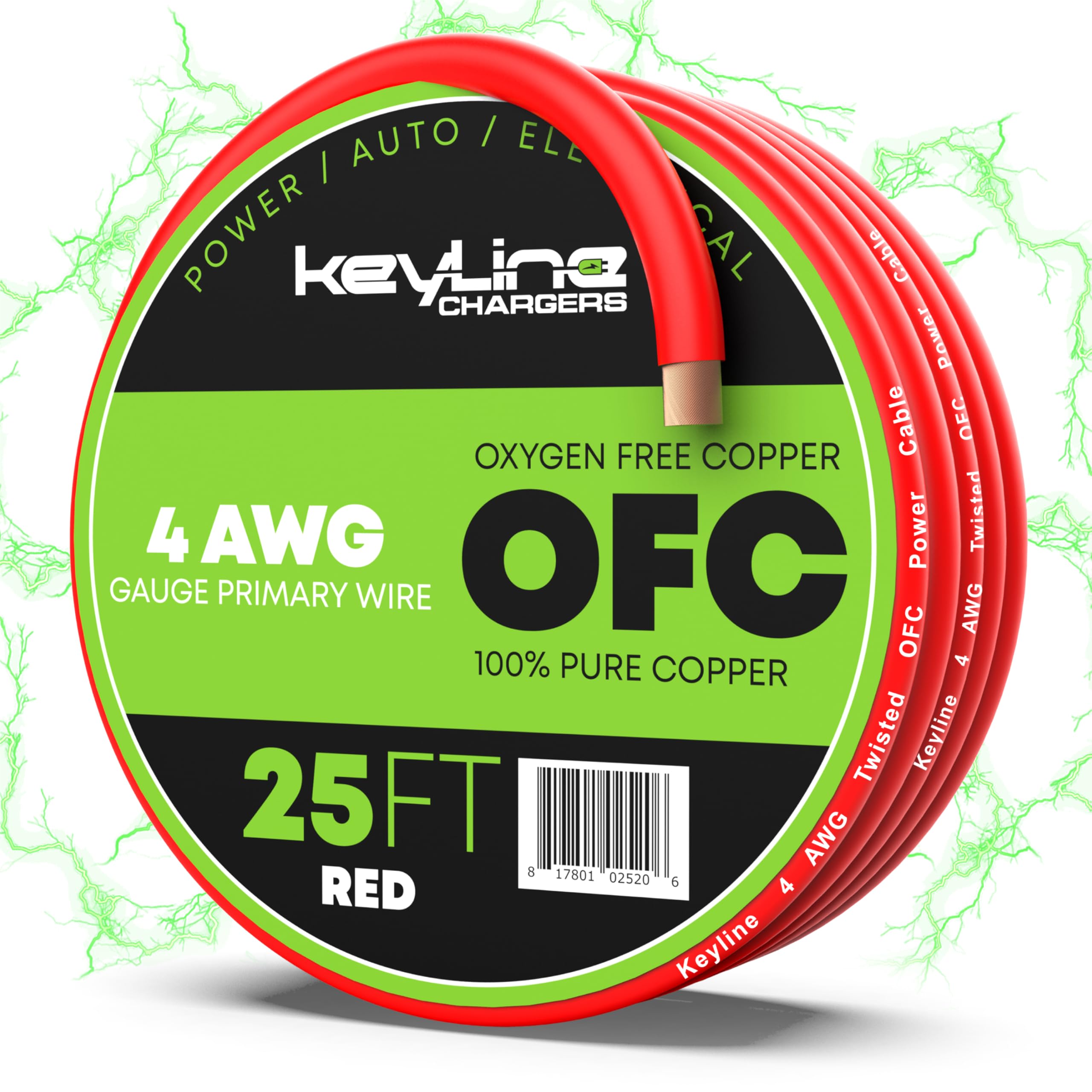
A full 25-foot spool of oxygen-free copper wire that lets you cut custom lengths for any project.
This is the one to grab when pre-made cables do not fit your layout. It is a spool of bare 4-gauge wire—no lugs, no heat shrink—made from oxygen-free copper (OFC), which removes microscopic impurities that cause resistance. OFC is the same material used in high-end car audio power cables because it delivers cleaner current and stays flexible over years of vibration. The 25-foot length gives you enough wire for a long positive run to a rear battery, a welding lead replacement, or a ground cable to the chassis.
The big difference here is voltage. This spool is rated for 12 Volts, compared to the End Game cable which is rated for 60 Volts—a five-times gap. That 12V rating is fine for standard car, truck, and RV electrical systems, but you should not use it for higher-voltage solar arrays or industrial equipment. Reviewers point out the OFC wire is noticeably more flexible than standard copper welding cable, making it easier to snake through tight spaces and around sharp corners.
If you need to run a dedicated amplifier power cable from the front battery to a trunk-mounted subwoofer, or you want to make your own ground straps, this spool gives you the raw material and the flexibility to do it yourself.
What You Get
- 25 feet of genuine OFC (oxygen-free copper) for clean power transfer
- Flexible strands make routing through tight spaces easier
- Great for custom-length car audio power, ground, and welding cables
Watch Out For
- No lugs included—you need a crimper and terminals to finish the ends
- Rated for 12 Volts only—not suitable for 24V or 48V solar systems
Reach for this spool when: you are running a long 12V circuit—like a car amp to the trunk—and you want to cut your own exact lengths.
pass on it if: you need a plug-and-play cable set or you are working with a higher-voltage solar or marine system.
Understanding the Specs
Pure Copper vs. CCA
Pure copper wire (sometimes marked OFC for oxygen-free copper) conducts electricity far better than copper-clad aluminum—CCA. Pure copper also resists heat buildup and stays flexible longer. If the data says “pure copper” or “99.9% copper,” you are getting the real thing. If it says “CCA,” the wire core is mostly aluminum, which means higher resistance and more voltage drop over long runs.
Lug Size and Material
The ring terminal at each end must match the stud on your battery or device. The two standard sizes are 3/8-inch and 5/16-inch. A 3/8-inch lug fits most automotive battery clamps. A 5/16-inch lug is common on smaller terminals or distribution blocks. Tinned copper lugs have a thin layer of tin that prevents corrosion—critical in any damp or marine environment.
Voltage Rating
Each cable has a maximum voltage it can safely handle. A 60-Volt cable works on 12V, 24V, and 48V systems with a big safety margin. A 12-Volt cable is fine for car/truck/RV use but should never be used on a 24V or 48V solar bank. Always match or exceed your system voltage.
Crimp Method
A hydraulic crimp (sometimes a 10-ton press) squishes the lug onto the wire with enormous force, creating a gas-tight connection that moisture cannot penetrate. A hand-crimper or hammer-style crimp is much weaker and can loosen over time, causing resistance and heat. Adhesive-lined heat shrink over the crimp adds another layer of moisture protection.
FAQ
Can I use a 4 gauge cable rated for 12V on a 24V solar system?
What is the difference between 3/8-inch and 5/16-inch lugs?
How long should my 4 gauge battery cables be?
Is a hydraulic crimp really better than a hand crimp?
What does OFC mean in a battery cable?
Can I use these cables for welding?
How many cables do I need for a series battery bank?
Can I use a 4 gauge cable for a car audio amplifier?
Final Thoughts: The Verdict
For most people, the 4 gauge battery cables winner is the TUELETFU 4FT Cable Set because it delivers pure copper, pre-crimped lugs, and tinned corrosion protection in a ready-to-use pair at a sensible price. If you need the toughest possible build for harsh conditions, grab the End Game Single Cable for its 10-ton hydraulic crimp and 60-volt rating. And for custom-length 12V projects or a long car audio power run, the KeyLine Chargers 25-foot OFC spool gives you the raw flexibility to cut exactly what you need.
How We Picked
We do not accept paid placement. Every pick is matched to a real buyer and a real use-case; we do not hands-on test units.
Sources & Methodology
Specifications: manufacturer listings and product documentation. Review insights: verified customer reviews, as of July 2026. Pricing: not shown on this page (it changes often); check the current price via the retailer link.
As an Amazon Associate, Gadgets Feed earns from qualifying purchases. This does not affect which products we feature.