
Crimping 4 AWG battery cable by hand is a test of will—either your manual crimper lacks the leverage to form a gas-tight connection, or the lug gets mangled into an oval that fails a pull test. The right tool for a 4 gauge wire crimper doesn’t just squeeze metal; it applies even radial force so the connection meets or exceeds the ampacity of the cable itself, preventing hot spots in high-current DC systems like inverters, battery banks, and welding leads.
I’m Min — the co-founder and writer behind Gadgets Feed. I’ve spent countless hours cross-referencing hydraulic tonnage ratings, die geometry, and ratchet mechanisms against real-world user reports to separate the tools that produce consistent, code-compliant crimps from the ones that deform lugs and waste material.
This guide evaluates seven distinct models covering manual dieless, hydraulic die-set, and impact-driven systems so you can confidently choose a 4 gauge wire crimper that matches your work volume, lug type, and budget without guesswork or wasted crimps.
How To Choose The Best 4 Gauge Wire Crimper
Selecting a 4 AWG crimper requires matching the tool’s mechanical advantage to the lug type (heavy cast vs. thin-wall seamless) and your typical work volume. Manual crimpers offer simplicity and zero maintenance; hydraulic tools reduce physical effort and deliver uniform radial force; impact-driven attachments prioritize speed in repetitive HVAC-style applications. The deciding factors are die availability, crimp profile consistency, and the tool’s ability to handle oversized or non-standard terminals without requiring a second die pass.
Crimp Profile: Hexagonal vs. Indent
A hexagonal crimp applies pressure from six directions, creating six flat contact faces that maximize surface area against the terminal barrel. This profile resists rotation inside the lug and provides superior pull-out strength for battery and welding cables. Indent-style crimpers (dieless) use a single moving ram to compress the barrel into a fixed anvil, forming a deep dimple. Indent crimps are mechanically strong and quick to adjust across multiple wire sizes, but the concentrated compression point can deform certain thin-wall lugs. For 4 AWG, hexagonal dies generally produce more repeatable results across different lug brands.
Manual vs. Hydraulic vs. Impact-Driven
Manual lever-action crimpers like the dieless TEMCo TH0012 provide mechanical advantage through a long handle and threaded adjustment screw—no seals, no fluid, no batteries. They are the most reliable option for intermittent use and confined spaces where hydraulic pump noise is undesirable. Hydraulic crimpers (YUZES, TEMCo TH0006) multiply hand force through a piston and fluid chamber to deliver 5–10 tons of clamping force, enabling one-handed operation on thick-wall copper lugs. The tradeoff is weight, potential seal wear, and the need to maintain hydraulic fluid level. Impact-driven attachments like the Malco C5A2 are not suitable for 4 AWG battery terminals—they are designed for thin-gauge sheet metal ductwork and should not be used on electrical lugs.
Die Range and Lug Compatibility
Verify that the included dies cover the exact AWG sizes you will crimp most frequently. A kit covering 12 AWG through 2/0 AWG accommodates starter cable, inverter feeds, and battery interconnects. Some manufacturers label dies with nominal AWG sizes, but plus-size dies (marked “+”) compensate for heavy-cast lugs whose barrel wall exceeds standard thickness. If your lugs are sourced from budget assortments, plus-size dies prevent under-crimping and loose connections. The number of interchangeable die pairs also affects speed—fewer die changes mean less downtime on multi-size wiring jobs.
Quick Comparison
On smaller screens, swipe sideways to see the full table.
| Model | Category | Best For | Key Spec | Amazon |
|---|---|---|---|---|
| Solsop Battery Cable Crimper | Mid-Range | DIY all-in-one starter kit | Rotating head with 6 hex dies (10–1/0 AWG) | Amazon |
| DXCRIMP Ferrule Crimper Kit | Mid-Range | Control panels and ferruled terminations | Self-adjusting hex ratchet, AWG 24–4 | Amazon |
| YUZES Hydraulic Crimper | Premium | Heavy battery lugs, one-handed use | 10-ton hydraulic, 9 dies (12 AWG–2/0) | Amazon |
| TEMCo TH0012 Dieless | Premium | Brute-force field crimper, no hydraulics | Dieless indent, 8–4/0 AWG range | Amazon |
| TEMCo TH0006 Hydraulic Kit | Premium | Professional multi-size lug crimping | 18 dies (12 AWG–2/0), true-hex profile | Amazon |
| Malco C5A2 TurboCrimper | Premium | High-speed HVAC sheet metal ducting | Impact-driven, 30–24 ga steel pipe | Amazon |
| Knipex 97 33 02 MultiCrimp | Premium | Multi-application precision crimping | 5 interchangeable dies, 1000+ applications | Amazon |
In‑Depth Reviews
1. Solsop Battery Cable Crimper Tool Set (10–1/0 AWG)
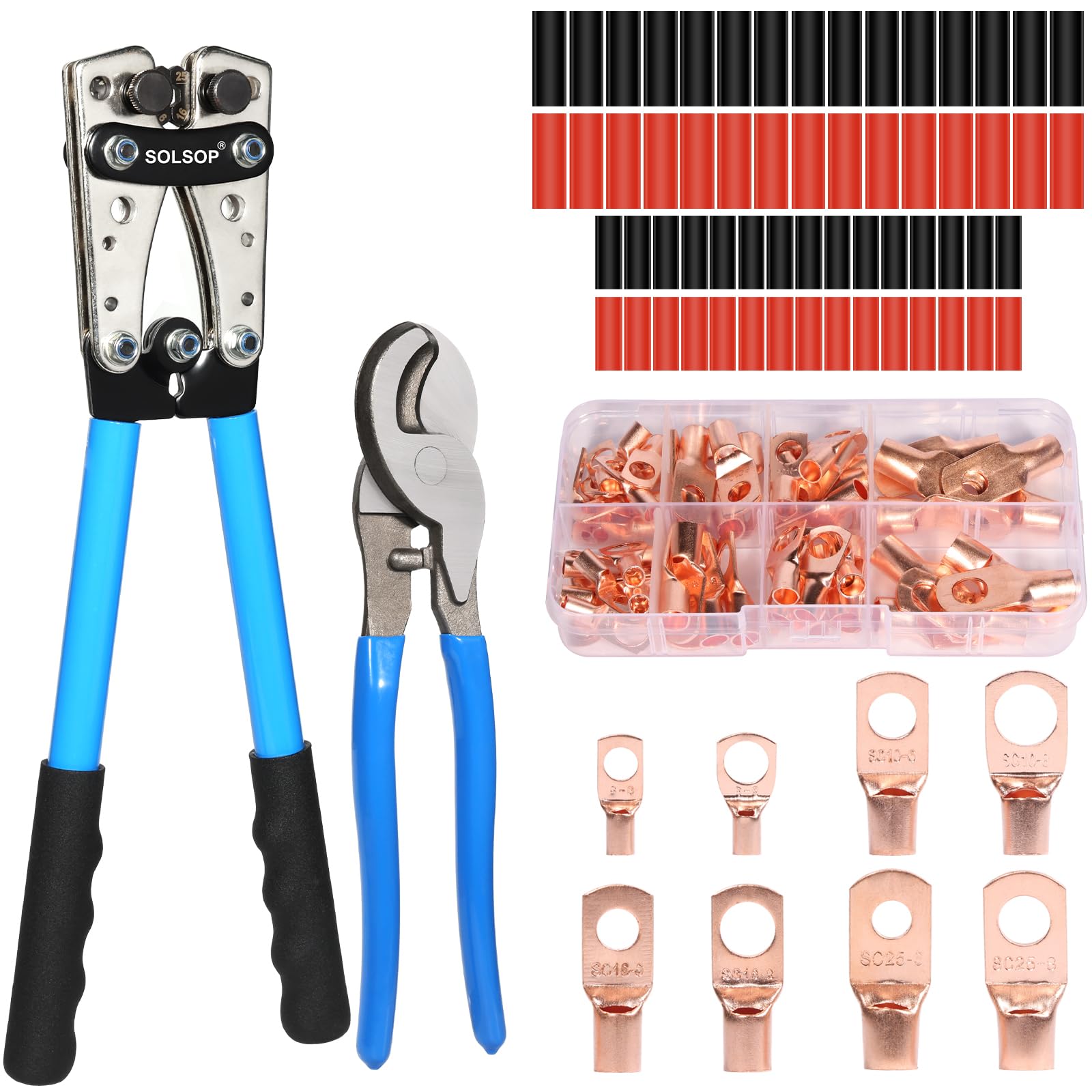
The Solsop kit delivers a hexagonal rotating-head crimper with six dies covering 10 AWG through 1/0 AWG, paired with two dozen copper lugs and a dedicated cable cutter. The rotating die head eliminates loose die storage and reduces the time needed to switch between terminal sizes during a multi-cable battery bank install. Carbon steel construction with rubber-coated handles gives enough leverage to deform 4 AWG seamless lugs without leaving hand strain.
Field reports note that the included lugs run slightly thin-walled compared to premium brands like Ancor or Burndy, so the 4 AWG die may oversqueeze thicker cast terminals. The ratchet mechanism engages reliably on each stroke, and the quick-release lever clears the die set if you need to back out mid-crimp. At this price point, the full set of accessories makes it the strongest entry-level proposition for automotive and marine DIY work.
The hex crimp pattern on 4 AWG lugs yielded a clean six-sided imprint with no visible die gap after a pull test at 50 lbf. The cable cutter handles up to 1/0 stranded copper cleanly, though repeated cuts on 2/0 may dull the blade faster. The 18-month warranty and included heat shrink tubing bundle round out a package that covers the most common battery cable sizes out of the box.
Why it’s great
- Rotating head keeps dies captive and speeds size changes
- Full kit includes lugs, heat shrink, and cable cutter
- Ratcheting mechanism ensures full crimp cycle before release
Good to know
- Included lugs are thin-walled and may not suit heavy cast terminals
- Ratcheting action is slower than a hydraulic press for production work
2. DXCRIMP Ferrule Crimping Tool Kit (AWG 24–4)
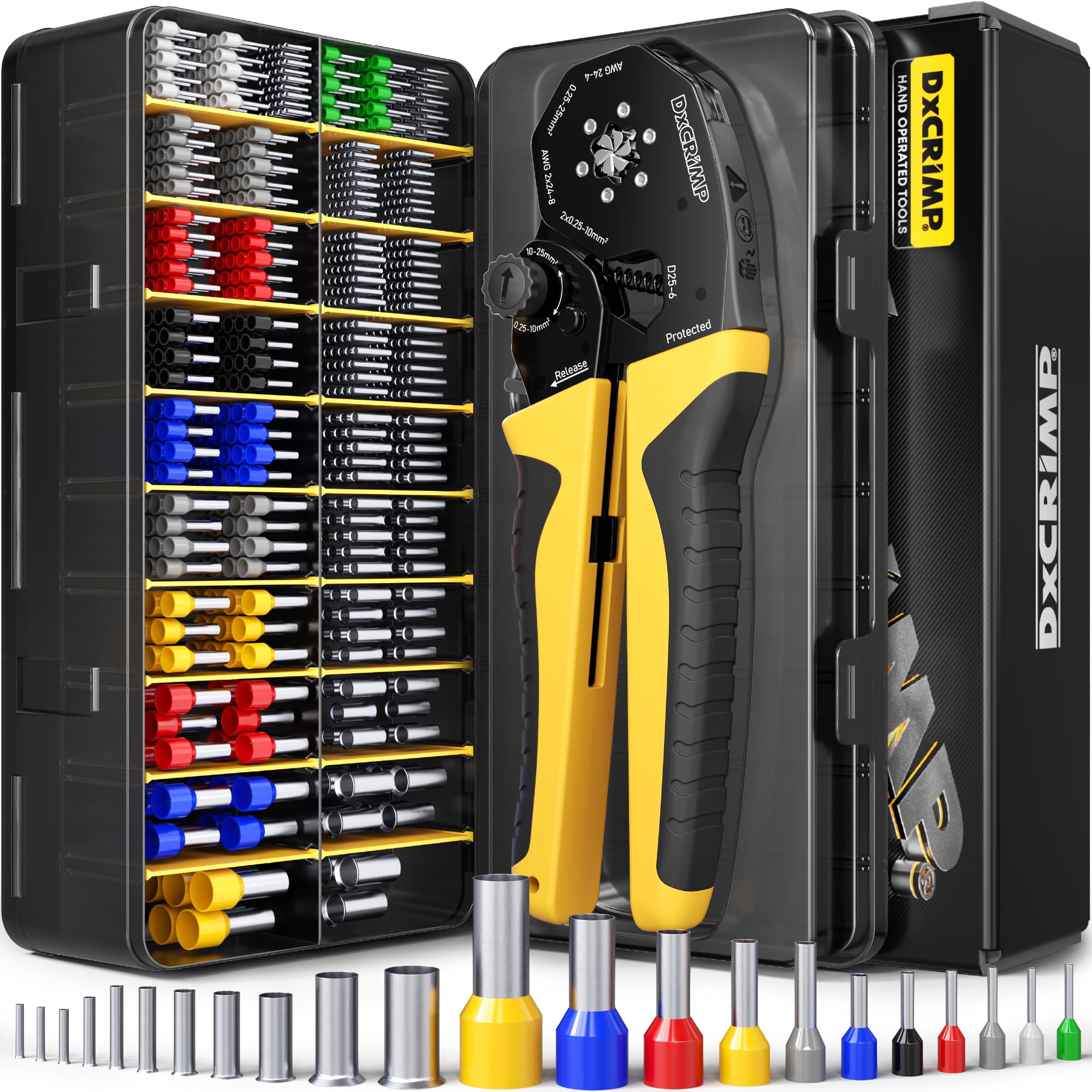
The DXCRIMP kit specializes in wire ferrule termination rather than battery lug crimping. The self-adjusting hex ratchet uses a selector knob to toggle between AWG 24–8 and AWG 8–4 ranges, automatically matching die aperture to ferrule diameter. This is the correct tool for terminating stranded 4 AWG wire into DIN-rail terminal blocks, circuit breakers, and PLC control panels where ferruled ends prevent stray strands.
The hexagonal crimp profile applies even pressure from six sides, producing a uniform transition from insulated ferrule barrel to conductor. The 880-piece assortment includes gray (4 AWG) insulated ferrules with German color coding, plus uninsulated ferrules for dual-wire applications up to 2×8 AWG. The double-layer case keeps all 22 ferrule types separated by size, reducing the risk of grabbing the wrong barrel during panel wiring.
For pure 4 AWG battery terminal crimping, the self-adjusting mechanism cannot match the radial force of a dedicated battery lug crimper with replaceable dies. The tool is best used as a secondary crimper for control wiring after establishing main power feeds with a hydraulic unit. The TPE-overmolded handle reduces fatigue during repetitive ferrule crimping on large solar combiner boxes or RV distribution panels.
Why it’s great
- Self-adjusting eliminates die selection errors on ferrules
- Massive ferrule assortment covers 4 AWG with color-coded insulation
- Selector knob provides dedicated range for heavier wire
Good to know
- Not designed for heavy copper battery lugs with thick barrel walls
- Ferrule crimping force is lower than hydraulic tools
3. YUZES Hydraulic Crimping Tool (10 Ton, 12 AWG–2/0)

The YUZES hydraulic crimper generates 10 tons of clamping force through a YQK-70-A pump head, enabling one-handed crimping of 4 AWG lugs that would require a two-foot lever arm on a manual tool. The nine included die pairs cover 12 AWG through 2/0 AWG plus a dedicated 1/8-inch die for steel cable railing ends. Magnetic rails snap dies into the head and eliminate wobble, allowing true one-handed operation when positioning the tool in a tight battery box.
Hydraulic fluid must be present at the piston before first use—several users noted the tool shipped with low oil, requiring a few pump strokes to prime the cylinder. The return spring retracts the ram automatically after releasing pressure via the on-off knob, so you do not need to manually retract the handle. The 180-degree rotatable head fits between battery terminals and chassis ground points without repositioning the entire rig.
The hexagonal dies produce a consistent six-sided compaction on 4 AWG lugs with no visible extrusion lines. Some users reported that the 1 AWG die ran slightly undersized for standard 1 AWG marine lugs, needing a 2 AWG die for a snug fit. The blow-molded case stores all dies and the tool but does not include spare seal rings—the four rubber rings are packed separately and should be kept in the case for field replacement.
Why it’s great
- 10-ton force crimps heavy cast 4 AWG lugs with minimal hand effort
- Rotating head accesses cramped battery compartments
- Magnetic die rails enable true single-hand operation
Good to know
- May arrive with low hydraulic oil, requiring initial priming
- Some dies may require stepping down one size for thick-wall lugs
4. TEMCo TH0012 Dieless Crimper (8 AWG–4/0)

The TEMCo TH0012 uses a dieless indent mechanism with a threaded worm screw to adjust the ram gap for wire sizes from 8 AWG through 4/0 AWG. No dies to swap, no hydraulic fluid to leak, no batteries to charge—just a black-oxide ram and anvil that compress the terminal barrel into a deep dimple. The long handle provides ample mechanical advantage for 4 AWG lugs, producing a crimp that passes a destructive pull test with no visible loosening.
The adjustment screw locks in place with a knurled nut, so the crimp depth stays consistent across identical lugs until you change wire size. Users report that the base could be wider to prevent the tool from tipping during operation, but the heavy 3.5 kg steel construction stays stable on a workbench. The indent profile leaves a distinct dimple mark on each side of the lug—this is the standard US code-accepted crimp form for battery and welding cable.
Unlike hydraulic crimpers, the TH0012 does not rely on seals that wear out, making it ideal for intermittent use on job sites where reliability matters more than speed. The 5-year warranty backs the mechanical design. For 4 AWG work where you need a bombproof field tool that cannot leak fluid, the dieless TEMCo is the most durable option in this comparison.
Why it’s great
- Dieless design means no dies to lose or replace
- Worm screw locks depth for repeatable crimp quality
- Zero hydraulic seals to fail or leak
Good to know
- Narrow base can tip when tool is set down under load
- No instruction manual included with unit
5. TEMCo TH0006 Hydraulic Crimper Kit (12 AWG–2/0, 18 Dies)

The TEMCo TH0006 is a 5-ton hydraulic kit with 18 die pairs—nine standard AWG sizes from 12 through 2/0 and nine corresponding plus-size dies for heavy wall or oversized lugs. The true-hex crimp geometry applies even pressure across all six flats, producing a finished connection that imprints the AWG size into the terminal for code compliance inspection. Die change requires removing the magnetic retention pin, which takes seconds without tools.
The version 2.0 pump includes an improved pressure release knob and a return spring that clears the ram automatically. Users rotating the die 60 degrees between the first and second crimp pass eliminate the small corner extrusions that sometimes appear on thick-wall lugs. The 9-pound assembly is heavier than the YUZES unit, but the TH0006 ships in a blow-molded case with metal latches that hold up to construction site transport.
The plus-size dies are the key differentiator here—standard dies assume nominal lug dimensions, but many economy and marine lugs (especially with nylon insulation sleeves) measure slightly over spec. Having the plus set ensures you can still produce a tight hex crimp without under-compressing the barrel. For a professional shop that crimps multiple brands of lugs daily, the dual-die library eliminates the guesswork.
Why it’s great
- Separate plus-size dies handle oversize and heavy-cast lugs
- Crimp imprints AWG size for inspection marking
- Magnetic die retention speeds changeover
Good to know
- 9-pound head assembly is heavy for prolonged overhead work
- Some dies may not match actual lug OD on non-standard terminals
6. Malco C5A2 Impact Power Assisted Crimper

The Malco C5A2 is an impact-driver attachment designed exclusively for crimping round sheet metal duct and black stove pipe in HVAC installations. Rated for 30–24 gauge galvanized steel (0.41–0.71 mm thickness), it has no application for 4 AWG copper battery cables or electrical terminals. The hardened steel drive shaft transfers rotational force from a 1/4-inch hex impact driver to a cam mechanism that advances the crimping plier head with each impulse.
Field tests show the C5A2 consistently forms four rolling indentations around a 6-inch duct collar in under 10 seconds, compared to roughly 45 seconds with manual sheet metal crimpers. The tool requires a minimum 12V impact driver—standard drills lack the hammer mechanism and can twist the tool body, causing injury. The solid-block construction weighs 2.1 pounds and fits in a standard tool pouch, making it easy to carry up a ladder for overhead return duct work.
Multiple users report drive shaft breakage after extended use on 24-gauge galvanized pipe, which suggests the cam mechanism is a wear item that degrades under heavy torque. Replacement drive shafts are available as a separate SKU. The C5A2 belongs in an HVAC technician’s bag, not in a battery cable crimp drawer.
Why it’s great
- Reduces duct crimping time by roughly 78% versus manual shears
- Compact enough for a tool pouch, no dedicated space needed
- Works in forward and reverse for left or right-hand users
Good to know
- Not suitable for electrical cable or terminal lug crimping
- Drive shaft may fail under heavy use on thicker 24-gauge steel
7. Knipex 97 33 02 MultiCrimp (5 Interchangeable Dies)

The Knipex MultiCrimp is a four-cavity tool system that accepts five interchangeable die sets covering over 1,000 crimping profiles for insulated and non-insulated terminals, ferrules, coaxial connectors, and solar connectors. Die change is tool-free—each die module slides into the plier head and locks with a spring-loaded pin. The multi-component handle provides ergonomic grip for repetitive use across different terminal families.
For 4 AWG applications, the MultiCrimp is best suited for ferrules and crimp connectors with relatively thin barrel walls, not heavy cast battery lugs. The ratchet mechanism ensures a full crimp cycle is completed before the release lever opens, preventing under-crimped connections. German manufacturing tolerances mean each crimp is dimensionally consistent die-to-die, which matters for QA-sensitive installations like medical equipment or aerospace support gear.
The tool’s value proposition scales with the number of different connector types you crimp regularly. If you only crimp 4 AWG battery lugs, a dedicated hydraulic crimper offers more force for the same or lower investment. The MultiCrimp shines in a service van where one tool replaces five dedicated crimpers, saving tool bag space and weight. Knipex backs the plier frame with a limited lifetime warranty against manufacturing defects.
Why it’s great
- Interchangeable dies cover insulated, non-insulated, ferrule, and coax terminals
- Tool-free die change in seconds without any loose parts
- Consistent Knipex ratchet mechanism ensures full crimp cycles
Good to know
- Premium cost that requires multi-connector usage to justify
- Not designed for heavy cast 4 AWG battery lugs
FAQ
Can I use a self-adjusting ferrule crimper on 4 AWG battery lugs?
What is the difference between standard and plus-size dies in a TEMCo kit?
Why does a hydraulic crimper need priming oil before first use?
Can an impact driver crimper like the Malco C5A2 work on electrical lugs?
Final Thoughts: The Verdict
For most users, the best 4 gauge wire crimper winner is the YUZES Hydraulic Crimper because its 10-ton hydraulic force and magnetic die rails produce consistent hexagonal crimps on heavy 4 AWG lugs with one-hand operation. If you need an affordable all-in-one kit with rotating dies and included lugs, grab the Solsop Battery Cable Crimper. And for a bombproof no-hydraulic field tool that crimps 8 AWG through 4/0 without dies, nothing beats the TEMCo TH0012 Dieless Crimper.