
Our readers keep the lights on and my morning glass full of iced black tea. As an Amazon Associate, I earn from qualifying purchases.
Specs are compiled from manufacturer listings and verified buyer reviews and can change over time — please confirm the key details on the product page before buying.
You want a 4 GPM pressure washer that starts on the first pull, rolls over your lawn without bogging down, and lets you clean the whole driveway without dragging the machine every five minutes. At this flow rate — 4 gallons per minute (GPM), which is the volume of water that sweeps dirt away — a cheap hose or a weak pump turns a quick job into an afternoon of frustration. You need the one that works every time.
I’m Min — the founder and writer behind Gadgets Feed. This guide is built by comparing the manufacturers’ published specifications and the patterns across verified customer reviews, so you get each pick’s real strengths and trade-offs instead of marketing spin.
A 4 gpm pressure washer cleans faster and more thoroughly than lower-flow machines, but picking the right one means weighing the engine’s reliability against the pump’s build quality and the hose’s reach — and knowing when a budget model is enough for home tasks versus when a commercial-grade unit pays for itself in avoided downtime.
Our Picks at a Glance
How To Choose The Best 4 GPM Pressure Washer
The 4 GPM flow rate is the dividing line between a weekend machine and a workhorse. At this flow, the pump and hose are as important as the engine because moving 4 gallons a minute puts real strain on every connection and seal. Knowing the three specs that separate a satisfying purchase from a frustrating one saves you a return trip for warranty service.
Pump Architecture: Triplex vs. Axial Cam
An axial cam pump (common on units around –) is simpler and cheaper to replace. A triplex plunger pump (found on the Simpson models) has three plungers running in oil, making it quieter, cooler, and much longer-lived under daily commercial use. For a homeowner who washes twice a year, an axial cam pump may be perfectly adequate. For a contractor or someone cleaning multiple driveways each month, a triplex pump is a durability essential.
Hose Length and Wheel Size
A 25-foot hose forces you to move the washer around the house every few minutes — you park it, wash a section, drag it forward, park it again. A 50-foot hose covers about twice the area before you have to reposition the machine (50 feet vs 25 feet, a 2.0x gap). Likewise, 10-inch “never-flat” wheels work fine on pavement but sink on grass and gravel. 13-inch pneumatic tires (as on the Simpson units) roll over soft ground and curbs without you needing to lift the 124–161 lb machine.
Engine Reliability and Warranty
A Honda GX390 engine (389cc, overhead-valve) has a reputation for starting on the first pull after winter storage. The 212cc engines that power the mid-range models also start reliably but have less thermal mass and may feel strained under continuous high-load runs. Look at the warranty: a 3-year engine / 5-year pump commercial warranty (Simpson ALH4240) versus a 2-year blanket warranty (Steupoek / Imdot) tells you which manufacturer expects their product to last.
Quick Comparison
| Model | Best For | PSI / GPM | Engine | Hose | Amazon |
|---|---|---|---|---|---|
| Simpson ALH4240★ Best Overall | Professional / daily use | 4200 / 4.0 | Honda GX390 | 50 ft | $1,499.00Amazon |
| Simpson ALWB60827Premium Pick | Heavy commercial | 4200 / 4.0 | Honda GX390 | 50 ft | $1,799.99Amazon |
| Steupoek STE39X | Budget value | 4200 / 4.0 | 7HP 212cc | 25 ft | $379.99Amazon |
| Imdot YGA36 | Homeowner toughness | 4200 / 4.0 | 212cc OHV | 25 ft | $399.99Amazon |
| IvyBess YG0039 | Mobility / yard reach | 4200 / 4.0 | 212cc 7.0HP | 33 ft | $399.99Amazon |
In‑Depth Reviews
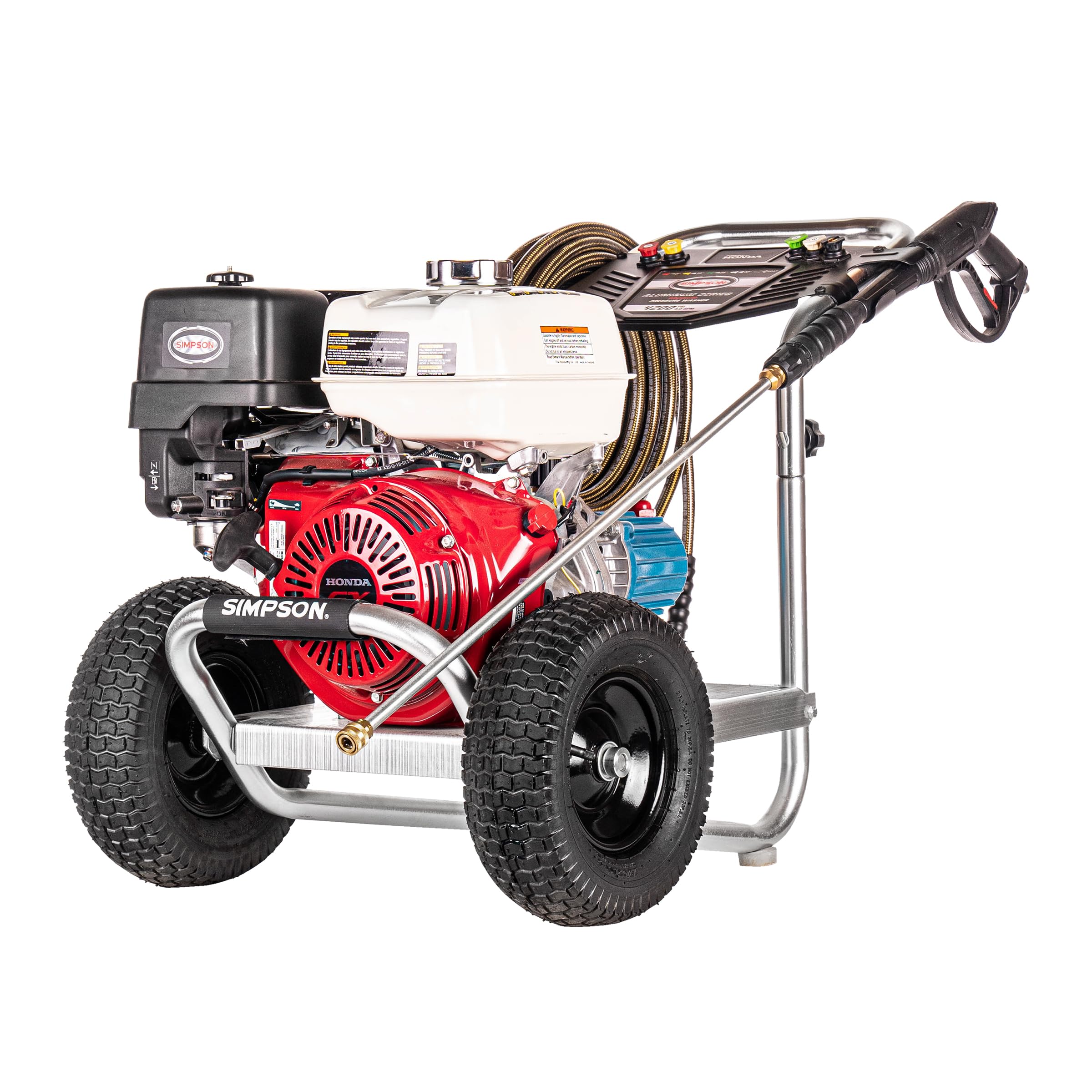
1. Simpson Aluminum Series 4200 PSI Gas Pressure Washer, 2.5 GPM, Honda GX390 (ALH4240)
Our pick — over 4★ from 550+ verified ratings; the strongest balance of quality and price.
The commercial-grade standard that turns a full day of washing into an afternoon.
This Simpson machine pushes 4200 PSI (pounds per square inch – the force that blasts dirt off the surface) and 4.0 GPM through a CAT triplex plunger pump – a pump with three ceramic plungers running in an oil bath that cools and lubricates the seals for long life. It uses a Honda GX390 engine, the same combo you see on construction sites. The thermal relief valve in the pump bleeds hot water automatically, so you don’t have to stand there pulling the trigger during breaks to keep the pump from overheating — just walk away and come back. The 50-foot Monster series hose resists kinks and abrasion, and the non-marring polyurethane jacket protects finished surfaces against scuff marks if the hose drags across a car’s paint. At 124 lb with 13-inch pneumatic tires, moving it over gravel or grass takes a solid push but the balanced layout and aluminum frame make it manageable for one person on flat ground.
Buyers report the Honda GX390 starts on the first or second pull even after sitting for months, a real advantage over small engines that require priming and frustration after a winter in the shed. The 5 included quick-connect nozzles (0°, 15°, 25°, 40°, and soap nozzle) cover everything from stripping paint on concrete to washing a car without damaging the clear coat. Compared to the Simpson Water Blaster below, the ALH4240 uses the same GX390 engine and the same 50-foot hose (50 feet on both models), but it weighs 124 lb versus 161 lb, making it easier to maneuver for a contractor who loads and unloads it daily.
One reviewer noted that the frame is aircraft-grade aluminum with a powder-coated finish and resists corrosion, and that assembly took a single afternoon with basic hand tools. The main trade-off is the aluminum frame’s higher cost versus a steel frame — you pay a premium for the corrosion resistance and reduced weight.
The Professional Edge
- CAT triplex pump with ceramic coated pistons for extended seal life vs axial cam pumps found on budget models
- Honda GX390 engine includes low-oil shutdown — the engine turns off automatically before damage occurs
- 50-foot dual-braided hose keeps you moving along a house foundation without relocating the machine
- Engine — 3 Year Limited Commercial Warranty; Pump — 5 Year Limited Warranty
Reality Check
- At 124 lb, it is still heavy to lift into a truck bed without a ramp — 64 lb heavier than the 60-lb Imdot model
- Higher initial investment than the budget picks
Who gets this pick: Professionals and serious homeowners who plan to own one pressure washer for the next 5–10 years and want the engine and pump to last through that run.
Who should look elsewhere: Occasional users washing a car twice a year will overbuy on both price and capability — a mid-range axial cam unit will be more than enough.
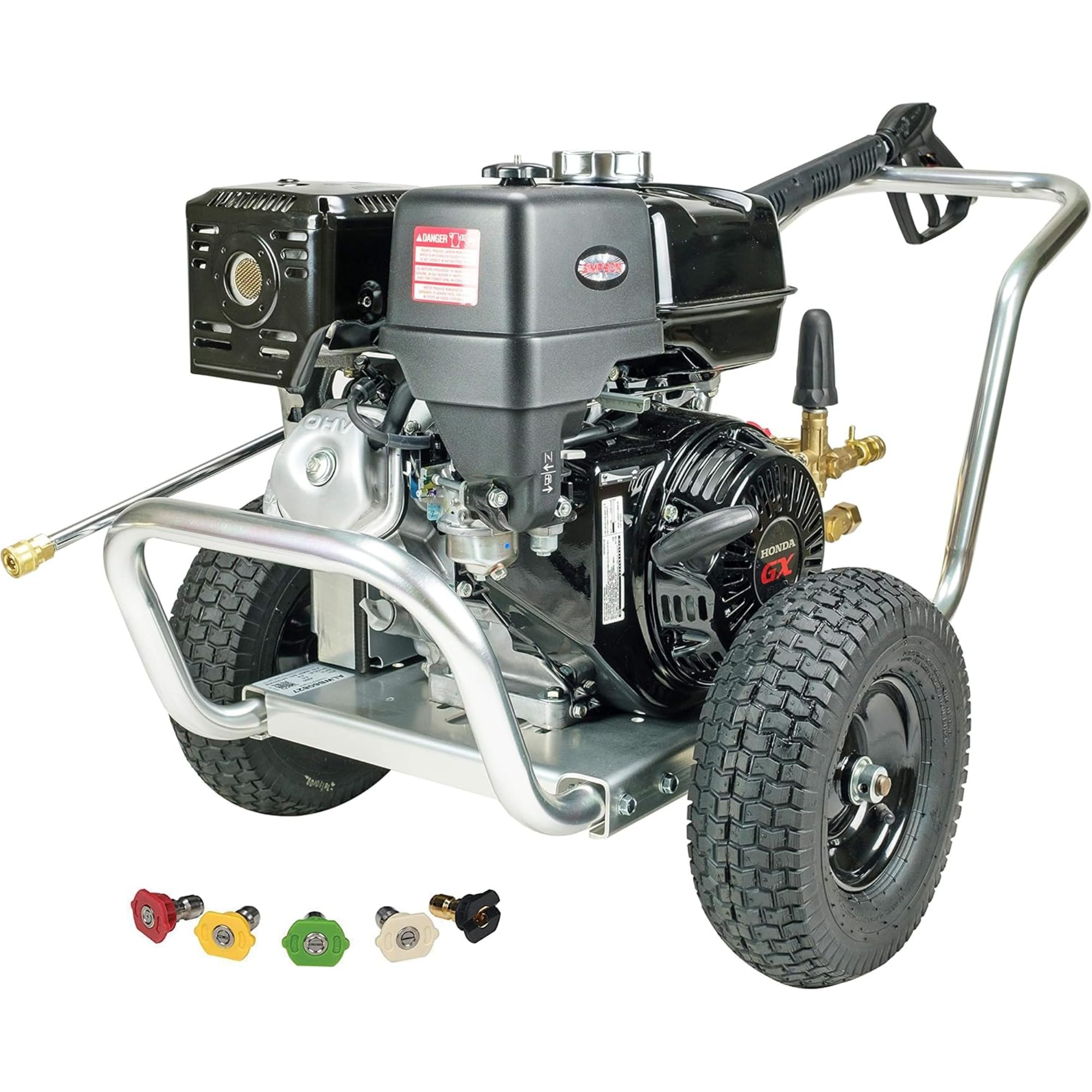
2. Simpson 4200 PSI Gas Pressure Washer, 4.0 GPM Commercial Power Washer, Honda Engine, 50’ Hose (ALWB60827)
The Water Blaster series — the 161-lb tank that trades portability for a 10-year frame warranty.
Step up to the Simpson ALWB60827 and you get the same 4200 PSI / 4.0 GPM output and the same 50-foot Monster hose as the ALH4240, but the AAA triplex pump here adds an integrated unloader with a thermal relief valve. What that means for you: the unloader diverts water back to the pump inlet when you close the trigger, so the pump does not deadhead against a closed nozzle — a common failure point on cheaper units. The 10-year frame warranty (the longest in this roundup) tells you Simpson expects the aircraft-grade aluminum frame to outlast the engine and probably the operator.
At 161 lb this is the heaviest machine on the list — 37 lb heavier than the ALH4240. The 12.6″ larger dimensions (46″ L x 26″ W x 25″ H vs 38″ L x 23.5″ W x 29″ H on the ALH4240, a 73% more gap in footprint) mean it takes up more storage space in a garage or van. The 48-inch insulated spray wand and rear-load professional spray gun with QC/NPT fittings are clearly aimed at contractors who run a truck-mounted washer and want a standalone backup unit. Owners mention the Honda GX390 starts consistently, and one owner mentioned that the low-oil shutdown saved the engine after a hose cracked on a hillside job.
The trade-off is clear: if you are running a business where downtime costs money, the longer warranty (3-year engine / 5-year pump / 10-year frame) and heavier-duty fittings justify the weight. For a homeowner with a standard driveway, the ALH4240 offers 98% of the same performance at a lower weight.
Warranty that covers the frame for 10 years: Simpson clearly expects this machine to survive commercial abuse. The 50-foot hose reaches to the back of a two-story house without moving the washer.
The weight management reality: Loading 161 lb into a pickup bed without a helper or ramp is a genuine pain. Look elsewhere if you have significant stairs or soft terrain.
The contractor’s choice: If you run a cleaning business and need a backup unit that handles daily abuse and is backed by a commercial warranty, this is the one. skip it if: You are a homeowner — the ALH4240 is much easier to maneuver and costs less.
3. Gas Powered Pressure Washer 4200PSI, 4.0GPM 212CC Commercial (Steupoek STE39X)
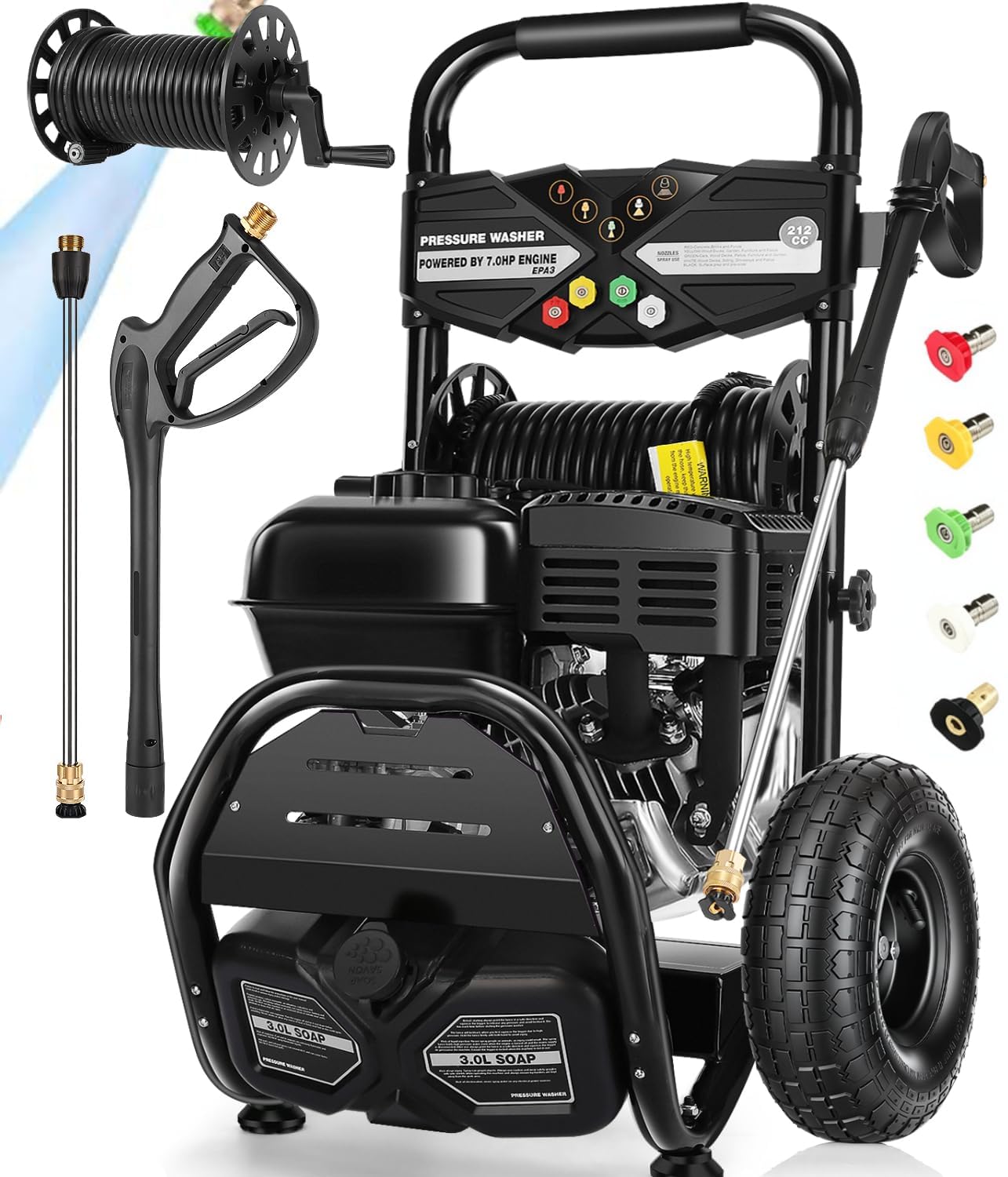
4200 PSI at 4.0 GPM for half the price — but the 25-foot hose is your first clue.
The Steupoek STE39X matches Simpson’s 4200 PSI and 4.0 GPM numbers with a 212cc engine (7 HP) and an axial cam pump, but at 60 lb it is 64 lb lighter than the Simpson ALH4240. The pump is simpler and cheaper to replace if it fails, but axial cam pumps do not have the thermal relief or oil-bath lubrication of a triplex unit, so you need to be more careful about letting the pump idle with the trigger closed. The 25-foot hose means you reposition the machine roughly twice as often as with a 50-foot hose — 25 feet vs 50 feet, a 2.0x gap in reach — so plan to walk back to the washer to move it every few minutes on a long driveway.
Buyers rate this unit 4.5 out of 5 stars from 21 ratings, noting that it starts on the second or third pull and has enough pressure to strip old paint from a fence. The 5 quick-connect nozzles (0°, 15°, 25°, 40°, and soap) cover standard tasks, and the 3-liter (0.8-gallon) dual soap tank lets you run detergent without refilling mid-job. The 10-inch “never-flat” wheels are fine on concrete but will sink into soft grass, unlike the Simpson’s 13-inch pneumatic tires. One buyer mentioned the ETL certification (a safety testing mark) as a confidence point, and the included engine oil and tools make assembly straightforward.
The main limitation: the axial cam pump and shorter hose mean this is a homeowner-grade machine dressed in commercial-looking specs. For a twice-a-year driveway wash it is an excellent value. For a contractor running it four hours every day, the pump will wear out faster than a triplex.
Why the price works
- Full 4.0 GPM at 4200 PSI for a fraction of the Simpson’s price
- Relatively lightweight at 60 lb for a gas 4 GPM washer
- CARB compliant — legal for sale in California and other strict-emissions states
- Two-year warranty mentioned in the listing
Where it falls short
- 25-foot hose means more repositioning — unlike the 50-foot on the Simpson units
- “Never-flat” wheels struggle on gravel vs the 13″ pneumatics on the premium picks
- Axial cam pump lacks the thermal relief valve and oil-bath cooling of a triplex
Best for the homeowner on a budget: If your pressure washing is confined to a driveway, patio, and car, and you do not mind moving the machine around the house, this delivers full 4 GPM performance for your money. Look elsewhere if: You need commercial durability or a long hose — the Simpson units are much better suited to all-day work.
4. 4200PSI Pressure Washer, 4.0GPM Heavy Duty (Imdot YGA36)
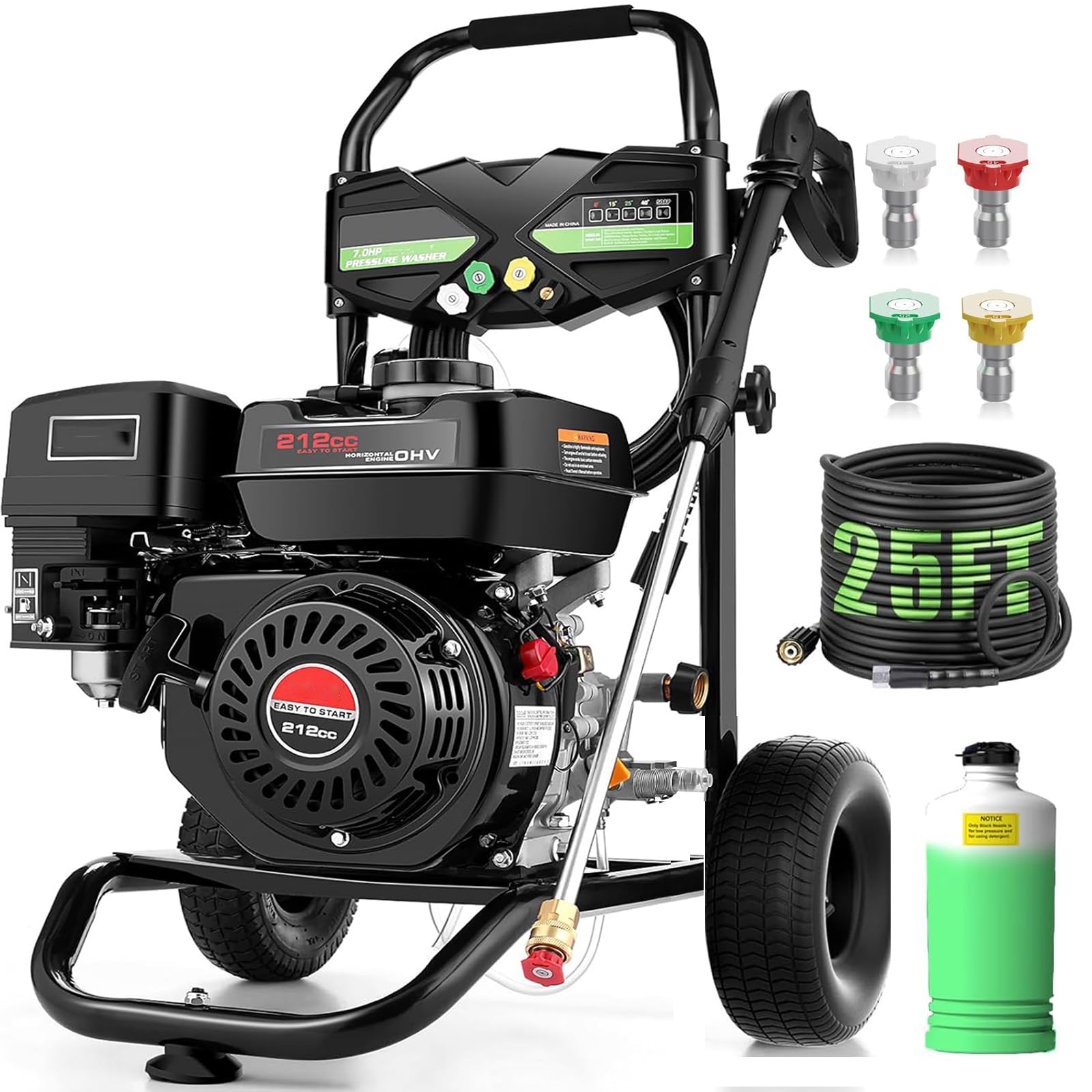
A 60-lb steel-frame washer that keeps the pump cool with a thermal release valve.
The Imdot YGA36 packs a 212cc 4-stroke OHV (overhead valve) engine and an OEM axial cam pump delivering 4200 PSI at 4.0 GPM, but the detail that separates it from other budget units is the thermal release device. When the pump gets hot from recirculating water with the trigger closed, the thermal release opens and spills a small amount of water to cool it — the same principle as the Simpson’s thermal relief valve, just in a simpler form. The powder-coated welded steel frame is heavier-duty than the lightweight frames on some entry-level washers, and the 10-inch high-profile no-flat wheels roll over pavement without needing air pressure maintenance.
The 0.5-gallon (64-fluid-ounce) fuel tank is smaller than the 3-liter soap tank on the IvyBess model, but the 25-foot ultra-flexible hose is the same length as the Steupoek’s — adequate for a single-car driveway but short enough to require moving the machine along a two-story house. Buyers give it 4.5 out of 5 stars from 18 ratings, with several noting that the assembly took under an hour and the engine started on the second pull. One owner mentioned the water pressure was strong enough to clean a decade-old moss stain off pavers. A potential issue: at 60 lb this is one of the lighter 4 GPM washers, but the compact dimensions (23″ L x 17″ W x 22″ H) mean it stores easily under a workbench or in a shed corner.
The trade-off with the Imdot is the same as with the Steupoek: the axial cam pump will not survive the same abuse as a triplex. But for, the thermal release valve adds a layer of protection that makes it more forgiving for a homeowner who may forget to let the pump cool.
The thermal release device: Not common at this price point. It prevents pump overheating during those “let me just grab the phone” moments when you leave the trigger closed.
The compact storage advantage: At 23″ x 17″ x 22″, it is smaller than the Simpson units by a significant margin, fitting into a standard garage shelf.
For the careful budget buyer: If you want a thermal release for pump protection but cannot stretch to a triplex unit, the Imdot is a solid middle ground. Not ideal if: You have a large property with multiple zones — the 25-foot hose will be frustrating.
5. 4200PSI Professional Gas Pressure Washer, 4GPM 212CC (IvyBess YG0039)
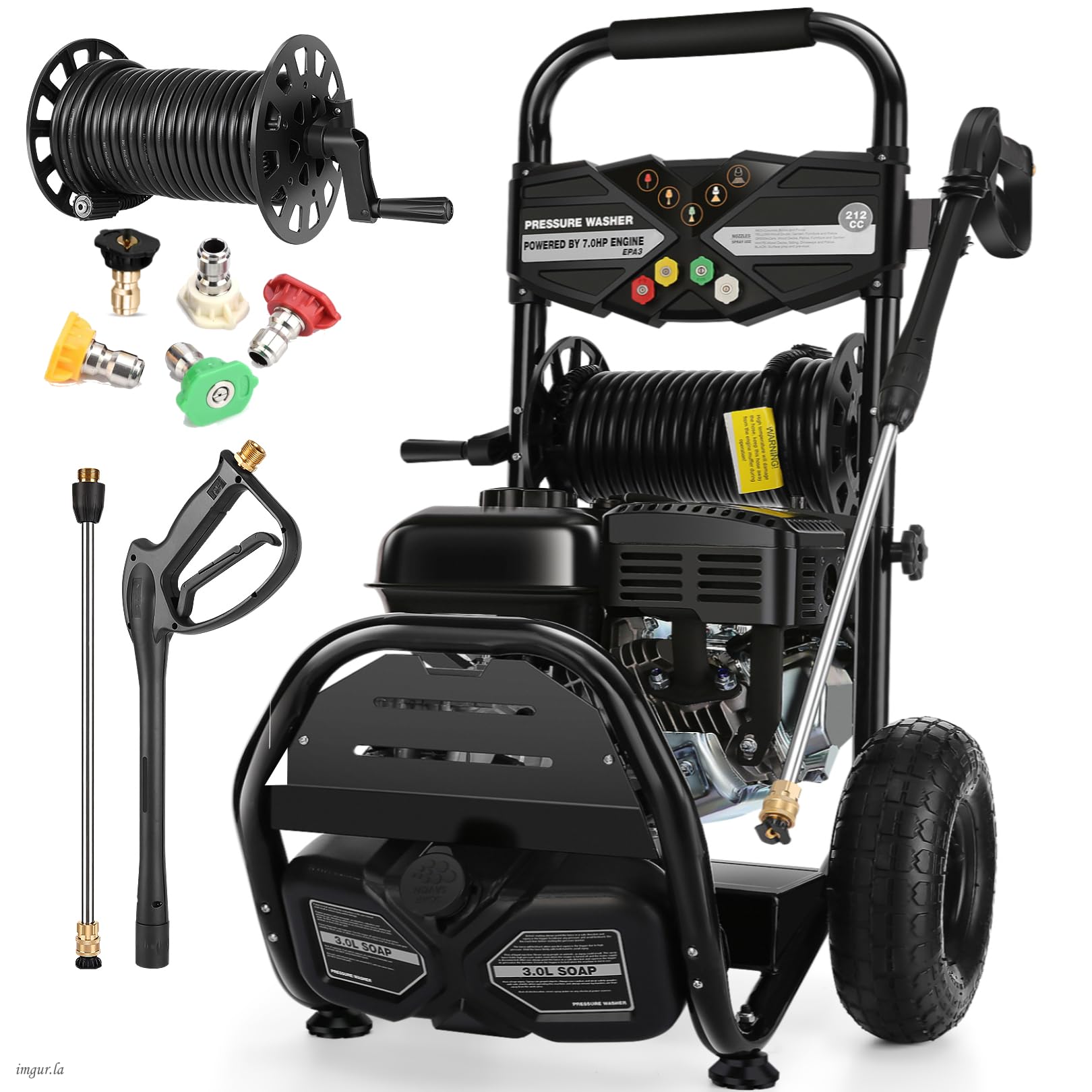
33 feet of hose — eight more feet than the other budget units — so you move the washer less.
The IvyBess YG0039 stands out in the budget segment with a 33-foot hose, which is 8 feet longer than the 25-foot hoses on the Steupoek and Imdot units. On a two-car driveway that extra length can mean the difference between washing the whole thing from one spot versus having to walk back and drag the washer forward. The 212cc 7.0 HP 4-stroke engine and axial cam pump deliver the same 4200 PSI and 4.0 GPM as the rest of the mid-range group, and the 10-inch wheels are the same no-flat type found on the Imdot. The 3-liter (0.8-gallon) foam bottle (soap tank) is larger than the Imdot’s 0.5-gallon fuel tank, but note that the foam bottle is for detergent, not fuel — the fuel tank is separate.
EPA, CARB, and ETL certifications mean this unit is legal to buy and operate in all 50 states including California, where emissions restrictions are strictest. Buyers give it 3.7 out of 5 stars from 36 ratings — the lowest average in this roundup — and several mentioned minor assembly issues like a loose clamp on the pump outlet that required tightening. On the positive side, customers note the engine starts reliably and the 33-foot hose does make a tangible difference in reach. The 0°, 15°, 25°, 40°, and soap nozzles are standard, and the safety lock on the trigger is a welcome addition for anyone washing around kids or pets.
The main difference between the IvyBess and the Steupoek / Imdot beyond the longer hose is the 33-foot reach versus 25 feet and the lower average review score. If hose length is your priority and you are comfortable with the 3.7-star rating, the IvyBess gives you more reach than any other budget-priced 4 GPM model on this list.
The Reach Advantage
- 33-foot hose — 25% longer than the 25-foot hoses on the Steupoek and Imdot
- EPA / CARB / ETL compliant — legal in all states including California
- 3-liter foam bottle for soap allows longer detergent runs vs the 0.5-gal on the Imdot
Caveats Noted by Buyers
- 3.7 out of 5 stars from 36 ratings — a few assembly quality complaints
- The axial cam pump is still the same consumer-grade type as the other budget units
- No carbon-fiber or aluminum frame; steel frame adds weight vs the aluminum Simpson units
Best for the buyer who values hose reach over everything else: If your property has a big driveway or long fence line and you cannot stretch to a Simpson, the extra 8 feet on the IvyBess matters. Look elsewhere if: You want a proven track record in buyer reviews — the higher-rated Steupoek or Imdot are safer choices on paper.
Understanding the Specs
GPM vs PSI — which one actually cleans?
PSI (pounds per square inch) is the force behind the water — it blasts dirt off the surface. GPM (gallons per minute) is the volume of water that sweeps the dirt away. At 4 GPM, a pressure washer moves roughly 60% more water per minute than a 2.5 GPM unit, so cleaning a driveway takes noticeably less time. Both numbers matter, but for rinsing soap off siding or sweeping mud from concrete, GPM is the spec that saves you time. A 4 GPM machine paired with 4200 PSI (as every unit here is) gives you a wide nozzle pattern to cover ground quickly while still having enough force to cut through grease on a garage floor.
Triplex pump — why the oil matters
A triplex plunger pump runs three ceramic plungers inside an oil bath. The oil lubricates the seals and dissipates heat, so the pump can run continuously for hours without the seals drying out or melting. An axial cam pump, by contrast, has a simpler design where a wobble plate pushes plungers in and out — no oil bath, less cooling. For a homeowner washing a car for 20 minutes, an axial cam pump is perfectly adequate. For a contractor scrubbing eight driveways in a day, the triplex is a durability requirement. The Simpson ALH4240 and ALWB60827 both use triplex pumps (CAT and AAA triplex respectively), while the Steupoek, Imdot, and IvyBess use axial cam pumps.
FAQ
Will any of these 4 GPM pressure washers work with a standard garden hose?
Can I use a 4 GPM pressure washer on a car without damaging the paint?
What does “triplex pump” mean and why does it cost more?
Is a 25-foot hose enough for a standard two-car driveway?
Which of these 4 GPM machines is CARB compliant?
How long does a 4 GPM pressure washer pump typically last?
Will a 4 GPM pressure washer work with a surface cleaner?
What oil should I use in a 4 GPM pressure washer engine?
Can I use a 4 GPM pressure washer with a foam cannon?
Are 4 GPM pressure washers noisy?
Final Thoughts: The Verdict
For the majority of shoppers, the 4 gpm pressure washer winner is the Simpson ALH4240 because its Honda GX390 engine and CAT triplex pump deliver the reliability that keeps you working instead of troubleshooting, and the 50-foot hose means you move the machine once per job, not every five minutes. If you want a budget-friendly model that still delivers 4200 PSI at 4.0 GPM, grab the Steupoek STE39X. And for the contractor who needs a 10-year frame warranty and the heaviest-duty pump in this roundup, the standout is the Simpson ALWB60827.
How We Picked
We do not accept paid placement. Every pick is matched to a real buyer and a real use-case; we do not hands-on test units.
Sources & Methodology
Specifications: manufacturer listings and product documentation. Review insights: verified customer reviews, as of July 2026. Pricing: not shown on this page (it changes often); check the current price via the retailer link.
As an Amazon Associate, Gadgets Feed earns from qualifying purchases. This does not affect which products we feature.
Related Guides
Product prices and availability are accurate as of the date/time indicated and are subject to change. Any price and availability information displayed on Amazon at the time of purchase will apply to the purchase of this product. As an Amazon Associate I earn from qualifying purchases.
CERTAIN CONTENT THAT APPEARS ON THIS SITE COMES FROM AMAZON. THIS CONTENT IS PROVIDED "AS IS" AND IS SUBJECT TO CHANGE OR REMOVAL AT ANY TIME.
Amazon and the Amazon logo are trademarks of Amazon.com, Inc. or its affiliates.