
A 4-inch insulated flexible duct is the critical link between your HVAC equipment and the conditioned space, but picking the wrong one means throwing energy dollars out the attic vent. The most common mistake buyers make is assuming all insulated ducts deliver the same thermal resistance, which leads to condensation, mold growth, and poor airflow in bathrooms, grow tents, and dryer exhaust runs.
I’m Min — the co-founder and writer behind Gadgets Feed. I’ve spent countless hours analyzing dozens of insulated duct listings, reading field reports from HVAC pros, and cross-referencing R-values versus actual customer installation feedback to separate legit thermal barriers from glorified tin foil tubes.
This guide compares seven 4-foot by 25-foot models with R-4.2 and R-6 ratings, covering everything from fiberglass shedding to clamp quality, so you can select the best 4 insulated flexible duct for your specific heating, cooling, or exhaust project.
How To Choose The Best 4 Insulated Flexible Duct
Four-inch insulated flexible duct looks simple, but the differences between a model that lasts a decade and one that collapses within a year come down to three specific properties: thermal resistance rating, jacket construction, and inner liner integrity.
R-Value: The Energy Efficiency Benchmark
The R-value measures the duct’s resistance to heat flow. Common offerings are R-4.2 and R-6, with R-6 providing roughly 33% more insulation. In unconditioned spaces like attics or crawlspaces, R-6 models prevent condensation on the duct surface during summer cooling and reduce heat gain, keeping your HVAC system from working overtime. For short runs inside conditioned walls, R-4.2 is adequate.
Jacket Material and Tear Resistance
The outer jacket is the first defense against physical damage. Aluminum foil jackets offer reflectivity and moderate puncture resistance, but heavy-duty metallized polyester jackets with embedded fiberglass scrim are significantly tougher against rodent chewing and accidental snags during installation. Black polyethylene vapor barrier jackets, like those from Dundas Jafine, add UV stability for outdoor exposure but can be less puncture-resistant than aluminum-scrim composites.
Inner Liner Air-Tightness and Fiberglass Containment
The inner core must be airtight to prevent conditioned air from leaking into the insulation blanket, which would bypass the thermal barrier entirely. More critically, some cheaper models allow fiberglass fibers to erode into the airstream, which is a respiratory hazard. Look for ducts that explicitly state “no fiberglass erosion into air stream” or have an air-tight inner core made of polyester laminate or aluminum.
Quick Comparison
On smaller screens, swipe sideways to see the full table.
| Model | Category | Best For | Key Spec | Amazon |
|---|---|---|---|---|
| Dundas Jafine BPC425R6 | Premium | High-heat attic runs & long-term durability | R-6 insulation, UL 181 listed, black PE jacket | Amazon |
| VEVOR R-6.0 4×25 | Premium | Noise-sensitive installations with maximum thermal barrier | R-6.0, 3-layer aluminum/PET, 2 clamps included | Amazon |
| HVAC Premium R-4.2 | Mid-Range | General heavy-duty HVAC in conditioned spaces | R-4.2, aluminum housing, airtight inner core | Amazon |
| Rubber-Cal HVAC Insulated-Flex | Mid-Range | Flexible routing for portable AC units | Acoustic insulation, compressible, 25ft | Amazon |
| Muctamo R-4.2 4×25 | Mid-Range | Cost-effective DIY HVAC and pipe insulation | R-4.2, weather-resistant outer layer, lightweight | Amazon |
| Master Flow F6IFD4X300 | Mid-Range | Standard HVAC and venting applications in attics | R-6, ETL listed, durable HDPE plastic construction | Amazon |
| InfiniPower 4×25 Insulated | Budget | Budget dryer exhaust and small-vent runs | 4-layer design, PVC material, noise-reducing | Amazon |
In‑Depth Reviews
1. Dundas Jafine Insulated Flexible Duct with Black Jacket, 4-Inches by 25-Feet BPC425R6
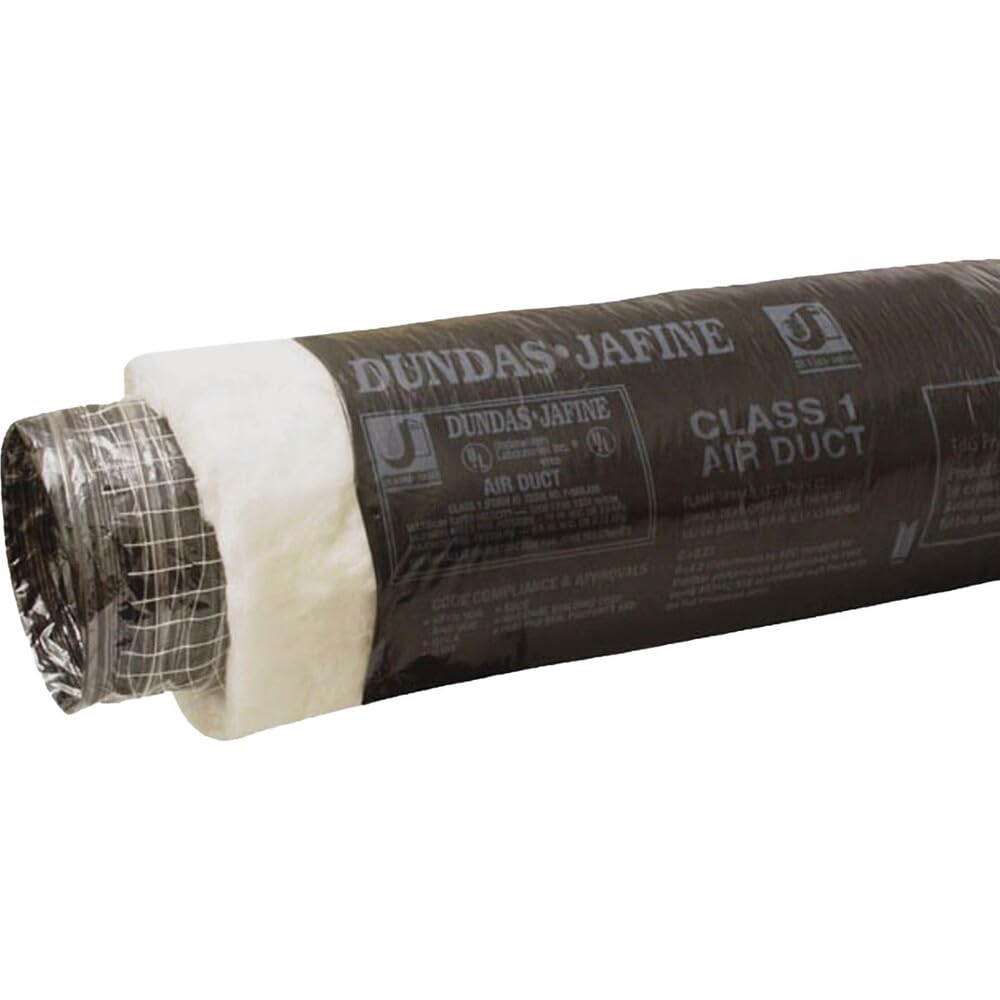
The Dundas Jafine BPC425R6 is the only model in this roundup with a UL 181 listing as a Class 1 air duct, which means it has been independently tested for flame spread and smoke development limits. Its black polyethylene vapor barrier is fire-retardant and UV-stable, making it the safest choice for attic runs where building code compliance matters. The flexible helix core uses two-ply polyester laminate and corrosion-resistant galvanized wire, providing structural integrity without the kinking problems that plague single-layer designs.
The formaldehyde-free fiberglass blanket surrounding the core delivers true R-6 thermal resistance, reducing heat loss by 33% compared to standard R-4.2 ducts. Installers report that the outer jacket cuts cleanly with scissors, and the material handles tugging without ripping during pull-through installation. The 4-inch diameter fits standard collars on inline fans and roof vents without struggle.
One caveat: the inner liner is remarkably thin — multiple users describe it as “mylar-thin” and easily torn if snagged on sharp metal ductwork. This does not affect performance if handled carefully during installation, but it means you cannot treat this duct roughly. For long-term peace of mind in attic environments with no pest exposure, this duct is arguably the best investment among the seven models.
Why it’s great
- UL 181 listed Class 1 for highest fire safety compliance
- R-6 formaldehyde-free fiberglass insulation for maximum thermal barrier
- Black PE jacket resists UV and fire, ideal for exposed attic runs
Good to know
- Inner liner is very thin — handle gently to avoid tears
- Premium price tier does not include installation clamps
2. VEVOR Insulated Flexible Duct 4″ x 25 Ft R-6.0

The VEVOR R-6.0 duct bridges the gap between premium thermal performance and sensible mid-range pricing. Its three-layer wall construction — aluminum foil bonded to PET film with a fiberglass grid reinforcement — achieves an R-6.0 rating that competes directly with the Dundas Jafine while including two stainless steel clamps in the package. The aluminum outer layer provides excellent reflectivity against radiant heat in hot attics.
Where this duct distinguishes itself is noise absorption. The fiberglass insulation layer doubles as an acoustic dampener, noticeably reducing the whoosh sound from high-CFM inline fans compared to uninsulated or thinner ducts. Users running long bathroom exhaust runs report significant sound reduction at the grille. The spiral steel wire helix maintains its shape at bends without collapsing the inner bore, preserving static pressure.
The included clamps are the weakest link — the screw mechanism is stiff and difficult to tighten by hand. Several installers replace them immediately with zip ties or worm-drive clamps. Additionally, the duct is stiffer than average, making it a challenge to thread through tight spaces with existing obstructions like wiring or plumbing. For straight or gently curving runs where noise reduction is a priority, this is a top contender.
Why it’s great
- True R-6.0 rating with 3-layer aluminum/PET/fiberglass construction
- Significant noise reduction for inline fan systems
- Two stainless steel clamps included for immediate installation
Good to know
- Included clamps have stiff screws — many users switch to zip ties
- Rigidity makes it hard to pull through joist spaces with obstacles
3. HVAC Premium 4″ Inch Flexible Aluminum Ducting Hose Insulated R-4.2

The HVAC Premium R-4.2 duct is built around an air-tight inner core that explicitly prevents fiberglass erosion into the airstream — a critical health feature for ventilation systems supplying living spaces. Unlike cheaper ducts where the inner liner is a thin perforated membrane, this model uses a sealed polyester laminate that maintains pressure integrity. The outer housing is heavy-gauge aluminum bonded to a thick fiberglass blanket, giving it a nominal wall thickness of 0.1 inches.
Installers consistently praise this duct for its ability to handle sharp bends and turns without kinking, a direct result of the reinforced helix wire. The included two clamps are functional, though experienced users still recommend upgrading to worm-drive clamps for permanent installations. The 25-foot length compresses down to a compact shipping package, which means less wrestling with compressed duct memory during setup.
The primary trade-off is the R-4.2 rating instead of R-6. For runs that travel through conditioned basements or interior walls, R-4.2 is perfectly adequate. But if this duct goes through an unconditioned attic in a hot climate, you will experience measurable heat gain. The aluminum jacket also crinkles loudly during handling, which can be annoying in quiet installations.
Why it’s great
- Air-tight inner core prevents fiberglass from entering airflow
- Handles tight bends without kinking, preserving airflow
- Heavy aluminum jacket resists rodent damage better than foil-only models
Good to know
- R-4.2 rating — not ideal for unconditioned attics in extreme climates
- Outer aluminum crinkles audibly during installation
4. Rubber-Cal HVAC Insulated-Flex Ducting Ventilation Duct Hose, 4-Inch by 25-Feet

Rubber-Cal’s Insulated-Flex duct is notable for its compressibility — the full 25-foot length can be squished down significantly for transport, making it a go-to for mobile AC installations and temporary setups. The aluminum construction provides acoustic insulation in addition to thermal resistance, which helps quiet portable air conditioner exhaust runs that otherwise rattle and resonate through window kits.
The fiberglass insulation inside is coarse and sheds heavily during cutting — this is the itchiest duct in this comparison. Users report that the yellow insulation fibers become airborne easily, requiring a respirator and long sleeves for safe handling. The outer aluminum foil sheath rolls back effectively to contain the debris, but the cutting process is unavoidably messy.
For permanent HVAC installations, the lack of a stated R-value on the product page is a compliance concern — building inspectors may require a specific thermal rating. The three-year warranty from Rubber-Cal is longer than most competitors, but the coarse fiberglass and price-per-foot ratio place it as a situational pick rather than a universal recommendation.
Why it’s great
- Highly compressible for easy transport and storage
- Provides both thermal and acoustic insulation for noise reduction
- Three-year warranty from manufacturer
Good to know
- Coarse fiberglass sheds heavily — requires respirator during installation
- No published R-value, may not satisfy code requirements
5. Muctamo R4.2 Insulated Flexible Duct 4 Inch 25 Feet

The Muctamo R-4.2 duct offers the lowest per-foot cost for an R-4.2 rated duct that explicitly lists its thermal resistance. The high-density fiberglass insulation is sealed within a weather-resistant outer layer that can handle damp environments like basements and garages without degrading. At 2-inch nominal thickness, it provides a meaningful thermal break for DIY hot water pipe insulation and short HVAC runs.
Users note that the material beneath the insulation is noticeably thin, but functionally comparable to big-box store offerings at a fraction of the cost. The duct compresses into a small shipping package, and the lightweight nature makes it easy to handle for single-person installations. The manufacturer states suitability for year-round use in both heating and cooling applications.
The outer jacket feels less robust than the aluminum-scrim composites from VEVOR or HVAC Premium. It is more susceptible to tearing if snagged on sharp edges during installation. For ceiling-mounted runs where the duct will not be disturbed after installation, this is a solid entry-level choice, but it does not inspire confidence for rough attic environments with foot traffic.
Why it’s great
- Clear R-4.2 rating for code compliance at budget-friendly cost
- Weather-resistant outer layer suitable for damp locations
- Lightweight and easy for single-person DIY installation
Good to know
- Outer jacket is thinner and less puncture-resistant than premium models
- Inner liner is thin — require gentle handling during installation
6. GAF Master Flow 4″ X 25′ Insulated Flexible Duct with R6 Insulation

The Master Flow F6IFD4X300 delivers R-6 insulation with an ETL listing to UL181 standards, making it one of the most code-friendly options at a competitive price point. The duct is manufactured from HDPE plastic rather than the usual aluminum/PET sandwich, which gives it a unique resilience — it stretches like a heavy-duty trash bag, allowing it to conform to irregular shapes without kinking. This flexibility is a major advantage when navigating around attic obstructions.
Installers report that the plastic construction is surprisingly tough, only ripping when caught on a sharp metal seam (which the manufacturer considers user error and can be repaired with standard foil tape). The material is easy to pre-cut and pre-fabricate on the ground before carrying it into the attic, speeding up installation significantly. The HDPE material also does not crinkle audibly like aluminum jacketed ducts.
The trade-off is that the outer silver jacket is a heavy-duty metallized polyester rather than rigid aluminum, which offers less puncture resistance against sharp objects. Some users note that the insulation and jacket separate slightly from the inner tubing during handling. For standard HVAC and venting applications where code compliance and easy workability are the priorities, this is a well-engineered value proposition.
Why it’s great
- R-6 ETL listed to UL181 standard for code compliance
- Flexible HDPE plastic stretches without kinking around obstacles
- Easy to pre-fabricate and install compared to stiffer aluminum ducts
Good to know
- HDPE jacket less puncture-resistant than aluminum-scrim layers
- Insulation and jacket can separate from inner tube during handling
7. InfiniPower Dryer Vent Hose, 4″ Insulated Flexible Duct 25FT with 2 Clamps
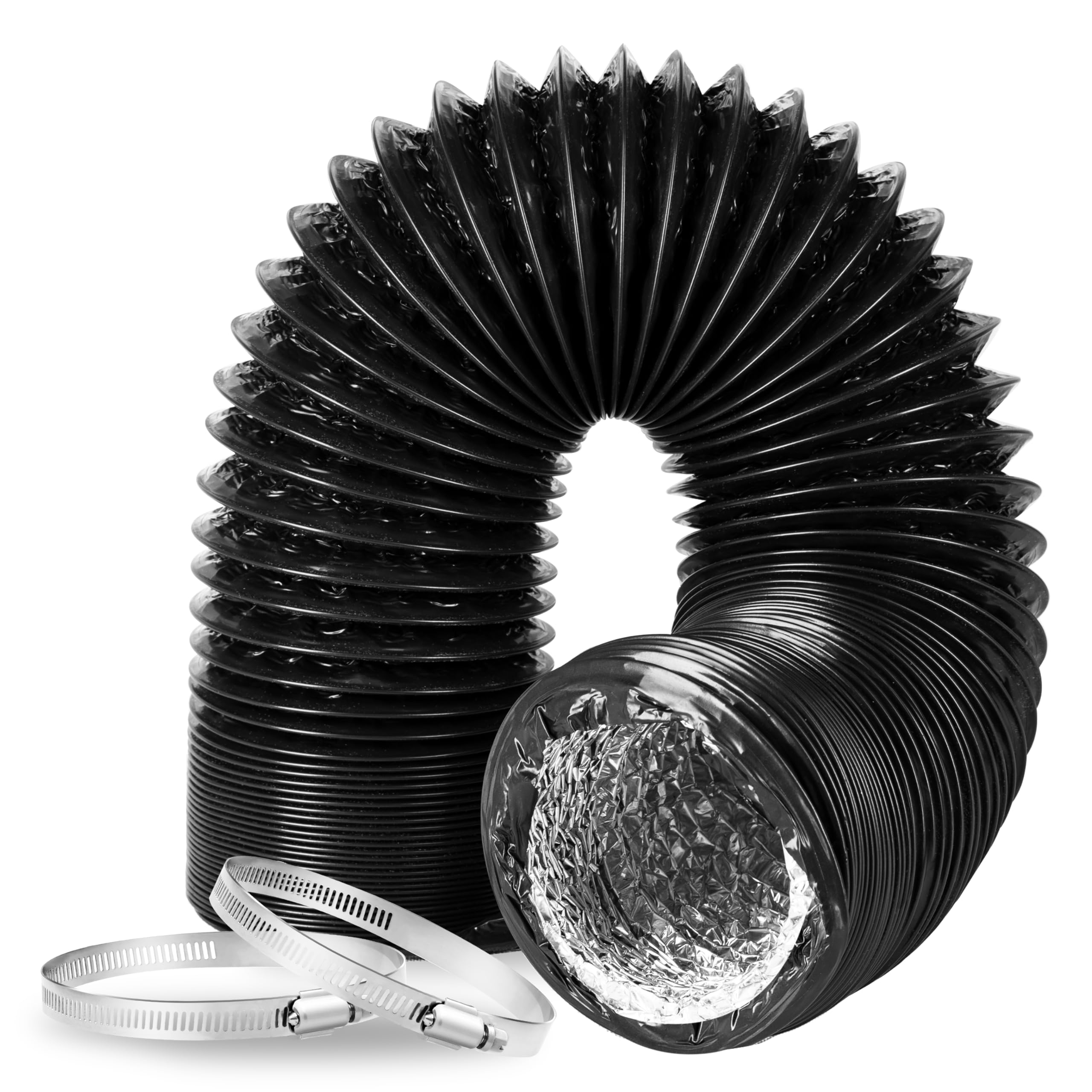
The InfiniPower duct uses a four-layer construction — three layers of aluminum foil plus a PET film and steel wire helix — to achieve a balance of durability and cost that is hard to beat for light-duty applications. The manufacturer specifically touts a 50% noise reduction from carbon filter fans and exhaust systems, making this a strong candidate for grow tent ventilation where silence matters.
Users are consistently surprised by the build quality at this price tier, with multiple reviews noting it outperforms standard dryer vent hoses in terms of stiffness retention and heat containment. The included two clamps are functional and fit the 4-inch diameter without slipping. The temperature range from -30°C to 150°C covers both freezing garage installations and hot dryer exhaust without material degradation.
The PVC material raises a durability question compared to all-aluminum or HDPE competitors — it is more susceptible to UV degradation if used outdoors long-term. For indoor use as a dryer vent or grow tent duct, this is a minor concern. The duct runs slightly small by a fraction of an inch, which can require extra foil tape to seal completely on some 4-inch collars.
Why it’s great
- Four-layer construction (3x aluminum + PET) at entry-level price
- Reduces fan and exhaust noise by up to 50%
- Includes two clamps and wide temperature tolerance
Good to know
- PVC outer material less UV-resistant for outdoor use
- Runs slightly narrow on 4-inch connectors — may need extra tape
FAQ
Can I use a 4-inch insulated duct for a portable air conditioner exhaust?
Why does fiberglass erosion matter in insulated ductwork?
Final Thoughts: The Verdict
For most users, the best 4 insulated flexible duct winner is the Dundas Jafine BPC425R6 because of its UL 181 listing, genuine R-6 insulation, and fire-retardant black jacket that satisfies building codes in attic installations. If you want maximum thermal performance with included clamps and noise dampening, grab the VEVOR R-6.0. And for a budget-friendly DIY project where R-4.2 is sufficient, the Muctamo R4.2 duct delivers the best per-foot value without sacrificing thermal performance.