
If your bulbs, roses, or vegetables are producing lackluster blooms or stunted root systems, the missing ingredient is often phosphorus. Bone meal delivers that essential nutrient slowly, feeding the soil food web while preventing the sudden nutrient spikes that synthetic fertilizers cause. The right 4-pound bag gives you precise control without the dust and waste of bulk bins.
I’m Min — the co-founder and writer behind Gadgets Feed. I’ve spent countless hours cross-referencing NPK ratios, customer feedback, and organic certification details to identify the formulations that actually translate into measurable results for home gardens.
Whether you are planting spring bulbs or setting up a raised bed for tomatoes, choosing the right phosphorus source makes the difference between modest growth and a show-stopping garden. This guide breaks down the top contenders for the 4 lb organic bone meal plant food category, comparing purity, texture, and nutrient density side by side.
How To Choose The Best 4 Lb Organic Bone Meal Plant Food
Selecting a bone meal isn’t complicated, but a few spec-level decisions separate an effective amendment from one that simply adds bulk to your soil. Focus on the phosphorus percentage, the physical form, and the organic certification.
Phosphorus Content (the middle NPK number)
Bone meal’s primary job is to supply phosphorus, shown by the second number in the NPK ratio. A product labeled 6-8-0 delivers 8 percent phosphorus, while a 0-10-0 or 3-12-0 provides more phosphorus per pound. For bulbs and flowering perennials, a higher middle number (8–12) typically produces stronger bloom sets. Vegetables and root crops can benefit from slightly lower ratios applied more frequently.
Powder vs. Granule Texture
Fine powder integrates evenly into soil and releases nutrients faster, but it creates airborne dust and can clump when applied in wet conditions. Granular or pelletized forms are cleaner to handle, resist blowing away in the wind, and break down over a longer period. If you are top-dressing established beds, granules are less messy. If you are mixing into potting soil at planting time, powder offers more uniform distribution.
Organic Certification and Additives
Look for an OMRI listing or similar organic certification to confirm the product contains no synthetic fillers or chemical additives. Some premium blends include mycorrhizal fungi or additional calcium sources, which further support root health. Avoid products with added urea or ammonium nitrate, which undermine the slow-release organic benefit.
Quick Comparison
On smaller screens, swipe sideways to see the full table.
| Model | Category | Best For | Key Spec | Amazon |
|---|---|---|---|---|
| Espoma Organic Bone Meal | Premium | Bulbs & Perennials | NPK 4-12-0, 8 lb bag | Amazon |
| FoxFarm Happy Frog Steamed Bone Meal | Premium | Bulbs & Containers | NPK 3-12-0, 4 lb bag | Amazon |
| Ferti-lome Bone Meal | Mid-Range | General Gardening | NPK 0-10-0, 4 lb bag | Amazon |
| Earth Science Natural Bone Meal | Mid-Range | Flowers & Vegetables | NPK not listed, 4 lb bag | Amazon |
| True Organic Bone Meal | Mid-Range | Fruit & Vegetable Beds | NPK 7-7-0, 3 lb bag | Amazon |
| Whitney Farms Organic Bone Meal | Budget-Friendly | Entry Level / Roses | NPK 6-8-0, 3 lb bag | Amazon |
| Triple Super Phosphate (The Grow Co) | Specialty | High-Phosphorus Correction | NPK 0-46-0, 5 lb bag | Amazon |
In‑Depth Reviews
1. Espoma Organic Bone Meal Fertilizer 4-12-0

Espoma delivers the highest phosphorus concentration in this roundup with a 4-12-0 ratio, meaning you get 12 percent phosphorus per pound. This makes it the most efficient option for heavy-feeding bulbs like tulips, daffodils, and alliums, as well as established perennials that need a reliable bloom trigger. The 8-pound bag also covers more ground than the typical 4-pound entry, reducing the number of refill trips during a busy planting weekend.
The powder form integrates smoothly into native soil and potting mixes alike, though you will want to wear a dust mask during dry application. Users consistently report stronger stem growth and noticeably larger flower heads after a single spring application. The OMRI listing confirms it meets organic production standards, with no synthetic additives or filler ingredients.
One minor trade-off is the bag size — at 8 pounds, it is heavier than the competition, which matters if you are carrying supplies across a large yard. But the price-per-pound value is exceptional, and the phosphorus density means you use less product per square foot. For gardeners serious about organic soil management, this is the benchmark bag.
Why it’s great
- Highest phosphorus ratio (4-12-0) in the list
- Large 8 lb bag offers best coverage per dollar
- OMRI certified, no synthetic fillers
Good to know
- Powder form can create dust during application
- Heavier bag may be cumbersome for small garden carts
2. FoxFarm Happy Frog Steamed Bone Meal 3-12-0
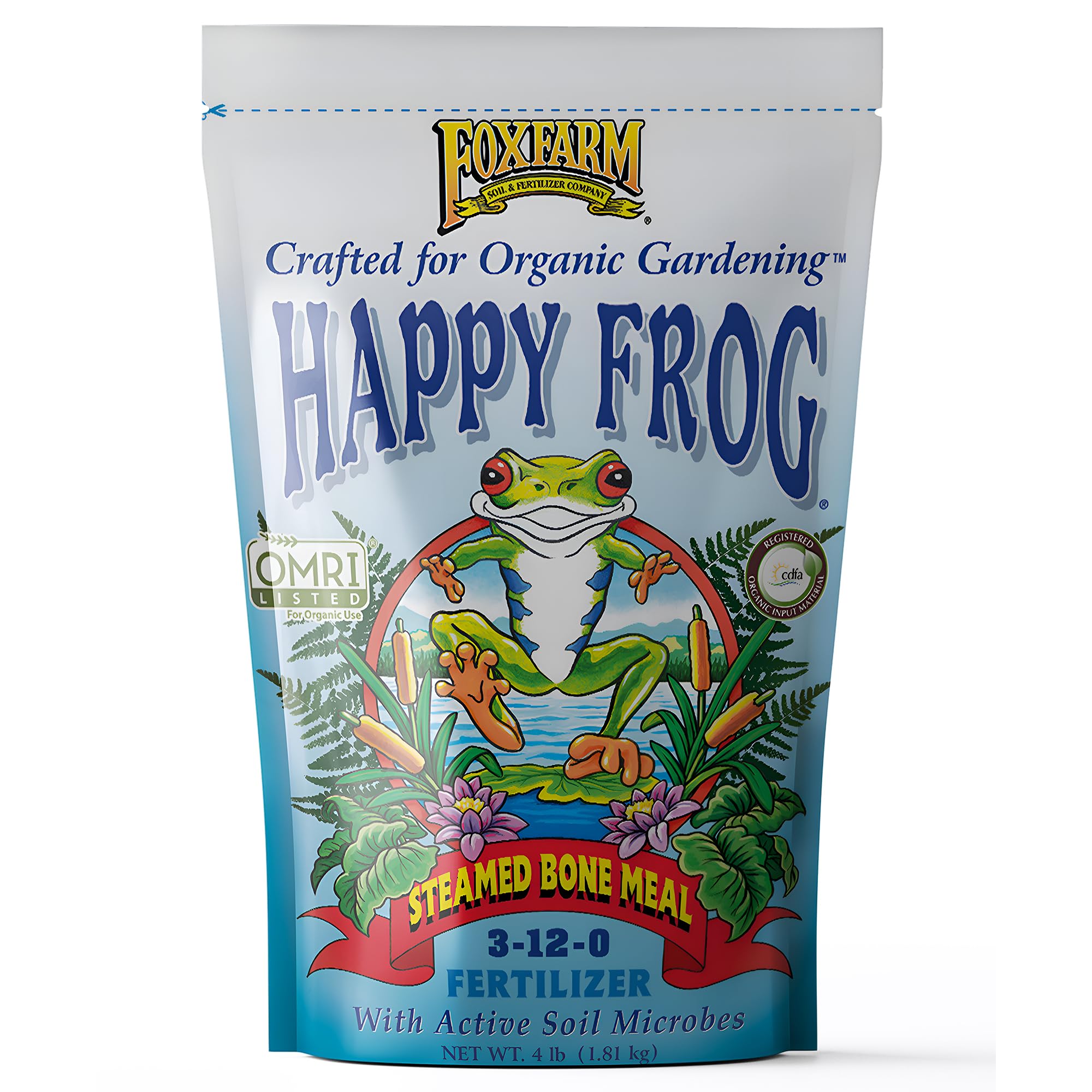
FoxFarm’s steamed bone meal stands apart because it includes mycorrhizal fungi, a beneficial soil microbe that extends root reach and improves phosphorus uptake. The steaming process also reduces the grease content found in raw bone meal, producing a finer, cleaner powder that mixes into potting soil without clumping. The 3-12-0 ratio delivers 12 percent phosphorus — equal to the Espoma bag, but with a slightly different nitrogen profile for early-season growth support.
This formula really shines in container gardens and raised beds where root space is limited. The mycorrhizal component helps plants extract phosphorus from the soil more efficiently, which is critical when you cannot amend a large area. Many users report that fig trees in pots and large dahlias respond with noticeably thicker stems and more buds per plant after switching to Happy Frog.
On the downside, the 4-pound bag runs out faster than the Espoma 8-pound bag if you are feeding a large garden. The powder also settles during shipping, so you may need to shake the bag before opening. Still, for precision feeding of high-value ornamentals and container plants, this is the most biologically active bone meal on the market.
Why it’s great
- Includes mycorrhizal fungi for enhanced phosphorus uptake
- Steamed process reduces mess and grease residue
- Fine texture integrates well in container mixes
Good to know
- Powder settles during shipping; needs shaking
- Smaller bag size for larger gardens
3. Voluntary Purchasing Group Fertilome Bone Meal 0-10-0

Ferti-lome delivers a straightforward 0-10-0 formula with no added nitrogen, making it the purest phosphorus source in the mid-range tier. This is ideal for gardeners who already have sufficient nitrogen in their soil from compost or blood meal and only need to correct phosphorus levels. The granular form is easy to broadcast over a large area without the airborne dust of finer powders.
Users have successfully revived old tulip and lily beds that had stopped blooming for years by mixing Fertilome with blood meal in a 50/50 ratio. The 4-pound bag is compact enough to store on a small garage shelf, yet it covers roughly the same square footage as pricier competitors. The slow-release nature of bone meal means you apply it once in spring and once in fall for bulbs, which matches the feeding schedule most experienced bulb gardeners already follow.
The main limitation is the granular texture — it takes slightly longer to break down in cold soil compared to powdered bone meal. If you are planting very early in spring before the ground has fully warmed, consider applying it a week early to give the microbes time to start working. Otherwise, this is a reliable workhorse that has been on the market for decades for a reason.
Why it’s great
- Pure phosphorus (0-10-0) with no added nitrogen
- Granular form minimizes dust and drift
- Proven track record for bulb rejuvenation
Good to know
- Granules break down slower in cold soil
- Requires a second application in fall for best bulb results
4. Earth Science Natural Bone Meal Plant Food

Earth Science positions this as a general-purpose bone meal suitable for bulbs, roses, potted plants, trees, and shrubs. The packaging does not list a specific NPK ratio, but independent customer reports indicate a phosphorus content comparable to standard bone meal (typically 10–15 percent). The 4-pound bag hits the exact sweet spot for a medium-sized garden — enough to cover about 100 square feet at the recommended 10 pounds per 100 square feet rate.
The fine granular texture strikes a useful balance between the dustiness of pure powder and the clunky feel of large pellets. It mixes into soil easily without forming clumps, and the earthy smell is mild enough to be pleasant rather than off-putting. Several users reported that their dahlias and tomatoes responded with visibly greener foliage and more abundant flowers within two weeks of application.
The main caveat is the packaging sensitivity — a few customers received bags that were punctured during shipping because the product was shipped in a poly bag rather than a box. If you order this, check the bag for holes before storing. For the price and versatility, however, this is a solid mid-range choice that performs well across multiple plant types.
Why it’s great
- Good balance of fine texture and low dust
- Versatile for bulbs, gardens, and containers
- Mild earthy smell, not overpowering
Good to know
- Exact NPK not printed on packaging
- Shipping bag may puncture easily without outer box
5. True Organic Bone Meal 7-7-0

True Organic breaks from the bone meal norm by offering a balanced 7-7-0 formula, providing 7 percent nitrogen alongside 7 percent phosphorus — more nitrogen than any other product here. This makes it uniquely suited for edible gardens where leafy growth and fruit development both need support. The 3-pound bag covers 61 square feet, which is ideal for smaller raised beds or intensive container gardening.
The product uses pelletized bone meal rather than loose powder, which significantly reduces the dust problem that plagues other bone meals. Pellets are also easier to distribute evenly in windy conditions, and they break down at a rate that matches the growing season for most vegetables. The pellets are attractive to dogs due to the smell, so store the bag securely in a sealed bin after opening.
One limitation is the coverage — 3 pounds goes fast if you are feeding a large in-ground vegetable plot. The bag size assumes you are either spot-feeding individual plants or working with a small garden. For those growing asparagus, peppers, or cold-hardy kiwi, the consistent NPK ratio provides steady nutrition without the need to mix multiple amendments.
Why it’s great
- Balanced 7-7-0 NPK for fruits and vegetables
- Pellet form eliminates dust during application
- Ideal for small raised beds and containers
Good to know
- Small 3 lb bag covers limited area
- Pellets attract dogs; requires sealed storage
6. Whitney Farms Organic Bone Meal 6-8-0
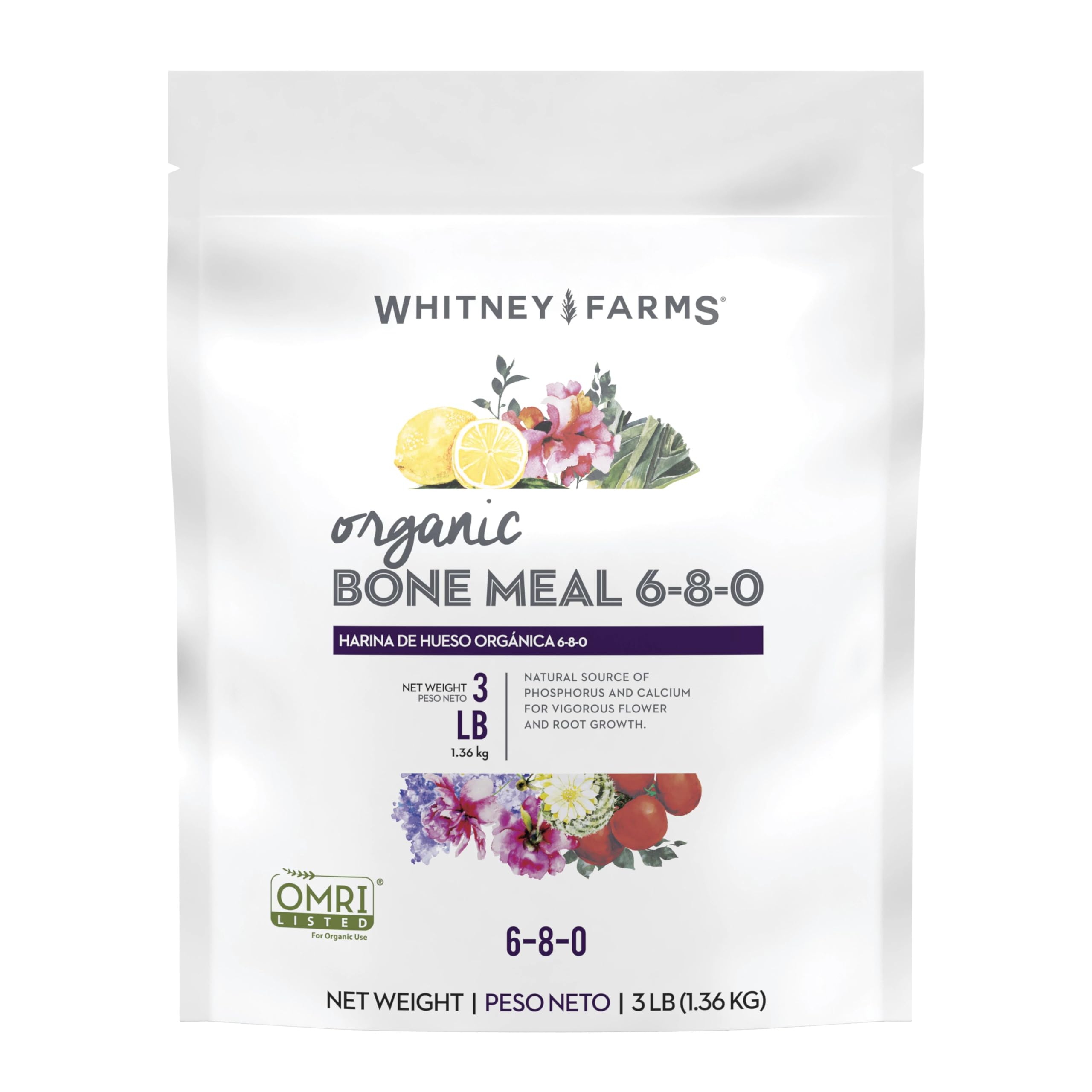
Whitney Farms offers the most accessible entry point for gardeners who want to try bone meal without committing to a large bag. The 6-8-0 ratio provides a moderate phosphorus level (8 percent) that works well for general feeding of roses, tomatoes, and bulb plants. The powder form is uniform and free of clumps, consistent with a well-milled product.
Several users noted that the fine texture makes it easy to mix into native soil at planting time, and the OMRI listing gives confidence that it meets organic standards. The 3-pound bag is convenient for small gardens or for testing whether your soil actually needs phosphorus before buying a bulk-size product. Gardeners with specific phosphorus hunger in their soil can always upgrade to a higher-ratio product later.
The main drawback is the mesh closure on the bag, which lets fine powder leak out if the bag is stored on its side. You will want to transfer the contents to an airtight container or use a strong clip to seal the opening. For the low entry cost and reliable results on roses and bulbs, this is a solid budget-friendly choice.
Why it’s great
- Lowest entry cost makes it easy to trial bone meal
- Uniform fine powder mixes well into soil
- OMRI listed for organic use
Good to know
- Powder leaks from mesh closure in storage
- 3 lb bag is small for large gardens
7. Triple Super Phosphate 0-46-0 (The Grow Co)
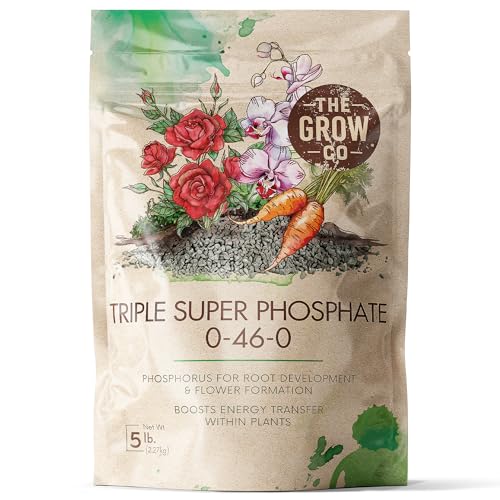
This is not strictly a bone meal — it is a concentrated synthetic phosphate fertilizer with an extreme 0-46-0 ratio. It belongs in this list because some gardeners need a targeted phosphorus booster without the organic carbon content of bone meal. When soil tests reveal a severe phosphorus deficiency, a single application of triple super phosphate corrects it faster than any organic alternative.
The granular form is easy to apply at the recommended half-pound per 100 square feet. It works exceptionally well for forcing blooms on hydrangeas, jasmine, and plumeria that have stubbornly refused to flower for years. Experienced users report applying it in the fall so the phosphorus is available for the spring bloom cycle, with results visible within a single growing season.
Because it is not organic and contains no calcium or nitrogen, you should use this only when soil tests indicate a phosphorus-specific need. Over-application can lead to nutrient lockout, especially in already fertile soil. Use it as a corrective tool rather than a routine feed, and you will get impressive bloom results without damaging the soil ecosystem.
Why it’s great
- Extremely high phosphorus (0-46-0) for quick correction
- Granular form allows precise application rates
- Proven to trigger blooms on stubborn plants
Good to know
- Synthetic; not an organic bone meal
- Risk of over-application if soil is already fertile
FAQ
How much bone meal should I apply per bulb or vegetable plant?
Can I use bone meal on potted plants and container gardens?
Why does bone meal attract dogs and how do I prevent digging?
Final Thoughts: The Verdict
For most gardeners, the strongest 4 lb organic bone meal plant food choice is the Espoma Organic Bone Meal because its 4-12-0 ratio delivers the highest phosphorus density in a certified organic powder that covers more ground per bag than any competitor. If you grow in containers and want mycorrhizal support for root development, grab the FoxFarm Happy Frog Steamed Bone Meal. And for vegetable gardeners seeking a balanced NPK with pelletized convenience, nothing beats the True Organic Bone Meal.