
Salt spray, direct sunlight, and constant vibration will destroy any speaker not purpose-built for the marine environment. The wrong 4-inch unit delivers muddy mids and a dead tweeter within a single season, leaving you cranking a radio you can barely hear over the wind. Choosing a 4-inch marine speaker isn’t about picking the loudest model — it’s about finding the one whose cone, surround, and basket withstand UV rays and humidity without corroding.
I’m Min — the co-founder and writer behind Gadgets Feed. I’ve spent dozens of hours cross-referencing impedance curves, sensitivity ratings, and IP certification notes to isolate the 4-inch marine speakers that actually survive a season on the water.
After analyzing power handling, mounting depth, and real-world user reports, these picks represent the most reliable options in the best 4 marine speakers category right now. My focus was on build quality and sustained performance rather than peak wattage marketing claims.
How To Choose The Best 4 Marine Speakers
Not all 4-inch speakers labeled “marine” are equally suited for wet, sun-exposed environments. The difference between a speaker that lasts three years and one that fails in six months comes down to a few specific materials and ratings you need to check before buying.
Woofer Cone and Surround Material
A polypropylene cone resists moisture absorption far better than paper or fiber cones, which swell and distort in humidity. The surround should be rubber, not foam — foam degrades under UV exposure and cracks within a year in direct sunlight. Rubber surrounds maintain their compliance and keep the cone centered even when the speaker is mounted near swim platforms or open helm stations.
Impedance and Amplifier Matching
A 4-ohm speaker is the standard for most factory and aftermarket marine head units, drawing less current and running cooler. A 2-ohm speaker pulls more power per channel and sounds louder on the same wattage, but it demands an amplifier stable down to 2 ohms. Mismatching impedance can send a head unit into thermal shutdown or distortion at moderate volume.
Mounting Depth and Cutout Diameter
4-inch marine speakers vary significantly in mounting depth — some require only 0.9 inches, while others need nearly 1.8 inches of clearance behind the panel. Measure the space inside your boat’s gunwale or console before ordering. A speaker that physically cannot fit forces you to cut new holes or return the set.
Power Handling (RMS vs Peak)
Peak wattage numbers are marketing figures — RMS is the continuous power the speaker handles cleanly. For a 4-inch marine speaker, 30 to 50 watts RMS per pair is sufficient for clear sound at cruising speeds. Higher RMS ratings generally mean a larger voice coil and better thermal management, which matters if you plan to amplify the system.
Quick Comparison
On smaller screens, swipe sideways to see the full table.
| Model | Category | Best For | Key Spec | Amazon |
|---|---|---|---|---|
| Polk Audio DB402 | Premium | Full-range clarity with marine certification | IP56 certified | Amazon |
| KICKER 41KM42CW | Premium | Highest volume output per watt | 2-ohm impedance | Amazon |
| BOSS Audio MR4.3B | Mid-Range | 3-way audio with dedicated midrange driver | 3-way design | Amazon |
| KICKER DSC40 | Mid-Range | Wide frequency response in a compact frame | 60–20k Hz response | Amazon |
| Pyle Low-Profile Marine | Budget | Ultra-shallow mounting for tight installations | 0.9″ mounting depth | Amazon |
| Herdio 4-Inch Ceiling | Budget | Fully waterproof design for exposed mounts | 160W peak pair | Amazon |
| BOSS Audio MR52B | Mid-Range | 5.25-inch alternative with aluminum voice coil | 1″ aluminum voice coil | Amazon |
In‑Depth Reviews
1. Polk Audio DB402 DB+ Series 4 Inch Speakers

The Polk DB402 is the only 4-inch marine speaker in this group with an IP56 certification, meaning its coated steel basket and treated cone resist not just splashes but salt fog, UV radiation, and sustained humidity. The polypropylene woofer and rubber surround are standard for the category, but Polk’s Dynamic Balance laser-imaging process ensures the driver material mix cancels distortion before it starts. The result is a clean 60Hz–22kHz frequency range that delivers vocals and acoustic instruments with unusual clarity for a 4-inch frame.
At 45 watts RMS per speaker and 4-ohm impedance, the DB402 pairs naturally with most marine head units without requiring an external amplifier. Owners report significant upgrades over factory speakers in everything from e-bike builds to Lexus dash replacements, noting the low profile fits tight spots that reject deeper baskets. The built-in crossover keeps highs directed to the mylar dome tweeter and lows to the woofer, preventing the muddiness that plagues budget coaxial models.
This speaker is for the buyer who values material integrity over peak wattage bragging rights. The rubber surround and stainless steel hardware cost more to manufacture than the ABS plastic found on entry-level units, but they translate directly to longer life on a boat. You pay a premium for the engineering and the certification, and both justify the price.
Why it’s great
- IP56 marine certification tested for salt fog and UV
- Dynamic Balance eliminates distortion without EQ
- Low mounting depth fits tight dash and console spaces
Good to know
- Higher price than most 4-inch marine competitors
- 45W RMS may feel underpowered on large open decks
2. KICKER 4 Inch KM-Series Marine Speakers 41KM42CW
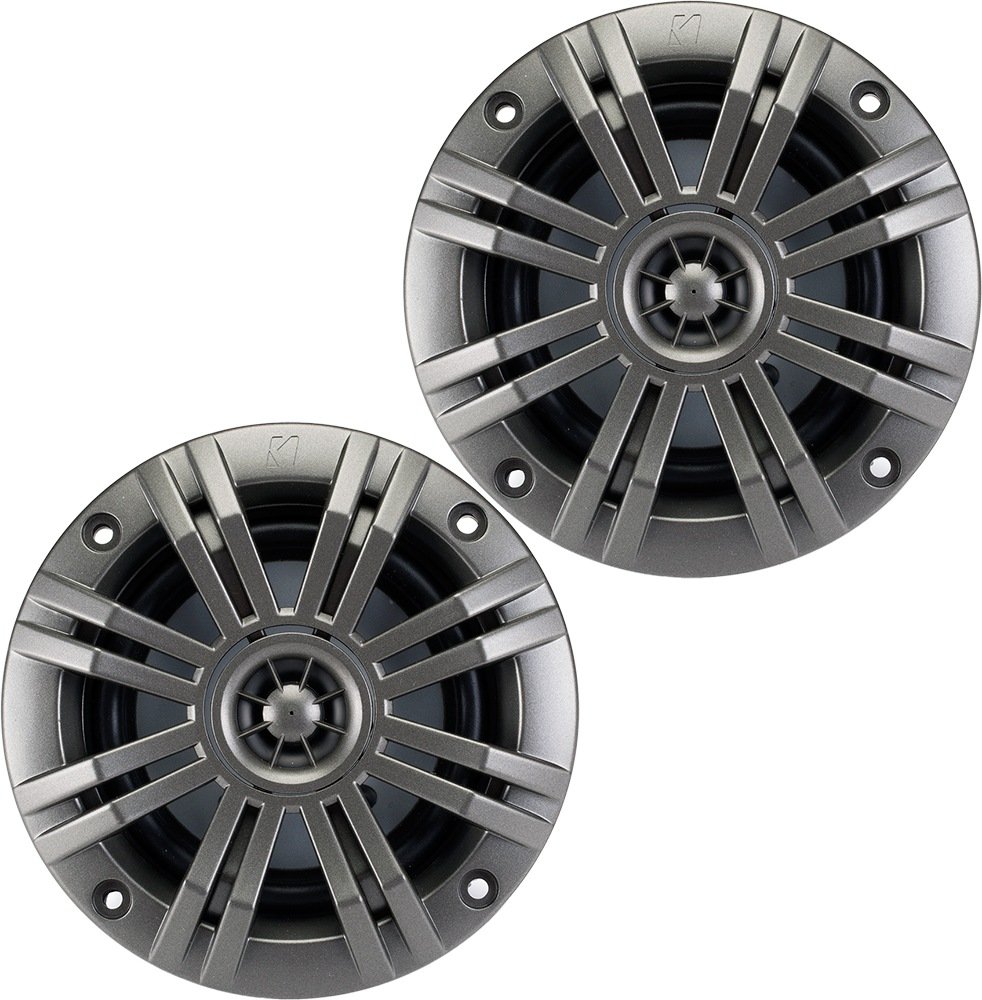
The KICKER 41KM42CW breaks from the 4-ohm standard with a 2-ohm impedance design that pulls more current from your amplifier and delivers noticeably higher volume per watt. With 50 watts RMS and 150 watts peak per pair, these 4-inch speakers produce sound that remains clean and undistorted even when competing with engine noise and wind at cruising speed. The polypropylene cone and UV-treated surround are engineered specifically for marine use, not adapted from a car audio chassis.
Real-world users consistently describe the output as “way louder than expected” from a 4-inch basket. The 2-ohm load means you must verify your amplifier supports 2-ohm stereo operation, but buyers who pair the KM-Series with a KICKER DX amp report a system that punches well above its size. The mounting depth is moderate, so measure your clearance before cutting — the speaker needs more rear space than ultra-slim models.
This pair is the choice for boaters who want the loudest possible sound without stepping up to 6.5-inch or tower speakers. The trade-off is the limited 2-ohm compatibility and the premium price. If your head unit is rated for 4-ohm loads only, you will need an external amp to unlock this speaker’s potential.
Why it’s great
- 2-ohm impedance delivers maximum output from compatible amps
- UV-treated cone and surround resist sun damage
- 50W RMS handles continuous high-volume play
Good to know
- Requires an amplifier stable at 2 ohms
- Moderate mounting depth limits installation options
3. BOSS Audio Systems MR4.3B 200 Watt 4 Inch 3-Way Marine Speakers

The BOSS MR4.3B stands out in the mid-range tier with a 3-way coaxial design that adds a dedicated 1.5-inch poly cone midrange driver alongside the 0.75-inch dome tweeter. This third driver fills the gap between bass and treble that many 2-way 4-inch speakers leave hollow, producing fuller vocals and a more present midrange at moderate volume. The polypropylene woofer cone, rubber surround, and plastic basket are all marine-grade, and the included swivel brackets simplify mounting in angled panels.
At 200 watts peak per pair and 4-ohm impedance, the MR4.3B pairs easily with any standard marine head unit. Users installing these in RVs and boats consistently mention “crisp highs” and “deep bass for the size,” noting improvement over factory Jensen and Furrion systems. The frequency response extends from 80Hz to 18kHz, which means the highest harmonics are present but the very top air beyond 18kHz is absent — acceptable for open-air boating conditions where ambient noise masks those frequencies anyway.
The 3-year platinum online dealer warranty gives this set an edge over competitors that offer only one year. For a budget-conscious build that still wants the midrange detail of a three-driver design, the MR4.3B hits a strong value point. The trade-off is slightly lower sensitivity at 85dB than some 2-way rivals, meaning it needs more power to reach the same perceived loudness.
Why it’s great
- 3-way design delivers richer midrange than 2-way competitors
- Included swivel brackets make angled installation simple
- 3-year warranty exceeds typical marine speaker coverage
Good to know
- 85dB sensitivity requires more amplifier power
- 18kHz top end limited by tweeter size
4. KICKER DSC40 4-Inch Coaxial Speakers

The KICKER DSC40 achieves a frequency response of 60Hz to 20kHz — the widest range of any 4-inch speaker in this review, extending deeper into the bass region than most competitors that start at 80Hz or higher. The high-sensitivity motor design (88dB) translates to strong volume output even from low-wattage factory head units, making this an easy drop-in upgrade without rewiring or adding an amplifier. The polypropylene cone and 4-ohm impedance follow the standard marine formula, keeping compatibility universal.
Users report using the DSC40 in custom Bluetooth boombox builds, excavator cabs, and antique radio retrofits, noting that the bass response is “impressive for a 4-inch” when the speaker is paired with a sealed enclosure. The 120W peak power handling (likely around 30W RMS) is modest, but the sensitivity means you won’t need to push the head unit into distortion to get adequate volume in a small cabin or pontoon.
The DSC40 is not IP-rated, so it’s better suited for covered helm areas or interior applications rather than exposed swim platform mounts. If your installation is protected from direct spray, this KICKER set delivers the widest frequency range in the 4-inch form factor and competes with speakers costing twice as much on sound quality alone.
Why it’s great
- Exceptional 60Hz low-end for a 4-inch woofer
- High sensitivity (88dB) works well with low-power head units
- Fits nearly any standard 4-inch cutout
Good to know
- No IP or marine certification for direct water exposure
- Low RMS rating limits sustained high-volume use
5. BOSS Audio Systems MR52B 5.25 Inch Marine Speakers

The BOSS MR52B is a 5.25-inch speaker, not a true 4-inch unit, but it earns a spot here because many buyers looking at 4-inch openings consider upsizing when they have extra panel space. The 1-inch aluminum voice coil handles heat better than copper equivalents, reducing power compression during extended play at higher volumes. The treated cloth surround and polypropylene cone resist moisture while the 89dB sensitivity ensures strong output from modest power sources.
At 150 watts peak per pair and 4-ohm impedance, this is a mid-range contender that works well for outdoor speakers on campers and smaller boats where the larger cone area produces noticeably more bass than any 4-inch driver can manage. Owners note the sound is “great for the price” but warn that the physical size requires a 5.25-inch cutout, so it is not a direct replacement for existing 4-inch holes without modification.
The MR52B is best considered a value alternative for those willing to cut a larger hole for significantly better low-end presence. The mylar dome tweeter delivers clear highs up to 20kHz, but the plastic basket and lack of high-end marine certifications mean it belongs in a drier mounting location rather than a spray-heavy bow area.
Why it’s great
- Aluminum voice coil resists heat buildup
- Larger 5.25-inch cone delivers superior bass
- 89dB sensitivity works with low-wattage head units
Good to know
- Requires 5.25-inch cutout — not a direct 4-inch swap
- Plastic basket less durable than coated steel alternatives
6. Pyle Low-Profile Waterproof Marine Speakers 4 Inch

With a mounting depth of only 0.9 inches, this pair fits where nothing else will. The ABS plastic grille and machined gasket are UV-stabilized, and the built-in blue LED ring adds a visual accent at night. The 100W max (50W RMS) and 4-ohm impedance are adequate for background audio in close quarters.
Installed in custom consoles, golf carts, and toy haulers, the Pyle speakers receive mixed feedback on sound quality — some users describe them as “surprisingly good for the size,” while others report the sound lacks richness and fullness. The 90Hz–18kHz frequency response rolls off both the deep bass and the airy top end, producing a mid-forward character that works for talk radio and pop but disappoints on bass-heavy tracks.
This pair is purpose-built for shallow spaces where no other 4-inch speaker fits. If you have more than one inch of mounting depth, consider a deeper speaker for better sound. But if you are stuck with a slim cavity, the Pyle is the only option that fits and still offers splash resistance and LED lighting.
Why it’s great
- Ultra-shallow 0.9-inch mounting depth fits tight spaces
- Blue LED ring adds nighttime visibility and style
- UV-stabilized ABS construction resists sun damage
Good to know
- Sound quality lacks bass depth and treble extension
- Plastic basket less rigid than metal alternatives
7. Herdio 4 Inches Waterproof Marine Ceiling Speakers

The Herdio 4-inch marine speaker is marketed as completely waterproof, built with a polypropylene cone, rubber edge, and a molded ABS plastic basket that resists heavy water splashes. At 160 watts peak per pair (roughly 40W RMS per speaker) and 89dB sensitivity, it delivers adequate volume for small boat cabins and enclosed trailer installations. The low-profile design keeps the speaker flush against the mounting surface, and the white finish blends into many ceiling panels and interior walls.
Owners report these speakers work well as direct replacements in Vanagon camper vans and behind convertible seats, noting sound that is “clear for the price” but not as refined as premium competitors. The frequency response of 100Hz–18kHz leaves the lowest bass notes absent — typical for a 4-inch driver at this price point. The plastic basket lacks the rigidity of coated steel, but for protected indoor-marine use it holds up fine.
This pair represents the entry-level option for buyers who need waterproof 4-inch speakers on a tight budget. There is no marine certification beyond the manufacturer’s claim, and the cloth surround is treated rather than a true rubber compound, so longevity in direct UV exposure is questionable. For dry or covered installations, however, the Herdio set provides functional audio at the lowest cost in the group.
Why it’s great
- True waterproof design for exposed installations
- Low-profile face sits flush against flat surfaces
- Budget-friendly price for a functional pair
Good to know
- 100Hz low-frequency cutoff leaves bass absent
- No independent IP or UV certification
FAQ
Can I use car speakers in my boat instead of marine speakers?
What size cutout do I need for a 4-inch marine speaker?
Do I need an amplifier for 4-inch marine speakers?
Are 2-ohm or 4-ohm marine speakers better for my boat?
Final Thoughts: The Verdict
For most users, the best 4 marine speakers winner is the Polk Audio DB402 because its IP56 certification and Dynamic Balance technology deliver clean, distortion-free sound in a package built to survive salt and sun. If you want the loudest output from a compact form factor, grab the KICKER 41KM42CW and pair it with a 2-ohm-stable amplifier. And for a shallow installation where every millimeter of depth matters, nothing beats the Pyle Low-Profile with its 0.9-inch mounting depth and integrated LED lighting.