
Our readers keep the lights on and my morning glass full of iced black tea. As an Amazon Associate, I earn from qualifying purchases.
Specs are compiled from manufacturer listings and verified buyer reviews and can change over time — please confirm the key details on the product page before buying.
You need a 4-pack of walkie talkies that actually reaches where you work or play—across a concrete construction site, around the neighborhood with kids, or between cars in a convoy—without eating your cell data. The real question is which set delivers the range and battery life it promises, and which one fits your plan. Here is how each radio’s real specs match real-world use, so you pick the one that works the day it arrives.
I’m Min — the founder and writer behind Gadgets Feed. This guide is built by comparing the manufacturers’ published specifications and the patterns across verified customer reviews, so you get each pick’s real strengths and trade-offs instead of marketing spin.
For work, play, or family trips, these 4 pack walkie talkies long range sets earned their spot by doing what owners actually need, day after day.
Our Picks at a Glance


How To Choose The Best 4 Pack Walkie Talkies Long Range
Before you buy, understand that walkie-talkie range is not a fixed number. The big mile claims on the box apply only to wide-open spaces with zero obstructions. In a city, through trees, or inside a concrete building, that range shrinks dramatically. Choose based on your real environment, not the best-case marketing figure.
FRS vs GMRS: Which Radio Service Fits You?
Family Radio Service (FRS) radios are license-free and ready to use from the start, making them the simple choice for families and casual outings. General Mobile Radio Service (GMRS) radios can push higher power and often connect to repeater stations for a longer reach, but they technically require an FCC license. If the product data does not state a license requirement, do not assume one applies; check the radio’s own specs to see which service it uses.
Battery Capacity and Charging Flexibility
Battery life is measured in milliamp-hours (mAh) — the higher the number, the more talk time you get before a recharge. Check how the radio charges too: USB-C is the modern standard that lets you top up from a laptop, car, or power bank, while older USB mini or desktop cradles lock you into one charging spot. Think about whether you will be near a wall outlet or out in the field with only a car charger.
Weather Alerts and Hands-Free Operation
NOAA weather channels are a genuine safety net if you spend time in remote areas where cell service drops and storms roll in fast. Voice-activated transmission (VOX) lets you talk without pressing the push-to-talk button, which is a real advantage when your hands are full carrying gear or managing kids. Neither feature matters much if you stay close to home, but both become crucial on long camping or hiking trips.
Quick Comparison
| Model | Best For | Radio Service | Battery Capacity | Standby / Talk Time | Amazon |
|---|---|---|---|---|---|
| Retevis RT68★ Best Overall | All-around family reliability | FRS | 1200 mAh | 24 hours talk | Amazon |
| JIANUA Walky TalkyBudget Champion | Budget-friendly battery life | FRS | 1200 mAh | 96 hours | Amazon |
| pxton 999STop Performer | Outdoor recreation with headsets | GMRS | 1500 mAh | 18 hours talk | Amazon |
| Topsung 10B | Family trips with weather alerts | FRS | 1800 mAh | 72 hours standby | Amazon |
| Midd Kacy MK108 | Car-to-car and farm comms | FRS, GMRS | 1800 mAh | 4-7 days | Amazon |
| Gaswei G1pro | Tough outdoor conditions | FRS | 1800 mAh | 100 hours standby | Amazon |
| Retevis RB48 Plus | Industrial and worksite use | GMRS | 2000 mAh | 18 hours talk | Amazon |
| Midland GXT1000VP4 | Event and camp coordination | GMRS | — | ~10 hours talk | Amazon |
| KAYOTOM AT-600 | Nationwide team communication | LTE | 3000 mAh | 24 hours talk | Amazon |
In‑Depth Reviews
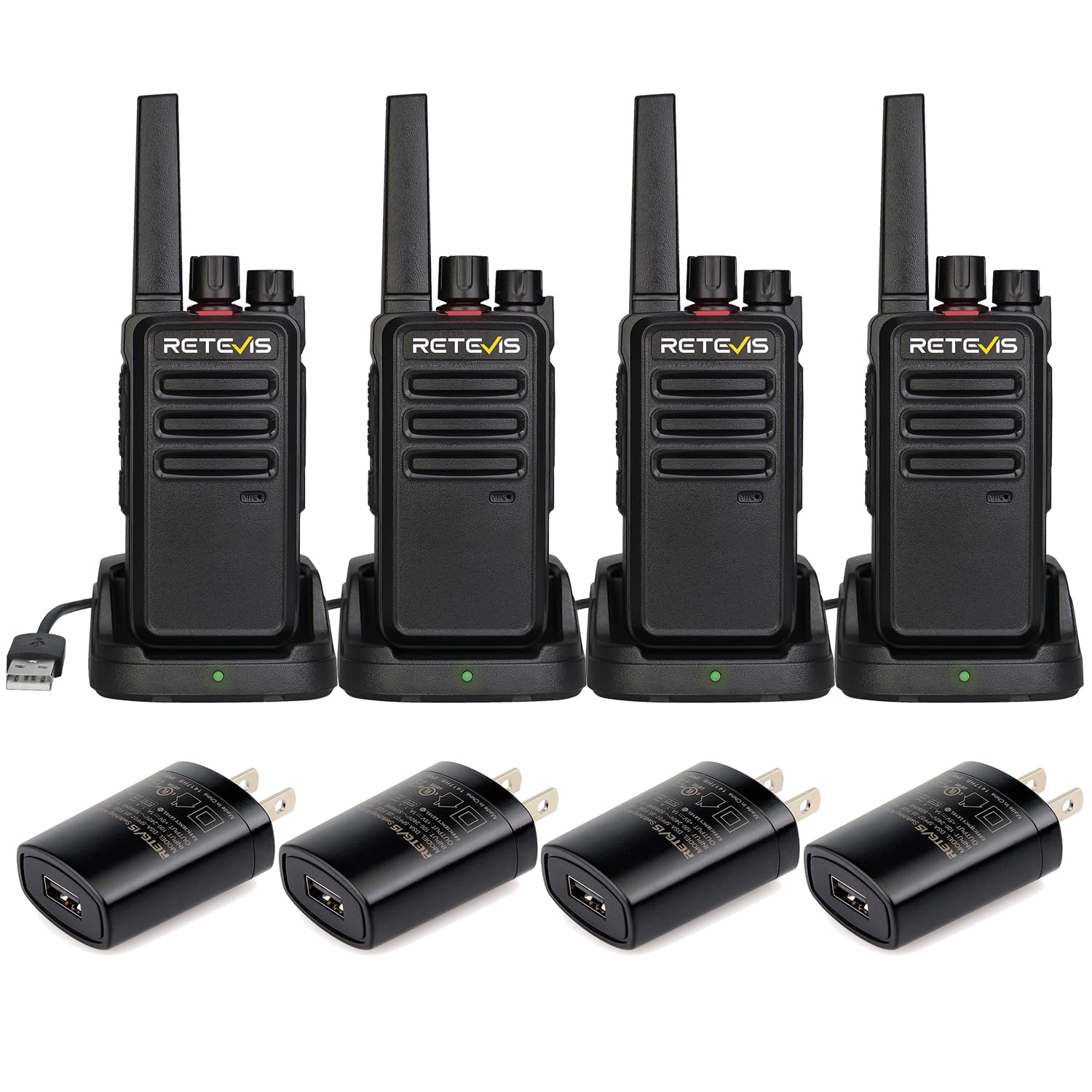
1. Retevis RT68 Walkie Talkies
Our pick — over 4.5★ from 650+ verified ratings; the strongest balance of quality and price.
The crowd-pleasing 4-pack that balances price, toughness, and talk time for nearly any group.
If you want one set that works for everything from a jobsite to a family outing, this Retevis is the one owners keep coming back to. Its 1200 mAh battery offers up to 24 hours of talk time per charge., so a busy day of coordinating never ends with a dead radio. It takes roughly 3-4 hours to charge fully, and the included USB charging base plugs in safely wherever you set it down.
Range and sound quality are where this set shines. The radios work through concrete walls and inside buildings, which is why a construction supervisor reports talking clearly from a conex office to the jobsite at about 400 yards through a PEMB building. A multi-car convoy running from Missouri to Orlando for roughly 24 hours never lost connection once.
The rugged enclosure survives a one-meter free fall without damage, and the splash-proof, weather-resistant build shrugs off light rain. The only recurring complaint across owners is the belt clip, which feels flimsy compared to the radio’s otherwise sturdy body — treat it gently and it will hold.
Built to last: The 30 dB audible noise rating means clear, loud output even on noisier job sites or trails, and the emergency alarm adds a layer of safety for group trips.
The honest catch: The flimsy belt clip is the one weak link in an otherwise rugged design, so attach it carefully if you plan to clip these to your waist all day.
Grab it for: A dependable, license-free set for families and work crews that need clear calls through walls and a full day of battery.
Choose another if: You expect the absolute maximum open-field mileage, since real-world range depends heavily on what sits between you and your partner.
2. Rechargeable Walkie Talkies (JIANUA T8)
A budget-friendly set where the battery simply refuses to quit, outlasting far pricier radios.
For sheer staying power, this colorful 4-pack is the one that surprises owners. Its 1200 mAh lithium battery lasts up to 96 hours on standby. — a full 4.0x longer than the Retevis RT68 above — and recharges from empty in just 1 hour thanks to the upgraded USB-C cable. That combination means you can charge it in the car or from a laptop and still have juice for days.
You get 22 FRS channels (the shared family radio frequencies) plus 99 CTCSS privacy codes (tones that filter out other conversations), for up to 2178 combos to keep your group clear. In open areas like rural fields or the seaside, the maker claims a 5-mile reach; in towns or forest, expect a more realistic 0.6-1.2 miles. Buyers report the trade-off plainly: one couple uses them between floors at home because the range is honest about its limits, but the battery genuinely lasts a couple of days—even the skeptical note “they don’t reach as far as I want them to” is followed by laughter about never climbing stairs again.
The bright color scheme makes each radio easy to tell apart, and the wrap-around back clip snaps on and off quickly for hands-free belt use. A built-in LED flashlight with LCD backlight comes in handy the moment the sun goes down on a camping trip.
What earns its keep
- 96-hour standby battery is the star here — days of use between charges
- 1-hour full recharge via USB-C means less downtime
- VOX adjustable from 0 to 3 lets you talk hands-free while working
- Compact and lighter than a cellphone for easy carrying
Know its limits
- Real-world range drops to 0.6-1.2 miles in built-up or wooded areas
- Best for close-range home or work use rather than wide-open chasing
Reach for it if: You value not thinking about charging for days and want a cheap, colorful set for home or a small crew.
Look elsewhere if: You need reliable multi-mile range through trees or dense neighborhoods — this one is honest about its shorter reach.
3. pxton 999S Walkie Talkies with Headphones
The outdoor enthusiast’s pick — GMRS power, NOAA weather alerts, and headsets in the box.
Grab this set when your adventures push beyond the backyard. As a GMRS radio (a licensed family radio service), the 999S can connect to repeater stations to stretch transmission further across open terrain, but it is not compatible with the maker’s older 888s, 777s, or 666s models. Its built-in 1500 mAh Li-ion battery (a rechargeable lithium-ion cell) is 25% larger than the Retevis RT68’s 1200 mAh, supports up to 18 hours of typical use, and charges fully in 2-3 hours or less from a dock, wall charger, laptop, or car.
The body is built from PC/ABS material that resists falls, abrasion, and shock, and the IP54 waterproofing keeps it working in rainy weather. Grandkids took these on bikes and kept a clear line back to base for about 2 miles with no programming required — just charge and press to talk. Anglers report flawless use on mountain streams with the bonus of charging in the truck between spots.
What sets this pack apart is the full kit: each radio ships with a headset, belt clip, lanyard, antenna, and charging base. The NOAA weather scan automatically checks 10 weather band channels to warn you before inclement weather rolls in — a genuine safety feature for remote hiking or fishing trips. The earpieces draw mixed reactions, with some owners finding them awkward, but the radios themselves earn consistent praise for clear, loud sound.
Why it stands out
- GMRS service with repeater support for longer reach in open country
- 1500 mAh battery good for up to 18 hours of talk time
- NOAA weather scanning on 10 channels keeps you ahead of storms
- Headsets, lanyards, and charging docks all included
Fair warnings
- GMRS use can require an FCC license depending on how you operate
- Headsets in the box are the least favorite part for some owners
- Obstructed range realistically ~1/4 mile, open range ~1 mile
Best for: Hikers, anglers, and families who roam open country and want weather alerts plus a complete accessory kit.
Not for: Anyone who dislikes managing a GMRS license or wants a set that plays nicely with the maker’s older radio lines.
4. Topsung Walkie Talkies with NOAA
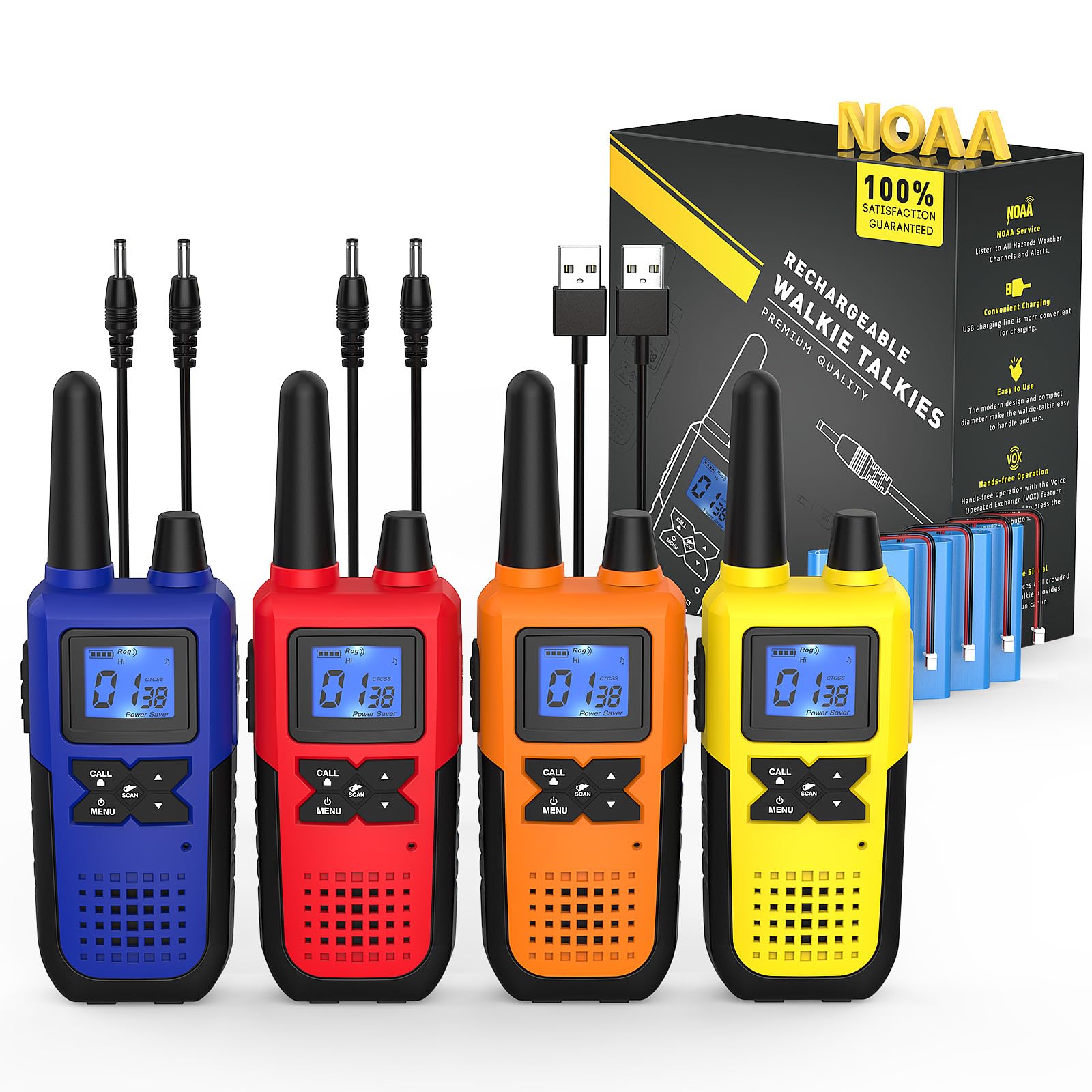
A big-battery, multicolor set that keeps a 9-year-old connected on a cruise for a full week.
Reliability in the wild is this radio’s calling card, and the numbers back it up. The 1800 mAh Li-Polymer battery provides about 72 hours of standby after a 3-hour USB fast charge. — enough that one cruise-ship family kept a 9-year-old connected for 7 days on a single charge. The four bright colors (blue, red, orange, yellow) make it simple to assign each family member their own radio and spot who is who at a glance.
On a 75-acre ranch, owners mention excellent reception and clarity even through metal walls, with a solid working distance of about 1/4 mile between metal buildings. Each unit runs 22 FRS channels with 121 privacy codes, plus an auto-squelch system that cuts background noise for clearer calls. The iVOX voice-activated mode means you can talk without pressing the push-to-talk button — genuinely handy when your hands are busy with gear or kids.
Beyond the basics, the NOAA weather service integration delivers hazard alerts even where cell service drops, which is why field operators describe these as perfect for two-man operations. The Y-cable charges two radios at once from a single USB source, cutting down on cable clutter at home or in the car.
Owner-approved dependability: The recurring praise centers on holding a charge for days and staying clear through obstacles that stop lesser radios, with cross-country road trips and ranch work both turning up as success stories.
One thing to plan for: These are FRS radios, so range in dense forest or city blocks will be far shorter than the open-field marketing suggests — treat the range as dependable, not infinite.
Pick it for: Families who want a full week of battery, easy color-coded ownership, and NOAA weather alerts on every trip.
Skip it for: Serious long-range work across miles of open terrain where a GMRS or repeater-capable radio would stretch further.
5. Midd Kacy MK108 Walkie Talkies
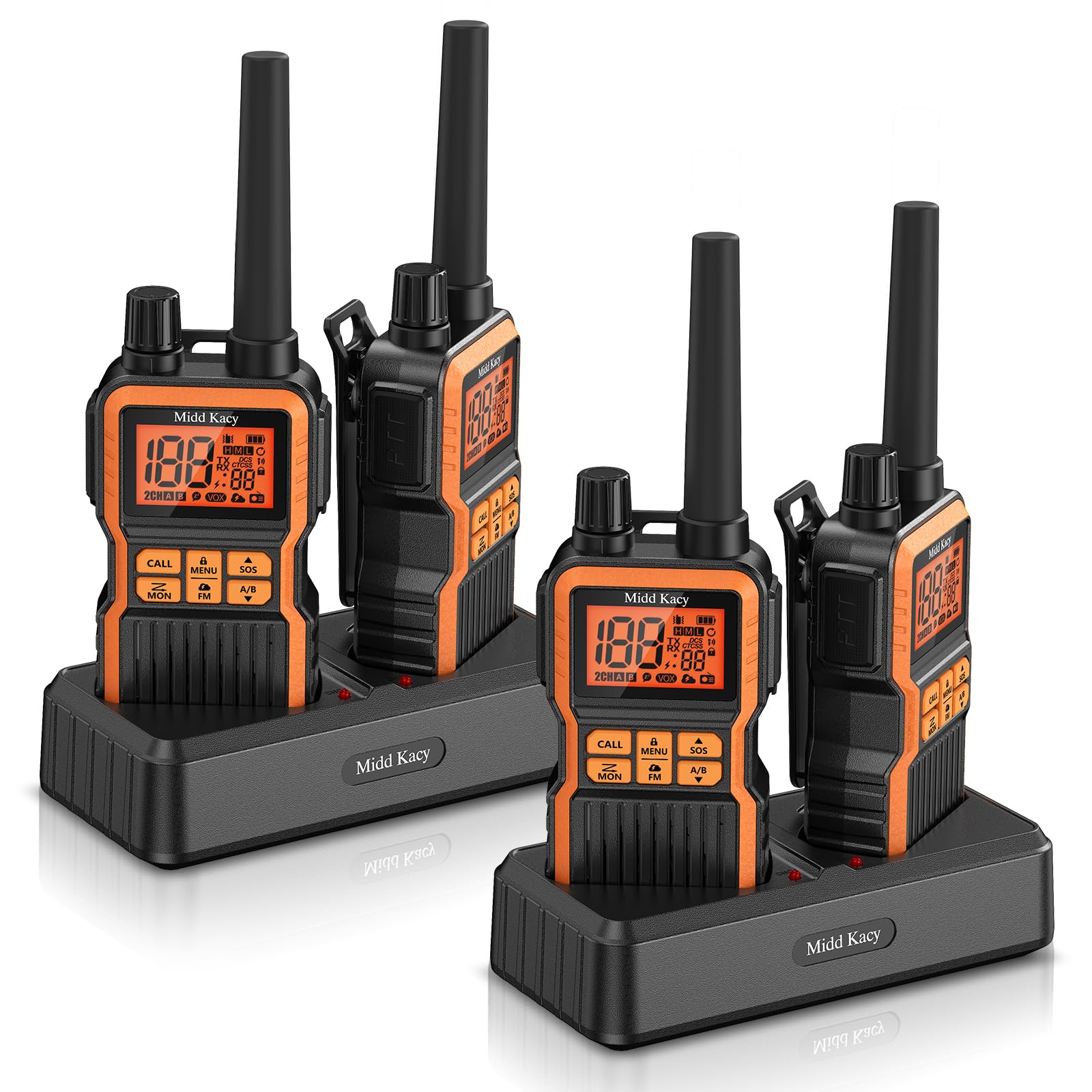
The car-convoy and farm favorite with a bold orange display and enough channels to dodge interference.
This orange-bodied set is built for people who spend real time in vehicles and on open land. Its 1800 mAh rechargeable packs run a normal 4-7 days on a charge, and customers note finishing a full two-car road trip with the batteries still showing around 2 bars. The dual desktop chargers in the box are stable enough to sit on an RV counter, and the radios clip neatly onto a visor for hands-free driving.
Communications wise, this is among the most flexible sets here. It carries 60 FRS channels plus 121 privacy codes, so when drive-through interference hits one channel, you have a deep bench of alternates to switch to. The 9 VOX sensitivity levels adjust how easily the mic triggers hands-free, and the bold orange backlit LCD screen stays readable at night. FM radio, SOS alarms, dual watch, and stopwatch timing all ride along as extras.
The advertised 6-mile open-field range holds up best in rural country; in cities expect 3-5 miles, and car-to-car on the highway lands closer to a football field before audio degrades inside moving vehicles. That pattern is consistent across owners — the radio itself performs within its specs, but physics still applies inside a metal car. The build is triple-proof (waterproof, anti-drop, dustproof) and owners praise the customization options like ringtones.
The strong points
- 60 channels and 121 privacy codes dodge crowded-spectrum interference
- 1800 mAh battery survives multi-day trips with charge to spare
- NOAA weather, SOS, FM radio, and dual watch all included
- Bold orange backlit display stays legible in the dark
Reality checks
- Signal inside moving cars drops off well before the open-field claim
- Range in towns lands at 3-5 miles, not the full 6-mile maximum
Choose it for: RVers, farm owners, and road-trip convoys who want deep channel options and multi-day battery in a rugged shell.
Pass on it if: You need dependable car-to-car audio at highway distances — no consumer radio reliably bridges that gap inside metal vehicles.
6. Gaswei G1pro IP67 Walkie Talkies

The tough-environment specialist that shrugs off rain and falls while pushing a 2W high-power signal.
When the conditions get rough, this is the radio you want clipped to your belt. Its IP67 rating means it is fully dustproof and survives immersion in water, and the shock-resistant body handles falls from up to 2 meters without skipping a beat. Owners have used these heavily in hilly, forested terrain with clear signal, and one family reports the set handled a full cruise with an excellent charge hold.
Power output is switchable between 0.5W low and 2W high, letting you boost range when you need it or save battery when you do not. The radios claim a maximum communication distance of up to 6 miles or 25 floors inside buildings, and The included 1800 mAh battery yields 12-24 hours of normal use or up to 100 hours on standby.. Type-C charging adds modern convenience, and a headphone jack is there when you need private listening.
The build quality impresses across the board, with a 2-day battery life under heavy kid use and controls simple enough for children to operate. The one durability story worth knowing: a single unit in one 4-pack failed after about 3 weeks, and the maker’s customer service promptly shipped a replacement — so the support backs up the hardware. The belt clip uses tiny screws that can be fiddly to install, often requiring two people.
Built for the backcountry: The combination of IP67 waterproofing, 2-meter drop resistance, and a switchable 2W high-power output makes this the set to trust when weather and terrain turn hostile.
The fair caveat: A small handful of owners hit early unit failures, though the responsive replacement service softens that blow considerably.
Reach for it when: Your work or play happens in rain, dust, and rugged terrain where a lesser radio would not survive the season.
Think twice if: You mostly talk across a house or yard — the rugged premium here is overkill for mild, indoor-only use.
7. Retevis RB48 Plus GMRS Walkie Talkies
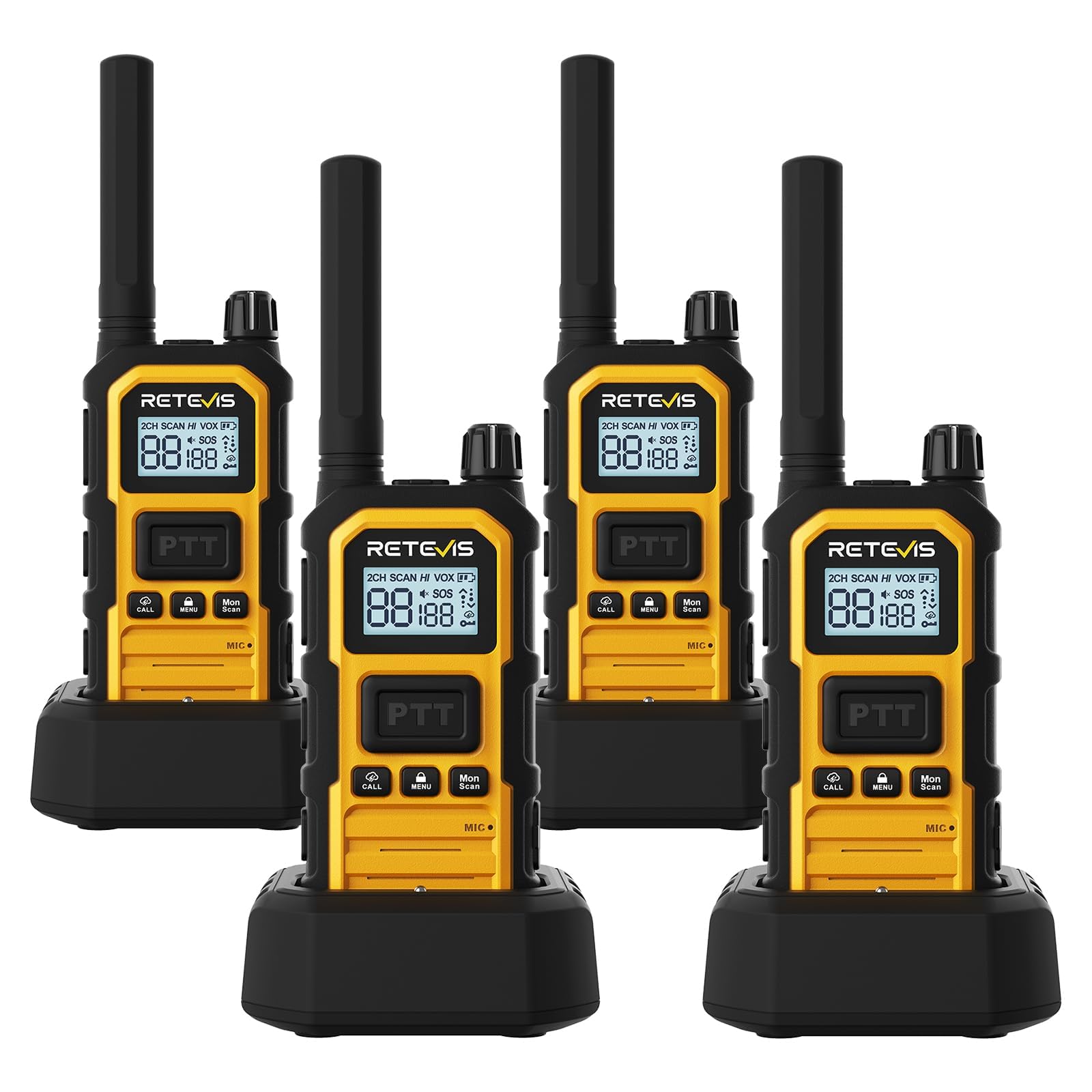
The worksite workhorse — GMRS power with a 2000 mAh battery and dual PTT buttons for gloved hands.
This is the radio designed for the demanding end of the spectrum, where reliable communication is a safety issue, not a convenience. It covers up to 350,000 square feet or 30 floors, making it a natural fit for construction sites, warehouses, and manufacturing plants. As a GMRS radio, it outranges standard FRS sets and can connect to 8 repeater channels to push communication even further across a sprawling site.
Battery life is the headline spec: The 2000 mAh cell delivers 18 hours of continuous talk time., and a traffic flagger confirms it easily covers a full 14-hour shift before needing a charge. The IP67 rating means it survives 1 meter of water for 30 minutes and blocks 0.1μm dense dust, while the shock-resistant, anti-slip body handles drops up to 2 meters. Reviewers point out it held up better in rain than a leading Midland model.
The double PTT design puts buttons on both the front and side, so you can key the mic from whatever position the radio sits in — a real advantage when you are wearing work gloves. The NOAA function provides weather warnings, and the SOS alarm adds a layer of worksite safety. A 5-year warranty backs the whole package, reducing the downtime and replacement costs that plague cheaper industrial gear.
Why crews choose it
- 2000 mAh battery runs a full 18-hour shift without dying
- IP67 triple-proof build survives rain, dust, and 2-meter drops
- Dual front-and-side PTT buttons work easily with gloves on
- GMRS power plus repeater channels cover huge facilities
Things to know
- The programming software is basic and lacks helpful guidance
- Advertised high-rise range may require a repeater at half the claimed distance
Built for: Construction, warehousing, and traffic crews who need all-shift battery and glove-friendly controls in punishing conditions.
Not ideal for: Casual family use where GMRS licensing and industrial pricing are more than the job requires.
8. Midland GXT1000VP4 50 Channel GMRS

The camp-and-event organizer with 50 channels and four boom mic headsets right in the box.
When you are running an event, a camp, or a search across open acreage, this Midland brings serious channel depth and clear audio. Its 50 GMRS channels plus 142 CTCSS/DCS privacy codes open up over 3,124 channel options to dodge interference — a genuine advantage in crowded areas where other groups are chatting. The four included boom mic headsets mean each person can talk hands-free without shouting into the radio body.
Owners have run these across a 15,000-square-foot building, a half-block radius, and 50 acres near Yosemite with no signal issues. In Colorado, reception stayed clear over 2 miles even with trees and hills in the way, and one user picked up trucker chatter from 10 miles away while in the mountains. The eVOX feature offers 9 sensitivity levels for voice-activated hands-free operation, and a twist-knob power control prevents accidental battery drain when the radio bounces around in a bag.
The honest trade-off shows up in the battery department. The rechargeable packs run roughly 10 hours of constant use — under a full day — though swapping in AA alkaline batteries stretches operation past a week. Range also earns mixed feedback overall: some owners get excellent multi-mile reach, while others report trouble beyond half a mile in tough terrain. This is a radio whose performance depends heavily on where you stand.
Event-ready strengths
- 50 GMRS channels and 142 privacy codes beat spectrum crowding
- Four boom mic headsets included for hands-free group use
- NOAA weather scan plus alert covers 10 weather band channels
- Proven clear reception across 2+ miles in hilly terrain
Plan around these
- Rechargeable batteries last under a day of constant use
- Range is inconsistent — some sites deliver miles, others barely half a mile
Grab it for: Camps, festivals, and group events where 50 channels, headsets, and weather alerts keep a large team coordinated.
Look past it if: You need all-day talk time on the rechargeables alone — budget for AA backups or choose a bigger-battery set.
9. KAYOTOM AT-600 4G LTE Walkie Talkies
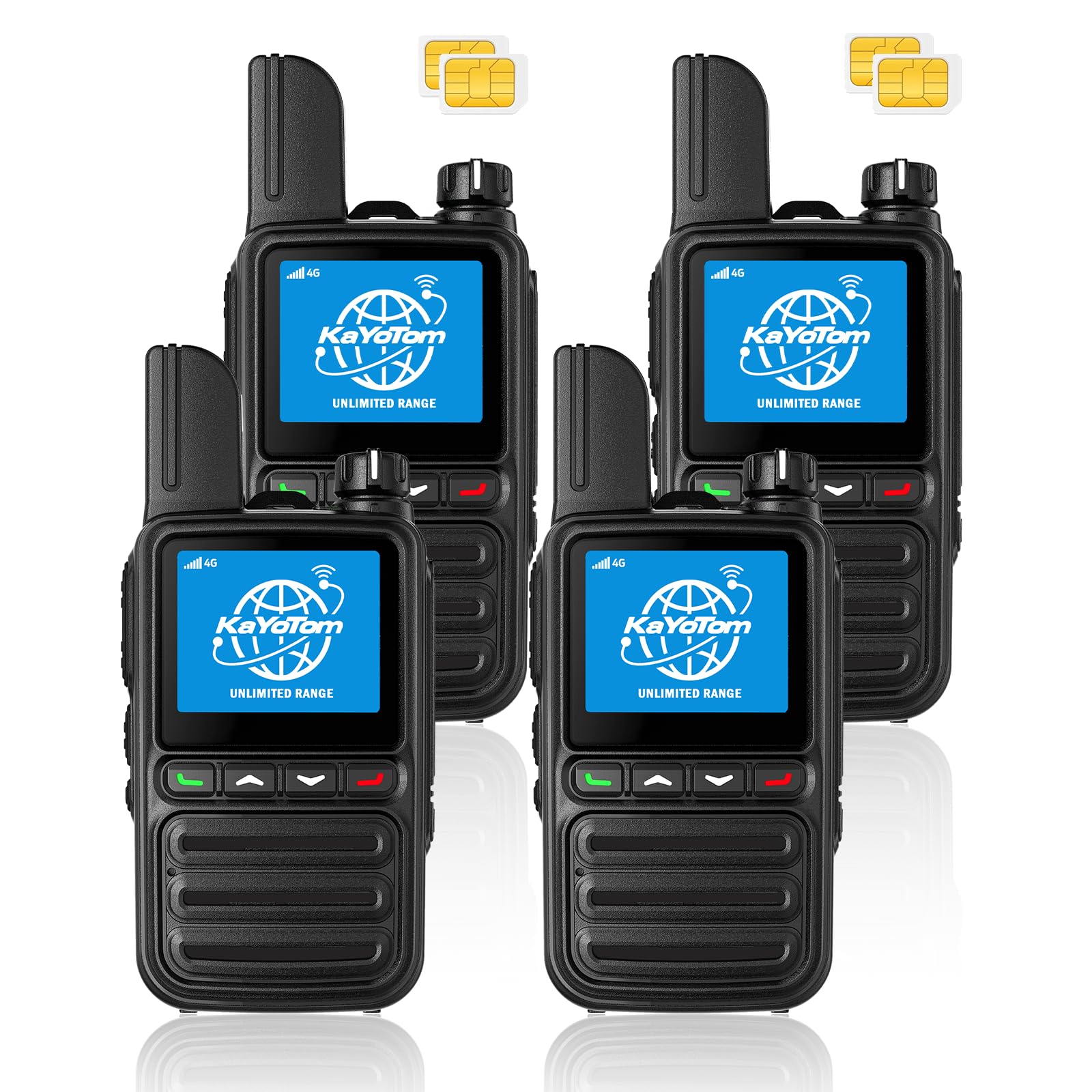
The radio that laughs at range limits — instant push-to-talk over cellular, nationwide.
This one changes the game: instead of fighting terrain and walls, it routes your voice over 4G LTE cellular networks (the same data network as your phone) for coverage that stretches 5000+ miles nationwide. Each unit ships with a lifetime free SIM card and no subscription fees, so the range question simply disappears. Push-to-talk over cellular (PoC) delivers real-time, broadcast-quality voice, and the built-in AI noise cancellation filters out 95% of ambient background noise—The maker reports clear transmission from Las Vegas to Manila, roughly a third of the way around the globe..
The hardware backs up the connectivity. The 3000 mAh battery provides over 24 hours of continuous talk time per charge., and The USB-C port restores 50% battery in 20 minutes. — a rapid top-up that keeps long shifts moving. Shoppers say a 48-hour battery still full after a day in the mountains, and the compact body feels solid in hand at a manageable weight. The volume knob sits a touch sensitive, so it can get turned down accidentally when the radio brushes against gear.
Setup requires a quick step: you message the support team with your IMEI IDs after purchase, and they link all four units into one group, or set up custom groups for larger teams. Some owners found the instructions vague, but the responsive support — reachable via WhatsApp — smooths the process. The belt clip is stiff to install, so several owners simply use the included lanyard instead.
The standout specs
- Nationwide 5000+ mile coverage via 4G LTE with a lifetime free SIM
- 3000 mAh battery exceeds 24 hours of continuous use
- 50% charge in 20 minutes via USB-C fast charging
- AI noise cancellation filters 95% of background noise
What to expect
- Needs cellular signal — no coverage means no communication
- Group setup requires contacting support with IMEI IDs
- Instructions read as vague; support picks up the slack
Choose it for: Teams spread across states or regions who need instant, crisp group calls without any range ceiling.
Avoid it if: You work in true dead zones with zero cell service, where old-school radio waves would be the only option.
Understanding the Specs
Radio Service: FRS vs GMRS vs LTE
FRS radios are license-free and the simplest choice for families. GMRS radios can push higher power and link to repeaters, but often require an FCC license. LTE radios route calls over cellular networks, eliminating range limits entirely but depending on signal coverage. Check which service a radio uses before you buy, since it determines both the range potential and any licensing homework.
Battery Capacity in mAh
A battery’s capacity is measured in milliamp-hours (mAh). More mAh generally means more talk time, but real-world duration also depends on power output, volume, and how often you transmit. A 1200 mAh pack might deliver a full day while a 2000 mAh pack stretches to 18 hours of continuous use. Look for USB-C charging when you want the freedom to top up from a car, laptop, or power bank.
Water and Dust Ratings
An IP rating (a standard that measures how well a device resists dust and water) tells you what a radio can survive. IP54 means splash and dust resistance for everyday use. IP67 is a step up—full dustproofing and survival through brief immersion in water. If your radios will face rain, mud, or riverbanks, an IP67 rating buys real confidence that a basic set cannot match.
Privacy Codes and Channels
More channels and privacy codes give you room to escape interference from other groups. FRS radios typically offer 22 channels, while some GMRS sets reach 50. Privacy codes (CTCSS and DCS) filter out conversations on your channel, so a busy park or job site does not bleed into your calls.
FAQ
Will any of these 4-packs work with radios from another brand?
Why does my range not match the miles on the box?
Do I need an FCC license for a GMRS radio?
How long do the batteries last between charges?
Can I charge these in my car or from a power bank?
What is VOX and why would I use it?
How do the 4G LTE KAYOTOM radios differ from traditional walkie talkies?
Are these radios safe for kids to use?
What does the NOAA weather feature actually do?
Final Thoughts: The Verdict
For most buyers, the best 4 pack walkie talkies long range is the Retevis RT68 because it pairs a crowd-pleasing 4.6-star reputation with rugged durability, 24-hour battery life, and clear communication through concrete walls at a price that makes sense for families and crews alike. If you want the battery that simply refuses to quit, grab the JIANUA T8 for its 96-hour standby and 1-hour USB-C recharge. And for nationwide reach with no range ceiling, the KAYOTOM AT-600 4G LTE set is the one to reach for.
How We Picked
We do not accept paid placement. Every pick is matched to a real buyer and a real use-case; we do not hands-on test units.
Sources & Methodology
Specifications: manufacturer listings and product documentation. Review insights: verified customer reviews, as of September 2026. Pricing: not shown on this page (it changes often); check the current price via the retailer link.
As an Amazon Associate, Gadgets Feed earns from qualifying purchases. This does not affect which products we feature.