
Our readers keep the lights on and my morning glass full of iced black tea. As an Amazon Associate, I earn from qualifying purchases.
Specs are compiled from manufacturer listings and verified buyer reviews and can change over time — please confirm the key details on the product page before buying.
A 4-person inflatable boat needs to do three things well: hold the weight of four adults, stay rigid enough to plane with a motor, and not leave you stranded with a leak after a season of use. The trouble is that a lot of budget models use thin PVC (polyvinyl chloride, a tough plastic) that stretches or cracks, or have floors so flimsy you feel every ripple. The picks here skip that drama — each one uses a heavy-duty aluminum floor and thick 1100-denier (a measure of thread thickness — higher means more tear resistance) or better fabric so you get a stable platform for fishing, tendering, or family days on the water.
I’m Min — the founder and writer behind Gadgets Feed. This guide is built by comparing the manufacturers’ published specifications and the patterns across verified customer reviews, so you get each pick’s real strengths and trade-offs instead of marketing spin.
You need an inflatable that can handle a short-shaft outboard or a rugged raft that stores in a car trunk. The 4 person boat you choose depends on how much weight capacity and seam quality you need for your water conditions.
Our Picks at a Glance

How To Choose The Best 4 Person Boat
Buying an inflatable boat for four people is a different decision than picking a kayak or a rigid dinghy (a small boat used as a tender). You are trading storage convenience for assembly time, and PVC toughness for weight. The three specs that decide whether you get a joy or a chore are fabric denier and seam construction, floor type, and weight capacity matched to your crew plus gear.
PVC Denier and Seam Welding
The number you see — 1100D or 1000D — is the measure of thread thickness in the fabric. A higher denier means more tear resistance and puncture protection when you drag the boat over a gravel launch or bump a submerged log. The other half is how the panels are joined. Heat-welded seams fuse the PVC into one piece instead of relying on glue that can fail in saltwater or extreme heat. Quadruple-overlap seams (four layers of material overlapping), when they are present, add another layer of security against seam separation under load.
Aluminum Floor vs. Air Floor
An inflatable floor (air deck) saves weight and packs smaller, but it flexes under foot and makes standing to fish or casting a rod feel unstable. A sectional aluminum floor — the kind with interlocking slats — gives you a rigid, flat surface you can walk on and mount a seat or cooler to. The trade-off is extra assembly time of about an hour on the first build and more weight to carry from the car to the water. For a boat that carries four adults and gear, an aluminum floor is worth the extra effort because it keeps the boat tracking straight and planing efficiently.
Weight Capacity and Tube Diameter
Four adults plus a motor, battery, tackle, and cooler adds up fast. A weight rating of around 1,100 to 1,300 pounds gives you the cushion to carry the full crew without riding low in the water. Tube diameter — the thickness of the side chambers — matters just as much. A tube diameter of roughly 16 to 17 inches provides the buoyancy and lateral stability (side-to-side balance) to keep the boat from tipping when everyone shifts to one side to net a fish or reach for a drink.
Quick Comparison
| Model | Best For | Weight Capacity | Item Weight | Material | Amazon |
|---|---|---|---|---|---|
| BRIS 10.8 ft★ Best Overall | Proven long-term durability | 1213 lbs | 121 lbs (55 kg) | 1100D PVC | Amazon |
| BEYOND MARINA 10.8FT | Max capacity & USCG-ready | 1300 lbs | 152 lbs | 1100D PVC | Amazon |
| BRIS 9.8 ft | Compact tender for sailboats | 1102 lbs | 110 lbs (50 kg) | 1100D PVC | Amazon |
In‑Depth Reviews
1. BRIS 10.8 ft Inflatable Boat
Our pick — over 4★ from 100+ verified ratings; the strongest balance of quality and price.
A five-year track record of no air leaks, with a deep-V keel (a V-shaped bottom centerline) that helps the boat plane easily.
Where the BEYOND MARINA is the new contender, this BRIS 10.8-footer is the veteran that buyers keep coming back to. Reviewers report no air leaks after two years of use, and one owner has had zero seam problems for five straight seasons. The fabric is 1100-denier PVC, a step above typical 1000-denier material, and all seams are quadruple-overlap heat-welded so they hold up in saltwater and humidity. The deep-V keel with rub-strake protection (a protective strip along the bottom) helps the boat track straight and plane with a smaller motor — owners mention it planes easily with two people and a 2.5 to 9.8 hp outboard.
The sectional aluminum floor creates a rigid, corrosion-proof platform you can stand on to fish, and the floor panels are heavy-duty enough that the boat handles high waves well, according to one verified review. At 1213 pounds of weight capacity, it sits between the two BRIS models, though it is 87 pounds lighter than the BEYOND MARINA’s 1300-pound rating. The package includes two aluminum bench seats, aluminum oars, a foot pump, a carrying bag, and a repair kit.
The real trade-off is assembly: the instructions are poorly translated, and several customers note it took roughly an hour to two days to figure out the floor the first time. The oar grips also tend to split after UV exposure, so plan to replace them seasonally. At 55 kilograms (about 121 pounds), it is still a three-person carry when fully assembled but packed.
Long-haul performer
- Proven durability — 5 years of use reported with no leaks or seam failures
- Deep-V keel improves planing and steering compared to flat-bottom inflatables
- Heavy-duty 1100D PVC with quadruple-overlap heat-welded seams
- Stable enough for 400+ pounds of gear plus two people in waves
Assembly friction
- Poorly translated instructions make first assembly slow (up to 2 days for some)
- Oar grips crack from UV exposure and need replacement
- Heavier than the 9.8-foot BRIS at 55 kg vs 50 kg
Perfect for: buyers who want a battle-tested boat with a proven five-year leak-free track record and a keel that helps cut through chop.
Consider the BEYOND MARINA instead: if you want higher payload capacity (1300 vs 1213 lbs) and much easier first assembly with English instructions.
2. BEYOND MARINA USCG Approved Inflatable Dinghy Boat, 10.8FT
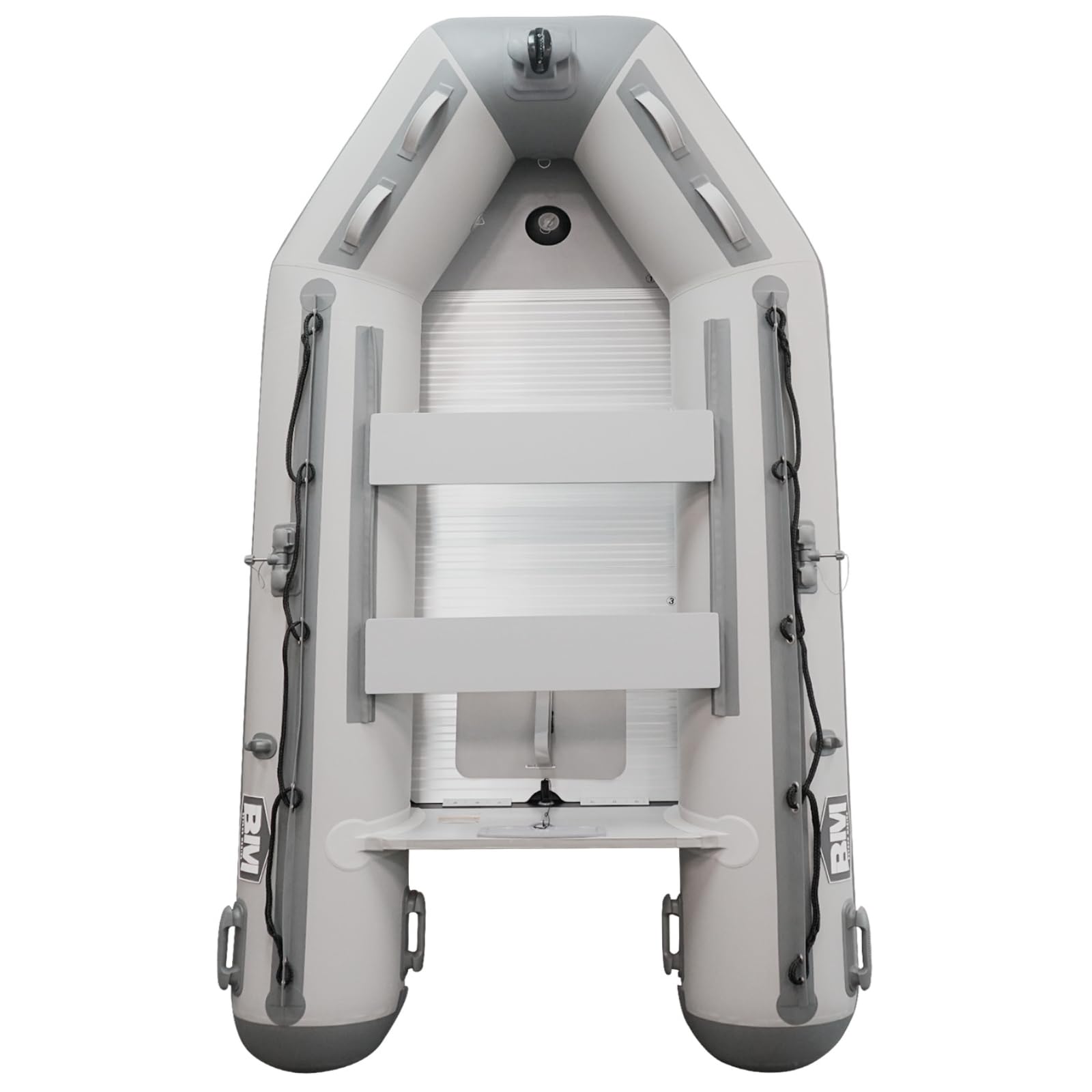
The heaviest lifter here, rated for 1300 pounds and easy enough to assemble in ten minutes.
This is the one you pick when the whole crew plus a cooler and a motor need to fit without riding low. The 1100D PVC hull uses heat-welded seams, and the 4-piece aluminum floor slides together with no tools. Buyers report the floor is solid and easy to install, with one reviewer calling the build quality impressive.
The package includes two aluminum oars, a foot pump, two bench seats, carrying bags, and a repair kit so you have everything to hit the water out of one box. The transom (the flat back panel where you mount the motor) height of 15.75 inches is built for standard short-shaft outboard motors up to 15 hp, and the boat comes with a Hull Identification Number (HIN — a unique ID like a VIN on a car) and Manufacturer’s Certificate of Origin (MCO — official proof of manufacturer), which makes state registration straightforward in most U.S. states.
One honest catch is that the foot pump fittings may lack glue from the start (a quick fix buyers mention), and the AFT floor panel can have sharp edges that need light sanding before assembly. At 152 pounds, this is a two-person job to carry deflated, so plan to assemble it near the launch point.
Why it leads the pack
- Highest weight capacity at 1300 lbs — best for four adults plus a motor and gear
- Assembles in under 10 minutes once you know the floor layout
- Includes HIN and MCO for easy boat registration
- Buyers love the “impressive build quality” and solid seams
What to watch for
- Heavy at 152 lbs — you need two people to carry it deflated
- Foot pump fittings may need glue reinforcement before first use
- Some floor panels have sharp mitered edges that need sanding
Grab this if: you want the highest payload, USCG-ready features, and the easiest assembly of any full-aluminum floor boat at this size.
Look elsewhere if: you need to carry the deflated boat solo — the 152-pound total weight makes that a two-person task.
3. BRIS 9.8 ft Inflatable Dinghy Boat

The shortest of the three at 9.8 feet, but the same tough PVC as its bigger siblings.
This one is built for the sailor or fisherman who needs a tender (a small boat used to go to and from a larger boat) that rows well and stows small, without sacrificing the rugged 1100-denier fabric and heat-welded seams of the larger BRIS models. Reviewers point out the PVC fabric is like a beach dinghy “but a lot more sturdy” — it will scratch if dragged on concrete, but holds air reliably and assembles in under an hour once you watch a setup video.
The sectional aluminum floor and the deep-V keel carry over from the 10.8-foot model, so you get a stable, standing-friendly platform. The 50-kilogram (110-pound) total weight makes it the lightest of the three, though owners emphasize it still needs two people to carry comfortably when inflated — one reviewer called it “very heavy” and suggested buying wheels or assembling near the shore.
One detail that matters for sailboat owners: this boat fits in a Camry after deflation, and the included foot pump is good for occasional use (though an electric pump is recommended for regular inflations). The package includes the hull, aluminum floors, two bench seats, oars, a carrying bag, a repair kit, and a foot pump.
Why it fits the tender role
- Lightest of the three at 50 kg (110 lbs) — manageable for two people to carry
- Same 1100D heat-welded PVC construction as the larger models
- Compact enough to deflate and stow in a Camry trunk
- Stable platform for rowing or a small outboard up to 4 hp
Size trade-offs
- Lower weight capacity (1102 lbs) — tight for four adults plus a cooler and motor
- Needs more than 4 hp to plane with a typical load
- No carry handle — awkward to move once inflated
Ideal for: a dinghy or tender for a larger boat, or solo-to-duo fishing where you want the smallest pack size with aluminum-floor rigidity.
skip it if: you need to regularly carry four adults and gear — the 1102-pound limit means you will hit the ceiling fast with a motor added.
Understanding the Specs
Denier (D) and PVC Thickness
The “1100D” you see on these boats refers to the weight and thickness of the nylon or polyester thread woven into the PVC fabric. A higher denier — 1100 versus the typical 1000 — means the base fabric is denser and more resistant to tears and punctures. The 0.9mm PVC coating on top adds abrasion resistance and water-tightness. Combined, an 1100D fabric with heat-welded seams is the standard for inflatables that will see saltwater, rocky launches, and years of UV exposure without delaminating (layers peeling apart).
Weight Capacity vs. Dry Weight
Weight capacity (measured in pounds) tells you the total load the boat can carry, including people, motor, fuel, battery, and gear. Dry weight is the boat itself, empty. The difference between the two — your usable payload — shrinks fast when you add a 50-pound outboard, a 30-pound battery, and four people averaging 180 pounds each. That is why a 1300-pound capacity boat like the BEYOND MARINA gives you a more comfortable margin than an 1100-pound boat when you run a full crew. Dry weight also matters for transport: these boats range from 110 to 152 pounds, so plan on needing at least two people to move the deflated package.
FAQ
Will a 4 person inflatable boat fit in a car trunk?
How long does it take to inflate and assemble these boats?
Can I use a 15 hp motor on these boats?
Are these boats USCG approved and registrable?
How many people actually fit comfortably on a 4 person boat?
Is an inflatable boat with an aluminum floor better than an air floor?
How do I keep my inflatable boat from leaking after a season?
Can I stand up to fish in these inflatable boats?
Final Thoughts: The Verdict
If you want one dependable pick, the 4 person boat winner is the BEYOND MARINA 10.8FT because it combines the highest 1300-pound weight capacity, USCG-ready features for registration, and the easiest assembly of any full-aluminum floor model at this price tier. If you want a proven track record with no air leaks across multiple seasons and a deep-V keel for better planing, grab the BRIS 10.8 ft. And for a compact tender that stows in a car trunk and still gives you aluminum-floor rigidity, the BRIS 9.8 ft is your best bet for dinghy duty or solo fishing trips.
How We Picked
We do not accept paid placement. Every pick is matched to a real buyer and a real use-case; we do not hands-on test units.
Sources & Methodology
Specifications: manufacturer listings and product documentation. Review insights: verified customer reviews, as of July 2026. Pricing: not shown on this page (it changes often); check the current price via the retailer link.
As an Amazon Associate, Gadgets Feed earns from qualifying purchases. This does not affect which products we feature.