
Our readers keep the lights on and my morning glass full of iced black tea. As an Amazon Associate, I earn from qualifying purchases.
Specs are compiled from manufacturer listings and verified buyer reviews and can change over time — please confirm the key details on the product page before buying.
Four devices, one round socket, and a family that all wants to plug in at once — that is the real job of a four-port car charger. The thing most people get wrong is assuming all four-port chargers are equal. They are not. Some split their total power so thin that a phone barely trickles, while others push a genuine 90W across the ports and keep a tablet and a laptop alive on the same trip. This guide walks you through which ones actually deliver, which ones fit snugly in the socket, and where the honest trade-offs sit.
I’m Min — the founder and writer behind Gadgets Feed. This guide is built by comparing the manufacturers’ published specifications and the patterns across verified customer reviews, so you get each pick’s real strengths and trade-offs instead of marketing spin.
A four-port charger lives or dies on how it divides its wattage, whether the plug stays put over bumps, and whether the ports match the cables your passengers actually carry. Every pick below was checked on those three points. Here are the ones worth plugging into your dash, chosen for this 4 port car charger shortlist.
Our Picks at a Glance


How To Choose The Best 4 Port Car Charger
The single biggest mistake buyers make is chasing a big wattage number on the box without checking how that number divides. A charger that boasts 90W total often caps one port at 45W and shares the rest, so a phone on a secondary port may only see a slow trickle. Your real question is not “how much power does it have” but “how much power does my phone get when my partner’s phone and the kids’ tablet are also plugged in.”
How the four ports divide their power
Look at the per-port maximum, not just the total. A 90W charger with two 45W USB-C ports means one laptop or fast phone can pull serious power from a single port. A 65W unit with a 30W PD port and an 18W QC port is honest about being a phone-and-tablet charger. Both are fine — you just need to match the split to what you carry. If someone in the car plugs in a laptop, only the higher-wattage PD ports will keep up.
USB-C PD versus Quick Charge versus PPS
USB-C Power Delivery (PD) is the standard iPhones and most modern Android phones use for fast charging through a USB-C cable. Quick Charge (QC) is a fast-charging standard mostly used by Android phones on the older rectangular USB-A port. PPS is a refined version of PD that lets a Samsung phone negotiate a precise voltage for its fastest mode. A charger that lists all three covers the widest set of phones without anyone needing to swap cables.
Plug fit, heat, and the bumpy-road test
A four-port charger runs hotter than a single-port one because it is pushing more current through the same small body. A metal or aluminum shell sheds that heat better than plastic, and a snug spring-loaded plug stays seated when you hit a pothole. A loose plug is the number-one cause of “it stopped charging” complaints — the charger has not failed, it has just wiggled out far enough to break contact. Check that the plug seats firmly in your 12V socket before you trust it on a long trip.
Matching ports to the cables your passengers carry
Count the cables in your car before you buy. If most people carry the older rectangular USB-A cable, you need at least one or two USB-A ports, not a charger that is all USB-C. If your family is all on newer phones with USB-C, the reverse is true. A 2-USB-C plus 2-USB-A layout is the safest mix because it handles both cable types without an adapter.
Quick Comparison
| Model | Best For | Total Output | Port Layout | Amperage | Amazon |
|---|---|---|---|---|---|
| JUNVANG USB C 4-Port 90W★ Best Overall | Best Overall | 90W | 2 USB-C + 2 USB-A | 3.75 A | Amazon |
| TIBEITA 90W 4-PortBest Value Split | Biggest Power Split | 90W | 2 USB-C + 2 USB-A | 3 A | Amazon |
| BERTHALESS Retractable 4-in-1Tidiest Console | Tangle-Free Console | — | 2 Retractable Cables + USB-A USB-C | 2.4 A | Amazon |
| WIDAQUO 90W 4-Port | Night-Time Use | 90W | 2 USB-C + 2 USB-A | 3 A | Amazon |
| Costyle 65W 2-Pack | Multi-Car Families | 65W | USB-C + USB-A | 3 A | Amazon |
| Bangfun 3-Pack 65W | Voltage Monitoring | 65W | 2 USB-C + 2 USB-A | 2.25 A | Amazon |
| DEWALT 4-Port 60W | Rugged Durability | 60W | USB-C PD + USB-A QC | 2.5 A | Amazon |
| DEWALT 65W 3-Port PD | Compact Premium | 65W | 2 USB-C PD + 1 USB-A QC | 5.42 A | Amazon |
In‑Depth Reviews
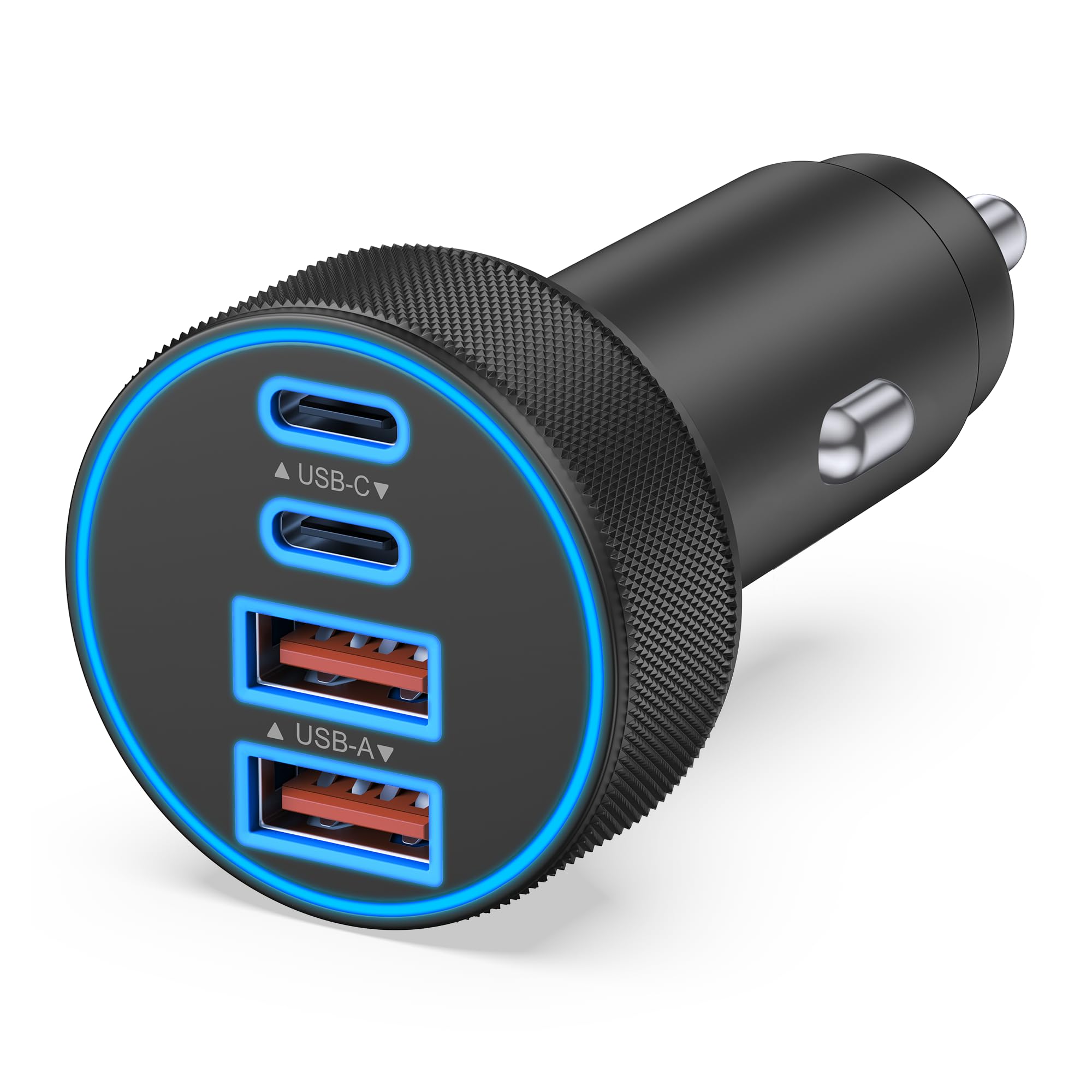
1. JUNVANG USB C Car Charger, 4-Port 90W Super Fast
Our pick — 4.5+★ from 3,500+ verified ratings; the strongest balance of quality and price.
The all-metal workhorse that divides 90W across four ports without a plastic shell running hot
The headline here is a 90W total output split across two USB-C and two USB-A ports, with a PD 45W and a QC 45W peak on the fast lanes. In plain terms, that means one phone can pull a full fast-charge from the USB-C port while the other three ports keep everyone else topped up. It charges an iPhone to 80% and an iPad to 60% in 30 minutes, and a Samsung Galaxy to 80% in 35 minutes. The 3.75 A rating is the highest on this list, and it is the reason the charger holds up when all four ports are loaded at once.
What buyers come back to most is build quality — the high-density all-metal housing is why so many owners trust it in a hot car. The metal shell is not cosmetic: it pulls heat away from the internal power chip, which is exactly what a four-port charger needs when three phones and a tablet are all drawing current on a highway drive. The charger also handles a 12V to 24V range, so it fits a sedan, an SUV, or a truck without a separate adapter. One honest note from the reviews: charging speed is the most-discussed topic, and it splits — some owners see the quoted fast speeds, others find a slower top-up when several devices share the load at once. That is normal for any charger splitting one 90W budget, but it is worth knowing before you expect laptop-grade power on all four sockets simultaneously.
The plug fit gets steady praise too, and the charger is compact at about 2.71 by 1.56 inches, so it sits low in the socket rather than sticking out of the dash. Amazon customers rate it 4.5+ stars across 3,900+ ratings, the strongest review signal on this list for a four-port unit.
What earns it the top slot
- 90W total across four ports, with a 45W PD and 45W QC fast lane
- 3.75 A rating — the highest current handling on this list
- All-metal housing sheds heat better than plastic rivals
- Works on 12V to 24V vehicles including trucks and SUVs
Where it asks you to compromise
- Fast charging can slow when all four ports are loaded at once
- Only one fast-charge lane, so a laptop and a phone compete for the peak
Pick this if: you want the best-reviewed four-port charger that handles heat, fits the socket, and covers both USB-C and USB-A cables.
Think twice if: you routinely fast-charge a laptop and a phone together on the highway — the 90W budget is shared, not doubled.
2. TIBEITA 90W 4-Port USB C Super Fast Car Charger
A 90W four-port that throws in the USB-C cable and an aluminum shell for not much more than a single-port brick
This one lands the same 90W total as the JUNVANG but with a cleaner per-port split: two USB-C and two USB-A ports, with a 45W max on each USB-C port. That per-port ceiling is the number to notice, because it means a single USB-C port on its own can charge a phone at full fast rates even while the other three ports top up easier devices. It charges a Samsung Galaxy S26 to 75% and an iPhone 17 to 70% in 30 minutes, and the 3 A rating keeps current steady with all four sockets busy. The flame-retardant PC case adds scratch resistance and heat dissipation — the practical payoff being a charger that doesn’t feel like it is melting on a July dashboard.
You get the extras in the box: a 3FT USB-C to USB-C cable (3 feet long, with the oval USB-C plug on both ends) and a full 1-Year Replacement. That cable means the charger works the moment you unbox it, with no trip to the store for the right cord. The aluminum enclosure also survives rough roads — the shockproof design keeps power flowing when you hit a pothole. That matters more on a four-port unit than a single-port one, because one loose plug cuts off everyone at once.
The trade-off to know about is that the product description accuracy gets some mixed feedback in the reviews. That is a fair note for any budget brand — check the port count and cable type against what actually ships before you rely on it. The function itself earns strong praise: buyers report it fast-charging a Samsung phone through a whole trip and handling all their chargeable devices without fuss.
The honest read: you get the same 90W split as the top pick, plus a cable and an aluminum body, for a slightly lower current rating of 3 A.
Reach for this if: you want a 90W four-port that ships with its own USB-C cable and a replacement guarantee, and you value the aluminum shell over the JUNVANG’s slightly higher 3.75 A.
Look elsewhere if: you need every port pushing peak power at once — the 90W is still shared.
3. BERTHALESS Retractable 4-in-1 Car Charger
Two cables that reel themselves back in, so your center console stops looking like a bowl of spaghetti
This charger solves a different problem than the others: cable clutter, not wattage. It has two 80 cm (31.5-inch) retractable cables built right into the body, plus a USB-A and a USB-C port, so four devices get power with zero loose cords snaking across the console. The 2.4 A rating is lower than the 90W units, and that reflects what this is: a convenience-first charger, not a fast-charge powerhouse. It handles 12V to 24V in sedans and SUVs, and the 180-degree rotation means you can angle it clear of the gear shift or handbrake.
What keeps people buying it is the retractable cord — owners across thousands of reviews call out how much they like not fishing for a dropped cable under the seat. A short extra pull and the cable retracts for storage, which is the kind of small win that matters every single day on a commute. For road trips and shared rides, the four-device capacity handles a driver’s phone, a passenger’s phone, and two tablets in the back.
The catch is durability, and it is the most-discussed issue after cord convenience. The retractable mechanism and the charging power both get mixed or negative feedback — buyer reports include cords that stop retracting and units failing sooner than a plain plug-in charger. That does not make it a bad buy; it makes it a fit choice. If you want neat cables, accept that the moving parts are the thing to treat gently. If you want a charger to last a decade, a simple metal plug-in like the JUNVANG is the safer bet.
The trade-off you accept: cord tidiness in exchange for lower current and more moving parts to look after.
This is for you if: a tidy console and no tangled cables matter more than the fastest possible charge.
Skip the retractable design if: you want a charger that just works for years with no mechanism to wear — the moving cables are the weak point here.
4. WIDAQUO 90W 4-Port USB C Fast Charge
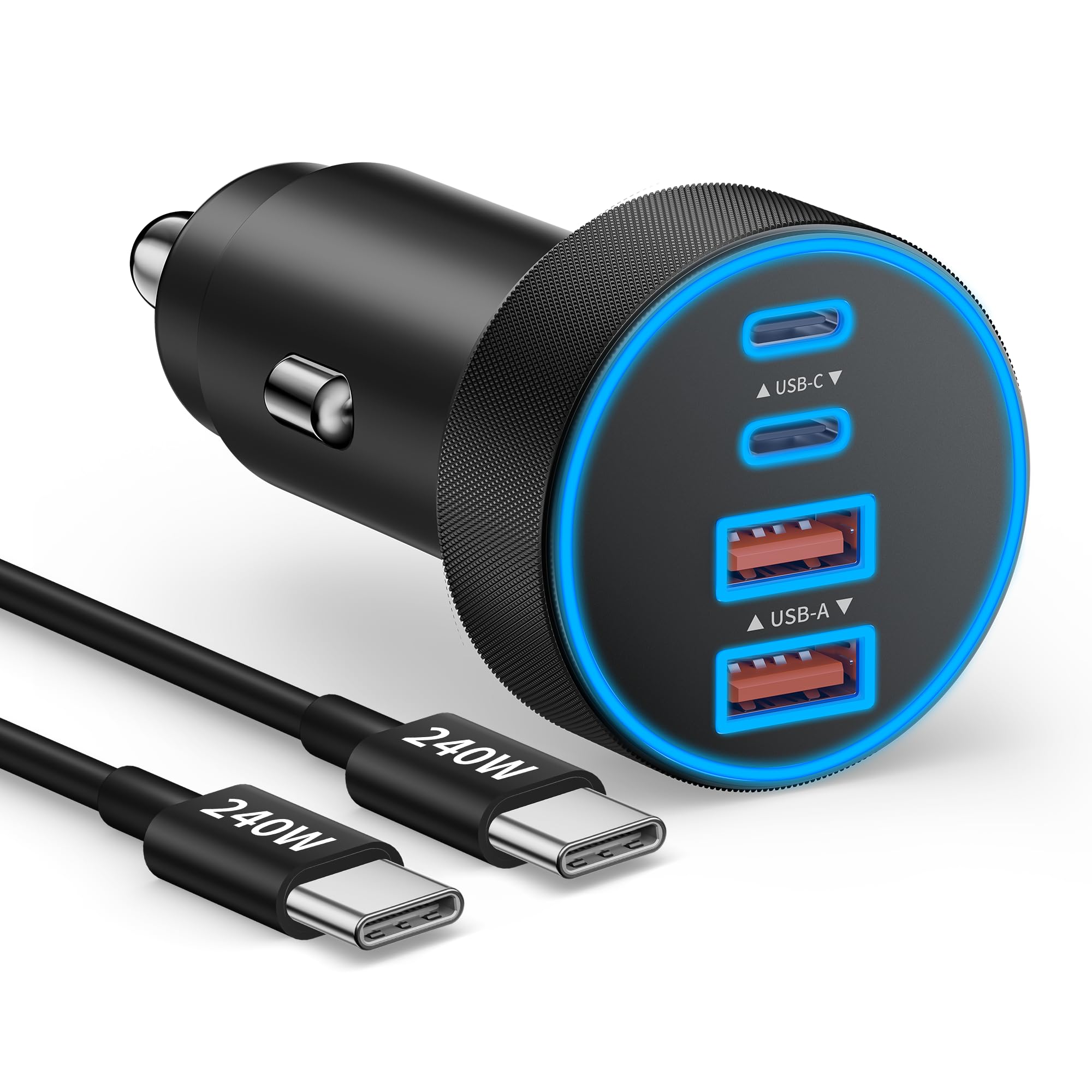
A 90W four-port with a soft blue charging light, so you can find the socket in the dark without blinding the driver
This charger delivers 90W total with a genuinely useful split: dual 45W USB-C PD3.0 ports plus 45W USB-A QC3.0. On the fast lanes, a phone hits 80% in about 30 minutes over USB-C, and a Samsung Galaxy S26 reaches 80% in roughly 35 minutes. The 3 A rating and the aluminum alloy body mean it runs cool enough to keep that speed going on a long drive. It also explicitly supports PPS, the protocol Samsung phones use to negotiate their fastest charge mode.
You can see charging status at night without distracting the driver, thanks to a soft blue-lit display — handy when you plug in at a dark rest stop. It also ships with a 240W E-Marker 3FT USB-C to USB-C cable (an E-Marker chip tells the charger how much power the cable can safely carry), which handles the charger’s 90W output. The safe-power stack covers overheating, over-voltage, over-current, short circuits, overcharging, and reverse polarity (power hooked up the wrong way), and it auto-cuts power when devices are full, so a phone is not left cooking on a dash all day.
The honest caveat is that value for money gets mixed feedback — some buyers feel the cable and the 90W justify it, others less so. It is also a slightly newer product with fewer reviews than the top pick, so the track record is shorter. What is clear from the ones that exist: functionality and charging speed are the two things owners praise most, and the anti-vibration plug fit keeps the power steady on bumpy roads.
What makes it stand out
- Soft blue-lit status display for night use without glare
- Dual 45W USB-C PD ports plus 45W USB-A QC
- Ships with a 240W E-Marker USB-C to USB-C cable
- PPS support for Samsung’s fastest charge mode
What to weigh up
- Value-for-money feedback is mixed among buyers
- Shorter track record than the top-rated picks on this list
The right fit: night drivers and road-trippers who want a lit port, PPS fast charging, and a 240W cable in the box.
The one caveat: if you want the longest proven track record over a known brand, the top pick has more history behind it.
5. Costyle 65W 4-Port Car Charger 2-Pack
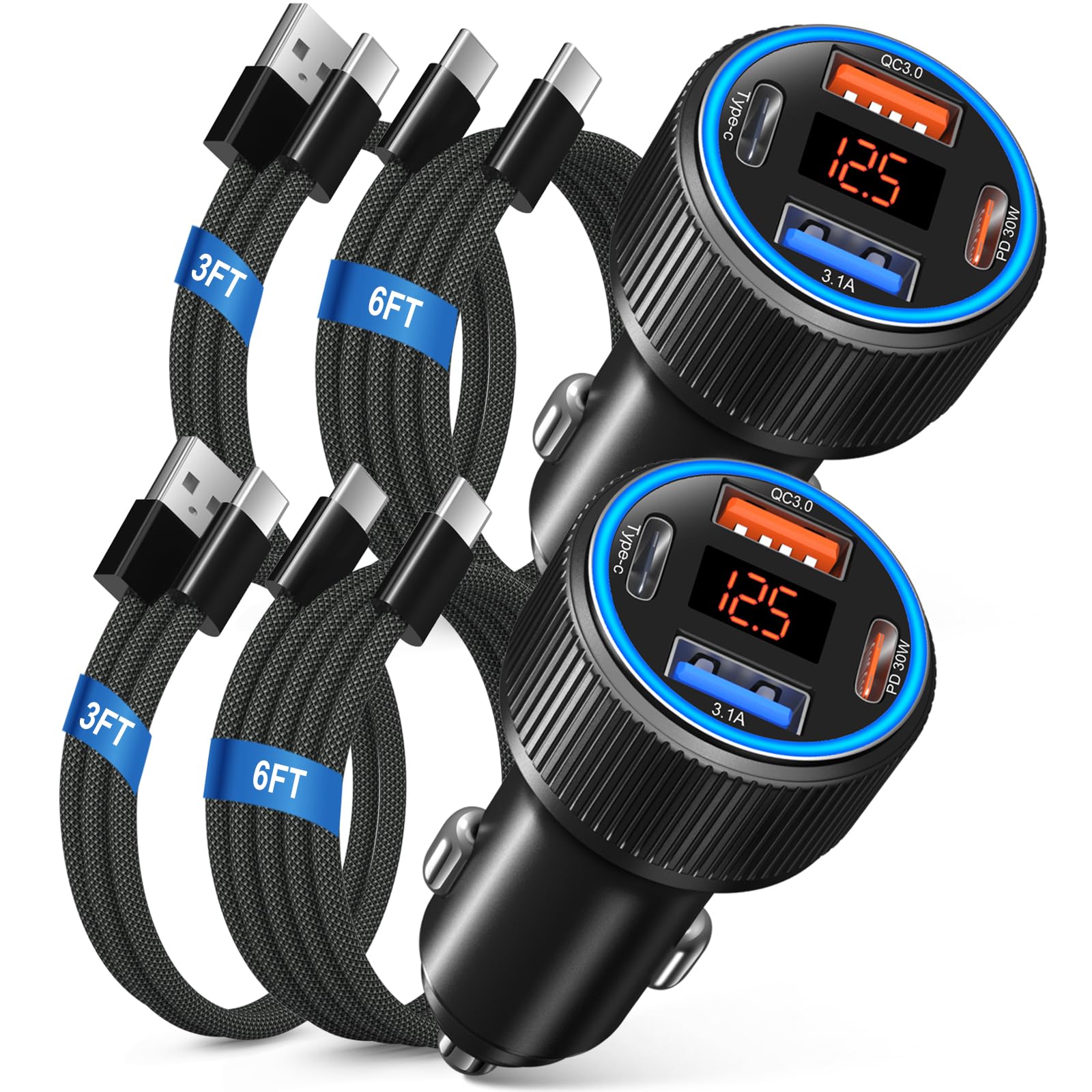
Two chargers and four cables in one box, built for the household with more than one vehicle
Two cars, one purchase: this kit covers both without buying twice. You get two 65W chargers plus four USB-C cables — two 3FT USB-A to USB-C for the front seat and two 6FT USB-C to USB-C for the back seat, where the longer cord lets kids or passengers reach their devices. The 65W total splits into a 30W PD (USB-C Power Delivery) port and an 18W QC (Qualcomm Quick Charge) port running at once, charging a phone or tablet to 60% in about 35 minutes. The 3 A rating (amps, the measure of current flow) keeps it steady, and the full aluminum alloy body is sturdier than a plastic plug.
The extra that earns its place is the LED voltmeter in the middle of the charger. A quick glance tells you the state of your car battery and system voltage — useful if you run a 12V pack while camping or want to check the battery on a hot day. The charger also fits snugly in the 12V port without needing force, and holds a solid connection on bumpy roads. The built-in smart chip stops charging when the battery is full and cuts all 12V outlets when you pull the keys from the ignition.
The reports back this one up well: buyers find it performs better than expected, handles two phones at once, feels well-built, and charges fast. The four-port layout uses ports on the edge of the body so you can plug cords in without crowding — that solves the one-port problem many older cars have. The honest note is that two cables are 3FT and two are 6FT, so if you need a long run to the very back row, check the cable length fits your layout.
Value read: the two-charger, four-cable bundle is doing the work of a family kit rather than a single dash upgrade.
Best for: two-car households that want both vehicles set up in one purchase, cables included.
Not for: single-car owners who would rather put their budget into one higher-current charger.
6. Bangfun 3-Pack 65W 4-Port Car Charger

Three 65W four-port chargers with a live voltage readout, so you can spot a tired battery before it strands you
This is the pick for the driver who wants to keep an eye on the car’s electrical health. The built-in voltage display works as a voltmeter, showing real-time readings so you can monitor the battery and charging system — helpful in hot summers and on long trips when a weak battery tends to show itself. Behind that display is a 65W charger: an 18W QC3.0 port and a 30W PD 3.0 port, split across two USB-C and two USB-A ports so four devices can charge at once. The 2.25 A rating keeps the load in check, and the all-aluminum exterior resists over-current, over-voltage, short-circuit, and overheating.
The thing buyers find most useful is that voltage reading — it doubles as an early warning on the alternator and battery, which turns a simple charger into a small diagnostic tool. It charges phones fast and powers several devices together, and the 12V to 24V range covers most vehicles. Being a 3-pack, it also suits someone setting up multiple cars or gifting a charger to a family member.
The peak 30W PD port is a tablet-and-phone charger, not a laptop charger. And because you get three, make sure you actually need three before choosing this over a single higher-output unit.
Why it’s here: the instrument-panel angle — a live voltage readout — is unique among these picks.
Plump for this if: you want a voltage watch on your dash and three chargers to spread across cars.
Pass if: you need to fast-charge a laptop — 30W max on the top port won’t get you there.
7. DEWALT Heavy Duty 4-Port USB C Car Charger
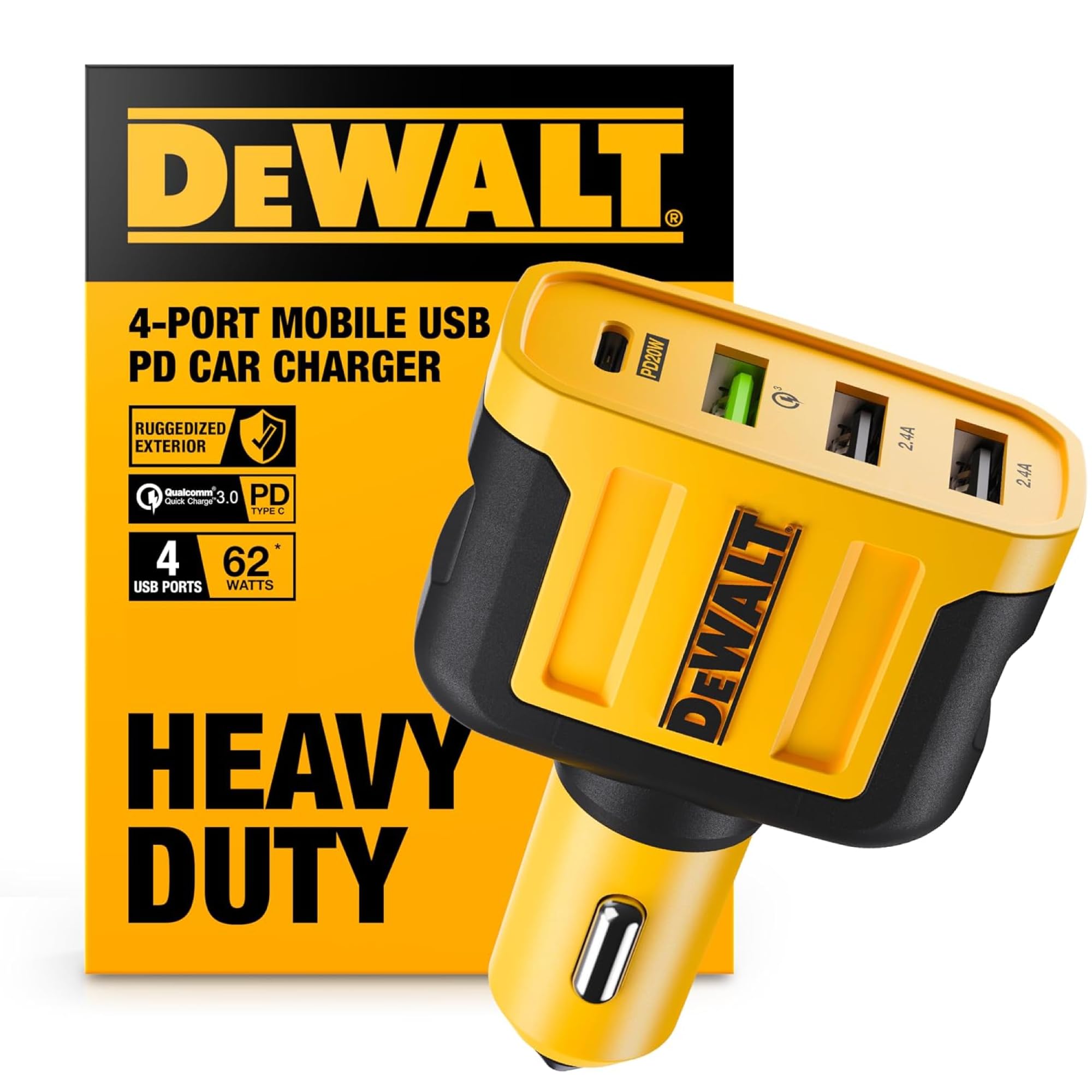
A job-site-tough charger built to take the abuse a work vehicle dishes out, day after day
DEWALT’s four-port delivers 60W of available power and charges four USB devices at the same time. It pairs a Type-C Power Delivery port with a Quick Charge USB-A port that charges devices to 50% in 30 minutes. The 2.5 A rating is modest, and the plastic exterior sounds plain on paper — but the charger’s reputation rests on its rugged construction, which is built to stand up to repeated wear and tear. For a truck, a work van, or a vehicle that lives outdoors, that durability is the point.
What owners value about it is the reliability — it is the charger that just keeps working, trip after trip. The four-port layout covers a driver’s phone, a passenger’s phone, and a tablet or dash cam without swapping cables. It earns its place in the glove box as a backup charger for road trips. The Type-C PD port handles newer phones at fast rates, while the Quick Charge USB-A port covers older Android devices on the rectangular connector.
The catch is that 60W total is the lowest on this list, and the split favors the PD port. If you want the bare maximum charge rate, the 90W picks will beat it. But if you want a charger that survives a rough vehicle, this is where DEWALT’s build quality earns its place.
Why it survives the job site
- Rugged exterior built for repeated wear and tear
- Type-C PD plus Quick Charge USB-A fast lanes
- Four devices charging at once from 60W
- Strong reputation for reliability
The limits
- 60W total is the lowest output on this list
- Plastic body rather than metal
The call: a work-vehicle charger where durability beats raw wattage every day of the week.
The exception: if you need maximum charge speed, the 90W chargers above leave it behind.
8. DEWALT 65W PD 3-Port Car Charger
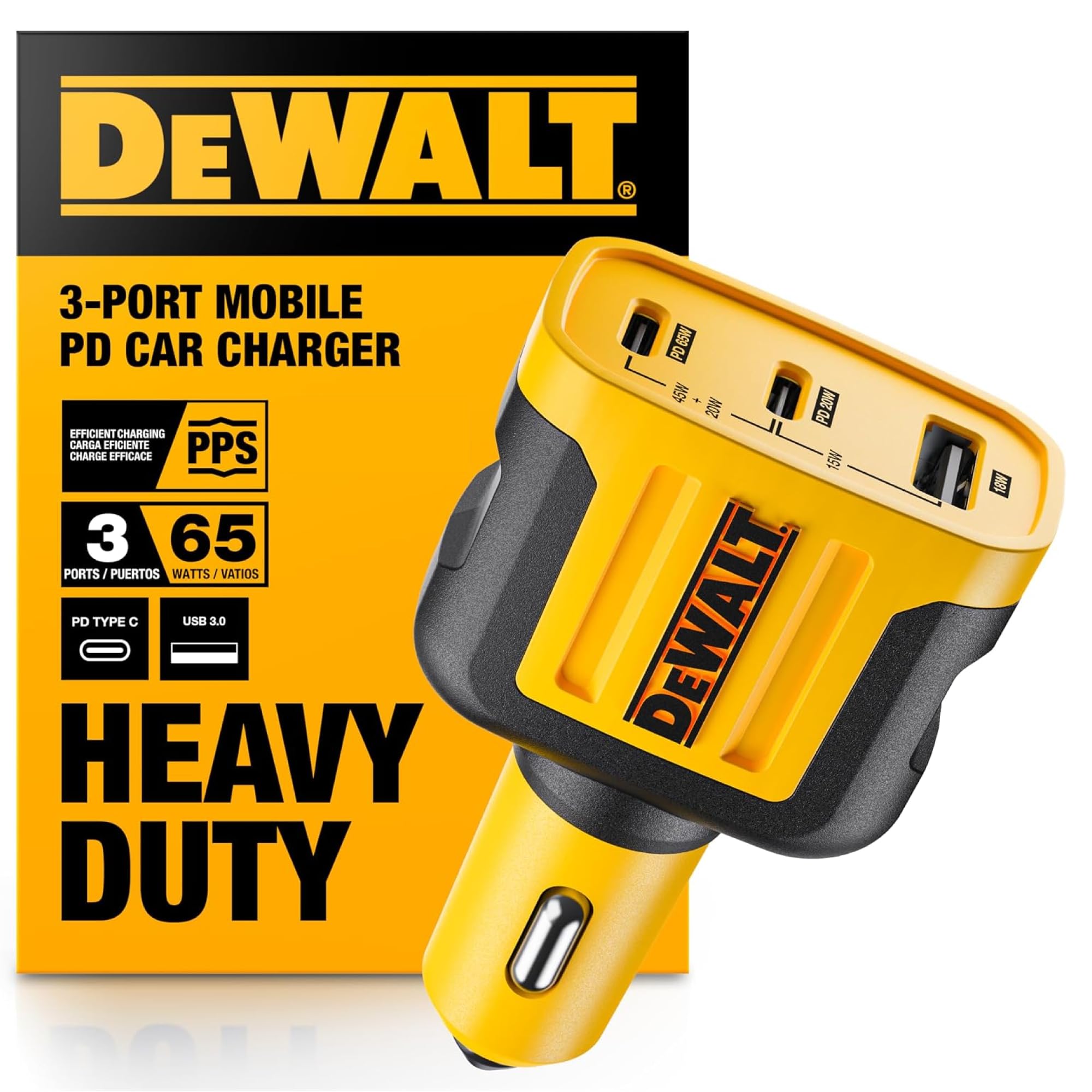
Three ports instead of four, but a 65W PPS smart-charging engine that keeps a laptop and two phones fed
DEWALT’s premium unit gives up one port to deliver smarter power. It has two USB-C PD ports and one USB-A QC port, delivering 65W of total output with a 5.42 A rating — the highest current on this list, and the reason it can push power reliably through fewer, higher-output ports. The smart PPS/PD technology (PPS is Programmable Power Supply, which fine-tunes voltage) adjusts charging to each device, which prevents overcharge and overheating. In plain terms: you charge a laptop, a tablet, and a phone together, and the charger picks the right voltage for each one.
The adaptive approach is what serious buyers want when a USB-C port has to double as a laptop charger and a phone charger. It is built from DEWALT-grade materials in a compact body, so it fits the socket without bulk. Owners mention it working well with fast phones — a Samsung S26 Ultra being a listed example — and appreciate the fast charging. The iPhone 17 and 18, Samsung Galaxy S24 Ultra and S23, iPad, and laptops all sit on the compatibility list.
The honest limit is the port count. This is a “3-Port” charger despite the category listing, so if you have four people in the car, one is going without a socket. It is also the highest-tier pick here, and with fewer reviews than the top units, its track record is shorter. If four occupied sockets are non-negotiable, look at the JUNVANG or TIBEITA above; if you want the smartest three-pot charger, this is the one.
The standout spec: 5.42 A — the highest current rating on this list — lets a 3-port unit keep a laptop and two phones alive on a long trip.
Built for: the road warrior who carries a laptop and wants adaptive PPS charging with top-tier current handling.
Not for: four-passenger cars that genuinely need four occupied sockets at once.
Understanding the Specs
Total Wattage vs Per-Port Wattage
Total wattage is the overall power a charger can supply across all its ports. Per-port wattage is what a single port can give one device, and that is the number that decides your actual charge speed. A 90W charger with a 45W USB-C port lets one phone or laptop fast-charge from that single port, while the other ports share the rest. When all four ports are loaded, no charger divides its total evenly — the fast lanes keep their share, and the rest slows down. If fast charging matters, look for a per-port max, not just the total.
PD, QC, and PPS in Plain Terms
PD (Power Delivery) is the fast-charging standard most modern phones and laptops use over USB-C. QC (Quick Charge) is the older standard used mainly on Android devices with rectangular USB-A ports. PPS is a refined PD mode that lets a Samsung phone negotiate a precise voltage for its fastest charge rate. A charger that lists all three protocols covers the broadest set of devices without anyone swapping cables. Missing PPS does not stop a Samsung phone charging — it just may not reach its top speed.
FAQ
Will a 4 port car charger fit my car’s 12V socket?
Why does my phone charge slowly when all four ports are in use?
Do I need PPS support for my Samsung Galaxy phone?
What is the difference between USB-C PD and Quick Charge?
Can a 4 port car charger charge a laptop?
Does a metal body make a car charger safer?
How long does a retractable car charger last?
Will a 4 port car charger drain my car battery when the engine is off?
Is 65W enough for four devices at once?
Can I use a 24V charger in a 12V car?
Final Thoughts: The Verdict
For most people, the 4 port car charger winner is the JUNVANG 4-Port 90W. It holds the highest current rating on this list at 3.75 A, packs a 90W total into an all-metal shell that sheds heat, and covers both USB-C and USB-A cables. It has the strongest buyer track record here, and it is the one to choose if you want four ports that stay seated and stay cool. If you value a cable in the box and an aluminum body, the TIBEITA 90W 4-Port matches its power split and adds a replacement guarantee. And for a tidy console with no cord spaghetti, the BERTHALESS Retractable is the one — as long as you accept its moving parts need gentle handling.
How We Picked
We do not accept paid placement. Every pick is matched to a real buyer and a real use-case; we do not hands-on test units.
Sources & Methodology
Specifications: manufacturer listings and product documentation. Review insights: verified customer reviews, as of November 2026. Pricing: not shown on this page (it changes often); check the current price via the retailer link.
As an Amazon Associate, Gadgets Feed earns from qualifying purchases. This does not affect which products we feature.