
A 4 speaker amplifier that can’t actually drive four speakers is just a paperweight with knobs. The real problem buyers face is not the power on the spec sheet — it’s the RMS rating into your specific speaker impedance. A 1000W max power figure means nothing if the amp only delivers 25W per channel cleanly into 4 ohms. This guide measures every amp by its real-world RMS wattage, crossover flexibility, and physical fitment for your vehicle or home setup.
I’m Min — the co-founder and writer behind Gadgets Feed. I’ve spent countless hours cross-referencing published power specs against customer-verified real-world performance, thermal behavior, and installation dimensions to separate genuinely capable amplifiers from marketing hype.
Whether you’re upgrading a car’s factory speakers or building a compact home theater, focusing on RMS per channel at your target impedance is the only metric that matters when choosing a 4 speaker amplifier.
How To Choose The Best 4 Speaker Amplifier
Selecting a 4 channel amplifier hinges on three variables: your speaker impedance (typically 2, 4, or 8 ohms), the available space in your vehicle or rack, and whether you need a variable high-pass filter to protect tweeters from low-frequency distortion. Many buyers overestimate the wattage they need and underestimate the importance of thermal management in tight enclosures.
RMS Power vs Peak Power
Peak power is a burst spec the amp can sustain for milliseconds. RMS (Root Mean Square) is the continuous power output the amp can deliver without distortion or overheating. A reputable 4 speaker amplifier will clearly list RMS per channel at 4 ohms and 2 ohms. As a rule, match the amp’s RMS output to your speaker’s RMS handling for balanced headroom without blowing voice coils.
Class D vs Class A/B Topology
Class D amplifiers are highly efficient, generating less heat and requiring smaller heatsinks — ideal for tight motorcycle fairings or under-seat car installs. Class A/B amplifiers produce warmer, lower-distortion sound but run hotter and draw more current. The trade-off is efficiency versus audio fidelity; Class D has nearly closed the gap for most applications, but purists still prefer A/B for critical listening.
Filter Options and Crossover Types
Variable high-pass filters (HPF) and low-pass filters (LPF) allow you to tune which frequencies reach each channel. For door speakers running full-range, a HPF set around 80Hz prevents sub-bass energy from damaging mid-range cones. For bridged channels driving a subwoofer, a LPF set to 80-120Hz ensures only bass notes pass through. Amplifiers with fixed 90Hz crossovers work for basic setups but lack the flexibility of variable controls.
Quick Comparison
On smaller screens, swipe sideways to see the full table.
| Model | Category | Best For | Key Spec | Amazon |
|---|---|---|---|---|
| WiiM Amp Ultra | Home Hi-Fi | Multi-room streaming & room EQ | 100W x 4 @ 4 ohm / ESS DAC | Amazon |
| Alpine S-A32F | Car Audio | SQ-focused compact installs | 55W RMS x 4 @ 4 ohm | Amazon |
| Pioneer GM-A6704 | Car Audio | Versatile Class A/B with bridging | 60W RMS x 4 @ 4 ohm | Amazon |
| DS18 SXE-1200.4 | Car Audio | High-output A/B for custom builds | 100W RMS x 4 @ 2 ohm | Amazon |
| Taramps TS 1200×4 | Car Audio | High-power Class D for loud systems | 300W RMS x 4 @ 2 ohm | Amazon |
| SounDigital 800.4 EVO | Compact Car | Motorcycle & powersport installs | 200W RMS x 4 @ 2 ohm | Amazon |
| Taramps TS 800×4 | Car Audio | Budget-friendly loudness in 2 ohm | 200W RMS x 4 @ 2 ohm | Amazon |
| Donner Stereo Receiver | Home Karaoke | Entry-level home audio & karaoke | 25W RMS x 4 @ 8 ohm | Amazon |
| Recoil DI550.4 | Car Audio | Value Class D with 4-way protection | 80W RMS x 4 @ 4 ohm | Amazon |
In‑Depth Reviews
1. WiiM Amp Ultra
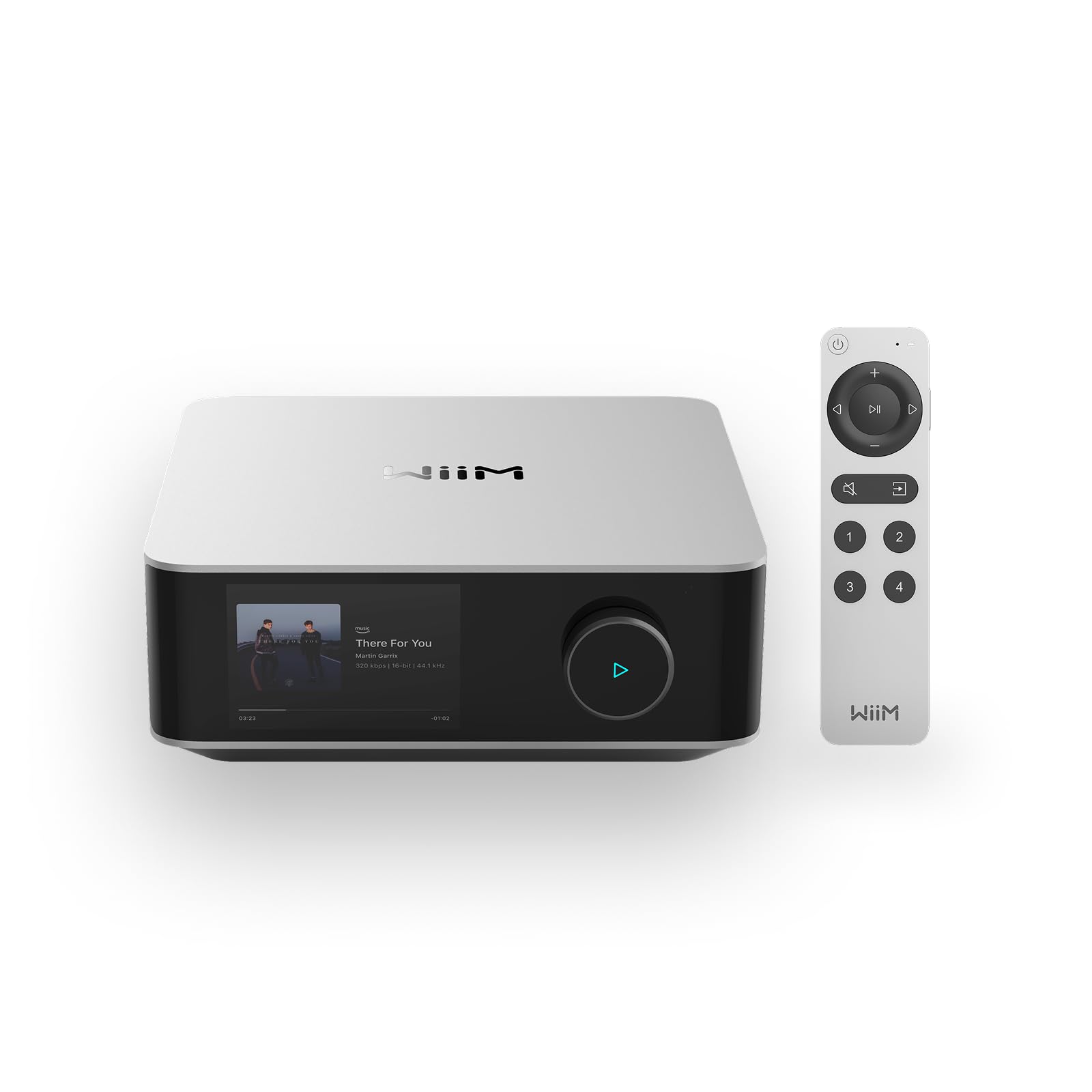
The WiiM Amp Ultra redefines what a 4 speaker amplifier can be by integrating a premium ESS ES9039Q2M DAC and dual TI TPA3255 Class D amps into a streaming-native chassis. Its 100W per channel into 4 ohms delivers studio-grade clarity with a signal-to-noise ratio that surpasses most legacy receivers. The built-in RoomFit Room Correction auto-calibrates for your specific speaker placement and room acoustics, eliminating guesswork entirely.
Connectivity matches modern ecosystems: Wi-Fi 6, Bluetooth 5.3 with LE Audio, HDMI ARC for TV integration, optical, RCA, and a 3.5-inch touchscreen for local control. Support for Spotify, TIDAL, Qobuz, and Roon Ready means your entire music library and streaming subscriptions are accessible without a separate source. The included voice remote and multi-room synchronization with other WiiM devices make expansion seamless.
Some users note Bluetooth sources introduce a several-second delay when switching inputs, and AirPlay is not supported — but these are minor compromises given the overall fidelity and feature density. For anyone building a primary home audio system around a 4-channel amplifier, this is the benchmark.
Why it’s great
- 100W RMS x 4 with ultra-low THD+N (-106 dB)
- ESS Sabre DAC and RoomFit correction for precise sound
- Wi-Fi 6, HDMI ARC, and multi-room streaming
Good to know
- No AirPlay support
- Bluetooth source switching has a brief delay
- Home-oriented finder, not for 12V car installs
2. Alpine S-A32F

The Alpine S-A32F is a pure sound-quality play, delivering 55W RMS x 4 into 4 ohms with an efficiency rating that keeps the compact chassis running cool. Its signal-to-noise ratio exceeds 98 dB referenced to rated power, translating to an absolutely black background between notes. The Class D design allows it to fit in tight spaces — under a seat or behind a dash — without the thermal overhead of a Class A/B amp.
Users consistently report that even at moderate gain settings (18/40 on the dial), the S-A32F wakes up speakers they thought were lifeless, producing tight bass and airy highs. The set-screw terminals are small; pin connectors are recommended for secure installation. It ships with a hex wrench for tuning, and the crossover controls (HPF/LPF) are fully variable, not fixed.
This amplifier is not about headline wattage — it is about how cleanly and consistently it reproduces a signal from whisper-quiet to full tilt. For a midrange car audio build prioritizing clarity over SPL, Alpine’s S-Series is the correct tool.
Why it’s great
- Exceptional noise floor at 98 dB SNR
- Compact and runs cool under load
- Variable HPF/LPF for precise speaker tuning
Good to know
- Set-screw terminals require pin connectors for best results
- Modest RMS power not suitable for loud 2-ohm builds
- No bridging output for a subwoofer channel
3. Pioneer GM-A6704

The Pioneer GM-A6704 is a Class A/B 4-channel amplifier that balances heat management with sonic warmth. It delivers 60W RMS x 4 at 4 ohms and can be bridged to 190W RMS x 2 to drive a subwoofer along with two full-range channels — a flexibility rarely found at this tier. Its variable high-pass and low-pass filters allow independent tuning for front and rear speaker pairs.
Owners praise its clean output after three years of daily driving use, noting that gains must be set with a voltmeter to prevent thermal stress under continuous high-volume playback. The unit runs slightly warm but never enters thermal protection when properly mounted with airflow. The plastic chassis is lightweight at 4.9 pounds, though not as robust as metal-clad competitors.
For a budget-conscious installer who wants the option of powering a sub on bridged channels without buying a separate mono amp, the Pioneer GM-A6704 provides mature engineering and proven reliability. It won’t win SPL competitions, but it will deliver musical, distortion-free sound every drive.
Why it’s great
- Bridged output option for subwoofer flexibility
- Class A/B topology for warm, low-distortion sound
- Proven three-year reliability in real-world installs
Good to know
- Gain setup requires voltmeter to prevent overheating
- Plastic chassis less durable than aluminum
- Modest 60W RMS per channel at 4 ohms
4. DS18 SXE-1200.4

The DS18 SXE-1200.4 is a Class A/B 4-channel amplifier that punches above its physical footprint, producing 100W RMS x 4 at 2 ohms or 60W RMS x 4 at 4 ohms. Its fully variable crossover and adjustable gain sensitivity give it the tuning range needed for custom builds aimed at maximum output without sacrificing control. The aluminum heatsink chassis is designed to dissipate the heat inherent to A/B operation.
Real-world users running four DS18 6.5-inch coaxial speakers report that the amp runs cool even after extended sessions, provided it is mounted on standoffs for airflow. Bridged output at 200W x 2 at 4 ohms offers additional flexibility for systems needing a more powerful sub channel. The build quality matches DS18’s reputation for rugged construction in demanding installations like trucks and jeeps.
The one consistent caution across the community is incorrect installation — blown fuses and thermal events trace back to undersized power wire or poor grounding. With 4 AWG power and ground and proper termination, the SXE-1200.4 delivers the rated power reliably.
Why it’s great
- 100W RMS x 4 at 2 ohms for loud builds
- Fully variable crossover for custom tuning
- Runs cool when properly mounted on standoffs
Good to know
- Requires 4 AWG wiring for optimal performance
- A/B topology runs warmer than Class D competitors
- Not ideal for 4 ohm-only setups where power is lower
5. Taramps TS 1200×4

The Taramps TS 1200×4 is a Class D multichannel amplifier that delivers a staggering 300W RMS x 4 at 2 ohms, or 600W bridged x 2 at 4 ohms, in a chassis that weighs just 2.73 pounds. That power-to-weight ratio is unmatched in the mid-range segment, making it a favorite for loud car audio systems where space is at a premium. The fixed crossover set at 90Hz (HPF and LPF) simplifies setup but limits fine-tuning.
Real-world feedback is split between owners who praise its output — many report it is louder than competing 1200W amps from larger brands — and a small number of early failures attributed to thermal or voltage stress. High quality installation with a proper 60A circuit breaker and vibration-absorbing mounts is strongly recommended to avoid channel dropout or whine over time.
The TS 1200×4 is a no-compromise power delivery device. It pairs best with 2-ohm speakers and a robust electrical system. For builders chasing SPL without spending premium cash per watt, this is the amp that delivers.
Why it’s great
- 300W RMS x 4 at 2 ohms for serious output
- Extremely compact and lightweight Class D design
- Automatic activation with high-level input
Good to know
- Fixed 90Hz crossover limits tuning flexibility
- Some reliability concerns under continuous high load
- Requires a 60A fuse and quality electrical system
6. SounDigital 800.4 EVO 4.0

The SounDigital 800.4 EVO 4.0 is purpose-built for environments where space is the hardest constraint: motorcycles, ATVs, UTVs, and marine applications. It measures only 9.84 x 4.72 x 2.36 inches and features a conformal-coated circuit board that resists moisture and vibration. The 200W RMS x 4 at 2 ohm output is more than sufficient to drive full-range speakers in open-air vehicles where road noise competes with audio.
Harley-Davidson riders are a core audience for this amplifier; reviewers consistently report it wakes up fairing-mounted 6x9s and provides clean, loud audio even at highway speeds. The Class D architecture keeps current draw low — critical for vehicle electrical systems with limited battery capacity. The bridgeable channels allow configuring a 2-channel setup with higher output to a single subwoofer.
Some installers note that the high-level input design is unconventional, requiring careful wire tucking. For any powersport or tight-space car build that demands durability and compactness, the SounDigital 800.4 is the specialist choice.
Why it’s great
- Moisture and vibration resistant for powersport use
- Ultra-compact footprint for tight installs
- Bridgeable channels for flexible system design
Good to know
- High-level input wiring is less intuitive
- Rated for 12.6V systems; may underperform in weak electrical setups
- Not the loudest option for 4-ohm car builds
7. Taramps TS 800×4
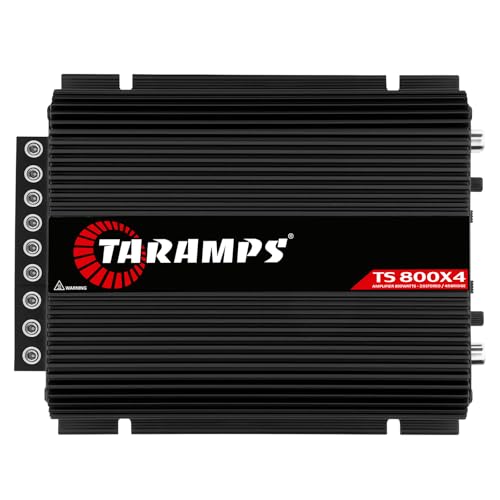
The Taramps TS 800×4 strips the 4-channel formula to its essentials: 200W RMS x 4 at 2 ohms, fixed 90Hz crossovers, and a chassis smaller than a paperback novel. It is designed for builders who prioritize output-per-dollar and need to fit an amplifier into a motorcycle batwing fairing or glove box. The aluminum housing keeps weight down to 1.9 pounds.
Users mounting this amp in Harley Road Glide and Street Glide fairings report that it triples the volume of factory audio while delivering surprisingly clear sound for a budget Class D unit. The automatic high-level input activation eliminates the need for a separate remote turn-on wire — a convenience in cramped installs. The fixed crossover means you cannot fine-tune slopes, but for simple full-range setups, it works.
Several long-term reviews note the previous DS 400×4 series had channel reliability issues; this TS 800×4 appears to use upgraded internal components. Vibration-absorbing mounts and a protection plan are sensible precautions given the high power density.
Why it’s great
- 200W RMS x 4 at 2 ohms in a tiny 1.9 lb chassis
- Automatic signal-sensing turn-on for easy install
- Incredible output for the price point
Good to know
- Fixed 90Hz HPF/LPF limits tuning
- Long-term reliability not yet proven across all units
- Best used with 2-ohm speakers for full power
8. Donner Stereo Receiver

The Donner Stereo Receiver is a Bluetooth 5.0 home amplifier that supports up to four speakers (8-ohm) with independent channel volume controls, dual 1/4-inch microphone inputs for karaoke, and digital inputs including optical and coaxial. Its RMS output is modest at 25W x 4, but this is adequate for kitchen, patio, or small room setups where background music and casual listening are the goals.
Users who connected this to inexpensive bookshelf speakers report surprising sound quality — better than many entry-level Sony receivers — with good clarity at moderate volume levels. The treble, midrange, and bass EQ controls are independent per input mode, a rare feature at this tier. The remote control provides full access to all settings.
However, this amplifier struggles to drive demanding tower speakers or low-impedance loads. Some users found it could not produce meaningful bass from large floor-standing speakers. Additionally, the speaker connection labeling (four pairs of terminals labeled L/R) can confuse first-time users expecting a traditional 4-channel binding post layout. It is a feature-rich receiver for its class, but expectations must match its 25W x 4 reality.
Why it’s great
- Optical and coaxial inputs for modern TV integration
- Dual mic inputs with Talk Over for karaoke
- Independent treble, mid, and bass EQ
Good to know
- Limited to 25W RMS per channel at 8 ohms
- Struggles with large floor-standing speakers
- Speaker terminal labeling can be ambiguous
9. Recoil DI550.4

The Recoil DI550.4 is a Class D 4-channel amplifier that delivers 80W RMS x 4 at 4 ohms — the highest clean RMS per channel at this tier — in a compact 7.48 x 5.90 x 1.77 inch package. It uses a high-speed MOSFET power supply and 4-way protection circuitry (thermal, short-circuit, over-voltage, and under-voltage). The adjustable gain, LPF, HPF, and bass EQ make it versatile despite the frugal price tag.
Owners using it to drive sets of Alpine S2 or Skar 6.5-inch speakers report that it stays cool even after extended listening sessions, and the sound quality is described as clean with decent stereo imaging. Some audiophile-leaning reviewers note a slight audible hiss — the real-world signal-to-noise ratio may be closer to 85 dB than the advertised 95 dB — but this is only noticeable during quiet passages in a very quiet vehicle.
For a first-timer building a budget 4-speaker system, the DI550.4 offers genuine 80W x 4 RMS, a sophisticated look, and enough thermal headroom to avoid clipping. The main compromise is the unconventional high-level input design, which requires careful wiring sequence. As an entry point into 4-channel amplification, it punches well above its cost.
Why it’s great
- 80W RMS x 4 at 4 ohms — genuine clean power
- Compact Class D design with 4-way protection
- Runs cool even during extended listening
Good to know
- High-level input wiring requires careful attention
- Real-world SNR may be lower than advertised
- Not designed for subwoofer BTL output
FAQ
Can I use a 4 speaker amplifier to power a subwoofer and door speakers?
What wire gauge do I need for a 4-channel car amplifier?
What is the difference between HPF and LPF on a 4 speaker amplifier?
Final Thoughts: The Verdict
For most users, the 4 speaker amplifier winner is the Alpine S-A32F because it delivers pristine sound quality in a compact, efficient Class D package that is ideal for midrange car audio builds. If you want streaming integration and room correction, grab the WiiM Amp Ultra. And for budget-conscious builders who need real 80W RMS per channel, nothing beats the Recoil DI550.4.