
Our readers keep the lights on and my morning glass full of iced black tea. As an Amazon Associate, I earn from qualifying purchases.
Specs are compiled from manufacturer listings and verified buyer reviews and can change over time — please confirm the key details on the product page before buying.
You want that moment in a movie where a helicopter flies over your head, not just across the front of the TV. A real 4 speaker surround sound setup delivers that by placing audio channels around your room — and against a single soundbar, the difference is night and day. The catch is that “surround” means very different things depending on whether you buy a true Dolby Atmos system or a budget all-in-one, and this guide cuts through that confusion.
I’m Min — the founder and writer behind Gadgets Feed. This guide is built by comparing the manufacturers’ published specifications and the patterns across verified customer reviews, so you get each pick’s real strengths and trade-offs instead of marketing spin.
You want surround sound that wraps around you, not just louder front speakers. These 4-speaker systems range from compact satellite sets to towering floorstanders, but each one places real audio channels behind you for that rich bubble of sound.
Our Picks at a Glance


How To Choose The Best 4 Speaker Surround Sound
Choosing a 4-speaker system means decoding a spec sheet full of numbers that sound impressive but don’t all translate to better audio. Before you buy, you need to know what actually makes a system feel like a theater — and what’s just marketing gloss.
Driver size: the muscle behind the sound
The physical size of the speaker drivers sets the ceiling on how much air they can move. A floorstanding tower with a 12-inch driver produces far more room-filling bass and authority than an 8-inch bookshelf satellite. Bigger drivers mean bigger cabinets, so this spec also tells you how much physical space you’re committing to.
The subwoofer: where the rumble lives
A surround system without a subwoofer sounds thin, because the main speakers can’t reproduce the lowest frequencies. Look at the sub’s driver size and amplifier wattage — a 12-inch powered sub with a 400W peak amplifier is a very different beast from an 8-inch unit. If you watch action movies or play shooters, the sub is the single most important upgrade for your experience.
Receiver reality: is the brain included?
Some packages include an AV receiver that decodes Dolby Atmos and switches HDMI inputs. Others are “passive” speaker sets that need you to supply a receiver. If you’re replacing a soundbar and want the simplest path, an all-in-one package with a receiver saves you the headache of matching components. Also check for HDMI eARC — that one cable carries both audio and control signals from your TV.
Quick Comparison
| Model | Best For | Configuration | Subwoofer Size | Amplifier | Amazon |
|---|---|---|---|---|---|
| Klipsch Reference 5.1★ Best Overall | Big cinematic rooms | 5.1 with Atmos towers | 12 inches | 400W peak (sub) | Amazon |
| Sony BRAVIA Theater QuadWireless Pioneer | Wireless minimalist setups | Quad + control box | — (optional) | — | Amazon |
| Yamaha YHT-4970UGaming Ready | Gaming + 4K120 passthrough | 5.1 with AV receiver | — | — | Amazon |
| Fluance Elite 7.1 | Audiophile music + movies | 7.1 with floorstanders | 10 inches | — | Amazon |
| Yamaha YHT-5960U | MusicCast multiroom streaming | 5.1 with AV receiver | 8 inches | 125W per channel | Amazon |
| ULTIMEA Poseidon D70 | Soundbar + real rear speakers | 7.1 virtual soundbar | Wireless | 410W peak | Amazon |
| STUDIOFINIX Outdoor | Patio and poolside sound | 4.0 with amplifier | — | 800W peak | Amazon |
| Rockville HTS56 | Karaoke on a budget | 5.1 with receiver | 8 inches | 1000W peak | Amazon |
| Rockville RPA70WBT | Restaurant or shop installs | 4.0 with amp + mics | — | 1000W peak | Amazon |
In‑Depth Reviews
1. Klipsch Reference 5.1 Dolby Atmos System
Our pick — over 4.5★ from 350+ verified ratings; the strongest balance of quality and price.
The tower-based system that puts a real cinema inside a 10×12 room.
You get the full cinematic bubble here — two floorstanding towers with built-in up-firing elevation channels bounce sound off your ceiling for that overhead helicopter effect, plus a center channel, two surrounds, and a powered sub. The 12-inch driver with a 400W peak all-digital amplifier delivers room-shaking bass that stays clean, keeping dialogue crisp.
The 12-inch driver moves 50% more air than the 8-inch unit on the budget Rockville below, a difference you feel in every explosion and soundtrack swell. Buyers report it as “excellent value” for a 5.1 system, with the rear and center speakers exceeding expectations for the price. The Tractrix Horn technology and LTS aluminum tweeters keep things efficient and low-distortion, so you can push volume without harshness.
There’s one honest catch: the screws that attach the tower feet are weak. Multiple owners pre-tap the holes before assembly to avoid snapping them — a 10-minute precaution that saves a headache. Once set up, this is a system owners describe as top-tier for anything under the premium two-thousand-dollar mark, with music performance that’s excellent even if it doesn’t quite reach audiophile boutique levels.
What wins people over
- Room-shaking 12-inch sub with clean 400W peak power
- Up-firing Atmos channels add height without ceiling speakers
- Compact footprint fits a 10×12 room comfortably
The honest trade-offs
- Feet screws are fragile — pre-tap to avoid breakage
- Music is great but not audiophile-reference level
Reach for this if: you want a true Dolby Atmos theater experience with a sub that actually shakes the couch, all in a package that fits a normal living room.
Think twice if: you’re on a tight budget and just want casual TV dialogue boost — this is a serious speaker investment, not a soundbar upgrade.
2. Sony BRAVIA Theater Quad HT-A9M2
Four wireless speakers that vanish into the room while sound wraps around you.
The entire premise here is freedom — four slim wireless speakers you can place virtually anywhere, with no speaker wire running across your floors. Sony’s 360 Spatial Sound Mapping analyzes the room and calibrates itself with Sound Field Optimization, creating phantom channels that make the system behave like a much larger array. It’s the rare system where an 88-year-old owner with hearing aids reports it’s easy to set up and sounds great.
Owners who pair it with a BRAVIA TV praise the integration — Acoustic Center Sync locks the dialogue to the TV screen itself. The 16 speaker units across the four cabinets deliver imaging so precise that one owner’s partner thought sounds were coming from outside the house. It supports Dolby Atmos, DTS:X, and IMAX Enhanced, so it handles every major cinema format.
The recurring note across reviews is the subwoofer situation: the system produces deep bass, but owners repeatedly say adding an optional wireless sub (like the SW5) completes the experience. It’s also the priciest system here, and reviewers are split on whether it’s worth it — several note it’s spectacular but expensive. If you want the cleanest wireless setup and don’t mind the premium, nothing else on this list matches its flexibility.
What stands out: you get true wireless freedom — four speakers with no wires between them, plus self-calibrating room correction that adjusts the sound to your room automatically, so setup is genuinely painless.
The honest ask: you’ll likely want the optional subwoofer for full theater rumble, which pushes the total cost up significantly.
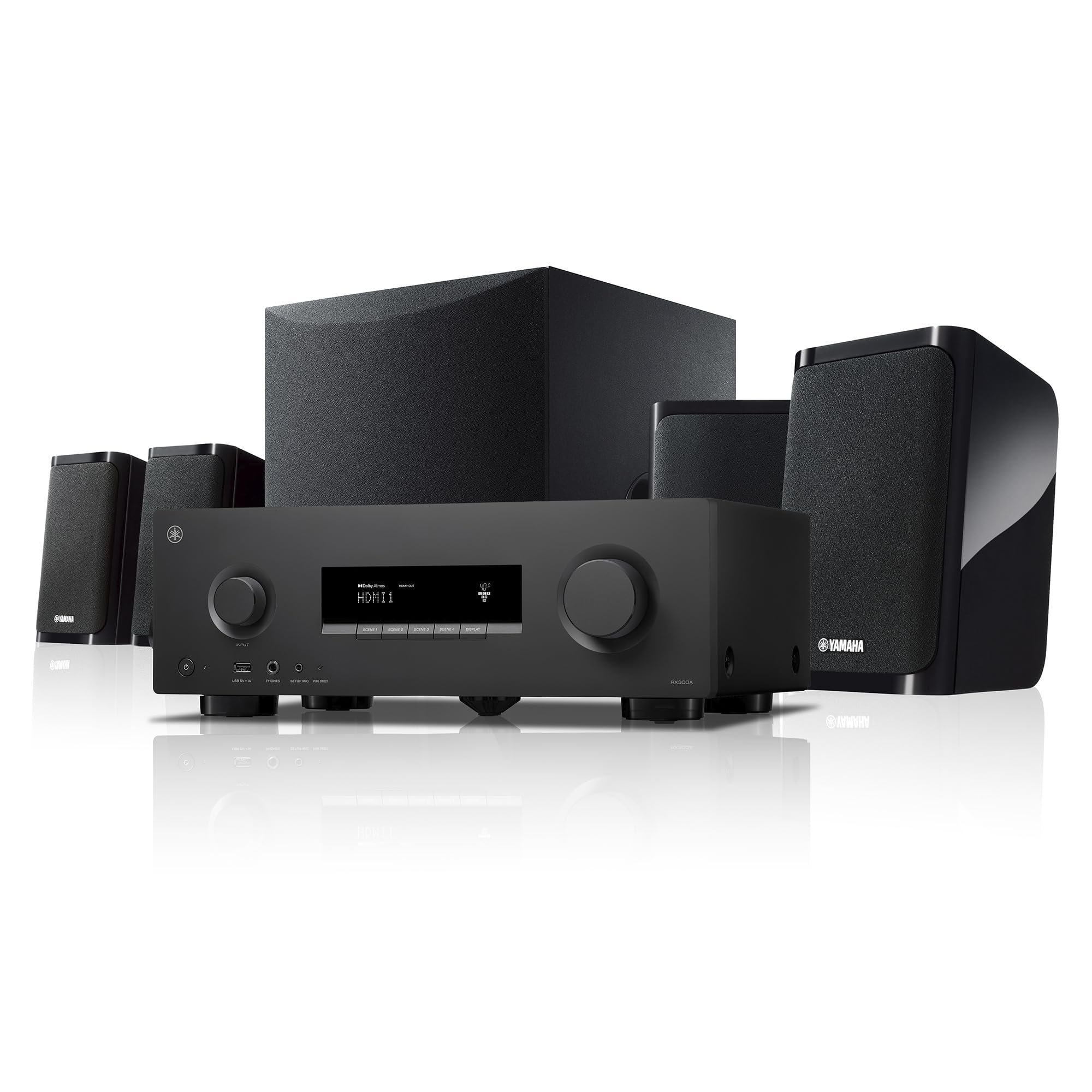
3. Yamaha YHT-4970U 5.1 System
The all-in-one bundle that treats your console like a first-class citizen.
This is the complete package — a Yamaha RX300A AV receiver, five speakers, a powered subwoofer, an 80-foot spool of speaker wire, and a 16-foot subwoofer cable all in one box. For gamers, the headline is the HDMI support: 4K/120 and 8K/60 passthrough with ALLM and VRR, so your PlayStation or Xbox gets the full frame-rate experience without a separate video processor. Dolby Vision and HDR10+ keep the picture pristine.
Setup takes more effort than a soundbar — you’ll cut and strip speaker wire yourself, though the included Quick Guide walks you through it. The payoff is genuine Dolby Atmos decoding (a format that adds height channels for overhead sound) with DTS Virtual:X (a processing mode that simulates surround from fewer speakers). The YPAO room correction uses the included setup microphone to measure your room’s acoustics and auto-tune the speakers, so you don’t have to fiddle with settings. Owners describe the sound as refined and powerful, with clear dialogue and a subwoofer that’s adequate without being extreme.
One setup quirk to expect: some owners hit issues with the subwoofer power switch being off by default, and the remote can be confusing until you learn the zones. But the build quality is classic Yamaha durability, and the sound at full volume stays clean with no distortion. It’s a mid-range price for a system that reviews call excellent value for the money.
The edge: 4K120 and 8K60 HDMI passthrough means your gaming console and latest TV are fully supported today, not just audio-wise.
Budget for time: setup is DIY — expect an evening of wire cutting and speaker placement, not a plug-and-play minute.
4. Fluance Elite High Definition 7.1 System

A timbre-matched 7.1 set that makes music feel live and movies feel huge.
Fluance built this system around a simple idea: every speaker should sound identical, so sounds move smoothly around you without tonal shifts. The 3-way floorstanding towers pair high-frequency tweeters with dedicated midrange drivers, and the 10-inch powered subwoofer adds room-shaking depth. The result is a system that’s as happy playing a jazz record as it is blasting an action film — owners note it’s very powerful for small rooms, with one warning to secure loose items once the sub goes past volume 30.
The “Elite” name earns itself in the details: precision-crafted MDF cabinets with a woodgrain finish suppress distortion, and the full lifetime warranty on parts and labor signals confidence. One owner who replaced an Onkyo system was so impressed they’ve kept it running strong after five years. The support team also gets high marks — a damaged tower in shipping was replaced free of charge.
The honest fit note: this is a passive speaker set, so you must supply your own AV receiver, and the bookshelf speakers are large enough that side-wall mounting can be a squeeze. And while the black ash finish is elegant, the subwoofer comes in black — a minor mismatch if you order a lighter wood finish. For the price, owners consistently call it a fantastic return on investment.
Where it shines: the timbre-matched 3-way towers deliver music reproduction that’s remarkably accurate and distortion-free for the money.
Plan ahead: you need a separate receiver, and the larger bookshelf speakers demand generous placement space.
5. Yamaha YHT-5960U 5.1 System
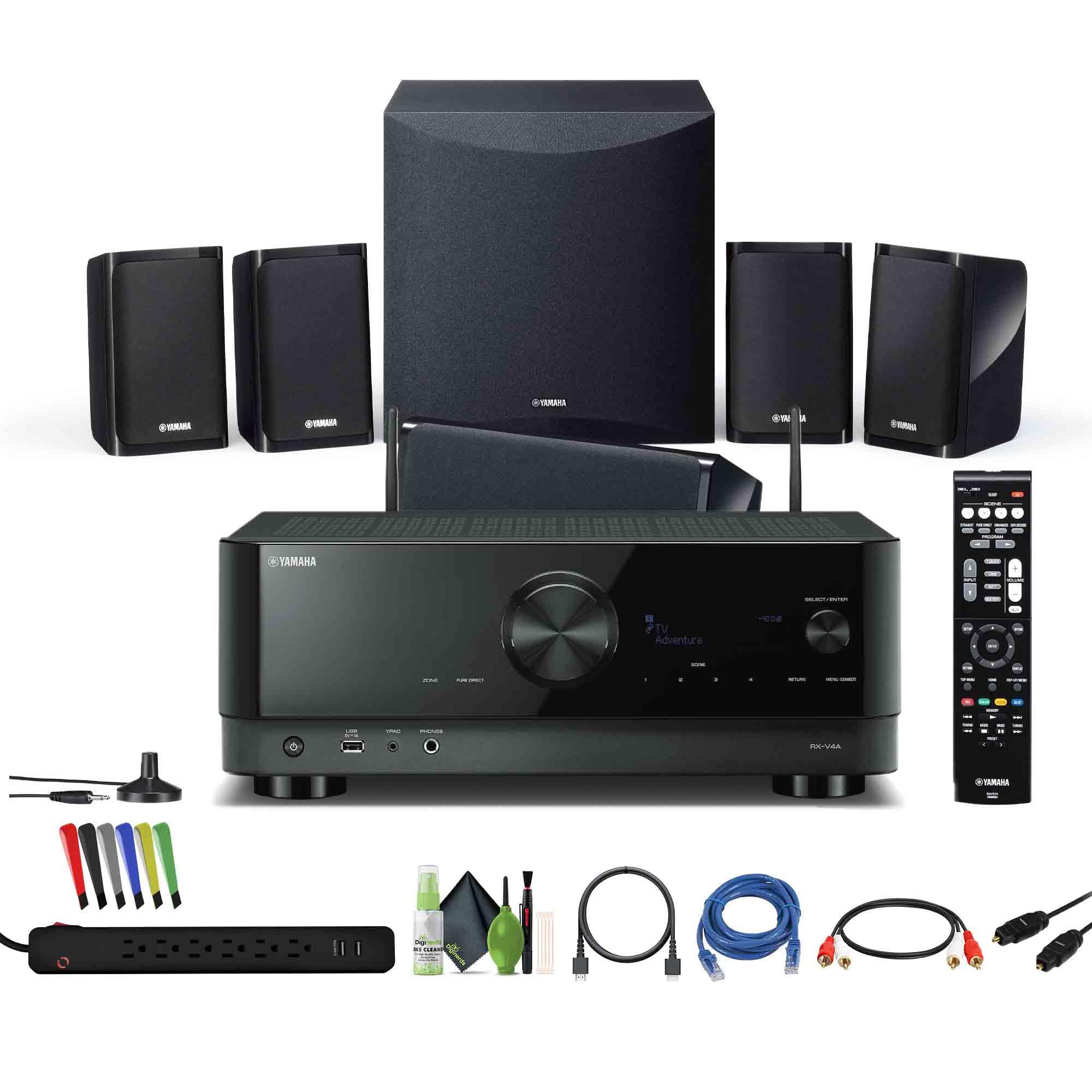
The 5.1 system that plays music in one room while a movie booms in another.
Yamaha’s MusicCast technology is the differentiator here — it streams audio to compatible speakers around your whole home, so you’re not limited to just the theater room. Bluetooth and AirPlay 2 give you phone streaming flexibility, and Google Assistant voice control handles volume and playback hands-free. The bundle sweetens the deal with an HDMI cable, optical cable, surge protector, and cleaning kit.
Under the hood, you get 125W per channel pushing compact front, rear, and center speakers, with an 8-inch 100W powered subwoofer for low-end depth. Dolby TrueHD and DTS-HD Master Audio decoding handle lossless Blu-ray soundtracks, while Cinema DSP 3D recreates the ambiance of concert halls. The YPAO calibration system measures your room and automatically tune the sound to your space.
The video side is future-proof: 4K/60Hz, HDR10, HLG, and Dolby Vision pass-through now, with future firmware updates open up 8K/60Hz and 4K/120Hz with ALLM, VRR, and QMS. Owners who get it set up report “theater quality” sound they don’t want to turn off. The caveats are real but manageable — the included speaker wire is thinner than ideal, and the setup process isn’t wireless, so expect some time with the manual.
The standout: MusicCast turns this from a single-room system into the backbone of a whole-home audio network controlled from one app.
Small catches: wiring quality is the common gripe, and the initial setup takes patience to dial in correctly.
6. ULTIMEA Poseidon D70 7.1ch

A soundbar with actual rear speakers — the upgrade path that skips the AV receiver entirely.
If a full receiver and speaker wire feels intimidating, this is the middle path: a soundbar that also connects four wired surround speakers (two front, two rear) plus a wireless subwoofer, all without needing a traditional AV receiver. The 410W peak power and dedicated sub deliver deeper bass than any TV speaker, and the ULTIMEA app gives you granular EQ control with modes for movies, music, voice, sports, games, and night listening.
Setup is genuinely painless — reviewers consistently mention color-coded wires and wireless rear speakers that connect to the sub. The subwoofer links to the soundbar wirelessly but still needs its own power outlet, and the rear speakers are wired to the sub rather than the bar. HDMI ARC handles TV audio with a single cable, while Optical, AUX, USB, and Bluetooth cover everything else.
The playback story has a nuance: the system processes 7.1 virtual surround but doesn’t decode Dolby Atmos or DTS, so you’ll set your TV to output PCM for unsupported formats. Owners also note the virtual surround movement is more subtle than a true discrete system — you get clear dialogue and deep bass, but don’t expect the helicopter-over-your-head precision of the Klipsch above. For the price, the recurring verdict is surprising quality with easy setup.
Why it’s easy to love
- Real rear speakers create a wider field than any soundbar alone
- Color-coded wires and app control make setup genuinely simple
- Strong music bass and full, clear sound even at low volume
Know before buying
- No Dolby Atmos or DTS decoding — set TV to PCM
- Surround movement is subtle, not a discrete channel system
Best for: anyone who wants rear-channel immersion without learning receiver setups, wiring walls, or decoding formats.
Look elsewhere if: you demand true Dolby Atmos object-based audio with pinpoint overhead effects.
7. STUDIOFINIX 800W Outdoor Bluetooth System

Weatherproof 6.5-inch drivers that bring the party to your patio and pool.
This system flips the script — it’s built for the outdoors, not the living room. Each of the four passive speakers pushes 200 watts, for a combined 800 watts across the full set, driven by the included AMP68 Bluetooth amplifier. The IP44 rating means it’s dust-proof and can handle water spray from any angle, so it lives comfortably near the pool or under the eaves without worry.
The amplifier accepts Bluetooth 5.0, AUX, USB, MIC, and TWS connections, so you can stream from your phone, play files from a USB stick, or plug in a microphone for outdoor karaoke. Owners have mounted them to deck rails and in each corner of a backyard, reporting they’re loud enough for the whole neighborhood. The rugged ABS cabinet and grill are built to last through seasons of weather.
The one thing to know before ordering: mounting hardware isn’t included, so plan to supply your own brackets or screws. And while the sound is clear with full-range mids and bass, this is a stereo system without discrete surround decoding — you get wide, powerful coverage, not object-based positional audio. For its intended job of filling an outdoor space with clean, loud sound, owners are emphatic it delivers.
The appeal: serious outdoor coverage with an IP44 rating that shrugs off pool splashes and summer showers.
Plan for: sourcing your own mounting hardware, and know you’re getting powerful stereo coverage, not Dolby Atmos positioning.
8. Rockville HTS56 5.1 Bluetooth System

The loud, colorful karaoke starter that fills a garage with sound for very little money.
Rockville’s HTS56 delivers massive peak power — 1000W across five satellite speakers and an 8-inch subwoofer — with a receiver built right into the sub. The karaoke angle is the real hook: two mic inputs with echo control, a 5-band EQ, and an FM radio turn this into a party machine. The LED display and subwoofer/satellite lights with blink-to-beat and spectrum modes add visual flair to the audio.
Setup is genuinely easy — all speaker cables run up to 30 feet, and the mounting kits and manual cover the rest. The Bluetooth connection is reliable, and owners have installed it in garages and living rooms alike, praising the bass and the price. For a Father’s Day gift or a first surround system, it’s an approachable way in.
The honest limits are format-related. This is a stereo-based system that processes virtual surround — it can’t decode true 5.1 audio (a six-channel format with a dedicated center and subwoofer channel), and over optical from a TV it may only receive PCM 2.1 (a two-channel format), which can produce odd soundtracks. A few owners mention screeching over TV optical specifically, finding it works fine from a game console instead. Some units also arrive with defects after a handful of uses, so treat it as a budget-friendly starter, not a long-term investment.
What you get
- Huge 1000W peak output with room-filling bass
- Built-in karaoke with mic inputs and echo control
- LED light modes that pulse to the beat
What to expect
- Not a true 5.1 decoder — virtual surround only
- TV optical input can glitch; console optical is more reliable
Suits: first-time buyers who want loud, easy sound with karaoke features and don’t need reference-grade fidelity.
Not for: anyone who wants discrete channel separation or plans to pair it with a smart TV’s optical output.
9. Rockville RPA70WBT 4-Speaker Karaoke System

A restaurant-grade amplifier with four slim wall speakers and two wireless mics.
This package targets a specific buyer: someone running a restaurant, shop, or event space who needs voice reinforcement and background music. The RPA70WBT V2 amplifier delivers 1000W peak power (125W RMS at 4 ohms) and includes two VHF wireless mics for announcements or karaoke. The four Rockville RockSlim 5.25-inch speakers are designed for wall mounting with 240W peak each, and their slim profile keeps them unobtrusive.
Connectivity is versatile — Bluetooth, USB, and 3.5mm aux for streaming, plus optical, coaxial, and RCA inputs for integrating with a TV or media player. The built-in mic mixer with echo control makes it genuinely karaoke-ready from the start. Owners confirm it’s loud and perfect for karaoke use, and the wall-mounted speakers can be customized into custom wood boxes if you prefer a furniture look.
The caveats are worth weighing. One owner found the receiver power “way overmatched” the small speakers that came with it, and another flagged that it isn’t truly wireless — the mics are VHF wireless, but the speakers are wired to the amp. If you’re expecting a ready-to-run true surround home theater, this isn’t it; this is a commercial PA-style setup for spaces where spoken clarity and background music matter more than rich surround.
Best fit: commercial or event spaces where you need loud, clear voice plus music from one box with two wireless mics included.
Set expectations: speakers are wired, and the amp output outmuscles the included satellites — plan your volume accordingly.
Understanding the Specs
Driver size and configuration
The number of speakers and the size of their drivers decide how much air they move and how wide the soundstage feels. A 5.1 system has five satellites plus a sub; a 7.1 adds two rears for more precise placement behind you. Larger drivers — like a 12-inch tower versus an 8-inch satellite — translate directly to more authority and deeper bass without needing the sub to work as hard.
Dolby Atmos and height channels
Atmos is object-based audio that adds a height dimension to the sound field. Systems with up-firing drivers bounce sound off the ceiling to simulate speakers above you, which is why the Klipsch R-625FA towers can create overhead effects without cutting into your ceiling. If the spec doesn’t mention Atmos, the system is likely doing virtual or matrixed surround, which widens the field but can’t place objects above you.
FAQ
Do I need an AV receiver for a 4 speaker surround system?
What is the difference between 5.1 and 7.1 surround sound?
Will my TV’s optical output work with these systems?
How much speaker wire do I need to run?
Is a soundbar with rear speakers as good as a real 5.1 system?
Can I add more speakers to a 5.1 system later?
What does the subwoofer size really do for movie sound?
Does Bluetooth sound worse than a wired connection?
How hard is it to set up a traditional 5.1 system?
What is HDMI eARC and why should I care?
Final Thoughts: The Verdict
The 4 Speaker Surround Sound winner is the Klipsch Reference 5.1 system because it pairs a true Dolby Atmos decode with a 12-inch, 400W sub that delivers the full cinema experience in a room-friendly footprint. If you want wireless flexibility and don’t mind a premium price, the Sony BRAVIA Theater Quad is the cleanest, most flexible option — just budget for the optional sub. And for gamers who need 4K120 passthrough with their audio, the Yamaha YHT-4970U bundles everything you need in one box. For everyone else, the ULTIMEA Poseidon D70 is the smart middle path — real rear speakers without the receiver learning curve, at a price that’s easy to justify.
How We Picked
We do not accept paid placement. Every pick is matched to a real buyer and a real use-case; we do not hands-on test units.
Sources & Methodology
Specifications: manufacturer listings and product documentation. Review insights: verified customer reviews, as of August 2026. Pricing: not shown on this page (it changes often); check the current price via the retailer link.
As an Amazon Associate, Gadgets Feed earns from qualifying purchases. This does not affect which products we feature.