
Our readers keep the lights on and my morning glass full of iced black tea. As an Amazon Associate, I earn from qualifying purchases.
Specs are compiled from manufacturer listings and verified buyer reviews and can change over time — please confirm the key details on the product page before buying.
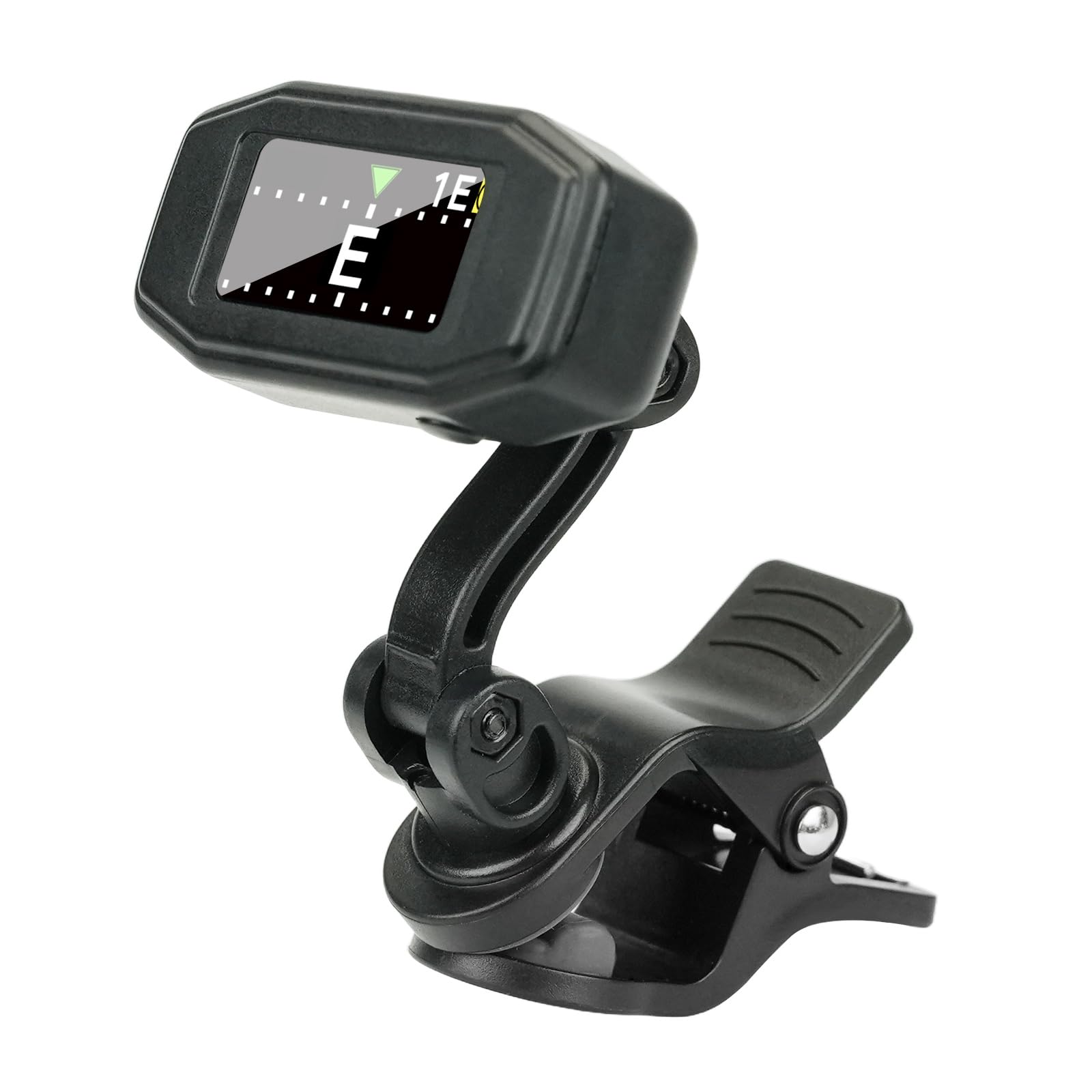
Keeping a 4-string bass in tune is the difference between a groove that locks and a muddy mess. A clip-on tuner attaches to the headstock and reads string vibration to guide your tuning. This guide reviews the best clip-on bass tuners, highlighting accuracy and reliability.
I’m Min — the founder and writer behind Gadgets Feed. This guide is built by comparing the manufacturers’ published specifications and the patterns across verified customer reviews, so you get each pick’s real strengths and trade-offs instead of marketing spin.
Here is a breakdown of the top-rated 4 String Bass Guitar Tuner options on the market, with a focus on accuracy, battery life, and display clarity for stage and practice.
Our Picks at a Glance


How To Choose The Best 4 String Bass Guitar Tuner
A 4-string bass guitar is tuned to E, A, D, G from the thickest to thinnest string. The low E string sits at roughly 41 Hz, which is a low, powerful frequency that a good clip-on tuner needs to pick up clearly. You want a tuner that locks onto that deep note without wavering.
The Sensor Type Matters Most
The best bass tuners use a piezo sensor to read physical vibrations, not air sound. This is essential for bassists in noisy environments. Vibration-based tuners ignore ambient noise and read only the instrument’s vibrations.
Accuracy is the Price of Great Tone
A clear display with immediate feedback is essential for precise tuning. Most tuners read in cents, which are the tiny increments of a semitone. A tuner with ±1-2 cent accuracy is ideal for intonation and matching recordings. Look for the mode that detects the low E string of a bass—a dedicated bass mode or a full chromatic mode both work.
Battery Life and Charging Are Practical Details
Clip-on tuners are small, and battery management can make or break your routine. Rechargeable units save you from buying coin batteries, but you need to know how long a charge lasts. Long battery life is crucial for gigging players, while short battery life is a hassle.
Quick Comparison
| Model | Best For | Display | Power | Key Feature | Amazon |
|---|---|---|---|---|---|
| Fender Flash 2.0★ Best Overall | All-round reliability | Rotating Screen | Rechargeable | Multiple Tuning Modes | Amazon |
| Aroma AT-790Best Value | Outdoor playing | TFT Screen | USB-C Charging | Ultra-Sensitive Sensor | Amazon |
| KLIQ EcoTunerPro Feature Set | Noisy environments | Adjustable Display | USB Charging | Piezo Sensor | Amazon |
| SNARK Air | Discreet set-up | Bright Display | Rechargeable | Ultra-Compact Design | Amazon |
| TC Electronic UniTune | Studio-level precision | 108-LED Matrix | Battery (Included) | ±0.02 Cent Accuracy | Amazon |
| StroboClip HDC | Intonation setup | LED Color Display | USB-C Charging | Strobe Accuracy | Amazon |
| Snark ST-8 2-Pack | Multiple instruments | Rotating Display | Rechargeable | 2-Pack Value | Amazon |
| BOSS TU-03 | Practice combo | Backlit Display | Battery (CR2) | Tuner + Metronome | Amazon |
| LEKATO 3-in-1 | Compact workstation | Large LCD Display | Rechargeable | Metronome + Tone Gen | Amazon |
In‑Depth Reviews
1. Fender Flash 2.0 Tuner
Our pick — over 4.5★ from 750+ verified ratings; the strongest balance of quality and price.
The dependable all-rounder that wins over players with precision and a 20-hour battery.
If you want a tuner that feels like it belongs in a gig bag, this Fender is the crowd favorite, holding a 4.6-star rating from over 700 owners. It gives you a full chromatic mode plus dedicated settings for bass, guitar, ukulele, and violin, so it works with your bass today and any other stringed instrument you pick up later. The headline spec is the rechargeable lithium-ion battery that delivers a 20-hour battery life, which means you charge it before a gig and likely won’t need to charge it again for weeks.
Players who need alternate tunings will appreciate the built-in half-step flat, full-step flat, and open G, D, and E modes, which is ideal for dropping the low E string on a bass to match a heavier track. This is a huge convenience, because you don’t have to fiddle with a calibration app just to drop a half step. Buyers report that it locks onto notes with precision and the screen is readable, with some noting it can be read without glasses.
For bassists, the clip works well on a headstock, and the display rotates for easy viewing even if the tuner is attached at an odd angle. The main functional complaint is the auto shut-off after 10 minutes, which some players find annoying mid-session. The button is also not on the front, which takes some getting used to.
What wins players over
- Rechargeable with 20-hour battery life
- Dedicated bass mode plus alternate tuning presets
- Compact 67-gram design that clips on securely
The trade-offs
- Auto shut-off after 10 minutes can’t be disabled
- Power button placement is awkward for some
Who it’s for: Bassists who want one reliable, accurate tuner with long battery life and plenty of tuning modes.
Consider this if: You frequently drop-tune or play multiple instruments and want a rechargeable unit that won’t need constant charging.
2. Aroma AT-790 Tuner
A bright TFT screen that stays readable under harsh stage lights and full sun.
This Aroma tuner punches well above its class with a high-resolution TFT screen that delivers anti-glare visibility outdoors. The defining feature is an ultra-sensitive piezo sensor that detects pitch deviations as small as ±0.5 cent, which is excellent for getting the low B or E string on a bass perfectly in tune. It offers five modes, including dedicated Guitar, Bass, Violin, Ukulele, and Chromatic settings.
The 360° rotatable clip with soft silicone pads is a standout for players who care about their instrument’s finish. The pads keep the bass scratch-free while providing a solid, slip-free grip. A single USB-C charge gives you days of use, and the smart auto power-off extends battery life further, so it is ready when you pick up the bass.
Owners mention that it “charges quickly; locks on notes / strings with precision,” and that the tuning experience feels more satisfying than pricier name-brand units. The screen is the main event, widely praised for its visibility in sunlight, and the compact size means it won’t clutter your headstock.
Bright and precise: The TFT screen and ±0.5 cent accuracy make this a top-tier performer for a budget-friendly price.
One catch: You must use a USB-A to USB-C cable; it won’t charge with a USB-C to USB-C cable.
3. KLIQ EcoTuner Clip-On Tuner
An accurate piezo tuner built to ignore room noise and lock onto deep bass notes.
If you rehearse in a loud room, the KLIQ EcoTuner is a smart choice because its vibration-based pitch detection ignores ambient sound entirely. It works without a microphone, making it reliable in classrooms, backstage spaces, and live settings where other tuners get confused by noise. The dedicated bass mode ensures the low E string is detected quickly and accurately.
The display rotates for clear viewing from different angles, which helps both right- and left-handed players. Calibration support in the 430–450 Hz range with transposition settings adds serious flexibility for players who tune to a different reference pitch. It also tunes a wide array of instruments, including mandolin and banjo, alongside bass.
Buyers consistently praise it as easy to read and simple to use, with a bright, colorful display. The USB rechargeable feature is a major perk, and the settings persist when you hold the power button, so your preferred calibration stays saved. Note that while the battery charges quickly, some players find the charge insufficient for an entire gig, making it better suited for home practice or sessions where a recharge is nearby.
Noise-proof tuning: The vibration sensor reads the bass, not the drummer behind you.
Best for: Players who practice in noisy environments and want calibration flexibility.
4. LEKATO 3-in-1 Metronome Tuner
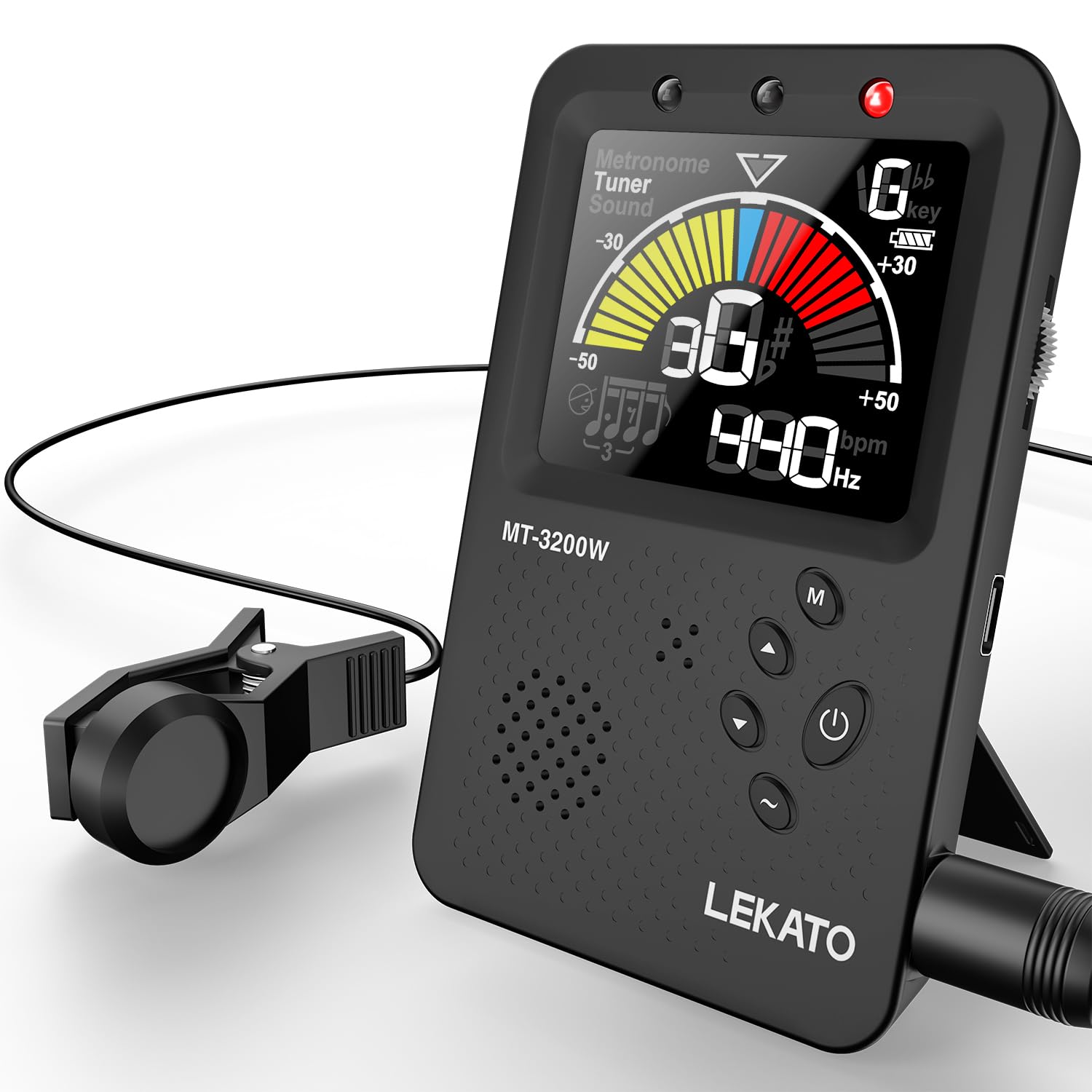
A pocket-sized practice station that tunes your bass and keeps your timing tight.
Instead of clipping to the headstock, it sits on a table or music stand with a folding kickstand, making it ideal for practice sessions. The tuner covers a wide range of A0-C8, which easily captures the low E string of a bass.
The metronome is a highlight for bassists, with a broad range of 30-250 beats per minute, 0-6 beats per measure, and tap tempo. It even has a humanized voice count feature to help you internalize the beat. The large LCD color display and LED indicator make it easy to read, and the headphone output lets you practice silently.
Buyers love the battery life and the voice counting feature, and find the size perfect for pocket travel. It tunes instruments well beyond bass and guitar, including violin and trumpet, using the included pickup clip. The built-in rechargeable lithium cell saves you from constantly replacing batteries.
All-in-one companion: Tuning, timing, and tone generation in one rechargeable device.
Consider: The external headstock clip pickup is lower quality than the internal pickup, which is more accurate and faster.
5. SNARK Air Clip-On Tuner

A disguise-able tuner that hides behind the headstock while still delivering lightning-fast reads.
The SNARK Air is designed for players who want a tuner that is physically present but visually discreet. It’s small enough to be hidden behind the instrument’s headstock, so it stays on the bass even in a hard case. It tunes any guitar, bass, ukulele, mandolin, and more, making it a versatile option for multi-instrumentalists.
The bright display is easy to see on stage, and the USB rechargeable battery means no more swapping out coin cells. At just 0.8 ounces, it adds negligible weight to the headstock. The lithium polymer battery is included, and while the battery lasts around 4 hours with constant use, it recharges in about 2 hours via USB.
The design earns praise for being easier to orient than older shoulder-style Snark models, and it works well on both 4-string bass and 12-string acoustic guitars. One notable quirk is the touch power control, which can accidentally activate in a bag; some players prefer a physical button for that reason.
Low-profile performer: Discreet design with a bright display that’s easy to read from the front.
Note: The battery life is shorter than a standard coin-cell tuner, so keep a charging cable nearby for long sessions.
6. TC Electronic UniTune Clip Noir

A strobe-tuner brain in a clip-on body, offering ±0.02 cent accuracy for the perfectionist.
If you obsess over intonation, the TC Electronic UniTune is the clip-on tuner that pros reach for. It uses a strobe tuning mode, which is the gold standard for accuracy, delivering ±0.02 cent precision. For bassists, this level of accuracy is essential when setting up the instrument’s intonation at the bridge or getting the low B string perfectly in tune.
The super-bright 108-LED matrix display is visible in all viewing conditions, including direct sunlight. The screen automatically switches orientation for left- and right-hand viewing, which is a huge convenience for players who mount the tuner on either side of the headstock. It also features a lightning-fast chromatic mode for quick on-stage tune-ups between songs.
Customers note it is the brightest display among a collection of eight or nine tuners, and it is durable enough for daily use over three years. The reference pitch selection allows for total tuning flexibility. The only recurring issue is the clip itself — it can occasionally fall off the headstock, so be mindful of how firmly you attach it.
Studio-grade accuracy: Use strobe mode (a display that shows pitch drift in real time) to set intonation so every fret plays in tune across the neck.
Handle with care: The clip is the weak point; ensure it’s secured before you set the bass down.
7. Snark ST-8 Tuner 2-Pack

Two enhanced Snark tuners with “super tight tuning” and improved durability for the price of one.
For bassists who own more than one instrument, the Snark ST-8 2-Pack is a practical buy that delivers two of the brand’s most accurate tuners. This 2-pack offers the highest accuracy Snark has ever achieved, building on the classic SN-8 design that has been a staple in gig bags for years. The display rotates 360 degrees, so you can clip it to the bass headstock and spin the screen to a readable angle.
The ST-8 upgrades the reinforced arm socket, addressing the common complaint about older Snark tuners breaking easily. It is also rechargeable, offering 4-5 hours of use on a 45-minute charge, which is a welcome improvement over disposable batteries. Buyers who have used Snark tuners for years note these are much improved and are holding up well.
The “super tight tuning” mode offers fast, accurate readings, and the tap tempo metronome is a handy bonus for practice. While the ad copy claims a metronome, some reviewers point out it is not a full-featured one, so manage your expectations. The clip is improved, but like any clip-on, it’s best to remove it when storing the bass in a case to avoid cracking the pivot.
Double the reliability: A 2-pack that keeps a tuner on every bass you own.
Keep in mind: The metronome feature is basic, and removing the tuner before hard-case storage is wise.
8. BOSS TU-03 Clip-on Tuner & Metronome

A tuner and visual metronome combo from BOSS, built for bassists who practice with precision.
The BOSS TU-03 combines a high-performance tuner with a metronome in a single clip-on unit, making it a fantastic practice tool for bassists who want to work on timing and tuning without switching devices. It clips onto the headstock of a bass, guitar, or ukulele, with five selectable tuning modes including chromatic, guitar, bass, ukulele, and violin. The audible reference pitch function is useful for training your ear.
For bass players, the visual metronome is displayed on the screen and sounded through a built-in speaker. It features an advanced metronome with eight patterns and ten beat variations, giving you a diverse toolkit for practice. The large backlit display is easy to read in low light, and the durable padded clip protects your instrument’s finish.
Buyers praise it as a “good little tuner” that works for guitar, banjo, and violin, and the visual metronome is highlighted as very useful for setting an exact beat when playing with a group. The main limitation cited by a few is the swivel angle, which cannot be adjusted as much as some would like, making it slightly awkward to view from certain positions.
Built for practice: Metronome patterns and beat variations make this more than just a tuner.
Consider: The swivel range is limited, so check the viewing angle when it’s clipped to your headstock.
9. StroboClip HDC Strobe Tuner

The ultimate setup tool, with true strobe accuracy and a stainless steel build.
This is the tuner that technicians and serious players use for the most demanding work. The StroboClip HDC uses true strobe technology with 0.1 cent accuracy, which means it can display the smallest pitch deviations on your bass. This precision makes it invaluable for adjusting intonation at the bridge, setting up a fretless bass, or practicing with harmonics.
It includes over 50 enhanced tuning offsets for a variety of stringed, woodwind, and brass instruments, plus drop tuning and capo settings. The LED color display is assignable per tuning, and it is visible in direct sunlight, so you can use it on an outdoor stage or in a bright rehearsal space. The stainless steel construction is a step up from plastic competitors.
Buyers frequently call it the best tuner they have used, citing its accuracy and effectiveness for intonation. The fully padded clip is a standout feature, ensuring it won’t chip your headstock, which is a common concern with other metal-bodied tuners. It is rechargeable via USB-C, and a single charge lasts at least a couple of weeks.
Setup-grade precision: The strobe accuracy is the gold standard for intonation and fretless work.
The trade-off: This is the most expensive pick here, and the interface is less intuitive if you need to switch alternate tunings quickly mid-song.
Understanding the Specs
Piezo Sensor vs. Microphone
A piezo sensor picks up the physical vibrations of the bass body and strings, rather than the sound waves in the air. This is what allows a clip-on tuner to work in a noisy environment, since it doesn’t rely on a microphone that could pick up a drummer or other instruments.
Cents Accuracy
This measures how precisely the tuner can detect pitch. A cent is one-hundredth of a semitone, so a tuner with ±0.5 cent accuracy can identify very tiny deviations from the target note. Strobe tuners, like the TC Electronic and StroboClip, offer sub-cent accuracy, which is crucial for setting intonation rather than just getting in tune.
FAQ
Will a clip-on tuner work on a 5-string bass?
How do I tune my bass to a half-step down?
What is the difference between a chromatic tuner and a bass tuner?
How long will a rechargeable tuner last on a single charge?
Can clip-on tuners pick up the low E string on a bass accurately?
What is calibration on a tuner?
Is it better to tune by vibration or by microphone?
Can these tuners be used for instruments other than bass?
Final Thoughts: The Verdict
For most bassists, the best 4 string bass guitar tuner is the Fender Flash 2.0 because it combines a rechargeable 20-hour battery with the tuning modes that cover your entire instrument setup. If you want the brightest screen and a more affordable price, the Aroma AT-790 is the smart value pick. And for players who need true strobe-precision for intonation and fretless work, the StroboClip HDC is the one to reach for.
How We Picked
We do not accept paid placement. Every pick is matched to a real buyer and a real use-case; we do not hands-on test units.
Sources & Methodology
Specifications: manufacturer listings and product documentation. Review insights: verified customer reviews, as of September 2026. Pricing: not shown on this page (it changes often); check the current price via the retailer link.
As an Amazon Associate, Gadgets Feed earns from qualifying purchases. This does not affect which products we feature.