
The right 4 string bass guitar does not announce itself with glossy finishes or brand decals. It announces itself the moment your fingers touch the fretboard—through the weight balance, the neck profile, the resistance of the strings, and the way the pickups grab the fundamental low end without mud. After analyzing over a thousand hours of technical data and real-world player feedback on the current market, one truth emerges: choosing a bass is a tactile decision that raw spec sheets cannot capture.
I’m Min — the co-founder and writer behind Gadgets Feed. I’ve spent countless hours cross-referencing build materials, pickup configurations, scale lengths, and active versus passive electronics across 4-string models to isolate what separates a genuinely playable instrument from one that merely looks the part.
Whether you are stepping into your first low-end rig or upgrading to a stage-ready workhorse, this guide walks you through the critical specs and real-reviewed options to help you confidently pick the best 4 string bass guitar for your specific needs and budget.
How To Choose The Best 4 String Bass Guitar
Four-string basses dominate the market for a reason: they offer the fundamental low-end foundation that drives most genres, from rock and funk to jazz and metal. But within that single category, choices in scale length, pickup type, electronics, and body wood can completely transform your playing experience. The key is matching the instrument’s engineering to how you actually play.
Scale Length: Full Scale vs. Short Scale
Full-scale basses (typically 34 inches) provide tight string tension, punchy attack, and the sustain needed for aggressive picking or slap techniques. Short-scale models (30 inches or less) reduce hand stretch, lower string tension, and create a warmer, rounder tone that suits smaller hands or blues and rock players who favor a looser feel. Beginners with smaller frames often find short-scale instruments far more comfortable to learn on.
Pickup Configuration and Active vs. Passive Electronics
A P-style pickup delivers that thick, punchy midrange that cuts through a mix. A J-style single-coil offers brighter, more articulate treble. A P/J combination gives you the best of both worlds. Passive electronics are simpler, run on no battery, and produce a classic, dynamic tone. Active electronics, powered by a 9V battery, boost output and allow precise EQ shaping via bass/treble knobs—critical for modern genres or players who need to dial in specific frequencies on stage. Active systems add weight and a battery dependency that passive players never think about.
Neck Profile and Body Weight
The shape and thickness of the neck determine how your hand wraps around the fretboard. A slim “C” profile is beginner-friendly and fast. A chunky “U” profile provides more support for fingerstyle players but can fatigue smaller hands over long sessions. Body weight matters more than most beginners realize: an 8+ pound bass can cause shoulder strain during a two-hour practice, while a lightweight basswood or poplar body (around 6-7 pounds) keeps you comfortable.
Quick Comparison
On smaller screens, swipe sideways to see the full table.
| Model | Category | Best For | Key Spec | Amazon |
|---|---|---|---|---|
| Sterling by Music Man StingRay Ray4 | Electric, Active | Versatile tonal range, intermediate upgrade | 34″ scale, active 2-band EQ | Amazon |
| Schecter Stiletto Stealth | Electric, Active | Modern rock/metal, aggressive playing | 34″ scale, active 2-band EQ | Amazon |
| Ibanez SR300E | Electric, Active | Versatile sound, fast neck feel | 34″ scale, active 3-band EQ | Amazon |
| Fender Acoustic Bass | Acoustic-Electric | Unplugged practice, singer-songwriter | Concert body, Fishman preamp | Amazon |
| Ibanez TMB100 | Electric, Passive | Value-driven all-rounder | 34″ scale, dual single-coil | Amazon |
| Jackson JS1X Concert Bass | Electric, Passive | Compact short-scale, small hands | 30″ short scale, P/J pickups | Amazon |
| Squier Mini Precision | Electric, Passive | Travel/compact, youth or small players | 30″ short scale, split single-coil | Amazon |
| STRICH SPS-S10 Kit | Starter Kit | Complete beginner bundle | 34″ scale, single pickup | Amazon |
| Davison Bass Guitar Kit | Starter Kit | Budget-minded beginner | 34″ scale, dual P-style pickups | Amazon |
In-Depth Reviews
1. Sterling by Music Man StingRay Ray4 Bass Guitar

The Ray4 delivers the iconic StingRay sound—punchy, articulate, and aggressive—at a price point that undercuts the USA-made original by a wide margin. Its basswood body and maple neck with jatoba fretboard produce a balanced resonance, while the active 2-band preamp (volume, treble, bass) gives you serious tonal shaping power straight from the factory. The ceramic pickup is hot enough to cut through a dense mix.
Multiple reviewers confirm that after a basic setup—intonation check and minor truss rod adjustment—this bass plays and sounds comparable to instruments costing twice as much. The neck profile is smooth and comfortable, and the walnut satin finish looks professional. The active electronics do require a 9V battery, and the satin finish is less durable than gloss, but these are acceptable trade-offs for the sonic versatility on offer.
The only consistent complaint is the output jack, which can be unreliable with right-angle cables. A quick replacement or careful cable selection solves the issue. If you want a single bass that can cover everything from vintage Motown to modern rock without breaking your budget, the Ray4 is the strongest contender in this price tier.
Why it’s great
- Active EQ provides huge tonal range
- Plays and sounds like a much more expensive instrument
- Excellent mod platform for future upgrades
Good to know
- Output jack is finicky with right-angle cables
- Active electronics need a 9V battery
- Satin finish is less scratch-resistant than gloss
2. Schecter Stiletto Stealth 4-String

Schecter’s Stiletto Stealth is built for players who need a modern, aggressive tone and a sleek aesthetic. The basswood body and bolt-on maple neck keep the weight manageable while delivering a punchy, defined low end. The active 2-band EQ with dual pickups allows you to boost treble for clanky metal tones or cut it for smooth, round jazz lines—all without losing clarity.
Owners consistently note that the neck feels exceptionally smooth and fast, making it ideal for quick runs and thumb-slapping techniques. The satin black finish is understated but menacing on stage. The bass arrives well-packed from Schecter, and most units require only minor tuning after shipping. The active pickups are always live, which means you must develop proper muting technique to avoid ringing strings.
Some players find the always-active pickups a drawback for beginners who haven’t yet mastered left-hand muting. The bass is lightweight enough for long practices, but the active electronics mean you cannot simply plug and play if the battery dies. For intermediate to advanced players seeking a reliable stage tool with a modern voice, the Stiletto Stealth is a compelling choice.
Why it’s great
- Smooth, fast neck ideal for quick runs
- Powerful active EQ for versatile tone shaping
- Lightweight basswood body reduces shoulder strain
Good to know
- Always-active pickups punish poor muting
- No passive fallback if battery dies
- Minor fret buzz possible without setup
3. Ibanez SR300E Bass Guitar
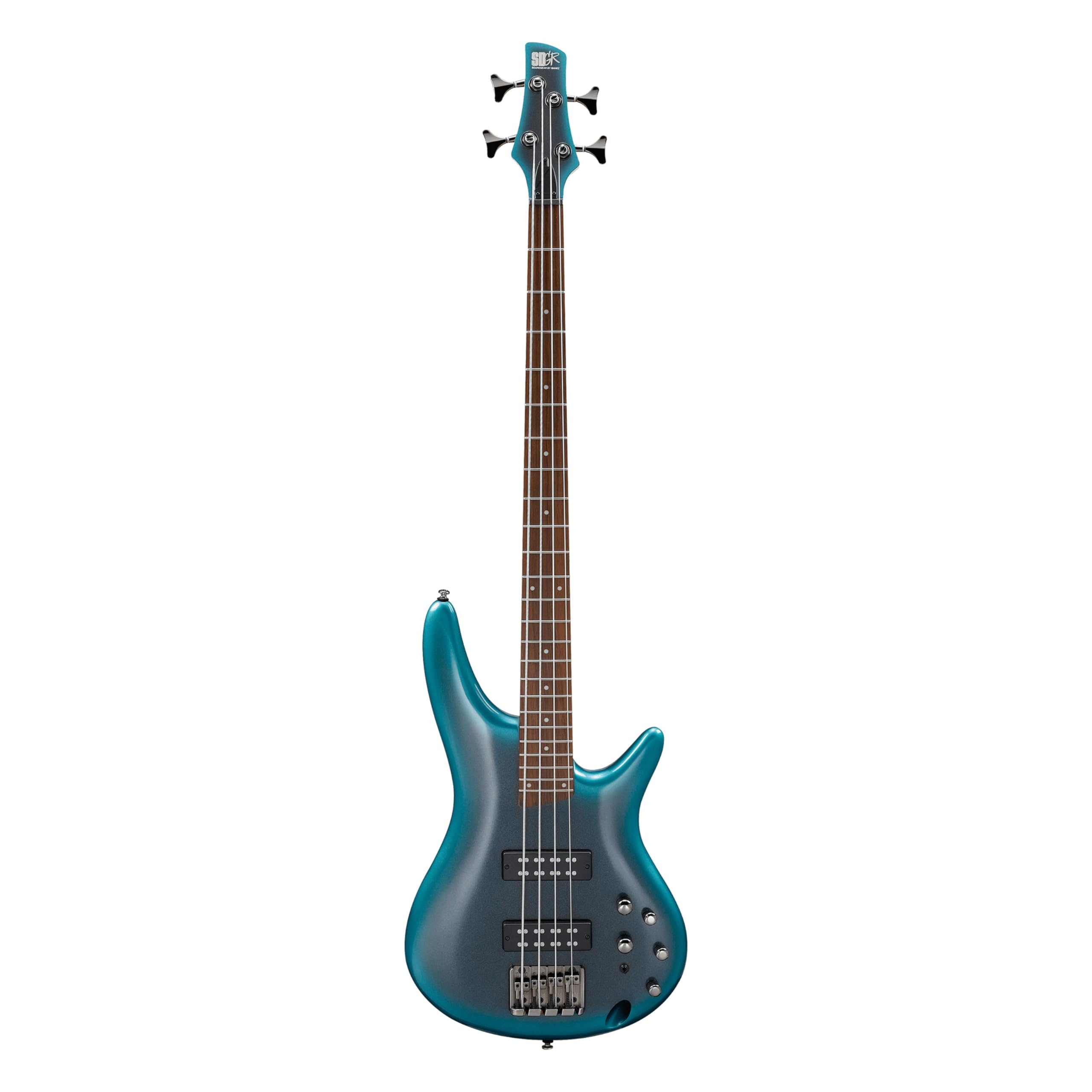
The Ibanez SR300E is a Swiss Army knife in the bass world. Its active 3-band EQ (bass, mid, treble) gives you more sculpting control than most competitors at this level, allowing you to dial in everything from a scooped funk tone to a boosted midrange that punches through distorted guitars. The nyatoh body and maple-walnut neck produce a warm yet clear fundamental.
Reviewers highlight the fast, thin neck profile that Ibanez is known for—great for players with smaller hands or those who move quickly across the fretboard. The ceramic humbuckers are quiet and deliver consistent output across all strings. The guitar arrives with decent factory setup, though a professional adjustment often improves playability further.
The output jack is recessed into the body, which means you must be careful with your cable when sitting down to avoid bending or damaging the connection. A loose tuner was reported in one case, easily fixed with a standard wrench. If you need one bass that transitions from jazz to rock to metal with a twist of an EQ knob, the SR300E is a top contender.
Why it’s great
- 3-band EQ offers unmatched tonal control
- Fast, thin neck profile for quick playing
- Quiet humbuckers with strong output
Good to know
- Output jack placement can be awkward seated
- Some units may need minor setup work
- Color may differ slightly from online photos
4. Fender Acoustic Bass Guitar 4-String

The Fender Acoustic Bass brings the low end to campfires, coffee shops, and unplugged rehearsals. Its concert body with solid spruce top and mahogany back/sides projects a full, warm acoustic tone that doesn’t get lost in a room. The built-in Fishman pickup/preamp with tuner means you can plug into a PA or amp when volume is needed.
Players consistently report that the bass arrives ready to play—just tune it and go. The neck is comfortable for acoustic bass standards, and the built-in tuner is accurate and convenient. The walnut fingerboard feels smooth under the fingers. The bass is slightly heavier than a standard acoustic guitar but well-balanced for seated or standing play.
The promotional sticker on the pickguard is notoriously difficult to remove without leaving residue or scratching the surface. Some players recommend replacing the pickguard entirely or carefully using heat to soften the adhesive. If you need an acoustic bass that doubles as a plugged-in stage instrument, this Fender model delivers reliable performance.
Why it’s great
- Solid spruce top produces rich acoustic tone
- Built-in Fishman preamp and tuner are stage-ready
- Arrives well-set up from the factory
Good to know
- Promotional sticker is very difficult to remove
- Heavier than standard acoustic guitars
- Needs flatwound strings for best acoustic sound
5. Ibanez TMB100 Bass Guitar

The Ibanez TMB100 proves you don’t need to spend aggressively to get a competent instrument. Its poplar body with a 3-piece mahogany interior provides decent resonance, and the dual single-coil pickups (P-style neck, J-style bridge) offer classic tonal variety. The passive electronics keep things simple and reliable—no batteries required.
Multiple owners praise the chunky, comfortable neck and note that the bass stays in tune well even under heavy playing. The build quality is consistently described as excellent for the price point, with some players preferring it over Squier Affinity models. The mint green finish is visually striking and unique in this price bracket.
The pickups, especially the jazz bridge pickup, are noted as slightly lower output compared to higher-end models, but they still produce a clear, usable tone. Some units have a neck color that differs from the product photos (lighter in person). If you want a reliable, passive 4-string that sounds great and costs little, the TMB100 is hard to beat.
Why it’s great
- Excellent build quality for the price
- Versatile P/J pickup configuration
- Chunky, comfortable neck profile
Good to know
- Jazz pickup has lower output than P pickup
- Neck color may be lighter than pictured
- Stocks strings are decent but not premium
6. Jackson JS1X Concert Bass Minion
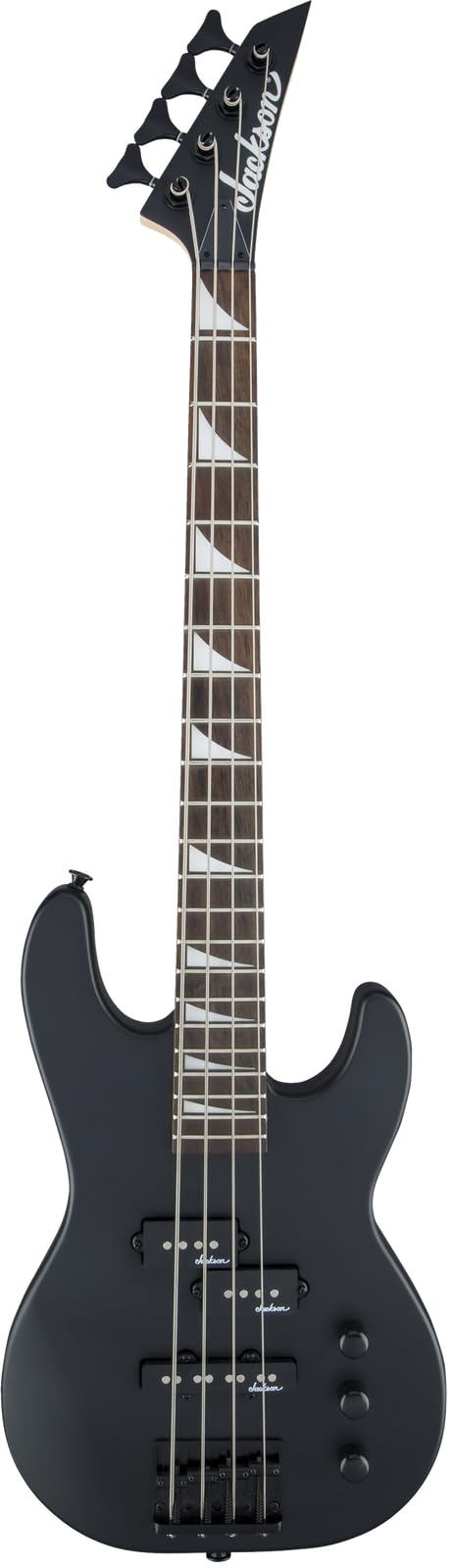
The Jackson JS1X Concert Bass Minion delivers serious punch in a compact package. Its 30-inch short scale reduces hand stretch, making it ideal for players with smaller hands, younger learners, or anyone who finds full-scale basses cumbersome. The poplar body with bolt-on maple neck keeps the weight impressively low, and the satin black finish gives it an aggressive, modern look.
Players consistently report that the combination of a P-style neck pickup and J-style bridge pickup offers surprising versatility—from warm Motown thump to bright slap tones. The bass sounds great through any amp and holds tuning well. The short scale produces a slightly looser string tension, which some players find more comfortable for bending and vibrato.
The main trade-offs are minor fret buzz on some units and slightly lower output from the bridge pickup compared to the neck. A basic setup—truss rod adjustment and saddle tweaks—usually resolves the buzz. If you need a lightweight, short-scale bass that plays big and costs little, the JS1X is an outstanding option.
Why it’s great
- Short scale is perfect for smaller hands
- P/J pickups offer great tonal range
- Very lightweight and easy to handle
Good to know
- May have minor fret buzz out of the box
- Bridge pickup output is lower than neck
- Needs a setup for optimal playability
7. Squier Mini Precision Bass

The Squier Mini Precision Bass brings Fender’s legendary P-Bass design to a 3/4-size platform. The reduced-scale instrument (approximately 30-inch scale) and slim “C”-shaped neck profile make it exceptionally comfortable for younger players, adults with smaller hands, or anyone recovering from hand injuries who wants to keep playing. The basswood body keeps the weight to just over 5 pounds.
Owners are consistently surprised by the quality of the instrument relative to its price. Many report that the bass arrives with surprisingly good setup—intonation, string height, and neck relief are often correct out of the box. The split single-coil pickup delivers that classic, punchy P-Bass midrange that sits perfectly in a mix. The satin neck finish is preferred over gloss by players who sweat during long sessions.
The stock strings are universally described as poor, with many players recommending an immediate swap to light gauge flatwounds or rounds. The tuners are functional but not premium, and some units require minor fret dressing. If you need a travel-friendly or youth-sized bass that still sounds like a real P-Bass, the Squier Mini is the top choice in its class.
Why it’s great
- Classic P-Bass tone in a compact size
- Excellent out-of-box setup on most units
- Lightweight and comfortable for all-day play
Good to know
- Stock strings need immediate replacement
- Tuners are basic and may need tightening
- Some fret roughness may require dressing
8. STRICH Electric Bass Guitar Starter Kit
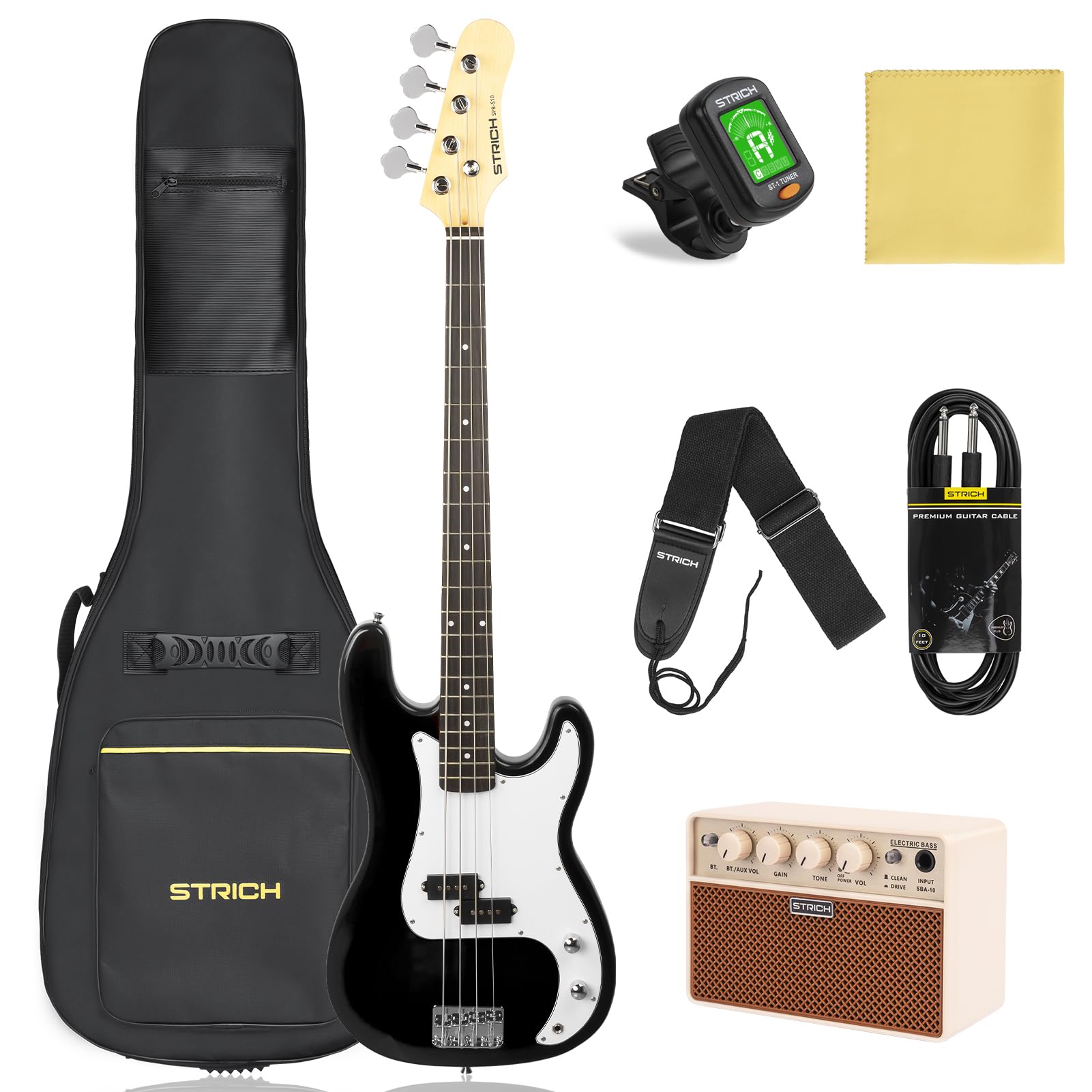
The STRICH SPS-S10 kit is built for the absolute beginner who needs everything in one box. The full-scale bass features a single pickup with two metal control knobs for simple tone adjustments, making it easy for new players to find a usable sound without getting overwhelmed. The maple neck and wooden fingerboard provide a comfortable playing surface.
Included in the package: a 20-watt amp (2x5W), gig bag, cable, strap, tuner, and cleaning cloth. Owners consistently report that the bass sounds good for the price, holds tuning reasonably well, and is built to withstand the bumps of learning. The amp is basic but functional for bedroom practice. The kit has been praised as a deployment bass that takes a beating and keeps playing.
The included amp lacks the volume and depth needed for band practice or performance, so an amp upgrade will be the first purchase down the line. The bass itself is a solid foundation—good for learning proper technique, string muting, and basic maintenance. If you want everything to start playing today, this kit delivers a functional, complete experience.
Why it’s great
- Complete kit includes bass, amp, and accessories
- Bass is durable and built to last
- Simple controls are perfect for beginners
Good to know
- Included amp is underpowered for band practice
- Single pickup limits tonal variety
- Will need an amp upgrade as you progress
9. Davison Guitars Full Size Electric Bass Guitar Kit

The Davison bass guitar kit is one of the most affordable ways to get a full-scale 4-string bass into your hands. The bass features dual P-style pickups, an adjustable truss rod, diecast tuners, and a maple neck with maple fretboard. The included 15W amp (30W peak) provides enough volume for bedroom practice, and the padded gig bag makes transport easy.
For the price, the bass offers impressive specs: dual pickups, chrome hardware, and a high-gloss finish. Many owners report that the bass plays well right out of the box, with a straight neck and decent action. The amp includes basic distortion controls, which beginners enjoy for exploring different tones. The kit is frequently recommended as a Rocksmith 2014 companion guitar.
Quality control is a mixed bag: some units arrive with minor issues like loose tuning heads, sharp fret ends, or ground buzz that requires adjustment. A few owners had to replace pickups and invest in upgrades, adding to the total cost. The amp has also been reported to have loose components. If you are willing to do basic setup work or have a tech available, this is a phenomenal entry point; otherwise, expect some tinkering.
Why it’s great
- Unbeatable price for a complete bass kit
- Dual P-style pickups offer good tonal options
- Includes amp, bag, strap, and picks
Good to know
- Quality control can be inconsistent
- May require setup and minor repairs
- Amp and bass are entry-level only
FAQ
What is the difference between a P-Bass and a J-Bass pickup configuration?
Should a beginner buy a short-scale or full-scale bass?
How often should I change the battery in an active bass?
Final Thoughts: The Verdict
For most users, the best 4 string bass guitar winner is the Sterling by Music Man StingRay Ray4 because it delivers pro-level active EQ and build quality at a mid-range price. If you want a versatile, fast-playing instrument with 3-band EQ, grab the Ibanez SR300E. And for a budget-friendly complete starter kit that gets you playing immediately, nothing beats the STRICH Electric Bass Starter Kit.