
Our readers keep the lights on and my morning glass full of iced black tea. As an Amazon Associate, I earn from qualifying purchases.
Specs are compiled from manufacturer listings and verified buyer reviews and can change over time — please confirm the key details on the product page before buying.
Your lawn has a steep slope, thick mud, or uneven ground, and a standard two-wheel-drive mower just spins its tires — leaving you to finish the job by hand. A 4WD mower (a mower where all four wheels pull at once) keeps climbing hills, crossing wet grass, and navigating bumpy terrain without getting stuck. Some of these are fully autonomous robots with laser navigation, while others let you drive with a handheld remote. Your choice depends on yard size, slope steepness, and how much hands-on control you want.
I’m Min — the founder and writer behind Gadgets Feed. This guide is built by comparing the manufacturers’ published specifications and the patterns across verified customer reviews, so you get each pick’s real strengths and trade-offs instead of marketing spin.
The best 4 wheel drive lawn mower for you depends on your yard size, the steepness of your slopes, and how much hands-on control you want — here is exactly what to look for in each category.
Quick Picks
- Segway Navimow X430 Robot Lawn Mower — Best Overall
- MOVA LiDAX Ultra 3000 AWD Robot Lawn Mower — Wire-Free Champ
- Worx Landroid Vision Cloud 4WD Robot Lawn Mower — Cloud Nav
- Mammotion LUBA 3 AWD 1500H Robot Lawn Mower — LiDAR Precision
- Mammotion LUBA 3 AWD 3000H Robot Lawn Mower — Medium-Yard Specialist
- Mowrator S1 4WD 18Ah Remote Control Lawn Mower — Remote Control Beast
How To Choose The Best 4 Wheel Drive Lawn Mower
Buying a 4WD mower — whether it drives itself or you steer it with a remote — means looking past the general specs and focusing on a few key numbers that decide whether the machine will actually handle your yard without getting stuck or leaving patchy grass. Here is what matters most.
Slope Rating: The Number That Tells You It Will Climb
Every 4WD mower lists a maximum slope it can climb, given as a percentage (like 80%) or an angle in degrees (like 40°). That number is not a suggestion — it is the steepest incline the mower can handle while keeping all four wheels gripping. If your lawn has a sharp drop-off or a hill that feels tough to walk up, look for at least 75% (roughly 37°). The higher the slope rating, the more confident you can be that the mower won’t slide or tip on steep transitions.
Cutting Width vs. Yard Size: How Fast It Finishes
The cutting width — the swath of grass the blades actually cut in one pass — directly controls how long the mower takes to finish your lawn. A wider deck (17 inches or more) covers ground faster, making it a better match for yards over half an acre. A narrower deck (around 8-9 inches) takes more passes but is lighter and often more maneuverable around flower beds and trees. Pair the cutting width with the battery runtime to see if the mower can finish your whole yard on one charge.
Robot vs. Remote-Controlled: Who Does the Driving?
Robot mowers (like the Segway, MOVA, Worx, and Mammotion picks below) map your yard, avoid obstacles, and return to their charger automatically. They need an initial setup — boundary mapping via an app — but then run on a schedule with little input from you. Remote-controlled mowers (like the Mowrator S1) put you in the driver’s seat with a handheld controller. They are heavier, bulkier, and require your full attention during every pass, but they handle tall weeds, thick brush, and steep rocky terrain better because a person is actively steering and reacting.
Quick Comparison
On smaller screens, swipe sideways to see the full table.
| Model | Best For | Cutting Width | Slope Rating | Battery Life | Amazon |
|---|---|---|---|---|---|
| Segway Navimow X430 | Large automated lawns | 17 Inches | 84% (40°) | — | $2,099.00$2,499.00Amazon |
| MOVA LiDAX Ultra 3000 AWD | Easy, wire-free setup | 15.8 Inches | 80% | 165 minutes | $2,279.00$2,999.00Amazon |
| Worx Landroid Vision Cloud 4WD | Cloud navigation, no antenna | 8.7 Inches | 84% (~40°) | — | $2,399.99$2,999.99Amazon |
| Mammotion LUBA 3 AWD 1500H | Small precision lawns | 400 mm (15.7 in) | 80% (38.6°) | 175 minutes | $2,608.00Amazon |
| Mammotion LUBA 3 AWD 3000H | Medium yards, multi-zone | 400 mm (15.7 in) | 80% (38.6°) | 175 minutes | $3,008.00Amazon |
| Mowrator S1 4WD 18Ah | Steep, rugged, remote control | 21 Inches | 75% (37°) | 2.25 hours | $3,999.00Amazon |
In‑Depth Reviews
1. Segway Navimow X430 Robot Lawn Mower
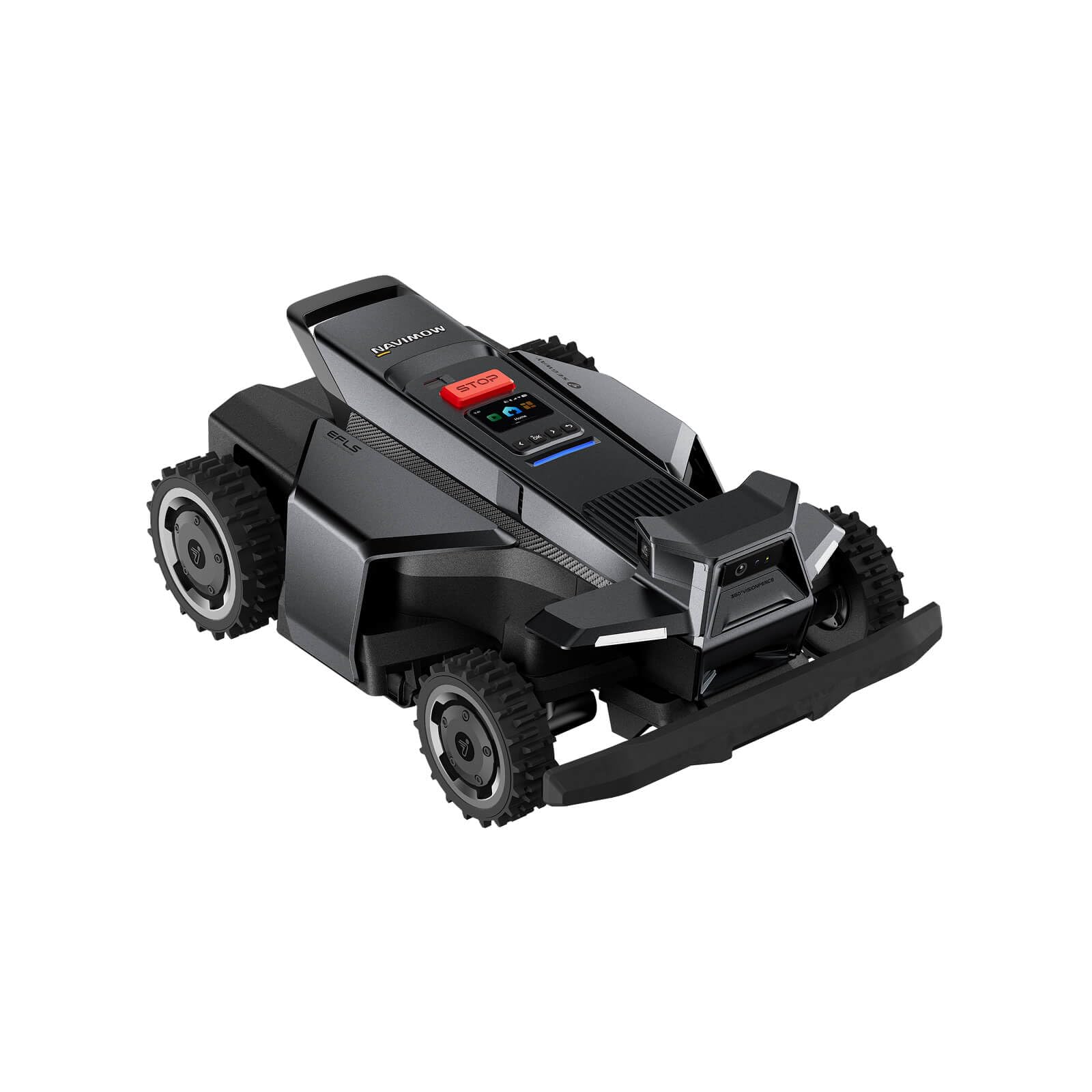
The robot that cuts an acre of steep lawn while saving you three hours every week.
The Segway Navimow X430 earns the top spot because its 17-inch cutting width is the widest of any robot here — versus the Worx Landroid below at 8.7 inches — so you cover ground in fewer passes. The 4WD system uses an ORV-tuned dual suspension (a suspension designed like an off-road vehicle so wheels stay planted on bumps) to climb slopes up to 84% (40°). That means it handles nearly any backyard incline you have. The Xero-Turn steering rotates the mower without tearing the grass. If you have up to an acre, buyers report it “saves ~3 hrs/week mowing,” which matches the efficiency from the dual 180W motors and dual cutting discs with 12 blades. The EFLS tri-frequency RTK system (a satellite positioning network that corrects for signal errors) works with 360° Vision to keep the mower accurate even under tree cover, and the AI recognizes over 200 types of obstacles. Still, the app can feel unintuitive during setup, and some owners found the navigation occasionally made odd decisions around zone edges.
The Segway has a 17-inch deck versus the MOVA at 15.8 inches, but at 63.71 pounds it is heavier than the 52-pound MOVA — so moving it manually takes more effort. This is the pick for a 0.5 to 1 acre yard with moderate to steep slopes where you want the fastest robot cut per hour and are willing to spend an afternoon on setup.
Why It Leads
- Widest robot deck here at 17 inches — fewer passes per session
- Climbs 84% slopes with ORV suspension that keeps wheels planted
- Zero-turn steering prevents turf damage during tight maneuvers
The Trade-Offs
- App mapping is manual and the interface takes time to learn
- Owners mention navigation can get confused near zone edges
Who it fits: Owners of 0.5–1 acre yards with moderate to steep slopes who want the fastest robot cut per hour and are okay spending an afternoon on setup.
One honest shortfall: At 63.71 pounds it is notably heavier than the 52-pound MOVA below, so moving it manually across the yard takes more effort.
2. MOVA LiDAX Ultra 3000 AWD Robot Lawn Mower
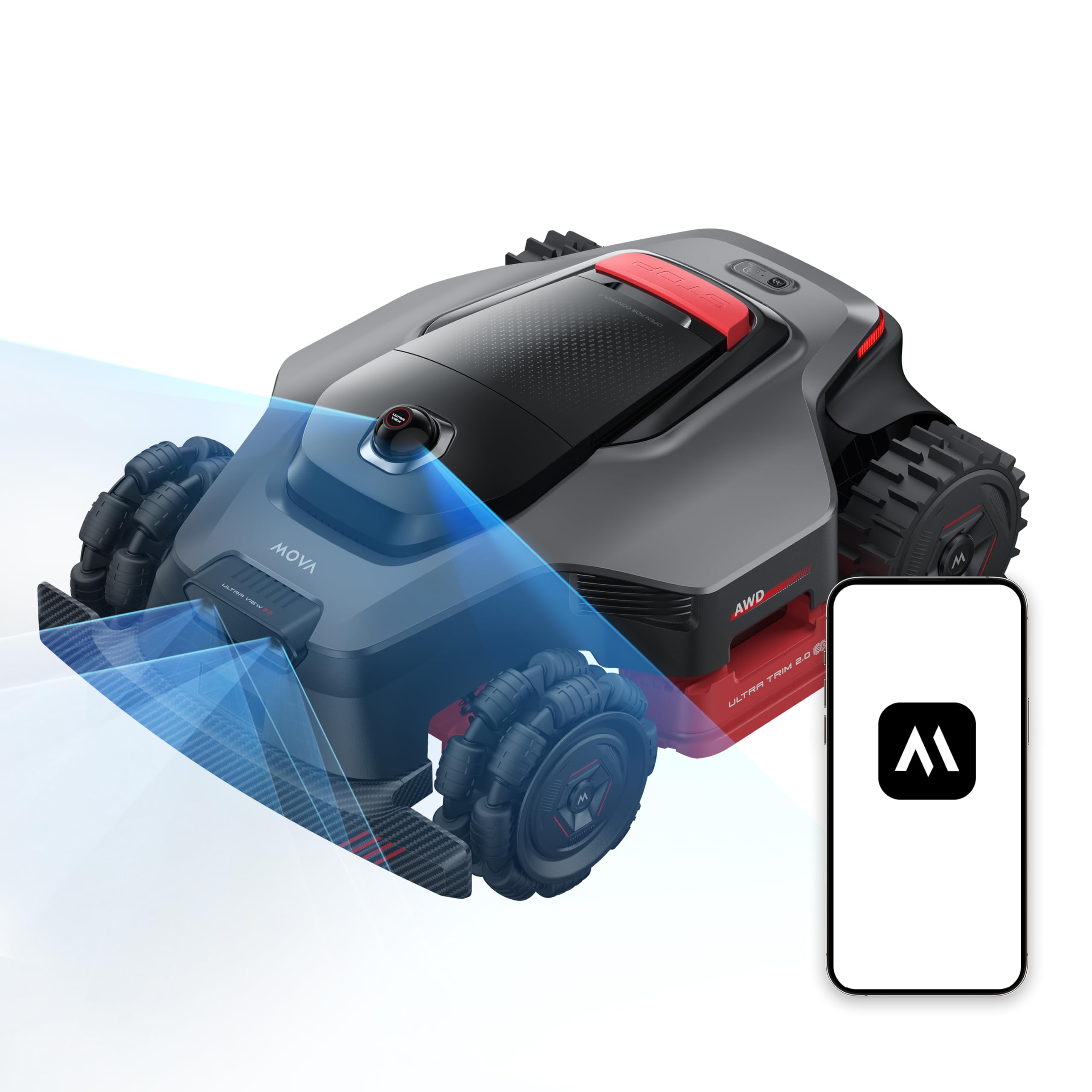
A robot mower that maps your yard in minutes with no wires, no RTK base, and no antenna.
This MOVA mower skips two things most other robots need — boundary wires and an RTK base station (a ground antenna that corrects satellite signals). Instead, it uses a 360° 3D LiDAR (a laser that spins and builds a 3D map of the lawn) combined with AI dual-vision cameras to create centimeter-accurate maps automatically the first time you turn it on. Four high-torque 116W hub motors drive the wheels up 80% slopes, and the floating cutting discs adjust to uneven ground so you get a consistent cut on bumpy sections. The cutting height adjusts from 1.2 inches up to 4 inches, versus the 3.54-inch max on the Worx Vision Cloud, which helps when you let the grass grow long between cuts. One reviewer says it saves 2 hours per week. The 15.8-inch cutting width and the 165-minute battery handle up to 0.25 acre per charge. The UltraTrim 2.0 edge-riding technology leaves just 1.2 inches of uncut grass along borders, so you rarely need a string trimmer afterward. However, the front wheels do not turn, which can scuff dirt on imperfect lawns, and some customers note that the no-go zone setup in the app is not as clear as it should be. A few units also arrived with sensor errors that needed replacement.
The MOVA sets up faster than the Segway because there are no wires to bury and no antenna to mount — literally unbox, power on, and let it map. If your lawn is under 0.75 acres and you want the simplest possible installation, this is your mower. skip it if your lawn has lots of dips or gullies that need a steering front axle to avoid turf tearing.
What Stands Out
- No boundary wire and no RTK station — literally unbox, power on, and let it map
- Run time of 165 minutes per charge covers most small-to-medium yards in one session
- Edge-riding tech leaves only 1.2 inches of grass along borders
What to Watch
- Front wheels are fixed (non-steering), which can dig into uneven or soft turf
- Quality control has been spotty — a few units arrived with sensor errors that needed replacement
Best for: Anyone with a 0.75-acre lawn who wants the simplest possible setup — no wires to bury, no extra antenna to mount.
pass on it if: Your lawn has lots of dips or gullies that need a steering front axle to avoid turf tearing.
3. Worx Landroid Vision Cloud 4WD Robot Lawn Mower
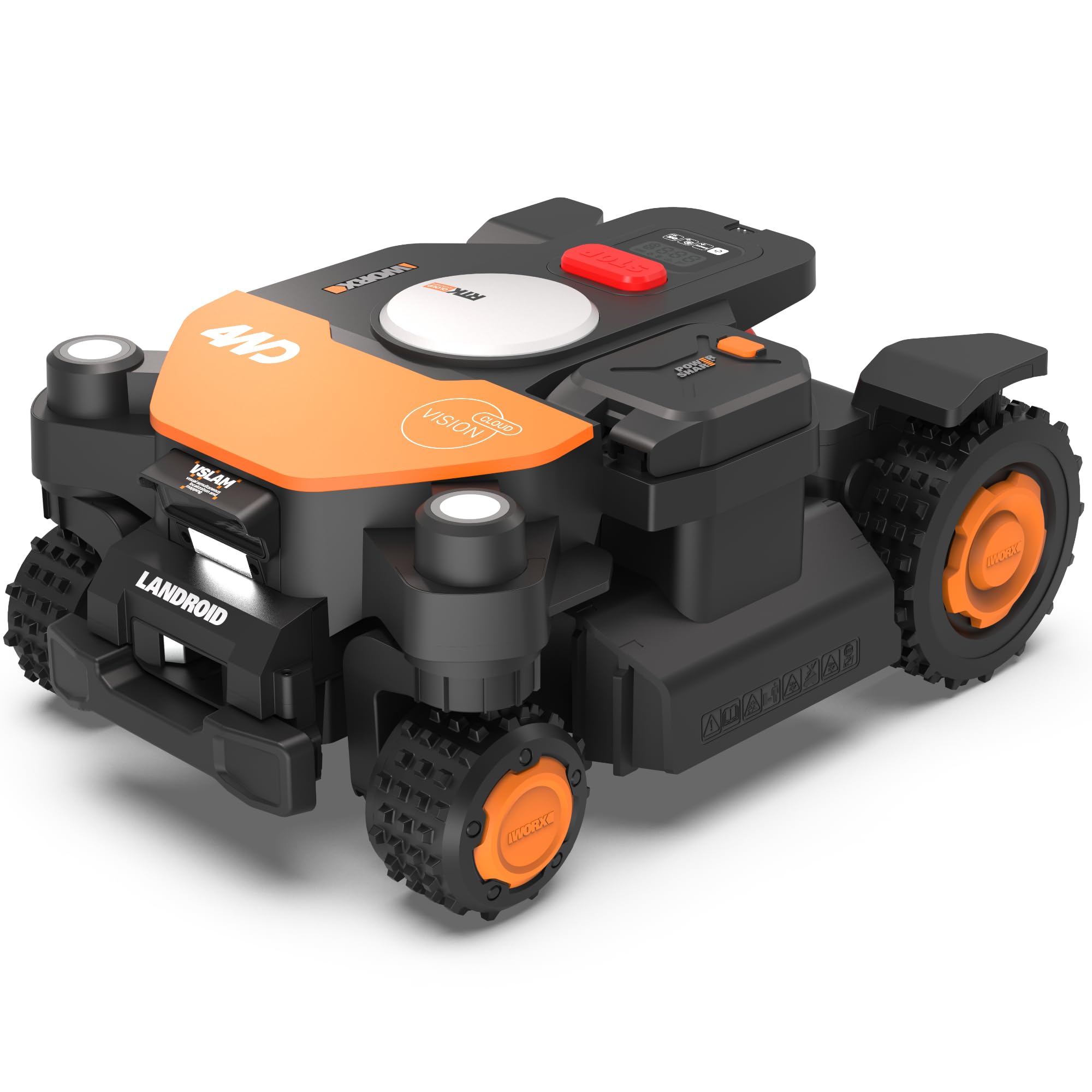
A cloud-connected mower that uses RTK without needing any local antenna on your property.
The Worx Vision Cloud is the only pick here that uses commercial-grade RTK (a satellite correction service that improves GPS accuracy) delivered from the cloud — you do not install an antenna or base station on your roof. Its Vision AI runs a neural network that processes up to 10 trillion operations per second to recognize objects like pets, toys, and garden furniture. The 4WD chassis climbs slopes up to 84% (~40°), and the terrain-adaptive chassis keeps all four wheels in contact on uneven ground.
Reviewers point out that “edging is good but not flawless (~90-95% coverage),” so you will still need to trim a few spots by hand. The cutting width is 8.7 inches — the narrowest deck in this lineup — which means it requires more passes to cover the same area compared to the 15.8-inch MOVA or the 17-inch Segway. That narrower width, though, makes it more maneuverable around tight flower beds and narrow pathways. The Cut-to-Zero offset blade lets the mower trim grass closer to fences and walls than most robots can reach. Some shoppers say frustrating firmware update failures and connection drops, especially on larger properties where the 2.4GHz Wi-Fi signal is weak.
If you want the cleanest antenna-free installation and have a yard under 1 acre with moderate obstacles, this is your pick. The narrow deck makes it too slow for large open yards where the Segway or MOVA would finish much faster.
Why It Is Different
- No local RTK antenna — cloud-based correction keeps the yard clean
- Cut-to-Zero blade reduces manual string trimming along fences
- Vision AI identifies objects and adjusts mowing paths on the fly
Limitations
- At 8.7 inches, the cutting deck is narrow — expect longer mowing sessions on larger lawns
- Firmware and connectivity issues are common in the early weeks, requiring patience
Reach for this if: You want the cleanest antenna-free installation and have a yard under 1 acre with moderate obstacles.
Look elsewhere if: You have a large open yard — the 8.7-inch cutting width will feel too slow compared to wider-deck robots.
4. Mammotion LUBA 3 AWD 1500H Robot Lawn Mower
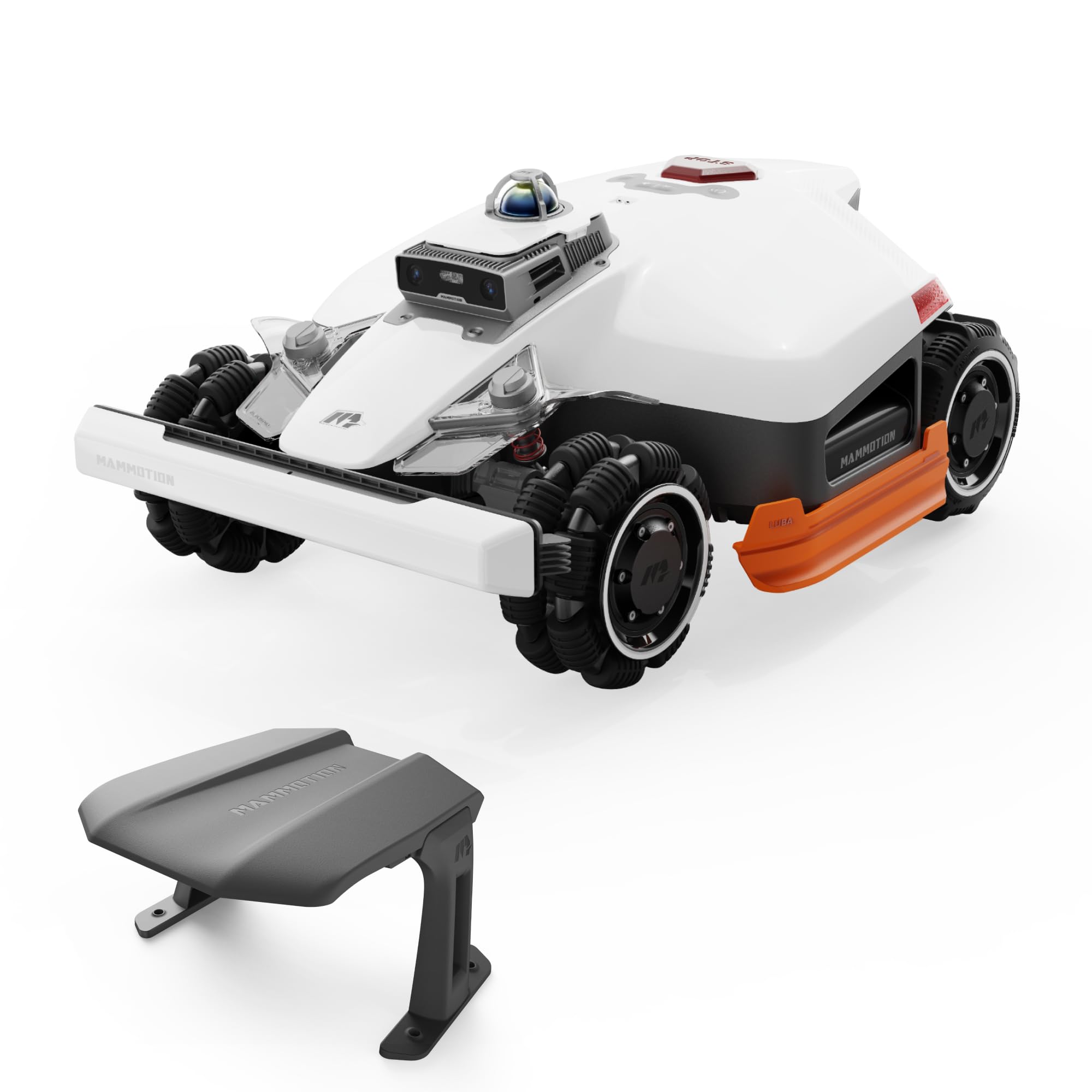
A compact 4WD robot that uses a spinning laser eye to map every inch of your lawn.
The Mammotion LUBA 3 AWD 1500H is built around a 360° LiDAR that spins horizontally while also scanning a 59° vertical field, capturing millions of laser returns up to 230 feet away. That data creates a real-time 3D point cloud that maps everything from grass height to tree branches. Unlike the Segway and MOVA, this robot does not need RTK or WiFi to navigate — it uses its LiDAR and dual-camera AI vision to stay on track, which makes it a solid fit for yards where the satellite signal is weak or blocked by heavy tree cover.
Four independent motors handle 80% (38.6°) slopes, and the omni wheel (a small extra wheel that spins freely) lets the mower pivot in place for tight turns without tearing the turf. The cutting height range is 2.2 to 4.0 inches — the highest maximum in this group — and the 9.4Ah battery delivers 175 minutes of runtime. Reviewers report the first cut on an overgrown yard takes about 3 hours, then subsequent cuts drop to around 2 hours. The catch: the garage is shipped separately, and the 0.37-acre coverage on this version means it is best suited for smaller, detailed lawns rather than wide-open spaces. The LiDAR makes it a better choice than the Worx for shaded yards, since it does not rely on satellite signals.
If your lawn is under 0.4 acres with lots of trees or buildings that block GPS, this is the mower. Anyone with a yard larger than 0.4 acres should go up to the 3000H version for more coverage.
Strengths
- 360° LiDAR tracks your yard without needing RTK or any cellular signal
- Omni wheel enables zero-radius turns that protect the grass
- Battery lasts 175 minutes — enough for the whole 0.37 acres on one charge
Weaknesses
- Rated for 0.37 acres — too small for larger properties
- Garage ships separately, not in the same box as the mower
Who it fits: Owners of small, intricately-shaped yards with lots of trees or buildings that block GPS — the LiDAR handles those conditions better than satellite navigation.
Who it does not fit: Anyone with a yard larger than 0.4 acres; go up to the 3000H version for more coverage.
5. Mammotion LUBA 3 AWD 3000H Robot Lawn Mower
Takes the LiDAR precision of the 1500H and adds more coverage with a bigger battery and smarter navigation.
The LUBA 3 AWD 3000H is the larger sibling of the 1500H, with the same 360° LiDAR and omni-wheel chassis but a larger 12Ah battery that delivers 175 minutes of runtime covering up to 500 square meters per hour. It adds Tri-Fusion Navigation — combining the LiDAR with NetRTK (a network-based satellite correction) and dual-camera AI vision — so it switches between sensors depending on the environment. That means it keeps centimeter-level accuracy even when moving from an open field into heavy tree cover, which the Segway can struggle with under dense branches.
Two 165W motors drive the cutting discs, and the AI vision auto-adjusts the motor speed and power based on how dense the grass is. You can set up to 30 separate mowing zones, each with its own schedule and cutting height. Buyers report the real-world battery coverage runs at roughly 60% of the advertised 500 m²/hr, but they keep the mower because the RTK navigation is reliable and the final cut quality — including visible lawn stripes — beats what a riding mower delivers. The cutting height runs from 2.2 inches to 4.0 inches, matching the 1500H, and the 4WD climbs 80% slopes just as confidently. No replacement batteries are sold yet, raising long-term concerns for heavy users.
Pick this for a 0.75-acre yard with a mix of open lawn and shaded sections where satellite-only robots lose their way. Consider something else if you want guaranteed battery-replacement availability — the 3000H does not have that option today.
Key Advantages
- Tri-Fusion navigation (LiDAR + NetRTK + AI cameras) handles any yard condition
- Supports 30 mowing zones with custom schedules per area
- 165W dual motors cut dense, overgrown grass efficiently
Watch Out For
- Real-world coverage is lower than the advertised 500 m²/hr
- No replacement batteries are sold yet, raising long-term concerns
Pick this for: A 0.75-acre yard with a mix of open lawn and shaded sections where satellite-only robots lose their way.
Consider something else if: You want guaranteed battery-replacement availability — the 3000H does not have that option today.
6. Mowrator S1 4WD 18Ah Remote Control Lawn Mower
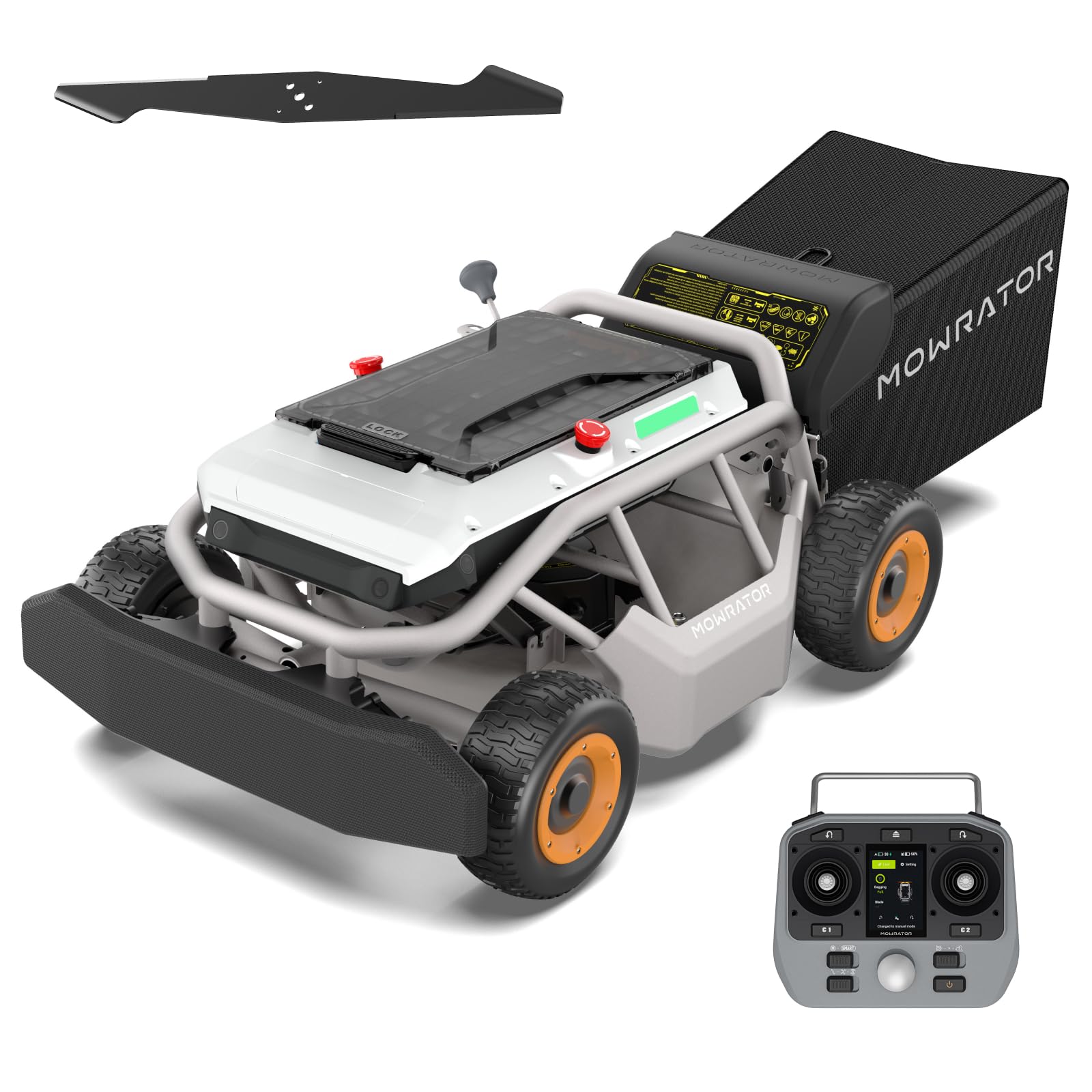
A remote-controlled tank that cuts through steep, rocky terrain no robot can handle.
Unlike every other pick here, the Mowrator S1 is not a robot — you steer it with a handheld remote, which means you are in full control over every pass. That makes it the right tool for the toughest lawns: steep slopes up to 75% (37°), tall invasive grass, wet mud, and rocky ground where a robot’s sensors would get confused or stuck. The cutting deck is 21 inches wide — the widest in this lineup — and the cutting height ranges from 1.5 to 4.3 inches, giving you more room to raise the deck for rough terrain. That is 21 inches versus the Segway’s 17-inch deck and the Worx’s 8.7-inch deck, so it covers large, rugged areas fast.
The all-metal construction uses steel and aluminum, and at 147.7 pounds it is heavier than the robots here. That weight gives it the stability to climb steep hills without tipping. Buyers call it a “beast” and say it makes lawn mowing fun, though they also warn that the AWD can tear up turf during sharp turns if you are not careful. Battery life is 2.25 hours, which one owner says covers two 45-minute mows per charge. The optional snow plow and mulching blade attachments let it work year-round.
Property owners with steep, rocky, or overgrown terrain where automated robots would fail will appreciate the remote control — it gives you total command over the cut. Anyone who wants a “low-maintenance” mower should pass; this is a hands-on tool, not a robot.
Why You Would Pick It
- 21-inch cutting deck is the widest here — finishes large areas quickly
- All-metal chassis (steel and aluminum) handles tough terrain without breaking
- Uses a remote so you fully control speed, direction, and blade engagement
What Holds It Back
- You have to be present for every minute of mowing — no automation
- At 147.7 pounds it is heavy to transport and the AWD can scuff turf on tight turns
Who it works for: Property owners with steep, rocky, or overgrown terrain where automated robots would fail — the remote control gives you total command over the cut.
Who should pass: Anyone who wants a “low-maintenance” mower — this is a hands-on tool, not a robot.
Understanding the Specs
Slope Rating
The slope rating (given as a percentage, like 80%) tells you the steepest incline the mower can climb while keeping all four wheels in contact with the ground. A 100% slope equals a 45-degree angle. For most residential lawns with visible hills, 75% to 80% is enough. The Segway and Worx both hit 84%, which handles nearly any backyard slope you will encounter. The cutting height also plays a role — the minimum adjustable cutting height on the MOVA is 1.2 inches, versus 1.57 inches on the Worx, letting it cut shorter if you prefer a golf-green look.
Cutting Width and Battery Runtime
Cutting width determines how much grass the mower shears in a single pass. Wider decks (17 inches on the Segway, 21 inches on the Mowrator) finish a yard faster, while narrower decks (8.7 inches on the Worx) take more passes but fit through tighter spaces. Battery runtime tells you how long the mower can cut before recharging. The MOVA runs for 165 minutes, and both Mammotion robots run for 175 minutes — enough for a medium yard. The Mowrator runs for 2.25 hours (135 minutes), but you control the pace manually so you can stop and restart as needed.
FAQ
Will a 4WD mower work on my steep lawn?
Do I have to bury boundary wires for these mowers?
How long does it take to set up a robot mower?
Can these mowers handle wet grass?
What happens if the robot mower runs out of battery mid-lawn?
How do these mowers avoid obstacles like toys or pets?
Is the Mowrator S1 louder than the robot mowers?
Do these mowers work in shaded or tree-covered yards?
What maintenance do these mowers require?
Can I use a robot mower if I have a very complex lawn with many flower beds?
Final Thoughts: The Verdict
For the majority of shoppers, the best 4 wheel drive lawn mower winner is the Segway Navimow X430 because its 17-inch cutting width handles up to an acre fast while the 84% slope rating and ORV suspension keep it stable on any hill. If you want the simplest possible wire-free setup, grab the MOVA LiDAX Ultra 3000 AWD — it maps itself using LiDAR in minutes with no wires or antenna. And for the toughest, steepest, most overgrown terrain where no robot can survive, the standout is the Mowrator S1 4WD — you stay in control with the remote while the 21-inch steel deck chews through anything.
How We Picked
We do not accept paid placement, and we did not hands-on test every unit. Instead, we match each pick to a real buyer and use-case by comparing the manufacturers’ published specifications against the patterns in verified customer reviews — so you get each pick’s real strengths and trade-offs instead of marketing copy.
Sources & Methodology
Specifications: manufacturer listings and product documentation. Review insights: verified customer reviews, as of July 2026. Pricing: not shown on this page (it changes often); check the current price via the retailer link.
As an Amazon Associate, Gadgets Feed earns from qualifying purchases. This does not affect which products we feature.
Product prices and availability are accurate as of the date/time indicated and are subject to change. Any price and availability information displayed on Amazon at the time of purchase will apply to the purchase of this product. As an Amazon Associate I earn from qualifying purchases.
CERTAIN CONTENT THAT APPEARS ON THIS SITE COMES FROM AMAZON. THIS CONTENT IS PROVIDED "AS IS" AND IS SUBJECT TO CHANGE OR REMOVAL AT ANY TIME.
Amazon and the Amazon logo are trademarks of Amazon.com, Inc. or its affiliates.