
Our readers keep the lights on and my morning glass full of iced black tea. As an Amazon Associate, I earn from qualifying purchases.
Specs are compiled from manufacturer listings and verified buyer reviews and can change over time — please confirm the key details on the product page before buying.
If you’ve opened your thermostat’s old cover and found just four small wires staring back at you, upgrading can feel like a job for an electrician, not a weekend DIY project. These thermostats are built for exactly that scenario: simple 4-wire setups for conventional, single-stage heating and cooling systems. Many smart thermostats need a common wire (the “C-wire,” which supplies constant power) to stay on, which leaves you stuck; the models here run on battery power or the existing 24VAC wiring you already have, so you can swap them in without calling a pro.
I’m Min — the founder and writer behind Gadgets Feed. This guide is built by comparing the manufacturers’ published specifications and the patterns across verified customer reviews, so you get each pick’s real strengths and trade-offs instead of marketing spin.
From dead-simple non-programmable units to 5-1-1 day programmable models that handle heat pumps, this roundup covers the best 4 wire thermostat options that take the guesswork out of installation and get your home comfortable fast.
Our Picks at a Glance


How To Choose The Best 4 Wire Thermostat
Choosing a thermostat means matching it to your specific HVAC system, not just its looks. With a 4-wire setup, you’re almost always dealing with a conventional system, but there are key decisions that determine whether your new thermostat will click right in or leave you sweating.
Match the thermostat to your HVAC system type
First, identify your heating and cooling equipment type. These thermostats are designed for “single-stage” systems — meaning one speed of heating and one speed of cooling (often written as 1H/1C). If you have a heat pump with auxiliary or emergency heat, you need a specific model that supports an “O/B” terminal and more stages. Putting a 1H/1C thermostat on a multi-stage system will usually result in it not working at all, or only running parts of your system. Check the compatibility lists carefully before you add to cart.
Understand C-Wire requirements and power sources
Traditional 4-wire systems use wires commonly labeled R (power), W (heat), Y (cool), and G (fan). That leaves no “C” wire, which is the constant power wire that many digital and smart thermostats require. The workaround is a dual-power supply: the thermostat can run on the 24VAC from the heating/cooling wires, or it can fall back on batteries. Buyers report that looking for a thermostat with “battery-powered or hardwired” capability is your insurance policy against not having a C-wire.
Programmable vs. non-programmable
This choice hinges on your daily routine, not just specs. Non-programmable units (like the PRO1 IAQ T701) are the epitome of “low-maintenance” — you set one temperature and leave it. Programmable models (like the Heagstat 5-1-1) let you set a schedule for weekdays and weekends — waking, leaving, returning home, and sleeping. If you are replacing a 20-year-old unit and crave simplicity, a non-programmable is often the better pick. If you want to save energy without thinking about it daily, the 5-1-1 day scheduling is the way to go.
Read the display before you buy
Buyer feedback consistently highlights display readability. A 4 sq. inch display (like the PRO1) with large numerals is a godsend for those with aging eyes. Some units, like the White-Rodgers, feature a backlight that some users find “dim,” while others, like the Aowel, have a 5.0 sq. in backlit LCD. “Large” and “bright” are the top adjectives in reviews, but what counts as readable for you might differ — so prioritize a big, clear display if you’re often in a dim hallway.
Quick Comparison
| Model | Best For | System Type | Scheduling | Display | Amazon |
|---|---|---|---|---|---|
| PRO1 IAQ T701★ Best Overall | Simple, reliable replacement | 1H/1C | Non-Programmable | 4 sq. inch with blue backlight | Amazon |
| Honeywell Home RTH111BPrecision Pick | Quick DIY hookup & precise control | 1H/1C | Non-Programmable | Easy-to-read digital display | Amazon |
| Riseem S3001Easiest Install | Budget-friendly novice installs | 1H/1C | Non-Programmable | Backlight LCD | Amazon |
| Aowel 1H/1C | Fine-tuned temperature control | 1H/1C | Non-Programmable | 5.0 sq. in backlit LCD | Amazon |
| Heagstat H705 | Simple 5-1-1 scheduling | 1H/1C | 5-1-1 Day Programmable | 4.5 sq inch backlit LCD | Amazon |
| Suuwer S715 | 2H/2C conventional multistage | 2H/2C | 5-1-1 Day Programmable | Blue backlit digital display | Amazon |
| Heagstat H725 | Heat pumps with aux/emergency heat | 2H/1C Heat Pump | 5-1-1 Day Programmable | 4.5 sq inch backlit LCD | Amazon |
| White-Rodgers 1F78-151 | Classic weekday/weekend schedules | 1H/1C | 5-2 Day Programmable | Backlit display | Amazon |
| Honeywell Home X2P RTH20B | A “smart” feel without the smart price | 1H/1C | 5-2 Day Programmable | Large backlit display | Amazon |
In-Depth Reviews
1. PRO1 IAQ T701 Non-Programmable Electronic Thermostat
Our pick — over 4.5★ from 950+ verified ratings; the strongest balance of quality and price.
A crowd-pleaser that proves simplicity wins, with a display built for tired eyes.
This pick replaces your old thermostat with identical behavior but far better performance. The display is the headliner: a 4 sq. inch screen with blue backlighting and large numerals that owners describe as particularly suitable for older eyes. Fit is another strong suit, snapping into existing sub-bases from other brands, which makes it a low-friction swap. The data shows the most common praise centers on its functionality and ease of use, making it the top pick for pure, unfiltered convenience.
The wiring is about as simple as it gets for a 4-wire install, and the front battery compartment with included Duracell batteries means you won’t be pulling the whole unit off the wall to swap cells. You can also power it via hardwire if you prefer. Owners mention the setup is a “Simple 4-wire install” — even noting the green wire was actually blue on their system — and that it “works immediately.”
The honesty here is that it’s a non-programmable unit, so you won’t get weekday sleep/wake schedules, which is a feature some users want. This is purely a “set the temp and forget it” device. The review pages also note that a few units have stopped working within three months of use, which appears to be a quality control outlier rather than the norm for this otherwise 4.6-star crowd favorite.
Why it works so well
- Large, backlit display with big numerals that are easy to read from across the room
- Runs on 2 AA batteries (included) or hardwired, so the C-wire question disappears
- Dependable, no-frills operation — just set the temperature and go
Keep in mind
- No scheduling — it’s manual only, so you’ll be adjusting it yourself when seasons change
- A minority of buyers had units fail early, pointing to some variability in the batch
The verdict: Ideal for anyone — especially older homeowners — who wants a huge, readable screen and a rock-solid simple thermostat to replace a tired existing unit.
Who should skip: Not for you if your whole goal is automating a daily heating schedule to save on bills.
2. Honeywell Home RTH111B Digital Non-Programmable Thermostat
A famous brand name with dead-simple hookup and temperature accuracy that goes beyond the usual ±1°F.
Honeywell is a name synonymous with thermostats, and the RTH111B delivers that reputation at a value price. The standout spec is its precise temperature control of ±0.5 degrees Celsius — a tighter window than many competitors that only offer ±1°F, meaning your room stays closer to the number you actually set. It’s a non-programmable unit, so you don’t get schedules, but what you lose in programming you gain in sheer simplicity.
Installation stories here are overwhelmingly positive, and it’s a genuine 4-wire setup workhorse. One reviewer noted a “Quick in easy setup connect wires in minutes no frills & just works well,” and screwing it onto your wall is often easier since screw holes line up with older Honeywell baseplates, meaning no new drilling. The soft-touch buttons are easy for all ages, and an easy-access battery compartment with a change reminder prevents surprise shutdowns.
One thing to check before buying: the compatibility list. It works with heating, cooling and heat pumps without auxiliary heat, but it does NOT work with electric baseboard heat (120-240 V), heat pumps with backup, or multi-stage heating/cooling. If you have a simple gas furnace and AC, this is a low-maintenance swap; if you have a heat pump with backup strips, you’ll need to look at the Heagstat H725 below.
Verdict: The best choice for the price-conscious purist who wants Honeywell reliability and tighter ±0.5°C temperature control without any programming fuss. Just verify your system is single-stage first.
3. Riseem NonProgrammable Thermostat for Home
A genuinely friendly DIY option with large terminal blocks that gets novices through the door in half an hour.
If the thought of wiring makes you nervous, the Riseem S3001 was practically designed for you. It comes with “large terminal blocks” that make seating wires easier, and a universal sub-base that fits the footprint of older Honeywell thermostats. Most customers note the install taking under 5 minutes, while the specs mention a 30-minute window even for careful work. The dual power supply means you can run it on 24VAC or just pop in 2 AA batteries, and it only needs a C-wire for heat-only or cool-only systems.
The control experience is just as friendly. It has a clear, easy-to-read backlit LCD display, big buttons, and separate heating and cooling swings (cycle rates) so you can tweak how often your furnace kicks on. Buyers describe it as “Easy install for novice (single woman)” and note it replaced a 20-year-old Honeywell with zero prior experience needed. The temperature control is a solid ±1°F, with a room display range from 41°F to 95°F.
Crucially, this is a strict 1H/1C unit — the base supports a maximum of 2 to 5 wires. If you have a heat pump, multi-stage system, or anything with 6 to 8 wires, this is not the thermostat for you. But for a conventional gas furnace and AC, it’s among the most welcoming entry points on this list, backed by a 2-year warranty.
Reach for it if: you’re a first-timer who needs forgiving terminal blocks and a clear manual; the value-per-dollar is exactly what you want.
Look elsewhere if: you’re running a heat pump or any system beyond a single stage of heat and cool — it won’t be compatible.
4. Aowel 1 Heat/1 Cool Non-Programmable Thermostat
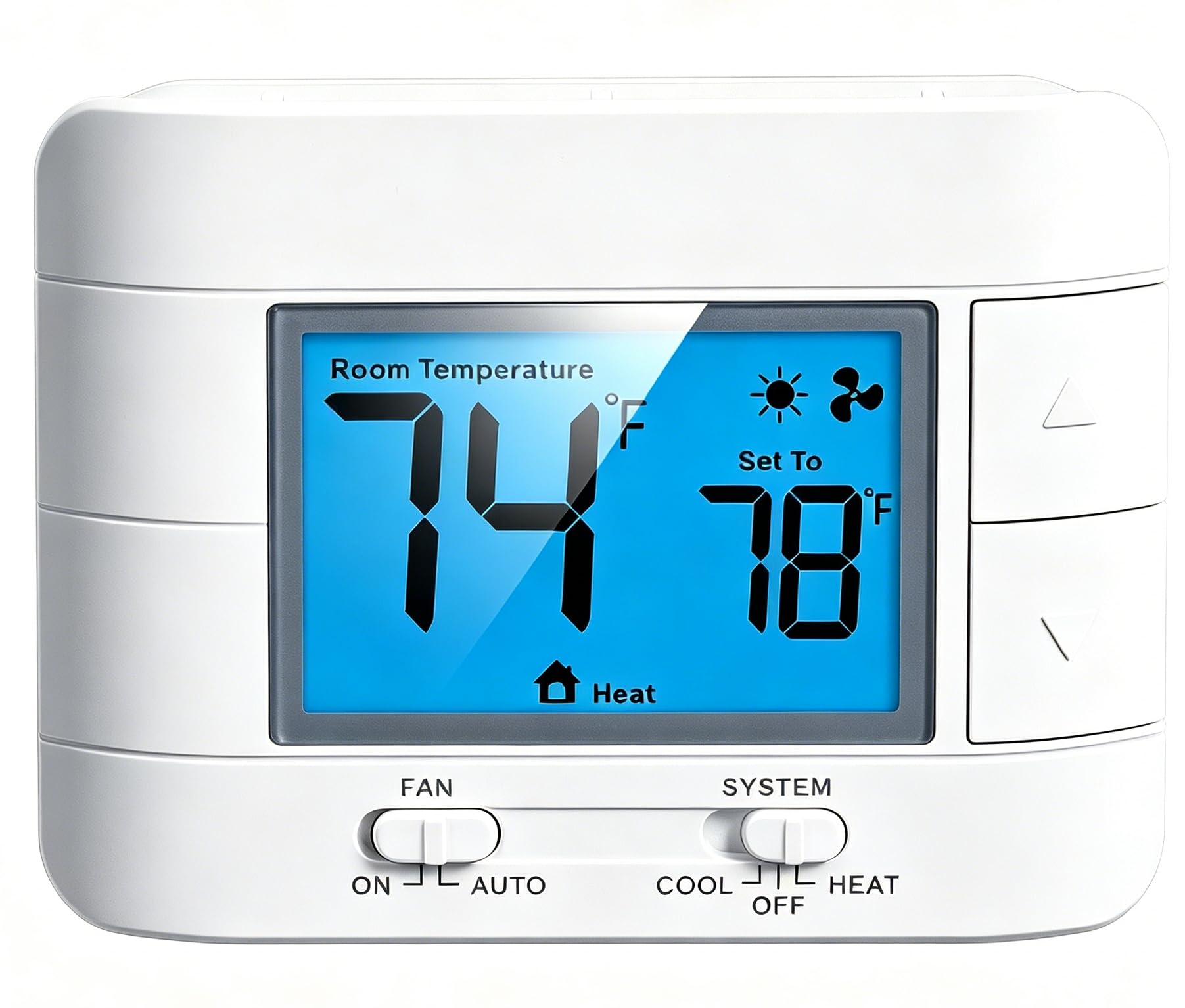
The no-frills manual unit that hides a surprising amount of adjustability behind its clean white face.
At first glance, the Aowel looks like another simple thermostat, but it offers more custom control than most in its class. It features a 5.0 sq. in. backlit LCD (larger than the PRO1’s 4-inch screen) for clear display, with the backlight activated manually via a key. Beyond the standard ±1°F temperature accuracy, it lets you adjust the temperature swing (differential) from 0.2°F to 2°F, meaning you can decide how much the room must drift before the system kicks back on — great for sensitive sleepers.
The wiring is standard for a 4-wire setup, with terminals for RH, RC, W, Y, G, and C. Reviewers point out it works with a Trane heat pump after jumping the Y-W terminals, and praise its much faster response time compared to a 20-year-old unit when running a pellet stove. There’s even a built-in humidity monitor (display only — it won’t control humidity) and a low battery reminder on this budget-friendly unit.
The honest trade-off in the data is temperature accuracy: while most find it accurate, at least one owner reported the sensor can read off by 3 degrees. Also, the support structure is thin — the only contact path is through the Amazon “Agaric Tech” link rather than a website or phone number, and the 2-year warranty requires registration. For the money, it’s a feature-dense pick, but you’re taking a small chance on the sensor calibration.
The trade-off: A feature-packed budget unit with a big display and fine control over temperature swing, but you trade a slick support team and risk a slightly-off sensor for that value.
5. Heagstat 5-1-1 Day Programmable Thermostat H705

A gateway to energy savings with 5-1-1 day programming that stays blissfully simple to operate.
If you want the energy savings of a schedule but dread complicated menus, the Heagstat H705 walks a smart middle line. This is a 5-1-1 day programmable thermostat: it gives you separate programs for weekdays (5 days) and each weekend day (1 + 1), with 4 program periods per day for waking, leaving, returning, and sleeping. It’s more flexible than a simple 5-2 model, yet the large LCD and user-friendly design keep it operable for people of all ages.
The H705 is a conventional single-stage unit (1H/1C), and it runs on the standard RH, RC, W, Y, G, C terminals. Like others on this list, it uses a dual power supply — 24VAC or 2 AAA batteries — so it’s another “no C-wire required” success story. That 4.5 sq inch backlit LCD is a highlight, with “extra-large numbers ideal for older eyes” being a common refrain, and the ±1°F accuracy with an adjustable 0.2°F to 2°F swing keeps the HVAC from short-cycling.
Programmed correctly, this is a great way to cut usage without thinking. The specs note the temperature control receives mixed feedback, with some reporting incorrect temperatures, so that’s a factor to consider. Also note that the “Hold” function lets you run it manually, which is good for guests. For the price, it’s one of the best ways to start automating a schedule.
What earns its keep
- 5-1-1 day scheduling with 4 time periods balances savings and flexibility
- Large, bright 4.5 sq inch backlit display that’s easy on the eyes
- No C-wire required thanks to the dual-power design
Worth noting
- Temperature readings have some variation in accuracy among owners
- The plastic build is functional but not premium
Best fit: For budget-minded homeowners who want a straightforward way to automate their weekday and weekend comfort without diving into smart-home ecosystems.
Think twice if: you need absolute pinpoint accuracy or the most polished hardware feel.
6. Suuwer 5-1-1 Day Programmable Thermostat S715

The rare budget-friendly thermostat that smoothly handles two stages of heat for larger conventional homes.
The Suuwer S715 breaks from the pack by supporting 2 Heat/2 Cool systems. If you have a conventional multi-stage gas furnace or a larger home that needs two speeds of heating, this is one of the few affordable options that won’t lock you into the single-stage club. It’s a 5-1-1 day programmable model with separate weekday and weekend programs, plus 4 periods per day (wake, leave, return, sleep).
The display is a blue-backlit digital panel that buyers call large and clear, and it’s specifically noted as being very suitable for middle-aged and elderly people. Installation is straightforward, with owners calling it a “plug & play” replacement and getting it fully installed and programmed in 30 minutes. It also brings a built-in filter change reminder that you can set from 50 to 2000 hours, so you won’t forget that chore.
There are a couple of quirks in the data. The clock is 24-hour military time only, which takes some getting used to. And the “away” setting can only push the cooling target up to a max of 90°F — so if you live in a hot state and want to fully shut off the AC when away, this thermostat can’t do it. If you can accept those limitations, it’s a strong pick for a 2H/2C home that other budget thermostats simply won’t support.
The standout: One of the few value-priced thermostats that supports 2H/2C conventional systems, with a bright display and useful filter reminders.
7. Heagstat H725 5/1/1 Day Programmable Heat Pump Thermostat

Purpose-built for heat pumps with auxiliary heat, offering stage control most budget units just don’t have.
Most budget thermostats explicitly exclude heat pumps, which makes the Heagstat H725 a bit of a unicorn. This is a 2 Heat/1 Cool heat pump thermostat, meaning it can control two stages of heating plus a single stage of cooling, and it properly manages auxiliary and emergency heat. The “O/B” terminal lets you select how your reversing valve works (O for cool, B for heat), a critical setting that trips up many DIYers with other brands. Just note emergency heating requires a manual switch — it won’t engage automatically.
Shoppers say an “easy install” with “simple instructions for wire placement,” even on a Carrier heat pump. It runs on the standard R, W/E, W2, Y, O, B, G, C terminals, and like the other Heagstat in this list, it uses a dual power supply of 24VAC or 2 AAA batteries. The 5/1/1 programming with 4 periods per day lets you set a lifestyle-specific schedule, changing temperature up to four times per day.
The recurring praise centers on functionality and how much you get for the money. The tech reviewer notes the adjustable heat/cool swing settings help reduce short-cycling, which saves wear on your heat pump. The main trade-offs are the small display — older users might find the numbers hard to read — and the wall plate that can be stubborn to detach. For a heat pump home, this is the pick that bridges a massive price gap.
Reach for it if: you have a heat pump with auxiliary/emergency heat and want professional-grade stage control at a DIY price.
Look elsewhere if: you need an automatic emergency heat switch, or you have a multi-stage system beyond 2H/1C.
8. White-Rodgers 70 Series 1F78-151 Programmable Thermostat
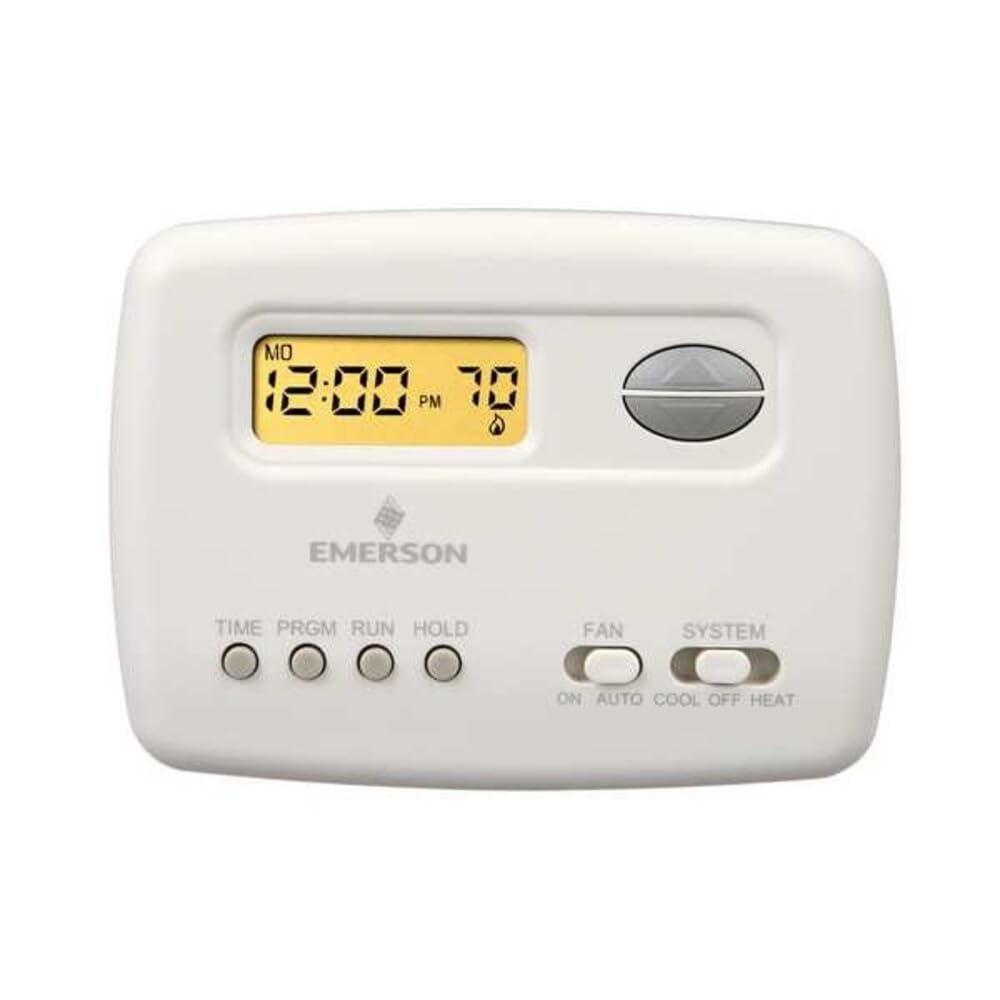
The reliable old-school workhorse with a classic 5-2 day schedule and battery-powered freedom from the C-wire.
The White-Rodgers 70 Series is a familiar face in this category for a reason — it’s reliable and does its job without drama. This programmable model offers 5-2 day scheduling, so you can set different schedules for weekdays and weekends, which is plenty of control for most homes without the complexity of individual day settings. It’s battery-powered (two AAA batteries included) specifically for maximum compatibility, which is great news for a 4-wire system with no C-wire.
It covers single-stage heating, cooling, and heat pump (without aux) systems, with a precise ±1 degree F temperature control. Curiously, the specifications list “Wi-Fi” as the connectivity protocol, but buyer experience makes clear this is a purely local, button-operated unit — don’t expect any smart features here. Instead, expect exactly what the reviews describe: “easy to install and program” units that drop into old White-Rodgers bases with zero new drilling.
There are some honest caveats. The backlight has mixed feedback — several users say it’s noticeably dim, and it’s more of a gray-on-gray LCD that struggles in the dark. Wiring has also earned a negative mention in the data, with some owners finding the small contact screws tight and requiring a precision screwdriver. But the long-term reliability stories are strong, with one 4-year-old unit still going strong, and it reliably keeps temps very close to set points.
Bottom line: A trustworthy, classic choice for a simple weekday/weekend schedule — just keep a flashlight handy for the dim display and have a precision screwdriver ready for the terminals.
9. Honeywell Home X2P Programmable Thermostat RTH20B
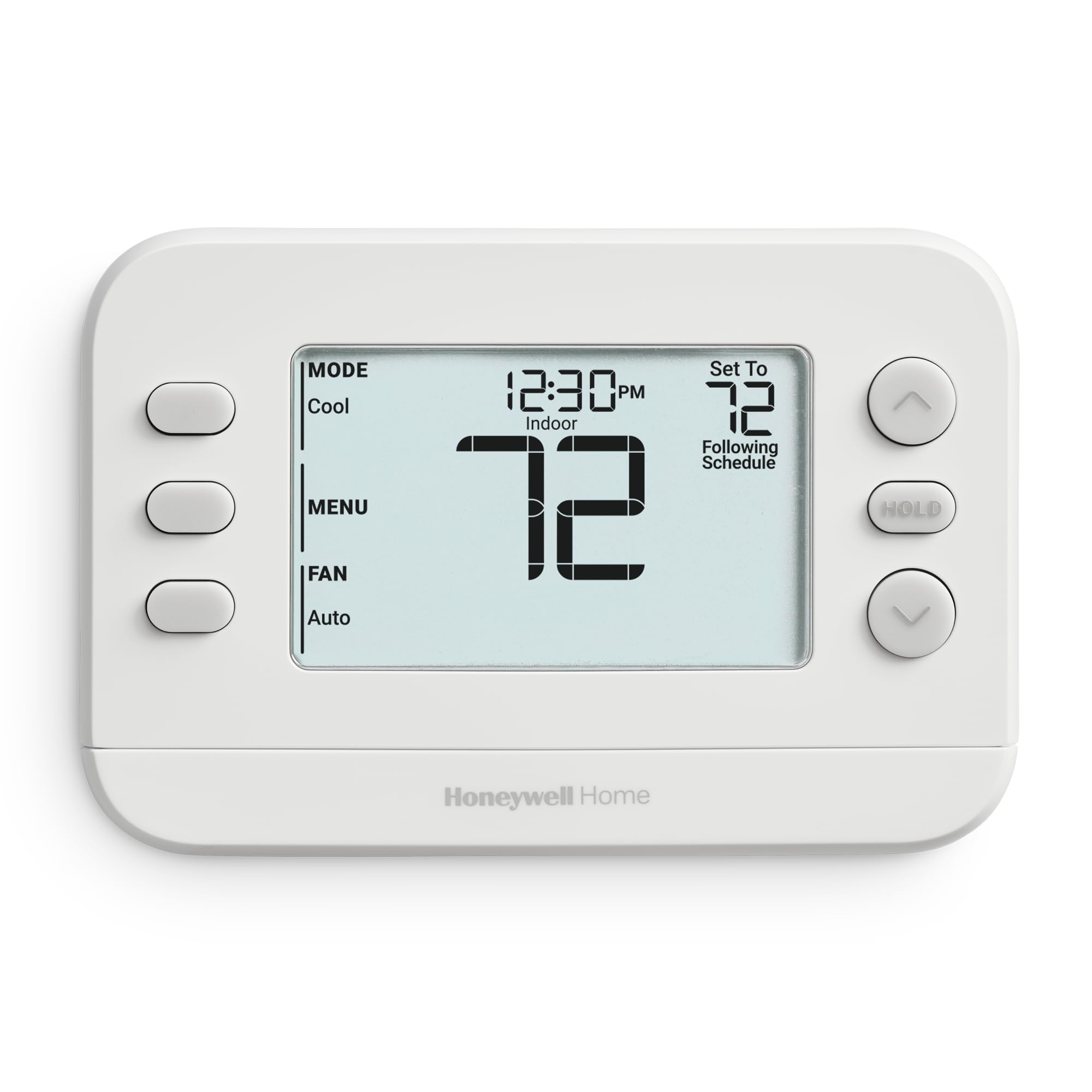
A programmable unit that learns your home’s heating and cooling pace so the right temperature arrives right on time.
This is the closest thing on the list to a “smart” device without the smart price. The Honeywell Home RTH20B (direct replacement for the RTH2300) uses adaptive recovery — it learns your house’s heating and cooling rates so it knows when to start running before your set time arrives. Set 72°F for 5 PM, and the system might kick on around 3:45 PM to hit that target exactly, rather than waiting until 5 PM to start and leaving you chilly.
Installation is simplified by the Honeywell Home UWP wall plate, which buyers report provides an easy install and simplifies future upgrades since it’s a standard footprint. It’s compatible with 1 Heat/1 Cool, 750 mV, hot water heat, and forced air systems — but not electric baseboard heat. It runs on 2 AA batteries (not included), so again, no C-wire is needed. The large backlit screen and clear font are enough to make the display a praised feature.
Reviews praise the quality of the housing as “sturdy” and a “great value upgrade” from old mercury thermostats. There is a mixed note on programmability: while the 5-2 day scheduling is easy enough, the instructions come with tiny print and assume some expertise, plus it has 16 wire slots with cryptic labels. For a simple boiler using just red and white wires, one buyer had to guess between W and RH — it worked, but it’s worth knowing the manual can be less than hand-holding.
The highlight: It’s a genuine “set and forget” unit that learns your home’s thermal behavior, making it a great upgrade from a basic non-programmable model.
The friction: The dense, small-print manual might test you if you’re a novice; make sure to map your wires against the labels carefully.
Understanding the Specs
Scheduling: Non-Programmable vs. 5-1-1 Day
Non-programmable thermostats, like the PRO1 IAQ, just hold a single temperature you set manually. Programmable models let you automatically change the temperature at set times of day. A 5-1-1 day schedule is a flexible middle ground — it gives you one schedule for the typical Monday-to-Friday work week, and a separate schedule for Saturday and another for Sunday. That lets you sleep in on weekends without reheating the house at 6 AM every Saturday by mistake.
No C-Wire and Dual Power
The “C” wire, or common wire, provides constant power to a thermostat. Many older homes have just four wires (R, W, Y, G), meaning no C-wire. Thermostats with a “dual power supply” are the workaround — they can pull power from the 24VAC system wires themselves or simply run on AA or AAA batteries. If your home has no C-wire at the wall, you’ll want a model with the battery fallback so you’re not installing a power extender kit.
FAQ
What does a 4-wire thermostat exactly mean for my home setup?
Do I need a C-wire for a 4-wire thermostat?
Can I use a 4-wire thermostat with a heat pump?
What is the difference between a 2H/1C and a 1H/1C thermostat?
How do I know if my system is single-stage or multi-stage?
Will a thermostat from a different brand work with my existing wires?
Why do some thermostats say “no C-wire required” and others don’t?
What is the temperature swing or cycle rate on these thermostats?
Are these thermostats compatible with electric baseboard heaters?
Final Thoughts: The Verdict
For most users with a conventional 4-wire system, the winner is the PRO1 IAQ T701 because it pairs the clearest, largest display with the most reliable no-frills operation, earning its crowd-favorite status. If you want a simple 5-day schedule to save energy without much effort, grab the Heagstat H705. And for heat pump owners who need stage control, the Heagstat H725 is the one to reach for.
How We Picked
We do not accept paid placement. Every pick is matched to a real buyer and a real use-case; we do not hands-on test units.
Sources & Methodology
Specifications: manufacturer listings and product documentation. Review insights: verified customer reviews, as of August 2026. Pricing: not shown on this page (it changes often); check the current price via the retailer link.
As an Amazon Associate, Gadgets Feed earns from qualifying purchases. This does not affect which products we feature.